
A cheap, unregulated charger is the fastest way to reduce the cycle life of your expensive 18650 cells. The difference between a good charger and a bad one isn’t just charge speed — it’s about terminating the charge at the correct 4.2V cutoff, reading internal resistance, and preventing the thermal runaway that turns a lithium-ion cell into a hazard. That is what this guide is built to solve.
I’m Rikta — the co-founder and writer behind FitlyFast. I’ve spent many hours cross-referencing technical datasheets, analyzing real-user reports across thousands of charge cycles, and comparing the voltage accuracy, bay independence, and safety certifications that define a genuinely dependable 18650 battery charger.
This guide covers seven models that span the range from budget-friendly to serious workshop gear, each evaluated on its USB-C compatibility, bay count, display granularity, and safety features — making it easier to find the best 18650 battery charger for your specific needs.
How To Choose The Best 18650 Battery Charger
An 18650 charger is a simple device on the surface, but the wrong choice can mean shortened battery life, inconsistent charges, or even a fire risk. Below are the three most critical specifications to evaluate before buying.
Independent Bays vs Shared Current
A charger with independent bays allocates the full selected current to each slot regardless of how many batteries are inserted. Shared-current models split the total available power across active slots, which slows charging when you fill every bay. If you regularly charge multiple 18650s at once, independent bays save time and deliver consistent results per cell.
Charge Current Flexibility
The ability to manually select the charge rate — typically from 0.25A up to 2A or 3A — is essential. Charging a 3500 mAh cell at 0.5A is gentle and extends cycle life. A 1A or 2A rate is fine when you need a full charge in under two hours. A charger that forces a single high current on all cells will generate unnecessary heat and accelerate capacity fade over time.
Display and Diagnostic Information
Basic chargers only show a blinking light. Mid-range and premium models include an LCD that reports real-time voltage, charged capacity in mAh, charge current, and sometimes internal resistance. This data helps you verify that a cell is healthy before putting it into a device, and it lets you spot a failing battery early based on capacity numbers that don’t match the rated spec.
Quick Comparison
On smaller screens, swipe sideways to see the full table.
| Model | Category | Best For | Key Spec | Amazon |
|---|---|---|---|---|
| Nitecore UMS4 | Premium | High-speed multi-bay charging with QC adapter | 4 bays, up to 3000mA per slot with QC | Amazon |
| Fenix ARE-A4 | Premium | Long-term reliability for 18650 and 21700 cells | 2 bays, AC/DC dual input, 4.2V output | Amazon |
| Nitecore UMS2 | Mid-Range | Fast dual-slot charging with travel organizer | 2 bays, max 3000mA per slot, LCD display | Amazon |
| XTAR VC4SL | Mid-Range | Capacity testing with discharge function | 4 bays, Type-C input, UL certified | Amazon |
| XTAR VC4H | Mid-Range | Affordable 4-bay with per-channel current select | 4 bays, 2A max, Type-C input | Amazon |
| EdisonBright ARE-A2 | Premium | Compact charger with included battery case | 2 bays, UL/FCC certified, LCD display | Amazon |
| SEVENKA R8 | Budget | 8-bay capacity for low-cost batch charging | 8 bays, adjustable 0.25A-0.8A for Li-ion | Amazon |
In‑Depth Reviews
1. Nitecore UMS4

The Nitecore UMS4 delivers up to 3000mA per slot when paired with a QC 2.0 or 3.0 power source, making it one of the fastest four-bay chargers you can buy for 18650 cells. The LCD screen reports voltage, charged capacity in mAh, internal resistance in ohms, and estimated time remaining — giving you workshop-grade diagnostics without needing a separate tester.
Each bay operates independently, so you can mix 18650s, 21700s, and even Ni-MH AA cells without affecting charge current on adjacent slots. The bundle includes a LumenTac QC 3.0 adapter, which removes the guesswork of finding a compatible high-output USB wall charger. Users report that the UMS4 successfully revives deeply discharged 18650 cells that other chargers mark as dead, which is a genuine money saver if you have a pile of old vape or flashlight batteries.
The only real trade-off is the instructions — they are dense and can be confusing if you want to manually override the automatic current selection. But for consistent, safe, fast charging across four slots with full diagnostic readouts, this is the benchmark model in its class.
Why it’s great
- Independent bays deliver full current to each slot
- Included QC 3.0 adapter provides the necessary 12V input for high-speed charging
- Revives over-discharged 18650s that other chargers refuse
Good to know
- Manual mode settings are buried in a complex menu system
- Requires a QC-capable adapter to reach maximum current output
2. Fenix ARE-A4

The Fenix ARE-A4 is a two-bay smart charger that supports both AC wall power and DC input, making it equally at home on a workbench or inside a vehicle. It automatically detects the battery type — Li-ion, Ni-MH, or Ni-CD — and selects the appropriate charge current to prevent overcharging. The LCD screen displays voltage, charging current, and capacity progress in a clear, easy-to-read format.
Fenix has a reputation for building chargers that last a decade or more, and the ARE-A4 continues that trend with UL-certified protection circuits covering short-circuit, over-current, over-voltage, and reverse polarity. It fits 18650 and 21700 button-top cells comfortably, and the included LumenTac battery organizer adds practical carry convenience for field use.
The two-bay limit may feel restrictive if you manage a large fleet of cells, and the 0.6A max charging rate per bay is slower than some competitors. But for anyone who prioritizes safety certifications, build quality, and the ability to charge from a car outlet, the ARE-A4 is a proven, reliable workhorse.
Why it’s great
- UL certified with multiple protection layers for safe unattended charging
- Dual AC/DC input allows flexible operation at home or on the road
- Built to the same high standard as Fenix flashlights, with documented long service life
Good to know
- Only two bays limits batch charging throughput
- Maximum charge rate is slower than Nitecore or XTAR alternatives
3. Nitecore UMS2

The Nitecore UMS2 packs the same intelligent charging engine as its four-bay sibling into a smaller, travel-friendly two-slot body. With a 9V QC 2.0+ power source, a single slot can pull up to 3000mA, which fully charges a standard 3500 mAh 18650 in roughly 70 minutes. The LCD shows real-time voltage, charge current, elapsed time, and total mAh delivered per battery.
Auto-detection of battery chemistry and size means you can drop in an 18650 alongside a Ni-MH AAA and the UMS2 will handle each with the correct charging profile. The bundle includes an organizer case for storing spare cells on the go, which is a nice touch for vapers, photographers, or anyone who carries extra batteries in a bag.
A small number of users report an audible electrical squeal during operation, and the unit does not have an auto-off feature when charging is complete — it simply stops delivering current while keeping the display on. If you need two fast, independent bays with clear diagnostics, the UMS2 delivers performance that punches above its size.
Why it’s great
- Very fast single-slot charging at up to 3000mA with a QC power source
- Compact footprint with USB-C input reduces cable clutter
- Accurate LCD reporting of voltage, capacity, and battery health
Good to know
- No auto-off function after charge completion — display stays lit
- Some units emit a high-pitched electrical noise during charging
4. XTAR VC4SL

The XTAR VC4SL is a four-bay charger that doubles as a capacity tester. It performs a discharge cycle before charging, allowing you to measure the actual mAh capacity of a cell and compare it against its rated spec. This is invaluable when buying used or off-brand 18650s — you can immediately spot a cell that claims 4000 mAh but delivers only 2500.
The Type-C input accepts standard USB power, but the charger is picky about its power source. Users report that some QC 3.0 adapters and cheap wall bricks cause the screen to flicker or the charger to fail mid-cycle. XTAR recommends using a high-quality 5V/3A adapter for reliable operation. The VC4SL supports both Li-ion and Ni-MH chemistries simultaneously across any combination of bays.
The display shows voltage, charging current, and internal resistance, though the voltage and current digits are small compared to the main capacity readout. Some users have noted that the automatic current selection is too aggressive — it tends to default to 1A or 2A even on nearly full cells — so manual override is recommended for gentle charging.
Why it’s great
- Built-in discharge function measures true cell capacity before charging
- Four independent bays support mixed Li-ion and Ni-MH charging
- UL certified for enhanced safety
Good to know
- Power source compatibility is finicky — requires a quality 5V/3A adapter
- Automatic current selection may default to higher rates than ideal for battery longevity
5. XTAR VC4H

The XTAR VC4H is a four-bay 18650 charger that strikes a practical balance between price and features. It accepts USB-C input and lets you select 0.5A, 1A, or 2A charge current per channel, which is a level of control you typically only find on more expensive models. The LCD shows battery voltage, charge current, and the mAh capacity that has been put into the cell so far.
Compatibility extends across the full range of 3.6V and 3.7V Li-ion cells — from tiny 10440s up to chunky 32650s — plus Ni-MH and Ni-CD in AA, AAA, C, and D sizes. The fire-retardant case material and RoHS/CE/FCC certifications add a layer of safety that is reassuring for overnight charging. Some users report that the USB-C port is proprietary and does not work with every USB-C cable, though the included cable functions reliably.
The main limitation is the 2A maximum per bay when using a 5V/3A adapter — if you need faster charging, you will want a QC-compatible model. But for a dependable four-bay unit that gives you per-channel current control without breaking the budget, the VC4H is a strong choice.
Why it’s great
- Manual 0.5A/1A/2A current selection per bay extends battery life
- Broad battery format support including protected 21700 and 32650 cells
- Fire-retardant materials and multiple safety certifications
Good to know
- USB-C port may not accept all third-party cables — original cable is recommended
- Maximum 2A per bay is adequate but not as fast as QC-powered competitors
6. EdisonBright ARE-A2

The EdisonBright ARE-A2 is a compact two-bay charger that fits 18650, 21700, 26650, and smaller cells with ease. The LCD screen shows voltage, charge current, and elapsed time in a blue-on-white display that is readable under most lighting conditions. The bundled BBX5 battery carry case adds practical value for users who rotate cells through flashlights or other outdoor gear.
Multiple layers of protection — short-circuit, over-current, over-voltage, and reverse polarity — are built into the circuit, and the unit carries both UL and FCC safety certifications. Charging current is fixed at 1A, which is a reasonable middle ground for most 18650 cells, and users report that batteries stay cool to the touch throughout the charge cycle.
The two-bay limit and 1A fixed current mean this charger is not ideal for users who need high-throughput or adjustable charging speeds. But for a dedicated compact unit that reliably handles 18650 and 21700 cells without overheating them, the ARE-A2 is a solid, safety-oriented choice, especially when paired with the included battery case for organized storage.
Why it’s great
- Cells stay cool during charging, which preserves long-term capacity
- UL and FCC certified with comprehensive protection circuits
- Includes a battery carry case for organized transport
Good to know
- Only two bays and a fixed 1A charge rate limit flexibility
- DC barrel jack input is less universal than USB-C
7. SEVENKA R8
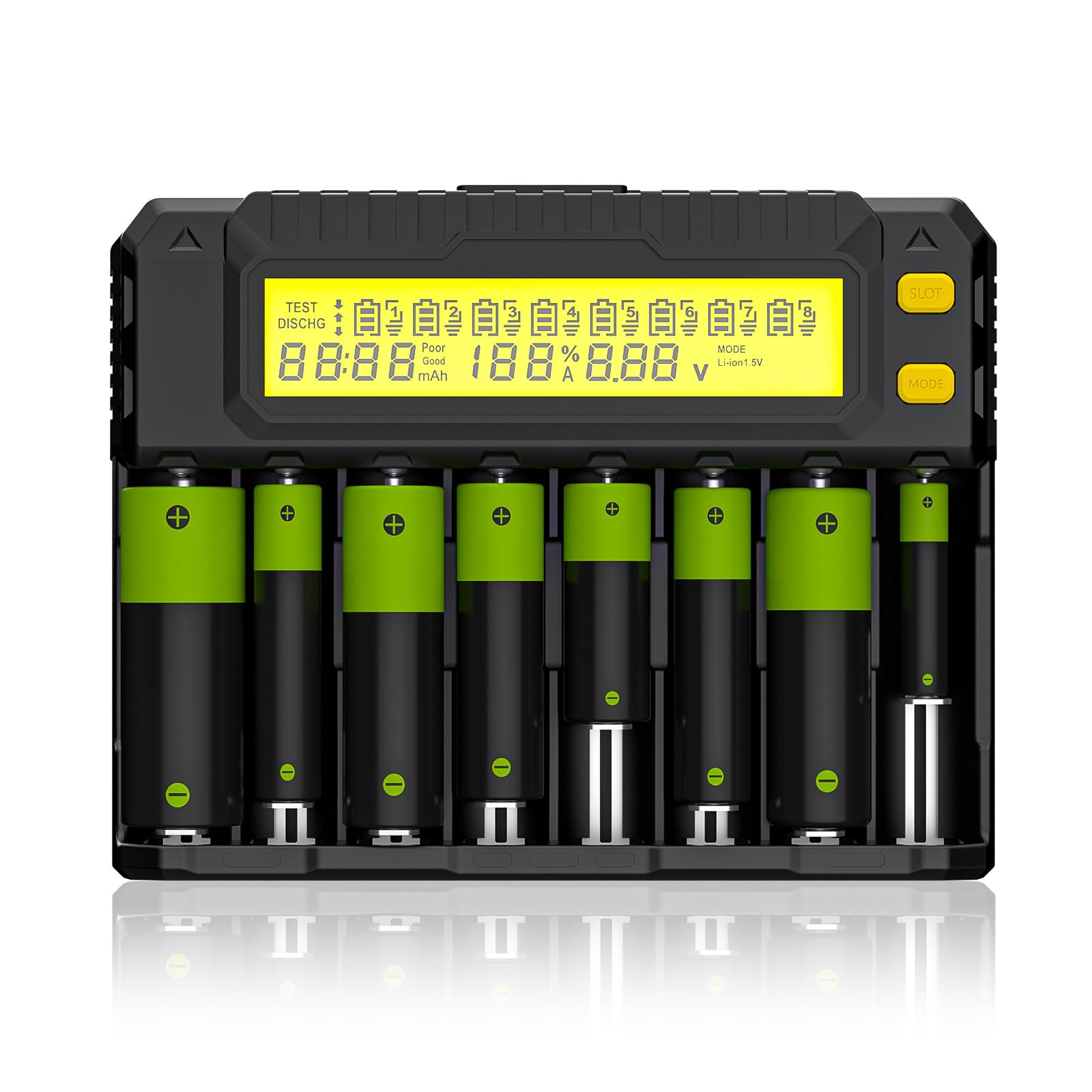
The SEVENKA R8 stands out for its eight independent bays, making it the obvious choice for anyone maintaining a large collection of 18650 cells — think high-drain flashlights, power banks, or battery packs. The large LCD screen displays voltage, charge percentage, and charge time for each battery, so you can monitor all eight cells at a glance.
Adjustable charging speeds of 0.25A, 0.5A, and 0.8A are available for lithium batteries, though the 0.8A maximum rate is slower than most mid-range chargers. For Ni-MH cells, the rate is fixed at 0.5A. The charger is made from fire-retardant PC material and carries ETL certification, which is a meaningful safety indicator at this price tier.
The trade-off for eight bays is charge speed. Users report that charging eight 18650s from empty can take 24 hours or longer at the lowest current setting. If fast turnaround is your priority, a four-bay unit with higher per-slot current will serve you better. But for batch charging overnight or topping off a set of seldom-used cells, the R8 delivers capacity that no other charger in this roundup can match.
Why it’s great
- Eight independent bays allow simultaneous charging of a large battery inventory
- Fire-retardant housing with ETL certification for safer operation
- LCD displays voltage and charge percentage per bay
Good to know
- Maximum charge rate of 0.8A per bay results in very long charge times
- Slow charging may not suit users who need batteries ready quickly
FAQ
Can I charge different sizes of batteries at the same time?
What does the LCD display tell me about battery health?
Is it safe to leave 18650 batteries charging overnight?
Final Thoughts: The Verdict
For most users, the best 18650 battery charger is the Nitecore UMS4 because it combines four independent bays, high-speed QC 3.0 charging, and detailed diagnostic data — all in a package that has proven reliable across thousands of charge cycles. If you want a dedicated capacity tester that also charges, grab the XTAR VC4SL. And for batch charging eight cells at once on a budget, nothing beats the SEVENKA R8.