
Our readers keep the lights on and the weekend projects moving. As an Amazon Associate, I earn from qualifying purchases.
The hardest part of buying a 2-bay NAS isn’t the setup—it’s realizing your precious family photos, years of creative work, and entire music library are trapped on a single failing external drive with zero redundancy. You need a centralized vault that keeps your data safe, accessible from anywhere, and expandable enough to grow with your digital life. This guide cuts through the RAID modes, processor benchmarks, and OS ecosystems to find the machine that actually fits your workflow.
I’m Rikta — the co-founder and writer behind FitlyFast. I’ve spent countless hours analyzing NAS hardware specifications, comparing data transfer protocols, and evaluating RAID configurations to identify the storage solutions that offer genuine long-term value and data security.
Whether you are securing a family archive or building a media server, choosing the right 2 bay nas means matching your data needs to the correct processor power and redundancy strategy—a decision that protects your files for years.
How To Choose The Best 2 Bay NAS
A 2-bay NAS is a sweet spot for home users and small creatives—it offers RAID redundancy without the cost of a 4-bay unit. But the internal components differ wildly between models, and picking the wrong one can mean sluggish transfers or an inability to run your preferred apps.
Processor: ARM vs. Intel x86
The CPU is the heart of your NAS. ARM processors, like the Cortex-A55 found in the QNAP TS-233, are energy-efficient and perfectly capable for file backups, photo syncing, and basic media streaming. Intel x86 chips, like the quad-core processor in the TERRAMASTER F2-425, unlock hardware-accelerated 4K transcoding (Plex, Emby, Jellyfin) and support for Docker containers. If you plan to stream high-resolution video to multiple devices or run custom applications, prioritize an Intel-based unit.
RAID and Data Redundancy
In a 2-bay system, RAID 1 (mirroring) writes identical data to both drives, protecting you against a single drive failure. Synology’s SHR (Synology Hybrid RAID) adds flexibility by allowing mixed-capacity drives. TERRAMASTER’s TRAID saves storage space while maintaining redundancy. Avoid running a 2-bay NAS without some form of RAID—without it, a single disk crash wipes out everything.
Network Speed: 1GbE vs. 2.5GbE
A standard 1 Gigabit Ethernet port caps transfers at about 125 MB/s. Models like the Asustor Drivestor 2 Pro Gen2 and the TERRAMASTER F2-425 include a 2.5GbE port, pushing speeds to roughly 312 MB/s. This matters if you edit video files directly from the NAS or frequently move large datasets. For routine file backup and streaming, 1GbE is sufficient and more budget-friendly.
Quick Comparison
On smaller screens, swipe sideways to see the full table.
| Model | Category | Best For | Key Spec | Amazon |
|---|---|---|---|---|
| UGREEN DH2300 | 2-Bay NAS | Entry-level personal storage | 64TB capacity, 1GbE | Amazon |
| TERRAMASTER F2-425 | 2-Bay NAS | 4K media server & Docker | Intel x86, 2.5GbE | Amazon |
| Synology DS223 | 2-Bay NAS | Professional backup & file sync | Synology DSM, 2-bay | Amazon |
| Asustor Drivestor 2 Pro Gen2 | 2-Bay NAS | Quad-core home media server | 2.5GbE port | Amazon |
| Synology DS223j | 2-Bay NAS | Secure private cloud | Entry-level, DSM | Amazon |
| QNAP TS-233 | 2-Bay NAS | ARM-based data storage | Quad-core 2.0 GHz | Amazon |
| ORICO 9848RU3 | 4-Bay DAS | Multi-RAID direct storage | 8 RAID modes | Amazon |
| CENMATE 4 Bay | 4-Bay DAS | Plug-and-play JBOD storage | 80TB capacity | Amazon |
| JONSBO N4 | PC Case | Custom DIY NAS build | 8-drive bay support | Amazon |
In‑Depth Reviews
1. TERRAMASTER F2-425
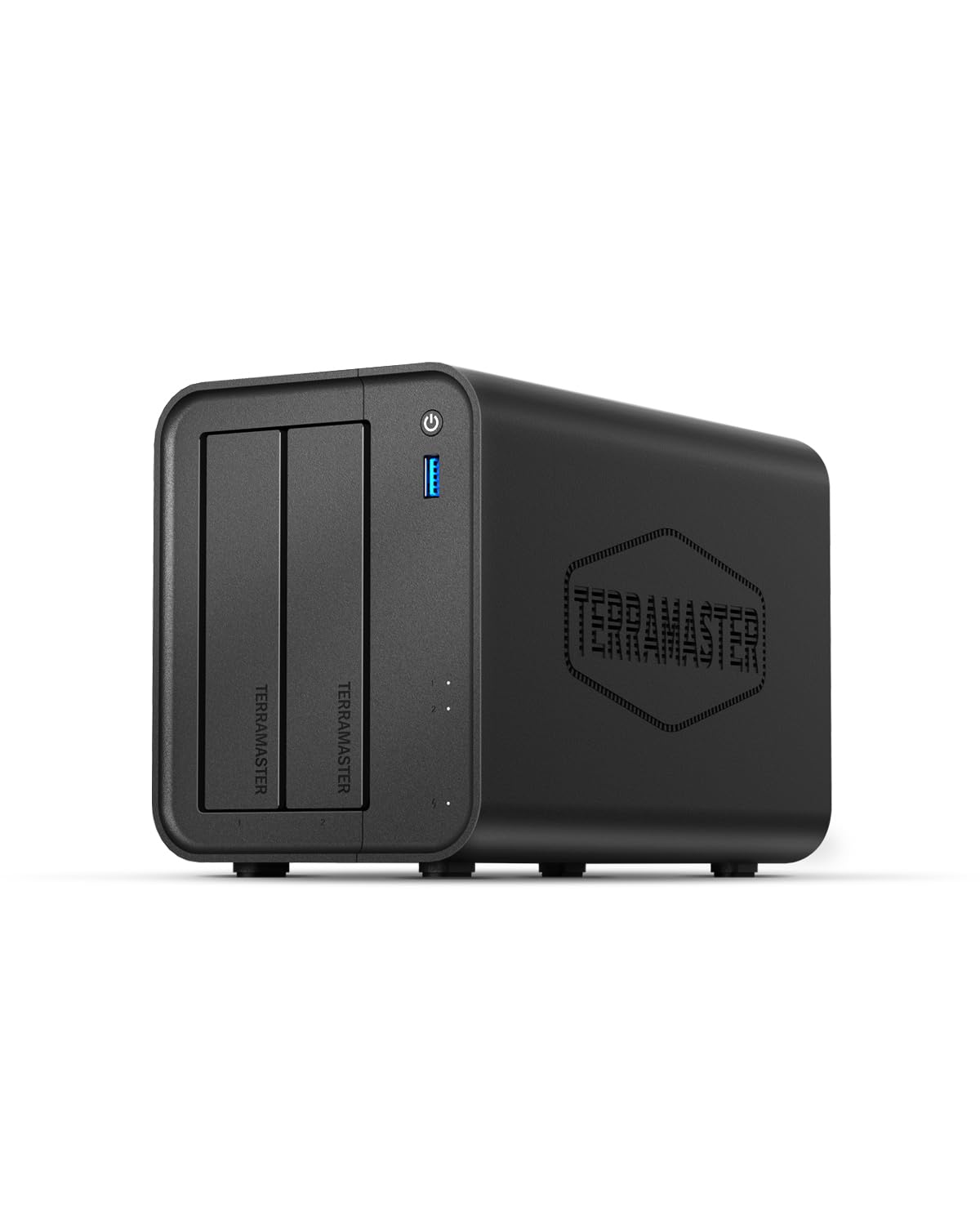
The TERRAMASTER F2-425 is the strongest contender for the title of best all-around 2-bay NAS. Its Intel x86 quad-core processor with QuickSync technology handles 4K H.265 transcoding in Plex, Emby, or Jellyfin without dropping frames, and the 2.5GbE LAN port delivers real-world transfer speeds that saturate a Gigabit connection. With 4GB of DDR4 RAM (expandable to 16GB), this unit supports Docker containers for running custom apps like a Home Assistant server or a download manager.
TOS 6 operating system is functional and modern, offering TRAID for efficient storage pooling that saves up to 30% more space than traditional RAID. The tool-free Push-Lock drive trays allow HDD installation in seconds, and the fan noise is rated at just 19dB(A)—quiet enough for a bedroom office. Users report smooth operation with Emby and the ability to stream two 4K video streams simultaneously without glitches.
Some users note that boot time can be slow (15–20 minutes) after a full shutdown, and the limited official app store means heavy reliance on the community store or Docker for expanded functionality. However, the combination of Intel power, fast networking, and TOS6 makes this the most versatile 2-bay unit for media enthusiasts and prosumers who want future-proof performance.
Why it’s great
- Intel QuickSync enables hardware-accelerated 4K transcoding
- 2.5GbE port for significantly faster file transfers
- Expandable RAM up to 16GB
- Docker support for advanced app deployment
Good to know
- Boot time can be 15–20 minutes
- Limited official app store relies on community/ Docker
- Plastic enclosure feels less premium than metal alternatives
2. Asustor Drivestor 2 Pro Gen2 AS3302T v2

Powered by a Realtek quad-core processor, the Asustor Drivestor 2 Pro Gen2 delivers stable, efficient performance for a home media server. The inclusion of a 2.5GbE Ethernet port immediately elevates network transfer speeds over standard Gigabit models, making backups and large file copies noticeably faster. With 2GB of DDR4 RAM, this unit manages simultaneous file synchronization, cloud backup, and media streaming without slowdowns.
Asustor’s ADM operating system is notably user-friendly, featuring repeatable walkthrough tutorials for common tasks like setting up Plex or creating shared folders. The tool-free drive bay design lets you slide in 3.5-inch HDDs without any screws. It supports 4K video playback and transcoding, making it a solid foundation for streaming high-resolution content to smart TVs, Xbox, or Roku devices. Users frequently praise its ease of setup and the responsive app store.
A minority of users experienced fan failures within the first few days, though these were resolved by reseating the fan connector. A more consistent criticism is that the Realtek CPU lacks the raw power for heavy Jellyfin transcoding—some users report constant buffering on Ethernet-connected TVs when converting high-bitrate 4K files. For direct-play streaming or lower-resolution content, this NAS performs admirably.
Why it’s great
- 2.5GbE networking for high-speed transfers
- Tool-free drive installation
- Excellent beginner-friendly OS with tutorials
- Supports 4K media playback and streaming
Good to know
- CPU can struggle with demanding 4K transcoding
- Occasional fan connector issues reported
- Enclosure is metal but feels lightweight
3. Synology DS223

The Synology DS223 is built for the user who values data integrity and professional-grade software above raw processing power. It features Synology’s DiskStation Manager (DSM), widely considered the most polished and feature-rich NAS operating system available. With DSM, you get Snapshot Replication for ransomware protection, Active Backup for seamless PC and Mac backups, and Synology Hybrid RAID (SHR) that supports mixing drive capacities while maintaining redundancy.
The aluminum alloy enclosure is robust and minimizes vibration from the installed HDDs, contributing to quiet 24/7 operation. Setup is straightforward via the web interface, and the DS223 integrates natively with macOS Time Machine, Windows File History, and Synology Photos for automatic mobile backups. Users upgrading from old WD My Cloud units report a significant improvement in speed and reliability—file transfers via SMB are consistent and responsive.
One notable limitation is the lack of a 2.5GbE port—the DS223 is capped at 1GbE, which may feel restrictive if you frequently transfer large video files. Additionally, the plastic cover tabs on the drive caddies are fragile and can break during installation. The DS223 also lacks Docker support, meaning you cannot run custom containers, but for pure file storage, backup, and surveillance, it remains a top-tier choice.
Why it’s great
- Synology DSM offers the best software ecosystem
- SHR allows mixed-capacity drives
- Metal build reduces noise and vibration
- Excellent mobile backup and file sync apps
Good to know
- Limited to 1GbE networking
- No Docker or container support
- Drive caddy plastic tabs can break easily
4. UGREEN DH2300 NASync
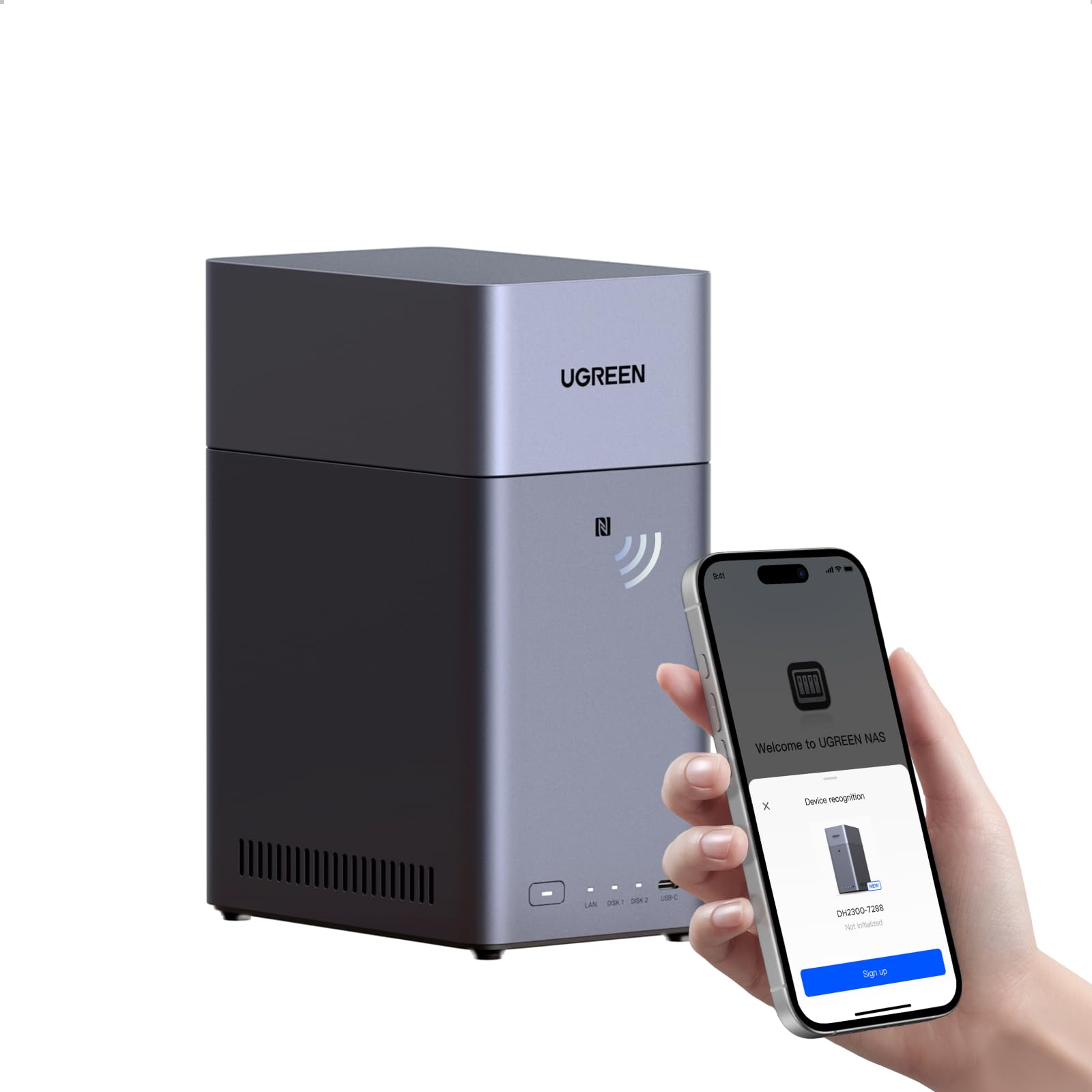
The UGREEN DH2300 is designed specifically for users migrating away from cloud subscriptions or external drives, offering a very low barrier to entry. The UGOS Pro operating system is clean and intuitive, making initial setup a breeze even for non-technical users. AI-powered photo tagging automatically identifies faces, locations, and objects, making it easy to search through thousands of family photos—a feature typically reserved for more expensive models.
With its 1GbE port and SATA III interface, the DH2300 delivers up to 125 MB/s transfers, which is sufficient for personal file backups and streaming. It supports up to 64TB of raw storage (two 32TB drives in RAID 0). The unit also includes a 4K HDMI output for direct media playback to a TV, and external USB drives are automatically detected for easy expansion. Users report seamless integration with macOS via SMB shares appearing as local drives, and the mobile app handles automatic phone backups effectively.
The DH2300 does not support Docker or virtual machines, and Plex requires a manual side-load from UGREEN’s site rather than running natively. The plastic chassis amplifies HDD noise, so some users add acoustic foam to quiet the operation. It also lacks Wi-Fi, requiring a wired Ethernet connection. For a pure, subscription-free personal cloud with AI photo management, this is an excellent entry point.
Why it’s great
- Very beginner-friendly UGOS Pro OS
- AI photo tagging for automatic organization
- 4K HDMI port for direct TV playback
- Massive 64TB capacity support
Good to know
- No Docker or VM support
- Plastic case amplifies HDD noise
- Plex must be installed manually
5. Synology DS223j
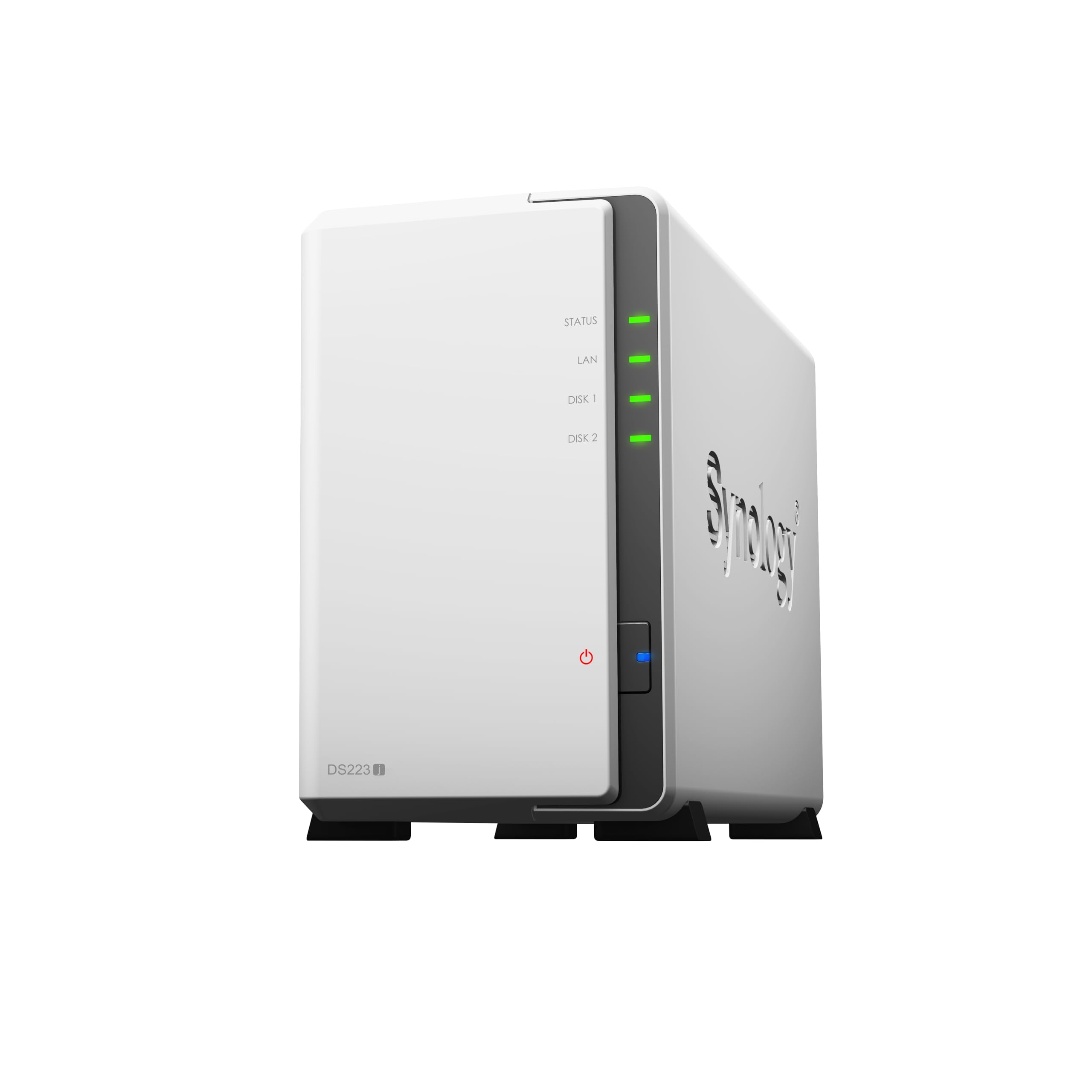
The Synology DS223j is the most affordable entry into the Synology ecosystem, packing DSM into an energy-efficient chassis that sips power. It is ideal for users who primarily need automated backups, file sync across devices, and a secure private cloud without the recurring costs of services like Dropbox or Google Drive. The DS223j supports RAID 0 and RAID 1, giving you a choice between maximum capacity or data mirroring.
Setup is straightforward via the web interface, and Synology Photos automatically backs up photos from mobile devices when connected to your home Wi-Fi. The DS223j also supports Surveillance Station for IP camera recording and Hyper Backup for multi-destination backups. Users upgrading from older WD MyCloud units consistently note the much faster transfer speeds and more reliable connection. The unit is quiet enough for a living room environment.
Being the ‘j’ (junior) series, the processor is a lower-powered ARM chip, so multitasking can induce lag when running multiple apps like Photos and Surveillance Station simultaneously. It also lacks a 2.5GbE port and does not support Docker. The enclosure is plastic and tempered glass, which feels less premium than the metal-cased DS223. For a simple, reliable, low-cost backup and file server, the DS223j is a proven performer.
Why it’s great
- Lowest-cost entry to Synology DSM ecosystem
- Very energy efficient for 24/7 operation
- Reliable automated phone photo backup
- Supports Surveillance Station for home security
Good to know
- Lower-powered ARM CPU can lag under load
- Plastic and glass build is less durable
- No Docker or 2.5GbE networking
6. QNAP TS-233

The QNAP TS-233 is a well-rounded 2-bay NAS built around a 64-bit ARM Cortex-A55 quad-core processor clocked at 2.0 GHz with 2GB of RAM. It is designed for users who want a silent, reliable storage solution with advanced data protection features like Snapshots, which allow you to revert files to previous versions in case of ransomware attacks or accidental deletions. The metal enclosure is compact and operates very quietly, making it suitable for deskside placement.
QTS (QNAP’s operating system) offers a rich app center, including support for Plex Media Server, making the TS-233 a capable media streamer for direct-play content. The Qfile Pro mobile app automatically syncs photos and files when you return home, providing a continuous backup loop. Users consistently praise the easy setup process and the system’s stability, with many using it solely as a reliable data vault and finding it perfectly adequate for their needs.
The 2GB of RAM is non-expandable, which can limit performance when running multiple apps simultaneously. The processor, while efficient, is not powerful enough for heavy 4K transcoding—it is best suited for direct media playback. Additionally, the TS-233 is limited to a single 1GbE port. If you need a straightforward, quiet, and secure backup hub for photos and documents, the TS-233 delivers solid value.
Why it’s great
- Snapshot protection against ransomware
- Very quiet metal enclosure
- Reliable auto-sync via Qfile Pro
- Easy setup and stable QTS OS
Good to know
- RAM is not expandable
- Limited to 1GbE networking
- Not suitable for heavy 4K transcoding
7. ORICO 9848RU3

While technically a 4-bay Direct Attached Storage (DAS) enclosure rather than a true NAS, the ORICO 9848RU3 is included here because many users consider it for local RAID storage as an alternative to networked systems. It supports an impressive eight RAID modes (0, 1, 3, 5, 10, JBOD, CLONE, and CLEAR), offering maximum flexibility. The all-aluminum chassis with an 80mm silent fan provides excellent heat dissipation for sensitive HDDs, and the tray-less design with independent safety locks prevents accidental drive ejection.
Using the USB 3.0 interface, the 9848RU3 achieves transfer rates up to 235 MB/s, which is fast enough for large backups and file transfers to a single workstation. The built-in 150W power supply eliminates the need for a bulky external power brick. Users report that the unit is very quiet and stable under constant load, with RAID 5 offering a good balance of speed and parity protection for a local media library.
Being a DAS, this unit must be connected directly to a computer—it cannot serve files over a network without a host PC. Some users experienced a hard-coded power management timeout that forces a daily hard reset when left idle, which is a significant drawback for always-on use. The USB 3.0 interface also means that write speeds can drop significantly after the cache fills, making it less ideal for continuous heavy writing tasks compared to a dedicated NAS.
Why it’s great
- 8 different RAID modes for maximum flexibility
- Aluminum chassis with efficient silent fan
- Built-in 150W power supply, no external brick
- Tray-less drive bays with safety locks
Good to know
- DAS requires direct USB connection to a PC
- Idle timeout can force daily hard resets
- Write speeds drop after cache fills
8. CENMATE 4 Bay Enclosure

The CENMATE 4 Bay Hard Drive Enclosure is a simple, no-frills DAS designed for easy external storage expansion. It connects via USB 3.0 and eSATA, and it automatically recognizes drives without requiring any software installation—true plug-and-play. The aluminum-alloy body and integrated 2-inch fan help manage heat, making it a reasonable option for adding bulk storage to a workstation or a Plex media server.
With support for up to 80TB of total capacity (four 20TB drives), this unit can hold a substantial media library. The tool-less trays are easy to slide in and out, simplifying drive swaps. Users note that for plug-and-play media serving on Windows or macOS, it works reliably and is faster than cheaper alternatives. Its JBOD mode allows each drive to appear as a separate logical volume, which is useful for server environments where you need logical disk management.
This enclosure does not support any hardware RAID, so data redundancy must be managed by your operating system or software. The fan noise is rated at 40-50 decibels, which some users find noticeable, and a few reports mention that the small fan moves limited air, encouraging upgrades to a full-size PC fan. There is also a critical review reporting complete data corruption across all four drives after a few days—while an outlier, it underscores the risk of using non-RAID enclosures for valuable data.
Why it’s great
- True plug-and-play, no software required
- Supports up to 80TB capacity
- Aluminum body for heat dissipation
- Tool-less drive trays for easy installation
Good to know
- No built-in RAID or data redundancy
- Fan noise may be noticeable at 40-50 dB
- Risk of data corruption reported in isolated cases
9. JONSBO N4 Case

The JONSBO N4 is not a pre-built NAS but a premium Mini-ITX/Micro-ATX case designed for users who want to build their own custom NAS from scratch. It features an 8mm thick North American black walnut wood front panel, marrying natural aesthetics with a 0.7SGCC steel chassis. The case supports up to eight drives: four hot-swap 3.5-inch bays, two non-hot-swap 3.5-inch bays, and two 2.5-inch SSD mounts, offering immense storage flexibility in a compact footprint.
The interior is split into two compartments to separate the motherboard and PSU from the drive bays, improving airflow and cable management. It includes a pre-installed 120mm fan and supports front-panel USB 3.2 Gen 2 Type-C and USB 3.0 ports. The N4 is compatible with standard ITX and Micro-ATX motherboards, SFX power supplies, and half-height expansion cards, making it a versatile foundation for a TrueNAS, UnRAID, or Proxmox server.
Users love the build quality and the compact form factor for the number of drive bays. However, the case is cramped to build in, and the included fan can produce a low pulse noise that some replace with a Noctua. The right-hand drive cage lacks hot-swap and requires manual SATA cabling. Most critically, several users report that the lower drive bays can overheat above 70°C under heavy load without additional case fans, potentially reducing HDD lifespan.
Why it’s great
- Beautiful solid walnut wood front panel
- Supports up to 8 drives in a compact case
- 4 hot-swap bays for easy drive management
- USB-C front I/O connector
Good to know
- Cramped interior makes building difficult
- Lower drive bays can overheat under load
- Included fan may have noise issues
FAQ
Do I need a 2.5GbE port on my 2-bay NAS?
Can I run Plex or Emby on any 2-bay NAS?
What hard drives should I use in my 2-bay NAS?
Final Thoughts: The Verdict
For most users, the 2 bay nas winner is the TERRAMASTER F2-425 because its Intel x86 processor with QuickSync, 2.5GbE networking, and Docker support offer genuine future-proof performance for both media and file storage. If you want the best software ecosystem and painless setup, grab the Synology DS223. And for a simple, subscription-free personal cloud with AI photo management, nothing beats the UGREEN DH2300.