
Our readers keep the lights on and the weekend projects moving. As an Amazon Associate, I earn from qualifying purchases.
For couples, roommates, and siblings, finding a two-player game that avoids the pitfalls of multiplayer solitaire or overly-long downtime is the real challenge. You need a duel that delivers depth, tension, and replayability without demanding a sprawling table or a three-hour commitment. The best options offer head-to-head mechanics that keep both players engaged every turn, creating moments of genuine competition and shared fun.
I’m Rikta — the co-founder and writer behind FitlyFast. I’ve spent hundreds of hours analyzing player reviews, mechanics breakdowns, and component quality reports to identify the board games that truly excel in the two-player format. This guide focuses on the specific features that separate a great dueling game from a forgettable one.
From worker placement to trading card duels, the right pick balances strategic depth with quick rounds. This guide breaks down the top contenders to help you find the absolute best 2 person board games for your next game night.
How To Choose The Best 2 Person Board Games
The ideal two-player game needs more than just a good concept—it must deliver a tight, interactive experience where every move counters your opponent. Look for games built from the ground up for two, avoiding rules that were simply tacked on from larger multiplayer games. Focus on mechanics that force direct competition, like shared marketplaces or simultaneous action selection.
Mechanics and Player Interaction
Games that excel in the two-player format use mechanics like card drafting from a shared central pool, worker placement on a fixed grid, or resource trading where each decision directly affects your opponent’s options. Avoid games where players can build their own engine in isolation; you want mechanics that create a tense push-and-pull, such as in 7 Wonders Duel where taking a card from the pyramid opens up new opportunities for the other player.
Playtime and Complexity
Consider when you’ll be playing. For a quick weeknight game after work, sessions of 20 to 30 minutes are ideal. Heavier strategy titles like Targi offer deeper decision-making that might run closer to an hour. Look at the rule complexity: games that are easy to teach (like Jaipur) allow for more spontaneous play, while denser rule sets reward repeated sessions.
Quick Comparison
On smaller screens, swipe sideways to see the full table.
| Model | Category | Best For | Key Spec | Amazon |
|---|---|---|---|---|
| 7 Wonders Duel | Strategy | Intense head-to-head civilisations | Three victory conditions | Amazon |
| The Lord of the Rings: Duel for Middle-Earth | Strategy | Thematic LOTR fans | Asymmetrical leader powers | Amazon |
| Sky Team | Co-op | Collaborative couples play | Silent dice placement | Amazon |
| Splendor Duel | Strategy | Fast gem-collecting duels | Alternate win conditions | Amazon |
| Jaipur | Card Game | Quick trading card duels | 30-minute playtime | Amazon |
| Targi | Worker Placement | Deep strategic planning | 60-minute playtime | Amazon |
| Boop | Abstract Strategy | Lightweight cat-themed fun | 20-minute playtime | Amazon |
In‑Depth Reviews
1. 7 Wonders Duel

7 Wonders Duel redefines the two-player strategy genre by adapting the core card-drafting mechanics of its parent game into a tense, head-to-head struggle. The card pyramid setup — with a mix of face-up and face-down cards — forces you to weigh each pick carefully, as exposing a card to the opponent is often unavoidable. This creates a constant push-and-pull where you must balance building your own civilization while simultaneously blocking your opponent’s key strategies.
The game offers three distinct paths to victory: military supremacy, scientific advancement, or economic dominance. This multiple-victory-condition design ensures that no two games play out the same way. The military track operates as a tug-of-war, with the threat of instant defeat if you neglect your defenses entirely, while the scientific track requires collecting specific symbols for a technological breakthrough. This variety makes every session feel fresh and encourages adaptive thinking.
Component quality is excellent, with thick card stock and clear iconography that make gameplay smooth after a short learning phase. The Wonders themselves offer powerful, game-altering abilities, but sacrificing cards to build them adds a meaningful cost. For those seeking a deep, replayable, and genuinely competitive experience, this is the gold standard. The only minor downside is the instruction manual, which can be slightly dense for new players.
Why it’s great
- Deep strategic depth with three win paths
- Excellent replayability due to card pyramid setup
- High-quality components and clear iconography
Good to know
- Rulebook can be dense for beginners
- Some cards can feel overpowered in certain setups
2. Jaipur

Jaipur captures the thrill of a merchant duel in the markets of Rajasthan. You and your opponent compete to buy, trade, and sell commodities like leather, spices, and gold. The core mechanic involves collecting sets of goods cards and selling them at optimal moments—the more of a single good you sell at once, the higher the payout. This creates a constant strategic tension: do you hold out for a larger set and risk your opponent cornering that market, or sell early for guaranteed points?
The game shines in its simplicity and pace. A full match wraps up in under 30 minutes, making it ideal for multiple rounds in a single sitting. The hand management system is deceptively deep, requiring you to track which goods are abundant and which are scarce to time your sales effectively. The inclusion of camels as a wild resource adds an extra layer of strategic choice, as they can be used to swap out your hand but occupy valuable space.
Component quality is solid, with thick cards and satisfyingly chunky tokens, though the box is compact enough to throw in a bag for travel. The only minor complaint from some players is the need to re-sort the tokens and cards between games, but this is a small price to pay for such an engaging and fast-paced duel. It’s an excellent entry point for new board gamers and a satisfying challenge for veterans.
Why it’s great
- Fast, engaging rounds under 30 minutes
- Deep strategic trading with high replayability
- Compact and portable box design
Good to know
- Requires manual re-sorting of tokens between sessions
- Strictly two-player, no solo variant available
3. Sky Team

Sky Team is the rare cooperative two-player game that feels genuinely tense and collaborative rather than solvable. You and your co-pilot work together to land an airplane by placing dice on various cockpit controls—throttle, flaps, landing gear, and brakes. The catch is that communication is limited; once a round begins, you cannot discuss your planned dice placements, forcing you to intuit your partner’s intentions based on the developing board state.
The game uses a simple dice-placement system where the value of a die determines the action’s effectiveness. Coffee tokens allow limited re-rolls, adding a small layer of luck mitigation. The real brilliance lies in the escalating difficulty across 20 different airport scenarios, each introducing new modules like ice on the tarmac or a fuel leak. This ensures the game remains challenging long after you’ve mastered the base mechanics. The absence of an alpha-player problem—where one player dictates the strategy—is a standout feature.
Component quality is impressive, with a clear cockpit board, custom dice, and sturdy player screens. The rulebook is well-organized, and a typical game takes only 20 to 30 minutes, including setup. The only potential drawback is the silent gameplay, which may not appeal to those who prefer chatting during a game. For couples seeking a true team experience, this is a top-tier choice.
Why it’s great
- True cooperative experience with no quarterbacking
- High replayability with 20 unique scenarios
- Quick setup and fast 20-minute sessions
Good to know
- Requires compatible play style; silent rounds may feel awkward
- Dice luck can occasionally frustrate
4. The Lord of the Rings: Duel for Middle-Earth

The Lord of the Rings: Duel for Middle-Earth builds on the acclaimed 7 Wonders Duel engine while introducing asymmetrical play that significantly alters the dynamic. One player controls the Fellowship, working to destroy the One Ring, while the other commands Sauron’s forces, aiming to conquer Middle-earth. This asymmetry is not just cosmetic—each side has unique cards, abilities, and victory conditions, fundamentally changing how you approach the game.
The core card-drafting mechanism from 7 Wonders Duel is enhanced with new elements like area control on a central map, tower building, and a race track where the Fellowship inches toward Mount Doom. The three victory conditions—military conquest, forging alliances with six peoples, or completing the Ring quest—ensure that every game is a multi-layered challenge. The resource economy feels less punishing than its predecessor, allowing for more flexible strategies. The production quality is outstanding, with vibrant, thematic artwork and high-quality card stock.
Sessions run about 30 minutes, and the rulebook does a commendable job of explaining the asymmetrical roles. The only consideration is the slightly higher price point, which reflects the premium components and the licensed theme. For fans of Tolkien or those who enjoy 7 Wonders Duel and want a fresh twist, this is an excellent investment. It requires careful reading to fully grasp the asymmetrical nuances, but the payoff is substantial.
Why it’s great
- Deep asymmetrical gameplay with thematic immersion
- High-quality components and stunning artwork
- Three distinct victory conditions for high replayability
Good to know
- Premium price compared to other two-player games
- Asymmetry requires careful rule study initially
5. Splendor Duel
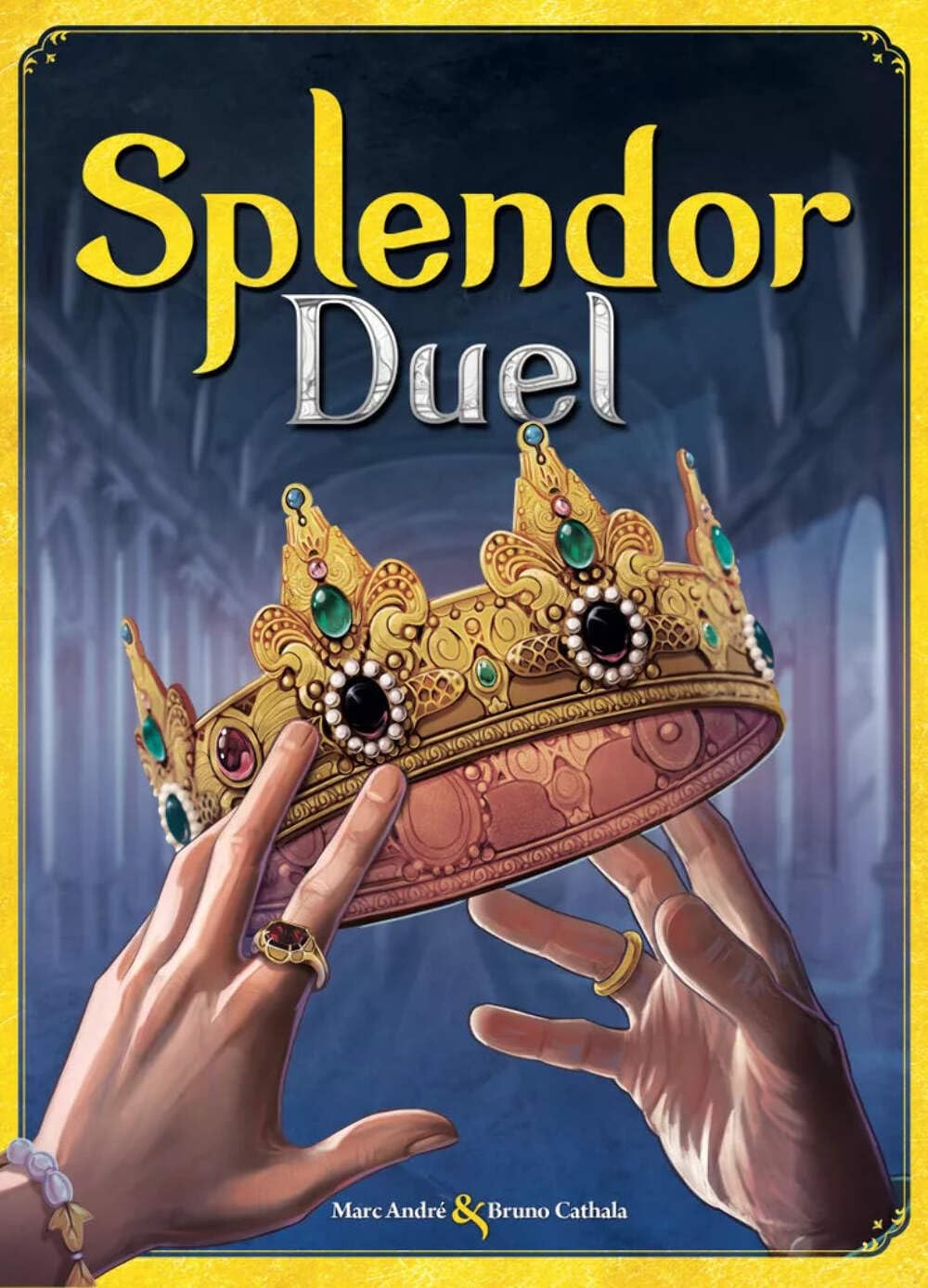
Splendor Duel takes the elegant gem-collecting concept of the original Splendor and refines it exclusively for two players. The setup involves a central board with development cards arranged in a diamond pattern, along with a pool of gem tokens. Each turn you either take tokens or reserve a card, with the goal of collecting combinations that yield prestige points or special powers. The key innovation here is the use of ‘pearls’ and ‘privilege scrolls’ that add new layers of tactical depth.
The game introduces alternate winning conditions beyond mere prestige points—you can achieve victory by collecting a certain number of royal favor tiles or by reaching ten prestige points first. This dual-path design forces you to monitor your opponent’s progress and pivot your strategy accordingly. The restricted gem token pool creates a race dynamic, where hoarding specific gems can block your opponent’s key purchases. This interaction is more direct than the original Splendor, making every decision feel weighty.
Component quality mirrors the original, with heavy plastic gem tokens and thick card stock. The box is compact and travel-friendly. The rules are easy to teach, with a learning game suggested for first-timers. The only downside is that some players may find the alternate win conditions slightly less intuitive than the classic point race. For those new to two-player board games, this is an excellent starting point that offers depth without overwhelming complexity.
Why it’s great
- Easy to learn with deep strategic decision-making
- Introduces alternate win conditions for variety
- Premium components and compact travel-friendly box
Good to know
- Alternate win conditions require a learning read of the rules
- May feel similar to base Splendor for some players
6. Targi

Targi is a dedicated two-player worker placement game that captures the essence of a tribal trading culture in the Tuareg tradition. Unlike many worker placement games that require multiple players to function, Targi’s grid-based system is perfectly tuned for two. Each player places three workers on the border of a 4×4 grid, claiming action cards and resources at the intersection points. This fixed border combined with variable center cards ensures that the available actions change every game.
The core loop involves collecting goods cards to trade for tribe cards, which provide victory points and special abilities. The puzzle-like placement system requires careful planning: placing a worker in a prime spot might block your opponent from a critical resource, but it also opens up new opportunities for them on their turn. The BGG rating for this game consistently sits above 7.5, reflecting its strong design. It offers a deeper, more thoughtful experience that rewards careful strategy over quick reactions.
Component quality is a mixed bag; the cards are good, but the wooden tokens are all the same shape and size, which can make organization tricky. No playing mat is included, and the lack of variety in the fixed border cards can lead to staleness after many plays. The solo variant is a nice bonus for occasional solo play. For players seeking a meaty, contemplative duel that lasts about an hour, Targi is a fantastic choice. It demands attention and rewards careful planning.
Why it’s great
- Unique worker placement grid built for two players
- Deep strategic gameplay with high BGG rating
- Includes solo variant for solo play
Good to know
- Tokens are uniform in size and shape, making sorting difficult
- Fixed border cards can feel repetitive after many sessions
7. Boop

Boop is an abstract strategy game wrapped in a charming cat-and-kitten theme. The goal is straightforward: get three cats in a row to win. The twist lies in the ‘boop’ mechanic—every time you place a kitten on the quilted bed board, it pushes all adjacent pieces one space away. This simple rule creates a constantly shifting battlefield where your careful setups can be disrupted in a single move, adding a chaotic and fun layer to the classic tic-tac-toe formula.
The game is incredibly easy to learn, with a rulebook that even an 8-year-old can understand. A typical round takes under 20 minutes, making it perfect for a quick warm-up or a game with younger players. The production quality is excellent for its price point, featuring a soft fabric board and beautifully crafted wooden cat and kitten pieces. The board’s soft material can cause pieces to slide slightly, which is a minor consideration but generally adds to the playful chaos rather than detracting from it.
The main downside is the lack of deep strategic depth compared to other games on this list. For players seeking a complex, multi-layered duel, Boop may feel too light. However, for families, couples looking for a fun and quick game, or as a gift for cat lovers, it delivers exactly what it promises: adorable, fast-paced, and highly engaging fun. It’s a game that triggers spontaneous laughter and is easy to pull out for multiple rounds.
Why it’s great
- Quick to learn and fun for all ages
- Unique ‘boop’ mechanic keeps games lively
- High-quality, cute components
Good to know
- Lacks deep strategy for serious gamers
- Soft board can cause pieces to slide
FAQ
What game mechanics work best for two players?
How much playtime should I expect for a good two-player game?
Can I find two-player games that are also fun for casual play?
What should I look for in component quality for two-player games?
Final Thoughts: The Verdict
For most users, the 2 person board games winner is the 7 Wonders Duel because it offers a perfect blend of strategic depth, high replayability, and elegant two-player mechanics. If you want a fast-paced trading card duel with incredible value, grab the Jaipur. And for a cooperative experience that demands genuine teamwork and delivers tense moments, nothing beats the Sky Team.