
Our readers keep the lights on and the weekend projects moving. As an Amazon Associate, I earn from qualifying purchases.
A two-player board game for adults needs to solve a very specific problem: how to deliver meaningful strategic tension, direct competition, or tight cooperation without relying on a larger group to balance the action or fill seats. The wrong pick will feel like a neutered version of a bigger game, lacking depth, replayability, or a satisfying win condition engineered specifically for a one-on-one or duo dynamic. The best options in this space lean into asymmetric roles, head-to-head drafting, or time-pressured cooperation that forces real interaction.
I’m Rikta — the co-founder and writer behind FitlyFast. I analyze game mechanics, component quality, and replay value across hundreds of tabletop titles to identify which designs genuinely earn their spot in a dedicated two-player collection.
Whether you want intense head-to-head drafting, silent cooperative tension, or a thematic race against disease, the right game changes your table. You’ll understand exactly which mechanics define the best 2 player board games for adults and which specific titles deliver them best.
How To Choose The Best 2 Player Board Games For Adults
A dedicated two-player game must solve a core tension that a multiplayer game cannot. The best designs either force direct competition for limited resources or require tight cooperation that makes every decision matter. The first question you should ask is whether you want to compete against your partner or work with them — that choice determines the entire mechanic profile you should look for.
Competitive vs. Cooperative Structure
Competitive two-player games, like Splendor Duel or 7 Wonders Duel, rely on card drafting and resource denial to create tension. Cooperative games, like Sky Team or Castle Panic, require synchronized planning and role specialization to solve a puzzle that escalates as the game progresses. The cooperative category needs a mechanic that prevents one player from dominating decisions — known as the alpha player problem — which Sky Team solves with silent dice placement rounds.
Replayability and Variable Setup
A game that offers twenty scenarios, multiple asymmetric leaders, or a randomized card pyramid will feel fresh longer than one with a fixed setup. Look for titles that include campaign progression or modular difficulty systems. Games that rely solely on dice outcomes for variability often have lower replay depth than those with draftable card pools or branching victory conditions.
Quick Comparison
On smaller screens, swipe sideways to see the full table.
| Model | Category | Best For | Key Spec | Amazon |
|---|---|---|---|---|
| Scorpion Masqué Sky Team | Co-op | Silent team strategy | 20 scenarios, 8 dice | Amazon |
| Splendor Duel | Competitive | Gemstone engine building | 25 gem tokens, 67 cards | Amazon |
| 7 Wonders Duel | Competitive | Civilization card drafting | 3 victory paths, 30 min | Amazon |
| Lord of the Rings: Duel | Competitive | Thematic area control | 3 win conditions, 69 cards | Amazon |
| Castle Panic 2nd Ed | Co-op | Family tower defense | 4 modes, 3D towers | Amazon |
| Pandemic | Co-op | Global disease teamwork | 7 specialist roles, 45-60 min | Amazon |
| Dittle Dice Battle | Competitive | Quick coffee table duel | Wooden board, 14 dice | Amazon |
In‑Depth Reviews
1. Scorpion Masqué Sky Team

Sky Team earned the Spiel des Jahres award by solving the alpha player problem that plagues cooperative games. During each round, both players place their dice silently on a shared cockpit board — no talking, no signaling, just raw trust in your partner’s decision-making. The core loop of rolling eight dice and assigning them to throttle, flaps, radio, or brake slots forces tense trade-offs between speed and precision.
The box contains twenty distinct scenarios that escalate from a basic landing at Montreal to ice-covered runways in Reykjavik, each introducing new rules like kerosene leaks or a clumsy intern. Each session runs about twenty to thirty minutes, making it easy to play multiple rounds in one sitting. The component quality is clean and well-organized, with a compact footprint that fits standard table sizes.
Setup takes minutes using the included booklets, and the Dized app provides tutorial guidance for first-time players. Couples who value structured cooperation without quarterbacking will find this game consistently surprising. The escalating campaign difficulty ensures that even after ten sessions, new challenges emerge.
Why it’s great
- Silent dice placement eliminates quarterbacking and forces real partnership.
- Twenty scenarios provide deep campaign replayability without expansions.
- Compact box and short playtime fit weeknight gaming sessions.
Good to know
- No solo mode — strictly a two-player experience.
- Dice luck can occasionally frustrate strategic plans.
2. Splendor Duel
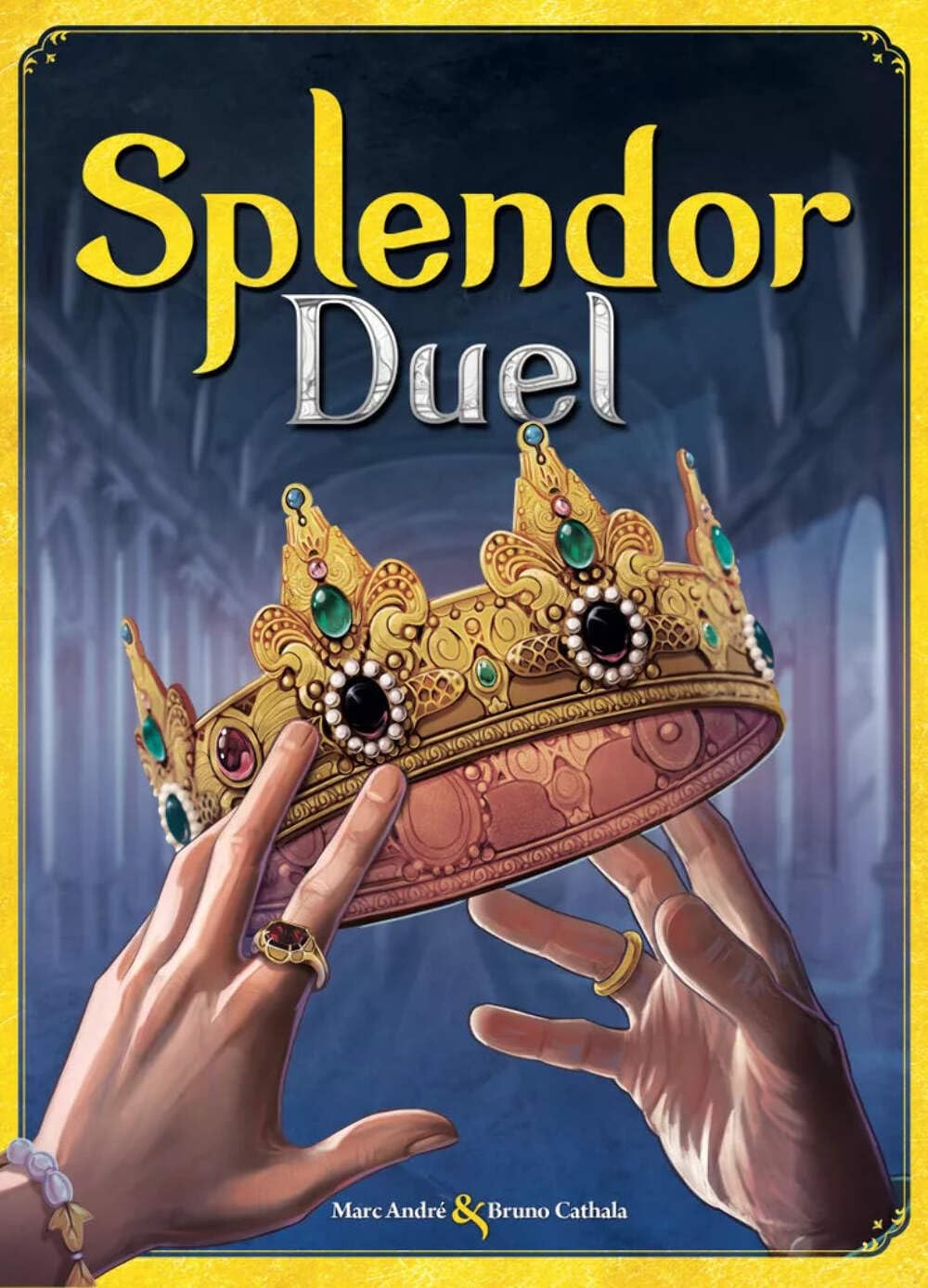
Splendor Duel distills the base Splendor experience into a version that is tighter, faster, and far more aggressive. Instead of the passive gem-drafting of the original, this version adds a shared board where players compete for same-row gems, pearl tokens that grant special powers, and privilege tokens that allow rare extra turns. The three win conditions — reaching ten prestige points, collecting six different nobles, or claiming ten gems in a single color — force you to adapt your strategy round to round.
Component quality is excellent with thick card stock, solid plastic gem tokens that have a satisfying weight, and a compact box that travels easily. Gameplay averages thirty minutes but can swing faster if one player commits to an aggressive noble-collecting strategy. The decision space is more constrained than 7 Wonders Duel, which makes it more accessible for new players while still offering depth for experienced gamers.
The gem restriction mechanic — you can only hold ten gems at a time — creates a constant tension between hoarding resources and spending them before your opponent steals the card you need. It pairs well with other mid-weight competitive games and is often the first one recommended for couples who want a low-argument, high-replay option.
Why it’s great
- Three distinct win conditions keep every game tense.
- Premium components with weighted gem tokens.
- Easy to teach in under ten minutes.
Good to know
- No solo mode or four-player variant.
- Pearl tokens can feel overpowered in early rounds.
3. 7 Wonders Duel

7 Wonders Duel is the gold standard for competitive two-player card drafting. Instead of the draft-and-pass mechanic of the original, this version lays cards in a staggered pyramid where roughly half are face-down, forcing a risk-reward calculation every time you draw. The three victory conditions — military conquest, scientific supremacy, or plain point accumulation — create layered tension because ignoring one path leaves you exposed to a sudden loss.
The Wonders themselves are the heart of the game. Each requires a specific resource sacrifice and card discard to activate, but the payoff can include extra turns, permanent resource discounts, or instant military progress. The shared card market means every choice denies your opponent a potential combo, and the Progress tokens add asymmetric bonuses that shift from game to game. The base game plays thirty minutes and supports expansions like Pantheon for more variety.
Component quality is high with clear iconography and sturdy cards, though sleeving is recommended for frequent play. The rules teach in about fifteen minutes but the strategic depth unfolds over dozens of games. Couples who enjoy engine-building and direct confrontation will return to this title regularly.
Why it’s great
- Three distinct victory paths prevent staleness.
- Pyramid draft creates deep risk-reward decisions.
- Wonders add replayable asymmetric powers.
Good to know
- Military win condition can end the game abruptly.
- Science victory requires tracking six unique symbols.
4. The Lord of the Rings: Duel for Middle-Earth

The Lord of the Rings: Duel for Middle-Earth adapts the 7 Wonders Duel engine into a richly thematic asymmetric experience. One player leads the Fellowship, trying to destroy the One Ring, while the other commands Sauron’s forces attempting to conquer Middle-earth. The three win conditions mirror the films: the Ring reaches Mount Doom, Sauron exerts total military dominance, or a player secures allegiance with six Peoples.
Instead of drafting cards from a pyramid, players allocate influence across a central board divided into three chapters. Each chapter introduces new High Places that grant tactical bonuses, and the area-control element adds a spatial layer missing from the original Duel formula. The component quality is excellent with detailed pawns, sturdy tiles, and evocative art that captures Peter Jackson’s visual language. Games run tight at twenty to thirty minutes, and the asymmetric leaders provide high replayability.
The resource economy is balanced well — gold retains value across all three chapters, and the tug-of-war dynamic on the military track keeps both players engaged. It works as a standalone game even for players unfamiliar with 7 Wonders Duel, though fans of the original will appreciate the streamlined complexity.
Why it’s great
- Asymmetric roles with distinct win conditions.
- Area control adds spatial strategy to card drafting.
- Beautiful thematic components and art.
Good to know
- Requires familiarity with 7 Wonders Duel to play optimally.
- Board can feel crowded with many tokens.
5. Castle Panic 2nd Edition

Castle Panic is a cooperative tower-defense game where players trade cards and coordinate attacks to defend three wooden towers from monster waves. The 2nd edition upgrades the production with 3D towers, vibrant monster tokens, and an illustrated board that makes spatial positioning intuitive. Players take turns drawing monster cards from a bag, spawning enemies at specific compass points, and then discarding matching colored cards to attack.
With four game modes — cooperative, solo, competitive Master Slayer, and Overlord mode where one player controls monsters — it offers good flexibility for different group preferences. The core mechanic of card trading forces genuine cooperation because no single player holds all the colors needed to defend every tower. Difficulty scales by adding or removing monster types, and the boss monsters introduce special abilities that disrupt standard tactics.
Playtime runs about forty-five minutes, which is longer than the other games on this list. It supports up to six players, but the two-player experience works well because each player controls multiple hero cards. The game is accessible for mixed-age groups and provides a satisfying escalation curve from early monster waves to the final boss confrontation.
Why it’s great
- Four distinct game modes increase replay value.
- 3D towers and detailed components enhance table presence.
- Card trading mechanic forces genuine cooperation.
Good to know
- Longer playtime may not suit quick sessions.
- Can feel too easy once you learn optimal strategies.
6. Pandemic

Pandemic is the definitive cooperative board game that established the genre for modern tabletop. Players take specialized roles — Medic, Scientist, Researcher, Operations Expert — and travel between cities to treat disease cubes while collecting sets of cards to discover cures. The game escalates through epidemic cards that reintroduce previously cured diseases, causing chain outbreaks that can end the game in a single turn.
With two players, each person controls two characters, which allows for broader strategic coverage but requires careful hand management and route planning. The difficulty is adjustable by changing the number of epidemic cards in the player deck, and the random city infection setup ensures no two games play the same. Playtime runs forty-five to sixty minutes, making it a longer session but rewarding for players who enjoy deep tactical planning.
Component quality is solid with a mounted board, thick city cards, and color-coded disease cubes. The Updated Edition includes clearer iconography and refined rules. It serves as a gateway to the Pandemic Legacy series for players who want a campaign experience with permanent consequences.
Why it’s great
- Asymmetric specialist roles create meaningful team interdependence.
- Cascading outbreak mechanic provides genuine tension.
- Adjustable difficulty extends replayability.
Good to know
- Two-player can feel like solo play if one player dominates.
- City layout can feel cramped with four player cards per location.
7. Dittle Dice Battle

Dittle Dice Battle is a dexterity-adjacent dice game where you tilt a honeycomb-patterned wooden board to move your dice across the table, jumping opponent dice and landing on the far side for points. The face value of each surviving die determines your score, which adds a push-your-luck layer to the physical movement. It plays fast — fifteen minutes per round — and requires no reading, making it accessible for quick warm-up games.
The board is made from sustainably sourced New Zealand wood with a natural brown finish that works as coffee table decor when not in use. The rules are simple enough to teach in two minutes, but the strategic depth comes from angled tilts and blocking maneuvers. The game includes seven black dice and seven white dice, and the movement mechanic rewards practice and muscle memory.
Setup is instant: place the board, distribute dice, and take turns tilting. It is best suited for casual players who enjoy tactile play and want something lighter than card-drafting games. The cooperative reviews note that the rules contain some ambiguity, so watching a quick tutorial video helps clarify edge cases.
Why it’s great
- Eco-friendly wood construction with planting partnership.
- Ultra-fast 15-minute rounds suit casual play.
- Portable and attractive as coffee table decor.
Good to know
- Rules contain some ambiguity that requires video clarification.
- Less strategic depth than card-drafting alternatives.
FAQ
What is the difference between a game designed for two players and one that scales down?
How can I avoid quarterbacking in a cooperative two-player game?
Which two-player board game is best for couples who argue during competitive games?
Final Thoughts: The Verdict
For most users, the 2 player board games for adults winner is the Sky Team because it solves the alpha player problem with silent dice placement while offering twenty scenarios of campaign depth in a compact thirty-minute package. If you want a competitive engine-building head-to-head, grab the Splendor Duel for its three win conditions and premium component feel. And for a thematic area-control experience that pairs deep lore with tight design, nothing beats the Lord of the Rings: Duel for Middle-Earth.