
Our readers keep the lights on and the weekend projects moving. As an Amazon Associate, I earn from qualifying purchases.
Specs are compiled from manufacturer listings and verified buyer reviews and can change over time — please confirm the key details on the product page before buying.
A big, stationary two-stage compressor is the single most important tool in a serious home garage — it decides whether your sanding, painting, and impact work flows nonstop or stutters waiting for the tank to refill. The real battleground is air delivery, measured in CFM, and tank size, because those two numbers determine if your tools ever run out of breath. This guide breaks down the five best 2-stage workhorses, comparing how much air each one truly moves so you pick the one that fits your shop, your power supply, and your budget.
I’m Rikta — the founder and writer behind FitlyFast. This guide is built by comparing the manufacturers’ published specifications and the patterns across verified customer reviews, so you get each pick’s real strengths and trade-offs instead of marketing spin.
Here is what matters before you spend: matching the compressor’s voltage and motor size to your garage wiring, and its CFM output to your hardest-working tool. 2 stage air compressor for home garage choices live and die on these details, not on brand stickers.
Our Picks at a Glance


How To Choose The Best 2 Stage Air Compressor For Home Garage
A two-stage pump compresses air twice before it reaches the tank, which gives you higher pressure and more usable air than a single-stage unit at the same motor size. The trade-off is a bigger, heavier, pricier machine — so it only makes sense when your tools genuinely need that constant supply. Focus on four numbers: CFM, tank size, PSI, and the voltage your garage can supply.
Match CFM to your most demanding tool
CFM (cubic feet per minute) is the volume of air a compressor can deliver at a set pressure, and it is the number that keeps tools running. A grinder or sandblaster can eat 15 CFM or more, while a framing nailer needs far less. Look at the CFM rating on your biggest air tool, then choose a compressor that meets or beats that figure at the same PSI.
Tank size decides runtime between refills
A 60-gallon tank gives a solid buffer for sustained work, while an 80-gallon tank stretches that buffer for the heaviest jobs. Bigger tanks also mean longer gaps between the motor kicking in, which keeps the compressor cooler and extends pump life. If you are painting a car or running a media blaster, prefer the larger reservoir.
Voltage and motor power are a wiring decision
Every unit here runs on 230 volts, which usually means a dedicated breaker in your garage panel — most often a 30-amp circuit for a 5 HP motor. Before you buy, confirm your panel has the space and that an electrician can run the wiring, because a compressor you cannot plug in is just a very heavy decoration.
Quick Comparison
| Model | Best For | Air Flow (CFM) | Tank Size | Max PSI | Amazon |
|---|---|---|---|---|---|
| Campbell Hausfeld XC602100★ Best Overall | Balanced value & power | 7.6 cfm | 60 gallons | 175 psi | Amazon |
| Maxair C5160V1-MAPAirflow King | High-volume air delivery | 18.5 cfm | 60 gallons | 170 psi | Amazon |
| DEWALT DXCMV5076055 | Quiet 5 HP operation | 15.3 cfm | 60 gallons | 175 psi | Amazon |
| Ingersoll Rand 2340L5-V | Continuous-duty durability | 14.3 cfm | 60 gallons | 175 psi | Amazon |
| Ingersoll Rand 2475N7.5 | Maximum shop air supply | 24.3 cfm | 80 gallons | 175 psi | Amazon |
In‑Depth Reviews
1. Campbell Hausfeld 60 Gallon Vertical Air Compressor
Our pick — over 4★ from 100+ verified ratings; the strongest balance of quality and price.
The garage workhorse that pairs a proven two-stage pump with a price that leaves room for the wiring job.
This is the compressor for the home mechanic who wants a durable oil-lubricated two-stage pump without jumping to premium pricing. It pushes up to 175 PSI — the highest peak pressure here — which owners say takes stubborn nuts off with ease, and its ASME-certified 60-gallon vertical tank keeps a steady supply for sanding and impact tools. At 255 pounds and 33″L x 29″W x 77″H, it is substantial but its vertical shape saves floor space in a crowded garage.
You get more work done per dollar here because the high PSI (pounds per square inch, the air pressure) shortens cycle times compared to single-stage units. Owners say it is quiet enough to talk over and that it holds 100 PSI under load while working — but they also flag two catches: the unit vibrates enough to walk unless you bolt it down, and the 230V motor needs an 8/2 wire on a 30-amp breaker. It delivers 7.6 cfm (cubic feet per minute, the airflow volume), which is 2.4x less air than the Maxair above — fine for most hobby tools, but light for a hungry sandblaster.
The honest limit: durability is a coin flip in the owner notes, and one buyer explicitly reported “Seal blew out at 10 months.” That is a real risk on a machine this size, so weigh the 3-year limited warranty against the confidence of a pricier brand. For the majority running nailers, grinders, and spray guns on weekends, the balance of power, price, and proven performance makes this the sensible first pick.
What owners rave about
- 175 PSI peak handles stubborn fasteners
- Quiet operation for a 3.7 HP unit
- Fast recovery keeps tools running
- Value pricing for a two-stage design
Worth knowing
- Vibrates; must be bolted to the floor
- One report of a seal failure at 10 months
- Requires a 230-volt, 30-amp circuit
The honest take: reach for this if you want the best blend of capability and cost for weekend garage work.
The trade-off: shop for the 7.6 cfm ceiling and the mixed durability record before committing.
2. Maxair C5160V1-MAP 60-Gallon Compressor
The bruiser that moves 18.5 cfm — more than double the Campbell Hausfeld — for serious painting and plasma work.
If your garage list includes car painting, plasma cutting, or any tool that gulps air, this is the unit that keeps pace. Its 5 HP motor delivers 18.5 cfm at 100 PSI — a 2.4x gap over the Campbell Hausfeld’s 7.6 cfm — which is the difference between steady work and waiting on a refill. Owners coming from older compressors rave about the cast iron cylinders, copper cooling tubes, and three filters that keep the air dry and the pump noticeably cooler.
The build quality is what everyone mentions first, and it shows in details like the liquid-filled gauge, sight glass, and easy-access front drain. At 280 pounds, it is 25 pounds heavier than the Campbell Hausfeld, and the three slotted feet mean bolting it down is non-negotiable to stop it from walking. The 170 PSI max is modestly lower than the Campbell Hausfeld’s 175 psi, so you trade a touch of peak pressure for a massive gain in raw airflow.
The real caveat here is delivery, and it is a big one. Buyers report a painful pattern: “Two deliveries arrived damaged/unusable; third order cancelled due to damage at pickup.” It is a quality unit when it arrives intact, but the freight experience is a gamble — plan to inspect thoroughly on the drop and check that all three filters are present and the drain valve is intact. The 2-year limited warranty helps, but the ordering headache is the price of that high airflow.
The strong suit: 18.5 cfm at 100 PSI makes this the airflow champion of the 60-gallon group, ideal for continuous-demand tools.
The honest catch: freight damage on arrival is the recurring theme in owner reports — inspect every seam and fitting before you sign.
3. DEWALT 60 Gallon Stationary Vertical Air Compressor
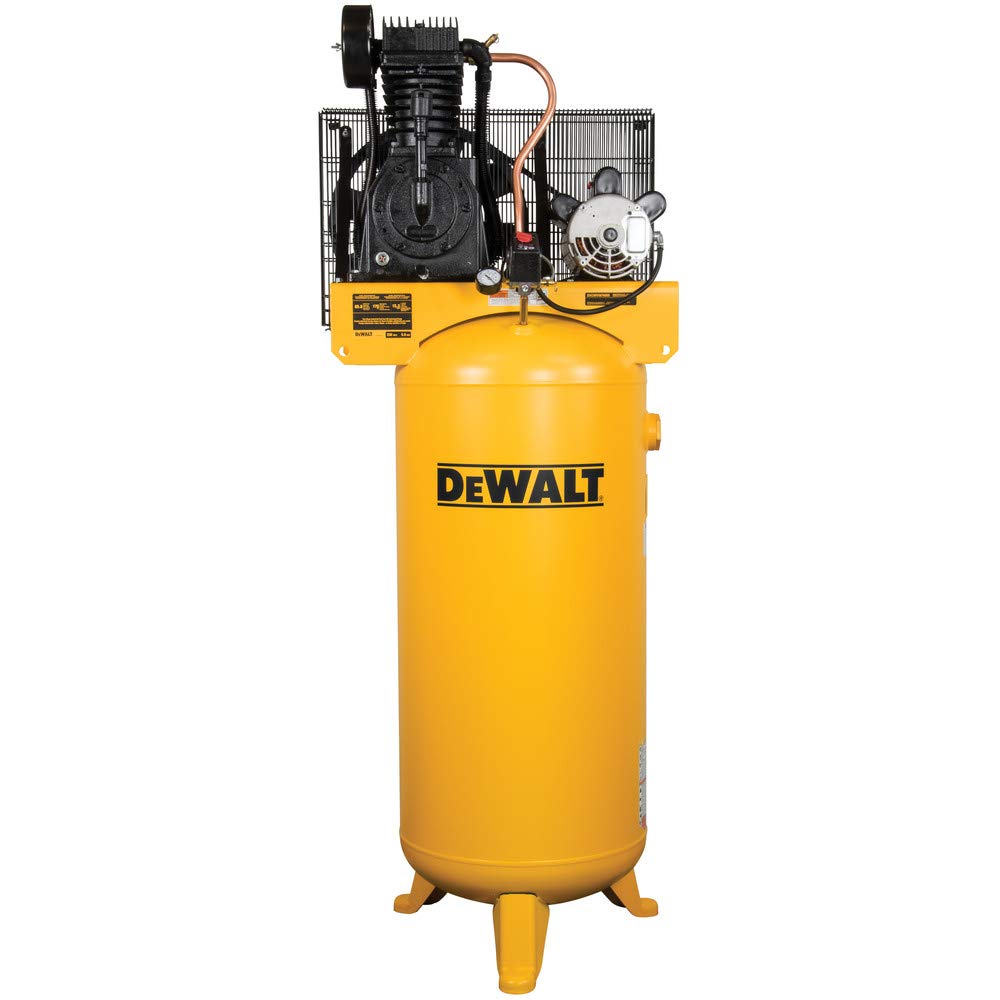
A 5 HP two-stage that hums at just 65 dB while holding pressure for days — the workshop-friendly DEWALT.
This DEWALT is the pick for the home shop that doubles as a living-adjacent space, because its 65 dB rating makes it one of the quieter large compressors you can buy. It pairs that quiet with real muscle: 13.5 SCFM at 175 PSI and 15.3 SCFM at 100 PSI from a 5 HP, 230-volt motor with thermal overload protection. It is also the tallest of the group at 40″L x 31″W x 80″H, so plan for headroom.
Owners mention the airflow builds confidence fast — one notes it reaches 170 psig quickly — and the build quality is the most-praised feature. The stand-out real-world detail: “After 7 days with off still has pressure,” meaning the tank and check valve hold air so well you can leave it charged between weekends. The motor keeps up with continuous tools, and the 2-stage pump is designed for longevity.
The trade-off is quality control at the factory. One owner received a unit with a hole in a welded seam, and others note the wiring instructions are sparse, which is a frustration when you are already paying for an electrician. It is the most expensive 60-gallon here, so you are paying for the DEWALT name and the quiet — and hoping your unit ships with good welds. For most tradesmen and serious home users, the combination of quiet and leak-free holding makes it worth the premium.
The reason to buy: 65 dB noise plus 5 HP power is a rare pairing, and the pressure-holding tank is a genuine daily convenience.
The thing to check: inspect the tank welds on delivery and be ready for minimal wiring documentation.
4. Ingersoll Rand 2340L5-V Type 30 Two-Stage

The Type 30 legend — a cast-iron pump rated for 100% continuous duty that shrugs off a full workday.
This is the compressor for the guy who actually runs a shop out of his garage, because its cast-iron pump is built for 100% continuous operation without blinking. It delivers up to 14.3 CFM at 90 PSI with a 175 PSI ceiling, from a 5 HP motor on 230 volts single phase. The Type 30 design — individually cast cylinders, an overhung crankshaft, and a one-piece connecting rod — is the same architecture pro shops have trusted for decades, and it shows in the 430-pound weight.
Owners consistently call the performance phenomenal and note it is remarkably quiet for a 5 HP unit, with one saying it “exceeded expectations” versus industry-standard equipment. The freight experience is a bright spot here too — the unit arrives well-packaged on a pallet, and the delivery crew often brings it right into the garage. Compared to the lighter 255-pound Campbell Hausfeld, this is a far more massive, more industrial machine.
The catch is assembly-quality checks. One owner found pump bolts not even started and a stripped drain plug, which is frustrating on a premium unit. Also, at 24″L x 33″W x 69″H it is compact footprint-wise but heavy, and the 1-year warranty is shorter than the Campbell Hausfeld’s 3-year coverage. For the serious DIYer who values the reputation and continuous-duty rating, this is the trust pick — just budget time to check every bolt before first start.
The pro side
- Rated for 100% continuous duty
- Quiet for 5 HP power
- Industrial cast-iron pump design
The check-it side
- Inspect bolts and drain plug on arrival
- 1-year warranty is on the shorter side
Best suited to: the home shop running daily continuous tools where downtime is not an option.
Reconsider if: you want a longer factory warranty or prefer a lighter unit that is easy to move.
5. Ingersoll Rand 2475N7.5 7.5 HP Two-Stage

The endgame compressor — 24.3 cfm and an 80-gallon tank built for a full shop that never runs dry.
This is the compressor for the hobbyist who has outgrown “hobby,” because 24.3 CFM at 90 PSI with an 80-gallon ASME tank means a medium-sized shop genuinely never runs out of air. Its 7.5 hp motor runs on 230 volts, and the cast-iron pump is rated for over 15,000 hours of use — a lifespan measured in decades of weekend work. At 611 pounds, it is the heaviest unit here by a wide margin, dwarfing the 280-pound Maxair and the 430-pound Ingersoll Rand 2340L5-V.
Owners describe it as “more substantial than I actually need” yet love that the worry of running out of air simply disappears. The All-Season Select synthetic lubricant stretches service intervals to 2,000 hours — four times longer than petroleum-based oil — which means fewer maintenance days and more working days. It delivers up to 175 psig, and the automatic shut-off keeps things efficient.
The honest truth is the price: this is the most expensive pick here, reserved for those who genuinely need continuous high-volume air. Some owners note the synthetic oil itself is pricey to replace. The 80-gallon tank also demands more floor and ceiling space at 38″L x 24″W x 70″H, though the footprint is actually narrower than the DEWALT. If you run a real shop, this is the final answer; if you just fix your own car on weekends, it is overkill.
The verdict: the 24.3 cfm and 80-gallon tank make this the only true “never think about air again” choice in the group.
The honest note: it is a professional-grade investment with professional-grade oil costs — best for the busiest garages.
Understanding the Specs
CFM and PSI — the air duo
CFM (cubic feet per minute) is the volume of air delivered, and PSI (pounds per square inch) is the pressure behind it. A two-stage compressor delivers both at higher levels than a single-stage, which is why it can run sanders and sandblasters continuously. Always match both numbers to your biggest tool’s requirements — a tool rated for 15 CFM at 90 PSI needs a compressor that meets that at the same pressure.
Tank size and duty cycle
The tank’s gallon rating is your air reservoir — bigger means longer runtime before the motor kicks in and less frequent cycling, which keeps the pump cooler and lasts longer. “Duty cycle” describes how long a pump can run continuously; a 100% continuous-duty rating, like the Ingersoll Rand units have, means it can run all day without overheating. For a home garage, 60 gallons suits most work; 80 gallons is for the heaviest continuous jobs.
FAQ
Will a 2-stage compressor run on a standard home outlet?
How much CFM do I need for a home garage?
What is the difference between a 60-gallon and 80-gallon tank?
How long does a two-stage compressor last?
Do I need to bolt these compressors to the floor?
Is 175 PSI better than 170 PSI?
What does “100% continuous duty” mean?
Can I use a 2-stage compressor for spray painting?
How much noise do these compressors make?
Final Thoughts: The Verdict
For the majority of shoppers, the 2 stage air compressor for home garage winner is the Campbell Hausfeld 60 Gallon because it pairs proven two-stage performance with the most balanced value for weekend work. If your tools demand serious airflow for painting or plasma, the Maxair moves 18.5 cfm versus the Campbell Hausfeld’s 7.6 cfm. And for the busiest garage that never wants to run out of air, the Ingersoll Rand 2475N7.5 with its 80-gallon tank and 24.3 cfm is the endgame choice.
How We Picked
We do not accept paid placement. Every pick is matched to a real buyer and a real use-case; we do not hands-on test units.
Sources & Methodology
Specifications: manufacturer listings and product documentation. Review insights: verified customer reviews, as of August 2026. Pricing: not shown on this page (it changes often); check the current price via the retailer link.
As an Amazon Associate, FitlyFast earns from qualifying purchases. This does not affect which products we feature.