
Our readers keep the lights on and the weekend projects moving. As an Amazon Associate, I earn from qualifying purchases.
The difference between a frustrating power outage and a seamless backup plan often comes down to voltage. Standard portable generators deliver 120V, which limits what you can run — your well pump, central AC, electric dryer, or EV charger all require 240V to operate. A 220V generator bridges that gap, giving you the flexibility to power heavy-duty appliances and whole-house loads without stepping up to a massive, permanently installed standby unit.
I’m Rikta — the co-founder and writer behind FitlyFast. I’ve spent countless hours analyzing inverter technology, dual-fuel systems, and real-world wattage requirements to identify which 220V-capable generators deliver genuine value for home backup, RV life, and job-site work.
Whether you need to keep your refrigerator running during a storm, power a 50-amp RV, or run a 240V well pump off-grid, this guide breaks down the best options on the market to help you find the right best 220v generator for your specific setup.
How To Choose The Best 220V Generator
Selecting a 220V generator involves more than just looking at peak wattage. You need to match the generator’s output to your home’s electrical panel, fuel availability, and the specific appliances you plan to run. Focus on the voltage configuration — a true 240V outlet (like a NEMA 14-50R or L14-30R) is non-negotiable for powering well pumps, central air conditioners, or an electric range.
Dual Fuel vs. Single Fuel
A dual-fuel generator can run on both gasoline and propane, offering operational flexibility. Propane stores indefinitely, burns cleaner, and extends engine life, but provides slightly less peak wattage (usually 10-15% less than gasoline). If you live in an area prone to long outages, dual fuel gives you a backup fuel source when gasoline becomes scarce.
Inverter vs. Conventional
Inverter generators produce clean sine-wave power with less than 3% Total Harmonic Distortion (THD), making them safe for sensitive electronics like laptops and medical devices. They also run more quietly and adjust engine speed to match load, saving fuel. Conventional generators are cheaper and heavier-duty but produce dirtier power and run at full RPM regardless of load — fine for tools and resistive loads, but risky for smart devices.
Wattage and Startup Surge
Motors in appliances like air conditioners, well pumps, and refrigerators require a surge of power to start — often 2-3 times their running wattage. A 7,000-watt running generator may need to handle 10,500 starting watts for a few seconds. Always match peak wattage to the largest startup load in your home, not just running watts.
Portability and Installation
Larger 220V generators (over 7,000 watts) typically weigh 100-200 pounds. Look for models with built-in wheels, foldable handles, or wheel kits for easier movement. Generators intended for home backup should be compatible with a transfer switch or interlock kit for safe connection to your breaker panel. Never backfeed through a dryer outlet — it endangers utility workers and your household.
Quick Comparison
On smaller screens, swipe sideways to see the full table.
| Model | Category | Best For | Key Spec | Amazon |
|---|---|---|---|---|
| Westinghouse iGen12000DFc | Inverter / Dual Fuel | Whole-home backup & EV charging | 12,000W peak / 9,000W running (gas) | Amazon |
| AIVOLT VS12000411 | Inverter / Dual Fuel | 50A RV & home backup (CARB compliant) | 11,250W peak / 9,000W running (gas) | Amazon |
| Pulsar 7,250W Inverter | Inverter / Dual Fuel | 240V job-site & RV power | 7,250W peak / 6,000W running (gas) | Amazon |
| PowerSmart PS5055C | Inverter / Gasoline | Transfer-switch ready whole home | 7,000W peak / 6,000W running | Amazon |
| maXpeedingrods MXR4000GT | Inverter / Dual Fuel | RV with Bluetooth remote control | 4,000W peak / 3,200W running (gas) | Amazon |
| Champion 4000-Watt Dual Fuel | Inverter / Dual Fuel | Quiet camping & emergency backup | 4,000W peak / 3,000W running | Amazon |
| ERAYAK 4500W Inverter | Inverter / Gasoline | Lightweight job-site power | 4,500W peak / 3,500W running | Amazon |
| WEN DF360iX | Inverter / Dual Fuel | Dual-fuel flexibility in a compact frame | 3,600W peak / 2,900W running (gas) | Amazon |
| WEN 56360i | Inverter / Gasoline | Ultralight RV & camping backup | 3,600W peak / 2,900W running | Amazon |
| Aceup Energy 4000W Inverter | Inverter / Gasoline | Budget-conscious RV power | 4,000W peak / 3,200W running | Amazon |
| PowerSmart 3600W Inverter | Inverter / Gasoline | Entry-level inverter for RV AC | 3,600W peak / 3,200W running | Amazon |
In‑Depth Reviews
1. Westinghouse iGen12000DFc
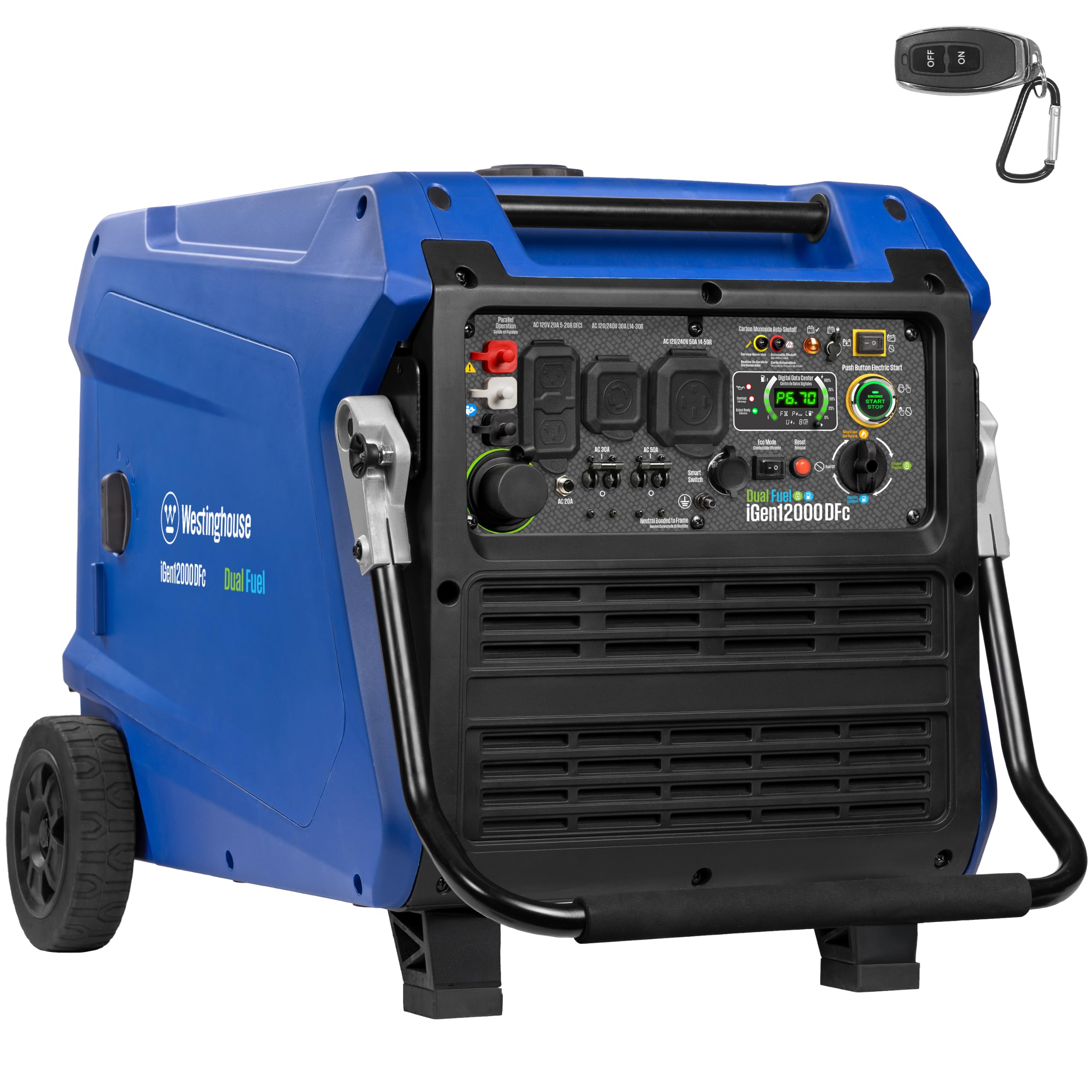
The Westinghouse iGen12000DFc is a powerhouse designed for serious home backup. With 12,000 peak watts (9,000 running) on gasoline and 11,000/8,100 on propane, it delivers enough juice to run a central heat pump, refrigerator, lights, and even charge a Tesla at 20-25 miles per hour through its 50A NEMA 14-50R outlet. The 457cc OHV engine runs up to 19 hours at 25% load on the 7.9-gallon tank, and the enclosed inverter construction keeps it quiet at just 64 dBA — quiet enough for suburban neighborhoods.
The sine-wave output with less than 3% THD protects sensitive electronics, and the Eco Mode matches engine speed to load, cutting fuel consumption significantly. The remote start key fob lets you fire it up from 50 feet away, and the digital display shows real-time fuel level, power output, and runtime. Assembly is straightforward — add oil, attach the battery, install the wheels, and you’re ready.
Some users note that the included oil is too thick for cold-weather starts below 23°F, recommending 5W-30 synthetic after the 5-hour break-in. The 187-pound weight is manageable with the built-in wheels and foldable handle, making it one of the most mobile generators in this power class. It’s the only model on this list that pairs 240V output with enough sustained wattage for heavy-draw appliances.
Why it’s great
- True 240V with 50A outlet for whole-home transfer switch
- Dual fuel (gas/propane) with long runtime on propane
- Very quiet for its size — 64 dBA at 23 feet
- Remote start and digital display for easy monitoring
Good to know
- Heavy at 187 pounds — wheels help but need stable ground
- Cold-weather starting may need thinner oil
- Propane hose connection can feel loose until fully tightened
2. AIVOLT VS12000411
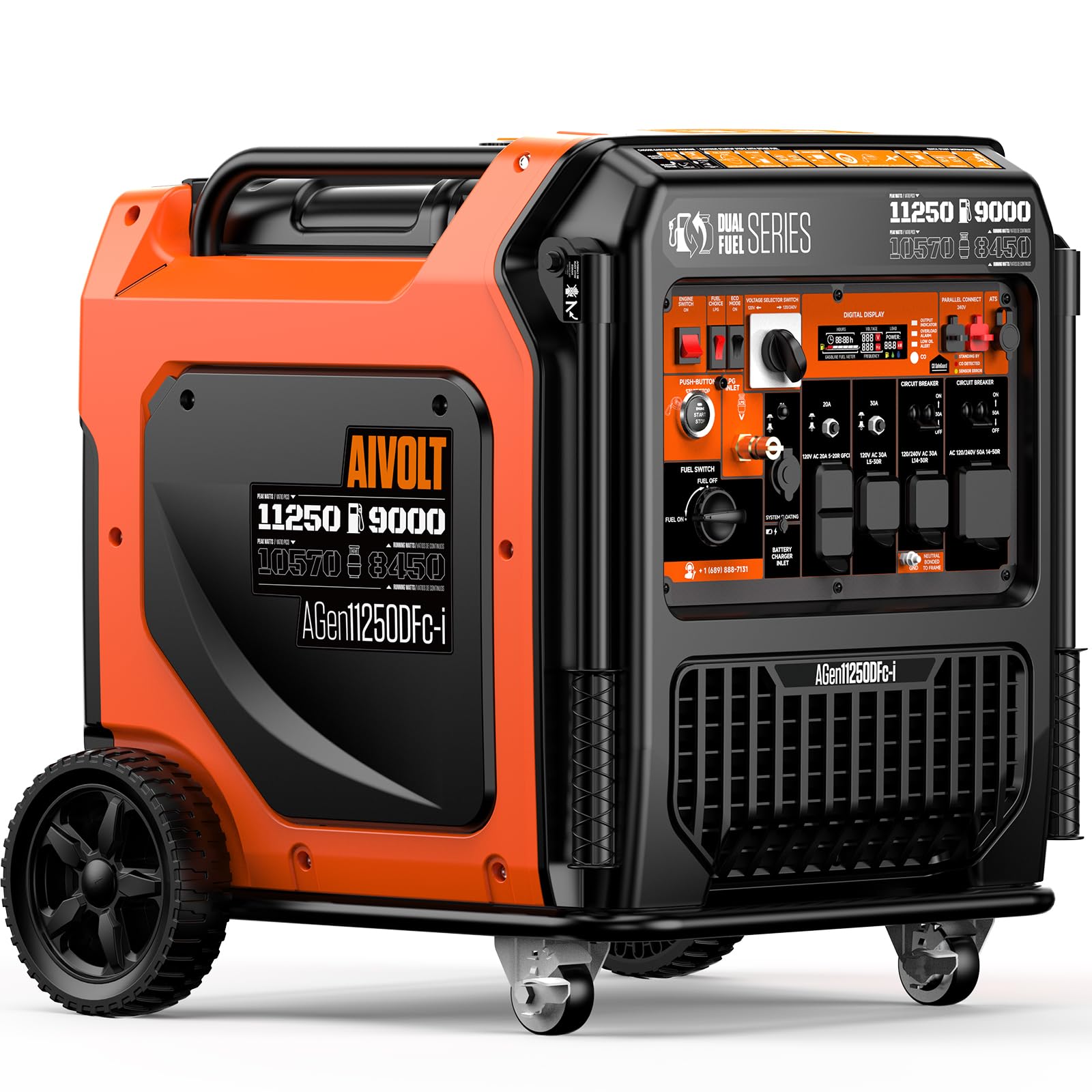
The AIVOLT VS12000411 matches the Westinghouse in peak wattage but adds CARB compliance, making it legal for sale and use in all 50 states, including California. It delivers 11,250 peak watts (9,000 running) on gasoline and 10,570/8,540 on propane. The 50A RV outlet is a standout feature for serious RVers who need to run a 50-amp coach, power a food truck, or supply a construction trailer with 240V.
The remote start, electric start, and recoil backup give you three ways to fire it up. The digital display tracks fuel level, voltage, runtime, and output, and the Eco Mode extends runtime to over 19 hours at light loads. Build quality feels premium — sturdy frame, well-organized control panel, and the propane hose connects securely. Sound levels are around 72 dBA at 5 feet, slightly louder than the Westinghouse but still conversational.
User reports highlight excellent performance powering portable AC units for hours in hot weather. The one recurring caution: after shutting it down hot, you may need to let it cool for up to an hour before restarting due to a safety interlock. Customer support is based in China, which can introduce delays for warranty claims. For buyers who need 50-state legality and 50A RV compatibility, this is the strongest contender.
Why it’s great
- 50A RV-ready outlet for high-draw recreational vehicles
- CARB compliant — legal in California and other restricted states
- Triple start options: remote, electric, and recoil
- Over 19 hours runtime at light load on propane
Good to know
- May take up to an hour to restart after hot shutdown
- Support team is based overseas; potential communication delays
- Sound level is slightly higher than premium competitors
3. Pulsar 7,250W Dual Fuel Inverter Generator

The Pulsar 7,250W inverter generator is the most affordable true 240V option in this lineup, making it a compelling choice for homeowners who need to run a transfer switch or interlock kit without paying flagship prices. On gasoline it delivers 7,250 peak watts (6,000 running), and on propane it produces 6,500/5,500. The L14-30R 30-amp twist-lock outlet provides 240V power for a subpanel or RV, and the pair of GFCI 120V outlets handle general loads.
The 312cc OHV engine runs in an enclosed frame that keeps noise in check, and the digital control center shows hours, voltage, load, and frequency. Remote start, electric start, and recoil give you full flexibility. The parallel capability lets you double your output by connecting a second Pulsar unit. Users note that the build quality is solid for the price, with the engine sharing technology with Honda designs.
A few owners experienced starter solenoid failures after a few uses — a cheap and easy fix if you’re handy, but worth noting. The unit requires 91 octane ethanol-free fuel for best longevity, and the break-in period calls for frequent oil changes. At 118 pounds, the built-in wheels help mobility but the handle could be sturdier. For a mid-range 240V-capable inverter, it beats everything cheaper on clean power output.
Why it’s great
- True 240V via L14-30R for transfer switch use
- Remote start included for convenience
- Dual fuel with propane delivering 25+ hour runtimes
- Parallel capable for future power expansion
Good to know
- Some units have weak starter solenoids
- Requires 91 octane ethanol-free fuel for best results
- Wheels and handle could be more robust for rough terrain
4. PowerSmart PS5055C 7000W Inverter
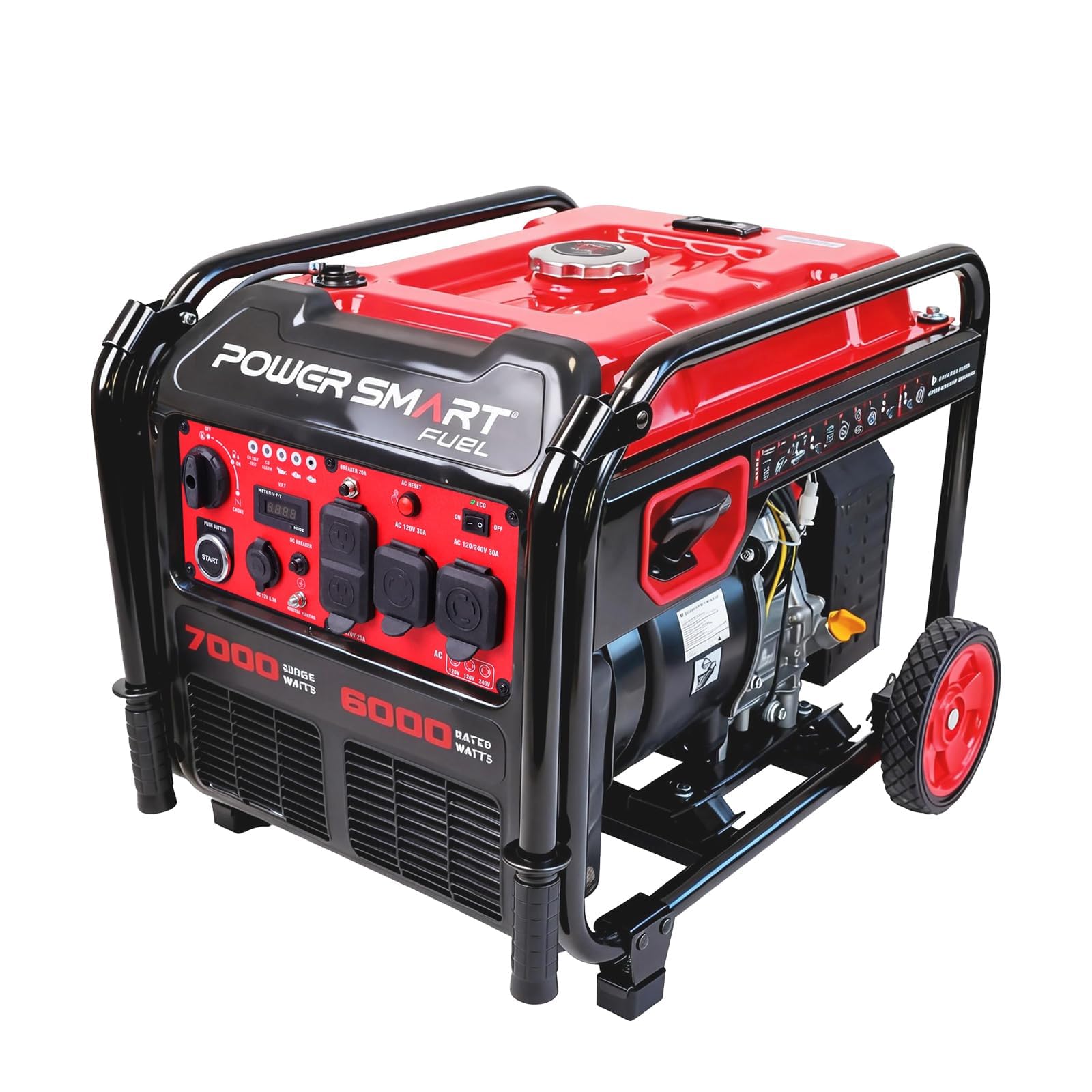
The PowerSmart PS5055C takes an open-frame inverter approach — it delivers clean sine-wave power (under 3% THD) like an enclosed inverter but uses an open frame for better airflow and engine cooling. This design choice keeps the weight at 113.5 pounds while offering 7,000 surge watts (6,000 running) and a 120/240V selector switch. The 322cc 4-stroke engine runs 6 hours at 50% load on the 3.2-gallon tank, and the electric push-button start (with recoil backup) makes startup effortless.
The 240V capability comes through L14-30R and 14-50R outlets, making it ready for a transfer switch or a 50-amp RV. The low-oil shutdown and overload protection add safety margins. Users running around 55 hours on the unit report smooth performance powering entire homes through a 30-amp inlet box (except for dedicated 240V appliances like dryers). The noise level is higher than enclosed inverters at 70 dBA, but still quieter than a conventional open-frame generator.
A small number of units have been reported to have defective control modules right out of the box. The brand’s support response varies, though Amazon’s return policy covers most cases. For buyers who need 240V inverter power and prioritize cooling efficiency and lower weight over sound damping, the PS5055C represents the best value in the 6,000-watt class.
Why it’s great
- 120/240V dual voltage with 50A RV outlet
- Open-frame design improves engine cooling and lifespan
- Electric start with recoil backup
- Under 3% THD for safe electronics use
Good to know
- Open frame is louder (70 dBA) than enclosed inverters
- Inconsistent quality control on early units
- Requires 10-minute warm-up before connecting heavy loads
5. maXpeedingrods MXR4000GT

The maXpeedingrods MXR4000GT stands out for its Bluetooth app control — a rarity in the generator world. The app lets you remotely start, stop, and monitor fuel level, voltage, frequency, and runtime from your phone. On gasoline it produces 4,000 peak watts (3,200 running), and on propane 3,600/3,000. The L5-30R RV outlet and included adapter make it a simple plug-and-play for a camper.
The 145cc engine is impressively quiet at 58-60 dBA in Eco mode — about the volume of a normal conversation. At 52.9 pounds, it’s one of the lightest dual-fuel inverters in its power range, and the compact dimensions make it easy to slide into an RV compartment. The UL 2201 and PGMA certifications add confidence in safety and build quality.
Some users have reported Bluetooth module failures and unresponsive customer service. The unit is also non-returnable through some sellers, so buying directly from Amazon is safer. Despite these risks, the core generator function is reliable: one user ran a 12,000 BTU RV air conditioner, fridge, and electronics for over 12 hours on a 20-pound propane tank. If you value remote monitoring and quiet operation, this is a strong mid-range dual-fuel choice.
Why it’s great
- Bluetooth app remote start and real-time monitoring
- Extremely quiet at 58-60 dBA in Eco mode
- Very light at 52.9 pounds for portability
- Dual fuel with propane auto-switch functionality
Good to know
- Bluetooth module failures reported; spare parts hard to get
- Rated wattage may be optimistic for continuous load
- Non-returnable from some third-party sellers
6. Champion 4000-Watt Dual Fuel Inverter

Champion’s 4,000-watt inverter is built for those who want dual-fuel flexibility in a compact, quiet package. On gasoline it produces 4,000 starting watts (3,000 running), and on propane 2,700 running watts. The TT-30R 30-amp outlet is perfect for RV use, and the duplex 120V outlets handle general needs. The 149cc engine runs up to 10 hours on gasoline and an impressive 25 hours on propane from a standard 20-pound tank.
The CO Shield carbon monoxide auto-shutoff system adds critical safety for camping or home use. The sound level of 64 dBA at 23 feet is genuinely unobtrusive — you can hold a conversation next to it. At around 53 pounds, it’s easy to carry by hand. The included propane hose and oil make it almost ready to use out of the box.
While most users love the reliability, a small batch of units have had quality issues, including two consecutive defective units in one experience. Champion’s support hours are 8 AM to 8 PM ET, which is limited compared to full 24/7 coverage. The 3-year warranty is solid, but the support period for claims can be tight. For a mid-range dual-fuel RV generator, the Champion delivers excellent fuel flexibility and quiet operation.
Why it’s great
- Up to 25 hours runtime on a 20-pound propane tank
- CO Shield auto-shutdown for safety
- 64 dBA — quietest in its power class
- 3-year warranty with free lifetime technical support
Good to know
- Occasional quality control issues reported
- Customer support limited to 8 AM – 8 PM ET
- Propane running watts (2,700) limited compared to peak gas
7. ERAYAK 4500W Inverter Generator

The ERAYAK 4500W inverter packs 4,500 peak watts (3,500 running) into a frame weighing just 55 pounds. The 208cc engine runs on gasoline and delivers clean power with THD as low as 0.2% — ideal for laptops, CPAP machines, and medical devices. The Eco Mode drops fuel consumption to just 0.21 gallons per hour at 25% load, making it one of the most fuel-efficient units in this list.
The outlet selection is versatile: one L5-30R 30-amp RV outlet, two 120V AC outlets, a 12V/5A cigarette lighter, plus USB-A and USB-C ports for phones and tablets. The unit is parallel-ready, with a kit letting you combine two units for 7,000W running and 9,000W peak with 50A support. The included TT-30R adapter and tool kit add value.
A small number of users reported unit failure after several hundred hours, including starting issues that persisted despite troubleshooting. The manufacturer offers a 3-year warranty and lifetime technical support by phone, though the defective unit experiences suggest that quality control could be tighter. For a lightweight, fuel-sipping inverter that’s genuinely easy to carry, the ERAYAK is a strong mid-range choice for camping and light home backup.
Why it’s great
- Ultra-clean power (0.2-1.2% THD) for sensitive electronics
- Extremely fuel efficient — 0.21 gal/hr at 25% load
- Lightweight at 55 pounds with compact dimensions
- 50A parallel-ready for expansion
Good to know
- A few reports of early unit failure
- Pull start can be stiff; electric start not available
- Oil level measurement is a bit awkward
8. WEN DF360iX

The WEN DF360iX is the dual-fuel version of the popular 56360i, adding propane flexibility to an already stellar lightweight platform. On gasoline it delivers 3,600 surge watts (2,900 rated), and on propane 3,500 surge (2,600 rated). The 149cc 4-stroke engine is notably quiet — comparable to a conversation — and the fuel shut-off feature maximizes engine lifespan by emptying the carburetor before shutdown.
The CO Watchdog sensor adds critical automatic shutdown protection. The outlet panel includes two 120V 5-20R receptacles, a TT-30R RV outlet, a 12V DC port, and two USB ports. At 49 pounds, it’s one of the lightest dual-fuel inverters on the market. Users report first-pull starts on both gasoline and propane, with stable idle and no surging even under half-load conditions.
A few users have noted that the 20A outlets can feel slightly loose, and the included propane regulator may arrive damaged if the box takes a hit during shipping. WEN’s customer service is responsive about replacing parts quickly. For campers and RVers who want the option to switch between gas and propane without bulk, the DF360iX is the smartest dual-fuel compact pick.
Why it’s great
- Dual fuel in a lightweight 49-pound package
- CO Watchdog auto-shutdown for safety
- Fuel shut-off prolongs carburetor life
- Very quiet conversation-level operation
Good to know
- 20A outlets can feel slightly loose on some units
- Propane regulator may arrive damaged in shipping
- Not powerful enough for large tools or 240V loads
9. WEN 56360i

The WEN 56360i sets the standard for ultralight inverter generators. At just 46 pounds, it’s the lightest generator in this review by a significant margin, yet still delivers 3,600 surge watts and 2,900 rated watts from its 149cc engine. The fully enclosed design keeps noise to a gentle purr, and the fuel shut-off feature stretches engine life by burning off residual fuel in the carburetor.
The outlet selection is generous: two 120V 5-20R receptacles, a TT-30R RV outlet, a 12V DC port, and two USB ports. Users report easy starts in cold weather (down to 14°F with 2-4 pulls), steady power for 13,000 BTU RV air conditioners, and about 5 hours runtime on a gallon of gas under load. The 48-pound dry weight is easy to lift into a truck bed or RV compartment.
It’s not powerful enough for heavy tools or whole-home 240V loads — this is strictly a 120V appliance and RV generator. The oil change interval is every 25 hours with no oil filter, which requires regular maintenance attention. For weight-conscious buyers who want inverter-clean power for camping, tailgating, or light emergency backup, the WEN 56360i remains the top choice in the ultralight category.
Why it’s great
- Incredibly light at 46 pounds for easy transport
- Inverter-clean power for sensitive electronics
- Fuel shut-off feature extends engine life
- Easy cold-start even below freezing
Good to know
- Only 120V output — not suitable for 240V appliances
- Oil changes needed every 25 hours with no filter
- Not powerful enough for large power tools
10. Aceup Energy 4000W Inverter
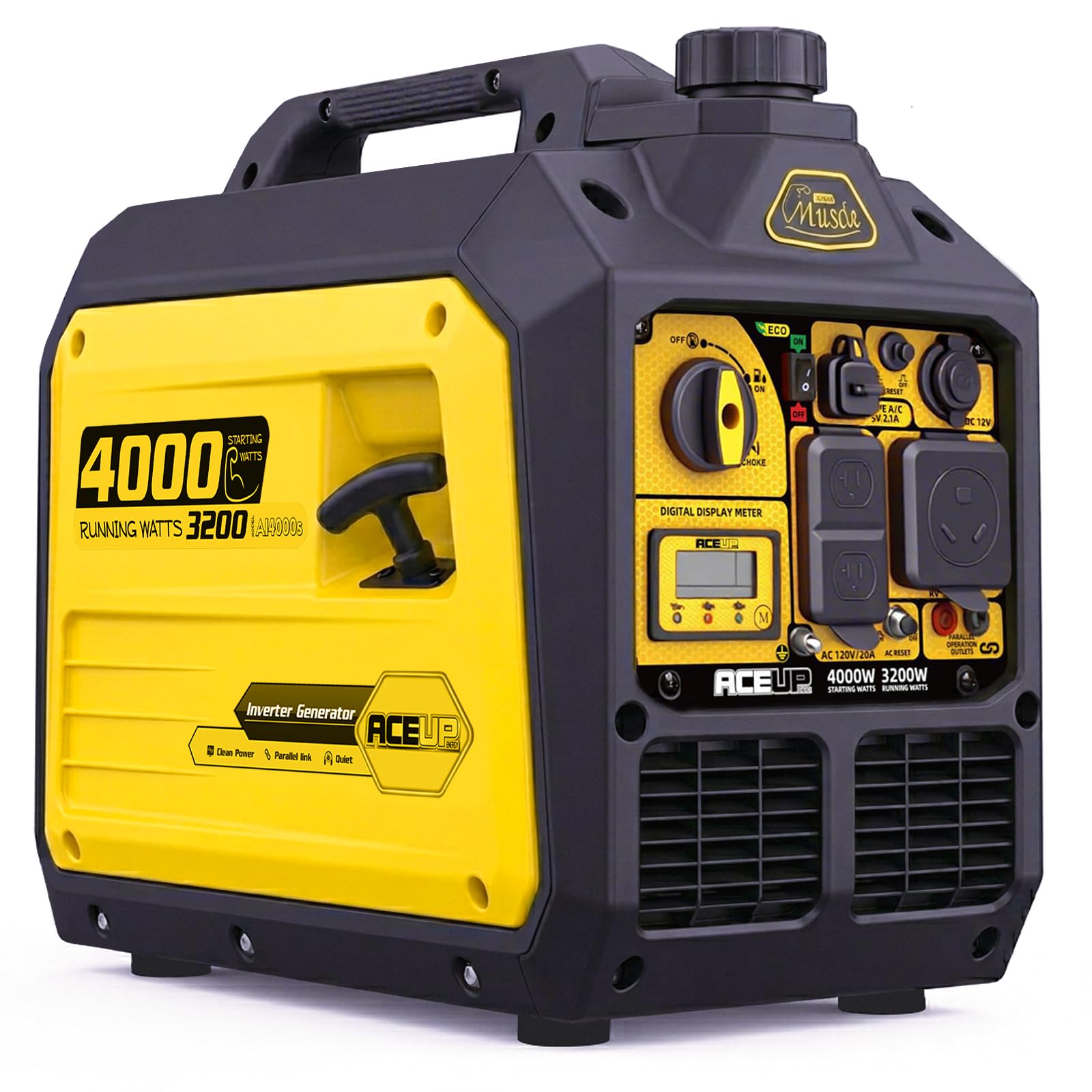
The Aceup Energy 4000W inverter generator offers a surprisingly complete feature set at an entry-level price point. The 149cc engine produces 4,000 peak watts (3,200 rated) and runs up to 5 hours at half-load on the 1.32-gallon tank. The intelligent gauge displays voltage, runtime, fuel level, hertz, and power output — data visibility usually reserved for much more expensive models.
The 5-in-1 control knob combines fuel on/off, engine on/off, and choke into a single switch, simplifying startup and shutdown. The inverter delivers under 1.5% THD for clean electronics power, and the noise level is around 60 decibels in Eco mode — quiet enough for campgrounds. At 48 pounds, it’s very portable, and the parallel-ready capability (kit sold separately) lets you double the output later.
Users report reliable starts and smooth power delivery for medium loads, including running an RV with a 15,000 BTU air conditioner and lights. The break-in period of 25 hours requires careful attention to oil changes. Some buyers wanted a bit more runtime for the tank size. For budget-focused buyers who need inverter-clean power with a useful data display, the Aceup Energy hits a sweet spot.
Why it’s great
- Intelligent gauge shows voltage, runtime, fuel, and output
- Very low THD under 1.5% for electronics safety
- Lightweight at 48 pounds with integrated handle
- 5-in-1 control knob simplifies operation
Good to know
- Only 5-hour runtime at half-load on gas
- Break-in period requires frequent oil changes
- Not as powerful as some 4000W-rated competitors
11. PowerSmart 3600W Inverter

The PowerSmart 3600W inverter is designed for those who want the quiet, clean power of an inverter generator without overspending. The 149cc 4-stroke engine produces 3,600 surge watts (3,200 rated) with less than 3% THD, meaning it’s safe for phones, laptops, and other sensitive gear. The 1.3-gallon tank delivers up to 8 hours at 25% load — enough for overnight camping or a full work shift.
The TT-30R RV outlet is ready for a camper (with an adapter for the standard twist-lock), and the parallel capability lets you link two PowerSmart units for double the wattage. At 50.7 pounds, it’s one of the more portable 3,500-watt-class inverters, with an integrated carry handle and compact footprint (21.9″ x 13.4″ x 19.5″). Users consistently praise the first-pull start and quiet operation at conversation level.
Some users have noted that the parallel kit is sold separately, and the 120V-only output means it won’t power 240V loads. The 2-year warranty is shorter than some competitors. For a first-time inverter buyer or someone who needs a reliable light-duty generator for RV AC, camping, or tailgating, the PowerSmart 3600W is the most affordable entry point into clean inverter power.
Why it’s great
- Budget-friendly entry into clean inverter power
- First-pull start and quiet operation
- Parallel capable for future power expansion
- Compact and manageable at 50.7 pounds
Good to know
- 120V only — no 240V capability
- Parallel kit is sold separately
- 2-year warranty is shorter than premium models
FAQ
Can a 220V generator power my entire house?
What’s the difference between 220V, 230V, and 240V outlets?
How do I safely connect a 220V generator to my breaker panel?
How long can a dual-fuel generator run on a 20-pound propane tank?
Is an inverter generator worth the extra cost for 220V?
Final Thoughts: The Verdict
For most users, the best 220v generator winner is the Westinghouse iGen12000DFc because it combines true 240V/50A output, dual-fuel flexibility, quiet inverter operation, and enough sustained wattage to handle whole-home backup including a heat pump, fridge, and lights. If you need a CARB-compliant unit for California or a dedicated 50A RV companion, grab the AIVOLT VS12000411. And for the best value in a 240V-capable generator, nothing beats the Pulsar 7,250W Dual Fuel — it delivers clean inverter power and true 240V support without breaking the bank.