
Our readers keep the lights on and the weekend projects moving. As an Amazon Associate, I earn from qualifying purchases.
Most portable generators deliver only 120V, leaving your well pump, larger RV air conditioner, or home backup transfer switch useless when the grid goes down. A true 240V inverter generator solves that by providing split-phase power your heavy-draw appliances actually need, all while keeping total harmonic distortion low enough for sensitive electronics.
I’m Rikta — the co-founder and writer behind FitlyFast. This guide focuses on separating the units that genuinely deliver clean, stable 240V power from those that merely claim it, based on hundreds of hours analyzing specs, customer reports, and real-world performance data.
Whether you need to power a 50-amp RV, run essential home circuits through a transfer switch, or keep a food truck operational during an event, finding the right best 240v inverter generator means matching wattage, fuel type, and noise profile to your specific load.
How To Choose The Best 240V Inverter Generator
Choosing among 240V inverter generators requires looking past the peak wattage numbers. The real decision points are fuel flexibility, startup surge capacity, and whether the unit includes the right outlets for your specific load — a standard TT-30R for RVs, an L14-30R for transfer switches, or a NEMA 14-50R for full 50-amp service.
Wattage and Surge Capacity
Running wattage tells you what the generator can sustain continuously, while peak (or surge) watts handle the momentary high draw from motor-starting appliances like air conditioners and well pumps. A 240V inverter generator should deliver at least 6000 running watts if you plan to back up an entire house; 3000–4000 running watts suffice for RV or job-site use if you manage loads carefully.
Fuel Type and Efficiency
Dual fuel models (gasoline and propane) offer operational flexibility — propane stores indefinitely and burns cleaner, while gasoline provides higher peak output. Single-fuel gasoline units are lighter and simpler but tie you to fuel that degrades over time. Eco Mode reduces engine speed at lighter loads, cutting fuel consumption and noise significantly.
Noise Level and Portability
Inverter generators are inherently quieter than conventional open-frame units, with many 240V models operating between 52 and 67 dBA — comparable to a normal conversation. Weight ranges from under 50 pounds for smaller units to over 130 pounds for high-wattage models. Look for built-in wheels, telescoping handles, and manageable dry weight if you plan to move the unit regularly.
Safety and Monitoring Features
CO shutdown sensors are now standard on most modern models, automatically stopping the engine if carbon monoxide accumulates. Low oil shutdown, overload protection, and digital displays showing voltage, frequency, runtime, and remaining fuel help you operate safely and avoid damage. Remote electric start with key fob adds convenience, especially for RV owners who want to start the generator from inside the camper.
Quick Comparison
On smaller screens, swipe sideways to see the full table.
| Model | Category | Best For | Key Spec | Amazon |
|---|---|---|---|---|
| PowerSmart 7000W | Premium | Whole-home backup | 7000W surge / 6000W running | Amazon |
| AIVOLT 11250W Dual Fuel | Heavy Duty | Full-house + 50A RV | 11250W surge / 9000W running (gas) | Amazon |
| Cummins Onan P4500I | Premium Compact | RV camping + remote start | 4500W surge / 3700W running | Amazon |
| AIVOLT 8000W Dual Fuel | Mid-Range | Home backup + job sites | 8000W surge / 6100W running | Amazon |
| Westinghouse 4021 | Mid-Range | RV + remote start | 4000W surge / 3300W running | Amazon |
| PowerSmart 4800W | Budget High-Watt | Home essentials | 4800W surge / 3800W running | Amazon |
| ERAYAK 4500W | Value | Camp + job site | 4500W peak / 3500W running | Amazon |
| WEN DF360iX | Dual Fuel | RV with propane option | 3600W surge / 2900W running (gas) | Amazon |
| Westinghouse iGen2800DFc | Compact Dual Fuel | Camping + light backup | 2800W surge / 2200W running (gas) | Amazon |
| WEN 56360i | Lightweight | Camper A/C + electronics | 3600W surge / 2900W running | Amazon |
| Champion 2500-Watt | Ultralight | Tailgating + light essentials | 2500W peak / 1850W running | Amazon |
In‑Depth Reviews
1. PowerSmart 7000-Watt Open Frame Inverter Generator
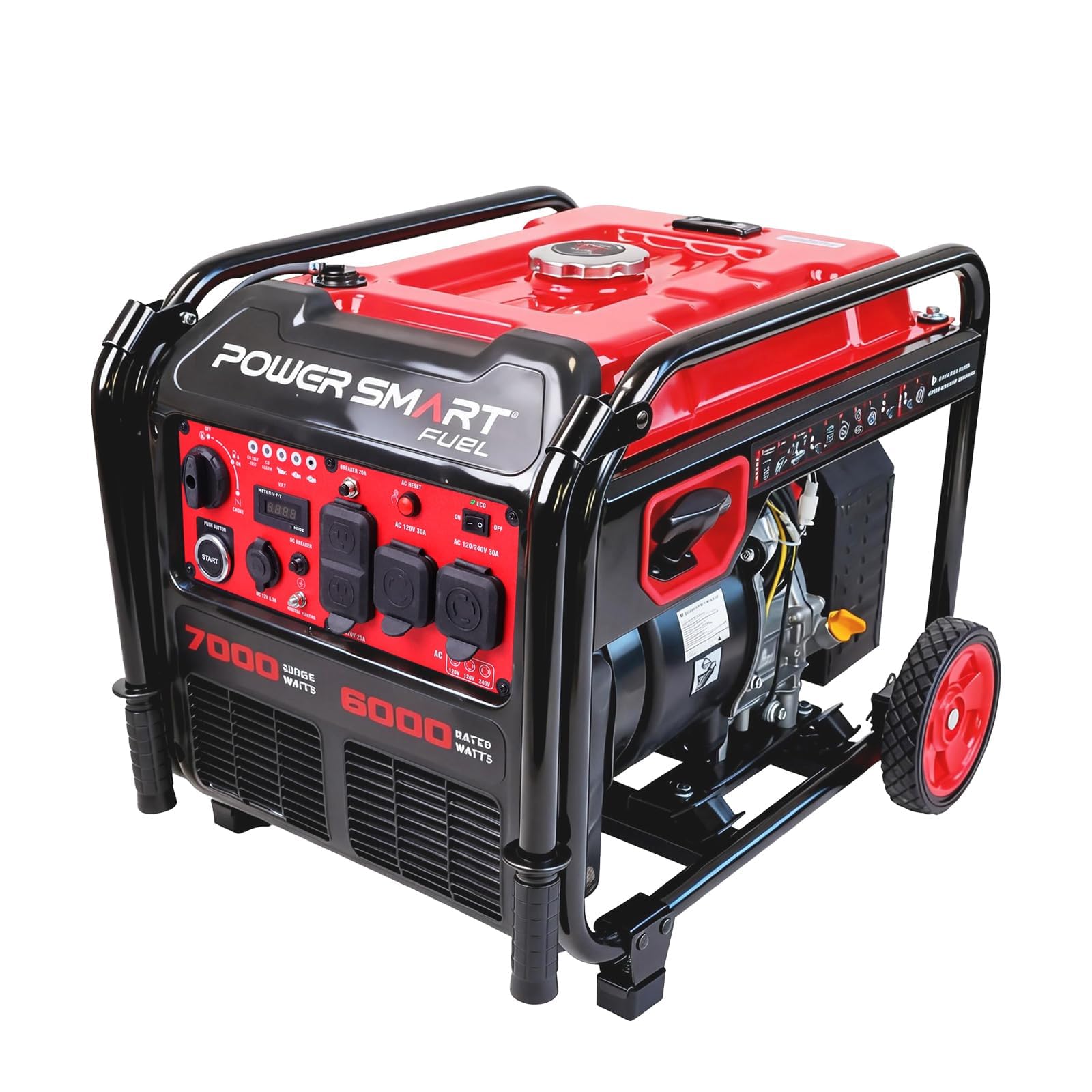
The PowerSmart 7000W sets the standard for mid-range 240V inverter generators by delivering 6000 running watts of clean sine wave power under 3% THD. Its 120V/240V selector switch makes it fully compatible with a standard household transfer switch or 50-amp RV service, and the 322cc OHV engine starts reliably via electric push-button or recoil backup.
Users report running an entire 30-amp inlet box setup — all household circuits except 240V dryers and water heaters — without issues. The open-frame design provides superior airflow for sustained heavy loads, and the 70 dBA noise level at 23 feet is neighbor-friendly for a unit in this power class. ECO mode further reduces fuel consumption and noise during lighter loads.
The main trade-off is weight: at 113.5 pounds, it is not a one-person carry unit, though the compact footprint (19″ x 19″ x 25.9″) helps with storage. Some users experienced early control module failures, but Amazon’s return policy resolved those cases. Overall, this is the most balanced 240V inverter generator for home backup without jumping to the top-tier price bracket.
Why it’s great
- True 120V/240V split-phase for transfer switches
- Electric start with backup recoil
- Clean inverter power under 3% THD
- Excellent power-to-weight ratio for its class
Good to know
- 113.5-pound weight limits single-person portability
- Some reports of early control module failure
- Gasoline only — no dual fuel option
2. AIVOLT 11250W Dual Fuel Inverter Generator
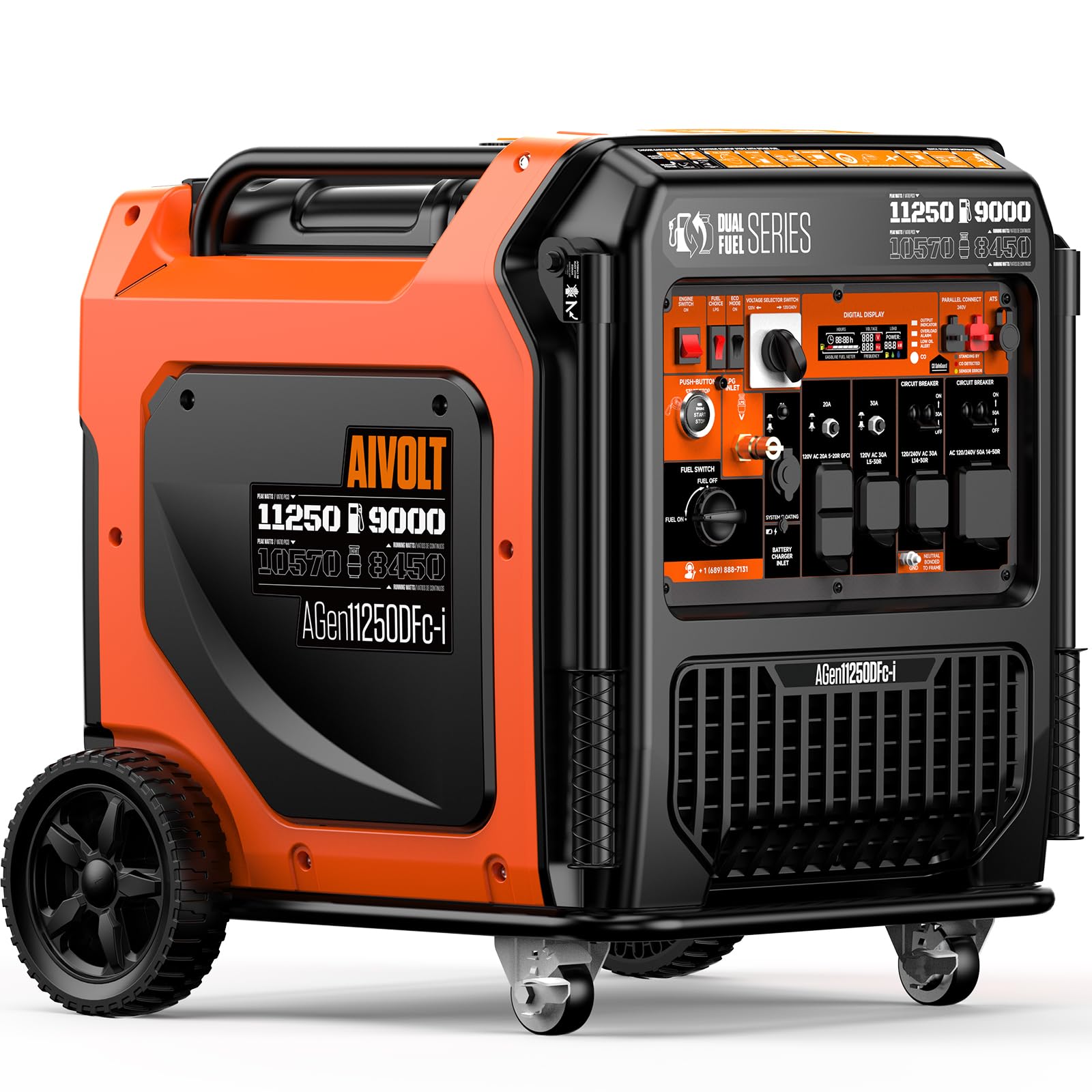
For buyers who need maximum reserve capacity, the AIVOLT 11250W offers 9000 running watts on gasoline and 8540 on propane, along with a dedicated NEMA 14-50R 50-amp outlet that powers the largest RVs and food trucks without adapters. The dual fuel system includes automatic fuel switching, letting you swap between gas and propane while the engine runs, which is invaluable during extended outages when fuel availability is uncertain.
The remote start key fob lets you fire up the generator from inside your RV or home, and the 19-hour runtime at 25% load on ECO mode means you can sleep through the night without refueling. The CO auto-shutdown sensor, low-oil protection, and overload shutoff provide multiple layers of safety. EPA and CARB compliance means it is legal to purchase and use in all 50 states, including California.
At 131 pounds and 28.4″ x 26.4″ x 29.7″, this is not a portable unit in the traditional sense — it lives on a dolly or in a truck bed. The measured noise level (72-73 dBA at 5 feet) is louder than the marketing claim, though still quieter than conventional generators of similar output. A small number of units have failed prematurely, and support is based in China, so a trustworthy retailer return policy is advised.
Why it’s great
- True 50-amp 240V outlet for RVs and transfer switches
- Dual fuel with automatic switching
- Remote electric start from inside
- 19-hour runtime on ECO mode
Good to know
- Heavy at 131 pounds — requires a dolly
- Noisier than claimed (72-73 dBA measured)
- Customer support is China-based
3. Cummins Onan P4500I Portable Inverter Generator
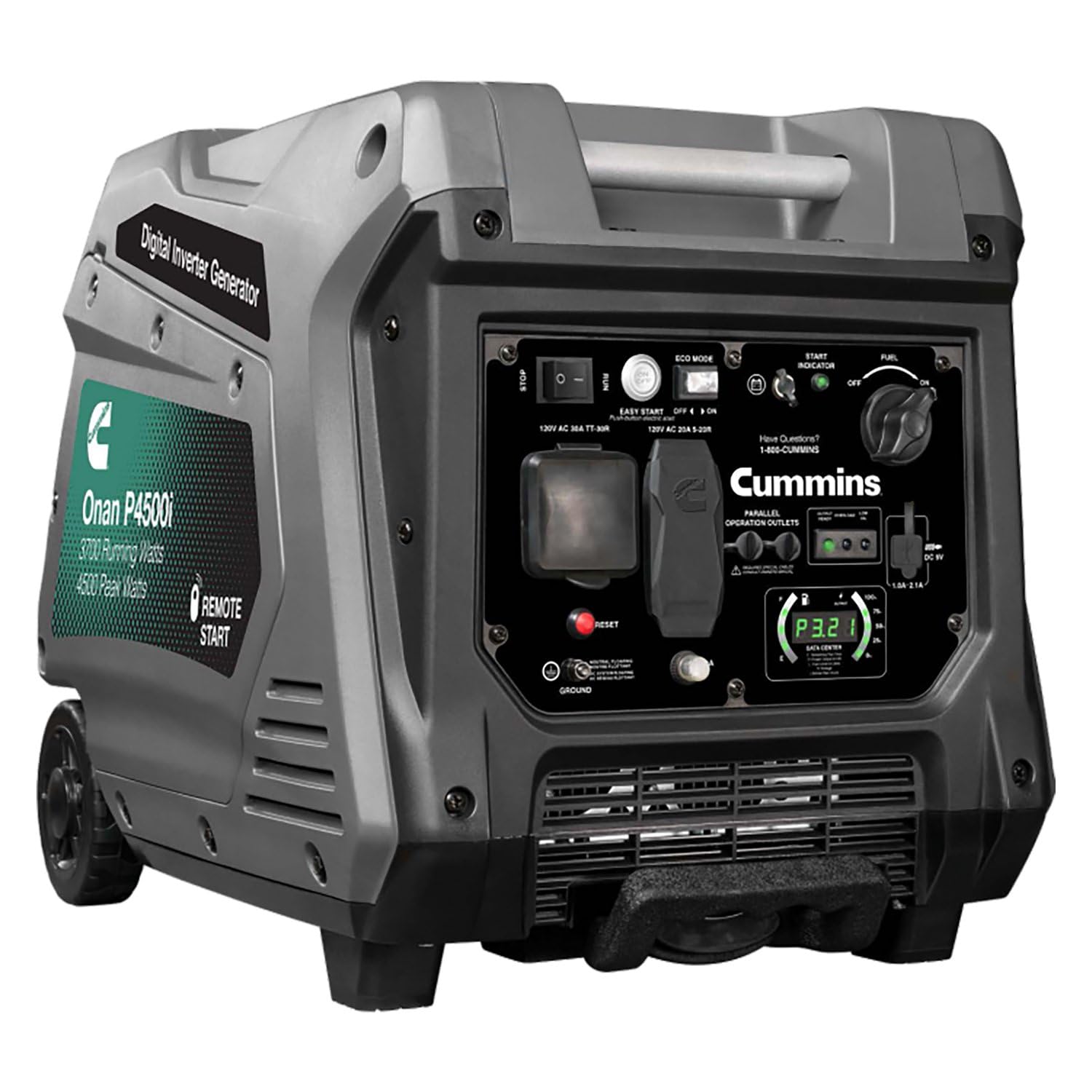
The Cummins Onan P4500I brings industrial-grade reliability to the portable inverter market. Its 7.3 HP 224cc OHV engine produces 4500 surge watts and 3700 running watts with clean sine wave output, and the remote start key fob is a standout feature for RV owners who want to start the generator from inside the camper on cold mornings without stepping outside.
The built-in TT-30R 30-amp outlet powers most RV electrical systems directly, and parallel capability with another P4500I doubles output for 50-amp service when needed. Users consistently praise its whisper-quiet operation — many report it does not disturb neighboring campsites at all. The unit started and ran flawlessly in sub-zero temperatures, which speaks to the quality of the carburetion and ignition system.
At 98 pounds, the telescoping handle and wheels make it manageable on gravel and uneven ground, but the oil drain plug is awkwardly positioned behind a body panel that does not align cleanly, making oil changes more laborious than necessary. The 50 Hz frequency output listed in some specs conflicts with the 60 Hz required for North American appliances, but verified buyers confirm it operates at 60 Hz for US use. Overall, this is the quietest premium option for serious RVers.
Why it’s great
- Remote key fob start for cold mornings
- Exceptionally quiet operation
- Proven reliability in extreme cold
- Parallel capable for power scaling
Good to know
- Oil drain plug clearance is poor
- No 240V outlet — single 120V panel
- 98 pounds without a dolly option
4. AIVOLT 8000W Dual Fuel Inverter Generator

The AIVOLT 8000W fills the gap between compact 4000W models and full-sized 11000W units by offering 6100 running watts on gasoline and dual fuel flexibility in a package that includes a 240V 30A twist-lock outlet and a 120V 50A industrial outlet. The 5-in-1 LCD display shows fuel consumption, output wattage, voltage, frequency, and runtime — making load management straightforward during extended use.
Owners running portable air conditioners in tents and RVs report 8-plus hours of runtime without refueling, and the automatic fuel-switching technology lets you switch from gasoline to propane without stopping the engine. The CO Alert system automatically shuts down the generator if dangerous carbon monoxide levels accumulate, adding a critical safety layer for enclosed camping or tailgate setups.
The main reliability concern is a small but notable pattern of units failing after a single hour of use — running rough and producing no voltage. These appear to be manufacturing defects rather than design flaws, but the support experience has been mixed, with some buyers receiving prompt replacement help and others facing delays. The 62 dBA rated noise is optimistic; actual readings at 5 feet are closer to 72-73 dBA under load.
Why it’s great
- 240V 30A twist-lock outlet included
- Dual fuel with auto-switching
- 5-in-1 LCD with real-time monitoring
- CO auto shutdown for safety
Good to know
- Known early failure rate on some units
- Customer support is China-based
- Measured noise higher than advertised
5. Westinghouse 4000 Peak Watt Inverter Generator (4021)

The Westinghouse 4021 delivers 4000 peak watts and 3300 rated watts with less than 3% THD, making it safe for laptops, phones, and CPAP machines. The remote start key fob with auto choke is its headline feature — users report starting the generator from inside their living room during a winter Texas outage without stepping outside. Electric push-button and recoil backup are also included.
The telescoping handle and 61.7-pound weight make it one of the most portable units in the 4000-watt class, and the 52 dBA noise output keeps neighbors happy at campsites and in residential areas. The TT-30R 30-amp outlet directly powers most travel trailers, and the LED data center rotates through fuel level, power output, remaining runtime, voltage, and lifetime hours — giving you full awareness at a glance.
The 1.69-gallon fuel tank limits runtime to about 7 hours at full load, and the battery may arrive drained — a quick charge resolves it. Some owners noted difficulty navigating Westinghouse’s parts and support website. The unit is gasoline only, so it lacks the flexibility of dual fuel models, but for its combination of quiet operation, remote start, and compact portability, it is a strong mid-range contender.
Why it’s great
- Remote start key fob with auto choke
- Quiet operation at 52 dBA
- Telescoping handle for easy mobility
- Clean inverter power under 3% THD
Good to know
- Small fuel tank — 7-hour max runtime
- Gasoline only; no dual fuel option
- Battery may arrive discharged
6. PowerSmart 4800W Portable Inverter Generator
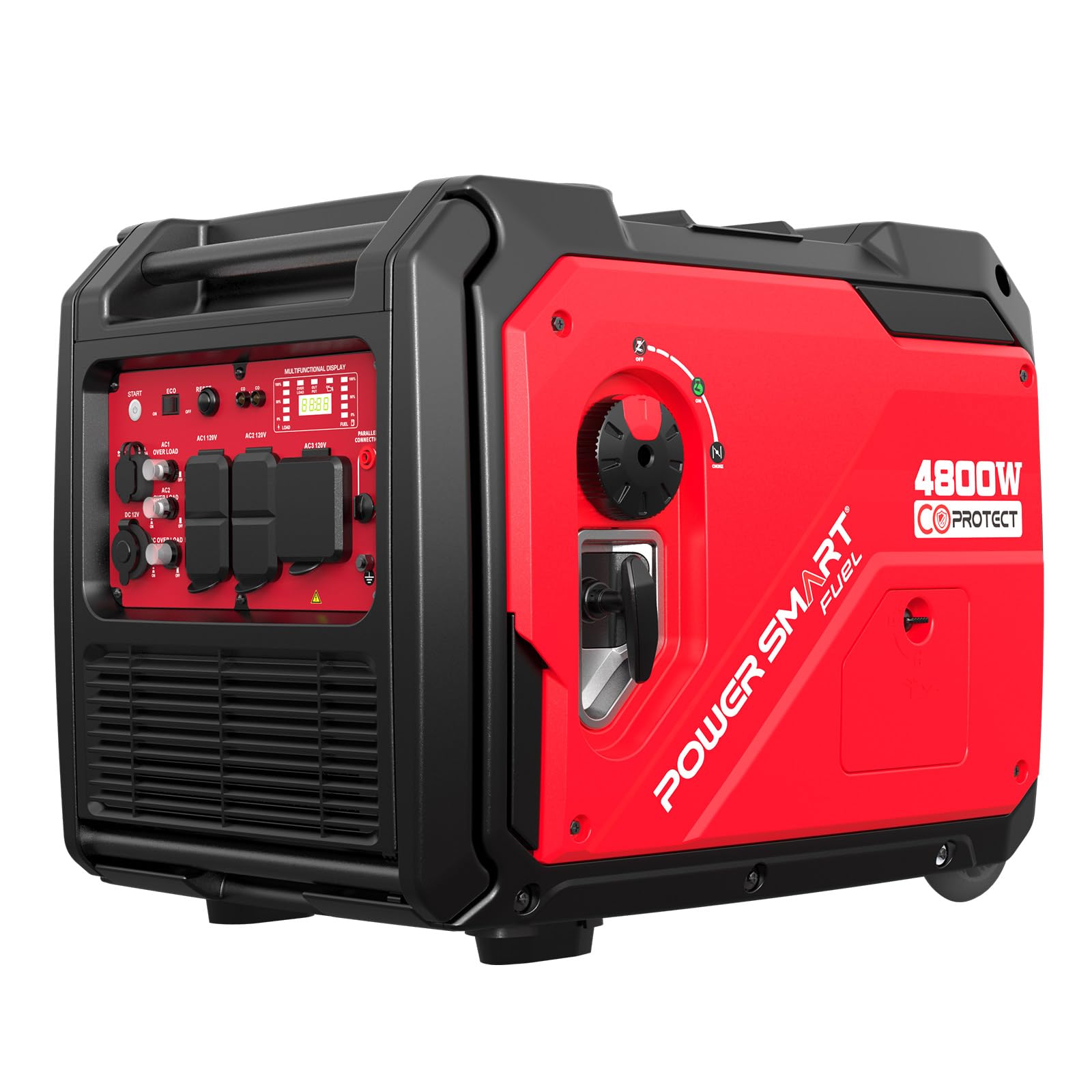
The PowerSmart 4800W delivers 4800 peak watts from a 223cc 4-stroke OHV engine, with one-touch electric start and a recoil backup. The control panel includes a TT-30R 30-amp RV outlet, two 120V household outlets, a 12V DC port, and dual USB outlets — all producing clean sine wave power safe for sensitive electronics. The integrated CO Guard automatically shuts down the engine if carbon monoxide reaches dangerous levels.
Users running reciprocating saws, angle grinders, window AC units, and full 30-amp RV setups confirm the generator handles startup surges without bogging. The 67 dBA noise rating is moderate for a 4800-watt unit, and the 3.43-gallon fuel tank delivers up to 10 hours of runtime at 50% load. Parallel capability allows linking two units for double the output, which is useful for scaling up without buying a single massive generator.
Some users reported sudden shutdowns with no power output after limited use, and no oil is included in the box — you’ll need to supply your own 10W-30. The dipstick may not be fully inserted during initial assembly, requiring careful oil level verification. At 68 pounds with built-in wheels, it is manageable for one person to roll but not carry. Overall, it offers strong value for the power output.
Why it’s great
- One-touch electric start with recoil backup
- TT-30R RV outlet included
- CO Guard auto shutdown for safety
- 10-hour runtime on a full tank
Good to know
- Some units fail unexpectedly after light use
- No oil included in the box
- Dipstick assembly requires careful initial check
7. ERAYAK 4500W Portable Inverter Generator

The ERAYAK 4500W packs 3500 running watts into a 54-pound chassis with dimensions (20″ x 11.7″ x 19.3″) that fit easily into most SUVs. The 208cc 4-stroke engine runs at just 60.5 dBA, and the inverter technology produces 0.2%–1.2% THD — among the cleanest power in this class, making it ideal for CPAP machines, laptops, and medical devices. Eco Mode dynamically adjusts engine speed to match load, reducing fuel consumption to as little as 0.21 gallons per hour at 25% load.
The outlet panel includes a TT-30R 30-amp RV outlet, two 120V household outlets, a 12V cigarette lighter port, and USB-A and USB-C ports. Parallel operation with a second 4500P unit delivers 7000W rated and 9000W peak power with 50A output. The 3-year warranty with lifetime technical support provides solid backup, and EPA compliance means it is legal to use nationwide.
The pull-start-only ignition is a drawback for those accustomed to electric start — the recoil can be stiff when new, and the initial oil fill is cumbersome because the dipstick tube design makes it difficult to access. A small number of units stopped working after around 350 hours of use despite proper maintenance. The build quality and portability are impressive for the price, making it a strong entry-level 240V-capable inverter generator.
Why it’s great
- Ultra-low THD (0.2%–1.2%) for sensitive electronics
- Very lightweight at 54 pounds
- Compact footprint fits in SUVs
- 55-amp parallel capability with 50A output
Good to know
- Pull start only — no electric start option
- Oil fill access is awkward
- Long-term reliability concerns after 350+ hours
8. WEN DF360iX Dual Fuel Inverter Generator

The WEN DF360iX is one of the lightest dual fuel inverter generators in the 3600-watt class at just 49 pounds. It runs on gasoline (3600 surge / 2900 rated watts) or propane (3500 surge / 2600 rated watts), with a tool-free LPG quick-connect that makes hookup effortless. The 149cc 4-stroke engine is quiet enough for normal conversation, and the CO Watchdog sensor automatically shuts the generator down if carbon monoxide accumulates to dangerous levels.
The outlet panel includes a TT-30R RV outlet, two 3-prong 120V receptacles, a 12V DC port, and dual USB ports. The digital display shows voltage, frequency, load percentage, runtime, and fuel level — a feature usually reserved for more expensive units. Users report reliable first-pull starts even after extended storage, and the fuel shut-off valve lets the carburetor run dry before shutdown, preventing gumming and extending engine life.
A few owners reported that both 20A outlets hold plugs loosely, which can cause intermittent power loss if the cord is jostled. The initial unit may ship with packaging damage, and one buyer received a broken propane regulator (replaced free of charge by WEN). At this price point, the combination of dual fuel, lightweight design, and digital display makes it an excellent value for RV owners who want propane flexibility.
Why it’s great
- Dual fuel with tool-free propane quick-connect
- Only 49 pounds — easy to transport
- Digital display with real-time data
- Fuel shut-off extends carburetor life
Good to know
- 120V outlets may hold plugs loosely
- Packaging can arrive damaged
- Propane output lower than gasoline
9. Westinghouse iGen2800DFc Dual Fuel Inverter Generator
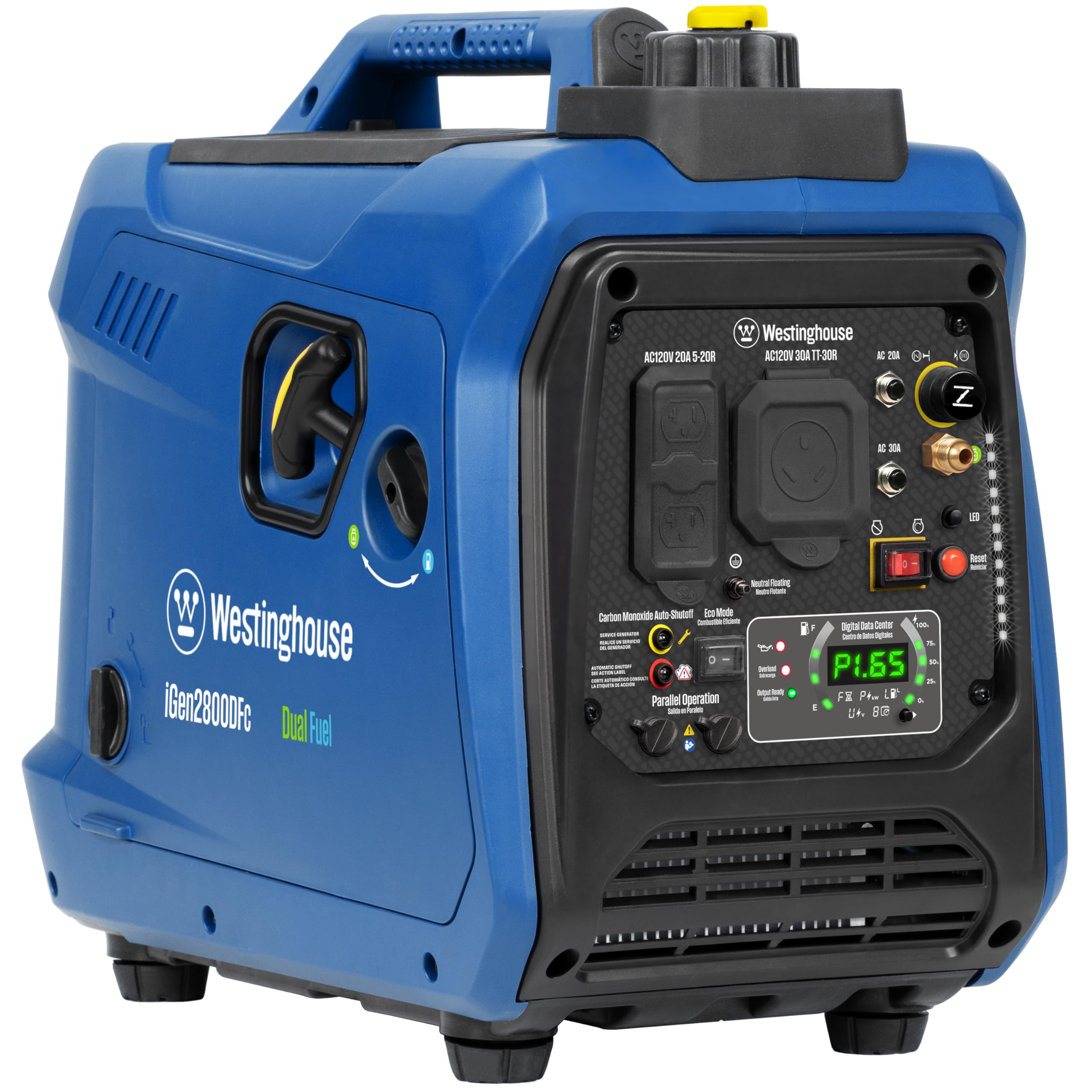
The Westinghouse iGen2800DFc delivers 2800 peak watts on gasoline and 2520 on propane in a 45-pound package that competes with the smallest dual fuel inverters on the market. The 52 dBA noise output is genuinely quiet for this class — users compare it to normal conversation — and the built-in TT-30R 30-amp RV outlet means no dongles are needed to plug into a travel trailer.
The LED panel displays fuel level and remaining run time, a feature that helps you plan refueling during long camping weekends or overnight outages. The variable-speed inverter engine with Eco Mode cuts fuel use by up to 50% compared to traditional generators, extending the 1.6-gallon tank to roughly 12 hours at 25% load. Parallel capability with compatible Westinghouse generators allows doubling output when needed.
The recoil start is reliable but requires a firm pull, and some users found metal flecks in the first oil change — normal for break-in but worth noting. The 20A standard duplex outlet is rated at 20 amps (5-20R), so you can use it with higher-draw tools than a typical 15A outlet allows. Customer support for parts and warranty issues has been inconsistent, with some buyers unable to reach a representative. Overall, it is the best ultralight dual fuel option for campers and light home backup.
Why it’s great
- Very lightweight at 45 pounds
- Ultra-quiet 52 dBA operation
- TT-30R RV outlet built in
- Dual fuel with propane for storage stability
Good to know
- Customer support response can be slow
- Metal flecks common in first oil change
- Gasoline output limited to 2200 running watts
10. WEN 3600-Watt Portable Inverter Generator (56360i)

The WEN 56360i is a gasoline-only inverter generator that punches above its 46-pound frame with 3600 surge watts and 2900 rated watts. The 149cc engine starts reliably in cold weather (reviewers report 4 pulls at 14°F) and the TT-30R RV outlet directly powers 13,000 BTU camper air conditioners without breaking a sweat. The fuel shut-off feature lets the carburetor run dry before storage, a major longevity advantage.
Users report roughly 5 hours of runtime on one gallon of gas with the A/C running in hot conditions, and the Eco Mode reduces fuel consumption significantly during lighter loads. The control panel includes two 120V household outlets, a 12V DC port, dual USB ports, and the RV outlet — covering all typical campsite needs. The three-year warranty provides standard protection, though the brand has a solid reputation for standing behind its generators.
The 46-pound dry weight makes it one of the lightest 3600-watt inverters on the market, and the 17.9″ x 11.6″ x 19.7″ dimensions slide into tight storage spaces. Some users noted the outlets are spaced closely together, which can be an issue with oversized plugs or adapters. There is no digital display — just a basic fuel gauge — so you lose the runtime tracking of pricier models. For RV owners who prioritize weight and reliable A/C power, this is a top choice.
Why it’s great
- Very light at 46 pounds
- Powers 13K BTU camper A/C reliably
- Fuel shut-off for carburetor protection
- Starts well in cold weather
Good to know
- Outlets may be too close for larger plugs
- No digital display for runtime
- Gasoline only — no propane option
11. Champion Power Equipment 2500-Watt Ultralight Inverter Generator

The Champion 2500-Watt Ultralight is the lightest inverter generator on this list at just 39.7 pounds, with 2500 starting watts and 1850 running watts. The 79cc 4-stroke engine operates at 53 dBA from 23 feet — quieter than most conversations — and produces clean power with less than 3% THD, making it safe for phones, laptops, and CPAP machines. The parallel kit lets you link it with another 2500-watt Champion unit to double your output.
Users running refrigerators, chest freezers, lamps, and small electronics report 7.5 hours on a full tank at 50% load, and the unit fires up on the first or second pull even after nine months of storage. The CO Shield auto shut-off system adds safety, but it also becomes the primary limitation: several owners report the CO sensor triggers a shutdown after as little as 15 minutes of operation outdoors, and there is no way to disable it.
The 120V duplex outlet (5-20R) and 12V automotive-style outlet cover basic needs, but there is no TT-30R or 240V outlet, so this unit is strictly for 120V loads. The 3-year warranty and lifetime technical support from Champion are solid, and the ultralight design means anyone can load it into a vehicle without strain. For tailgaters and those backing up a few home essentials, it is hard to beat the weight-to-power ratio — just be aware of the CO sensor sensitivity issue.
Why it’s great
- Industy-leading light weight at 39.7 pounds
- Very quiet at 53 dBA
- Starts easily after extended storage
- Parallel ready for power doubling
Good to know
- CO sensor may shut down unit prematurely
- No 240V outlet — 120V only
- Limited to 1850 running watts
FAQ
What is the difference between 120V and 240V inverter generators?
Can I run my RV air conditioner on a 240V inverter generator?
How does dual fuel affect performance on a 240V inverter generator?
What does the CO sensor do on a portable generator?
How do I maintain a 240V inverter generator for long-term reliability?
Final Thoughts: The Verdict
For most users, the best 240v inverter generator winner is the PowerSmart 7000W because it offers true 120V/240V split-phase output, 6000 running watts, and a reliable electric start at a mid-range price point that undercuts premium competitors while delivering genuine transfer-switch compatibility. If you want the ultimate dual fuel flexibility with 50-amp RV output and remote start, grab the AIVOLT 11250W. And for RVers who prioritize silent operation and key fob convenience in a compact, mobile package, nothing beats the Cummins Onan P4500I.