
Our readers keep the lights on and the weekend projects moving. As an Amazon Associate, I earn from qualifying purchases.
Specs are compiled from manufacturer listings and verified buyer reviews and can change over time — please confirm the key details on the product page before buying.
A lens that flickers mid-weld can ruin your bead, waste time, and strain your eyes. The right 2×4 welding lens locks into a solid, clear view of the puddle (the molten pool of metal) from arc strike to cool-down. It does this without flashing out (suddenly going clear) or eating batteries on the job. This guide compares published specs and patterns across verified customer reviews to show you which replacement lens delivers dependable auto-darkening performance for the way you weld — whether that is TIG (tungsten inert gas welding, a precise process using a non-consumable tungsten electrode) at 10 amps or heavy fluxcore (a type of welding wire that contains a flux core for shielding) on a pipeline.
I’m Rikta — the founder and writer behind FitlyFast. This guide is built by comparing the manufacturers’ published specifications and the patterns across verified customer reviews, so you get each pick’s real strengths and trade-offs instead of marketing spin.
If you are tired of swapping lenses or fighting a filter that flickers under low amps, here are the seven best options for a 2×4 welding lens ranked by real-world reliability and clarity.
Quick Picks
- ArcOne S240-10 Horizontal Single Auto-Darkening Filter — Best Overall
- ArcOne S240-9 Horizontal Single Auto-Darkening Filter — Top Contender
- Flex Series Gold Shade 5-13 Auto Darkening Welding Lens — Versatile Pick
- Tefuawe 2×4 1/4 Auto Darkening Welding Lens, Shade 10 — Low-Amp Specialist
- TrueArc Gold Auto-Darkening Welding Lens, Shade 10 — Premium Clarity
- YESWELDER Shade 8-13 2×4 Auto Darkening Welding Lens — Budget Pick
- AMERIARC Shade 10 Auto Darkening Welding Lens 2×4 — Entry Level
How To Choose The Best 2×4 Welding Lens
The right 2×4 replacement lens turns an ordinary welding hood into a precision tool. Before you buy, focus on a few specs that separate a lens you will keep for years from one you will pull out in a week.
Shade Range and Variable Control
A fixed-shade lens (like Shade 10 only) is simple and often more durable, but a variable range like 5-13 lets you move between TIG, MIG, and stick without swapping lenses. If you switch processes often, look for stepless adjustment (a smooth, continuous dial without clicks) so you can dial in the exact darkness for each pass.
Response Time and Sensor Count
The lens darkens when it detects the arc (the bright electrical spark). A switching speed of 0.5 milliseconds (500 microseconds) or faster protects your eyes from that first flash. Two independent sensors (small light detectors) give better coverage so the lens does not stay light if you weld at an angle or tuck into a corner.
Optical Clarity Rating
Ratings like 1/1/1/1 refer to the lens’s optical quality — lower numbers mean sharper view, truer color, less distortion. A high-clarity lens reduces eye strain on a full day of welding and lets you read the puddle clearly without flipping the hood up between beads.
Quick Comparison
| Model | Best For | Shade Range | Viewing Area | Weight | Amazon |
|---|---|---|---|---|---|
| ArcOne S240-10 | Premium reliability | Fixed 10 | 2 x 4.25″ (5.25 sq in) | — | Amazon |
| ArcOne S240-9 | Fixed shade quality | Fixed 9 | 2 x 4.25″ (5.25 sq in) | — | Amazon |
| Flex Series Gold | Variable shade versatility | 5 — 13 | 2 x 4.25″ | 3.84 oz | Amazon |
| Tefuawe Shade 10 | Low-amp TIG | Fixed 10 | 2 x 4.25″ | 32 g (1.13 oz) | Amazon |
| TrueArc Gold 10 | 1/1/1/1 clarity | Shade 10 | 2 x 4.25″ | 3.2 oz | Amazon |
| YESWELDER LY200J | Budget variable shade | 8 — 13 | 2 x 4.25″ | 3.52 oz | Amazon |
| AMERIARC Shade 10 | Entry-level auto-darkening | Fixed 10 | 2 x 4″ | 2.39 oz | Amazon |
In‑Depth Reviews
1. ArcOne S240-10 Horizontal Single Auto-Darkening Filter

The shop-standard auto-darkening filter that just works, day after day.
This lens has two independent sensors (small light detectors) and a clear, sharp view — one reviewer called it “like HD” after installing it in a carbon fiber pancake helmet, noting it auto-darkens instantly on arc strike and clears in about 1 second. The switching speed of 0.5 milliseconds (half a thousandth of a second) shields your eyes from the initial flash without delay, so the lens goes dark before the bright arc light hits you. The 5.25 square inches of active viewing area is generous for a 2×4 form factor (2 inches by 4.25 inches), giving you a wider view of the weld area.
Buyers report that the lens has survived three falls from 35 feet in a Huntsman hood, plus heat, cold, and light rain. It is water and dust resistant, so jobsite grit does not kill it. The dark-to-light delay of 0.2 seconds (the time it takes to go clear after the arc stops) keeps the lens dark just long enough after the arc ends — no blinding white light when you finish a bead. One owner mentioned that grinding sparks can trigger rapid on/off flickering, so you may want to switch to grind mode (a setting that locks the lens clear) before cleaning a joint.
Field-proven build: Three seasons of honest use — one reviewer noted after over a year the lens is still sharp and clear. If you want a fixed-shade 10 (dark enough for most stick and MIG welding) that you do not think about, this is it.
Single caveat: At a switching speed of 0.5 ms, it is fast but not the fastest on the list; the Flex Series Gold below reacts in 0.01 ms for quicker eye protection on low-amp starts.
Solid workhorse: This is the lens to buy if you want one that lasts past the first project — grab it for stick, MIG, and heavy TIG where fixed shade 10 is your go-to.
Think twice if: You need a variable shade range; this is fixed at 10 only.
2. ArcOne S240-9 Horizontal Single Auto-Darkening Filter
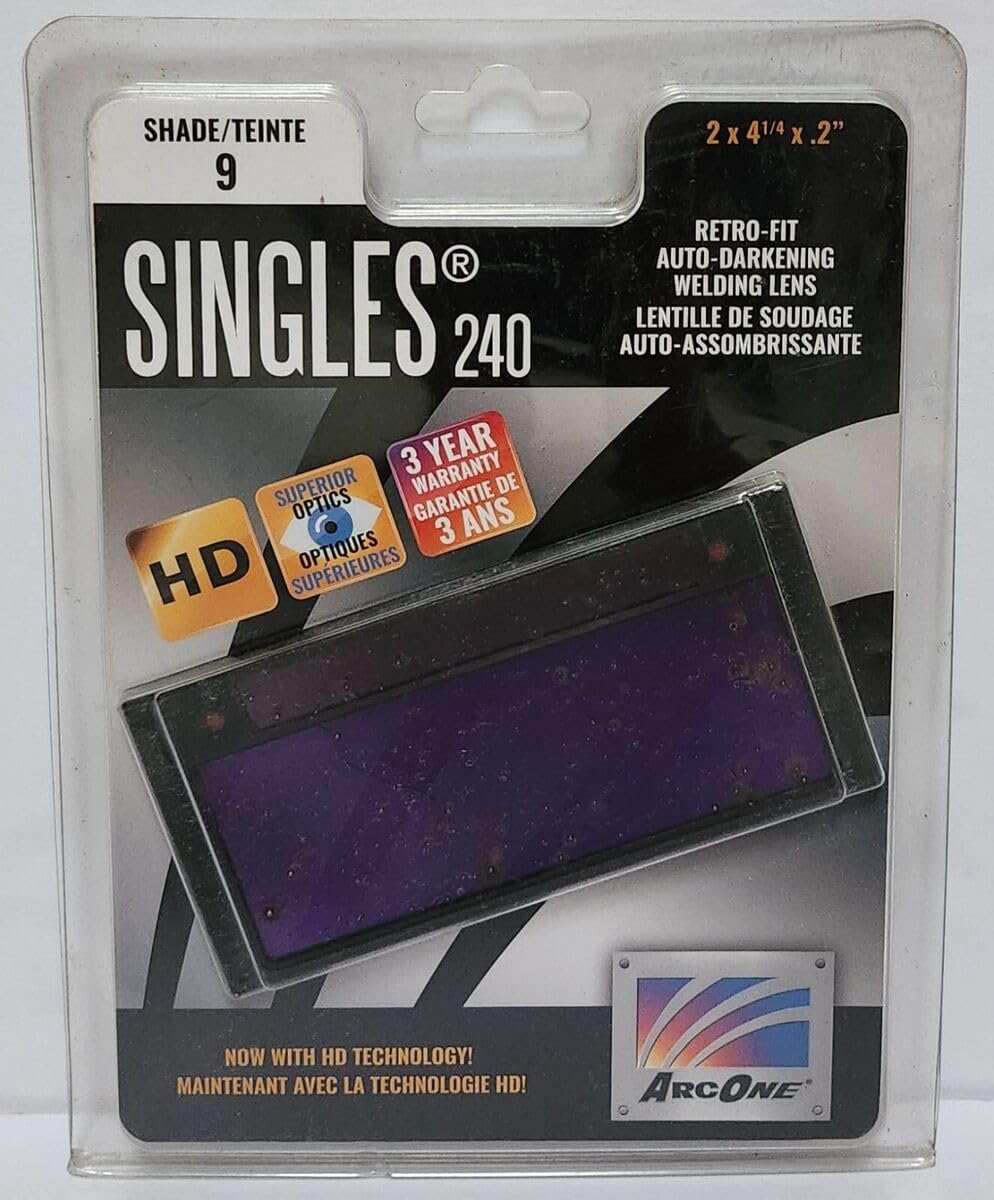
The same proven S240 chassis with a lighter shade for lower-amp work.
This is the Shade 9 version of the ArcOne S240 series, so you get the same 5.25 square inches of active area and two independent sensors as the S240-10 above. But with a lighter filter (Shade 9 instead of Shade 10), it is easier to see a low-amp TIG puddle without cranking the brightness — helpful for thin metal work where you need to watch the molten pool carefully. The switching speed of 0.5 milliseconds and dark-to-light delay of 0.2 seconds are identical, meaning the same fast eye protection and smooth recovery between welds.
Owners mention the lens offers a true-to-color view with no green, blue, or amber shading — one reviewer using it in a cutting goggle setup for tight spots said it simply works. It is built for a 2 x 4.25-inch hood opening and is multi-coated (several layers of anti-reflective coating) to cut glare. The obvious trade-off: Shade 9 may be too bright for high-amperage fluxcore, so match it to your process — if you weld thick plates at high amps, the S240-10 is a better fit.
Clear and neutral: The color fidelity means what you see through the lens is what the puddle really looks like, which helps with bead placement on thin material.
Size note: The lens dimensions are exactly 4.25 inches long by 2 inches wide, fitting pipeliner and pancake hoods without modification.
Choose this if: You run TIG on thin steel or aluminum and want a fixed shade that is crisp and color-neutral. Ideal for low-amp precision work.
Skip it for: Heavy stick or plasma cutting — go with the S240-10 or a variable-shade lens instead.
3. Flex Series Gold Shade 5-13 Auto Darkening Welding Lens
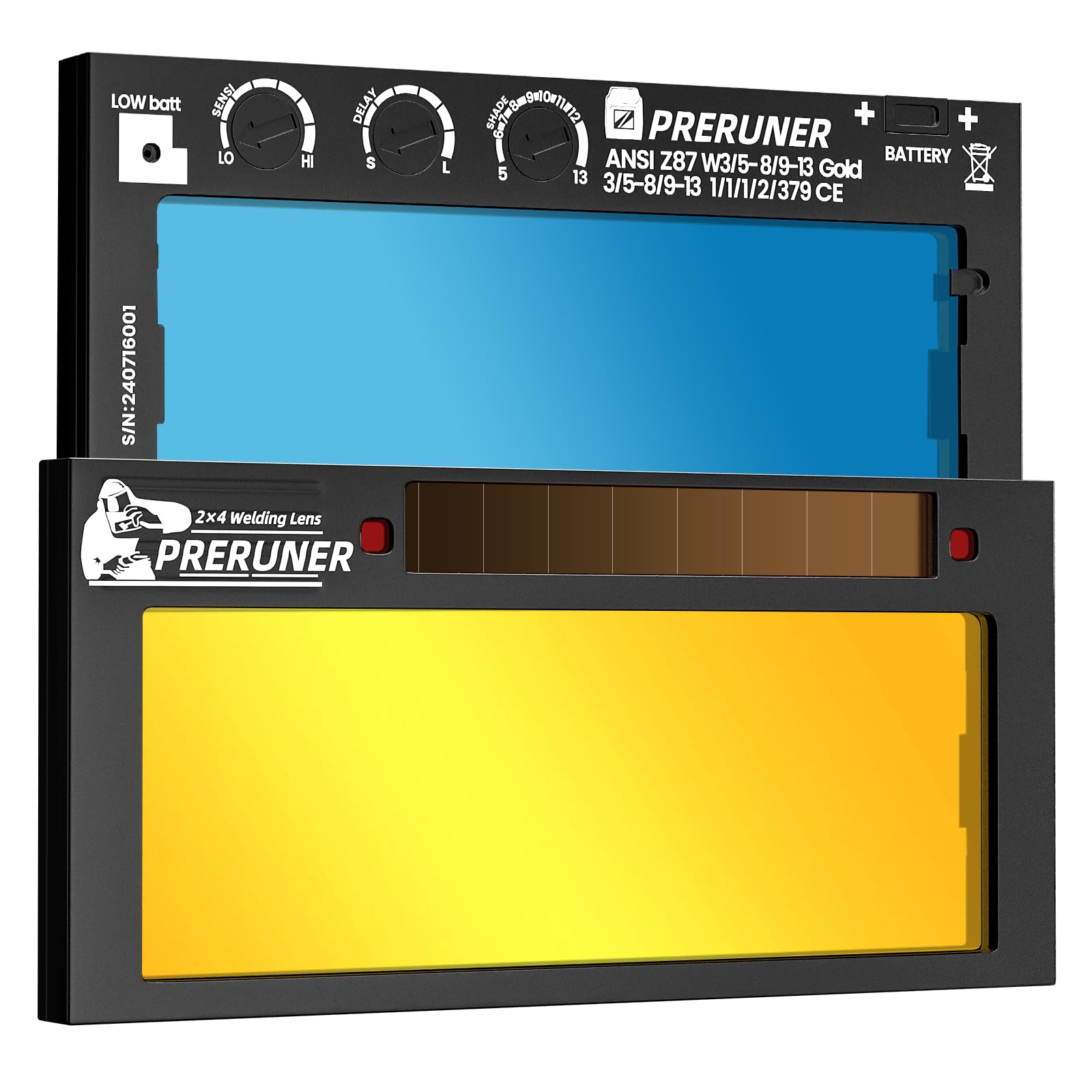
A variable-shade gold lens that covers TIG to gouging in one drop-in.
This lens adjusts from Shade 5 (light enough for plasma cutting, which uses a high-temperature jet to cut metal) to Shade 13 (dark enough for high-amp gouging, a process that removes metal with a carbon arc). So you do not swap lenses when you switch processes — you just spin the knob. The gold coating gives a signature cool blue puddle view that multiple customers note reduces eye fatigue and improves contrast compared to standard green filters. One buyer mentioned it “enhances clarity” and works for both pros and hobbyists.
Dual arc sensors trigger auto-darkening in 0.01 milliseconds (one-hundredth of a second), while the ArcOne is 0.5 ms — critical if you frequently start arcs in tight corners. Solar assist (a small solar panel that helps recharge the internal battery) plus a replaceable battery keep it powered. But buyers also report a real failure: one owner said it “worked for about 2 days and now starts flashing off the whole time” during TIG. Adjustable sensitivity helps, but a subset of units seem sensitive to low-amp flicker.
Widest range: At 5-13 versus the YESWELDER’s 8-13, meaning this lens handles gouging and plasma where the YESWELDER would be too dark.
Weighs in: At 3.84 ounces, it is 61% heavier than the AMERIARC at 2.39 ounces — you will notice the extra mass in a lightweight hood.
Versatility champion: If you regularly switch between TIG, MIG, stick, and plasma cutting in the same day, the range and speed here justify the upgrade.
Watch for: The occasional flicker issue reported on low-amp TIG — test it early and use the sensitivity dial.
4. Tefuawe 2×4 1/4 Auto Darkening Welding Lens, Shade 10

Ultrathin and super-clear — built for pipeliners who live on TIG.
At just 0.19 inches thick, this lens slips into any standard 2 x 4.25-inch hood, including tight pipeliner and pancake shells where thicker auto-darkening filters do not fit. The standout spec is the minimum amp rating of 5A for TIG — buyers confirm it handles down to 10A “no problem” in testing, with clear puddle and arc cone definition. One reviewer rated it one of the best lenses they have used, calling the view “perfect.”
The true-color optics give a light state (the lens color when no arc is present) of Shade 2.5, so the lens stays bright enough to see your setup before you strike an arc. Weighing only 32 grams (about 1.13 ounces), it is noticeably lighter than the Flex Series Gold at 3.84 ounces. The catch: the sensitivity is fixed, not adjustable. A buyer noted that below about 10A on stainless pipe, the lens “flashes on and off” and does not handle low-amp TIG well despite the 5A rating claim. For stick and high-amp TIG (50-150A), it is excellent.
Thin profile advantage: At 0.19 inches versus the AMERIARC’s unspecified but thicker housing, the Tefuawe is the only pick guaranteed to fit hoods with minimal retainer clearance.
Reviewer insight: “tested tig down to 10A handles it no problem” — but the same buyer warned not to cover the sensors with the seal.
Best for pipeliners: If you run TIG on pipe between 50-150A and want a thin, light lens that stays put, this is your pick.
Not for variable needs: Fixed shade 10 and non-adjustable sensitivity mean it is a single-task tool.
5. TrueArc Gold Auto-Darkening Welding Lens, Shade 10

A 1/1/1/1-rated gold lens that makes arc and puddle separation crisp.
TrueArc claims a flawless 1/1/1/1 optical clarity rating (the highest score possible for clarity, color, angular dependence, and homogeneity) on this gold-coated Shade 10 lens — the lowest distortion and sharpest image available in the 2×4 format. In everyday terms, that means the arc and puddle have razor-sharp edges, reducing eye strain even after a 10-hour shift. One owner reported after welding.052 fluxcore for a full shift it was a “welcome upgrade” from an ArcOne single HD lens, with coworkers impressed by the clarity.
The lens fits most 2 x 4.25-inch hoods including Pancake, Pipeliner, and Tigerhood models. It is solar-powered with batteries included. The maker notes it is not recommended for TIG welding — a buyer confirmed: “I bought this thinking I could tig welding in it and that is not true” — so treat it as a stick/MIG lens. Another owner said it stopped working after 4 days in the field and that the manufacturer charges shipping for replacements.
Sharpest optics: The 1/1/1/1 rating is the highest standard — no other lens in this list states that exact clarity grade.
Durability question: One buyer’s “4 days of work” failure is a red flag for field welders who need a lens to survive a full project.
Go for the clarity: If you are a stick or MIG welder who wants the clearest, most fatigue-free view in a fixed Shade 10, the TrueArc is the premium choice.
Avoid for TIG: The manufacturer and users both flag it — this is not a TIG lens.
6. YESWELDER Shade 8-13 2×4 Auto Darkening Welding Lens
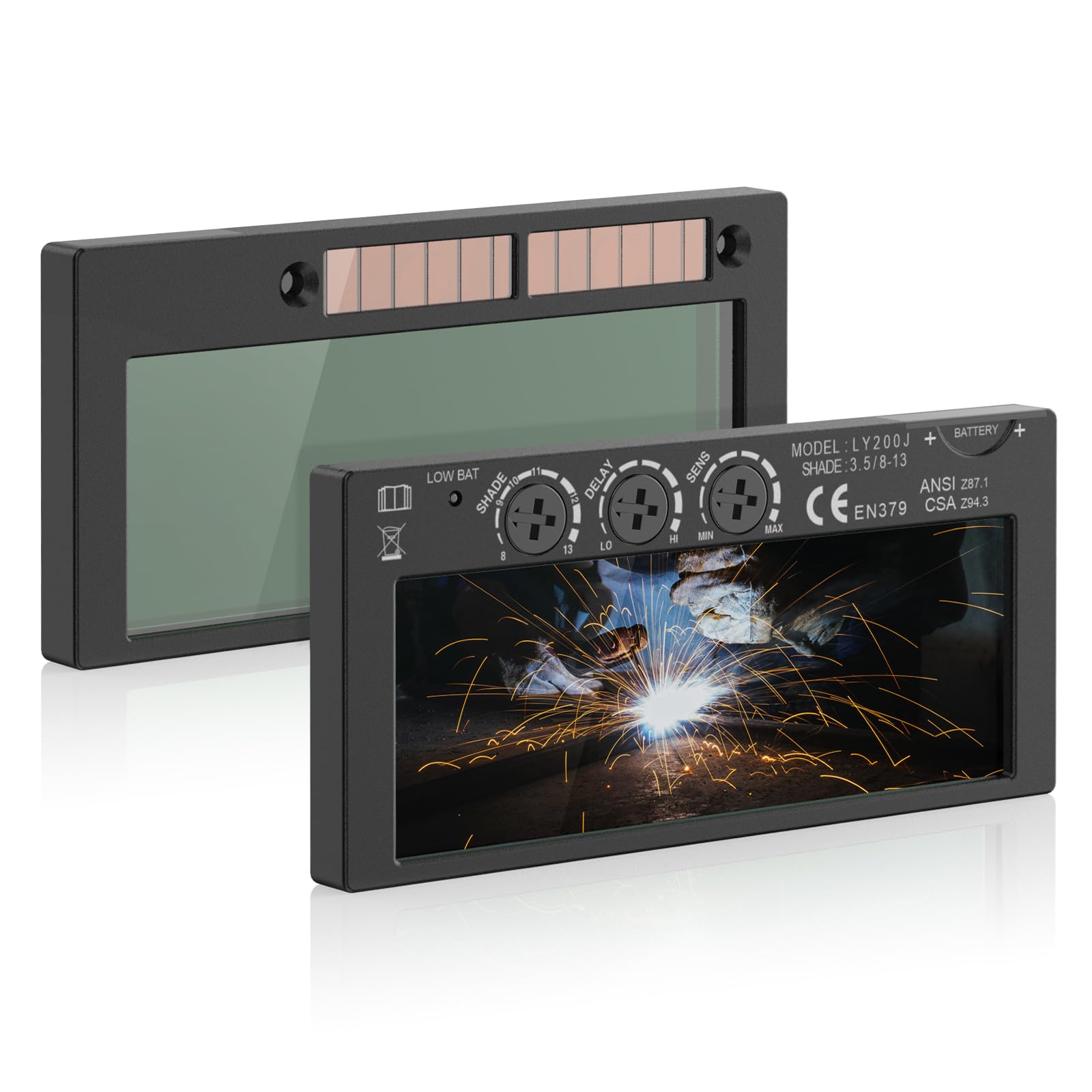
Variable shade on a budget — but keep a spare battery handy.
The YESWELDER LY200J gives you stepless adjustment (a smooth continuous dial) from Shade 8 to 13, covering MIG, stick, and most TIG work. It claims 1/1/1/1 optical clarity with a true-color blue technology filter that the brand says improves visibility compared to standard green lenses. Two premium sensors trigger auto-darkening in less than 2/10000 of a second (0.0002 seconds), so the lens goes dark before the arc flash reaches your eyes. At 3.52 ounces and dimensions of 1.77 x 5.51 x 8.27 inches, it is about 3.2x the volume of the Tefuawe.
The real concern is battery life. Multiple reviewers point out the lens “eats batteries,” especially when welding after dark when the solar panel cannot assist. One customer observed the “battery died in under a month” and dropped their rating to 1 star. The lens also has a tendency to “flicker and flash” when batteries get low, which can make it unreliable for precision work. A positive note: when the first unit failed, the manufacturer sent a replacement promptly.
Wide variable range: 8-13 covers most common processes, though it does not reach the Flex Series Gold’s Shade 5 for gouging/plasma.
Fit issue: One user highlighted it is too thick for a Fibre-Metal Tigerhood hood and required shaving the retainer (the frame that holds the lens in place) on a TOPDC hood.
Good for occasional use: If you weld a few hours a week and want variable shade without the premium price, this lens works — just stock spare lithium cells.
Not for full-time: The flickering and battery drain reported by multiple owners make it risky for daily professional use.
7. AMERIARC Shade 10 Auto Darkening Welding Lens 2×4

A no-frills fixed-shade lens that gives budget-friendly HD clarity.
The AMERIARC is a simple fixed Shade 10 auto-darkening lens with two independent sensors that detect light changes for eye protection. It is a standard 2×4 inch size, so it drops into most hoods including pancake shields, and the plastic housing with UV protection coating blocks harmful rays. At just 2.39 ounces, it is the lightest auto-darkening lens in this lineup after the 32-gram Tefuawe — good for reducing neck strain on long days.
Buyers call it a “true HD lens” that rivals pricier 2×4 auto lenses in clarity, with one owner saying they got almost 2 years out of their first unit. Another noted it works for TIG on AC (alternating current, used for aluminum welding) and DC (direct current, for steel). The catch: it is fixed at Shade 10 — no adjustment for different processes. And like several lenses on this list, durability is not guaranteed: one shopper added it “worked great for two months, then started flashing and became unusable.” No warranty information was included in the package.
Real-world clarity: One experienced reviewer rated it comparable to units costing over, calling the HD optics a genuine value.
Shade limitation: Unlike the Flex Series Gold (5-13) or YESWELDER (8-13), this is fixed at Shade 10, so you cannot brighten it for setup or darken it for high-amp gouging.
Starter lens: If you are new to welding or need a spare 2×4 lens for a backup hood, the AMERIARC offers HD-like clarity at an entry-level price.
Not a daily driver: The failure reports suggest it may not hold up to constant professional use — treat it as a budget stopgap.
Understanding the Specs
Shade Range and Variable vs Fixed
The shade number tells you how dark the lens gets when the arc strikes — higher numbers (like 13) block more light for high-amp processes like carbon arc gouging, while lower numbers (like 5) let more light through for plasma cutting or low-amp TIG. A variable-shade lens (like 5-13) lets you turn a dial to change shade for different jobs; a fixed-shade lens (like Shade 10 only) stays at that single darkness. Variable is more flexible, but fixed-shade lenses are often simpler and more durable with fewer electronics to fail.
Optical Clarity Rating (1/1/1/1)
The 1/1/1/1 rating covers four measures of optical quality: how sharp the view is (clarity), how true colors appear (color), how little the image distorts when you move your head (angular dependence), and how consistent the shade is across the whole lens (homogeneity). A 1/1/1/1 lens means the best score in every category, so the arc and puddle have crisp edges without rainbows or blur. Lower-rated lenses can look green-tinted or blurry at the edges, which strains your eyes over a full welding day.
Switching Speed (Milliseconds)
This is how fast the lens goes from clear (light state) to dark when the arc starts. A speed of 0.5 milliseconds (like the ArcOne S240) means the lens darkens in half a thousandth of a second — fast enough for typical MIG and stick work. A speed of 0.01 milliseconds (like the Flex Series Gold) versus 0.5 milliseconds (like the ArcOne S240), which helps on low-amp TIG starts where the arc can be weak and the lens might flicker if it reacts too slowly. For most home welders, anything under 1 millisecond is adequate, but faster is safer in industrial settings or around reflective surfaces.
Sensor Count and Solar Assist
An auto-darkening lens uses sensors (small light detectors, usually 2 or 4) to detect the arc’s light and trigger the darkening. Two sensors are standard and work well for head-on welding, while four sensors provide better coverage if you weld at extreme angles or around corners where a sensor might be shielded by your hand or the workpiece. Solar assist means the lens has a small solar panel on the front that helps recharge the internal battery when exposed to sunlight or welding light, extending the interval between battery swaps — useful if you weld outdoors frequently.
FAQ
Will a 2×4 welding lens fit any welding hood?
What shade number should I pick for TIG welding?
How long do auto-darkening welding lenses last?
What does 1/1/1/1 optical clarity mean for a welding lens?
Can I use an auto-darkening welding lens for plasma cutting?
Why does my auto-darkening lens flicker when I weld?
Are all 2×4 welding lenses the same size?
Can I replace batteries in my auto-darkening welding lens?
Is a single-sensor welding lens safe enough to use?
What does “light state shade 2.5” mean on a welding lens?
Final Thoughts: The Verdict
If you want one dependable pick, the 2×4 welding lens winner is the ArcOne S240-10 because it combines proven shop durability, two independent sensors, and a clear HD view that has held up for buyers over a year of daily abuse. If you want variable shade to jump between TIG and gouging without swapping lenses, grab the Flex Series Gold. And for ultralight design and low-amp TIG in a pipeliner hood, the Tefuawe Shade 10 delivers the thinnest profile and best value for fixed-shade users.
How We Picked
We do not accept paid placement. Every pick is matched to a real buyer and a real use-case; we do not hands-on test units.
Sources & Methodology
Specifications: manufacturer listings and product documentation. Review insights: verified customer reviews, as of July 2026. Pricing: not shown on this page (it changes often); check the current price via the retailer link.
As an Amazon Associate, FitlyFast earns from qualifying purchases. This does not affect which products we feature.