
Our readers keep the lights on and the weekend projects moving. As an Amazon Associate, I earn from qualifying purchases.
Specs are compiled from manufacturer listings and verified buyer reviews and can change over time — please confirm the key details on the product page before buying.
A scratchy, distant, muffled recording is the fastest way to lose your audience, whether you’re filming a YouTube tutorial, hosting a podcast, or jumping on a Zoom call. The fix is often a small clip-on microphone that puts the sound source inches from your mouth — but not all 3.5mm lavaliers deliver the same clean audio. Some let in background hum, others sound tinny, and a few quietly drop out mid-sentence. This guide breaks down the real-world differences between the most popular wired lapel mics so you know exactly which one matches your gear and your recording style.
I’m Rikta — the founder and writer behind FitlyFast. This guide is built by comparing the manufacturers’ published specifications and the patterns across verified customer reviews, so you get each pick’s real strengths and trade-offs instead of marketing spin.
We matched seven of the strongest contenders for the title of best 3.5 mm microphone, comparing audible noise floors, frequency response, and compatibility so you can pick a lapel mic that makes your voice sound natural and clear on camera.
Quick Picks
- RØDE Lavalier II — Best Overall
- Shure MVL Lavalier Microphone — Premium Pick
- Sony Compact Stereo Lavalier Microphone ECMLV1 — Value Pick
- DJI Lavalier Microphone — For DJI Systems
- Rode Lavalier GO — Broadcast Standard
- PowerDeWise Professional Grade Lavalier — Phone-Ready Bundle
- NEEWER CM10 — Entry-Level Kit
How To Choose The Best 3.5 Mm Microphone
A 3.5mm lapel microphone is a simple piece of gear, but a few key specs separate a clear recording from a noisy one. Focus on these three things first.
Audible Noise Floor (Self-Noise)
This number tells you how much internal hiss the microphone adds to your voice. It is measured in decibels (dB). A lower number (like 30 dB) means a quieter signal and cleaner background — perfect for quiet indoor interviews. A higher number (like 74 dB) means you may hear a soft electronic hum when no one is speaking. For dialogue-heavy work, aim for the quietest self-noise you can find within your budget.
Frequency Response
This is the range of sound frequencies the mic can capture, measured in hertz (Hz). A wider range — for example, 20 Hz to 20,000 Hz — covers deep bass and high treble. You don’t need the full 20 kHz for spoken word, but a mic that cuts off too early (like at 16,000 Hz) may make your voice sound slightly muffled compared to one that goes wider. A flat, honest response is your goal.
Connector Type and Compatibility
Most 3.5mm lavaliers use a TRRS (Tip-Ring-Ring-Sleeve) connector that carries both audio and a mono microphone signal — standard for smartphones. Many cameras and audio recorders use a TRS (Tip-Ring-Sleeve) plug that carries stereo audio only. The best bundles include an adapter to switch between them, so you can move from an iPhone to a DSLR without buying a second mic.
Quick Comparison
| Model | Best For | Self-Noise | Frequency Range | Weight | Amazon |
|---|---|---|---|---|---|
| RØDE Lavalier II | Broadcast & pro wireless systems | 38 dB | — | 13 Grams | Amazon |
| Shure MVL | Phones, tablets & RF-heavy environments | 65 dB | — | 0.06 Kilograms | Amazon |
| Rode Lavalier GO | Filmmaking & broadcast | 67 dB | 20Hz – 20kHz | — | Amazon |
| Sony ECMLV1 | Stereo recording on a budget | 30 dB | — | — | Amazon |
| DJI Lavalier | DJI Mic 2 wireless system users | 74 dB | 20 Hz – 20 kHz | — | Amazon |
| PowerDeWise Pro Grade | Phone-first creators on a budget | 74 dB | 20 Hz – 20 kHz | — | Amazon |
| NEEWER CM10 | Entry-level kit with monitoring | — | — | 2.12 Ounces | Amazon |
In‑Depth Reviews
1. RØDE Lavalier II

To get studio-radio sound that stays hidden from the camera, this is the mic to pick.
Your silent pauses stay truly silent with the RØDE Lavalier II. It has a self-noise floor (the faint electronic hiss the mic produces) of 38 dB, versus 74 dB for the PowerDeWise and 67 dB for the standard Rode Lavalier GO. That means no hiss creeps into your track when you stop talking, so your voice sounds clean and isolated. The capsule measures 1.2 x 0.39 x 0.2 inches and uses a flat cable that lies flat under clothing, so viewers never see it on camera.
The package includes a pop filter (for reducing plosive pops on P and B sounds), a mini furry windshield for outdoor use, colored ID rings for multi-talent shoots, and a zip case. The connector locks into compatible wireless transmitters like the Wireless GO II, so you won’t accidentally yank the cable loose during a take. Note that the data says it may not work directly with phones and cameras — you typically need a transmitter in between. It also tops out at 16,000 Hz, versus 20,000 Hz for DJI’s lavalier. For spoken word, reviewers find that difference negligible. They also report the build feels premium and the flat cable is a standout for concealment.
Broadcast-ready clarity: The lowest self-noise (38 dB) among our list means you hear pure voice, not background hiss.
System-dependent: Best paired with a wireless transmitter — not a direct plug-into-phone solution for most setups.
Reach for this if you: are a filmmaker, podcaster, or content creator who already uses a RØDE wireless system and wants studio-quality audio from a nearly invisible mic.
Look elsewhere if you: need a simple plug-and-play lav for a smartphone without buying a separate transmitter.
2. Shure MVL Lavalier Microphone

If phone interference buzz kills your takes, this metal mic is your fix.
The Shure MVL is built for the mobile creator who records on an iPhone or tablet and hates that sudden radio-frequency buzz mid-take. It features Shure’s RF/GSM interference protection (a design that blocks radio and cellular signal noise), so your phone can stay inches away with data on without that buzz appearing in the audio. That is a big practical advantage over plastic-bodied mics like the PowerDeWise or NEEWER that can pick up phone interference. The metal housing feels premium and durable.
With a self-noise of 65 dB, it is not the quietest mic here — the Sony ECMLV1 is rated at 30 dB. But the Shure compensates with what the maker says is a top-tier signal-to-noise ratio (the balance between the audio signal and the noise floor) and headroom for its size. The package includes a clip, windscreen, and a 1.3m cable. A notable downside: the Shure MVL measures 5.2 x 3.3 x 1.6 inches, versus the Sony’s 0.43 x 1.26 x 0.43 inches, making it harder to hide completely under clothing. Buyers report that the audio quality is exceptional for a mobile mic and the build feels like it will survive a lot of travel.
RF interference killer: Proven protection against phone buzz that plagues cheaper lavs like the PowerDeWise.
Bulkier clip: Larger than many competitors, so it is not the most discreet option for on-camera use.
Best suited for: vloggers and journalists who record mostly on smartphones and need a rugged mic that rejects phone noise.
Not ideal for: anyone who needs the smallest, most concealable lavalier possible — the Sony or RØDE Lavalier II are far more discreet.
3. Sony Compact Stereo Lavalier Microphone ECMLV1

For pure silence in the gaps, no other budget lav comes close to this Sony.
The Sony ECMLV1 punches well above its mid-range price by offering an audible self-noise of just 30 dB — easily the quietest in this entire lineup. That is 30 dB, versus 74 dB for the PowerDeWise and DJI lavaliers. For quiet indoor recording, this means your audio track starts with almost no background hiss at all. It is also remarkably small: the clip measures just 0.43 x 1.26 x 0.43 inches, so you can tuck it behind a collar button and forget about it.
The big differentiator here is that it captures stereo sound rather than a mono signal (mono is a single-channel audio). That makes it interesting for recording ambience or live music, but for most dialogue (podcasts, interviews, vlogs), mono is all you need. The included foam windscreen cuts down wind rumble outdoors. The plug-in power system means you do not need a battery. Owners mention that the 360-degree rotating clip is very handy for odd-angle mounting, and that the build feels solid despite the small size — a mix of metal and hard plastic. One trade-off: unlike the PowerDeWise kit, there are no USB-C or Lightning adapters in the box, so you will need your own if your phone lacks a headphone jack.
Nearly silent recording: At 30 dB, this is the quietest mic here — ideal for noise-sensitive environments.
Basic accessory kit: No phone adapters included; you may need a separate USB-C or Lightning dongle.
Grab this for: silent indoor interviews, ASMR, or any project where a dead-quiet background is non-negotiable — it beats the RØDE Lavalier II and Shure MVL on raw noise floor for less money.
Skip if: you need a full phone-ready kit with adapters and extension cables; the PowerDeWise or NEEWER bundles are more complete.
4. DJI Lavalier Microphone

Its rotating-latch connector stops accidental unplugging — a real help on a busy set.
If you already own a DJI Mic 2 or the original DJI Mic, this lavalier is the obvious companion. It uses a unique rotating design at the connector that prevents accidental unplugging — a small but critical feature when you are fumbling with gear on set. Its frequency response (the range of sound pitches the mic captures) stretches to 20,000 Hz, versus the RØDE Lavalier II’s 16,000 Hz, so it covers the full sonic spectrum including crisp high-frequency detail. That extra high-end can make speech sound more “open” and less congested.
The self-noise sits at 74 dB, which is the same as the PowerDeWise — the highest on this list. In a quiet room, you will hear a gentle hiss during pauses that the Sony ECMLV1 (30 dB) does not produce. This mic is designed specifically for the DJI ecosystem (it connects to the digital receiver, not directly to a phone), so it is not a general-purpose lav. Buyers praise the build quality and the cable-routing design that keeps the cord tidy, and note that it sounds fantastic when paired with the DJI Mic 2 transmitter. Its plastic enclosure feels light and durable.
Ecosystem-perfect: Rotating lock and cable routing make it a smooth add-on for DJI Mic 2 owners.
Noisy background: At 74 dB, it adds more self-hiss than the Sony ECMLV1, Shure MVL, or RØDE Lavalier II.
Reach for this if you: own a DJI Mic 2 or original DJI Mic and want the official lav that clicks in securely.
skip it if you: need a standalone mic for a phone or camera without a DJI wireless system — it is not designed for direct connection.
5. Rode Lavalier GO

A Kevlar-reinforced cable makes this a tough, reliable choice for run-and-gun filming.
The Rode Lavalier GO is a proven broadcast staple with a standard 3.5mm TRS connector that plugs straight into cameras, audio interfaces, and wireless transmitters. Its 1.2m (4ft) cable is reinforced with Kevlar (a strong synthetic fiber), which makes it much more resistant to being yanked, stepped on, or twisted than the nylon cables on the PowerDeWise or NEEWER. The sub-miniature 4.0mm capsule is small enough to be discreet, and the omnidirectional pattern (picks up sound equally from all directions) captures sound evenly regardless of which way the talent turns their head.
With a self-noise of 67 dB, it is not as quiet as the Sony ECMLV1 (30 dB) or the RØDE Lavalier II (38 dB), but it sits below the 74 dB of the PowerDeWise and DJI. Its frequency response spans a full 20 Hz to 20 kHz, matching the DJI and PowerDeWise, and giving it more high-end reach than the RØDE Lavalier II. The foam pop shield included in the pack helps control plosive sounds. One thing to note: at 3000 Ohms impedance (electrical resistance), it demands a decent amount of power from your recording device, so it may sound quieter on a phone than a low-impedance mic like the Sony.
Tough cable, reliable build: Kevlar reinforcement and a durable clip make it ready for daily location shooting.
Higher impedance: May need more gain from your recorder compared to the Sony ECMLV1.
Ideal for: run-and-gun videographers and wedding filmmakers who need a durable, no-nonsense lav that works with any camera.
Not the quietest option: If pure noise floor is your priority, the Sony ECMLV1 is a quieter and cheaper alternative at 30 dB.
6. PowerDeWise Professional Grade Lavalier
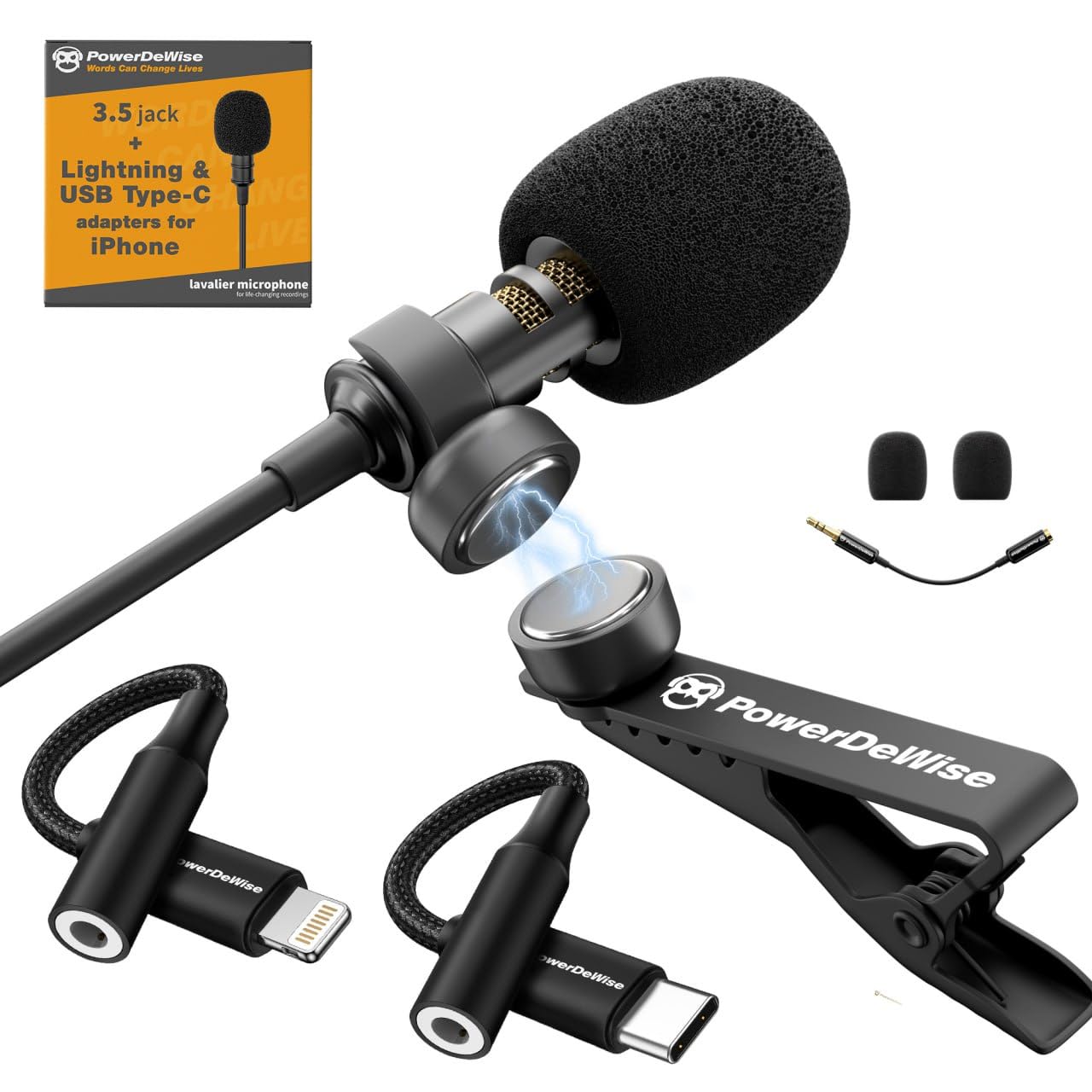
Every adapter you need for phone, laptop, or camera comes in one box — no extras to buy.
The PowerDeWise is a budget-friendly kit built to solve one specific problem: your modern phone has no headphone jack. It includes USB-C and Lightning adapters right in the box, so you can plug into an iPhone 16, a recent Android phone, or a DSLR without buying extra dongles. The total cable length is a generous 13 ft (4m) — a main 79″ cable plus a 79″ extension — giving you plenty of space to move away from the camera during an interview.
The trade-off is the self-noise: at 74 dB, this is one of the noisiest mics here, matching the DJI Lavalier. If you record in a quiet room, you will hear a soft hiss that the Sony ECMLV1 (30 dB) completely avoids. The audio sensitivity is also listed as 74 dB. The shielded cable is designed to cut out interference from WiFi and phones, which is useful when your phone is in your pocket. Buyers love the completeness of the bundle — spare wind muffs and a carrying pouch are included. The build combines aluminum and ABS plastic, giving it a slightly more premium feel than the all-plastic NEEWER.
True universal kit: USB-C, Lightning, and TRS adapters plus a 13ft cable make this the most versatile bundle.
Noticeable self-noise: At 74 dB, the internal hiss is higher than the Sony ECMLV1, Shure MVL, and RØDE Lavalier II.
Best for: creators on a tight budget who switch between an iPhone, an Android, and a camera and want one mic that works with all three from the start.
Not for: anyone recording quiet dialogue in a silent space — the hiss may be audible in pauses.
7. NEEWER CM10
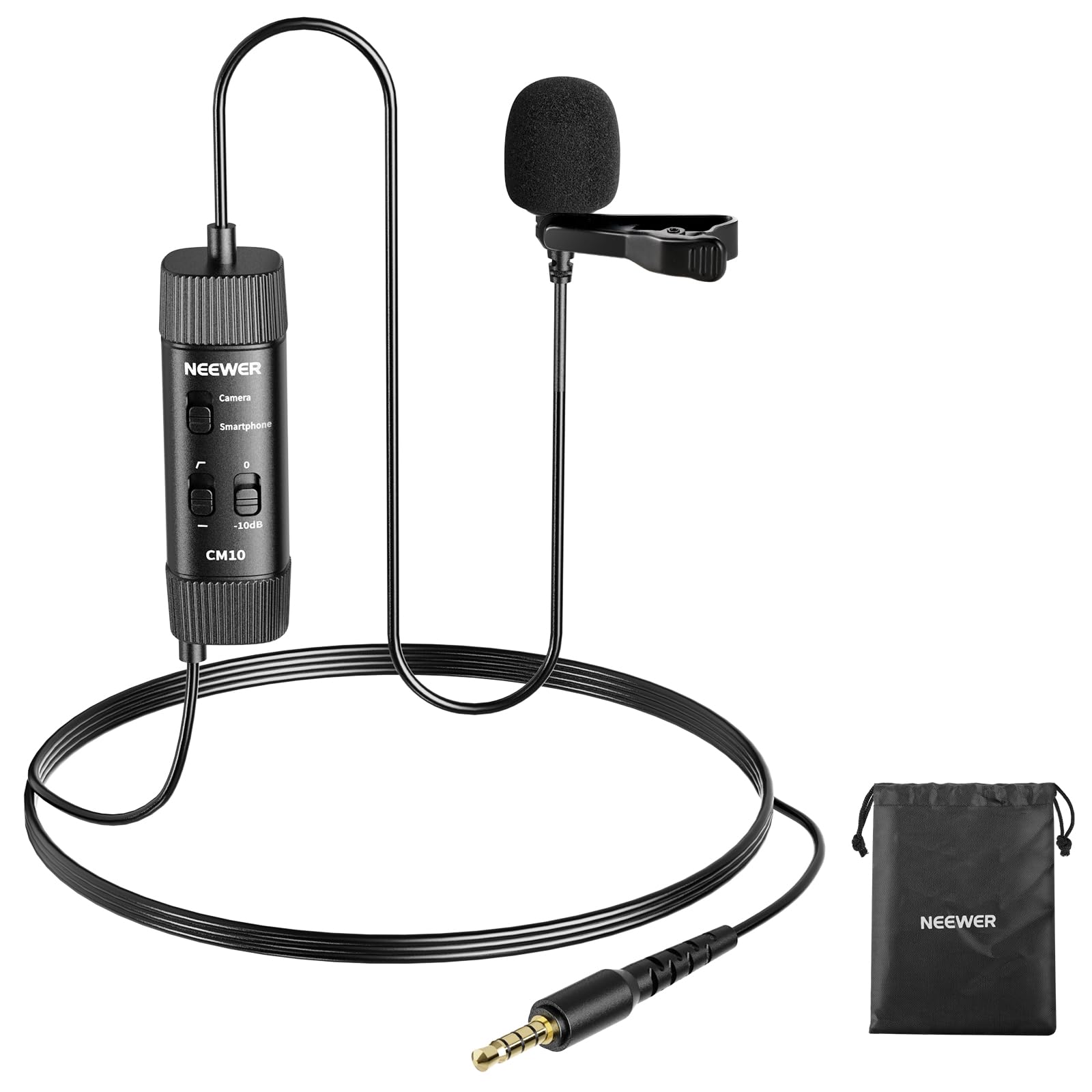
It adds a real-time headphone jack and a rumble filter — features rare at this low price.
The NEEWER CM10 is the most affordable mic in this roundup, but it brings two features you do not see on many budget lavs: a low frequency cut switch (a filter that removes deep rumble from air conditioners or traffic) and a -10dB gain control (a switch that lowers input level by 10 decibels) to prevent distortion when you are recording loud voices or near a speaker. Even better, it includes a 3.5mm TRS monitoring headphone jack in “Smartphone” mode, so you can hear exactly what the mic is picking up in real time — a feature missing on the Sony ECMLV1 and PowerDeWise.
The cable setup is flexible, with a 1.5m microphone cable and a 4.5m TRRS cable for positioning the mic far from your recorder. The 360° omnidirectional capsule picks up sound from all directions, which is standard for this class. The all-plastic enclosure keeps the weight down to 2.12 ounces, making it a light collar clip. Compatibility is solid for phones, cameras, and laptops via the 3.5mm TRRS plug, with a “Camera/Smartphone” switch to match your device. Buyers mention that the mic is great for starting out — the audio is clear enough for Zoom calls and basic vlogs — but the plastic build feels less durable than the metal Shure MVL or the Kevlar-cabled Rode Lavalier GO. The self-noise spec is not published for this model, so it is difficult to compare its background hiss directly with the competitors.
Real-time audio monitoring: The headphone jack lets you hear your recording as it happens — rare at this price point.
No published noise spec: Without a self-noise figure, it is hard to know if the background hiss is acceptable for quiet recordings.
Reach for this if: you are a beginner content creator on a minimal budget who wants monitoring and a rumble filter before upgrading to a pro mic.
Look elsewhere for: long-term durability or a proven low-noise floor — the Sony ECMLV1 or RØDE Lavalier II are better investments if you can stretch the budget.
Understanding the Specs
Self-Noise (Audible Noise)
This is the faint electronic hiss the microphone itself produces when nothing is being said. It is measured in decibels (dB). A mic rated at 30 dB is extremely quiet; one rated at 74 dB may have a noticeable background hiss in a silent room. For spoken-word recordings like podcasts or interviews, a lower self-noise number is your friend — it keeps your pauses clean and your voice isolated from the noise floor. You cannot remove this hiss in editing without also damaging the sound of your voice.
Frequency Response Range
This is the range of sound pitches the mic can capture, measured in hertz (Hz). A human voice lives mostly between 80 Hz and 8,000 Hz, so any mic can cover that. A wider range — like 20 Hz to 20,000 Hz — means the mic also captures deep rumble (useful for film ambience) and high treble detail (for crisp sibilants). For pure dialogue, a narrower range like 16,000 Hz is still fine, but a 20,000 Hz ceiling adds an airy openness to the sound that some listeners perceive as higher quality.
FAQ
Will a 3.5mm microphone work with my iPhone if it doesn’t have a headphone jack?
What is the difference between TRS and TRRS connectors?
Is a lower dB self-noise always better for a 3.5mm lavalier microphone?
Can I use a 3.5mm lavalier microphone with a DSLR camera?
How long does a typical wired 3.5mm lavalier microphone last?
Does a 3.5mm lavalier microphone need batteries?
What is the difference between omnidirectional and cardioid for a lapel microphone?
Should I get a 3.5mm lavalier microphone or a wireless one?
What does the low frequency cut switch do on a lavalier mic like the NEEWER CM10?
Why does my 3.5mm lavalier microphone sound quiet on my camera?
Final Thoughts: The Verdict
For most people, the best 3.5 mm microphone is the RØDE Lavalier II because its 38 dB self-noise and broadcast-grade capsule deliver the cleanest voice track in a tiny, concealable package. If you want the quietest possible hiss-free recording for silent indoor interviews, grab the Sony ECMLV1 with its 30 dB noise floor. And for a phone-first creator who needs adapters and an extra-long cable in one box, the PowerDeWise Professional Grade Lavalier is the most complete package.
How We Picked
We do not accept paid placement. Every pick is matched to a real buyer and a real use-case; we do not hands-on test units.
Sources & Methodology
Specifications: manufacturer listings and product documentation. Review insights: verified customer reviews, as of July 2026. Pricing: not shown on this page (it changes often); check the current price via the retailer link.
As an Amazon Associate, FitlyFast earns from qualifying purchases. This does not affect which products we feature.