
Our readers keep the lights on and the weekend projects moving. As an Amazon Associate, I earn from qualifying purchases.
If you are running an RV, a solar setup, or a home backup system, the single biggest question you face is which 300 amp hour lithium battery will actually deliver the power you paid for without failing in cold weather or dying years before it should. The real difference comes down to the battery’s internal management system (the BMS that protects it), its ability to charge below freezing, and how many times you can fully drain and recharge it before it wears out. This guide breaks down five of the most capable 300Ah lithium batteries on the market right now — all lithium iron phosphate (LiFePO4) chemistry — so you know exactly where your money goes.
I’m Rikta — the co-founder and writer behind FitlyFast. This guide is built by comparing the manufacturers’ published specifications and the patterns across verified customer reviews, so you get each pick’s real strengths and trade-offs instead of marketing spin.
Whether you are upgrading your camper’s power system or building an off-grid solar bank, you need a battery that balances capacity, safety features, and cold-weather performance — and this review of the 300 amp lithium battery market will show you which model fits your exact setup.
How To Choose The Best 300 Amp Lithium Battery
Picking the right 300Ah lithium battery comes down to four things: the continuous power your gear needs, whether you face freezing weather, your plans to expand capacity later, and the total cycles you expect over its life. Here is what to look for in each area.
The BMS Rating — The Real Limit on Power
The Battery Management System (BMS — the internal computer that protects the battery from damage) has a continuous amp rating that caps how much power you can draw at once. A 200A BMS, for example, lets you run about 2,560 watts of gear continuously (200 amps times 12.8 volts). If you plan to run a large inverter, an air conditioner, or a powerful microwave, aim for a 200A BMS. A 150A BMS caps you at roughly 1,920 watts, which may still be enough for lights, a fridge, and a furnace blower, but leaves less headroom.
Self-Heating vs. Low-Temperature Cutoff
Most LiFePO4 batteries cannot be safely charged below freezing (32°F / 0°C) because charging at those temperatures can permanently damage the cells. Some batteries solve this with a low-temperature cutoff, which simply stops charging until it warms up — a safe but limiting approach. Better batteries include a built-in self-heating function, which automatically warms the cells before allowing a charge. If your battery lives in an unheated garage, shed, or outdoor RV compartment during winter, self-heating is not a luxury — it is a necessity.
Cycle Life and Depth of Discharge
Cycle life is the number of times you can fully drain and recharge the battery before its capacity drops significantly. A battery rated for 4,000 cycles at 100% depth of discharge (DOD — how much of the battery’s capacity you use before recharging) will last about 11 years if you cycle it daily. Many batteries also list higher cycle counts at shallower discharge levels (for example, 15,000 cycles at 60% DOD). If you rarely drain the battery below half, those higher numbers matter. If you regularly use the full 300Ah, look at the 100% DOD cycle rating.
Expandability and Physical Fit
Most of these batteries can be connected in series (to increase voltage) or parallel (to increase capacity), but the limits vary — some allow up to 4 batteries in series or parallel, giving you a potential 48V system or 1,200Ah bank. Also check the dimensions and terminal type (M8 is standard on all models here) to ensure it fits your battery compartment. A battery that is 69 pounds is noticeably harder to lift and install than one that is 55 pounds, especially if your installation space is awkward.
Quick Comparison
On smaller screens, swipe sideways to see the full table.
| Model | Category | Best For | Key Spec | Amazon |
|---|---|---|---|---|
| TEMGO 12V 300Ah Self-Heating | Premium | Cold-weather & smart monitoring | 200A BMS, Self-Heating, Touchscreen | Amazon |
| Litime 12V 300Ah | Premium | High-cycle home backup | 200A BMS, EV-Grade Cells, 4000 Cycles | Amazon |
| VATRER POWER 12.8V 300Ah Self-Heating | Premium | Lightweight cold-weather use | 200A BMS, Self-Heating, 5000+ Cycles | Amazon |
| Power Queen 12V 300Ah | Mid-Range | Value-focused solar banks | 200A BMS, 2560W Output, 3840Wh | Amazon |
| OKMO 12V 300Ah Bluetooth | Mid-Range | Budget-friendly entry point | 150A BMS, Bluetooth, 10-Year Lifespan | Amazon |
In‑Depth Reviews
1. TEMGO 12V 300Ah Self-Heating LiFePO4 Lithium Battery
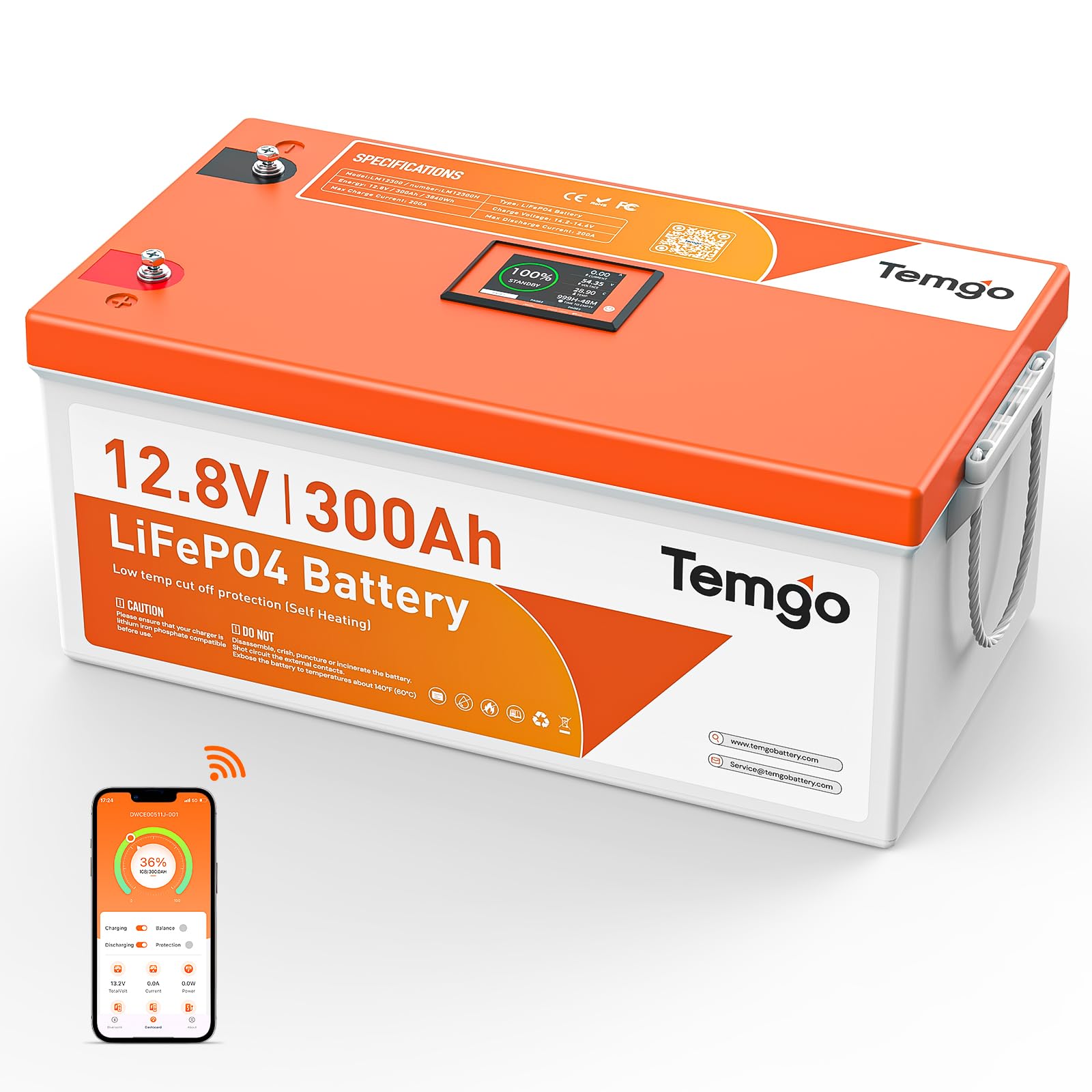
The TEMGO battery wins the top spot because it is the only one here that packs a 200A BMS (the internal safety system that lets you draw up to 2,560 watts continuously) and built-in self-heating with a smart touch screen — three features that together solve the most common headaches of owning a 300Ah battery. It is the right choice if you live in a cold climate, run high-draw appliances like a microwave or air conditioner, or just want to see your battery’s status without guessing.
At 64.92 pounds and 10.59″D x 20.47″W x 8.66″H, it is a 14% deeper footprint than the Power Queen battery — so measure your compartment first — but the real payoff is in cold-weather performance. The self-heating function wakes up when the temperature drops below 32°F (0°C), warming the cells to 41°F (5°C) before charging begins, so you never get stuck with a dead battery on a freezing morning. Buyers report that it handles “6+ hours of full 12V load, still at 80%,” which lines up with its 5000+ cycle rating and 3840Wh of total energy storage.
The smart touch screen shows remaining charge level (State of Charge), voltage, current flow, and estimated runtime right on the battery, and the companion Bluetooth app mirrors that data to your phone. If you want a do-it-all battery that handles winter without extra gear, this is your pick.
Why it’s great
- 200A BMS allows 2,560W continuous draw — enough for an RV air conditioner or large inverter
- Self-heating activates below 32°F so you can charge in freezing weather without damage
- Touch screen and Bluetooth app give you real-time voltage, current, and estimated runtime at a glance
Good to know
- 1-year warranty is shorter than the 5-year coverage on many competitors
- At 64.92 pounds and 10.59 inches deep, measure your battery box before ordering
2. Power Queen 12V 300Ah LiFePO4 Battery
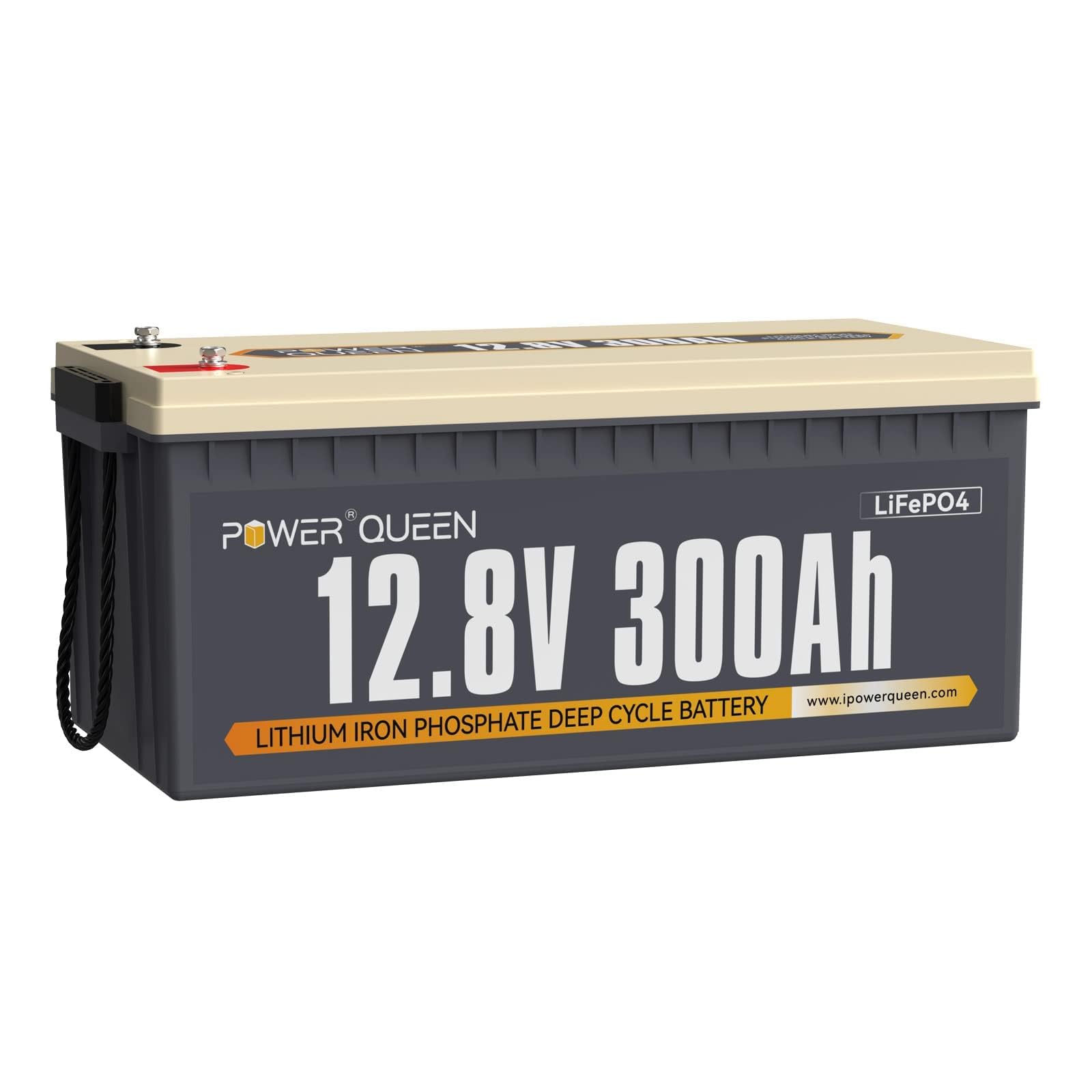
The Power Queen undercuts the TEMGO on price while still delivering a 200A BMS — the same continuous power ceiling of 2,560 watts — and a 5-year warranty that beats TEMGO’s 1-year by a wide margin. It falls short on cold-weather capability, though: it has no self-heating function, so if your battery sits below freezing while you try to charge it, the BMS will simply shut down input to protect the cells. If you never see freezing temperatures, this is a non-issue and the Power Queen becomes a very strong value play.
Its 2,560W power output and 3840Wh capacity match the TEMGO, and owners mention that it is “high capacity (300AH), lightweight, used for home backup and portable power” — it works seamlessly with Victron charge controllers and Bluetooth shunts. At 27.16 kilograms (about 59.9 pounds) and 9.33 inches deep, it is both lighter and shallower than the TEMGO, making it easier to install in tighter compartments. The cycle life is rated at 4,000 cycles at 100% depth of discharge, which translates to roughly 11 years of daily use.
Choose the Power Queen if you value a longer warranty and a slightly lighter build over self-heating, and your installation stays above freezing. It is the smartest balance of price, protection, and power output in this lineup.
Where it shines
- 200A BMS provides 2,560W continuous power — enough for most RVs and solar setups
- 5-year warranty offers long-term peace of mind beyond the basic coverage
- At about 60 pounds and 9.33 inches deep, it is lighter and more compact than the TEMGO
Worth noting
- No self-heating — you cannot safely charge it below 32°F without risk of cell damage
3. Litime 12V 300Ah LiFePO4 Battery
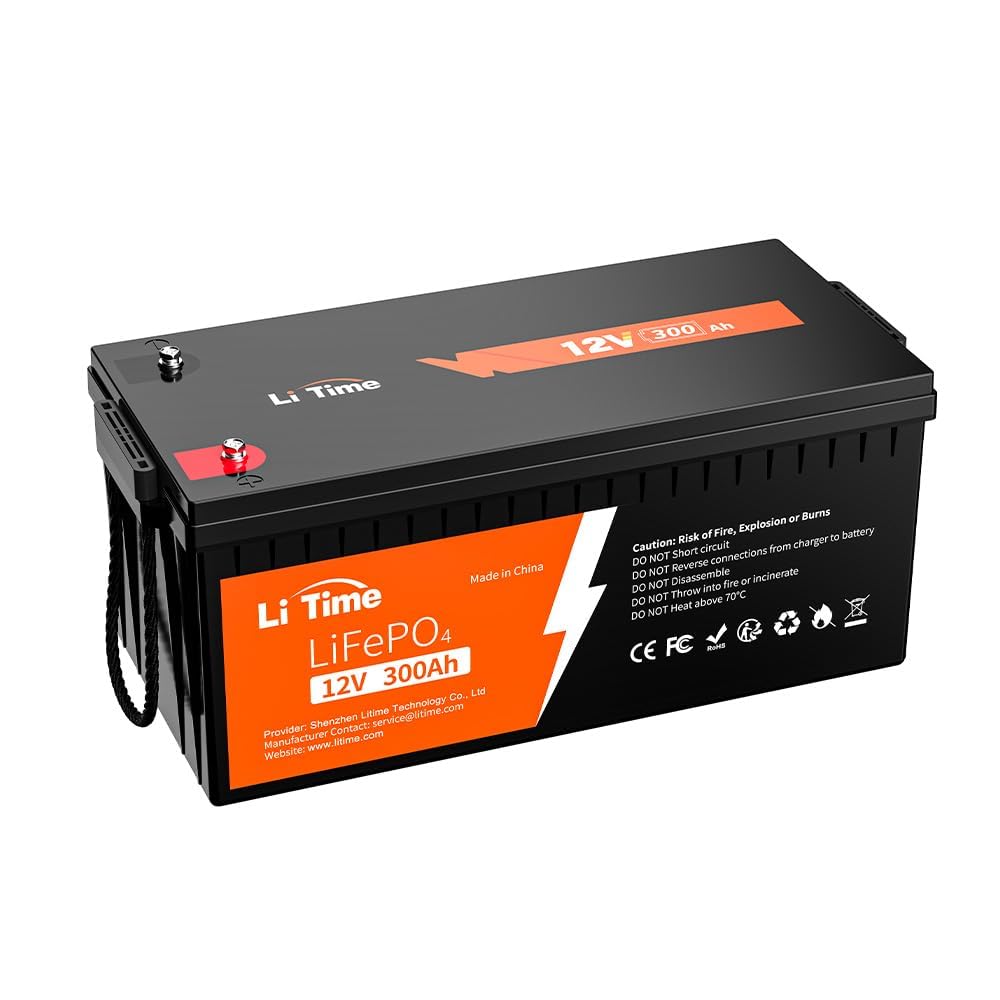
If you are building a home backup system where you rarely drain the battery below half, the Litime is the battery to beat. It packs the same 200A BMS and 3,840Wh of energy as the top picks, but it uses EV-grade lithium cells that are tested to higher automotive reliability standards, and it carries an ETL certification on its BMS — a safety mark that some budget batteries skip. At 10% lighter than the OKMO battery (62.83 pounds versus 69 pounds), it is noticeably easier to lift into a tight RV bay.
The Litime is rated for 4,000 cycles at 100% depth of discharge, but it also lists 15,000 cycles at 60% DOD — meaning if you typically use only 180Ah of its 300Ah capacity before recharging, this battery could last over 40 years of daily cycling. That makes it an excellent choice for a home backup system where you rarely drain the battery below half. Customers note that it is “reliable in a travel trailer for a year” and that the Bluetooth app, while occasionally finicky during charging, is useful for monitoring voltage and setting discharge cutoffs.
The catch is that it lacks self-heating, so like the Power Queen, it cannot be charged below freezing. If you never see freezing temperatures and want the most robust cell quality and longest theoretical lifespan, the Litime is your battery — and with 15,000 cycles at 60% DOD, it is built to outlast your system.
What stands out
- EV-grade cells and ETL-tested 200A BMS offer higher safety and reliability standards
- 4000 cycles at 100% DOD and up to 15,000 cycles at 60% DOD — among the longest lifespans in this class
- At 62.83 pounds, it is 10% lighter than the OKMO 300Ah battery
The trade-offs
- No self-heating — do not install where temperatures drop below freezing during charging
- Some reviewers point out the Bluetooth app can glitch during active charging cycles
4. OKMO 12V 300Ah LiFePO4 Lithium Battery With Bluetooth
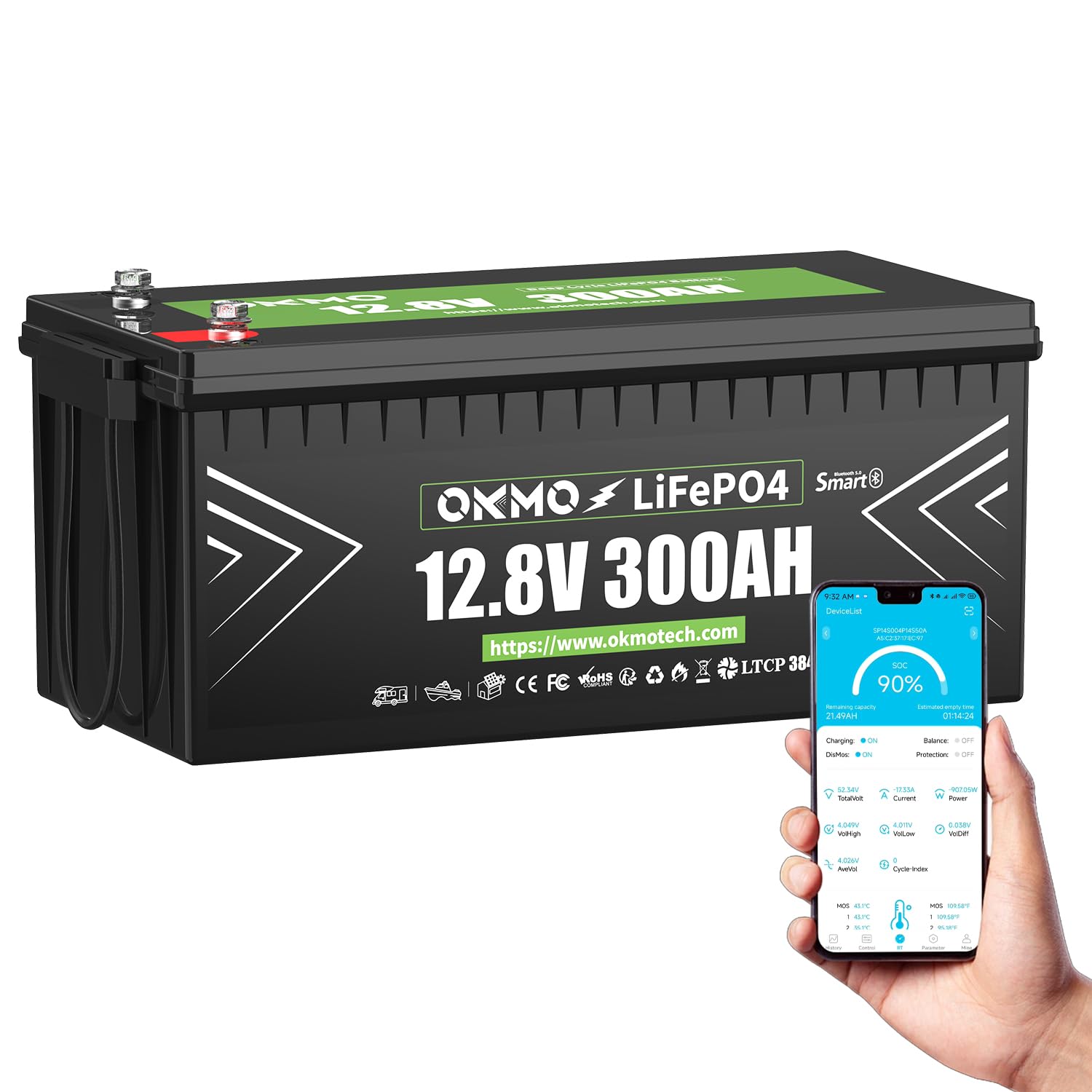
The single number that matters most in this category is the BMS continuous current rating, and the OKMO scores 150A — a 33% lower ceiling than the 200A BMS found on the TEMGO and Power Queen. That 150A limit means you can draw up to roughly 1,920 watts continuously, which is fine for lights, a refrigerator, a furnace fan, and a TV, but may not handle a large inverter running a microwave or an air conditioner without tripping the BMS. If your power demands are moderate, this limitation is irrelevant.
At 69 pounds, the OKMO is the heaviest battery in this group — 10% heavier than the Litime and about 15% heavier than the VATRER POWER — so lifting it into a high-sided truck bed or a deep storage compartment requires more effort. On the upside, it includes Bluetooth monitoring through a dedicated app, and shoppers say it “holds power for a long time and charges quickly” and that the company offers “responsive, knowledgeable email support.” The 5-year warranty matches the Power Queen and Litime, which is reassuring at this entry-level price point.
The OKMO also has a 10-year lifespan claim based on 4,000+ cycles at 100% DOD, and it supports up to 4-series, 4-parallel expansion for flexibility. For the money, it is a solid starter battery that gets you into 300Ah territory without the premium price — just be honest about your power needs before buying.
The upsides
- Most budget-friendly 300Ah LiFePO4 option in this lineup
- Bluetooth app lets you monitor voltage, charge level, and health from your phone
- 5-year warranty is competitive with more expensive batteries
Keep in mind
- 150A BMS limits continuous draw to about 1,920W — not ideal for high-power appliances
- At 69 pounds, it is the heaviest battery here — plan for a two-person install if your compartment is high up
5. VATRER POWER 12.8V 300Ah Self-Heating LiFePO4 Battery
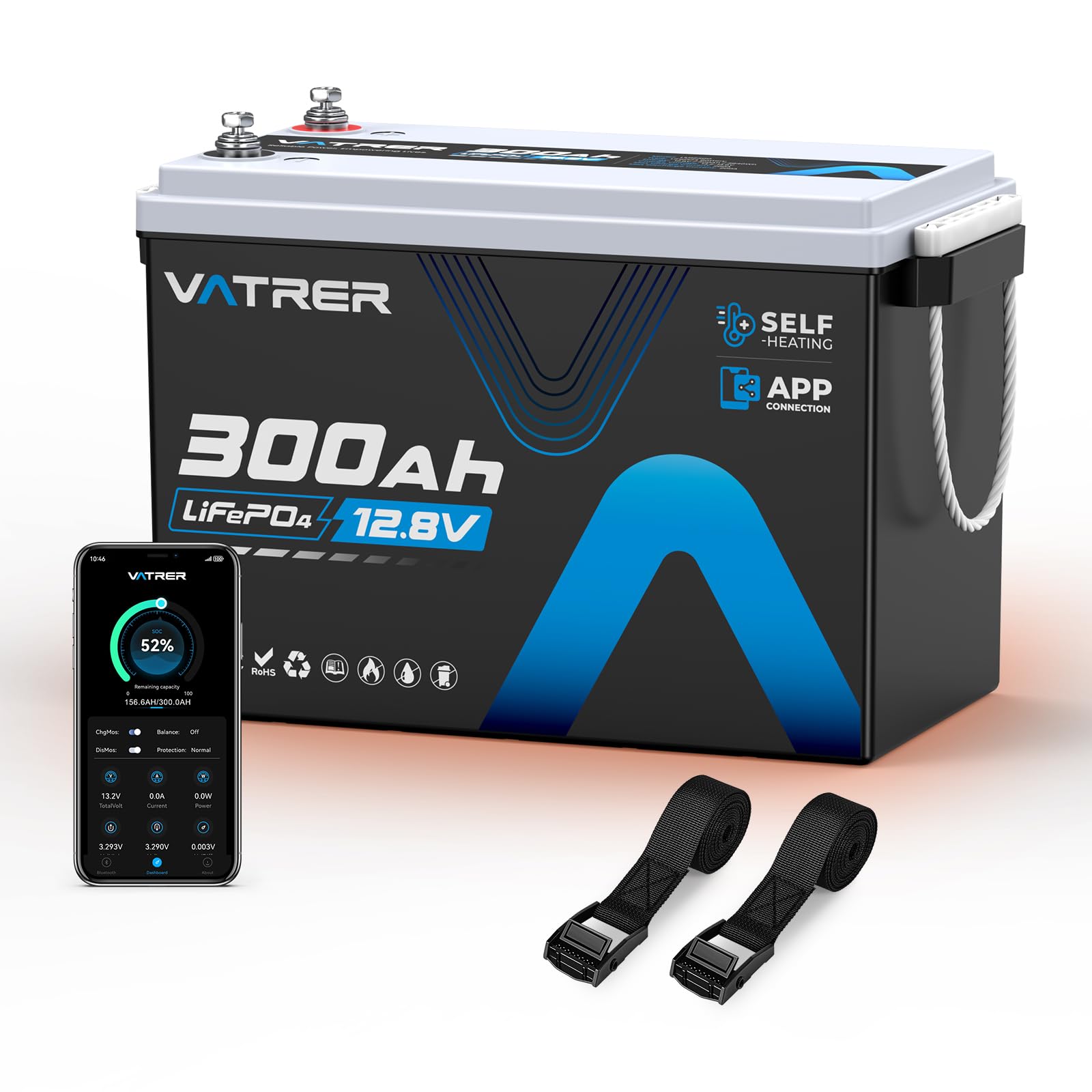
At this lower price, you get the lightest 300Ah self-heating battery in this roundup at 54.67 pounds — about 10 pounds lighter than the TEMGO and roughly 15 pounds lighter than the OKMO — plus the highest rated cycle life of the group: over 5,000 cycles at 100% depth of discharge, compared to the 4,000-cycle rating of most competitors and the 4000-cycle claim on the Litime.
It includes the same built-in self-heating function as the TEMGO, which means it can charge safely in freezing temperatures by warming the cells before accepting power. The companion Bluetooth app gives you real-time data on current, voltage, temperature, and cycle count. One reviewer noted it has a “larger footprint (21″x11″, 55lbs) but easy to stack,” and another said the self-heating feature was “most important to us. Now we can charge it in the winter!”
The downside is that VATRER POWER’s warranty is less clearly spelled out — the manufacturer says “Please refer to the official website” — whereas TEMGO, Litime, and Power Queen all have explicit warranty terms. If a clearly documented warranty is important to you, the VATRER POWER requires a bit more research on your part before buying. This battery is perfect for the budget buyer who needs self-heating but wants the lightest possible lift.
Why we’d pick it
- At 54.67 pounds, it is the lightest self-heating 300Ah battery here — much easier to handle than the 69-pound OKMO
- 5000+ cycles at 100% DOD is the best cycle life rating in this lineup
- Self-heating function allows safe charging in sub-freezing temperatures
A few caveats
- Warranty details are not clearly stated — you may need to contact the seller or check the website directly
- At 15.12 inches deep, it has a larger footprint than the TEMGO and Power Queen — measure your space
Understanding the Specs
BMS (Battery Management System)
The BMS is the brain inside your lithium battery that prevents it from overcharging, over-discharging, overheating, or short-circuiting. Its continuous amp rating — 150A or 200A — directly limits how many watts of gear you can run at once. A 200A BMS at 12.8V gives you 2,560W of continuous power, while a 150A BMS gives you about 1,920W. If you plan to run a 2,000W inverter, a 200A BMS gives you headroom; a 150A BMS leaves almost none.
Self-Heating vs. Low-Temperature Protection
LiFePO4 cells can be permanently damaged if you try to charge them below 32°F (0°C). Low-temperature protection simply shuts off charging until it warms up — safe, but frustrating in winter. Self-heating batteries include a built-in heater that warms the cells to a safe temperature (typically 41°F / 5°C) before charging begins. If your battery lives in an unheated space during winter, self-heating is essential.
Depth of Discharge (DOD) and Cycle Life
Depth of discharge is the percentage of the battery’s capacity you use before recharging. A battery rated for 4,000 cycles at 100% DOD means you can drain it fully each time and get 4,000 full charges before capacity drops. If you only use 60% of the capacity each cycle, the battery may last 15,000 cycles or more. Higher cycle life directly translates to fewer replacements over the life of your system.
Bluetooth Monitoring and Smart Displays
Bluetooth connectivity lets you check voltage, current, temperature, and remaining charge from your phone without walking to the battery. Some batteries also have an on-board touch screen that shows the same data. These features are useful for spotting problems early — like a cell imbalance or a slow discharge — and they save you from having to guess whether your battery has enough power for another night off-grid.
FAQ
Can I use a 300Ah lithium battery as a starter battery for my engine?
How long will a 300Ah battery run a typical RV fridge, lights, and furnace?
Can I connect multiple 300Ah batteries together for more capacity?
What charger do I need for a 300Ah LiFePO4 battery?
Final Thoughts: The Verdict
For most people, the 300 amp lithium battery winner is the TEMGO 12V 300Ah Self-Heating because it combines a 200A BMS, genuine self-heating for freezing weather, and a smart touch screen with Bluetooth — all in one package that covers every major concern a serious RV or solar owner has. If you want a longer warranty and do not need cold-weather charging, grab the Power Queen 12V 300Ah. And for the lightest self-heating option with the highest cycle life, the standout is the VATRER POWER 12.8V 300Ah Self-Heating.