
Our readers keep the lights on and the weekend projects moving. As an Amazon Associate, I earn from qualifying purchases.
Dialing in the light intensity for a 4×4 or 3×3 tent is the single largest variable separating a massive harvest from a disappointing one. Too many growers jump straight to 100% power and end up with light-bleached tops and a lot of wasted electricity. The challenge is finding a fixture that delivers uniform canopy penetration without creating hot spots, runs cool enough to keep your room temperature stable, and provides the specific red and far-red wavelengths that drive flowering and resin production.
I’m Rikta — the co-founder and writer behind FitlyFast. I have spent years dissecting PPFD maps, diode efficiency ratings, and driver reliability across hundreds of indoor horticulture fixtures to understand which specifications actually translate to denser buds and healthier root zones.
Whether you are outfitting your first grow tent or upgrading from an older blurple panel, the right 300 watt led grow light can cut your electricity bill in half while producing more consistent results than traditional HID systems.
How To Choose The Best 300 Watt LED Grow Light
Not all 300-watt fixtures are created equal. The actual power draw, diode quality, and spectral layout define whether your plants thrive or just survive. Here is what to look for when narrowing down your options.
Actual Wattage vs. Claimed Wattage
Many budget lights advertise “300W” but pull far less from the wall. Check the reported power draw — a true 300W fixture should consume roughly 280-300 watts at full intensity. A light that only draws 200W will struggle to flower a 4×4 tent properly.
PPF and PPE Efficiency
Photosynthetic Photon Flux (PPF) measures how many photons the light emits per second, while PPE (expressed as µmol/J) tells you how efficiently it converts electricity into usable light. Modern Samsung LM301H or LM301H EVO chips regularly hit 2.7-3.1 µmol/J. Older diodes may fall below 2.0 µmol/J, meaning more heat and higher electricity bills for the same PPF output.
Coverage Area and PPFD Uniformity
A single 300W fixture intended for a 3×3 flowering space will create hot spots if the diodes are clustered in the center. Bar-style layouts and wide reflectors (120 degrees) spread light more evenly, reducing the need to rotate plants or raise the light far above the canopy.
Spectral Composition
Full-spectrum white diodes (3000K-5000K) combined with dedicated deep red (660nm) and far-red (730nm) LEDs provide the photosynthetic range plants need from seedling stretch through flower development. UV and IR bars can further enhance trichome production and resin density.
Quick Comparison
On smaller screens, swipe sideways to see the full table.
| Model | Category | Best For | Key Spec | Amazon |
|---|---|---|---|---|
| AC Infinity IONFRAME EVO3 | Premium Bar | Precision spectrum control | 3.14 µmol/J, 840 diodes | Amazon |
| Spider Farmer G3000 | App-Controlled | Remote scheduling & dimming | 2.75 µmol/J, 896 diodes | Amazon |
| MARS HYDRO TSW2000 | Quantum Board | 3×3 flower / 4×4 veg | 300W draw, 120° reflector | Amazon |
| MARS HYDRO TSL2000 | Long Panel | 4×2 flowering footprint | 300W draw, 704 LEDs | Amazon |
| Barrina BU2000 | Adjustable Panel | Angle-focus for small tents | 816 LEDs, 60° beam angle | Amazon |
| SAYHON SH2000 | UV/IR Bar | Supplemental UV & IR spectrum | 2.7 µmol/J, 2.4″ height | Amazon |
| BESTVA BP2000 | Budget Board | Entry-level full-spectrum | Fanless design, 656-1150 LEDs | Amazon |
In‑Depth Reviews
1. AC Infinity IONFRAME EVO3
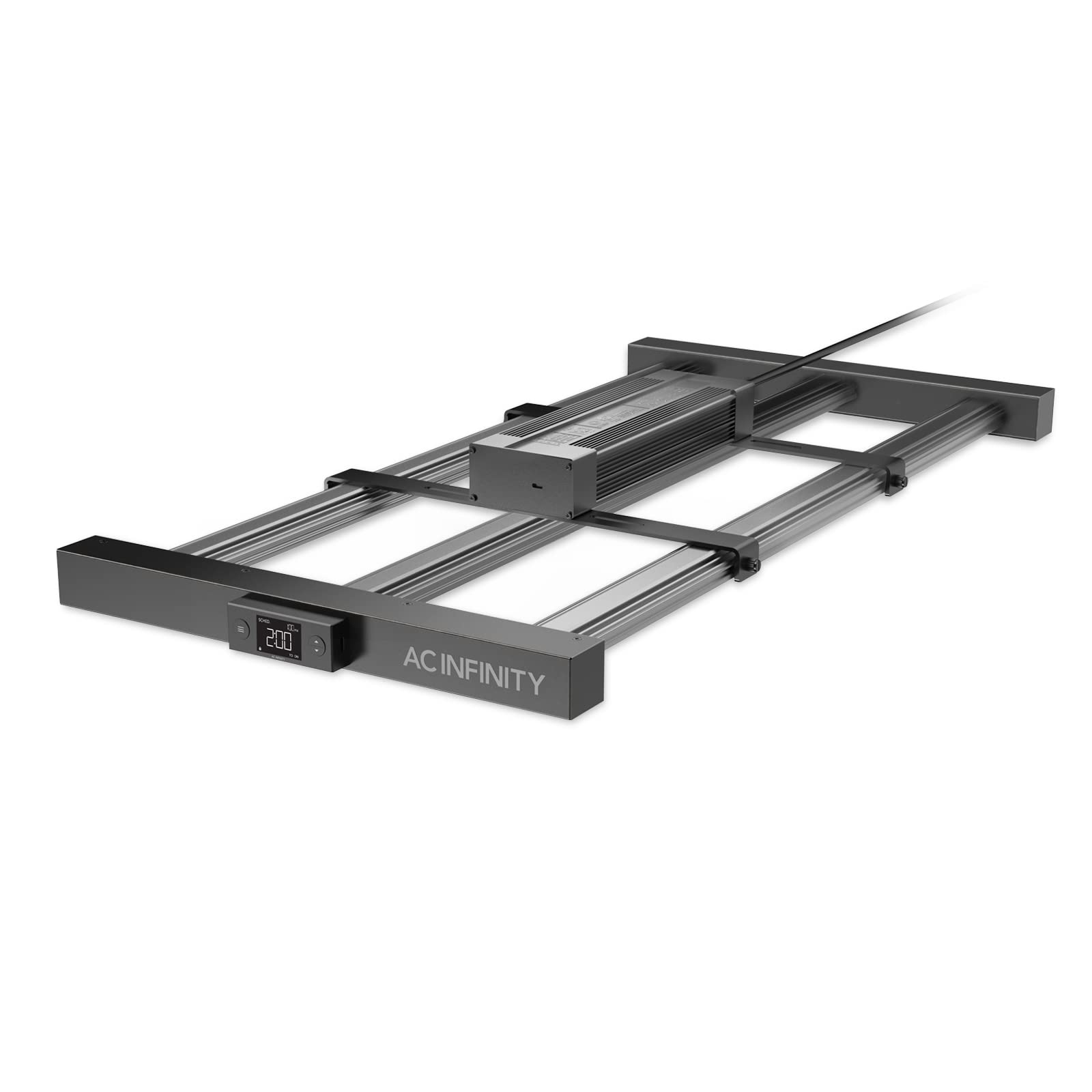
The AC Infinity IONFRAME EVO3 is the most technologically refined fixture in this lineup, leveraging Samsung LM301H EVO diodes that deliver a class-leading 3.14 µmol/J PPE. That efficiency translates directly into lower heat output and reduced electricity consumption — a meaningful advantage if you are running multiple lights or operating in a sealed room without active cooling. The 840 diodes are spaced algorithmically across the bar-style frame to produce an exceptionally even PPFD map, which minimizes hotspot formation and lets you drop the light closer to the canopy for deeper penetration.
What sets this unit apart is the integrated UIS controller platform. You can program sunrise and sunset dimming curves, set 10 distinct brightness levels, and daisy-chain up to 80 fixtures without needing external timers or dimmers. The passive cooling driver is removable, which helps balance heat dissipation and keeps the electronics away from high-humidity zones. The 2×4 flowering coverage is conservative — expect it to perform beautifully in a 2×4 or 3×3 space with excellent uniformity edge-to-edge.
The build quality feels substantial, with an aluminum and steel housing that weighs 17.4 pounds. The magnetic mounting system simplifies installation, and the ETL certification adds a layer of safety assurance. Growers who already use AC Infinity’s Controller 69 Pro will appreciate the single-app control over lighting, exhaust, and environment.
Why it’s great
- Highest PPE in class (3.14 µmol/J) lowers heat and energy costs
- Programmable sunrise/sunset dimming via UIS app or controller
- Algorithmic diode spacing produces uniform coverage and deep canopy penetration
- Daisy-chain up to 80 units for large-scale setups
Good to know
- Heavier than other 300W fixtures at 17.4 lbs
- Flowering coverage is limited to 2×4, not 4×4
- Premium pricing positions it above mid-range competitors
2. Spider Farmer G3000

The Spider Farmer G3000 brings app-based remote control to the mid-premium bracket, allowing you to adjust brightness and set custom light schedules from the Spider Farmer app while you are away from your grow. The bar-style frame houses 896 high-efficiency diodes that produce 824 µmol/s of PPF, achieving a solid 2.75 µmol/J PPE. That efficiency places it well above budget boards and comfortably within the range required for dense flower development in a 3×3 footprint.
The physical dimmer includes a built-in digital display that shows the current brightness level, which is a useful tool when dialing in intensity for different growth stages without owning a separate PAR meter. Daisy-chaining capability supports up to 50 units from a single master light, making the G3000 scalable for commercial applications. The spectrum spans 3200-4200K, 4800-5000K, and a dedicated 660-665nm red channel, giving you a broad white-based spectrum that mimics natural sunlight.
A standout here is the 5-year warranty backed by a U.S.-based service center. Several verified buyers noted that customer service responded quickly when minor hardware issues arose — always a good sign for long-term ownership. The fixture is lightweight at just a few pounds per bar, and the included yo-yo adjusters make height tuning straightforward.
Why it’s great
- App-controlled scheduling and sunrise/sunset simulation from anywhere
- Digital dimmer display shows brightness level without a PAR meter
- 5-year warranty with U.S. service center support
- Lightweight bar design simplifies hanging and height adjustment
Good to know
- No dedicated UV or IR supplemental bars included
- Coverage is optimized for 3×3 flower, may need two units for 4×4
- App requires stable WiFi connection for full remote functionality
3. MARS HYDRO TSW2000

The MARS HYDRO TSW2000 is a proven quantum-board design that pulls a true 300 watts from the wall, making it one of the few fixtures in this class that delivers on its power claims without a significant efficiency penalty. The patented 120-degree white reflector increases light utilization by 25 percent, which spreads the beam more evenly than traditional 90-degree lenses. This is particularly beneficial in a 3×3 flowering tent where edge plants often lag behind center colas.
The diode layout places chips densely in the center and sparser toward the edges, a deliberate strategy to compensate for natural light falloff. In practice, this produces a more uniform PPFD distribution across the canopy than a flat array of equally spaced diodes. The external driver features an independent dimming button that allows 0-100 percent adjustment, and the daisy-chain port can connect up to 50 fixtures for larger rooms. The auto-sensing power supply handles 120V, 240V, and 277V, so you can move it between different electrical environments without a separate adapter.
Customer feedback consistently mentions two things: the fixture is exceptionally quiet thanks to the fanless design, and it runs noticeably cooler than older 1500W equivalent LEDs. Several users reported that plants responded visibly within 24-48 hours of switching from cheaper panels. The build quality is solid for the mid-range price point, and the 704 LEDs deliver a full spectrum covering 730-740nm Red IR, 3200-4200K, and 5200-6800K.
Why it’s great
- True 300W draw provides sufficient power for flowering a 3×3 tent
- Patented 120° reflector improves edge-to-edge light uniformity
- Fanless operation with passive cooling keeps noise at zero
- Daisy-chain up to 50 units and auto-sensing voltage for varied setups
Good to know
- Some units develop driver dimming issues; warranty response is mixed
- Slightly warm surface temperature may affect enclosed tents with poor airflow
- Heavier than bar-style competitors at 7.69 lbs
4. MARS HYDRO TSL2000
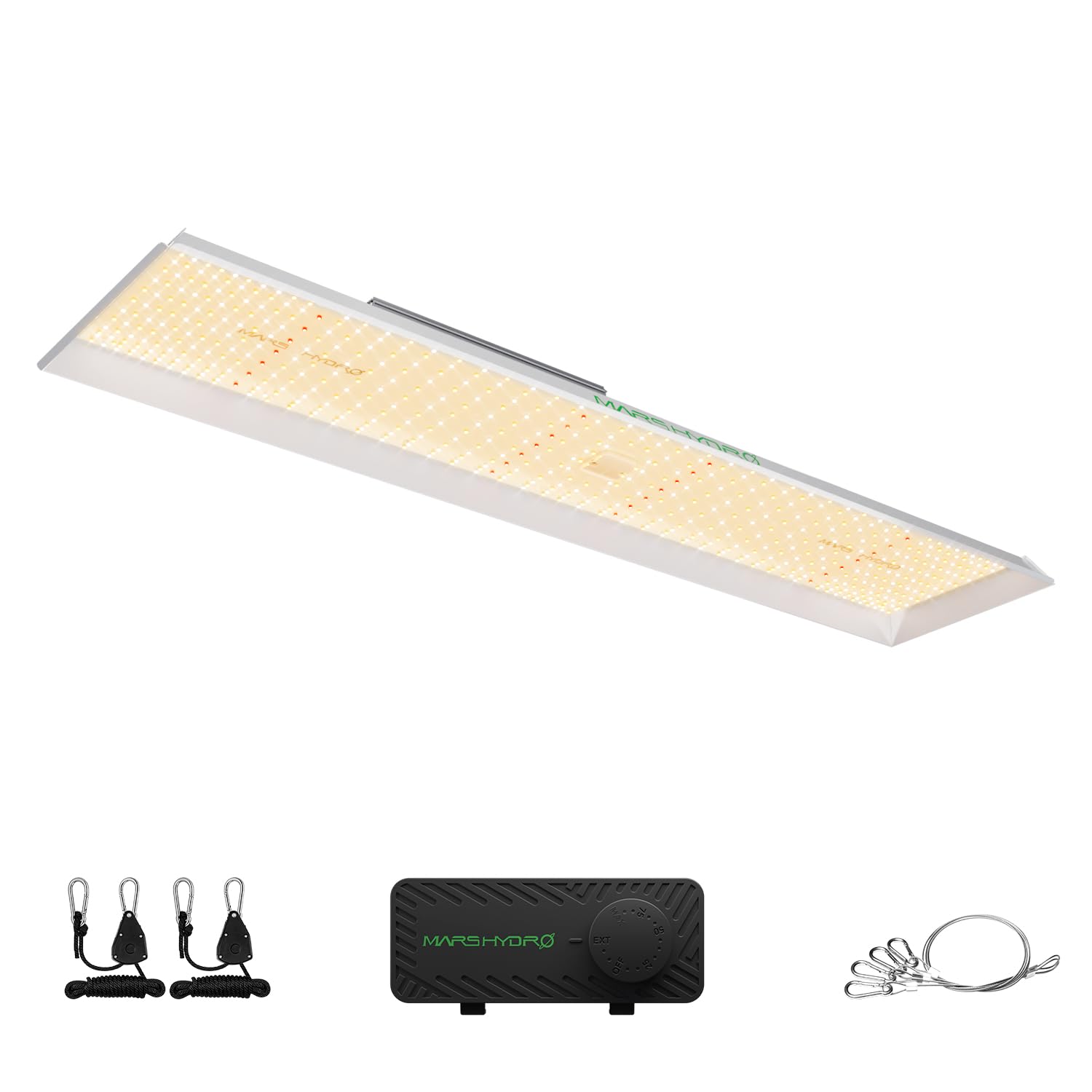
The MARS HYDRO TSL2000 shares the same driver and diode technology as the TSW2000 but in an elongated form factor designed specifically for 4×2 flowering tents. At 39.2 inches long and just under 10 inches wide, this fixture stretches the light across the narrow dimension, which means you can run a single unit down the center of a 4×2 without needing to pair two smaller boards. The 120-degree reflector works the same way, boosting light utilization by 25 percent to maintain even PPFD from front to back.
The 300-watt draw provides enough photon density to flower a 4×2 space completely, and the 704 LEDs cover the same full spectrum as the TSW2000 (730-740nm Red IR, 3200-4200K, 5200-6800K). The external driver with independent dimming lets you dial intensity back during veg and push to 100 percent for flower. Daisy-chaining up to 50 lights works in series, which simplifies wiring in multi-tent commercial layouts.
Users report that the TSL2000 produces noticeably more potent, denser buds compared to previous 1500W equivalent panels while drawing half the power. The silent fanless operation is a consistent highlight, though a few owners noted that the dimmer/daisy-chain box creates a slight weight imbalance that causes the light to tilt — an easy fix with a small counterweight. The warranty experience appears to vary, with some users receiving prompt replacements and others waiting a month.
Why it’s great
- Elongated design fits 4×2 tents perfectly without needing multiple panels
- True 300W draw with 704 full-spectrum LEDs supports dense flowering
- Fanless, silent operation maintains low ambient noise in tents
- Dimmable external driver allows precise intensity adjustment for each growth phase
Good to know
- Dimmer box weight can tilt the fixture; minor counterweight needed
- Warranty support is inconsistent, with response times up to one month
- Not ideal for 3×3 or 4×4 spaces due to the long, narrow form factor
5. Barrina BU2000

The Barrina BU2000 takes a different approach to light distribution with its two-panel adjustable design. You can angle each panel independently to focus light toward specific canopy zones or spread it wider for veg coverage. When the panels are set to a 60-degree angle, central PPFD increases by over 25 percent — a feature that gives you tangible control over hotspot management without raising or lowering the entire fixture. This makes the BU2000 especially useful in smaller tents where hanging height is limited.
The diode mix includes blue 5000K, warm white 3000K, deep red 660nm, and IR 730nm, giving you a broad spectral range that supports everything from tight internodal growth during veg to resin production during flower. The 816 LED count is impressive for the price, and the central PPFD value reaches up to 1600 µmol/m²/s in the focused zone. The dimmer knob adjusts brightness continuously from off to max, and multiple units can be daisy-chained with unified dimming control.
Customer reviews highlight the surprising power output for the price point — several users noted that they initially burned their plants at full intensity because the light is stronger than expected. The fanless design keeps noise at zero, and the fixture runs cool enough that you can hang it relatively close to the canopy with proper airflow. The included network cable, hanging chains, and steel hooks make installation straightforward, though the 2-pound weight means it is one of the lightest fixtures in this roundup.
Why it’s great
- Two adjustable panels allow 60° focusing to boost central PPFD by 25%
- Full spectrum includes 660nm deep red and 730nm IR for flowering support
- Daisy-chain with unified dimming simplifies multi-light setups
- Very lightweight at 2 lbs, easy to hang and adjust
Good to know
- Actual power draw is 200W, not 300W — lower total output than true 300W lights
- Beam angle of 60 degrees may create hotspots if panels are not properly spread
- No UV supplemental bar or advanced controller features
6. SAYHON SH2000

The SAYHON SH2000 includes a dedicated UV and IR supplemental bar with its own separate switch, making it one of the few mid-premium fixtures that lets you toggle specific wavelengths on and off independently. The UV (390nm) and IR (730nm) channels, combined with blue 460nm, are designed to boost resin production and disease resistance during flowering and seedling stages respectively. This level of spectral granularity is usually reserved for fixtures costing significantly more.
The mainboard uses deep red 660nm, 2700K, and 5000K white LEDs to create a full spectrum spanning 400-760nm, and the reported PPE of 2.7 µmol/J is competitive with other lights in this class. The 3A+ grade aluminum heatsink is thicker than standard, which SAYHON claims lowers driver temperatures by up to 50°F compared to thinner alternatives. This thermal margin should help maintain 95%+ brightness after three years of continuous use, assuming reasonable ambient temperatures.
Installation is truly plug-and-play — no wiring or assembly required. The fixture is silent with no moving parts, and the 8.8-pound weight indicates solid construction. The 36-month local warranty adds peace of mind, although one verified review noted that a blue strip began flickering after a year and required persistence to get a replacement. The 4×4 veg and 3×3 flower coverage figures are realistic for the actual 208W power draw.
Why it’s great
- Dedicated UV (390nm) and IR (730nm) bar with independent on/off switch
- Thick 3A+ aluminum heatsink reduces driver temperature by up to 50°F
- Fanless design ensures zero noise during operation
- 36-month local warranty covers LED chips and driver
Good to know
- Actual power draw is 208W, lower than advertised wattage
- Dimmer knob cannot fully turn off the light — requires unplugging
- Some units experience blue strip flickering after extended use
7. BESTVA BP2000
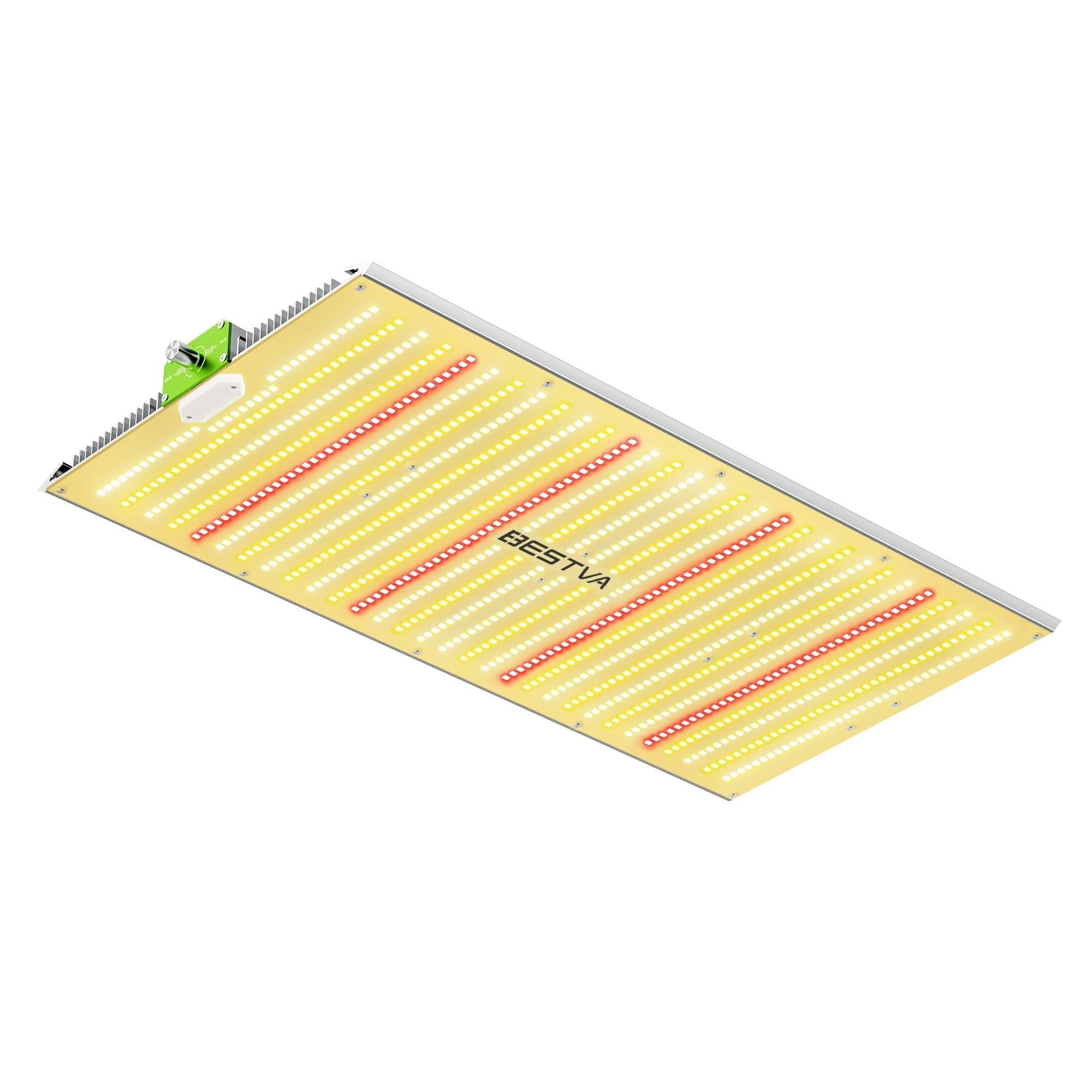
The BESTVA BP2000 is the most budget-conscious option in this roundup, offering a dimmable, full-spectrum LED board for growers who want to start with quality light without committing to premium pricing. The fixture uses an upgraded diode layout that improves PPFD uniformity compared to older BESTVA boards, and the fanless design keeps it silent during operation. The detachable driver and aluminum heatsink provide adequate heat dissipation for typical home gardening and small tent environments.
The spectrum includes warm white (3000K), cool white (5000K), and a dedicated 660nm deep red channel to support blooming and fruiting phases for ornamental plants, vegetables, and herbs. The dimming knob adjusts intensity from 0 to 100 percent, which is helpful when transitioning from seedling to flower. Users who grow leafy greens or houseplants will find the BP2000 more than capable of preventing leggy growth and maintaining vibrant foliage color.
A few early adopters reported inconsistencies with the first batch — some units drew 205W and were built with 656 LEDs, while the later “upgrade” batch draws 160W with 1150 LEDs. The lower power draw means this fixture is better suited for 2×2 or 2×3 veg spaces rather than flowering a full 3×3. Several reviewers also noted uneven coverage on 2×4 shelves, with seedlings at the edges leaning toward the center, so daily tray rotation may be necessary in rectangular setups.
Why it’s great
- Fanless operation produces zero noise for quiet indoor use
- Dimmable from 0-100% with a simple knob adjustment
- Detachable driver keeps electronics away from high-humidity zones
- Full spectrum with 660nm red supports flowering of houseplants and herbs
Good to know
- Actual power draw varies (160W-205W) depending on production batch
- Coverage can be uneven on 2×4 shelves, causing edge plants to stretch
- Some units develop flickering after extended use; warranty support is mixed
FAQ
Can I use a 300W LED grow light in a 4×4 tent for flowering?
What is the ideal hanging height for a 300W LED grow light?
Should I buy a light with separate UV and IR bars?
How much electricity does a 300W LED grow light use per month?
Final Thoughts: The Verdict
For most users, the 300 watt led grow light winner is the AC Infinity IONFRAME EVO3 because its Samsung LM301H EVO diodes deliver unmatched PPE, and the UIS controller platform gives you precise scheduling and dimming control that no other fixture in this class matches. If you want app-based remote scheduling with a long warranty, grab the Spider Farmer G3000. And for a proven quantum-board design that covers a 3×3 flowering space on a mid-range budget, nothing beats the MARS HYDRO TSW2000.