
Our readers keep the lights on and the weekend projects moving. As an Amazon Associate, I earn from qualifying purchases.
A 32-inch monitor hits a sweet spot that smaller screens cannot touch: you get immersive screen real estate for spreadsheets, timelines, and wide-angle gaming views without needing to turn your head like you are watching a tennis match. The problem is that this category is flooded with models that look identical on paper but deliver radically different experiences once they are on your desk — washed-out colors on a cheap VA panel, ghosting that ruins fast-paced FPS rounds, or a stand that forces your neck into a permanent crick.
I’m Rikta — the founder and writer behind FitlyFast. I have spent years tracking panel technology shifts, analyzing refresh rate versus resolution trade-offs, and separating marketing fluff from real-world performance in the 32-inch monitor space.
This guide cuts through the noise by comparing pixel density, color accuracy, adaptive sync behavior, and ergonomic adjustability so you can pick the best 32 inch monitor for your specific workflow or gaming setup.
How To Choose The Best 32 Inch Monitor
Finding the right 32-inch monitor is about balancing three things: resolution, panel type, and the refresh rate your hardware can actually drive. A 4K panel is stunning for creative work but demands a powerful GPU for gaming, while a 1440p panel hits the sweet spot for most mid-range builds. Your choice of VA versus IPS determines whether you prioritize deep blacks or wide viewing angles and consistent color. And the stand — often overlooked — is the difference between a comfortable all-day setup and a persistent neck ache.
Resolution: 1440p vs. 4K at 32 Inches
A 32-inch 1440p panel has a pixel density of roughly 92 PPI — the same as a 24-inch 1080p screen. Text is clear enough for most office work and gaming, and you do not need a top-tier graphics card to hit high frame rates. 4K on the same size pushes density to about 140 PPI, which makes text razor-sharp and gives video editors and photographers critical detail. The trade-off is that driving 4K at high refresh rates requires serious GPU power, especially in modern titles.
Panel Technology: IPS vs. VA vs. OLED
IPS panels offer consistent color from any angle, making them the go-to choice for designers and anyone working with color-critical content. VA panels deliver superior native contrast — often 3000:1 versus 1000:1 on IPS — which creates deeper blacks and better HDR performance in a dark room. The downside is that VA panels can exhibit black-level smearing in fast motion. OLED technology, found in premium models like the MSI MPG 321URX, provides perfect blacks and near-instant response times but comes with burn-in risk and a higher price tag.
Refresh Rate and Adaptive Sync
For general productivity, 60Hz is sufficient. For gaming, 120Hz or higher provides noticeably smoother motion. Adaptive sync technologies — AMD FreeSync and Nvidia G-Sync Compatible — eliminate screen tearing by matching the monitor’s refresh rate to the GPU’s frame output. Always check whether the specific connection (HDMI vs. DisplayPort) supports the monitor’s full refresh rate and adaptive sync, as some budget models limit these features to one port.
Ergonomics and Connectivity
A monitor that only tilts is a compromise you will feel after a few hours. Height adjustment, swivel, and pivot allow you to dial in a neutral head position that reduces neck and eye strain. USB-C with power delivery (65W or higher) simplifies cable management by charging a laptop and carrying video signal through a single cable. Port placement also matters — rear-facing ports are cleaner but harder to reach, while downward-facing ports can conflict with some monitor arms.
Quick Comparison
On smaller screens, swipe sideways to see the full table.
| Model | Category | Best For | Key Spec | Amazon |
|---|---|---|---|---|
| ASUS ROG Strix XG32UCG | Premium Gaming | Dual-mode 4K/FHD gaming | 0.3ms Fast IPS, 4K 160Hz | Amazon |
| MSI MPG 321URX QD-OLED | OLED Flagship | Infinite contrast & 240Hz gaming | 0.03ms GtG, OLED, 240Hz | Amazon |
| Samsung Odyssey G50D | Mid-Range Gaming | Fast IPS with full ergonomic stand | 180Hz, 1ms, Fast IPS | Amazon |
| KTC H32P22P | Value 4K Gaming | 4K 165Hz on a budget | 165Hz, Fast IPS, 121% sRGB | Amazon |
| ViewSonic VP3256-4K | Professional Color | Color-accurate productivity | 100% sRGB, Pantone Validated | Amazon |
| ASUS ProArt PA329CV | Creative Pro | Calman-verified color work | ΔE < 2, 100% sRGB/Rec.709 | Amazon |
| Dell S3225QS | 4K Productivity | Office & media with built-in speakers | 4K VA, 120Hz, ComfortView Plus | Amazon |
| LG 32GS60QC-B | Curved Value | Immersive curved gaming | 180Hz, 1ms, 1000R VA | Amazon |
| KTC 32 Inch 2K QHD | Budget QHD | Entry-level 1440p with IPS | 120Hz, IPS, ΔE<2 | Amazon |
In‑Depth Reviews
1. ASUS ROG Strix XG32UCG
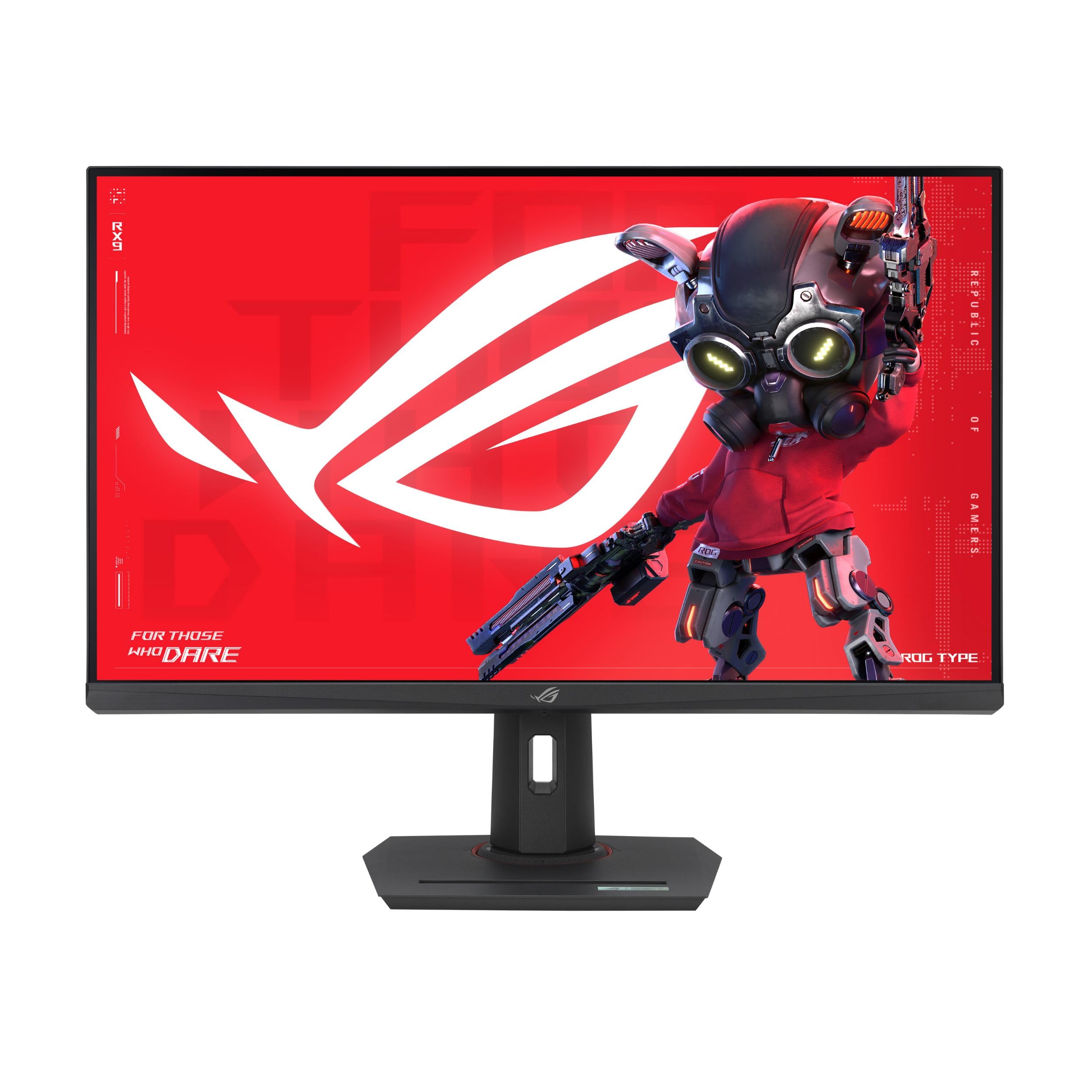
The ASUS ROG Strix XG32UCG delivers a dual-mode trick that no other 32-inch monitor at this premium tier pulls off: one button switches between native 4K at 160Hz and a boosted 1080p at 320Hz. The Fast IPS panel with 0.3ms response time keeps motion crisp regardless of the mode, and the inclusion of Extreme Low Motion Blur Sync means you get ELMB working in tandem with variable refresh rate rather than disabling it. Combined with a full ergonomic stand — height, swivel, tilt — this is the most versatile gaming monitor on the list.
Color performance is equally impressive. The 95% DCI-P3 coverage and 130% sRGB gamut produce vibrant, punchy images out of the box, and the built-in USB-C with DisplayPort Alt Mode keeps your desk clutter-free. The semi-gloss screen strikes a fine balance between reducing reflections and maintaining the deep blacks that glossy panels are known for. During extended work sessions, the flicker-free backlight and low blue light settings genuinely reduce fatigue.
The DisplayWidget Center software lets you adjust OSD settings with a mouse, which is a welcome convenience for anyone who has ever fumbled with rear-facing joysticks. A minor caveat is that the dynamic contrast ratio is rated at 100,000,000:1, but real-world performance is still limited by the 1000:1 static contrast of the IPS panel — meaning blacks are good but not OLED-level. The 3-year warranty and included ROG pouch add to the value proposition.
Why it’s great
- Dual-mode 4K 160Hz / FHD 320Hz with real-time switching
- Full ergonomic stand with height, swivel, and tilt
- ELMB Sync works with variable refresh rate
Good to know
- Static contrast ratio is standard IPS 1000:1
- Premium price point, no OLED black levels
2. MSI MPG 321URX QD-OLED

The MSI MPG 321URX QD-OLED is the gold standard for image quality in the 32-inch category. The Quantum Dot OLED panel delivers true blacks — not “very dark gray” blacks — because each pixel emits its own light and can turn off completely. This gives you an infinite contrast ratio and a VESA DisplayHDR True Black 400 certification that makes HDR content genuinely pop. With a 0.03ms GtG response time and 240Hz refresh rate, motion clarity is as close to perfect as current monitor technology gets.
Color accuracy is factory-calibrated to Delta E ≤ 2 across the 99% DCI-P3 gamut, so creative professionals can trust the image straight out of the box. The built-in KVM switch and Picture-by-Picture mode make it easy to share the screen between a work laptop and a gaming PC without swapping cables. The USB-C port provides 90W power delivery, which is enough to charge a 14-inch MacBook Pro at full speed.
OLED Care 2.0 handles burn-in mitigation through pixel refresh and panel shift routines, and MSI backs the monitor with a 3-year warranty that covers burn-in. The text clarity on the QD-OLED panel is excellent — no fringing issues that plagued earlier OLED monitors — making this viable for software engineering and productivity work as well. The lack of a headphone jack and the relatively low 250-nit full-screen brightness in SDR mode are the only real compromises for day-to-day use.
Why it’s great
- Infinite contrast and perfect HDR blacks
- 240Hz with 0.03ms response time
- Integrated KVM and 90W USB-C power delivery
Good to know
- SDR full-screen brightness is limited to 250 nits
- Burn-in risk exists despite OLED Care features
3. Samsung Odyssey G50D

The Samsung Odyssey G50D hits the mid-range gaming sweet spot with a 32-inch QHD Fast IPS panel that runs at 180Hz with a 1ms GtG response time. The combination of 2560×1440 resolution and a high refresh rate is ideally suited for modern GPUs — you get sharp enough text for everyday use and smooth enough frames for competitive shooters without breaking the bank. The VESA DisplayHDR 400 certification gives you decent peak brightness for HDR content, though the 1000:1 static contrast ratio is typical for IPS.
Where the G50D stands out from its mid-range peers is the full ergonomic stand. You get height adjustment, swivel, tilt, and pivot rotation — normally reserved for professional or premium models. This makes it easy to set up a comfortable viewing posture or switch to portrait mode for coding and document reading. The Eye Saver Mode and flicker-free technology reduce eye strain during extended sessions, and G-Sync Compatibility keeps the experience tear-free with both Nvidia and AMD GPUs.
Some users have reported that the factory calibration leans oversaturated, requiring about an hour of manual tuning to get accurate colors. The adaptive sync behavior can also cause color balance shifts when VRR is active, which is worth noting if you do color-sensitive work. But for pure gaming and general use, the adjustability and speed of this panel make it a compelling choice at its price tier.
Why it’s great
- Full ergonomic stand with height, swivel, and pivot
- 180Hz Fast IPS with G-Sync Compatibility
- VESA DisplayHDR 400 for decent HDR brightness
Good to know
- Default color calibration can be oversaturated
- Adaptive sync affects color balance when enabled
4. KTC H32P22P
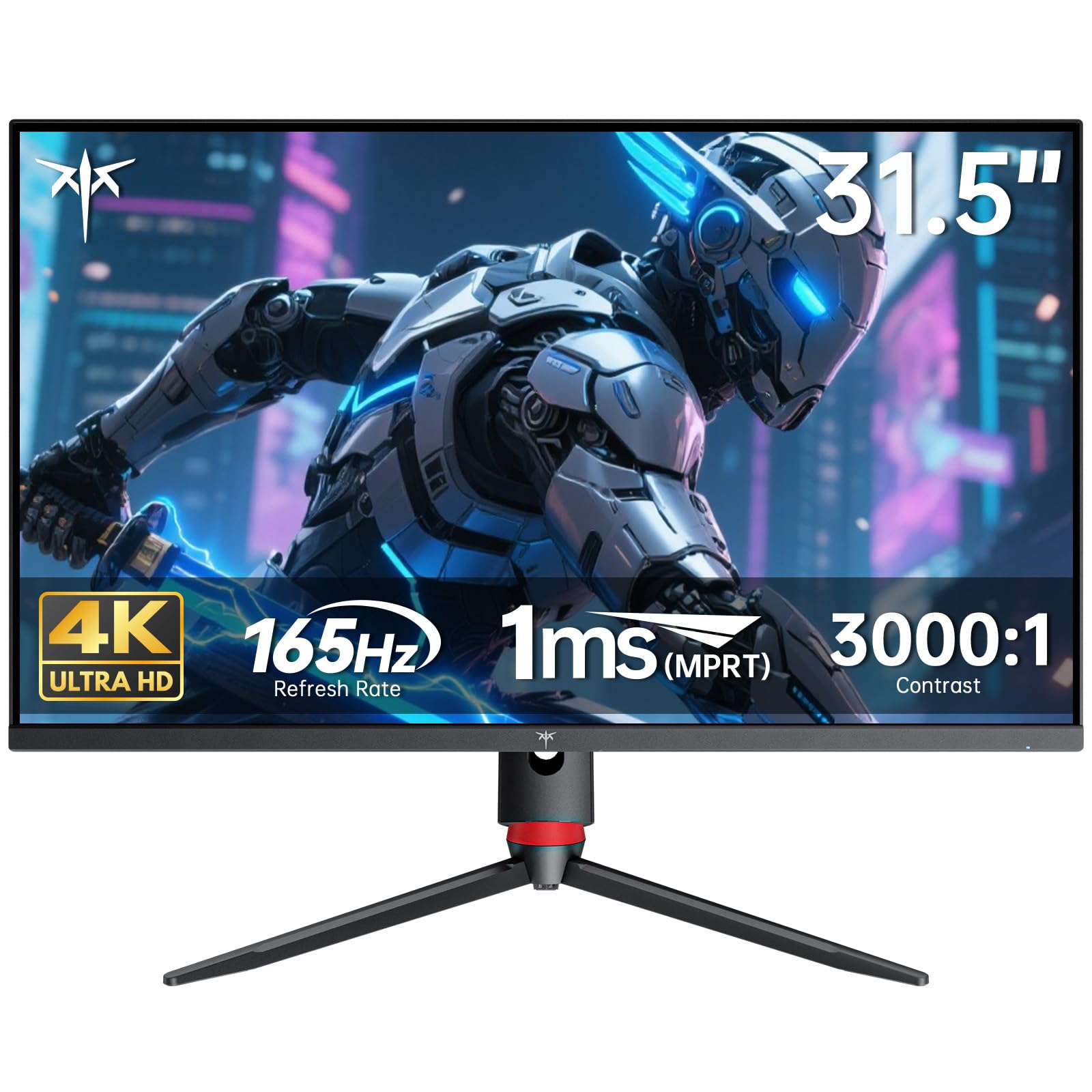
The KTC H32P22P packs 4K UHD resolution and a 165Hz refresh rate into a price that usually buys a mid-range 1440p monitor. The Fast IPS panel delivers the wide viewing angles and color consistency you expect from IPS technology, and the 121% sRGB color gamut area produces vivid images for gaming and media consumption. The 3000:1 contrast ratio is unusually high for an IPS panel — most sit at 1000:1 — so blacks look deeper than the competition in this tier.
Connectivity is well thought out for a budget-priced 4K monitor. You get HDMI 2.1 ports that support full 4K at 165Hz on next-gen consoles and PCs, plus a DisplayPort 1.4 that handles the same bandwidth. The KTC also includes a height-adjustable stand, which is rare at this price point, and a VESA 100x100mm mount pattern for arm installation. The package comes with a DP cable, screwdriver, and power adapter, so setup is straightforward out of the box.
Some units have been reported to cap at 100Hz over HDMI, so you may need to use DisplayPort to reach the full 165Hz. The built-in speakers are basic — fine for system sounds but not for critical listening or gaming. The three-year warranty and 12-hour response time on customer support provide peace of mind, but the brand awareness is lower than Samsung or LG, which may matter for some buyers.
Why it’s great
- 4K 165Hz at a price that rivals 1440p monitors
- 3000:1 contrast ratio for better-than-average IPS blacks
- Includes height-adjustable stand
Good to know
- Full 165Hz requires DisplayPort connection
- Onboard speakers are underwhelming
5. ViewSonic VP3256-4K

The ViewSonic VP3256-4K is built for professionals who need color accuracy straight out of the box. The 32-inch 4K IPS panel is Pantone Validated and covers 100% sRGB, EBU, and SMPTE C color spaces with a Delta E of less than 2. This makes it a reliable choice for photographers, video editors, and graphic designers who cannot afford color drift between their monitor and their output. The anti-glare coating reduces reflections without making the image look hazy.
USB-C connectivity with 65W power delivery turns the VP3256-4K into a docking hub for a modern laptop. One cable handles video, data, and charging, and the monitor also includes a four-port USB 3.2 hub for peripherals. The ergonomic stand is equally impressive — you get height adjustment, swivel, tilt, and pivot rotation, so you can dial in the exact position for your workflow. The flicker-free backlight and blue light filter help with all-day comfort.
The 60Hz refresh rate is a deliberate limitation — this is not a gaming monitor, and it never tries to be. The OSD menu navigation is clunky, though the free software control (ViewSonic’s ColorPro tools) provides a workaround for adjusting settings with a mouse. Some Mac users have noted that pivot rotation to portrait mode does not work properly when connected to macOS, so verify your OS compatibility if portrait orientation is a deal-breaker.
Why it’s great
- Pantone Validated with Delta E < 2 accuracy
- USB-C with 65W power delivery and built-in hub
- Full ergonomic stand with height, swivel, tilt, pivot
Good to know
- Limited to 60Hz, not suitable for competitive gaming
- Pivot rotation may not work with macOS
6. ASUS ProArt PA329CV

The ASUS ProArt PA329CV is a workhorse for color-critical workflows. The 32-inch 4K IPS panel is Calman Verified and factory-calibrated to achieve Delta E < 2, with 100% sRGB and 100% Rec. 709 color gamut coverage. This level of accuracy means that what you see on the screen will match your final output — whether that is a printed photograph, a broadcast video, or a digital campaign. The 400 cd/m² brightness is higher than most competing professional monitors, making it usable in brighter rooms.
Connectivity is comprehensive for a creative setup. The USB-C port supports DisplayPort Alt Mode and 65W power delivery, and there are four USB 3.2 Gen 1 Type-A ports for peripherals. The stand offers height adjustment, swivel, pivot, and tilt, which is essential for achieving a neutral viewing posture during long editing sessions. The desk C-clamp included in the box is a thoughtful addition for those who want to mount the monitor to a thicker desk without a third-party arm.
The bundled color pre-calibration report gives you confidence in the factory accuracy, but the front buttons are unlit and hard to see in a dim studio. Some users have reported that the USB-C display function required a firmware update to work reliably with M1 Macs. The build quality is solid but not luxurious — the chassis is mostly plastic, which keeps the weight manageable but does not match the premium feel of the ViewSonic VP3256-4K.
Why it’s great
- Calman Verified with factory Delta E < 2 calibration
- 100% sRGB and 100% Rec. 709 color coverage
- USB-C with 65W PD and four USB-A ports
Good to know
- Front OSD buttons are unlit and hard to locate
- Plastic build does not feel premium
7. Dell S3225QS

The Dell S3225QS is a 4K VA panel that prioritizes eye comfort without sacrificing image quality. The VA panel delivers a 1500:1 native contrast ratio, which is 50% higher than a typical IPS panel, producing noticeably deeper blacks and better perceived depth in movies and games. The refresh rate reaches 120Hz with AMD FreeSync Premium, so motion feels smooth without the high cost of a dedicated gaming monitor. The 99% sRGB and 95% DCI-P3 coverage ensures colors are accurate and vibrant.
ComfortView Plus is the standout feature — it reduces harmful blue light emissions to 35% or less without the yellow tint that most blue light filters introduce. For anyone who spends eight or more hours in front of a screen for office work or content creation, this is a genuine health benefit. The slim bezels and ash white finish give the monitor a modern, minimalist look that fits well in a professional workspace, and the built-in speakers are surprisingly robust for a monitor — they offer deeper frequency response than the previous generation.
The stand provides height and tilt adjustment, but it lacks swivel and pivot rotation. The volume on the built-in speakers is loud even at the lowest setting, which can be an issue if you need precise volume control for quiet environments. The included HDMI cable is only 6 feet long, so you may need a longer cable depending on your desk layout.
Why it’s great
- ComfortView Plus reduces blue light to ≤35% without yellow tint
- 1500:1 VA contrast ratio for deep blacks
- Built-in speakers with better-than-average sound quality
Good to know
- Stand lacks swivel and pivot rotation
- Speaker minimum volume is still quite loud
8. LG 32GS60QC-B
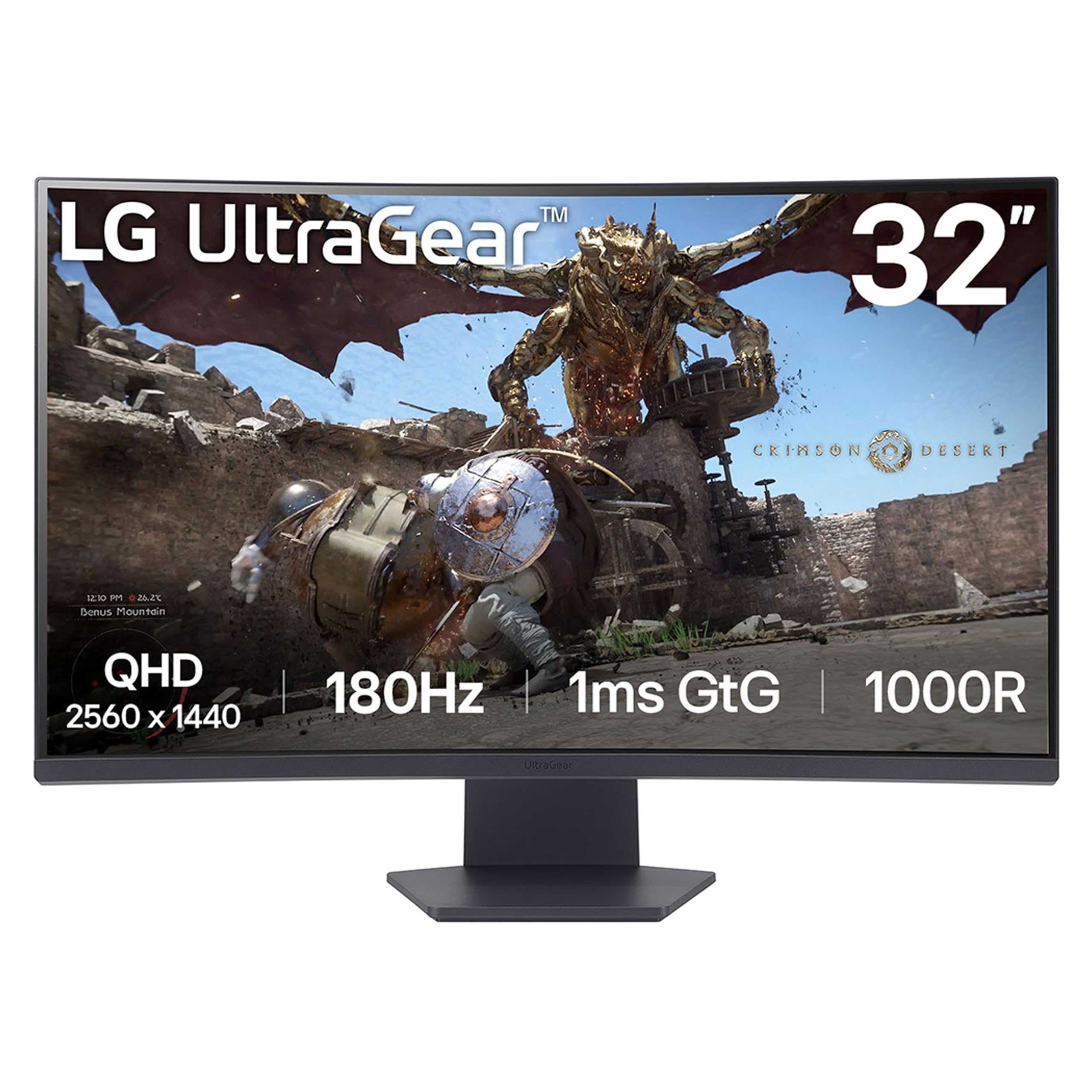
The LG 32GS60QC-B brings a steep 1000R curvature to the 32-inch QHD segment, wrapping the screen around your peripheral vision for a genuinely immersive experience in racing sims, flight sims, and single-player RPGs. The VA panel offers a native contrast ratio of 3000:1, which makes dark scenes look rich without the gray haze that plagues IPS monitors in dim environments. The 180Hz refresh rate and 1ms GtG response time keep fast motion clear, though VA panels can exhibit some black-level smearing at very low response time settings.
AMD FreeSync support covers the full 48-180Hz range, meaning no tearing or stuttering as long as your GPU can stay inside that window. The three-side virtually borderless design with a matte black finish looks clean on any desk, and the tilt-adjustable stand is functional if minimal. Connectivity includes two HDMI ports and a DisplayPort, which is enough for a dual-PC or PC-plus-console setup.
The stand only offers tilt adjustment — there is no height or swivel, which is a significant ergonomic limitation at this price point. The auto-brightness feature cannot be disabled, which can cause the screen to dim or brighten unexpectedly during mixed desktop usage. Some users have reported HDMI handshake issues that require switching to DisplayPort for reliable signal detection. The black stabilizer and dynamic action sync features are useful for competitive gaming.
Why it’s great
- 1000R curve wraps around your field of view
- 3000:1 VA contrast for deep, rich blacks
- 180Hz with 1ms response for smooth gaming
Good to know
- Stand lacks height adjustment and swivel
- Auto-brightness cannot be manually disabled
9. KTC 32 Inch 2K QHD
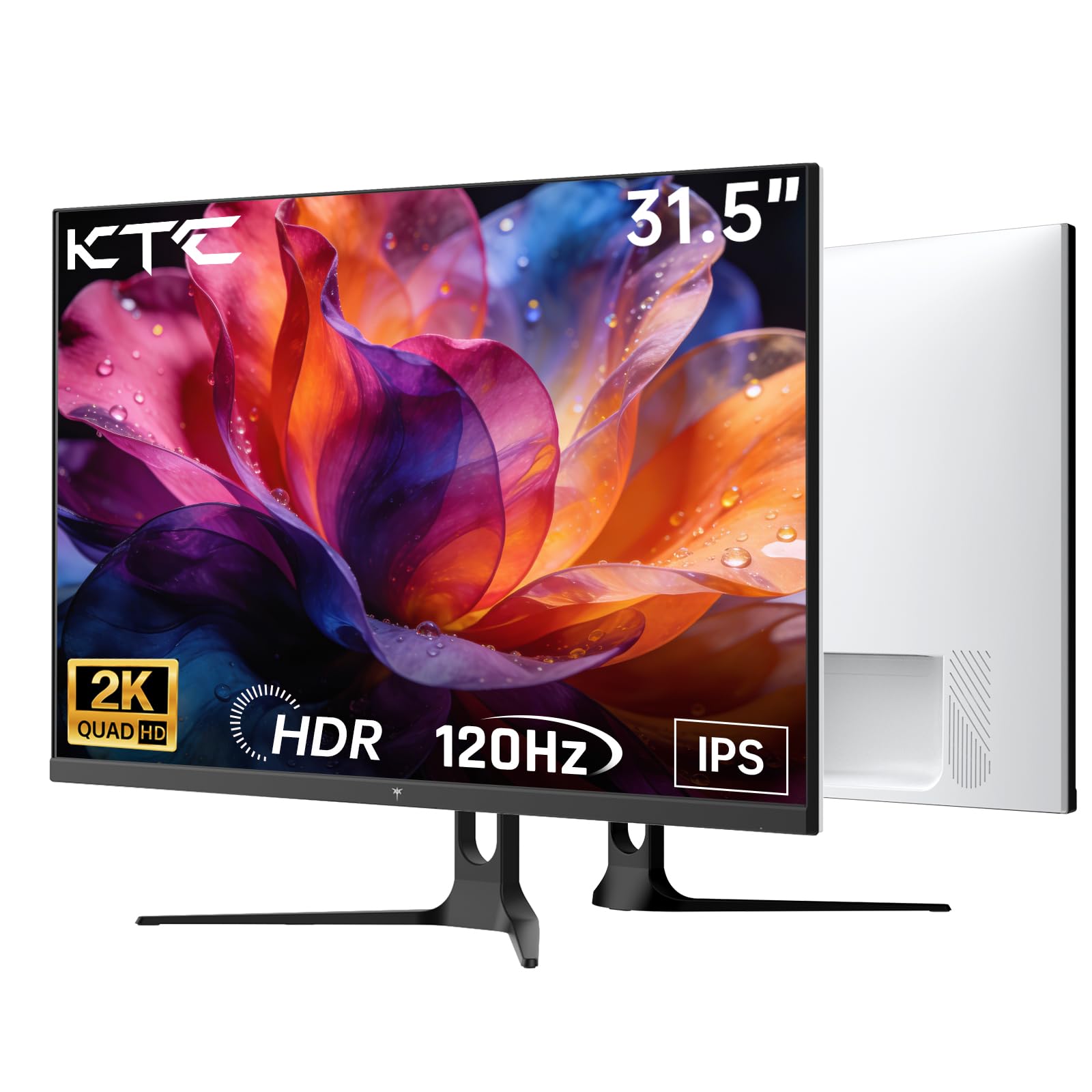
The KTC 32 Inch 2K QHD Monitor delivers a well-rounded package at an entry-level price. The 2560×1440 IPS panel hits a pixel density of about 92 PPI, which is sharp enough for office productivity, web browsing, and media consumption without forcing your GPU to work as hard as it would with 4K. The 120Hz refresh rate — achieved by overclocking from 100Hz — provides a noticeable smoothness upgrade over standard 60Hz monitors for daily use and light gaming.
Color quality is a strong point for this price tier. The monitor covers 109% sRGB color gamut area and features Delta E < 2 accuracy, which means colors are reasonably accurate out of the box. The 350 cd/m² brightness is sufficient for most indoor environments, and the low blue light and flicker-free technologies help reduce eye strain during long work sessions. The white color variant is a nice alternative for those who want a lighter aesthetic on their desk.
The stand only offers tilt adjustment, which limits your ability to dial in an ergonomic setup without a third-party arm. Some users have reported that after waking from sleep mode, the monitor’s settings become unresponsive and require switching inputs to regain control. The package includes only a DisplayPort cable, so HDMI users will need to supply their own cable. Adaptive Sync works but is limited to the 100Hz baseline in some configurations.
Why it’s great
- 1440p IPS panel with Delta E < 2 color accuracy
- 120Hz refresh rate is a big upgrade from 60Hz
- Low blue light and flicker-free eye care
Good to know
- Stand only tilts, no height or swivel adjustment
- Some units lose settings responsiveness after sleep mode
FAQ
Is 1440p sharp enough on a 32-inch monitor for office work?
What refresh rate do I actually need for gaming on a 32 inch monitor?
Does a curved screen make sense for a 32 inch monitor?
Final Thoughts: The Verdict
For most users, the 32 inch monitor winner is the ASUS ROG Strix XG32UCG because it combines dual-mode 4K gaming with a full ergonomic stand and excellent color coverage. If you want infinite contrast and the fastest response time possible, grab the MSI MPG 321URX QD-OLED. And for the best value at 1440p with full adjustability, nothing beats the Samsung Odyssey G50D.