
Our readers keep the lights on and the weekend projects moving. As an Amazon Associate, I earn from qualifying purchases.
The wraparound field of view pulls your peripheral vision into the action, making every racing turn and open-world horizon feel physically present. But choosing the right panel means navigating a battlefield of OLED burn-in fears, QD-OLED color saturation, VA contrast ratios, and refresh rate trade-offs—a decision that hinges on specific panel technology, not just diagonal inches.
I’m Rikta — the co-founder and writer behind FitlyFast. I’ve spent countless hours analyzing the engineering trade-offs between QD-OLED, WOLED, and high-refresh VA panels, examining pixel response data, burn-in mitigation algorithms, and color gamut measurements to separate genuine performance from marketing veneer.
Whether you prioritize silky 240Hz motion clarity for competitive shooters or deep inky blacks for atmospheric RPGs, this guide pinpoints the 34 inch curved gaming monitor that fits your specific gaming DNA and workload reality.
How To Choose The Best 34 Inch Curved Gaming Monitor
Stepping up to a 34-inch ultrawide means committing to a panel technology that will define your visual experience for years. The three dominant options—QD-OLED, WOLED, and VA—each carry distinct trade-offs in color volume, black depth, text clarity, and burn-in susceptibility that directly impact gaming immersion and daily usability.
Panel Technology: OLED vs. VA vs. QD-OLED
OLED panels deliver true black by turning off individual pixels, creating infinite contrast that makes HDR content pop. QD-OLED uses a quantum dot layer to convert blue light into pure red and green, achieving wider color gamut coverage (over 99% DCI-P3) and higher peak brightness than standard WOLED. VA panels can produce deep blacks and high contrast ratios (3000:1) at a fraction of the cost but suffer from slower pixel response times that introduce visible ghosting in fast-moving scenes. For a 34-inch curved gaming monitor, OLED-based panels are the gold standard for visual fidelity, while VA panels offer a budget-friendly entry point with solid contrast.
Refresh Rate and Adaptive Sync
Refresh rate determines how many frames the monitor can display per second—165Hz is the baseline for smooth ultrawide gaming, while 240Hz gives competitive players an edge in reaction-time-sensitive titles. Adaptive sync technologies (G-Sync Compatible, FreeSync Premium Pro) synchronize the monitor’s refresh rate with your GPU’s frame output to eliminate screen tearing without introducing input lag. Look for VESA AdaptiveSync certification as an independent validation of tear-free performance across both NVIDIA and AMD ecosystems.
Burn-in Prevention and Panel Care
OLED burn-in—permanent image retention from static UI elements—remains the primary long-term concern for curved gaming monitors. Effective prevention includes pixel shift (micro-movements of the image), pixel refresh cycles that run during standby, and logo/taskbar detection that dims static regions. Premium models from Dell, Alienware, ASUS, and Samsung now bundle 3-year burn-in warranties, which is the single strongest indicator of manufacturer confidence in panel longevity. Monitors without explicit burn-in coverage carry higher risk for users who leave HUD elements on screen for extended sessions.
Quick Comparison
On smaller screens, swipe sideways to see the full table.
| Model | Category | Best For | Key Spec | Amazon |
|---|---|---|---|---|
| Alienware AW3423DWF | QD-OLED | All-around gaming & content creation | 165Hz / 0.1ms / 1800R | Amazon |
| Alienware AW3425DW | QD-OLED | High-fps competitive gaming | 240Hz / 0.03ms / 1800R | Amazon |
| Acer Predator X34 | OLED | PS5/Xbox & PC hybrid gaming | 240Hz / 0.01ms / 800R | Amazon |
| LG 34GX90SA-W | OLED | Streaming + cloud gaming | 240Hz / 0.03ms / 800R | Amazon |
| Samsung Odyssey OLED G8 | QD-OLED | Bright-room HDR gaming | 175Hz / 0.03ms / 1800R | Amazon |
| ASUS ROG Strix XG34WCDG | QD-OLED | Burn-in worry-free gaming | 175Hz / 0.03ms / 1800R | Amazon |
| AOC Agon PRO AG346UCD | QD-OLED | Budget QD-OLED entry | 175Hz / 0.03ms / 1800R | Amazon |
| Philips Evnia 34M2C6500 | QD-OLED | Dark scene immersion | 175Hz / 0.03ms / 1800R | Amazon |
| Dell 34 Plus S3425DW | VA | Productivity + casual gaming | 120Hz / 0.03ms / 1800R | Amazon |
| LG 49WQ95C-W | Nano IPS | Multi-monitor replacement | 144Hz / 5ms / 3800R | Amazon |
| Samsung Odyssey Neo G9 | Mini-LED | Extreme ultrawide supersampling | 240Hz / 1ms / 1000R | Amazon |
In‑Depth Reviews
1. Alienware AW3423DWF Curved QD-OLED Gaming Monitor

The AW3423DWF strikes the ideal balance between visual excellence and long-term value, combining a 34-inch QD-OLED panel with a 165Hz refresh rate and 0.1ms response time. Its 1800R curvature wraps the 21:9 ultra-wide format around your peripheral vision without feeling too aggressive for productivity tasks like spreadsheets or video editing timelines. The quantum dot layer pushes color coverage past 99% DCI-P3, delivering HDR highlights that feel punchy without the over-saturated compromise often seen on lower-tier OLED panels.
Burn-in protection is handled through pixel refresh cycles that run during standby—users who reported no retention after 15 months of heavy daily use attest to its reliability. The included 3-year premium warranty specifically covers OLED burn-in, which removes the financial anxiety that typically shadows OLED monitor purchases. The Creator Mode offers native DCI-P3 and sRGB color space switching, making this monitor equally capable for gaming sessions and color-critical design work.
Downsides are limited to lower sustained brightness (250 cd/m² typical) compared to high-end Mini-LED panels, and a fragile screen coating that can micro-scratch if cleaned aggressively. The stand is fully adjustable with height, tilt, and swivel, though the 1800R curve remains gentle enough for dual-monitor setups. For gamers who want OLED magic without the premium tax or burn-in worry, this is the reference point.
Why it’s great
- Infinite contrast with true blacks makes HDR games like Cyberpunk 2077 transformative
- 3-year burn-in warranty provides unmatched long-term peace of mind
- Creator Mode with calibrated sRGB/DCI-P3 switching serves dual gaming and professional use
Good to know
- Peak brightness of 250 cd/m² can feel dim in brightly lit rooms
- Screen coating is prone to micro-scratches from microfiber cloths
2. Alienware 34 240Hz QD-OLED AW3425DW

Jumping from 165Hz to 240Hz on an OLED panel is a sensory leap that competitive gamers will feel immediately—the AW3425DW achieves 0.03ms response times with no perceivable ghosting, making fast flicks in Valorant and tracking in Apex Legends feel impossibly fluid. The QD-OLED panel delivers 99.3% DCI-P3 coverage and a 1,500,000:1 contrast ratio, producing specular highlights that genuinely appear to hover above the screen in HDR content. It carries both G-Sync Compatible and FreeSync Premium Pro certifications, ensuring tear-free synchronization regardless of your GPU brand.
HDR peak brightness hits 1000 nits on small highlights, which gives explosion effects and sunlight reflections a retina-searing intensity that lower-brightness OLEDs cannot match. The 1800R curve is gentle enough to avoid geometric distortion in non-gaming applications, and the matte anti-glare coating reduces reflections without crushing dark detail. The build quality matches Alienware’s premium reputation—the stand is rigid with height, swivel, and tilt adjustments, and cable management channels keep the desk clean.
The trade-off is a glossy screen surface that shows fingerprints easily and the inherent OLED concern over static UI burn-in, though the panel includes pixel refresh and logo detection tools. Text clarity is slightly softer than a high-PPI IPS panel due to the non-standard subpixel layout, so heavy spreadsheet users may notice minor fringing. At its price tier, this monitor is the pure gaming performance champion for those who refuse to compromise on motion clarity.
Why it’s great
- 240Hz refresh rate with 0.03ms response eliminates all motion blur in competitive titles
- 1000 nits peak HDR brightness creates explosive highlight detail
- Dual adaptive sync (G-Sync + FreeSync Pro) covers both NVIDIA and AMD ecosystems
Good to know
- Glossy screen surface shows fingerprints and requires careful cleaning
- Text clarity is slightly softer than high-PPI IPS panels due to subpixel layout
3. Acer Predator X34 OLED Curved Gaming Monitor

The Predator X34 distinguishes itself with dual HDMI 2.1 ports, making it the rare ultrawide OLED that fully supports PS5 and Xbox Series X at native 3440×1440 with variable refresh rate. The 800R curvature is significantly steeper than the 1800R standard, wrapping the image tightly around your field of view—this creates a genuinely cockpit-like immersion in racing sims and flight games, though it introduces visible geometric distortion on desktop windows and spreadsheets. The OLED panel hits 240Hz at 0.01ms response time, making it one of the fastest 34-inch monitors available regardless of panel technology.
Color performance is strong with 99% DCI-P3 coverage and VESA DisplayHDR True Black 400 certification, though peak brightness tops out at 275 cd/m² typical and 450 cd/m² peak—noticeably lower than QD-OLED competitors. The integrated KVM switch allows seamless keyboard and mouse sharing between two source devices, a practical feature for PC and console hybrid setups. USB-C delivers 90W power delivery, enough to charge a gaming laptop during use.
The main drawback is software-related: users report an aggressive image retention refresh pop-up that appears every few hours during gaming sessions, forcing a 5-minute black screen if accepted. The OSD menu is functional but feels dated compared to competitors. For console gamers who demand HDMI 2.1 VRR support in an ultrawide OLED format, this monitor is essentially unmatched—but PC-first users may find the features better served elsewhere.
Why it’s great
- Dual HDMI 2.1 ports enable full VRR support for PS5 and Xbox Series X
- 800R steep curve creates unmatched cockpit immersion in racing and flight sims
- Integrated KVM switch simplifies multi-device setups
Good to know
- Aggressive pixel refresh pop-up interrupts gaming every few hours
- Peak brightness is lower than QD-OLED alternatives
4. LG 34GX90SA-W Ultragear OLED
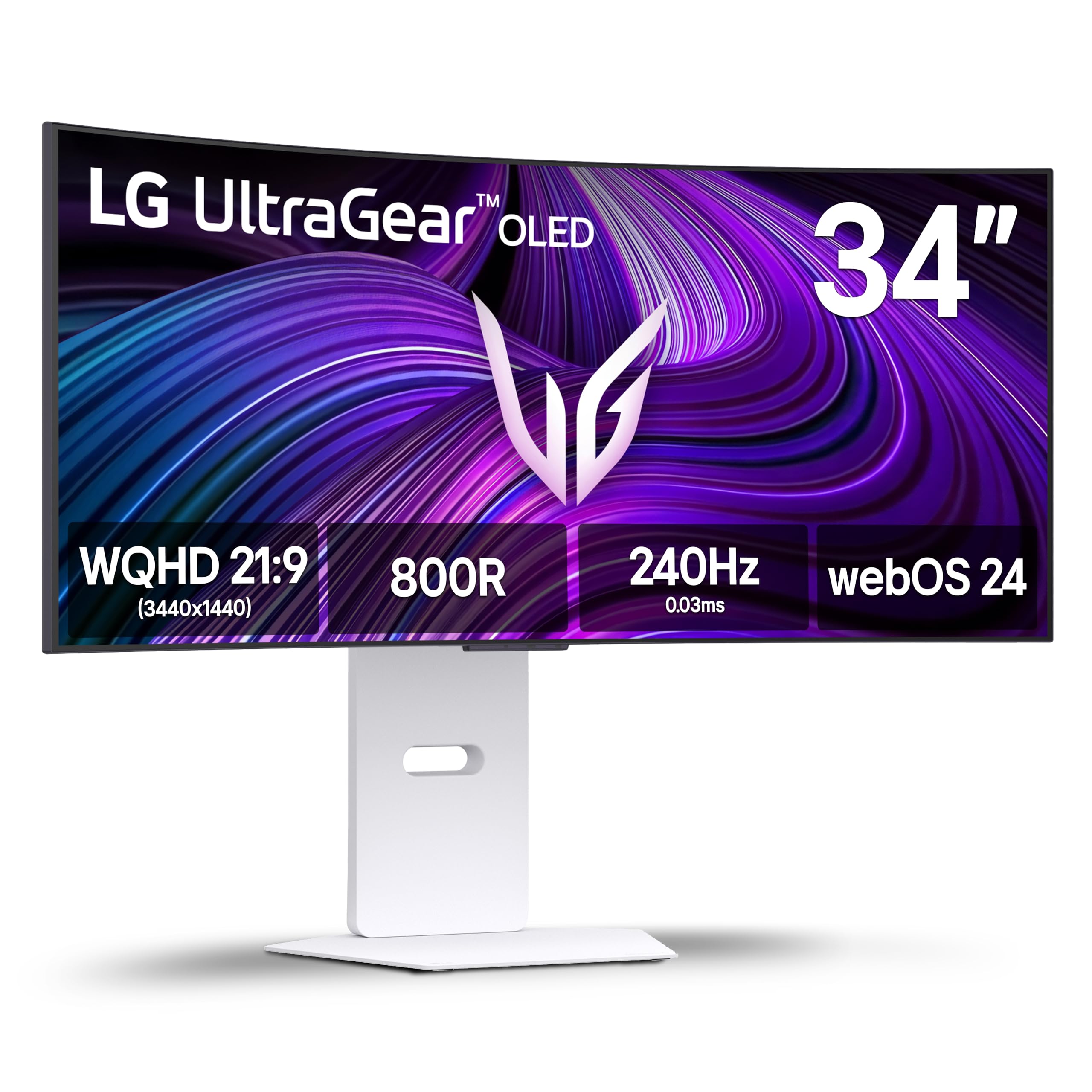
The LG 34GX90SA-W is unique in this category because it integrates webOS 24 directly into the monitor, enabling Netflix, Prime Video, and cloud gaming services (NVIDIA GeForce NOW, Amazon Luna) to run without a PC connected. This transforms the monitor into a standalone entertainment hub—ideal for gamers who want a large curved screen for console-style living room setups or dorm rooms where desk space is limited. The OLED panel delivers 98.5% DCI-P3 coverage and a 1.5M:1 contrast ratio, but what truly sets it apart is the 800R curve, the steepest in this list, which wraps the image around your field of view aggressively.
Performance matches the premium tier: 240Hz refresh rate, 0.03ms response time, and both G-Sync Compatible and FreeSync Premium certifications. The anti-glare surface minimizes reflections effectively, and USB-C provides 65W power delivery for laptops. The white chassis is a visual departure from the black/red gaming aesthetic, fitting modern minimalist desk setups. OLED Care tools include pixel cleaning and a 2-year limited warranty covering the panel.
The smart TV functionality introduces complexity—webOS can feel slower than a dedicated streaming device, and the remote control is an additional item to keep track of. Some users report the auto screen refresh after 12 hours of cumulative use can be disruptive. For pure PC gaming without the smart features, a simpler monitor with the same panel at a lower price may be preferable.
Why it’s great
- Built-in webOS streams Netflix and cloud gaming without a PC
- 800R steep curve delivers immersive peripheral wrap in racing and action games
- White chassis fits clean, modern desk aesthetics
Good to know
- Smart TV interface adds complexity and slows down the pure monitor experience
- Auto screen refresh after 12 hours can interrupt gaming sessions
5. Samsung 34 Odyssey OLED G8 (G85SD)

Samsung’s Odyssey OLED G8 brings their Smart TV platform into the gaming monitor space with Glare Free technology that significantly reduces reflections—a meaningful advantage for rooms with large windows or overhead lighting where traditional glossy OLEDs wash out. The 34-inch QD-OLED panel delivers 99% DCI-P3 coverage with a 1,000,000:1 contrast ratio, and its 1800R curve provides a comfortable, natural viewing arc that works for both immersive gaming and productivity. The 175Hz refresh rate and 0.03ms response time perfectly match the QD-OLED’s fast pixel switching, making motion look exceptionally clean.
The built-in Smart Hub offers access to streaming apps and cloud gaming directly on the monitor, similar to LG’s webOS but with Samsung’s Tizen interface. The remote control enables quick switching between inputs and streaming services, though purists may find the smart features unnecessary overhead. The monitor includes Samsung’s Gaming Hub for Xbox Cloud Gaming and GeForce NOW without requiring a connected PC.
Downsides include the typical QD-OLED text clarity compromise—pixel fringing is visible in white-on-black text, making long reading sessions slightly fatiguing. The Dynamic Black Equalizer is effective at revealing shadow details in dark games without overexposing highlights. For users in bright environments who want the vibrant colors of QD-OLED without glare washing out the image, this is the strongest option in the category.
Why it’s great
- Glare Free technology maintains contrast in brightly lit rooms
- Built-in Smart Hub streams content and cloud games without a PC
- Dynamic Black Equalizer exposes shadow detail without crushing highlights
Good to know
- Text clarity suffers from QD-OLED subpixel fringing
- Smart TV features add cost for users who only want a pure monitor
6. ASUS ROG Strix XG34WCDG QD-OLED
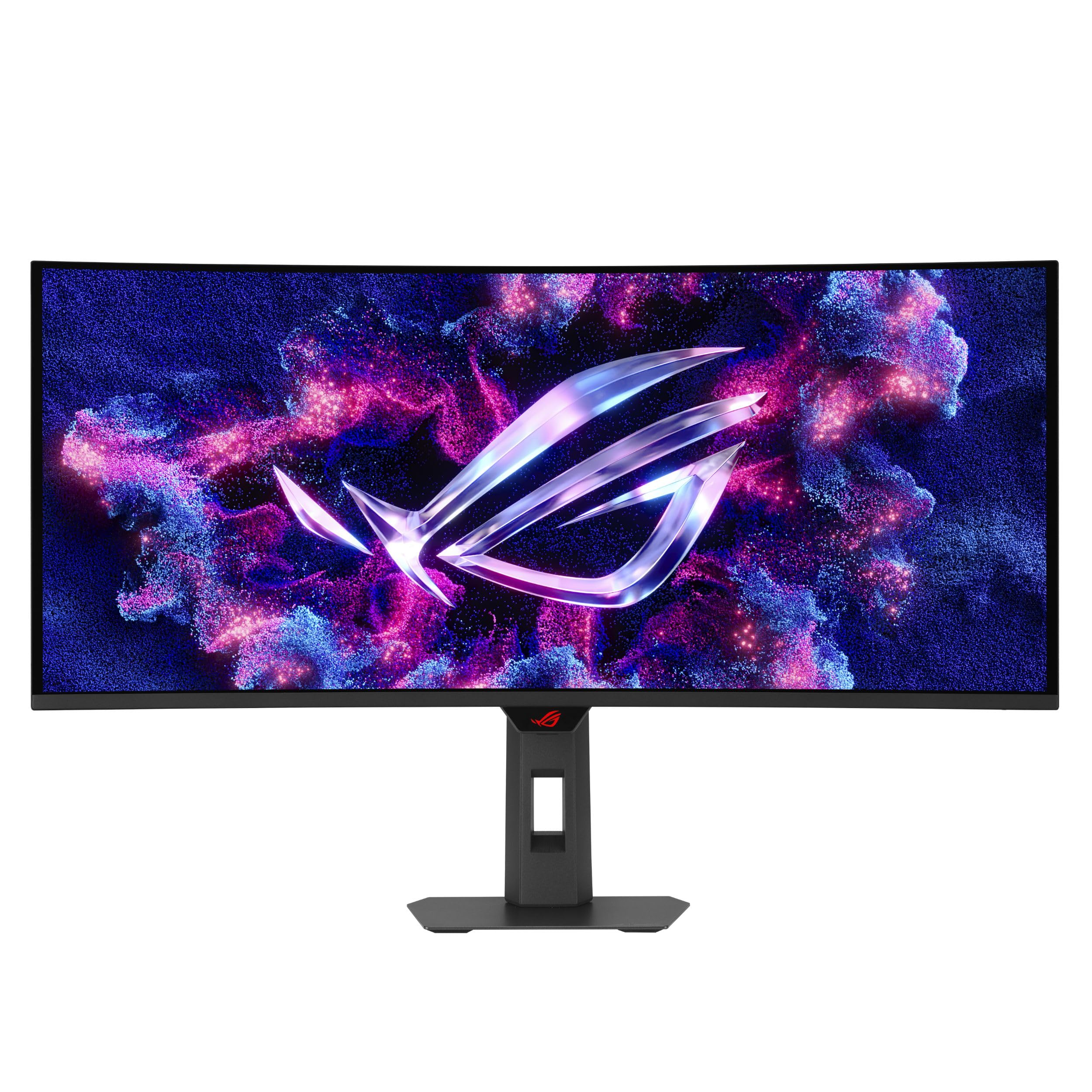
The ASUS ROG Strix XG34WCDG differentiates itself through OLED Care Pro, which includes a Neo Proximity Sensor that detects when you step away and automatically switches the screen to black—reducing static image exposure that causes burn-in. This is the most mature burn-in prevention system available on a 34-inch curved gaming monitor, and it’s backed by a 3-year warranty that explicitly covers OLED burn-in. The QD-OLED panel itself delivers 99.3% DCI-P3 coverage with Delta E color accuracy, making it suitable for color-graded video work alongside gaming.
The 175Hz refresh rate and 0.03ms response time pair with G-Sync Compatible certification for tear-free gameplay across NVIDIA and AMD GPUs. True 10-bit color processing ensures smooth gradients without banding, which is especially noticeable in skyboxes and shadow transitions in open-world games. The DisplayWidget Center software allows mouse-based adjustment of all settings, including OLED Care functions, without fumbling with the OSD joystick.
The primary drawback is the premium price position and a reported color cycling issue that some users experience every few days, requiring a display reset to correct. The stand is sturdy with full ergonomic adjustment but occupies significant desk depth. For users who prioritize panel longevity above all else and are willing to pay for the most comprehensive burn-in protection, this monitor justifies its cost with unique hardware-level detection.
Why it’s great
- Neo Proximity Sensor detects user absence and blacks out the screen to prevent burn-in
- 3-year burn-in warranty offers industry-leading panel protection
- True 10-bit color processing eliminates banding in gradient transitions
Good to know
- Some units exhibit a color cycling issue requiring periodic OSD reset
- Premium price positions it above competing QD-OLED models
7. AOC Agon PRO AG346UCD QD OLED

The AG346UCD brings QD-OLED performance to a more accessible price tier without cutting critical corners—it retains the 175Hz refresh rate, 0.03ms response time, and 1,500,000:1 contrast ratio that define the premium OLED experience. The 1800R curve provides a balanced wraparound feel that works for both gaming immersion and productivity without distorting straight lines. HDR400 True Black certification ensures deep blacks and good highlight separation, though peak brightness is lower than high-end QD-OLED models.
Color reproduction is excellent with the quantum dot layer, producing vivid, saturated images that make games like Ori and the Will of the Wisps look painterly. G-Sync Compatible certification eliminates tearing, and the stand offers full height, swivel, and tilt adjustments plus VESA compatibility for monitor arms. The monitor includes built-in speakers—rare for QD-OLED models—which is useful for console gaming or quick desktop setups.
The build quality is slightly less premium than Alienware or ASUS alternatives—the plastic housing feels functional rather than luxurious—and the OSD menu is basic but responsive. Some users report the screen protector is extremely difficult to remove, leaving adhesive residue that requires careful cleaning. For budget-conscious gamers who want true QD-OLED performance, this monitor delivers the core experience at a lower entry cost.
Why it’s great
- QD-OLED panel with 175Hz and 0.03ms at a lower price than competitors
- Built-in speakers add convenience for console and casual setups
- Full ergonomic stand with height, swivel, and tilt adjustments
Good to know
- Build quality uses more plastic than premium-tier alternatives
- Screen protector removal can leave adhesive residue on the bezel
8. Philips Evnia 34M2C6500 QD OLED
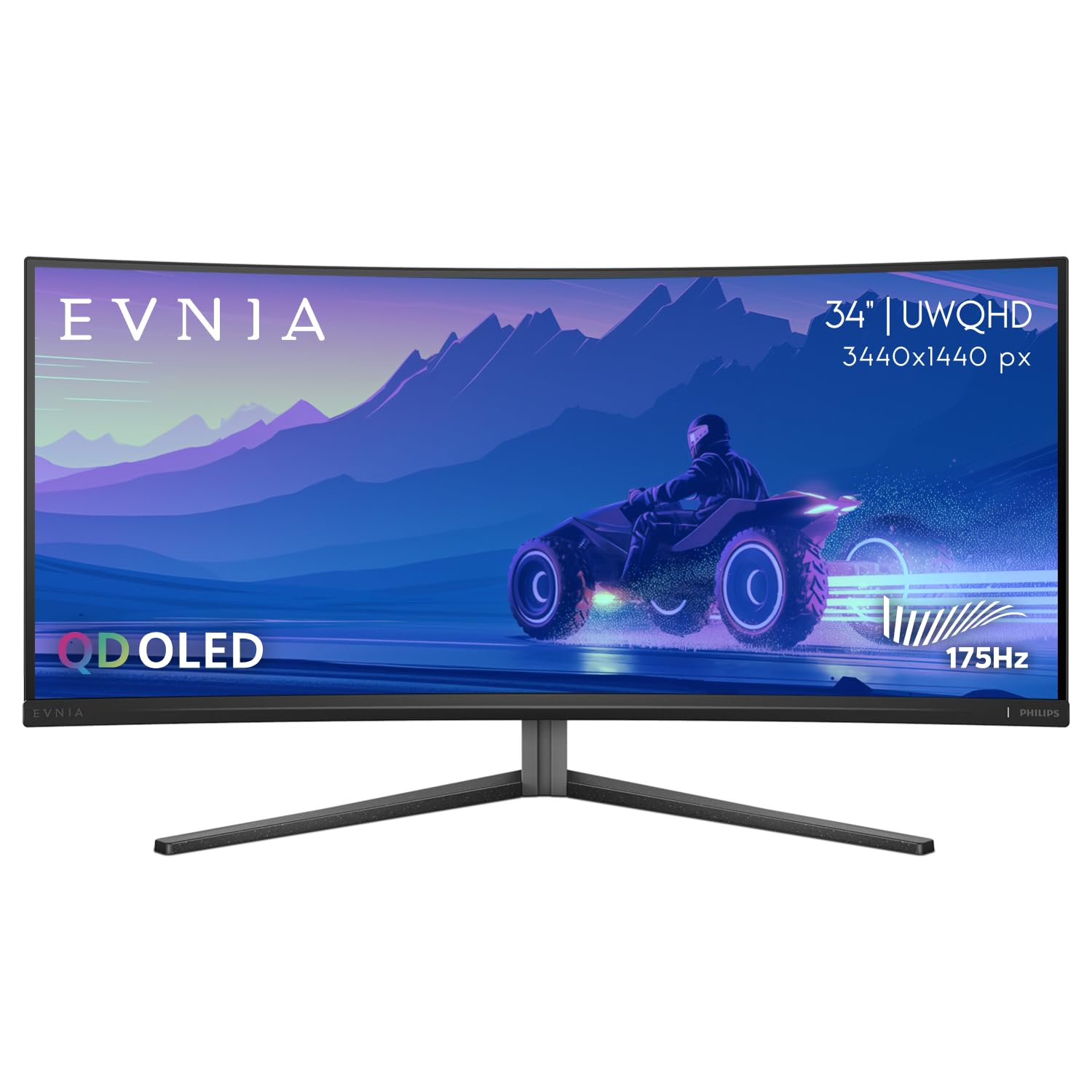
Philips brings its display heritage to gaming with the Evnia 34M2C6500, featuring a QD-OLED panel that produces exceptional black levels and a 1,000,000:1 contrast ratio ideal for dark, atmospheric games like Resident Evil and Alan Wake 2. The 1800R curve is restrained enough to avoid inducing geometric distortion in productivity applications, making this a rare OLED that serves both gaming and office work without compromise. The 175Hz refresh rate and 0.03ms response time ensure fluid motion across all content, while VESA DisplayHDR TrueBlack 400 certification guarantees that black remains black without the grayish bloom typical of VA panels.
The Ambiglow backlight system projects ambient light onto the wall behind the monitor, extending the gaming immersion into the physical space—though the effect only lights three sides and lacks the synchronization precision of Philips’ higher-end models. The stand is functional but predominantly plastic, and the OSD navigation via a basic joystick feels less polished than competitors. Connectivity is straightforward with HDMI 2.0 and DisplayPort 1.4, though the lack of USB-C with power delivery limits single-cable laptop setups.
Build quality concerns appear in customer reviews—some units arrive with dead pixels or cosmetic damage, and the 4-year advance replacement warranty only covers panel defects within strict tolerance thresholds. For users who prioritize black level performance and want a QD-OLED that works in brighter rooms without glare issues, the Evnia delivers where it counts.
Why it’s great
- Exceptional black levels make dark game environments truly immersive
- 4-year advance replacement warranty provides long-term coverage
- Ambiglow backlight adds physical immersion to gaming sessions
Good to know
- No USB-C port limits single-cable laptop connectivity
- Build quality and cosmetic consistency can vary between units
9. Dell 34 Plus USB-C Curved Monitor S3425DW

The Dell S3425DW is the only VA panel in this list, offering a 3000:1 contrast ratio that produces noticeably deeper blacks than IPS panels while avoiding the higher cost and burn-in concerns of OLED. The 34-inch 3440×1440 display runs at 120Hz with AMD FreeSync Premium, which is sufficient for smooth casual gaming but will feel sluggish compared to the 175Hz+ OLEDs above. Its 1800R curve is gentle and natural, making it the most comfortable choice for all-day productivity work like coding or spreadsheet management.
Color coverage reaches 99% sRGB and 95% DCI-P3, which is excellent for a VA panel and serves photo editing and video work well without the oversaturation risks of wide-gamut OLEDs. The built-in speakers offer improved audio output over previous Dell generations, with deeper frequency response that works for conference calls and background videos. USB-C connectivity with 65W power delivery enables a single-cable desktop setup for supported laptops, and the ComfortView Plus feature reduces blue light emissions to below 35% without washing out colors.
The limited connectivity—HDMI and USB-C only, no DisplayPort—may conflict with some GPU setups, and the VESA mount design has a recessed mounting point that requires specific bracket assemblies. The 120Hz refresh rate and slower VA response time cause visible ghosting in fast-paced shooters. For users who need a daily driver for work with occasional gaming, the Dell provides excellent value and eye comfort.
Why it’s great
- 3000:1 contrast ratio delivers deep blacks without OLED burn-in risk
- USB-C with 65W PD enables single-cable laptop connection
- ComfortView Plus reduces blue light without sacing color accuracy
Good to know
- 120Hz refresh rate and VA response time show ghosting in fast shooters
- Limited to HDMI and USB-C—no DisplayPort for some GPU setups
10. LG 49WQ95C-W 49-Inch Nano IPS

The LG 49WQ95C-W is a 49-inch 32:9 super ultrawide monitor that effectively replaces dual 27-inch setups with a single 5120×1440 surface, ideal for gamers who also need extensive screen real estate for trading, video editing, or software development. The Nano IPS panel delivers 98% DCI-P3 coverage with 400 cd/m² brightness and VESA DisplayHDR 400, producing vibrant colors and good contrast for an IPS panel. The 3800R curvature is much gentler than 1800R or 1000R curves, which helps maintain image consistency across the wide screen but reduces the perceived immersion effect in games.
The 144Hz refresh rate with both G-Sync Compatible and FreeSync Premium Pro ensures smooth tear-free gameplay, though the 5ms response time (GtG) is significantly slower than OLED alternatives. HDMI 2.1 connectivity supports full-bandwidth 4K-like input from next-gen consoles, and USB-C with 90W power delivery charges laptops while carrying display signal. The built-in KVM switch enables seamless keyboard/mouse sharing between two connected computers.
The insufficient curvature causes dark corners—the edges of the screen appear darker than the center due to the viewing angle limitations of IPS technology at this width. Users with dual-computer setups report discomfort from having to turn their head to see edges clearly. This monitor excels as a productivity upgrade but falls short of providing the immersive gaming experience of a 34-inch 21:9 OLED.
Why it’s great
- 32:9 format replaces dual monitors with a single seamless surface
- HDMI 2.1 supports full bandwidth input from PS5 and Xbox Series X
- Built-in KVM switch simplifies multi-computer workflows
Good to know
- IPS dark corners are visible on edges due to 3800R curve and panel technology
- 5ms response time cannot match OLED motion clarity
11. Samsung 57 Odyssey Neo G9 G95NC

The Samsung Odyssey Neo G9 is the only monitor on this list pushing Dual 4K UHD (7680×2160) resolution across a 57-inch 32:9 panel, effectively delivering two 4K monitors side by side in a single curved surface. Quantum Mini-LED technology with 2392 local dimming zones produces 1000 nits peak brightness and a 1,000,000:1 contrast ratio that rivals OLED in HDR performance without any burn-in risk. The 1000R curve matches the natural curvature of the human eye, creating a genuinely panoramic field of view that makes supported games feel like you’re looking through a helmet visor.
Performance hardware is equally extreme: 240Hz refresh rate with DisplayPort 2.1 input that can maintain full 7680×2160 at 240Hz with variable refresh rate—a feat that DP 1.4 cannot achieve. AMD FreeSync Premium Pro and G-Sync Compatible support ensure tear-free play across all supported titles. Picture-by-Picture mode allows simultaneous display of two inputs at native resolution, making it possible to game on one half while monitoring Discord or streams on the other.
The monitor weighs 40 pounds and requires a desk at least 30 inches deep or a heavy-duty monitor arm (rated for 40+ lbs). The 32:9 aspect ratio means many games show black bars on the sides or require ultrawide patches to fill the screen. For most gamers, the 57-inch size is excessive and the price is prohibitive—but for flight sim enthusiasts, day traders, and anyone who demands absolute pixel density, the Neo G9 is unmatched.
Why it’s great
- Dual 4K resolution (7680×2160) provides massive screen real estate at high pixel density
- 2392 Mini-LED zones produce OLED-like contrast without burn-in risk
- DisplayPort 2.1 enables full 240Hz VRR at max resolution
Good to know
- 40-pound weight requires deep desk or heavy-duty monitor arm
- Many games lack native 32:9 support, resulting in black bars or stretched images
FAQ
Is QD-OLED worth the extra cost over standard OLED for gaming?
Will a 34-inch curved monitor work for programming and spreadsheet work?
What GPU do I need to drive a 3440×1440 ultrawide at 175Hz?
Final Thoughts: The Verdict
For most users, the 34 inch curved gaming monitor winner is the Alienware AW3423DWF because it delivers the transformative QD-OLED picture quality with deep blacks and vibrant colors, a well-balanced 165Hz refresh rate, and a robust 3-year burn-in warranty that removes the primary concern of OLED ownership. If you want 240Hz competitive speed with aggressive HDR brightness, grab the Alienware AW3425DW. And for those needing a budget-friendly productivity-first monitor with solid image quality and zero burn-in worry, nothing beats the Dell 34 Plus S3425DW.