
Our readers keep the lights on and the weekend projects moving. As an Amazon Associate, I earn from qualifying purchases.
Finding a portable power station that balances enough wattage for essential appliances with a noise level that won’t disturb the campsite or neighborhood is the core challenge of the 3500-watt inverter generator market. These units deliver clean, stable electricity for sensitive electronics like CPAP machines and laptops, all while sipping fuel more efficiently than conventional open-frame generators.
I’m Rikta — the co-founder and writer behind FitlyFast. Over the past few years, I’ve analyzed hundreds of portable generator specs, read thousands of owner reviews, and cross-referenced price-to-performance ratios to understand exactly what separates a smart buy from a frustrating one in this mid-range power class.
Whether you need backup power for a refrigerator and lights during an outage or a reliable companion for RV camping, understanding the trade-offs between running watts, runtime, fuel type, and parallel capability is critical. This guide evaluates the top models to help you confidently choose the best 3500 watt inverter generator for your specific needs.
How To Choose The Best 3500 Watt Inverter Generator
Picking the right 3500-watt inverter generator means looking past the marketing noise and focusing on a few key specs that dictate real-world performance. Your decision hinges on how you plan to use it: occasional camping, regular home backup, or off-grid work.
Running Watts vs. Surge Watts
Surge (starting) watts handle the brief spike when a motor like an RV air conditioner or a refrigerator compressor kicks on. Running (rated) watts is the continuous load the generator can sustain. A unit with 3500 surge watts and 3000 running watts will struggle to power a 15000 BTU RV AC plus lights and a microwave simultaneously. Always match your total running load to the generator’s rated output, not the peak number.
Dual Fuel vs. Gasoline Only
Dual-fuel generators run on both gasoline and propane. Propane offers easier storage (no carburetor gumming over months of disuse) and cleaner combustion, but delivers slightly less peak power. Gasoline is more energy-dense and widely available, but requires more maintenance. If you live in an area prone to long outages, dual-fuel flexibility is worth the slight premium.
Noise Level and Eco Mode
dBA ratings tell you how loud a generator sounds. A drop from 68 to 58 dBA is noticeable — the lower figure sounds about as loud as a normal conversation. Eco Mode automatically adjusts the engine speed to match the load, which cuts fuel consumption and lowers noise significantly during light use. For campgrounds with quiet hours, a model running under 60 dBA is ideal.
Quick Comparison
On smaller screens, swipe sideways to see the full table.
| Model | Category | Best For | Key Spec | Amazon |
|---|---|---|---|---|
| Champion 200977 | Dual Fuel | Home backup & RV | 4250 surge / 3500 rated watts | Amazon |
| Westinghouse 4021 | Premium Gas | Remote start convenience | 52 dBA noise rating | Amazon |
| MaXpeedingrods MXR3500-DC | Dual Fuel | Budget dual fuel | Remote/electric start | Amazon |
| WEN DF360iX | Dual Fuel | RV & propane flexibility | 49 pounds | Amazon |
| GENMAX GM3500iAED | Dual Fuel | Camping & travel | Telescopic handle & wheels | Amazon |
| Generac GP3300i | Gas Only | Home backup | PowerRush starting boost | Amazon |
| Cummins Onan P4500I | Premium Gas | Heavy duty RV use | 224cc OHV engine | Amazon |
| WEN 56360i | Gas Only | Lightweight & compact | 46 pounds | Amazon |
| Champion 2500 Best | Ultralight Gas | Solo carry & tailgating | 39.7 pounds | Amazon |
| ERAYAK 2400P | Budget Gas | Entry-level backup | 52.5 dBA quiet operation | Amazon |
| Westinghouse iGen11000DFc | Large Dual Fuel | Whole-home backup | 11,000 peak watts | Amazon |
In‑Depth Reviews
1. Champion Power Equipment 200977

The Champion 200977 lands in the sweet spot of the 3500-watt class. It delivers 4250 starting watts and 3500 running watts on gasoline, and 4250 starting / 3150 running on propane, with a 22-hour runtime at 25% load. That’s enough to run a 15000 BTU RV air conditioner all day or keep a refrigerator and several lights running through an extended outage. The 224cc engine is a proven platform, and the Intelligauge display gives you live voltage, frequency, and hour tracking.
At 79 pounds, it’s heavier than ultralight competitors, but still manageable for one person to wheel into position. The 64 dBA noise level is quieter than traditional open-frame generators, though it’s on the louder side within the inverter category — expect neighbors to hear it at a quiet campground. The Economy Mode helps throttle down fuel consumption when you’re not pulling heavy loads.
Build quality is solid, with a steel frame and durable components. Some owners report the included oil is unsuitable for very cold starts, so switching to synthetic 5W-30 after break-in is recommended. Overall, the dual-fuel flexibility, long runtime, and brand reliability make this the most versatile pick for both home backup and RV use.
Why it’s great
- True 3500 running watts on gas, 3150 on propane
- 22-hour runtime on gasoline
- RV-ready TT-30R outlet included
Good to know
- 79 pounds is heavier than some rivals
- Not the quietest inverter at 64 dBA
- Cold-weather oil recommendation needed
2. Westinghouse 4021

The Westinghouse 4021 stands out for its remote start with a key fob, allowing you to fire it up from inside your RV or house without braving the weather. It produces 4000 peak watts and 3300 running watts at less than 3% THD, making it safe for sensitive electronics. The telescoping handle and 61.7-pound weight make it easier to move than many comparable units, and the rotating digital display shows fuel level, power output, and remaining runtime.
Noise output is a standout feature at 52 dBA — one of the quietest in this class. That’s roughly the sound of a normal conversation, which matters if you’re camping in a quiet area or running it near a neighbor’s property line. The 1.69-gallon tank delivers up to 7 hours of runtime at full load on Eco Mode, which is decent but not class-leading.
Owner experiences are overwhelmingly positive, with particular praise for the ease of starting and the quiet operation. The included CO sensor adds a safety layer, automatically shutting down the generator if carbon monoxide builds up. The trade-off is that it runs on gasoline only — no propane option — and the runtime is shorter than some dual-fuel competitors.
Why it’s great
- 52 dBA — whisper-quiet operation
- Remote start with key fob
- Clean power under 3% THD
Good to know
- Gasoline only, no dual fuel
- 7-hour runtime is average
- 61.7 pounds with handle, not ultralight
3. MaXpeedingrods MXR3500-DC

The MaXpeedingrods MXR3500-DC offers a compelling triple-start option: remote, electric, and recoil. It runs on gasoline (3500 surge / 3200 rated watts) and propane (3100 surge / 2800 rated watts), with impressive runtimes — up to 11 hours on gas and 24 hours on propane at 25% load when connected to a larger external tank. The digital display is clear and provides real-time feedback on load and fuel level.
At roughly 55 pounds, it’s reasonably portable for its output class, and the included wheels and handle make transport straightforward. Users consistently report it starts easily and powers an RV’s 15000 BTU air conditioner without issue. Noise is measured around 62-65 dBA, which is acceptable for most campgrounds but not as hushed as premium competitors.
There are some concerns around battery longevity — a few owners received units with dead batteries after storage, and replacement can be tricky because the battery is a proprietary size. The spark plug tool is also flimsy. That said, the overall value proposition is strong for a dual-fuel unit with remote start at this price point.
Why it’s great
- Triple start: remote, electric, recoil
- Up to 24 hours runtime on propane
- Good dual-fuel value
Good to know
- Proprietary battery can be hard to replace
- Noise around 62-65 dBA
- Spark plug tool is low quality
4. WEN DF360iX

The WEN DF360iX packs dual-fuel capability into a 49-pound frame, making it one of the lightest 3500-watt dual-fuel inverters available. It produces 3600 surge / 2900 rated watts on gasoline and 3500 surge / 2600 rated watts on propane. The 149cc engine is quiet enough for RV parks, and the included WEN Watchdog CO sensor provides automatic shutdown for safety.
Fuel efficiency is strong thanks to the Eco Mode, and the fuel shut-off feature lets you drain the carburetor before storage, reducing gumming and maintenance. The compact footprint (18 x 11.6 x 19.7 inches) slides under most RV bunks. Users consistently praise the easy starting on both fuels and the informative display showing volts, frequency, and runtime.
One recurring complaint is that the 20-amp household outlets hold plugs loosely, which can be annoying. The CO sensor has also triggered false shutdowns in some windy conditions. Still, for RVers who want propane flexibility without a heavy, bulky unit, this is a top-tier choice.
Why it’s great
- Lightest dual-fuel inverter at 49 pounds
- Fuel shut-off for easy storage
- CO Watchdog safety sensor
Good to know
- Outlets can hold plugs loosely
- CO sensor may trigger false shutdowns
- Rated watts lower than some peers
5. GENMAX GM3500iAED

The GENMAX GM3500iAED is built for mobility. It features a telescopic handle and two rolling wheels, reducing the effort of moving a dual-fuel generator across pavement or gravel. It produces 3500 peak / 3200 rated watts on gasoline and 3500 peak / 3200 rated watts on propane, with clean power under 3% THD. The 5-in-1 digital data center tracks hours, voltage, loading, fuel level, and frequency.
Noise is rated at 62 dBA at 25% load, which is moderate — quiet enough for daytime campsite use but not silent. The Low Idle Mode (similar to Eco Mode) adjusts engine speed for fuel efficiency. Remote start with a key fob adds convenience, and the parallel capability lets you pair two units for up to 7000 watts of peak output.
Owner feedback is mixed on reliability. Several users report starting issues after a few uses, often linked to the low-oil sensor or carburetion problems. Customer service responsiveness varies, though some users have received excellent support. If you get a good unit, it’s a capable, portable dual-fuel generator.
Why it’s great
- Telescopic handle and wheels for easy transport
- Remote start with key fob
- Parallel capable for doubled output
Good to know
- Mixed reliability reports
- Low-oil sensor can cause false shutdowns
- 65 pounds without fuel
6. Generac GP3300i

Generac brings its reputation as a major home standby generator manufacturer to the portable inverter market with the GP3300i. It produces 3300 peak / 2600 rated watts with TruePower Technology delivering less than 3% THD. The standout feature is PowerRush Advance Technology, which provides over 50% more starting capacity — helpful for surging appliances like well pumps and refrigerators.
The unit weighs 59.5 pounds and has a compact footprint. It’s quiet for an inverter at approximately 58 dBA, and the Economy Mode reduces fuel consumption during light loads. LED indicators for low oil, overload, and ready status make operation simple. Two USB ports and parallel readiness round out the feature set.
Some owners report excellent early performance and quiet operation, but there are warnings about longevity under heavy use — a few units failed after a few hundred hours, with limited parts availability. It’s best suited for occasional home backup rather than full-time off-grid living.
Why it’s great
- PowerRush starting boost for motor loads
- Quiet at 58 dBA
- Generac brand support network
Good to know
- Rated watts lower than some competitors
- Mixed long-term reliability reports
- Gasoline only
7. Cummins Onan P4500I
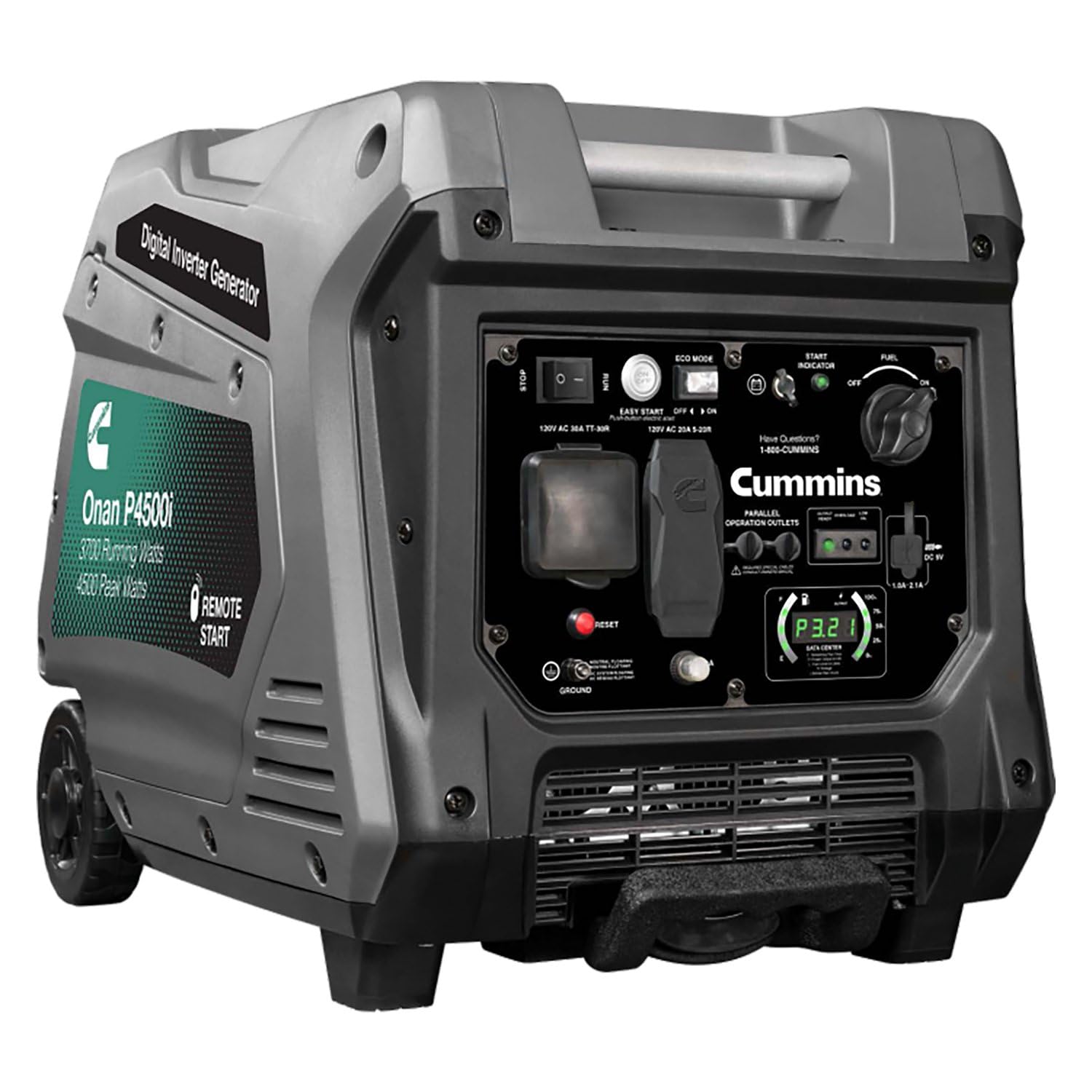
The Cummins Onan P4500I is a premium inverter generator built for serious RVers who want reliability and performance. Its 224cc OHV engine produces 4500 peak / 3500 running watts, giving you headroom for running a 50-amp RV air conditioner plus other appliances. The push-button electric start (with recoil backup) is effortless, and the remote start adds convenience.
At 98 pounds, it’s heavy — but the luggage-style handle and wheels make it manageable for one person on flat ground. Noise is impressively low, comparable to a Honda EU series, which makes it a welcome presence in campgrounds. The output voltage stays rock-steady at 120V even under significant load, and the parallel capability lets you combine two P4500I units for up to 50 amps.
Oil changes are slightly fiddly due to the panel alignment, and the price is a significant step up from mid-range options. But the build quality, reliable starting in sub-zero temperatures, and consistent power delivery justify the investment for frequent RV travelers.
Why it’s great
- 4500 peak watts for heavy RV loads
- Very quiet, Honda-like operation
- Remote start and push-button start
Good to know
- 98 pounds is heavy
- High price point
- Oil change access is tight
8. WEN 56360i

The WEN 56360i weighs just 46 pounds, making it one of the lightest 3600-surge-watt inverters available. It’s easy for one person to lift into a truck bed or carry short distances. The 149cc engine delivers 3600 surge / 2900 rated watts of clean power. The fuel shut-off feature extends engine life by running the carburetor dry before storage, a thoughtful touch for occasional users.
Noise is measured at around 58 dBA, which is quiet enough for most campgrounds. The compact dimensions (17.9 x 11.6 x 19.7 inches) fit easily under an RV bunk or in a garage corner. Users consistently report easy starting, smooth power delivery, and enough output to run a 13000 BTU RV air conditioner plus lights and a TV.
The main limitation is that it’s gasoline-only and lacks a remote start. The 2900 running watts also mean it won’t handle a 15000 BTU AC plus a microwave simultaneously. For lightweight camping and basic home backup, however, it’s an excellent value.
Why it’s great
- Only 46 pounds — very portable
- Fuel shut-off for easy maintenance
- Quiet at 58 dBA
Good to know
- Gasoline only, no dual fuel
- No remote or electric start
- 2900 running watts limits heavy loads
9. Champion Power Equipment 2500 Best

At 39.7 pounds, the Champion 2500 Best is the lightest inverter in this comparison, designed for true one-person portability. It produces 2500 starting / 1850 running watts — not enough for an RV AC unit, but sufficient for a refrigerator, lights, fans, laptops, and phone charging during an outage or camping trip. The 53 dBA noise rating is impressively low.
The unit features CO Shield auto-shutdown for safety and is parallel-ready, so you can pair two units to reach up to 5000 starting watts if needed. The runtime of up to 11.5 hours at 25% load is excellent for its size. Users consistently praise the easy starting, even after months of storage.
The main drawback is the CO sensor, which has been reported to trigger false shutdowns in some environments (especially enclosed or windy setups). While the sensor is a safety feature, its sensitivity can be frustrating. This generator works best for dedicated use in open spaces.
Why it’s great
- Ultra-light at 39.7 pounds
- 53 dBA — very quiet
- Parallel ready for more power
Good to know
- 1850 running watts is limited
- CO sensor may trigger false alarms
- Gasoline only
10. ERAYAK 2400P

The ERAYAK 2400P is a budget-friendly entry point into inverter generators. It provides 2400 peak / 1800 running watts with very low THD (0.2% to 1.2%), making it exceptionally safe for sensitive electronics. The 52.5 dBA noise rating is among the quietest in this class, ideal for campgrounds where noise regulations are strict.
It weighs 42 pounds and has a compact footprint (18.82 x 11.73 x 18.11 inches), making it easy to store and transport. Fuel efficiency is a highlight — it can run up to 16 hours at 25% load on Eco Mode. The digital display and dual USB ports add convenience for device charging.
The trade-off is lower power output. It won’t run a large RV AC or heavy tools. Some owners note the need for frequent refueling under heavier loads, and the included oil funnel is basic. For cost-conscious buyers who need quiet, clean power for lights, a fridge, and electronics, this is a solid choice.
Why it’s great
- Very quiet at 52.5 dBA
- Ultra-clean power with low THD
- Excellent fuel efficiency
Good to know
- Only 1800 running watts
- Not enough for RV AC
- Basic accessories included
11. Westinghouse iGen11000DFc

The Westinghouse iGen11000DFc is in a different class entirely — a heavy-duty dual-fuel inverter generator with 11,000 peak / 9000 running watts on gasoline and 10,000 peak / 8100 running watts on propane. It’s designed for whole-home backup, capable of powering a heat pump, well pump, refrigerator, lights, and even a Tesla charger (adding 20-25 miles per hour).
The 457cc engine is robust, and the inverter technology keeps THD under 3%, delivering clean sine-wave power that won’t damage sensitive electronics. It features a 50-amp outlet for transfer switch hookup, remote start with key fob, and a rotating digital display. At 187 pounds with wheels and a folding handle, it’s not portable in the traditional sense — it’s a rolling power station.
Owners praise the build quality, quiet operation for its size (64 dBA), and the ability to run an entire house during an outage. The dual-fuel flexibility is a major advantage for long-term fuel storage. The main downsides are the high price and the sheer weight — it requires two people for stairs or rough terrain.
Why it’s great
- 9000 running watts powers whole home
- Clean sine wave under 3% THD
- Dual fuel with 50A outlet for transfer switch
Good to know
- 187 pounds — very heavy
- High cost of entry
- Fuel consumption significant under heavy load
FAQ
Can a 3500-watt inverter generator run an RV air conditioner?
Is dual fuel really worth the extra cost for a 3500-watt inverter generator?
How loud is a typical 3500-watt inverter generator at a campsite?
What does parallel capability mean for a 3500-watt inverter generator?
Final Thoughts: The Verdict
For most users, the best 3500 watt inverter generator winner is the Champion 200977 because it delivers true 3500 running watts on dual fuel, offers a 22-hour runtime, and includes RV-ready outlets at a competitive price. If you want whisper-quiet operation and remote start, grab the Westinghouse 4021. And for whole-home backup power that can handle a transfer switch and even EV charging, nothing beats the Westinghouse iGen11000DFc.