
Our readers keep the lights on and the weekend projects moving. As an Amazon Associate, I earn from qualifying purchases.
The first 35mm camera you buy shouldn’t feel like a test of your patience. It should make you want to shoot, to experiment, and to burn through rolls of film without worrying if you’ve memorized every technical manual. The difference between a camera that collects dust and one that sparks a lifelong passion comes down to a handful of specific choices—autofocus versus manual, lens compatibility, and the feel of the winding mechanism in your hand.
I’m Rikta — the co-founder and writer behind FitlyFast. I’ve spent hundreds of hours analyzing film camera specifications, sorting through buyer feedback for dozens of models, and identifying the precise features that turn a confusing gear purchase into a confident creative decision.
Whether you want a trusted autofocus SLR from Canon, a rugged fully manual Vivitar, or a modern half-frame Pentax that doubles your shots per roll, this guide cuts through the hype to help you find the right 35mm camera for beginners.
How To Choose The Best 35mm Camera For Beginners
The appeal of film photography is real, but the gear decision can feel overwhelming. Beginners often focus on brand reputation or vintage aesthetics rather than the three concrete factors that determine whether a camera will be a joy to use or a frustrating shelf weight: the autofocus or metering system, the lens ecosystem, and the shooting experience (manual wind, battery dependency, weight). Knowing which of these matters most to you shortens the search dramatically.
Autofocus vs. Full Manual: Which Suits Your Learning Style?
A camera like the Canon Rebel 2000 or Canon Rebel G offers a modern 7-point or wide-area autofocus system that lets you frame and shoot without worrying about focus accuracy. This is ideal if your goal is to capture moments first and learn exposure theory second. On the other end, a fully manual camera like the Vivitar V3800N forces you to compose focus using a split-image viewfinder and adjust aperture and shutter speed yourself. That slower process is the fastest way to internalize the exposure triangle, but it also means missing spontaneous shots while you dial in settings. Choose the experience that matches your tolerance for practice versus instant results.
Lens Mount Compatibility and Future Flexibility
An interchangeable lens SLR (like the Canon AE-1 with FD mount or the Pentax-mount Vivitar V3800N) lets you gradually build a lens collection as your skills grow. Investing in a system with a widely available lens lineup—Canon FD or Pentax K-mount, for example—saves you from being locked into a dead-end platform. Fixed-lens cameras (like the KODAK Snapic A1 or the Pentax 17) are simpler and lighter but offer no path to upgrade optics later. For a beginner serious about progressing into advanced photography, an SLR with a standard kit lens is almost always the smarter long-term buy.
Film Economy: The Case for Half-Frame Format
Film and development costs add up fast. A half-frame camera like the Pentax 17 captures two 17mm x 24mm images on each standard 35mm frame, delivering 72 photos from a single 36-exposure roll. That effectively halves your per-shot film cost and doubles the number of practice frames you can shoot while learning. The trade-off is image size: half-frame negatives are smaller, so enlargements beyond 8×10 may show grain earlier than full-frame 35mm. But for social media, snapbooks, and everyday shooting, the economic advantage is significant for a beginner on a budget.
Quick Comparison
On smaller screens, swipe sideways to see the full table.
| Model | Category | Best For | Key Spec | Amazon |
|---|---|---|---|---|
| Canon Rebel 2000 w/ 28-80mm | SLR | Autofocus everyday shooting | 7-point AF, 30s max shutter | Amazon |
| Pentax 17 | Half-frame | Budget film economy | 72 shots per 36-exp. roll | Amazon |
| Canon EOS Kiss (Rebel G) | SLR | Reliable autofocus SLR | ISO 100–3200, auto modes | Amazon |
| Vintage Canon AE-1 w/ 50mm | SLR | Classic manual learning | TTL metering, FD mount | Amazon |
| Vivitar V3800N | SLR | Full manual for darkroom work | K-mount, no batteries needed | Amazon |
| KODAK Snapic A1 | Point & Shoot | Compact outdoor shooting | 3-element glass lens, 2-zone focus | Amazon |
| Kodak PIXPRO FZ55 | Digital | Buddy for digital/video | 16MP, 5x optical zoom | Amazon |
In‑Depth Reviews
1. Canon Rebel 2000 SLR Film Camera with Canon 28-80mm EF Auto Focus Lens (Renewed)
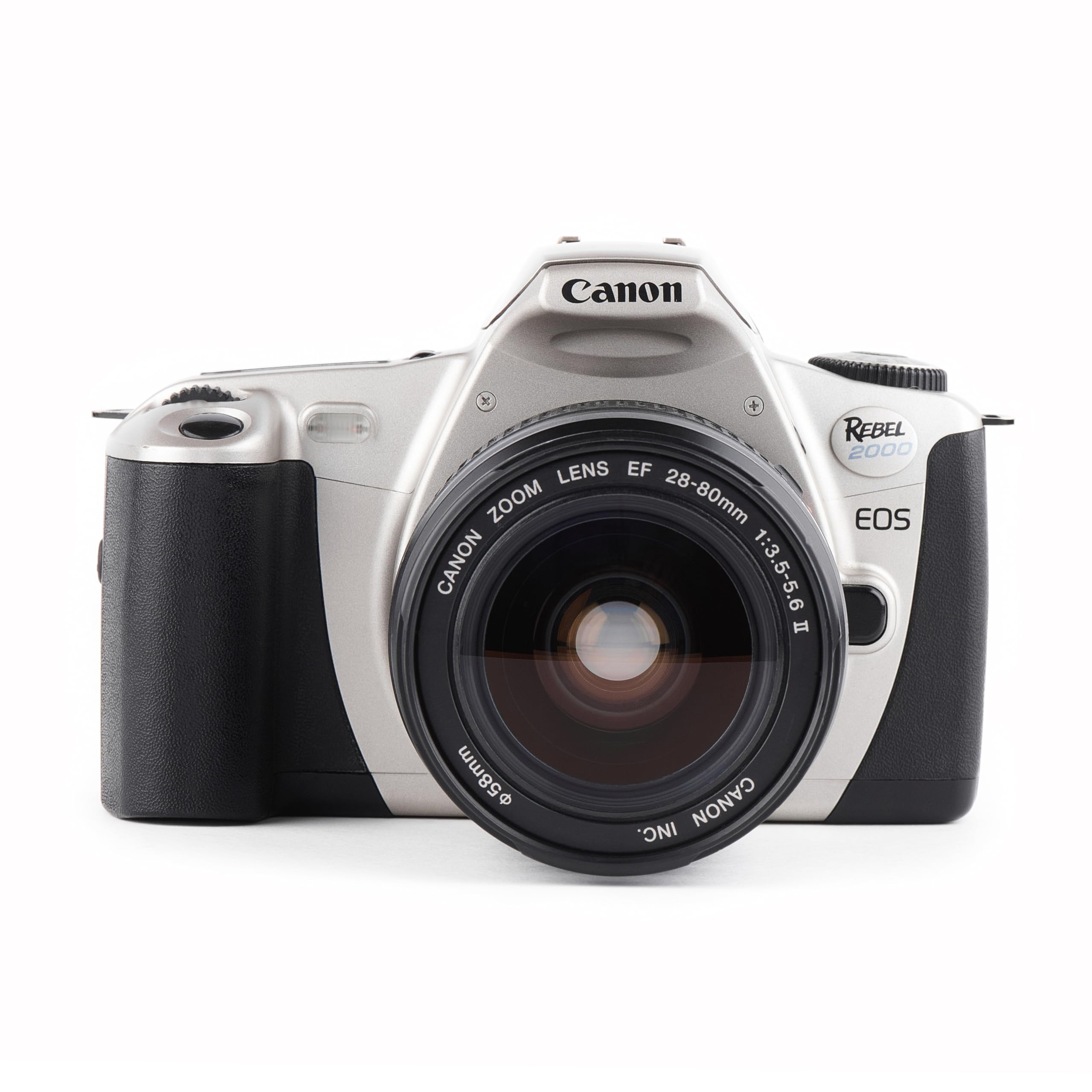
The Canon Rebel 2000 is the autofocus workhorse that removes the biggest barrier beginners face: missed focus. Its 7-point autofocus system locks onto subjects quickly, and the 28-80mm zoom lens gives you enough range to shoot everything from group portraits to landscapes without swapping glass. The auto-load, advance, and rewind feature means you don’t need to learn film handling tricks right away—just drop in a roll and start shooting.
With Program AE, Aperture Priority, Shutter Priority, and full Manual mode, this camera scales with your skill level. Shoot in auto while you learn composition, then gradually shift into priority modes as you start caring about depth of field and motion blur. The 30-second maximum shutter speed also opens up long-exposure night shooting, a feature most budget point-and-shoots skip entirely.
The renewed unit arrives with a 28-80mm EF lens and body in solid condition, and most buyers report cosmetic wear that doesn’t affect function. A small minority have noted longer-than-expected shipping or missing accessories, so confirming the listing’s return policy is worthwhile. But for the price-to-feature ratio, this is the most capable all-around starter SLR in the lineup.
Why it’s great
- Reliable 7-point autofocus with multiple exposure modes for gradual learning
- Auto film transport and built-in flash remove technical barriers
- EF lens mount opens a huge used lens market for future upgrades
Good to know
- Renewed condition means cosmetic wear is possible
- Reported occasional shipping delays
2. Canon New EOS Kiss (AKA Rebel G in USA/Canada) SLR AF Film Camera With 35-80mm EF Lens (Renewed)

The Canon Rebel G (sold as the New EOS Kiss in Japan) is essentially the same camera as the Rebel 2000’s predecessor, sharing the same EF lens mount and a similar set of auto modes. Its wide-area autofocus point is forgiving for beginners who haven’t yet mastered recomposing after focus lock—just aim, half-press, and the camera does the heavy lifting.
The camera offers full auto, program, aperture priority, and shutter priority modes, giving you the same learning path as the Rebel 2000. The built-in flash works as both a low-light solution and a fill-flash for backlit scenes, a feature beginners often overlook until they lose a shot to harsh shadows. The ISO range of 100–3200 means you can shoot consumer-grade films like Kodak Gold or Portra 400 without the camera fighting the exposure.
Buyers consistently praise the condition of these renewed units, reporting clean bodies, functioning meters, and batteries included. The 35-80mm lens is a slightly tighter starting range than the 28-80mm, but still covers everyday focal lengths well. If the Rebel 2000 is sold out or you find a better deal on this model, it’s a near-identical alternative that delivers the same beginner-friendly experience.
Why it’s great
- Wide-area autofocus forgiving for beginners still learning composition
- Multiple auto modes with manual override for skill progression
- Excellent condition reported by the majority of buyers
Good to know
- Kit lens starts at 35mm, slightly less wide than the 28mm option
- Renewed stock may have limited availability
3. Vintage Canon AE-1 35mm SLR Camera with 50mm 1:1.8 Lens (Renewed)

The Canon AE-1 is the textbook starting point for photographers who intend to understand exposure from day one. Its shutter-priority auto mode is a gentle middle ground: you choose the shutter speed to stop motion or allow blur, and the camera’s TTL metering sets the aperture automatically. That one compromise makes the AE-1 far more usable than a fully manual body for someone still building confidence.
The included 50mm f/1.8 lens is the best companion lens for a beginner. It’s sharp, fast in low light, and forces you to “zoom with your feet,” which trains your eye for composition far better than a kit zoom ever could. The metal body and FD mount are robust, and the used market for FD lenses is deep enough to let you add a 28mm wide-angle or 135mm portrait lens later at a low cost.
Because these are vintage units at a premium price point, quality control can vary. Most buyers receive functional cameras that look near-new, but the feedback indicates a small percentage of units need a replacement or repair. The renewed sellers (like Blue Pen Refurbishing) are responsive, but you should budget a few extra dollars for a CLA (clean, lubricate, adjust) service if you plan to keep the camera for years.
Why it’s great
- Shutter-priority mode bridges manual control and auto convenience
- 50mm f/1.8 kit lens is optically excellent and teaches framing
- FD lens mount offers affordable vintage glass for future expansion
Good to know
- Premium pricing for a vintage model; quality varies per unit
- Fewer auto modes than modern SLRs; some users may need CLA
4. Vivitar V3800N 35mm SLR Camera w/ 28-70mm Lens

The Vivitar V3800N is built for learners who want no electronic interference between their eye and the image. This is a fully manual SLR with a bright viewfinder that features split-image focusing—you line up two halves of the image until they become one. It’s the purest way to learn focus control, and the 28-70mm multi-coated zoom lens covers a useful range for general street, landscape, and portrait photography.
The 3-LED display in the viewfinder tells you if your exposure is under, over, or correct, which is a small but vital assist for beginners. The depth-of-field preview button and multiple exposure capability are bonus creative tools you’d normally only find on advanced bodies. And because the V3800N can function entirely without batteries (the mechanical shutter runs at 1/125 second), you’re never stranded by dead cells.
At this price tier, there are compromises. The K-mount is great for Pentax compatibility, but the body feels slightly unbalanced with heavier lenses, and the shutter is louder than more refined SLRs. Some users note a tight aperture ring at the wide end. Still, for someone targeting a budget-friendly entry into analog basics—especially for darkroom work or black-and-white film—this Vivitar is a rugged, no-fuss partner.
Why it’s great
- Fully mechanical operation works without batteries
- Split-image focusing and 3-LED exposure assist for learning
- Multiple exposure and depth-of-field preview features included
Good to know
- Manual focus means missed shots during fast-paced scenes
- Heavier shutter and slight imbalance with long lenses
5. Pentax 17 35mm Film Camera (Half Frame, Dark Silver)

The Pentax 17 is a brand-new camera built on a classic concept: half-frame 35mm photography. It captures two vertical 17mm x 24mm images on each standard frame, so a 36-exposure roll of film yields 72 shots. For a beginner who wants to shoot freely without the fear of wasting frames on experimental compositions, that economy is transformative. The magnesium alloy top and bottom covers give it a dense, durable feel that belies its compact size.
The 25mm f/3.5 lens (equivalent to 37mm in full-frame) uses Pentax’s HD coating, which controls flare and delivers pleasing contrast. Focusing is zone-based—you set one of six distance marks—which is fast once you get a feel for it. The manual film advance lever recreates the tactile rhythm of vintage cameras, and the quiet shutter makes it ideal for street photography or candid portraits without drawing attention.
The main consideration is cost: at the premium end of the spectrum, you’re paying for new-manufacture reliability and modern quality control rather than raw feature count. The lens is fixed and not interchangeable, and the zone-focus system requires practice to nail critical sharpness. But if you value fuel economy for your film budget and want a camera that works out of the box with no vintage repair concerns, the Pentax 17 is a delightful daily shooter.
Why it’s great
- 72 frames per roll halves film and development costs
- Modern build with HD-coated lens and magnesium alloy body
- Quiet, discreet shutter for candid or street photography
Good to know
- Fixed lens with no interchangeability; zone focus takes practice
- Premium pricing relative to other entry-level options
6. KODAK Snapic A1 35mm Film Camera – 2-Zone Focus, Compact (Ivory White)
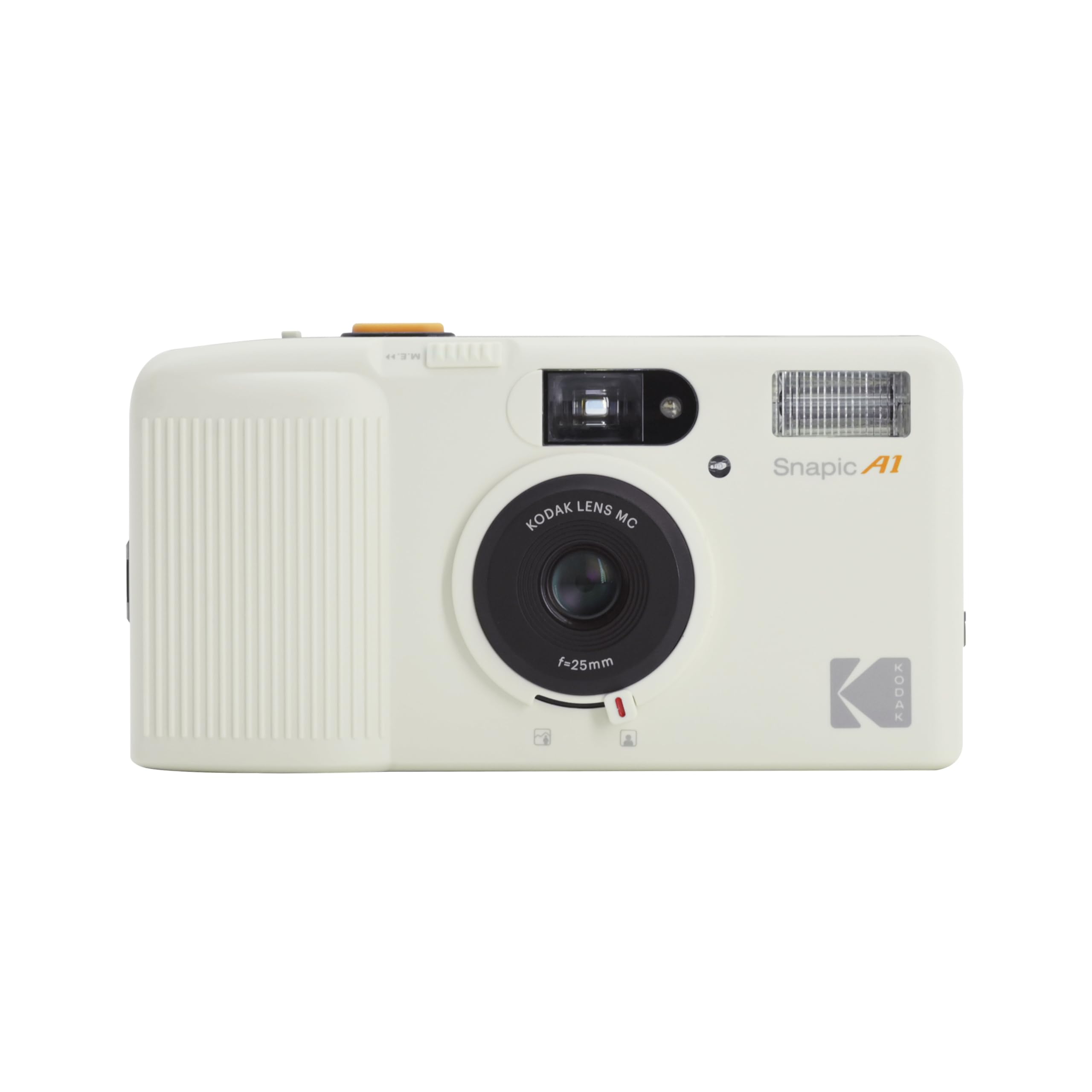
The KODAK Snapic A1 is a compact point-and-shoot that’s barely larger than a deck of cards, making it the most pocketable option in this list for spontaneous shooting. Its 3-element glass lens is a real step up from the plastic lenses found in disposable cameras, delivering noticeably sharper images and better contrast. The 2-zone focus system lets you switch between close-up and infinity modes, which simplifies one less variable while you focus on composition.
The built-in auto flash includes red-eye reduction, and the multiple exposure mode lets you layer two scenes on one frame—a creative trick that’s genuinely fun to experiment with. The auto-wind and auto-rewind features mean you treat it almost like a disposable camera with better optics, which is exactly the low-friction experience many entry-level film shooters want.
Performance is daylight-dependent. Users report excellent results with Kodak Gold 200 in good sun, but underexposure in low light or night scenes even with flash. The flash button is easy to trigger accidentally, and the camera requires alkaline batteries (NiMH rechargeables don’t provide enough voltage). If you’re willing to work within its sunny-day sweet spot, it’s a charming, budget-friendly companion for road trips, brunch outings, and everyday snapshots.
Why it’s great
- Genuine 3-element glass lens for sharper images than disposables
- Ultra-compact form factor fits in a small pocket or bag
- Multiple exposure mode encourages creative experimentation
Good to know
- Struggles in low light; best results are in daytime sun
- Requires alkaline batteries only; flash button easily pressed by mistake
7. Kodak PIXPRO FZ55-RD 16MP Digital Camera – 5X Optical Zoom, 28mm Wide Angle, 1080P HD Video (Red)

The Kodak PIXPRO FZ55 stands apart from the other entries here—it’s a digital camera, not a film body. It belongs in this guide because many beginners want to learn photographic fundamentals (composition, zoom range, exposure modes) without committing to the ongoing cost of film and development. The 16MP CMOS sensor delivers clean images for everyday use, and the 5X optical zoom with a 28mm wide-angle lens gives you compositional flexibility that a fixed-lens film camera can’t match.
Full HD video recording at 1080p makes this a viable option for simple vlogging or capturing family moments in motion. The 2.7-inch LCD screen is bright enough for outdoor framing, and the rechargeable li-ion battery comfortably lasts a full day of casual shooting. It supports SD, SDHC, and SDXC cards up to 512GB, so storage is rarely a concern.
The trade-off, of course, is that it doesn’t deliver the look, grain, or tactile ritual of analog film. If your goal is to learn aperture and shutter speed relationships with instant feedback and zero per-shot cost, the FZ55 is a practical training tool. If you’re set on the experience of loading film and waiting for development, skip it. For a beginner who wants a low-stakes introduction to photography before diving into analog, this is the smart stepping stone.
Why it’s great
- Instant image feedback with zero film or development cost per shot
- 5X optical zoom and 28mm wide angle cover a useful range
- Long battery life and 1080p video make it a versatile everyday camera
Good to know
- Digital sensor lacks the grain and character of film
- Requires a separate SD card; not a true film camera experience
FAQ
Should I buy an autofocus SLR or a fully manual camera as a beginner?
What does “half-frame” mean and is it worth it for a beginner?
What battery type do most film SLRs require and can I use rechargeables?
Can I use modern LED or studio strobes with a vintage manual camera?
Final Thoughts: The Verdict
For most users, the 35mm camera for beginners winner is the Canon Rebel 2000 because its 7-point autofocus, intuitive auto modes, and EF lens ecosystem provide the shortest path to confident shooting. If you want a camera that teaches you exposure through hands-on control with a legendary lens, grab the Canon AE-1. And for a budget-friendly, low-friction option that doubles your film economy, nothing beats the Pentax 17.