
Our readers keep the lights on and the weekend projects moving. As an Amazon Associate, I earn from qualifying purchases.
The sound of a mechanical shutter, the deliberate advance of the film lever, the anticipation of seeing your negatives for the first time — shooting 35mm film isn’t just photography, it’s a tactile ritual that forces you to slow down and frame every shot with intention. Whether you’re chasing that analog color science or building a workflow that rewards patience, the right body and lens pairing determines whether your first roll is a masterpiece or a lesson in underexposure.
I’m Rikta — the co-founder and writer behind FitlyFast. I’ve spent hundreds of hours analyzing the build quality, lens ecosystems, and metering accuracy of the most debated film camera lines to help new shooters skip the gear regret and find a platform they’ll actually carry and use.
Finding your first or next best 35mm film camera comes down to matching your shooting style — manual or auto — to a body with a reliable light meter and a lens mount that offers room to grow without breaking your workflow.
How To Choose The Best 35mm Film Camera
The ideal 35mm body depends on whether you want automation for fast candid shooting or full manual control for deliberate composition. Autofocus SLRs like the Canon Rebel series offer program modes and in-body metering that make your first rolls forgiving, while fully manual cameras like the Pentax K1000 require you to understand the exposure triangle — aperture, shutter speed, and ISO — before you even press the shutter. A camera with a dead or inaccurate meter can ruin entire rolls, so prioritize bodies with known reliable TTL metering or a proven track record from refurbishers.
Lens Mount and System Expandability
The mount determines every lens you can ever use, so it’s the most strategic decision you’ll make for this system. Canon’s EF mount offers the widest selection of affordable, sharp autofocus lenses from the 1990s and 2000s, while the older FD mount (used by the Canon AE-1) requires manual glass but delivers a distinct vintage look. Pentax’s K mount is fully compatible with decades of lenses, including modern manual options that are still produced today. The bigger the ecosystem, the cheaper and easier it is to find replacement glass without paying collector markups.
Metering Reliability and Battery Dependency
Your camera’s light meter is the most failure-prone component in any refurbished body. Most electronic film cameras — including the Canon Rebel G and AE-1 — rely on a battery to power the meter and shutter, meaning a dead battery turns the camera into a paperweight. Fully mechanical bodies like the Pentax K1000 only need a single silver-oxide battery for the meter, but the shutter still fires mechanically at every speed without any power at all, making them more resilient for decades of use. If you shoot in freezing temperatures or remote locations, mechanical operation is a serious reliability advantage.
Quick Comparison
On smaller screens, swipe sideways to see the full table.
| Model | Category | Best For | Key Spec | Amazon |
|---|---|---|---|---|
| Canon AE-1 50mm f/1.8 | SLR Manual Focus | Vintage aesthetic with auto exposure | TTL metering / FD mount | Amazon |
| Pentax 17 Half Frame | Compact Half Frame | 72 shots per roll for social media | 25mm f/3.5 / Zone focus | Amazon |
| Canon Rebel 2000 28-80mm | SLR Autofocus | Beginner-friendly auto modes | 7-point AF / EF mount | Amazon |
| Canon EOS Rebel G 35-80mm | SLR Autofocus | Reliable autofocus on a budget | 30s max shutter / ISO 3200 | Amazon |
| Pentax K1000 50mm f/2 | SLR Mechanical | Pure manual learning camera | All-mechanical / K mount | Amazon |
| FUJIFILM X100VI Black | Digital Hybrid | Digital with analog dials & film sims | 40.2MP / 6-stop IBIS | Amazon |
| NONS SL660 Instant | Instant SLR | Interchangeable EF lens instant camera | Instax Square / EF mount | Amazon |
| FUJIFILM X Half Premium | Digital Half Frame | Digital camera that simulates 35mm half frame | 18MP / 26 film filters | Amazon |
| Kodak Funsaver 7-Pack | Disposable Single Use | Events and party favors | ISO 400 / Built-in flash | Amazon |
In‑Depth Reviews
1. Canon AE-1 35mm SLR Camera with 50mm 1:1.8 Lens (Renewed)

The Canon AE-1 is arguably the most iconic 35mm SLR ever made, and for good reason — its shutter-priority auto-exposure mode made professional-level photography accessible to hobbyists in the late 1970s. The chrome-top metal body feels substantial in the hand, and the included 50mm f/1.8 FD lens is sharp, fast, and renders that warm, slightly contrasty analog look that digital shooters try to simulate with presets. The TTL center-weighted metering is accurate enough for negative film when the battery is fresh.
Shutter speeds range from 2 seconds down to 1/1000 plus Bulb, giving you enough range for available-light street work or long exposures on a tripod. The FD mount is fully manual — no autofocus — so you control focus with the split-prism rangefinder in the viewfinder, which is a satisfying skill to learn. Most refurbished units come with a fresh battery and a CLA (clean, lube, adjust) that restores the mirror dampening and shutter timing.
The main tradeoff is battery dependency: without the 4LR44 battery, the shutter won’t fire at any speed. Some buyers report the refurbished meter can drift, so cross-checking your exposure with a phone app or external meter on the first roll is a smart habit. Overall, the AE-1 remains the entry point for anyone who wants the vintage aesthetic with a proven feature set.
Why it’s great
- Classic 1970s metal-body design that still feels premium
- Shutter-priority auto mode is forgiving for beginners
- FD 50mm f/1.8 lens is sharp, fast, and affordable
- Bulb mode enables long exposures without a cable release
Good to know
- Completely dead without a 4LR44 battery — no mechanical backup
- FD mount requires manual focus, no autofocus upgrade path
- Refurbished meter calibration can vary; verify against a known reading
2. Pentax 17 35mm Film Camera (Half Frame)

The Pentax 17 is a brand-new compact half-frame camera that reimagines the 35mm experience for the modern era. By capturing two 17x24mm vertical images per standard 35mm frame, you squeeze 72 shots out of a 36-exposure roll — perfect for travel and daily carry where every frame has to matter. The 25mm f/3.5 lens (equivalent to 37mm in full-frame terms) is treated with Pentax’s HD coating, delivering surprisingly sharp center resolution with a gentle vignette at the edges that reinforces the film look.
The zone-focus system divides your focusing distance into six zones — from macro to infinity — and you select the right zone using a dial on the top plate. It’s not as precise as split-prism focusing, but for casual street and social photography it’s fast and intuitive once you internalize the distance markers. The magnesium alloy top and bottom covers give the body a solid, retro feel, and the manual film advance lever recreates the tactile feedback of classic cameras.
At this price point, the Pentax 17 is committing to being a hobbyist’s companion rather than a professional tool. The fixed lens and zone-focus system limit your creative control, and the lightweight plastic mid-frame can feel less substantial than all-metal alternatives. But if you want a new, repairable 35mm camera with warranty coverage and the economic advantage of half-frame shooting, the Pentax 17 delivers a unique modern solution that no other manufacturer currently offers.
Why it’s great
- 72 images per standard 36-exposure roll — saves on film costs
- HD coated 25mm f/3.5 lens produces sharp images with analog character
- Zone-focus system with six zones makes street photography fast
- Magnesium alloy top and bottom for a durable, retro feel
Good to know
- Fixed lens with no zoom or interchangeable option
- Zone-focus has a learning curve; not as precise as SLR focusing
- Lightweight mid-frame plastic may feel less premium than the price suggests
3. Canon Rebel 2000 SLR Film Camera with Canon 28-80mm EF Auto Focus Lens (Renewed)
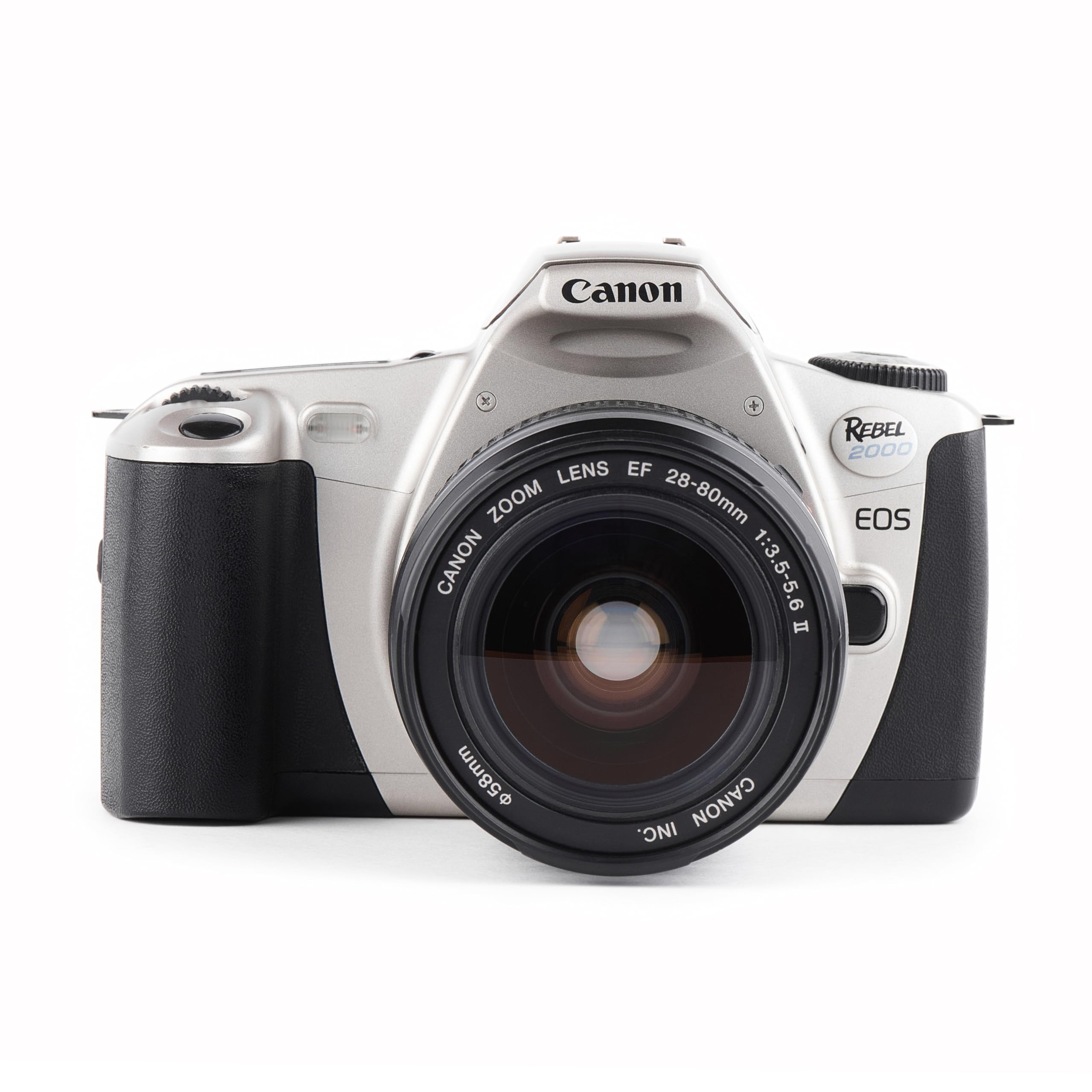
The Canon Rebel 2000 (EOS 300) represents the peak of 35mm autofocus SLR value for modern shooters. It uses the same EF mount as Canon’s digital EOS cameras, meaning you can mount any EF or EF-S lens you already own — or pick up dirt-cheap used glass from the 1990s and early 2000s. The 7-point autofocus system locks onto subjects quickly in good light, and the four exposure modes (Program, Aperture Priority, Shutter Priority, Manual) give you a full learning path without being overwhelming.
The automatic film loading, advancing, and rewinding means you can rip through rolls without ever touching a film spool, which is a major convenience for event or travel shooting. The built-in pop-up flash provides decent fill in backlit scenarios, and the camera reads DX-coded film canisters to set ISO automatically — one less thing to forget. At roughly the same weight as a modern mirrorless body with a kit zoom, it’s genuinely carry-all-day manageable.
The tradeoff for that lightweight plastic body is a less tactile, less emotionally engaging shooting experience compared to an all-metal manual camera. The viewfinder is small and dark by modern standards, and the 28-80mm kit zoom is adequate but not optically exceptional. For the entry-level price, the Rebel 2000 gets you into the EF system affordably, and you can upgrade to a 50mm f/1.8 STM for a big quality jump later. It’s the smartest buy for anyone who wants autofocus convenience with room to grow.
Why it’s great
- EF mount compatible with thousands of affordable lenses
- 7-point autofocus works well in good light for sharp candid shots
- Automatic film loading, advance, and rewind
- Four exposure modes — Program, Av, Tv, Manual — for learning
Good to know
- Plastic body lacks the tactile satisfaction of metal cameras
- Kit 28-80mm zoom is optically average; budget for a prime lens
- Small, dim viewfinder compared to pro-level SLRs
4. Canon New EOS Kiss (Rebel G) SLR AF Film Camera With 35-80mm EF Lens (Renewed)

The Canon EOS Kiss — sold as the Rebel G in North America — is the predecessor to the Rebel 2000 and shares the same EF lens mount and core autofocus architecture. The wide-area autofocus point is reliable for center-frame composition, and the camera reads DX film codes up to ISO 3200, giving you latitude for pushing Tri-X or shooting Portra 800 in low light. The 35-80mm zoom lens that ships with most refurbished units is a solid starter walk-around range for landscapes and portraits.
What sets the Rebel G apart from its younger sibling is the user interface: the top-plate LCD and dedicated button layout are slightly more intuitive for adjusting exposure compensation and drive modes. Multiple buyers report their refurbished units arrived with fresh batteries and working meters, producing sharp, well-exposed images on the first roll. The build quality is plastic but robust enough to survive a semester of film photography class or a year of daily carry.
Like the Rebel 2000, this is an electronic camera that requires a battery to operate — dead battery means no autofocus and no shutter release. The 35-80mm kit lens has visible chromatic aberration at the wide end, but stopping down to f/8 cleans it up noticeably. If you find a clean copy at a discount price, the Rebel G is a capable entry point into the EF ecosystem without the slight premium of the newer model.
Why it’s great
- EF mount compatibility with Canon’s huge lens library
- Intuitive top-plate LCD and button controls
- DX code reads up to ISO 3200 for fast films
- Refurbished units often arrive in excellent mechanical condition
Good to know
- Battery required for all functions — no mechanical shutter backup
- Kit 35-80mm zoom shows noticeable purple fringing at wide apertures
- Plastic construction doesn’t inspire long-term confidence
5. Pentax K1000 Manual Focus SLR Film Camera with Pentax 50mm Lens (Renewed)

The Pentax K1000 is the definitive manual SLR — the camera that taught generations of photography students what aperture, shutter speed, and ISO actually do to an image. It has no autofocus, no program mode, no unnecessary electronics. The match-needle light meter is powered by a single LR44 battery, but the shutter is fully mechanical: every speed from 1/1000 down to Bulb will fire without any battery at all, making this one of the most resilient film cameras ever built. The included 50mm f/2 SMC Pentax lens is sharp from edge to edge and affordable to replace if damaged.
The built-in, always-on light meter shows a needle alongside the viewfinder frame — you adjust the aperture ring and shutter dial until the needle centers, and you’re guaranteed a proper exposure for most scenes. The K1000’s all-metal chassis and leatherette grip feel substantial without being backpack-heavy, and the Pentax K mount is compatible with every Pentax manual lens going back to 1975, plus third-party options from Vivitar, Tamron, and Sigma. A single battery lasts over two years of regular use because it only powers the meter.
The main risk with refurbished K1000 bodies is the meter itself — several buyers report receiving units with a non-functional meter, and the repair cost can approach the camera’s value. The 50mm f/2 is a fantastic lens, but it’s an all-manual setup: no autofocus, no autoexposure, no automation at all. For purists who want to master the exposure triangle with equipment that will outlast them, the K1000 is still the gold standard.
Why it’s great
- Fully mechanical shutter runs at all speeds without a battery
- SMC Pentax 50mm f/2 lens is legendary for its sharpness and contrast
- Pentax K mount compatible with decades of affordable lenses
- Match-needle metering forces you to learn the exposure triangle
Good to know
- Refurbished meters are a common failure point — test your first roll
- No autofocus, no autoexposure, no program modes
- Repairing a broken meter can cost as much as replacing the camera
6. FUJIFILM X100VI Black

The X100VI is a digital camera, but it deserves a place on this list because it captures the soul of 35mm film photography through its hybrid viewfinder, dedicated aperture ring and shutter dials, and 20 Film Simulation modes that emulate Fujifilm’s classic analog stocks — including the new REALA ACE profile. The fixed 23mm f/2 lens (equivalent to 35mm full-frame) delivers the same field of view as a classic street rig, and the 40.2MP X-Trans CMOS sensor resolves detail that rivals medium-format digital backs.
The internal 4-stop ND filter lets you shoot wide open in bright daylight, and the 6-stop in-body image stabilization system keeps handheld shots sharp down to 1/4 second exposures — something no 35mm film camera can do without a tripod. The hybrid autofocus system, powered by the X-Processor 5 chip, tracks faces and eyes accurately even in dim light, and the 6.2K video with F-Log opens up a hybrid workflow for content creators who want both stills and motion. The Frame.io Camera to Cloud feature lets you upload directly while shooting.
This is not a film camera — you won’t get the chemical grain structure or the satisfaction of hand-developing negatives. The price is also a significant step up from any analog body on this list, and the fixed lens means you can’t swap optics for different perspectives. For shooters who want the tactile, dial-based shooting experience of a classic rangefinder without the hassle of processing film, the X100VI is the closest you can get with digital convenience.
Why it’s great
- 20 Film Simulation modes deliver authentic analog color science
- 40.2MP sensor with 6-stop IBIS for sharp handheld shots
- Hybrid viewfinder switches between OVF and EVF
- 6.2K video with F-Log for professional hybrid shooting
Good to know
- Fixed 23mm f/2 lens — no interchangeable optics
- Digital sensor grain is different from real film grain
- Premium price that far exceeds any analog body
7. NONS SL660 Instant Camera – Interchangeable Lens EF Mount SLR

The NONS SL660 is a fully manual instant SLR that uses the Canon EF lens mount, meaning you can mount any vintage or modern EF lens you own — including fast primes, tilt-shift, or macro optics — onto a body that exposes directly onto Instax Square film. The 1:1 square format is the same aspect ratio as a Polaroid, and the result is a physical print with that instant-film color palette. The body is crafted from CNC-anodized aluminum alloy with a stainless steel speed dial, and the included wooden hand grip provides a secure, analog feel.
You have full control over shutter speed (Bulb mode included), aperture via the lens ring, and multiple exposure capability for double exposures on a single frame. The hot shoe supports external flashes with a 1/250 sync speed, giving you studio-style lighting control on an instant format. For photographers who already own a collection of EF glass, the SL660 is a fascinating experiment that bridges traditional SLR craftsmanship with instant gratification.
The built-in light meter is the camera’s weakest link — multiple users report it being off by one to two stops, requiring an external handheld meter for consistent exposures. The optical viewfinder with the included field expander cuts the effective light by about two stops, meaning you need to compensate your exposure setting manually. The vignette is also aggressive with wide-angle lenses. This is a camera for tinkerers who enjoy solving exposure puzzles, not for casual instant shooters who want predictable results out of the box.
Why it’s great
- Canon EF mount accepts thousands of lenses from vintage to modern
- CNC aluminum body with wood grip feels premium and durable
- Full manual control with Bulb mode and multiple exposure
- Instax Square film gives a classic 1:1 instant print
Good to know
- In-camera meter is unreliable; plan to use an external light meter
- Optical field expander reduces light by two stops, affecting exposure
- Strong vignette with wide-angle and zoom lenses
8. FUJIFILM X Half Premium Compact Camera – Black

The FUJIFILM X Half is a compact digital camera that simulates the half-frame 35mm format. Unlike a real film camera, it captures digital images with an 18MP 1-inch sensor and applies one of 26 analog-inspired film and filter simulations that mimic the look of classic Fuji emulsions like Velvia, Provia, and Classic Chrome. The camera uses a unique 2-in-1 mode that can combine a still photo with a short video clip into a single memory, and it can print directly to a compatible Instax printer or share via the dedicated app.
The retro design features dedicated dials for exposure and film simulation selection, giving it the tactile interface of a vintage rangefinder. The form factor is genuinely pocketable at just over 0.98 pounds, making it a go-everywhere companion for travel and daily documentation. The JPEG-only output is sharp in good light, and the film simulations are well-tuned to produce share-ready files without any post-processing. The built-in self-timer and simple menu system make it accessible for anyone who just wants fun, film-like photos without learning exposure theory.
This is a niche camera designed for novelty and enjoyment rather than professional image quality or flexible editing. The autofocus is slow in dim conditions, the thumb advance lever lacks real physical tension, and the absence of RAW files limits your ability to correct exposure later. At its price point, you’re paying for the film-simulation ecosystem and the compact convenience, not raw sensor performance. If you want an honest digital approximation of half-frame photography that requires no film, no chemicals, and no scanning, the X Half delivers that exact experience.
Why it’s great
- 26 film simulations emulate classic Fuji emulsions and filter looks
- Pocketable size at 0.98 lbs — fits any bag or jacket pocket
- 2-in-1 mode combines a still and video clip into one memory
- Direct print to Instax printers via app connectivity
Good to know
- JPEG-only output — no RAW files for flexible editing
- Slow autofocus in low light compared to modern smartphones
- Thumb advance lever is cosmetic and lacks tactile realism
9. Kodak Funsaver Disposable Camera Bulk 7-Pack 27exp 35mm

The Kodak Funsaver is the easiest way to put 35mm film into anyone’s hands — just point, press the shutter, and wind the thumb wheel. This 7-pack bundle gives you seven fully loaded disposable cameras, each pre-loaded with 27 exposures of Kodak 400-speed color negative film. The built-in flash provides fill light for indoor events and evening gatherings, and the fixed-focus lens delivers consistently sharp results from about 4 feet to infinity when there’s enough ambient light. The microfiber cloths included help keep the plastic lens element clean between uses.
The 27-exposure count is higher than the standard 24-exposure disposables, giving you more frames per camera for wedding tables, birthday parties, or conference swag bags. The Kodak 400 film is optimized for general-purpose shooting — it has enough speed for overcast outdoor scenes and works with the flash out to about 10 feet. The compact, lightweight design means you can toss them into welcome bags or a center dish without worrying about someone damaging an expensive SLR.
These are single-use devices with no controls whatsoever — no exposure compensation, no focusing, no way to change the film speed. You get exactly what the fixed settings give you: consistent snapshots with a slightly soft vintage look. The per-unit cost of a single Funsaver is lower than the bulk pack suggests if you can find them individually, and processing fees add to the overall expense. For controlled event photography where you want analog candids without gear anxiety, the Funsaver delivers pure simplicity.
Why it’s great
- Zero learning curve — point, shoot, wind, repeat
- Kodak 400 film delivers warm, saturated colors and good latitude
- Built-in flash works for indoor and evening events
- Disposable format eliminates fear of loss or damage at events
Good to know
- Single-use design produces plastic waste and no reusable body
- No exposure control, manual focus, or creative options
- Per-unit cost plus developing fees adds up quickly
FAQ
What does “renewed” mean for a 35mm film camera?
Half frame vs full frame: which should I choose?
Do I need a battery for my 35mm camera to work?
How do I know if a refurbished camera’s light meter is accurate?
Final Thoughts: The Verdict
For most users, the best 35mm film camera winner is the Canon Rebel 2000 because the EF mount gives you access to the largest, cheapest lens ecosystem in photography, the autofocus is reliable enough for everyday shooting, and the combination of automatic film handling with four exposure modes makes it the lowest-friction entry point. If you want the tactile ritual of manual everything with a lens that will outlive you, grab the Pentax K1000. And if you want to double your film economy and carry a modern half-frame compact that is repairable under warranty, nothing beats the Pentax 17.