
Our readers keep the lights on and the weekend projects moving. As an Amazon Associate, I earn from qualifying purchases.
Specs are compiled from manufacturer listings and verified buyer reviews and can change over time — please confirm the key details on the product page before buying.
You want the look of film without the hassle of a vintage camera that jams, leaks light, or eats your shots. This guide matches each reusable 35mm point-and-shoot to the way you’ll actually shoot.
I’m Rikta — the founder and writer behind FitlyFast. This guide is built by comparing the manufacturers’ published specifications and the patterns across verified customer reviews, so you get each pick’s real strengths and trade-offs instead of marketing spin.
You want a 35mm point and shoot camera that makes every roll count, so focus control, lens quality, and frames per roll matter most. For a first-timer, a fixed-focus model keeps things simple; for a seasoned shooter, manual controls give you creative freedom.
Our Picks at a Glance
How To Choose The Best 35mm Point And Shoot Camera
Choosing a film camera depends on your patience level and budget. Some shooters want full manual control, while others prefer a fully automatic point-and-shoot.
Focus system: fixed, two-zone, or six-zone
Fixed-focus cameras keep everything sharp from a few feet out, which is great for beginners but limiting. Two-zone focus lets you switch between a near and a distance setting, giving you a bit more control. Six-zone focus, found on premium models, lets you dial in the exact distance, but it requires you to think about your subject distance before every shot.
Half-frame versus full-frame: the shot count trade-off
A half-frame camera uses half a frame per shot, so a standard 36-exposure roll gives you 72 photos. That means more shots per roll and cheaper per-image cost, but each negative is smaller, which can limit how large you can print your images. Full-frame cameras use the whole negative, giving you bigger, higher-quality images at the cost of fewer shots per roll.
Lens quality and glass elements
The lens determines sharpness: multi-element glass lenses beat single-element plastic ones. Glass lenses deliver crisper, higher-contrast images; plastic lenses are softer, especially at the edges. Choose coated glass elements for better image quality over just the film look.
Quick Comparison
| Model | Best For | Focus System | Frame Type | Lens Standard | Amazon |
|---|---|---|---|---|---|
| KODAK Snapic A1★ Best Overall | First-time film shooters | 2-Zone | 3-Element Glass | Amazon | |
| KODAK EKTAR H35N | Budget-conscious creators | Focus-Free | Half Frame | Single Glass | Amazon |
| Halina Tegra AF290 | Retro autofocus fans | Auto Focus | Full Frame | 28mm Wide | Amazon |
| Pentax 17 | Enthusiasts who want control | 6-Zone | Half Frame | 25mm F3.5 HD | Amazon |
In-Depth Reviews
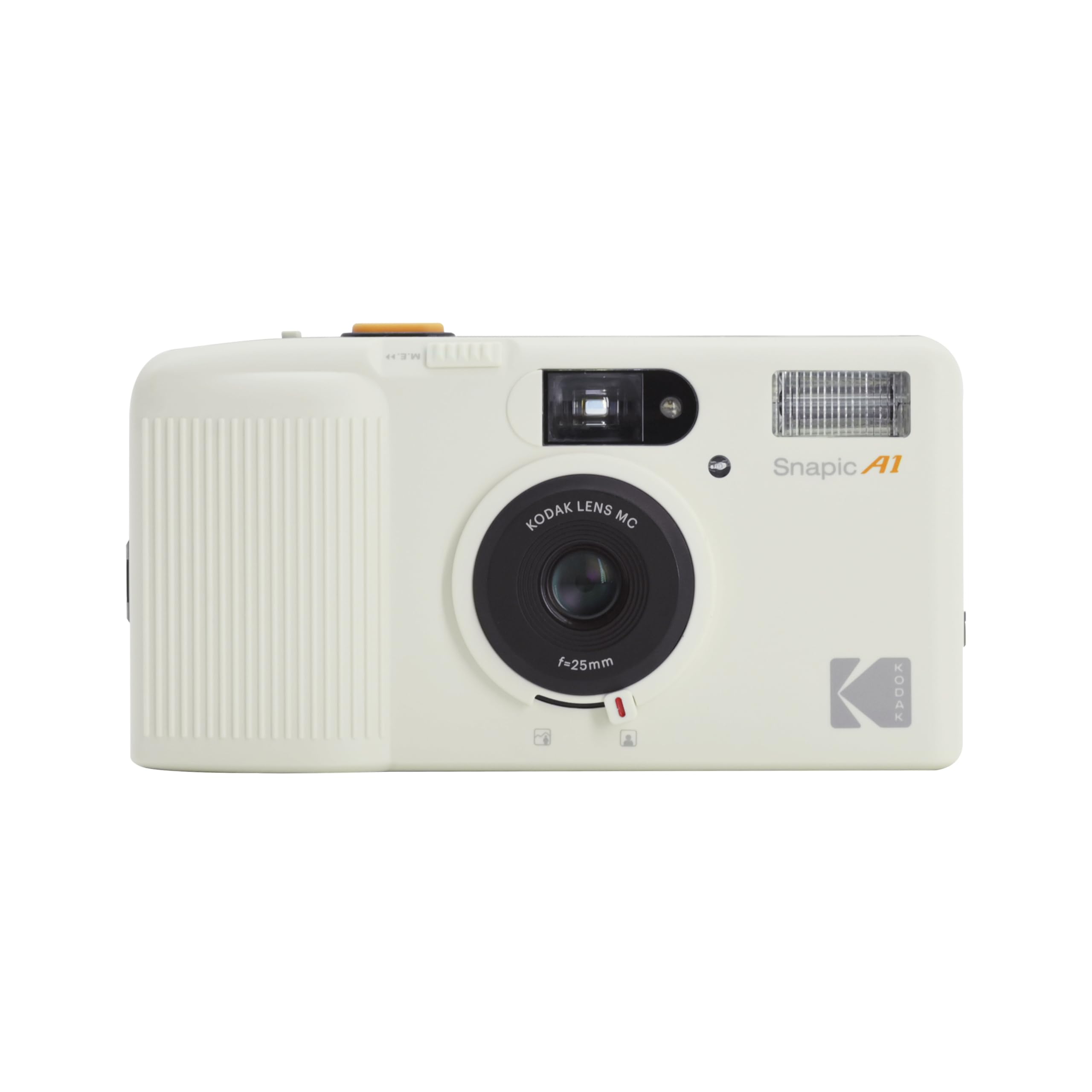
1. KODAK Snapic A1 35mm Film Camera
Our pick — 4.5★ from 100+ verified ratings; the strongest balance of quality and price.
The pocket-friendly auto-everything camera that takes sharp glass-lens photos without a learning curve.
The easiest path into film photography is this KODAK that handles the busywork for you. It auto-winds, auto-rewinds, detects when to fire the flash, and even shows a shot counter, so you can focus on composing instead of mechanics. The 3-element glass lens (a three-piece glass setup that captures finer detail than simple plastic lenses) delivers the sharpness that makes film worth shooting at all.
You just flip between a near and distance setting—buyers report “anything past 5-6 feet is distance setting,” so everyday snapping is nearly simple to use. Owners who compared it to pricier gear found it a smarter buy than the Pentax 17 or Lomo MC-A for a fraction of the cost, and several called it the better pick over the EKTAR line.
It is a daylight camera at heart. Shoot with Kodak Gold 200 film in good light and the images sing, while night shots can come out underexposed with only decent flash coverage. The build is plastic and simple, which keeps it light and gift-worthy but not rugged. If you want a reliable, no-fuss entry into 35mm, this is the one that gets out of your way.
What wins people over
- Camera quality is the top praise — a dozen owners single out the sharp glass lens
- Compact and portable design, with five buyers calling out how easily it pockets
- Multiple exposure mode lets you blend two scenes into one layered photo
The honest trade-offs
- Night shots run underexposed even with the auto flash engaged
- Exposure control gets mixed feedback from owners who want more manual say
- Plastic body feels simple, not premium, in the hand
Reach for this if: you want auto-everything convenience with genuine glass-lens quality for your first film camera.
Look elsewhere if: you shoot concerts or low-light scenes regularly, since the flash only goes so far at night.
2. KODAK EKTAR H35N Half Frame Film Camera

A half-frame creator’s tool that doubles your shots per roll and adds a star filter for flair.
This is the camera to grab when you want maximum shots from every roll, because the half-frame format packs two photos into each standard 35mm frame. That means a 36-exposure roll becomes roughly 72 photos, which is a huge value if you are burning through film at concerts or on day trips. Owners confirmed the math works: “Got decent pictures with it! I used the Ektar 100 film with it.”
The built-in star filter turns tiny light sources into a four-beam flare, so string lights and cityscapes get a dreamy, cinematic sparkle straight out of camera. There is also a bulb function for long exposures — the camera holds the shutter open to capture the trail of moving objects at night — and a tripod hole to keep it steady during those long shots. The coated, improved glass lens sharpens images beyond what the older EKTAR models delivered.
Candid feedback from the reviews: it is plastic, all of it, and the slide-to-open button sits a bit too accessibly, so it can open by accident in a bag. It works as long as you treat it with care, and its lightweight 110 g build makes it vanish into a pocket, especially with the included carry bag in the premium kit. For a beginner who wants variety — concert shots, night trails, and star bursts — without spending big, this delivers.
Why it clicks
- Half-frame design doubles your shots, stretching every roll of film further
- Star filter creates a four-beam flare on light spots for creative night shots
- Premium kit bundles accessories and a bag for a ready-to-go start
Where it bends
- Entire body is plastic, so it demands gentle handling over time
- Focus-free design keeps everything sharp from a distance but limits close-up control
- Smaller half-frame negatives cap how large you can print your images
Grab it for: budget-friendly experimentation — the star filter and bulb mode make it a creative playground.
Pass if: you want a metal-bodied camera that can survive being tossed in a backpack without care.
3. Halina Tegra AF290 35mm Film Camera

A vintage-styled autofocus point-and-shoot with a wide 28mm lens for classic retro framing.
For a vintage vibe with a genuinely wide field of view, the Halina captures more of the scene in every frame thanks to its 28mm wide-angle lens (28 millimeters—noticeably wider than the standard 35mm kit lens on the other picks). It runs on 2x AA alkaline batteries (two standard AA cells you can grab anywhere, no proprietary chargers), and its motorized autofocus system does the sharpness work for you.
The aperture range of F2.8 to F5.6 (the opening that controls how much light hits the film) gives you some flexibility in varied lighting, and the built-in flash handles dimmer situations. It ships boxed with a manual and strap, and its LCD display tells you what the camera is up to. For someone who grew up on digital and wants a fun, analog sidekick, the autofocus removes the biggest fear of film: missed focus.
Owners who love it call film “betta than digital” and found it a silly, joyful gift for a younger sibling. However, this is the pickiest of the four: one reviewer noted the camera “Shredded my film and couldn’t use,” and another received a unit with a jammed plastic frame dial. This one is best bought with cautious expectations — a fun retro shooter when you get a good unit, but quality control is clearly less consistent than the KODAK options.
Where it wins: The wide 28mm lens and motorized autofocus make it the most forgiving for framing big scenes without fiddling with focus zones.
Where it frustrates: Quality control is a real gamble — a small share of units arrive jammed or chewing up film, so inspect it before your first roll.
Choose this for: a cheap, fun, wide-angle shooter where the risk of a dud unit is acceptable for the retro charm.
Think twice if: you need reliability for important trips — a jammed frame dial would ruin a whole roll.
4. Pentax 17 Half-Frame Compact Film Camera

The enthusiast’s half-frame with a 25mm HD-coated lens and six-zone focus for deliberate control.
If you want to actually think about every shot, the Pentax 17 gives you manual control. Its 25mm f/3.5 fixed lens uses advanced HD coating (a glass treatment that reduces flare and boosts contrast), and a manual ISO range of 50–3200 lets you match the film to the light. Exposure compensation of ±2 EV lets you fine-tune brightness in tricky scenes.
Its six-zone focus system spans from 0.25m to infinity (about a hand’s length to as far as you can see), so you can dial in the exact distance for your subject. The electronically controlled central shutter supports six shooting modes, which is a level of depth none of the other picks offer. This kit also bundles a 3-pack of Kodak Gold 200 film and a microfiber cloth, so you can start shooting right away.
Owners praise the “sharp lens” and admit the smaller half-frame negatives do “limit large prints,” which matters if you plan big enlargements. Feedback calls the build “excellent” and image quality “superb,” though the features don’t fully justify the high cost for everyone — it is as much a collector’s piece and design statement as a tool. At 16 ounces, it is notably heavier than the KODAK options, so it feels more substantial but less pocket-innocent.
The enthusiast’s edge
- Six distinct focus zones from 0.25m to infinity give precise control for deliberate shots
- Manual ISO 50–3200 pairs with ±2 EV compensation for creative flexibility in any light
- Bundle includes Kodak Gold 200 film so you can shoot immediately
The enthusiast’s catch
- Half-frame negatives cap large print sizes, a real limit for wall displays
- Premium price is hard to justify on features alone for casual shooters
- Heavier at 16 ounces versus the featherweight KODAK bodies
Worth it for: serious hobbyists and collectors who want a modern, well-built half-frame with real manual control.
Not for: casual users who just want pocket snaps — the KODAK Snapic delivers most of the joy for far less.
Understanding the Specs
Zone Focus vs. Autofocus
Zone focus lets you pick a preset distance range, which is simple and reliable but requires a quick guess. Autofocus locks focus automatically for beginners but adds moving parts that can jam. Focus-free means everything is preset to stay sharp from a distance, with no control at all.
Half-Frame vs. Full-Frame Format
Full-frame cameras use the entire 35mm negative for each photo, giving you maximum image quality and the biggest possible prints. Half-frame cameras use only half the negative per shot, so you get twice as many photos per roll but smaller negatives that limit enlargement. Choose full-frame for print quality and half-frame for shot volume and lower cost per image.
FAQ
Is a 35mm point and shoot camera good for beginners?
How many photos do I get from one roll of film?
What is the difference between zone focus and focus-free?
Can I shoot at night with these cameras?
Does a half-frame camera produce worse images?
What batteries do these cameras use?
Is the Pentax 17 worth the higher price compared to the KODAK Snapic?
What film should I use for daytime shooting?
Final Thoughts: The Verdict
If you want one dependable pick, the 35mm point and shoot camera winner is the KODAK Snapic A1 because it combines auto-everything convenience with a 3-element glass lens and two-zone focus at a price that beats the premium competition. If you want double the shots per roll and creative extras like a star filter, grab the KODAK EKTAR H35N. And for the enthusiast who wants six-zone focus and full manual ISO control, the Pentax 17 is the one to reach for — just know the extra cost buys control, not necessarily better images for casual use.
How We Picked
We do not accept paid placement. Every pick is matched to a real buyer and a real use-case; we do not hands-on test units.
Sources & Methodology
Specifications: manufacturer listings and product documentation. Review insights: verified customer reviews, as of August 2026. Pricing: not shown on this page (it changes often); check the current price via the retailer link.
As an Amazon Associate, FitlyFast earns from qualifying purchases. This does not affect which products we feature.