
Our readers keep the lights on and the weekend projects moving. As an Amazon Associate, I earn from qualifying purchases.
Specs are compiled from manufacturer listings and verified buyer reviews and can change over time — please confirm the key details on the product page before buying.
You want to capture everything around you in one take, then pick your perfect angle later — but the wrong 360 video camera leaves you with soft, grainy footage or a frustrating editing app that ruins your flow. What actually matters is sharp true-360 resolution that gives you room to reframe, reliable stabilization so your video doesn’t make viewers seasick, and a stitching engine that hides the seam. This guide cuts through the buzzwords to the specs and real-owner experiences that separate the pro-grade spherical cameras from the gimmicks.
I’m Rikta — the founder and writer behind FitlyFast. This guide is built by comparing the manufacturers’ published specifications and the patterns across verified customer reviews, so you get each pick’s real strengths and trade-offs instead of marketing spin.
After comparing resolution, sensor size, storage capacity, and stabilization across eight models, the clear winner for most buyers looking for a 360 video camera is the GoPro MAX2 because it delivers true 8K spherical capture with replaceable lenses and HyperSmooth stabilization at a mid-range price that undercuts the premium tier without sacrificing usable quality.
Quick Picks
- GoPro MAX2 — Best Overall
- DJI Osmo 360 Essential Combo — Premium Imaging
- Xtra 360 Camera — Highest Resolution
- Insta360 X5 Essentials Bundle — Battery Champion
- DJI Osmo 360 Standard Combo — Value 8K Entry
- GoPro MAX — Budget 360
- AKASO 360 Action Camera Cycling Combo — Entry Level
- Ricoh Theta Z1 51GB — Real Estate Pro
How To Choose The Best 360 Video Camera
A 360 camera is different from a regular action camera because it uses two or more ultra-wide lenses to capture a full sphere around you. The camera then stitches those views together into one smooth spherical video. The buying decisions come down to what you do with that sphere — whether you reframe into 16:9 clips for social media or deliver full 360 tours for real estate.
Video Resolution and Reframing Headroom
When a camera claims “8K,” that is the total spherical capture, not the final reframed video. After you crop a 16:9 rectangle from a sphere, the usable resolution drops significantly. A true 8K spherical capture (like 7680 x 3840) gives you crisp 4K reframed clips, while a 5.7K sphere only yields about 1080p after cropping. More spherical pixels equals more flexibility when you choose your shot after recording.
Sensor Size Equals Low-Light Performance
The physical sensor size — measured in inches — determines how much light each pixel can collect. A larger 1-inch sensor captures far more light than a 1/2.3-inch sensor, which translates directly to cleaner, less noisy footage at dusk, indoors under room light, or in shade. If you shoot mostly outdoors in bright sun, sensor size matters less. If you capture city nights or indoor action, prioritize the 1-inch sensor.
Internal Storage vs External Memory
360 video files are enormous because the camera records the full sphere. A 30-minute 8K clip can eat 30GB or more. Some cameras include built-in storage (105GB is common at the premium end) so you can shoot immediately without buying a microSD card. Others rely entirely on a memory card slot. Built-in storage also means one fewer component to fail in wet or dusty environments.
Stabilization and Horizon Lock
Because you often mount a 360 camera on a helmet, bike, or selfie stick, electronic stabilization is critical. Look for gyroscope-based stabilization that smooths out bumps without cropping into your already-limited spherical pixels. Horizon Lock (also called Horizon Steady) keeps the video level even when you spin the camera a full 360 degrees — essential for action sports where you rotate the camera around yourself.
Replaceable Lenses and Durability
The protruding lenses on a 360 camera are the most vulnerable part — one drop on gravel can scratch or crack a dome. Some higher-end models now offer replaceable glass lenses, which means a scratch no longer ruins the entire camera. If you shoot in rocky, sandy, or wet environments, a model with water resistance to 15 meters (49 feet) and user-replaceable lens covers is a worthwhile investment.
Quick Comparison
| Model | Best For | Spherical Video | Sensor Size | Storage | Amazon |
|---|---|---|---|---|---|
| GoPro MAX2 | Best Overall | 8K 360 | — | microSD | Amazon |
| DJI Osmo 360 Essential Combo | Premium Imaging | 8K/30fps 360 | 1-inch | 105GB Built-in | Amazon |
| Xtra 360 Camera | Highest Resolution | 8K 360 | 1-inch equivalent | 105GB Built-in | Amazon |
| Insta360 X5 | Battery Life | 8K30fps 360 | Dual 1/1.28-inch | microSD | Amazon |
| DJI Osmo 360 Standard Combo | Value 8K Entry | 8K/30fps 360 | 1-inch | 105GB Built-in | Amazon |
| GoPro MAX | Budget 360 | 5.6K30 360 | — | microSD | Amazon |
| AKASO 360 | Entry Level | 5.7K 360 | Dual 1/2-inch | microSD (256GB included) | Amazon |
| Ricoh Theta Z1 | Real Estate Photos | 4K 360 | Dual 1-inch BSI CMOS | 51GB Built-in | Amazon |
In‑Depth Reviews
1. GoPro MAX2
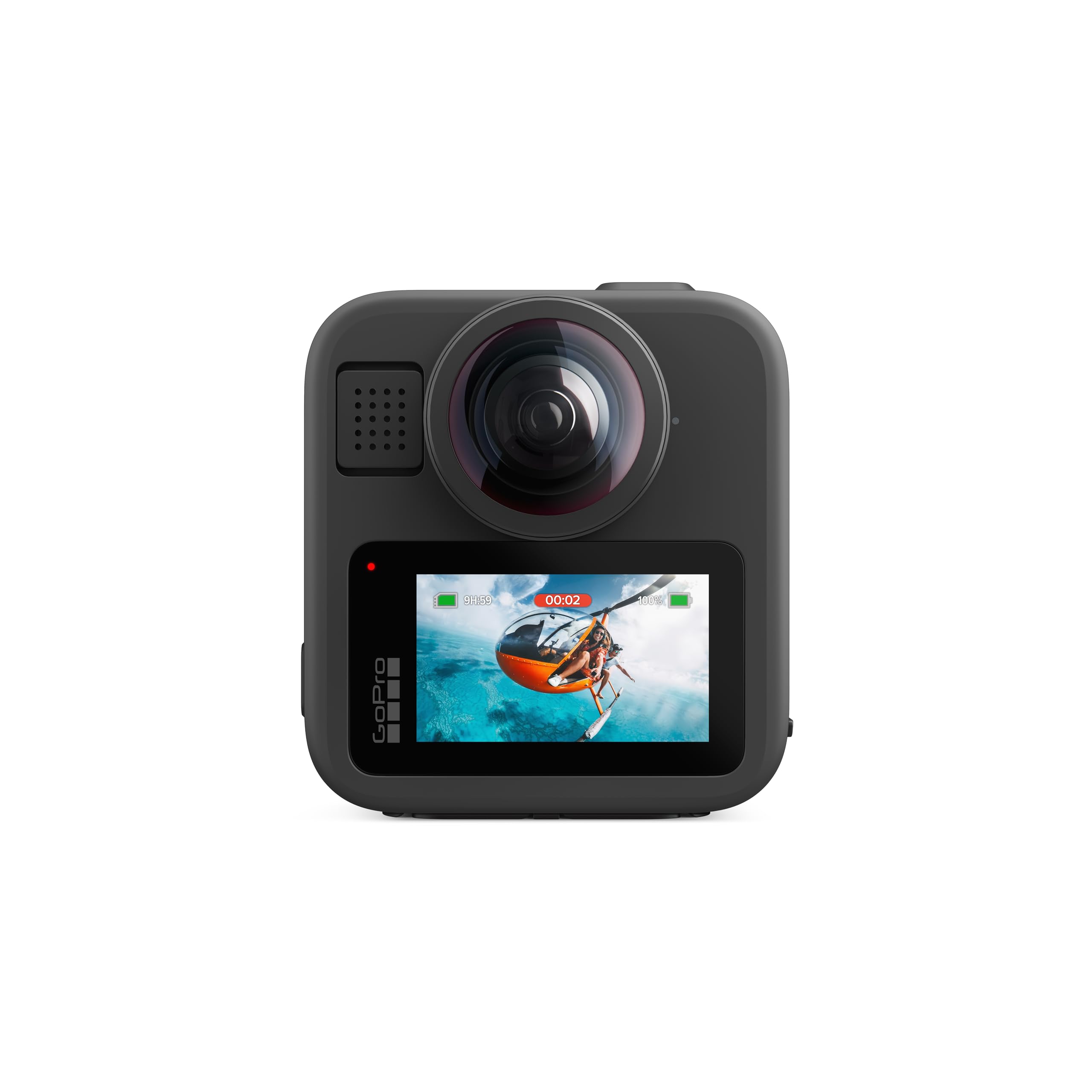
The 360 camera that gives you usable 8K spherical video and replaceable lenses for under.
The MAX2 delivers True 8K 360 video — which the manufacturer says results in up to 21% more resolution than the competition — so when you reframe your spherical footage into standard 4K clips in the GoPro Quik app, you keep crisp details rather than soft pixels. The HyperSmooth stabilization locks the horizon even when you spin the camera a full 360 degrees, and the 29MP stills have impressive dynamic range, according to verified buyers. Six internal microphones capture ambisonic audio that shifts with your perspective as you pan.
Unlike the earlier GoPro MAX, which tops out at 5.6K30 spherical, the MAX2 jumps to 8K while adding replaceable glass lenses that are water-repelling and optically strong — so a scratch no longer ends the camera. Buyers report the battery lasts through a heavy morning of 8K shooting, and the camera handles heat dissipation better than previous generations. The invisible mounting using 1/4-20 threads makes your selfie pole vanish from the footage automatically.
The main trade-off versus the DJI Osmo 360 models is the lack of built-in storage — the MAX2 relies on a microSD card, so you need to bring your own high-speed card for 8K recording. It is also a touch heavier than smaller-sensor competitors.
The Sharp Edges
- True 8K spherical video gives great reframing headroom to 4K
- Replaceable glass lenses — a scratch costs, not a new camera
- 6-microphone ambisonic audio shifts with your perspective
- Invisible stitching with no exposure steps in 360 mode
The Rough Spots
- No built-in storage — you must buy a high-speed microSD card separately
- Some owners mention the camera runs warm during extended 8K recording
- Large 8K file sizes may require monthly cloud storage fees
The go-to 360 camera for most people: if you want true 8K spherical capture with replaceable, tough glass lenses and proven stabilization from GoPro’s ecosystem, this is the best all-around value on the list right now.
Not your pick if: you need internal storage (get the DJI Osmo 360 instead) or you want the highest still resolution (the Xtra 360 Camera at 120MP beats this by a 7.2x gap in effective still resolution).
2. DJI Osmo 360 Essential Combo
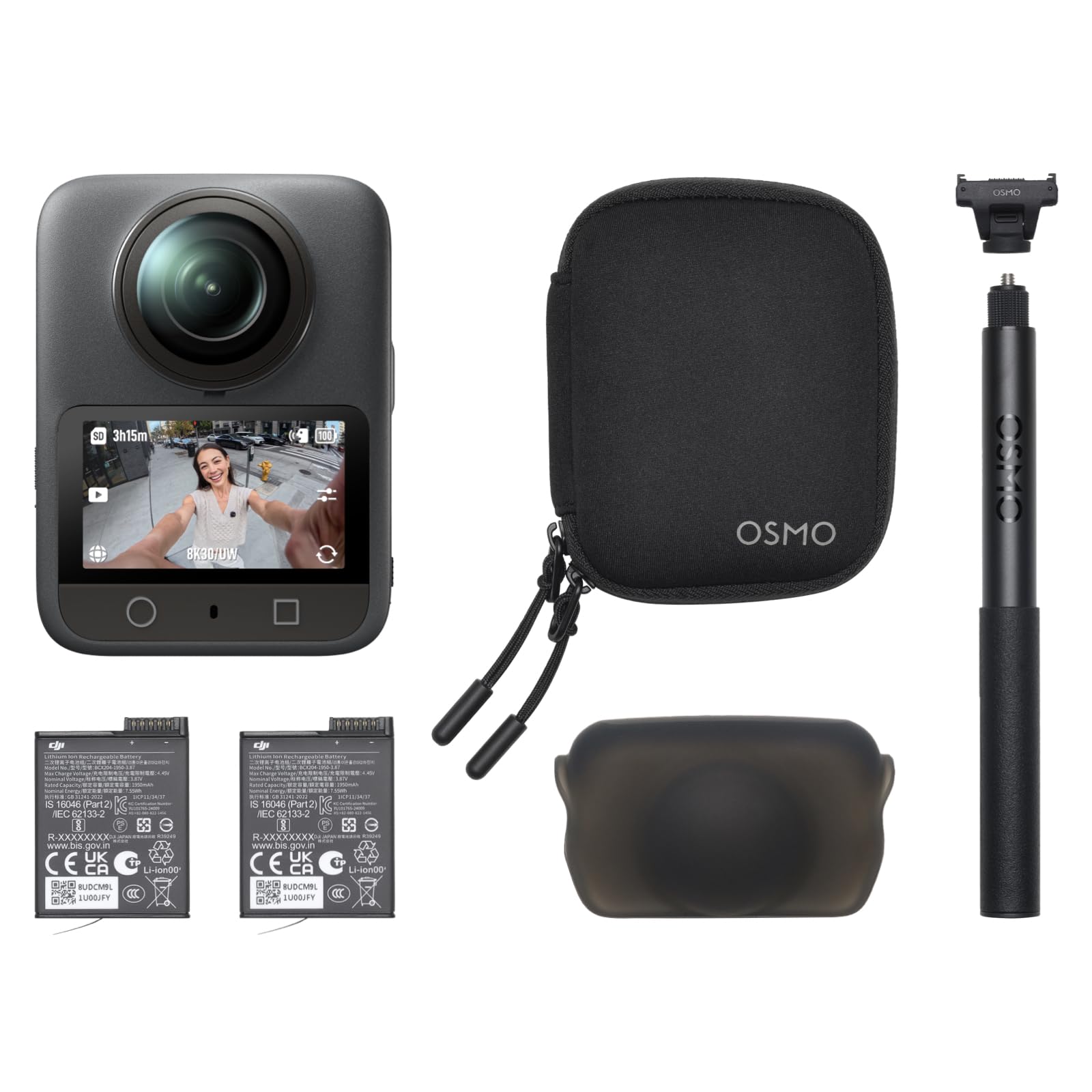
The 1-inch sensor 360 camera that gives you pro-grade low-light and 105GB of low-maintenance built-in storage.
This Essential Combo pairs the Osmo 360 body with a 1.2m Invisible Selfie Stick and an extra 1950mAh battery, so you can shoot 8K/30fps 360 video all day. The 1-inch dual-sensor imaging delivers excellent low-light performance — far cleaner than any 1/2.3-inch sensor camera — and the 120MP 360 photos capture lifelike detail in a single tap. The built-in 105GB storage means you never miss a shot because you forgot your microSD card at home.
Buyers consistently praise the video quality and stabilization, calling it “crisp and vivid” with 10-bit D-Log M color matching the DJI Mavic 3 Pro drone. One reviewer noted no overheating after 45 minutes of 8K/30fps recording, which is a solid sign for reliability. The magnetic quick-release system in the Essential Combo lets you swap between 360 and single-lens modes in seconds, and the included 1.2m invisible selfie stick makes third-person shots look like you had a separate cameraman.
The catch is the 100-minute battery life in 8K mode — the standard combo’s 190-minute rating likely applies to lower resolutions. The DJI Mimo app is removed from Google Play (you download from DJI’s website), which may frustrate some users who prefer the Play Store convenience.
Standout Specs
- Groundbreaking 1-inch 360° imaging for superior low-light quality
- 105GB built-in high-speed storage — no microSD needed
- 120MP 360° photo capture in one tap
- Essential Combo includes extra battery and 1.2m selfie stick
Stumbling Blocks
- Battery life rated at 100 minutes for 8K — may require the extra battery on long shoots
- DJI Mimo app not on Google Play; must sideload from DJI website
- Editting 360 footage requires a learning curve, per buyer feedback
Reach for this if: you shoot in varied lighting from dusk to city streets and want the best sensor quality plus the confidence of 105GB internal storage — the dual 1-inch sensors and 10-bit color give you professional-grade raw material for post-production.
Look elsewhere if: you prefer the simplicity of GoPro’s Quik app or you need the longest single-battery runtime possible (Insta360 X5 claims 208 minutes).
3. Xtra 360 Camera
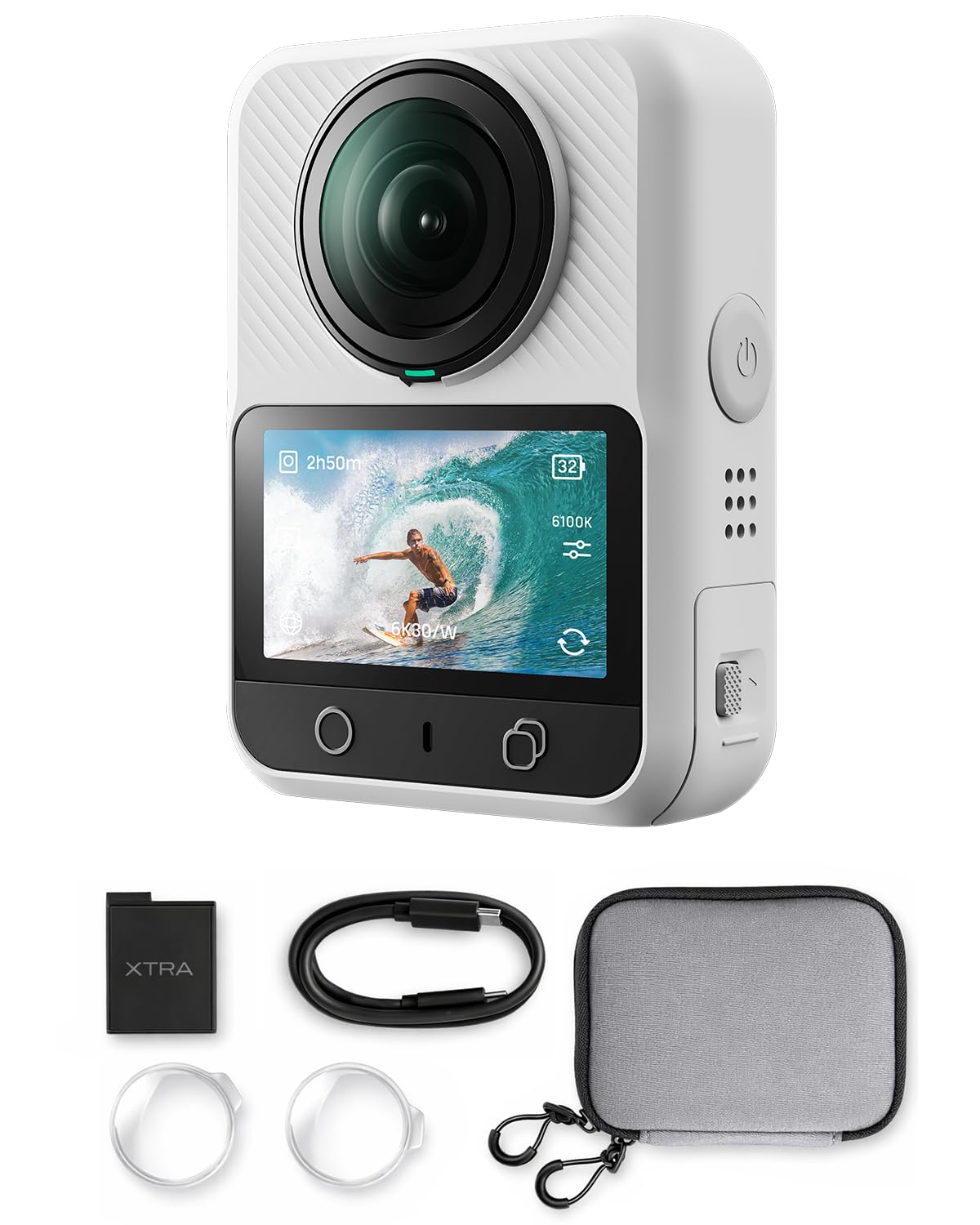
The 120MP stills and 8K panoramic video that out-resolves every other 360 camera at this price.
The Xtra 360 Camera packs a 1-inch sensor equivalent with a 120MP effective still resolution — a massive 7.2x gap over the GoPro MAX’s 16.6MP — and true 8K 360 video at 2160 effective video pixels, which is double the effective video resolution of the GoPro MAX (1080 pixels). Customers note the 8K panoramic video is sharper than the Insta360 X4, and the 105GB built-in storage handles massive files without needing a memory card. The magnetic quick-release system works with standard action camera mounts, and the 100MP panoramic photos are ultra-crisp with balanced natural colors.
What makes this camera unique is the combination of a 1-inch-equivalent sensor for cinema-grade depth and the 105GB internal storage that eliminates the “forgot my SD card” panic. The camera is waterproof and includes bullet-time effects, a carrying bag, and transparent lens protectors. Reviewers describe the image quality as “stunning with sharp details and great high-contrast handling” and say the built-in stabilization smooths footage effectively.
The clear downside — and a frequent complaint in the reviews — is the lack of desktop software for editing 360 footage. One buyer mentioned “there’s no software” to download 360 clips directly to a PC; you must use your phone for 360 editing and transfer. The standard footage transfers fine, but the 360 workflow is phone-dependent, which may frustrate filmmakers who prefer a PC-based edit.
Resolution King
- 120MP effective still resolution — 7.2x more than GoPro MAX’s 16.6MP
- 8K panoramic video that reviewers point out is sharper than Insta360 X4
- 105GB built-in storage — shoot immediately, no microSD purchase needed
- 1-inch sensor equivalent gives wide dynamic range and rich color
Software Struggle
- No desktop software for editing 360 footage — phone-only workflow for spherical clips
- Battery life rated at 1.5 hours — shorter than the premium DJI and Insta360 models
- Learning curve for the 360 editing process, per multiple reviews
Grab this for: the highest-resolution still photos and 8K panoramic video in its price range — if you want to pull ultra-crisp reframed shots and 120MP stills, the Xtra beats everyone on raw megapixels and effective video pixels.
skip it if: you need desktop editing software for your 360 footage or you want the longest possible battery runtime — the phone-only 360 editing workflow may be a dealbreaker for professional filmmakers.
4. Insta360 X5 Essentials Bundle

The 360 camera that outlasts every other pick with a claimed 208-minute runtime and fast charging to 80% in 20 minutes.
Insta360’s X5 brings dual 1/1.28-inch sensors that shoot 8K30fps 360 video with a new triple AI chip design that powers advanced noise reduction in low light. The battery life is the headline figure — up to 208 minutes of runtime with fast charging that hits 80% in just 20 minutes, so you can recharge during a quick break. The camera is waterproof to 49 feet (15 meters) without a case, and the rugged replaceable lenses are scratch-resistant and swap in seconds. The built-in Wind Guard on the 4-mic array reduces wind interference for clearer vlog audio.
Buyers love the ease of use — “just turn it on and edit the footage later” — and say the video quality is outstanding, even better than some DJI drones. The Insta360 app’s AI-powered reframing and one-tap export let you grab a shareable clip without any editing at all. The Essentials Bundle includes the 114cm Invisible Selfie Stick, an extra battery in a Utility Fast Charge Case, standard lens guards, and a carry case.
The biggest gap versus the DJI Osmo 360 models is the lack of built-in storage — the X5 relies entirely on a microSD card (sold separately). Some buyers also say the battery life doesn’t always match the 208-minute claim under heavy use, though the fast charging partially compensates. At the premium price point, it is the most expensive non-professional 360 camera on this list aside from the Ricoh Theta Z1.
Endurance Edge
- Up to 208-minute battery life with fast charging to 80% in 20 minutes
- Waterproof to 49ft (15m) without a case
- Rugged replaceable lenses that swap in seconds
- AI-powered reframing and one-tap export for instant social clips
Trade-Offs
- No built-in storage — microSD required and sold separately
- 72MP effective still resolution lags behind Xtra 360’s 120MP and DJI’s 120MP
- Highest price point aside from the Ricoh Theta Z1
Go for it if: you need the longest possible battery runtime in a single charge and want a waterproof, AI-powered 360 camera that is simple to operate and edit — the fast charging and rugged build make this ideal for all-day adventure shoots.
Pass if: you need built-in storage (get the DJI Osmo 360) or you prioritize still photo resolution — the 72MP max is lower than the Xtra and DJI options.
5. DJI Osmo 360 Standard Combo
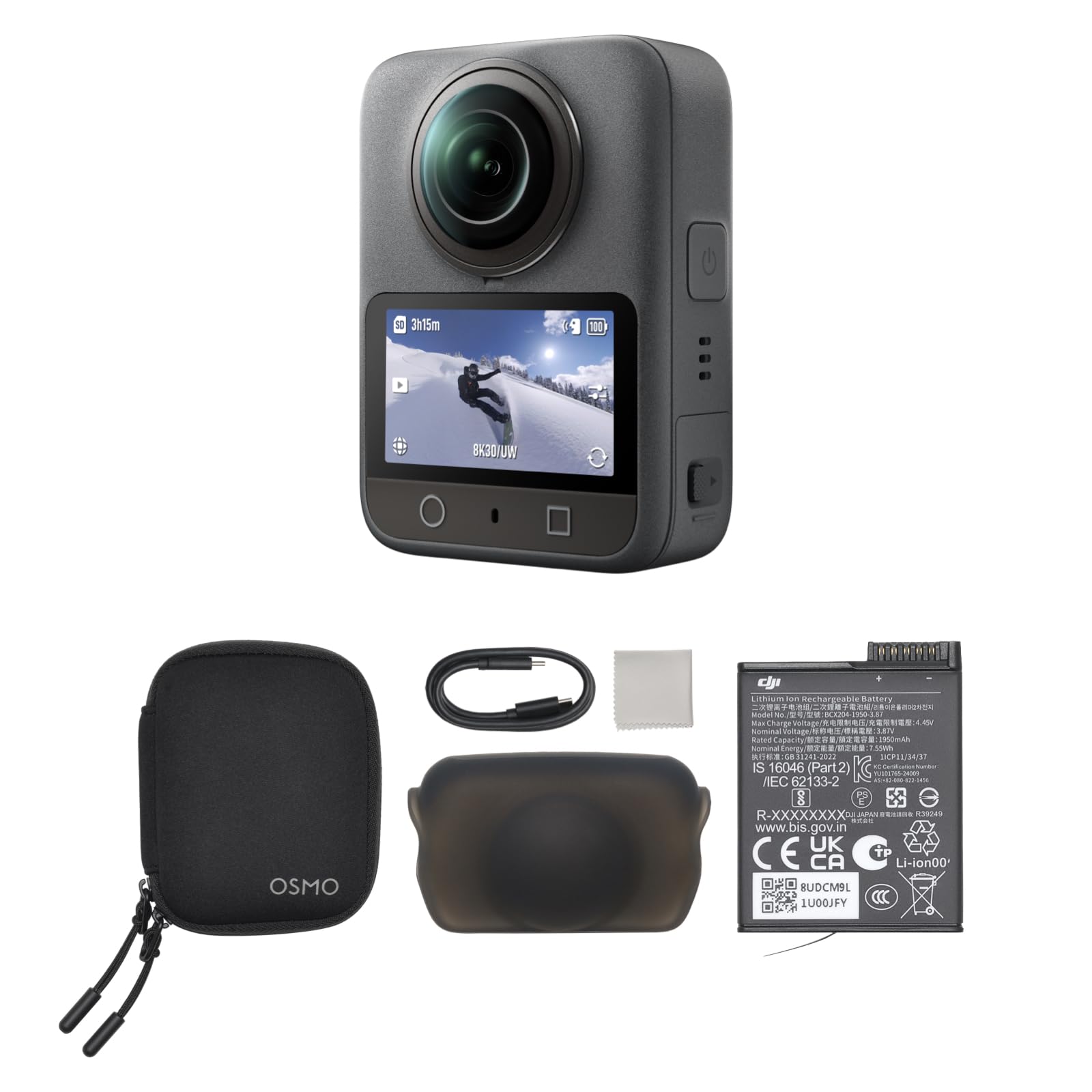
The same 1-inch sensor and 105GB storage as the Essential Combo, at a lower price without the extra accessories.
The Standard Combo is essentially the same high-end camera body as the Essential Combo — 1-inch 360° imaging, 8K/30fps 360 video, 120MP 360 photos, 105GB built-in storage — but without the extra battery and invisible selfie stick. This makes it a smarter buy if you already own DJI accessories or prefer to build your kit piece by piece. Buyers describe the camera as “great quality” with excellent stabilization and note that the batteries last 2-3 hours in typical use, not the full 190-minute max rating. The magnetic quick-release works with Osmo Action accessories, and the 1/4-inch thread fits tripods.
The 4x digital zoom is a unique addition among these picks, giving you the ability to punch in on distant subjects within your 360 sphere. The four-microphone array captures rich stereo audio, and the DJI Mimo app includes Pano Dewarp and Pano Pro Color Grading for cinematic editing. One reviewer who uses both this camera and a DJI drone said the 10-bit D-Log M color matches the Mavic 3 Pro, which is a major plus for video editors who want consistent color between aerial and ground footage.
The missing accessories mean you need to buy a selfie stick separately if you want the invisible pole effect, and the app is only available from the DJI website (not Google Play), which may be an annoyance. The lens is exposed and prone to scratches — a dive case is recommended for water activities.
The Essentials
- Same 1-inch dual sensor and 105GB built-in storage as the premium Essential Combo
- 8K/30fps 360 video with 4x digital zoom for distant subjects
- Four-microphone stereo recording with DJI Mic transmitter support
- Magnetic quick-release for fast mounting and angle changes
What’s Missing
- No invisible selfie stick or extra battery included (must buy separately)
- Exposed lens prone to scratches — dive case recommended for water
- DJI Mimo app removed from Google Play; download from DJI website
Perfect if: you want the DJI sensor and 105GB internal storage but already own a selfie stick and spare batteries, or you prefer to buy accessories a la carte and save on the bundle markup.
Not ideal if: you need everything in one box — the Essential Combo at the higher price gives you the selfie stick and second battery for a better overall value.
6. GoPro MAX

The entry-level 360 camera that still delivers solid 5.6K30 spherical video and GoPro’s proven stabilization ecosystem.
The GoPro MAX is the previous-generation 360 camera that drops the resolution to 5.6K30 spherical video and 16.6MP still photos, but it keeps the core experience: invisible mounting via 1/4-20 threads, the GoPro Quik app with Object Tracking and reframing, and the ability to switch to single-lens Hero mode for 1080p or 1440p widescreen video. The included Enduro Battery provides over 1 hour of run time per verified buyers, which is respectable for the price bracket. The camera captures everything around you so you do not have to frame the shot during action.
What makes the MAX still relevant in 2025 is its price — it is the cheapest true 360 camera from a major brand on this list — and the GoPro Quik app which one reviewer called “packed with features” that transform spherical footage into shareable clips with dramatic transition effects. Buyers consistently praise the “excellent video quality, vivid and bright” with impressive image stabilization, and say it replaces older 360 cameras with noticeably better quality. The 5.6K30 spherical capture still reframes to sharp 1080p clips, and 3K60 slow-motion lets you capture 2x slo-mo of action like kids jumping in a pool.
The hard limitation is the 1080 effective video pixels — half the effective video resolution of the Xtra 360 Camera’s 2160 pixels. The glass lenses scuff and scratch easily, causing distortion in the 360 footage, and you cannot replace them without sending the camera in. The MAX is also physically identical to the previous model, so there are no generational leaps in design.
Why It Still Works
- Budget-friendly entry to 360 video from a trusted brand
- 5.6K30 spherical video reframes to usable 1080p clips
- GoPro Quik app with Object Tracking and easy reframing
- Includes Enduro Battery with over 1 hour of run time
Where It Lags
- 1080 effective video pixels vs 2160 on the Xtra 360 (a 2.0x gap)
- Non-replaceable glass lenses that scuff and scratch easily
- Identical design to the previous model with no major hardware update
Pick this if: you are new to 360 video and want a proven, affordable entry point with the best app ecosystem from GoPro — the MAX is a solid starter camera that won’t break your budget.
pass on it if: you need 8K spherical resolution for pro reframing, replaceable lenses for rough environments, or the highest still image quality — the MAX2 or Xtra 360 are better long-term investments.
7. AKASO 360 Action Camera Cycling Combo
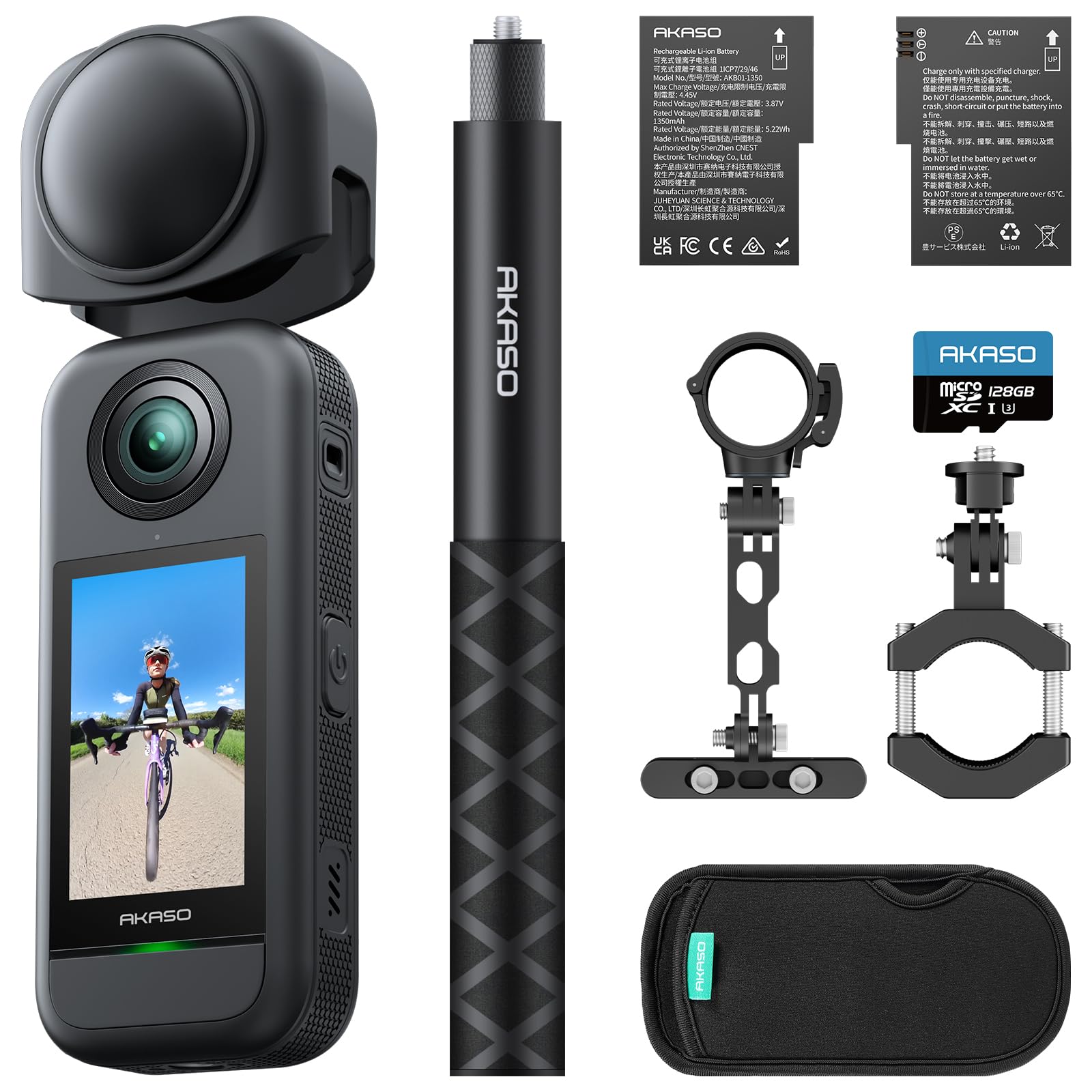
A complete starter kit with a 256GB microSD card, 5.7K 360 video, and an invisible selfie stick effect at a value price.
The AKASO 360 is aimed squarely at beginners who want an all-in-one package: the camera, a 256GB microSD card, dual 1/2-inch 48MP sensors for 5.7K 360 video, and 72MP 360 photos. The 360° Supersmooth stabilization and 360° Horizon Lock keep your footage level even when you spin or flip, and the AI Subject Tracking intelligently keeps a subject centered. The invisible selfie stick effect creates third-person shots without a visible pole, though the stick itself is not included. Buyers consistently describe this as an “excellent entry-level 360-degree camera” for motorcycle trips and outdoor adventures, praising the stabilization and 4K video quality.
The included 256GB microSD card is a significant value-add, since 360 video files are large and a high-speed card is often a hidden extra cost with other cameras. The camera can record while charging, which is useful for long rides, and the weatherproof design handles light rain. The AKASO 360 Studio app offers basic editing tools for reframing and keyframe animation, though shoppers say it lacks text overlays and transitions found in premium apps.
The low-light performance is noticeably weaker than the 1-inch-sensor cameras — one reviewer called it “poor” due to the lack of IR LEDs — and the battery life is described as “awful” by some buyers when recording at higher resolutions. The 5.7K spherical video also reframes to roughly 1080p, not 4K, so you have less headroom than the 8K cameras in this list.
Kit Value
- Includes 256GB microSD card — a -30 value and eliminates the first hidden cost
- 5.7K 360 video with effective 360° Horizon Lock stabilization
- AI Subject Tracking keeps subjects centered automatically
- Can record while charging, ideal for long motorcycle rides
Cut Corners
- Weak low-light performance due to no IR LEDs — daytime-only camera
- Battery life is short, especially at higher resolutions — carry spares
- App is basic, lacking text overlays and transitions found in GoPro/Insta360 apps
- No full waterproofing — weatherproof only, not submersible
Best for: budget-conscious beginners who want a complete kit with a microSD card included — perfect for daytime motorcycle vloggers and casual outdoor shooters who do not need 8K resolution or professional editing tools.
Not for: anyone who shoots in low light, needs true waterproofing, or wants the reframing flexibility of 8K spherical capture — the 5.7K sensor limits your final clip sharpness.
8. Ricoh Theta Z1 51GB

The professional-grade still-image 360 camera that photographers and real estate agents trust for accurate, high-dynamic-range captures.
The Ricoh Theta Z1 is a different breed from the action cameras above. It is built around two 1-inch back-illuminated CMOS sensors that deliver the highest still-image quality in the Theta series — 23MP images (approximately 6720 x 3360, or 7K) with a high-precision stitching process that suppresses ghosting, flare, and fringing. The 51GB internal memory stores approximately 6350 JPEG still images or 110 minutes of 4K video. Enhanced HDR image processing captures both interior and exterior brightness levels in a single shot, which is critical for real estate virtual tours. Buyers confirm that it produces “blue skies and no blown-out windows” in 3D tours, unlike the Insta360 X3 which they said had blown highlights.
The magnesium alloy body gives a premium, durable feel, and the USB 3.0 Type-C connection enables fast transfers. RAW development via Adobe Photoshop Lightroom Classic CC with the dedicated RICOH THETA Stitcher plug-in gives professionals full control over color and exposure. The camera supports YouTube livestreaming for live 360 broadcasts, and the 4-channel microphone captures rich spatial audio in 4K video.
The trade-offs at this price point are significant for video users. The Theta Z1 only shoots 4K 360 video, not 8K, and the battery lasts less than 1 hour (and is non-user-replaceable). There is no touchscreen — the interface is outdated. For still photography and real estate, the Theta Z1 is the undisputed top-tier, but for action sports, vlogging, or any video-first use case, the GoPro MAX2 or DJI Osmo 360 are far better tools.
The Still-Image Champion
- Dual 1-inch back-illuminated CMOS sensors for top-tier still image quality
- Enhanced HDR captures interior and exterior brightness without blown windows
- Magnesium alloy body is durable with a premium finish
- RAW development with Adobe Lightroom Classic CC and THETA Stitcher plug-in
- 51GB internal storage holds ~6350 JPEGs or 110 minutes of 4K video
The Video Limitations
- Only 4K 360 video — no 8K spherical capture for reframing to 4K clips
- Battery lasts less than 1 hour and is non-user-replaceable
- No touchscreen — interface feels outdated compared to action cameras
- Highest price point on this list with the weakest video specs
Choose this if: you are a real estate photographer, architect, or VR content creator who needs the best possible 360 still images with professional HDR and RAW workflow — the dual 1-inch BSI sensor is class-leading for stills in the 360 world.
Avoid it if: you need 8K video for reframing, long battery life for action shooting, or a user-replaceable battery — the Theta Z1 is a specialized stills tool, not a general-purpose action camera.
Understanding the Specs
Spherical Resolution vs Reframed Resolution
Every 360 camera records a full sphere, but most of that sphere gets cropped away when you reframe to a standard 16:9 video. A camera recording 8K spherical video (7680 x 3840) gives you sharp 4K reframed clips. A 5.7K sphere gives you roughly 1080p after reframing. More spherical resolution means more cropping flexibility and sharper final videos — this is the single most important number in 360 cameras.
Sensor Size and Low-Light Quality
Sensor size is measured in inches — 1-inch sensors are physically larger than 1/2-inch sensors. A larger sensor has bigger individual pixels that collect more light, resulting in cleaner, less noisy images in dim conditions. Cameras with 1-inch sensors (like the DJI Osmo 360 and Ricoh Theta Z1) dramatically outperform 1/2-inch sensor cameras (like the AKASO 360) in twilight, indoor, or shaded shooting. If you shoot mostly in bright sun, sensor size matters less.
Built-in Storage Benefits
360 video files are extremely large because they capture the entire visible sphere. A 30-minute 8K 360 clip can exceed 30GB. Cameras with built-in storage (105GB on the DJI Osmo and Xtra, 51GB on Ricoh) let you shoot immediately without buying a separate high-speed microSD card. This also means one less component to fail in wet, sandy, or dusty conditions. Cameras without built-in storage (GoPro, Insta360) require a fast microSD card — usually UHS-I Speed Class 3 (U3) or faster for 8K recording.
Stabilization and Horizon Lock
360 cameras use gyroscope-based electronic stabilization to smooth out bumps and jitters without cropping into your spherical video — because the entire sphere is recorded, the camera has plenty of room to stabilize. Horizon Lock (also called Horizon Steady or 360° Horizon Lock) keeps the video level even when you physically spin the camera a full 360 degrees. This is essential for action-sports shooting on a helmet, bike, or selfie stick, where the camera rotates around you but the video must stay upright.
FAQ
Can I use a 360 camera as a normal action camera?
Do I need a fast microSD card for 8K 360 video?
How long does a typical 360 camera battery last?
Can I livestream in 360 with these cameras?
What is the invisible selfie stick effect?
Which 360 camera has the best image quality for still photos?
Are 360 camera lenses replaceable if scratched?
Do I need desktop software to edit 360 footage?
Which 360 camera is best for real estate virtual tours?
Can I use a 360 camera underwater?
Can I use a 360 camera underwater?
Final Thoughts: The Verdict
For most buyers, the 360 video camera winner is the GoPro MAX2 because it delivers true 8K spherical capture, replaceable glass lenses, and HyperSmooth stabilization at a mid-range price that puts professional-grade 360 video within reach without the premium markup of built-in-storage models. If you want the absolute best low-light quality and internal storage for low-maintenance shooting, grab the DJI Osmo 360 Essential Combo. And for the highest still resolution and 8K panoramic sharpness on a budget, the standout is the Xtra 360 Camera — just be ready for the phone-only editing workflow.
How We Picked
We do not accept paid placement. Every pick is matched to a real buyer and a real use-case; we do not hands-on test units.
Sources & Methodology
Specifications: manufacturer listings and product documentation. Review insights: verified customer reviews, as of July 2026. Pricing: not shown on this page (it changes often); check the current price via the retailer link.
As an Amazon Associate, FitlyFast earns from qualifying purchases. This does not affect which products we feature.