
Our readers keep the lights on and the weekend projects moving. As an Amazon Associate, I earn from qualifying purchases.
A 3D filament dryer is not a luxury accessory — it is a core tool for anyone who demands consistent layer adhesion, bubble-free extrusion, and reliable results from hygroscopic materials like PETG, TPU, and nylon. Skipping proper drying turns a precision print into a stringy, brittle failure before the first layer finishes.
I’m Rikta — the founder and writer behind FitlyFast. I’ve spent years analyzing the thermal performance, sealing integrity, and real-world usability of filament dryers across every price tier, separating marketing claims from measurable drying power.
The market is flooded with boxes that claim to dry but fail to maintain temperature or seal out ambient moisture. This guide cuts through the noise to help you find the best 3d filament dryer for your workflow, spool volume, and material needs.
How To Choose The Best 3D Filament Dryer
Choosing a 3D filament dryer comes down to matching your material set, print volume, and workflow to the dryer’s heating technology, spool capacity, and sealing capability. A mismatch here leads to wasted time or damaged filament.
Heating Technology: PTC vs. PI Heating Pads
PTC (Positive Temperature Coefficient) heaters are the gold standard. They self-regulate, reach target temperatures faster, and are less prone to hot spots than PI (polyimide) heating pads. A 150W PTC heater can bring a chamber to 50°C in about seven minutes, while a PI pad often struggles to maintain uniform heat across the spool. For materials requiring 70°C and above, PTC is non-negotiable.
Spool Capacity and Physical Footprint
Single-spool dryers are compact but limit throughput. Dual-spool models double your drying capacity without a massive footprint. Four-spool units are ideal for print farms or users running multiple material types, but they demand more desk space and often require a dedicated shelf. Consider whether you need to dry and print simultaneously — the best units let you feed filament directly through sealed PTFE ports.
Sealing and Humidity Management
An effective dryer maintains low humidity even after the heating cycle ends. Look for silicone gaskets, latch-style lids (not magnetic), and the ability to add desiccant. Models with built-in hygrometers and auto-humidity start modes add an extra layer of protection against re-absorption, especially in humid environments.
Quick Comparison
On smaller screens, swipe sideways to see the full table.
| Model | Category | Best For | Key Spec | Amazon |
|---|---|---|---|---|
| Chitu Systems E1 | Premium | Multi-material users needing independent chamber control | Dual 120W PTC heaters, 4-spool capacity | Amazon |
| Creality Space Pi X4 | Premium | High-temp materials and simultaneous multi-spool drying | Dual 200W chambers, max 85°C | Amazon |
| SUNLU Filament Dryer S4 | Mid-Range | High-volume drying with auto-humidity control | 350W PTC heater, 4-spool capacity | Amazon |
| SUNLU SP2 | Mid-Range | Large 3kg spools and quick 15-min drying cycles | 250W PTC heater, max 70°C | Amazon |
| Creality Space Pi Plus | Mid-Range | Dual spool drying with touchscreen presets | 160W PTC heater, 360° hot air circulation | Amazon |
| Polymaker PolyDryer | Mid-Range | Modular system for expanding storage capacity | Modular Dry Dock + storage box design | Amazon |
| Sovol SH02 | Budget | Entry-level dual spool drying with one-key presets | 150W PTC heater, max 70°C | Amazon |
In‑Depth Reviews
1. Chitu Systems E1 Filament Dryer
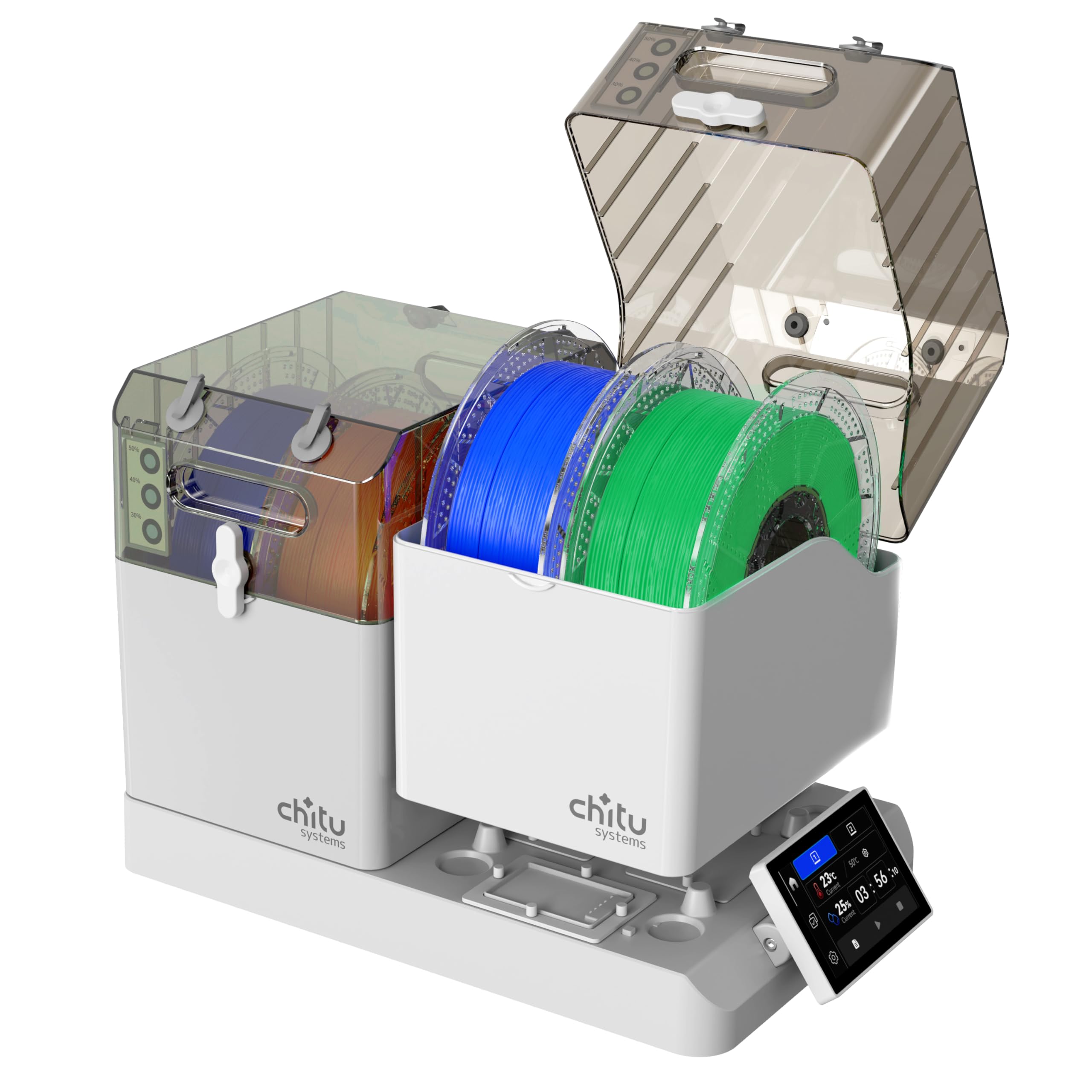
The Chitu Systems E1 is a genuinely engineered step forward in filament drying, built around a dual-zone heating base and two removable pods, each holding two 1kg spools. Each pod has its own 120W PTC heater and fan, giving you independent temperature and time control per chamber — a huge practical advantage when drying PLA in one pod and PETG in the other. The automatic humidity-start mode wakes the dryer from standby when the internal humidity crosses 50%, preventing re-absorption without manual intervention.
Real-world tests show the E1 pulling filament humidity down quickly, with accurate sensor readings during active drying. The LCD touch screen is responsive and includes preconfigured profiles for PLA, ABS, PETG, PA, and PC. The pod system also doubles as sealed storage pods, with closable magnetic vent plates and space for added desiccant. Direct PTFE feed-through means you can print from the dryer without breaking the seal.
Some build compromises exist: the plastic feels thin in spots, the lid handles are weaker than ideal, and the four unsealed holes on the bottom of each pod let humidity creep back in during idle storage. The rollers lack bearings, so larger spools can bind. Despite these quibbles, the dual-zone independence and auto-humidity logic make this the most feature-rich option for serious multi-material users.
Why it’s great
- Independent chamber control for different materials
- Auto-humidity start prevents secondary moisture
- Removable pods double as sealed storage boxes
Good to know
- Thin plastic build with no lid gasket
- Roller bearings absent for larger spools
- Bottom holes need plugs for true airtight seal
2. Creality Space Pi X4 Filament Dryer
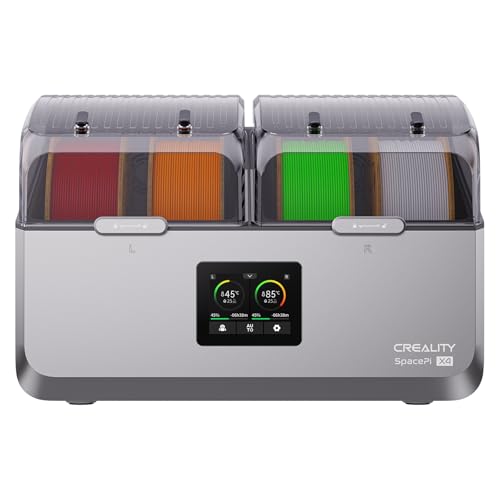
The Creality Space Pi X4 is built for users who need high-temperature drying for advanced filaments like ASA, PC, PET-CF, and PAHT. Its dual independent 200W heating chambers can hit 85°C, and the system dries filament roughly 30% faster than single-chamber alternatives. The touchscreen UI adapts drying parameters per material type — ASA at 80°C, PETG at 60°C — with real-time humidity monitoring that auto-resumes drying if the sensor detects moisture re-entry.
The X4 holds four 1kg spools or two 2kg spools, with separate left-and-right chamber controls so you can dry different materials at different temperatures simultaneously. Build quality is solid: the lid uses a silicone gasket for a tight seal, and the internal hygrometer reads within ±2°C of reference. An illuminated window lets you check spool status without breaking the humidity seal, and pneumatic PTFE fittings keep feed lines secure.
On the downside, the dryer does not include auto-rotation for spools, and the stock desiccant holder is too small to maintain dryness long-term without a DIY upgrade. Some users report that placing low-temp filaments like PLA near the hot spots can cause minor deformation. This unit is best reserved for those who regularly print high-temperature materials and need true chamber-level independence.
Why it’s great
- Dual 200W chambers reach 85°C for advanced filaments
- Auto-resume drying if humidity rises
- Illuminated window and pneumatic PTFE fittings
Good to know
- No spool auto-rotation
- Stock desiccant holder needs upgrading
- Hot spots can affect low-temp materials
3. SUNLU Filament Dryer S4
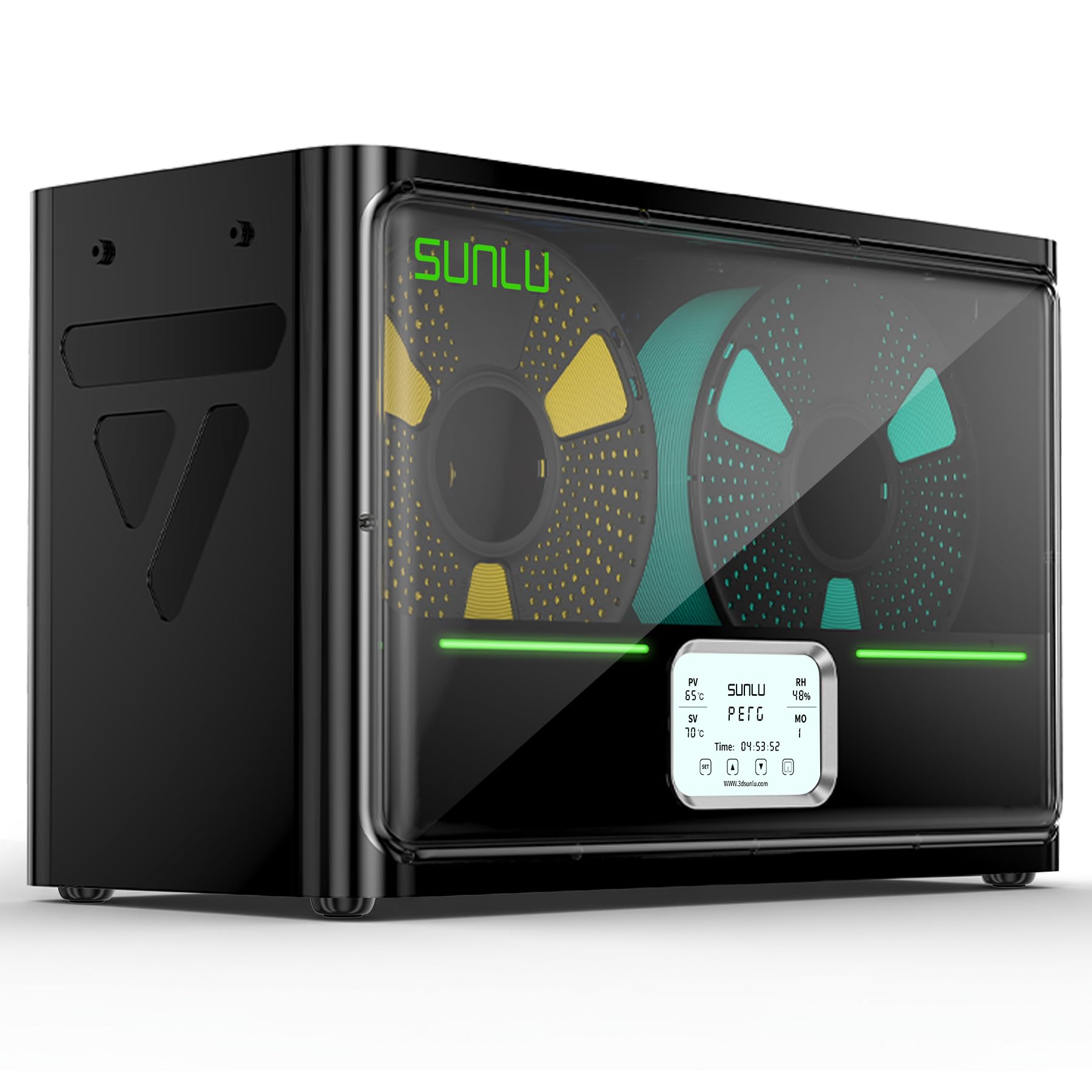
The SUNLU S4 puts a 350W PTC heater and three internal fans into a four-spool format, making it one of the fastest-heating multi-spool dryers on the market. It can climb from 25°C to 50°C in about 30 minutes — roughly 50% faster than typical dual-spool units. The triple-fan layout (two side, one bottom) keeps temperature variance inside the box to within ±3°C, which is critical for ensuring every segment of a spool gets evenly dried.
Smart auto humidity control is the headline feature here. You set a target range (30% to 50%), and the S4 automatically starts drying when humidity hits that threshold, shutting off below 25% to avoid over-drying fragile materials. This makes it a set-it-and-forget-it tool for humid climates. The unit connects to four printers simultaneously and supports 99% of filament types, including PLA, PETG, TPU, ABS, PA, and PC.
Build quality is solid with a latch-style lid, but the S4 does not quite achieve an airtight seal for long-term passive storage — expect to rely on the active auto-humidity mode rather than passive sealing. The LCD display is clear, but some users find the interface less intuitive than touchscreens on rival units. For high-volume users who print daily, the S4’s speed and auto-humidity logic are hard to beat.
Why it’s great
- Fast 350W PTC heater with triple-fan circulation
- Auto-humidity start and stop prevents waste
- Supports 4 printers simultaneously
Good to know
- Not airtight for long-term passive storage
- Interface less intuitive than touch-only models
4. SUNLU Filament Dryer SP2
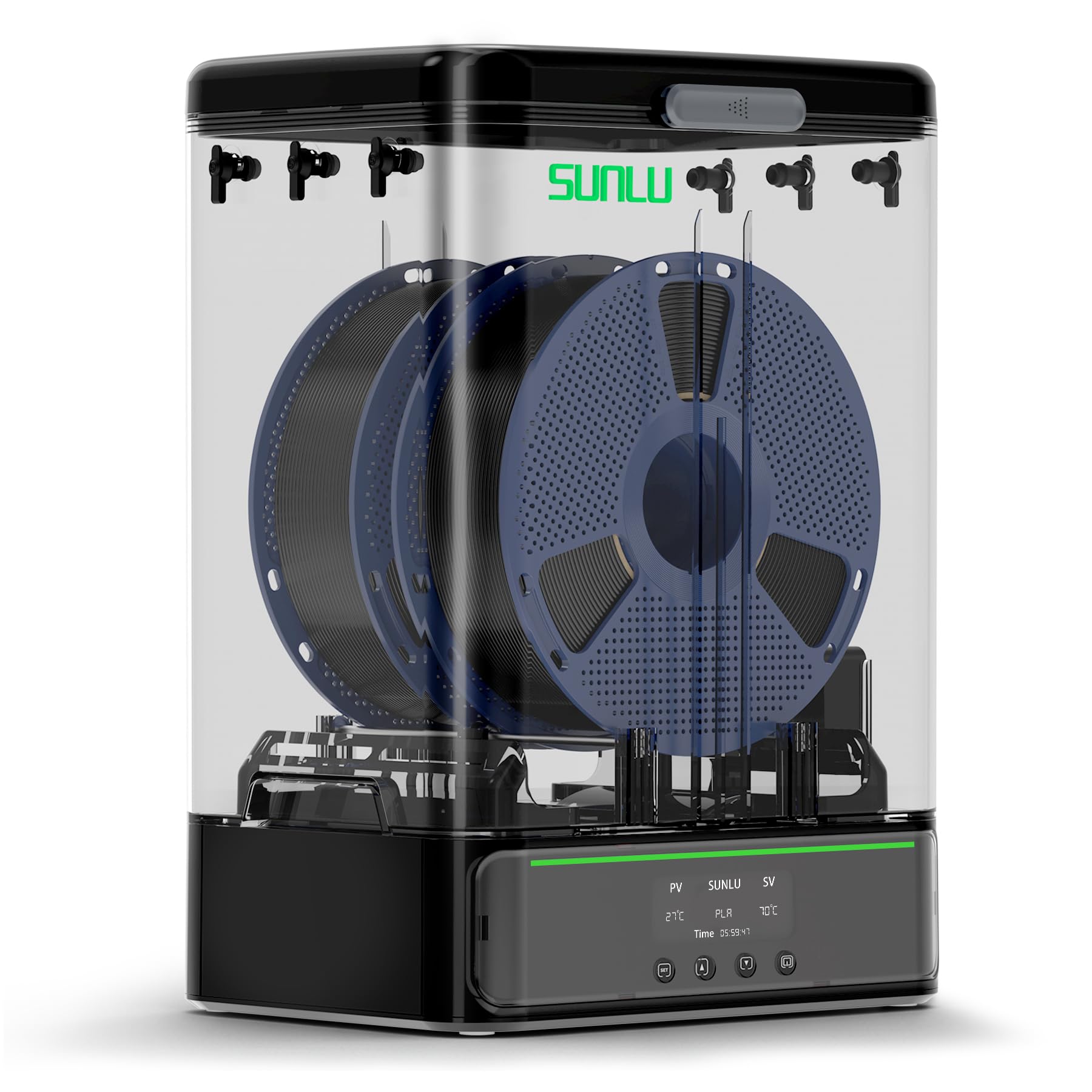
The SUNLU SP2 is purpose-built for users who work with large 2kg or 3kg spools, which simply do not fit in standard 1kg dryers. Its detachable design — a dryer base that lifts off from a sealed storage box — lets you dry and then store without transferring spools. The 250W PTC heater reaches 70°C in about 15 minutes, and the 360° surround heating ensures even drying without hot spots.
Six silicone feed holes and included PTFE tubes give flexibility for multi-printer setups, while the HD LCD touch screen displays real-time temperature, time, and humidity. The storage box has two sliding latches for a strong seal, and it holds humidity well — one user reported the box maintained its original RH reading after a full week sealed. The included hygrometer and desiccant containers add an extra layer of protection.
The main trade-off is that the SP2 holds only two 1kg spools simultaneously (or one 3kg spool), so throughput is lower than four-spool alternatives. The lift-off lid design is convenient but adds a step when swapping spools mid-print. For anyone regularly buying 3kg rolls, however, this is the most practical dedicated large-spool dryer available.
Why it’s great
- Fits 3kg spools that other dryers cannot
- Detachable storage box maintains humidity well
- Fast 15-minute heating to 70°C
Good to know
- Limited to two 1kg spools or one large spool
- Lift-off lid requires extra step for spool changes
- Desiccant container could be larger
5. Creality Space Pi Filament Dryer Plus
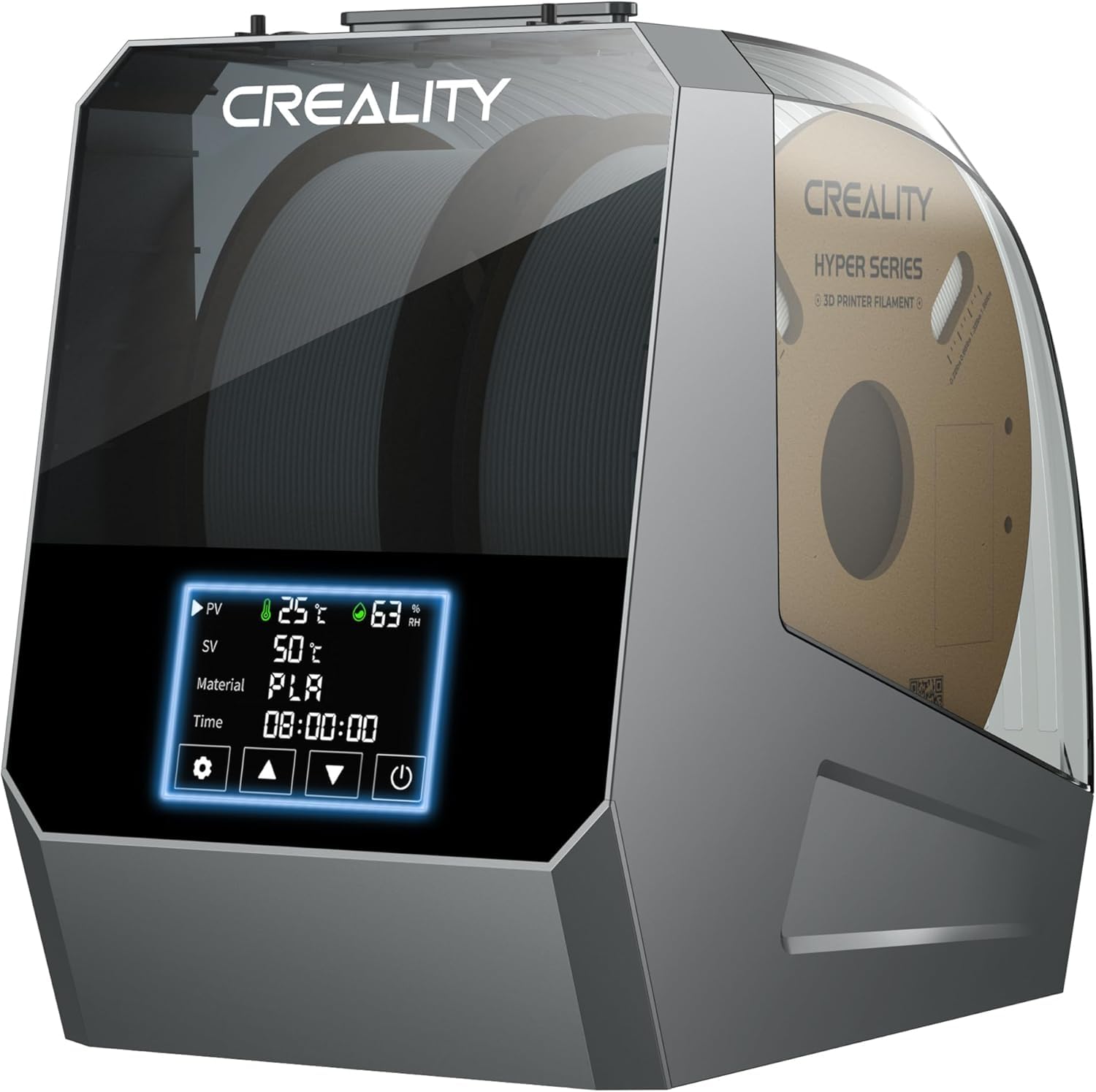
The Creality Space Pi Plus upgrades its predecessor with a 160W PTC heater and 360° hot-air circulation, improving both speed and uniformity. It holds two 1kg spools with four filament holes and two included PTFE tubes, allowing simultaneous feeding to two printers. The 4-inch LCD touch screen is snappy and gives one-key access to presets for 12 filament types — including demanding composites like PLA-CF, PETG-CF, and PA-CF — with a manual range of 45°C to 70°C.
Users consistently report that it resolves stringing and adhesion issues in PETG after a 10-hour cycle. The build feels sturdy, with a solid lid latch and smooth rollers. The unit also supports direct printing while drying, and the touchscreen lets you switch between Celsius and Fahrenheit easily. The PTC heater’s self-regulating nature means it rarely overshoots its target temperature, protecting sensitive filaments.
One quirk: the timer can continue past 00:00 on some units, which means you might need to manually check or use a separate smart plug for exact timing. The maximum temperature of 70°C also limits use with true high-temp materials like PC or PAHT — this is best for standard PLA, PETG, TPU, and ABS. For those running two printers off a single compact dryer, this is a reliable mid-range workhorse.
Why it’s great
- 160W PTC heater heats quickly and uniformly
- 12 one-key presets include advanced composites
- Dual-spool with direct feed for two printers
Good to know
- Timer may overrun past 00:00 on some units
- Max 70°C not suitable for advanced high-temp materials
6. Polymaker PolyDryer

The Polymaker PolyDryer takes a modular approach: a single Dry Dock base with a PTC heater and 360° airflow connects to one or more PolyDryer Boxes. Each box is a sealed storage unit with a central spool holder and a reusable desiccant pack. The idea is that you dry one box at a time but can store multiple boxes pre-loaded with dry filament, swapping them as needed without cycling the heater.
The three preset power levels cover PLA, PETG, and high-temp materials, and the 360° airflow is genuinely even — internal hygrometer readings show humidity dropping from 54% to 29% in about 22 hours of drying. The sealing is excellent; desiccant regeneration is simple with a microwave. The unit accepts spools up to 1kg in all common diameters (1.75mm, 2.85mm, even 3.00mm), making it universally compatible.
However, the fans are noticeably loud — comparable to a high-end PC under load — and the power brick is bulky. The max effective temperature is around 50°C, which struggles with nylon and ASA; some users report needing 24-hour cycles for these materials. The clips on the storage box can be difficult to open, and the small display is hard to read from an angle. This is a great choice if you value modular storage and mostly use PLA, PETG, or TPU.
Why it’s great
- Modular design scales storage without extra heaters
- Excellent sealing and good desiccant integration
- 360° airflow dries spools evenly
Good to know
- Loud fan noise during operation
- ~50°C max struggles with nylon and ASA
- Small display hard to read at an angle
7. Sovol Filament Dryer SH02

The Sovol SH02 is the most affordable dual-spool PTC dryer in this lineup, and it performs well above its price point. The 150W PTC heater reaches 50°C in 7 minutes and 70°C in 25 minutes, with a built-in fan circulating hot air 360° for uniform drying. It includes one-key presets for nine filament types — PLA, TPU, PETG, ABS, ASA, PVA, PC, PA, and PP — which simplifies setup for beginners and experienced users alike.
Sealing has been improved over the previous SH01 model, with thicker gasket material that holds humidity well even when the unit is off. The touch screen is responsive and modern-looking, and the two feed holes with caps let you seal the box during storage. Smart safety protection cuts heating if the PTC exceeds 130°C and sounds an alarm if the fan stops, preventing damage to the module.
The constant fan noise is the most common complaint — it runs at a pitch similar to a high-end PC under load, which is noticeable if the dryer is on the same desk as your printer. Some users wish for four feed holes (front and back) instead of two, and a larger four-spool version would be welcome. For the price, though, the SH02 delivers reliable dual-spool drying with solid safety features and a straightforward interface.
Why it’s great
- 150W PTC heater reaches 70°C in 25 minutes
- One-key presets for 9 filament types
- Improved sealing over previous generation
Good to know
- Constant fan noise noticeable on the same desk
- Only two feed holes limits flexibility
- No four-spool upgrade available
FAQ
Do I actually need a filament dryer if I store my spools in vacuum bags?
What temperature should I use for PLA versus PETG versus nylon?
Can I dry two different filament types at the same time?
Final Thoughts: The Verdict
For most users, the best 3d filament dryer winner is the Chitu Systems E1 because its independent dual-zone chambers and auto-humidity start give you genuine material flexibility without overcomplicating the workflow. If you primarily dry large 3kg spools and value quick cycles, grab the SUNLU SP2. And for high-temperature materials like PAHT and PET-CF, nothing beats the Creality Space Pi X4’s dual 200W chambers reaching 85°C.