
Our readers keep the lights on and the weekend projects moving. As an Amazon Associate, I earn from qualifying purchases.
The invisible byproduct of every resin print and every ABS spool is a cloud of volatile organic compounds and ultrafine particles that settle into your lungs and cling to your walls. A simple tent won’t stop that — only a properly ventilated enclosure with a powered exhaust path and sealed seams provides the barrier your home workshop actually needs. Choosing the wrong setup means you trade print quality for air quality, or worse, get neither.
I’m Rikta — the co-founder and writer behind FitlyFast. I’ve spent hundreds of hours cross-referencing fan CFM ratings, carbon filter density claims, and real-world user VOC readings to understand which enclosures actually move air instead of just trapping it.
Whether you’re fighting resin fumes in a shared apartment or managing the reek of a multi-filament farm, the right 3d printer enclosure with ventilation turns a toxic corner of your home into a safe, stable printing environment you can trust.
How To Choose The Best 3D Printer Enclosure With Ventilation
Picking a ventilated enclosure means balancing three conflicting goals: contain the fumes, maintain a stable internal temperature, and still let you see and reach your print. Every design trades one for another. Knowing which trade to make starts with two hard specs: exhaust CFM and filter media type.
Exhaust Power — CFM vs. Static Pressure
Fan speed measured in CFM (cubic feet per minute) tells you how fast air moves through the duct. A 50 CFM fan refreshes a typical 8 ft³ enclosure every ten seconds. But raw CFM is useless if the fan can’t push against the resistance of a carbon filter or a long duct run. Look for fans that specify static pressure ratings — at least 1.5 mmH₂O for setups with a single carbon sheet and a 3-foot duct. Lower-pressure fans stall when you attach anything beyond the bare tube.
Filter Media — Carbon Sheets vs. Activated Carbon Cartridges
Most included carbon filters are thin sheets pressed into a felt-like pad. They adsorb a fraction of the VOCs for the first few hours before saturating. For resin printers running daily, a replaceable bulk activated carbon cartridge or a secondary HEPA stage catches the particles that pass through the pad. If the enclosure only has a carbon sheet slot and no cartridge option, plan on swapping the sheet every two to three weeks.
Seal Quality — Zippers, Gaskets, and Ports
A tent that leaks at the zipper track or around the exhaust port bypasses the entire ventilation system. Look for dual-zipper flaps and EVA foam gaskets around the duct pass-through holes. Aluminum-framed enclosures with magnetic seals offer the tightest seal but often lack pre-cut ventilation ports, forcing you to drill — which compromises the seal you just paid for. Pre-installed grommets with screw-tightened collars are the gold standard.
Quick Comparison
On smaller screens, swipe sideways to see the full table.
| Model | Category | Best For | Key Spec | Amazon |
|---|---|---|---|---|
| Crafit Cabinet | Premium Cabinet | Integrated filament storage & vent fan | High-flow manual vent fan; 48-spool rack | Amazon |
| Fungdo Large Enclosure | Insulated Tent | Temperature stability & 180 CFM exhaust | Insulated lining; 180 CFM fan; 3m duct | Amazon |
| TOPCUBE F2 | Acrylic Box | Bambu Lab A1 visibility & active cooling | 360° clear acrylic; load-base cooling fan | Amazon |
| YOOPAI Resin Enclosure | Dual-Printer Tent | Resin printer & cure station combo | Double-wide 30 x 19.7 in; carbon sheet + fan | Amazon |
| SKOUPHY Tent | Value Tent | Budget dual-printer setup with odor control | 4500 RPM fan; carbon box on exhaust pipe | Amazon |
| SUMO Prusa XL Kit | DIY Kit | Prusa XL custom-fit enclosure | Custom 650x525x935mm; hygrometer included | Amazon |
| BIQU Panda Station | Workstation Cabinet | Mobile farm with AMS & tool storage | Rolling stand; 20-filament / 2-AMS storage | Amazon |
In‑Depth Reviews
1. Crafit 3D Printer Cabinet with 48-Spool Storage
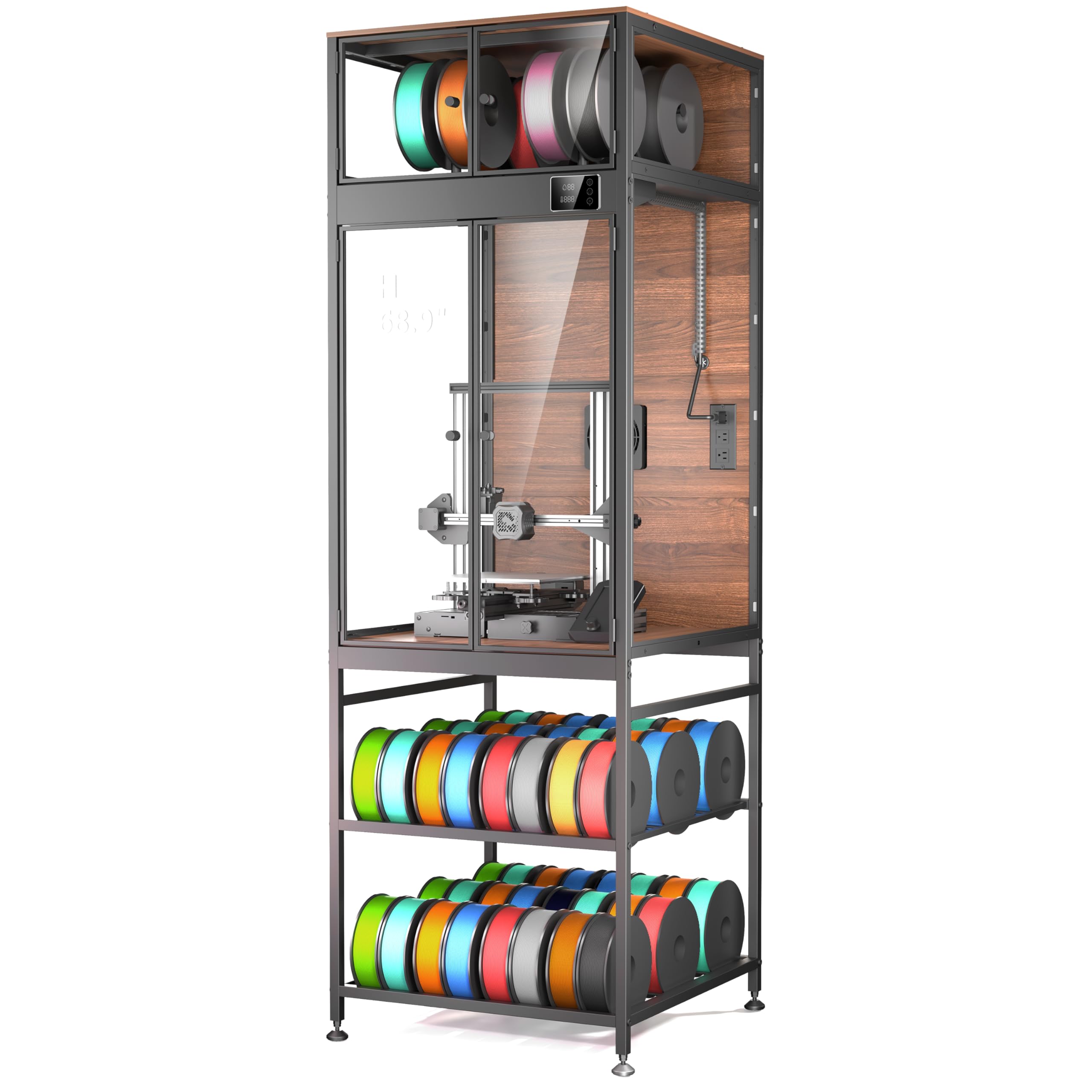
The Crafit cabinet is the only option in this roundup that treats ventilation and filament storage as a single engineered system rather than an afterthought. Its 5-inch exhaust port with a dedicated high-flow fan sits above the printer chamber, pulling fumes through a clear path instead of fighting against fabric folds. The manual fan control lets you run it only after a print finishes, preserving the stable thermal environment inside during long ABS or ASA runs.
The 66-pound carbon steel frame and rigid composite walls dampen vibration by up to 40 percent, which matters for high-speed CoreXY printers like the Bambu Lab P1S or X1C where enclosure resonance can introduce layer artifacts. The top compartment stores eight spools with feed-through ports for up to four filaments, and the base shelf holds 48 more spools — eliminating the need for a separate dry box tower. The integrated thermo-hygrometer gives you real-time chamber data without drilling holes.
Some owners report that the acrylic panels are thinner than expected and the magnetic door seals aren’t airtight. Adding weather stripping along the door edges closes the remaining gap. The LED light failed in a few units; Crafit replaced panels under warranty. For anyone running a multi-color farm in a shared space, this cabinet consolidates storage, ventilation, and thermal stability into one footprint.
Why it’s great
- Dedicated high-flow exhaust fan clears fumes without compromising chamber temperature
- Heavy carbon steel frame reduces vibration-related print artifacts
- 48-spool storage capacity eliminates the need for separate filament management
Good to know
- Door seals are not airtight; aftermarket weather stripping recommended
- Assembly takes around 2.5 hours with thin acrylic panels
- LED light reliability inconsistent across units
2. Fungdo Large 3D Printer Enclosure with Ventilation Kit

This tent enclosure solves the fundamental tension between ventilation and temperature control. The built-in insulation lining raises internal temperature 5 to 15 degrees Celsius above ambient, which prevents ABS warping and improves resin fluidity in cold rooms, while the 180 CFM exhaust fan refreshes the interior air ten times per minute. Dual exhaust ports let you route the duct out the left or right side without kinking the hose.
The dark TPU observation window blocks ambient UV light that could partially cure resin bottles left inside. Real-world users report successful ABS prints stored inside for over two years with internal humidity settling at 20 to 35 percent RH — passive drying that protects hygroscopic filaments. The stainless steel shelf and EVA seal gaskets around the ports maintain a consistent seal that most budget tents lack entirely.
Assembly requires cutting about half an inch off the top poles to get the zipper to close smoothly on some units. A small number of units have arrived with stitching tears. The 14-pound weight makes it portable but the fabric construction won’t dampen vibration the way a steel cabinet does. For cold-garage resin printers or ABS farms where thermal stability is the bottleneck, this is the strongest contender.
Why it’s great
- Insulated lining delivers 5-15°C temperature rise for consistent ABS and resin prints
- 180 CFM fan with dual exhaust ports provides powerful, flexible fume extraction
- Passive drying lowers internal humidity to 20-35% RH for filament storage
Good to know
- Some units require trimming tent poles for proper zipper closure
- Occasional stitching tears reported in early production runs
- Fabric construction does not dampen printer vibration
3. TOPCUBE F2 Acrylic Enclosure for Bambu Lab A1
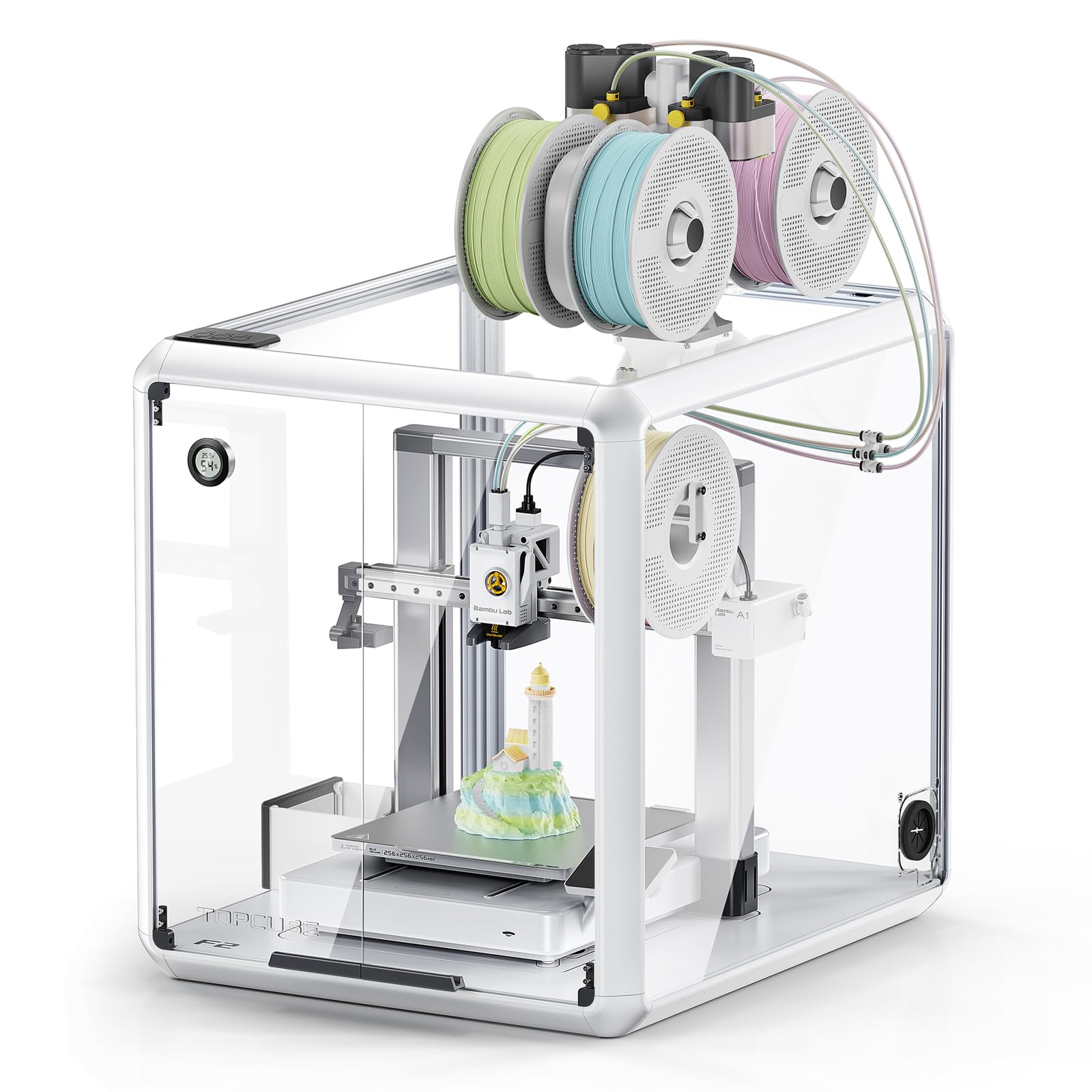
Most enclosures hide your print behind fabric or tinted plastic. The TOPCUBE F2 is built around 360-degree transparent acrylic panels that let you inspect every layer from any angle without opening the door and releasing fumes. This visibility matters for Bambu Lab A1 owners who run long prints and need to catch first-layer issues or spaghetti failures before they ruin the job.
The first-party active cooling base is unique among these options: a fan integrated into the load-bearing platform actively draws heat away from the printer motherboard. This prevents heat soak during prolonged printing, which can cause stepper driver thermal throttling on the A1. The centralized control panel on top switches the LED light strip, base fan, and display screen independently. An auxiliary switch supports DIY add-ons like a dedicated exhaust fan or recirculating filter.
The plexiglass walls are thin and the aluminum frame can rattle during high-speed printing. Some units arrived with missing plexiglass panels or incorrectly labeled parts, and the screws strip easily if over-tightened. A few owners note that the enclosure is not fully sealed at the bottom edge, so fumes can escape around the base. For A1 owners who prioritize visual monitoring and thermal management over absolute fume containment, the F2 delivers a clean, well-lit solution.
Why it’s great
- Full 360° acrylic transparency for continuous layer inspection
- Active cooling base prevents motherboard heat soak during long prints
- Centralized controls and auxiliary switch for DIY exhaust upgrades
Good to know
- Plexiglass panels are thin and the frame can rattle at high speeds
- Not fully sealed at the bottom — some fume leakage possible
- Screws strip easily; careful assembly required
4. YOOPAI Large Resin 3D Printer Enclosure with Ventilation Kit
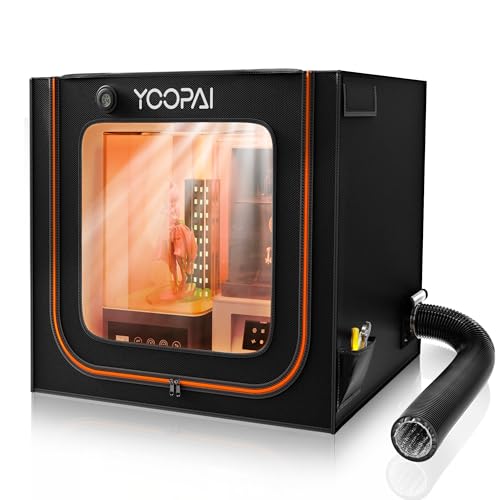
Resin printing creates two problems: toxic VOCs from the liquid resin itself and an equally smelly wash-and-cure station that often sits right next to the printer. The YOOPAI enclosure is specifically designed to hold both a resin printer and a curing machine side by side in its 30 by 19.7-inch double-wide interior, preventing odor leakage from either unit. The built-in carbon filter sheet adsorbs a portion of the resin smell while the exhaust fan and expandable pipe push the remaining fumes toward a window.
The high-transparency PVC front window lets you check print progress without opening the cover and releasing the concentrated VOC cloud inside. The six-sided fully enclosed structure also blocks resin splashes and dust from settling into the vat. Users report that the enclosure effectively keeps VOCs out of their living spaces when the exhaust is routed properly, and the internal heat insulation helps maintain a stable temperature for consistent resin flow during cold weather printing.
The carbon filter sheet slows airflow when attached, so you need to let the fan run for a while after the print finishes before opening the hood. Installing exhaust pipes on both sides of the enclosure improves air exchange rate. One unit arrived with a wrong part, though the replacement was fast. For resin printers who need to contain two machines in one footprint, this double-wide tent saves floor space without doubling the fume exposure.
Why it’s great
- Double-wide interior fits both a resin printer and cure station side by side
- High-transparency window allows print monitoring without releasing VOCs
- Internal heat insulation improves resin flow consistency
Good to know
- Carbon sheet slows airflow; requires extended fan running after prints
- Dual exhaust pipes recommended for adequate ventilation
- Some units have minor part defects, though replacements are fast
5. SKOUPHY Double Space Resin 3D Enclosure with Ventilation Kit
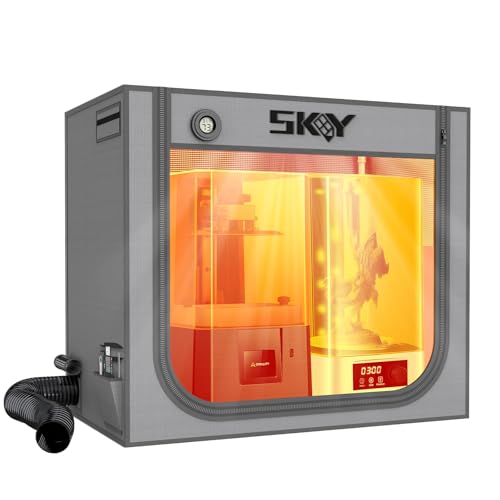
The SKOUPHY enclosure hits the value sweet spot for resin printers who need a spacious, ventilated workspace without jumping to cabinet-level pricing. Its 33 by 18.9-inch footprint easily accommodates an Elegoo Saturn 4 Ultra 16K alongside a wash and cure station. The 4500 RPM fan provides aggressive air movement, and the addition of a carbon box on the exhaust pipe gives the filter media more contact time with the airstream than a simple carbon sheet alone.
The double-layer aluminum mold Oxford cloth construction improves waterproofing and noise reduction compared to single-layer tents. The integrated LED light and thermo-hygrometer with Fahrenheit/Celsius switching give you environmental monitoring without additional sensors. The tinted front window blocks UV light that could prematurely cure resin left in the chamber.
The included carbon filter element is small and saturates quickly; experienced users recommend swapping it for a recirculating carbon/HEPA filter like the BentoBox for continuous VOC management. The hose connector attaches only to the enclosure side, so you need a separate adapter to connect the duct to a window. Assembly is straightforward at about 10 to 15 minutes. For budget-conscious resin operators, this tent provides the essential foundation — powered exhaust, UV protection, and enough room for two machines.
Why it’s great
- Spacious 33 x 18.9-inch interior fits large resin printer and cure station
- 4500 RPM fan with carbon box on exhaust pipe for odor absorption
- Dual-layer Oxford cloth construction dampens noise and blocks UV
Good to know
- Included carbon filter is small and saturates quickly
- Requires separate window adapter for duct connection
- Best paired with a recirculating HEPA filter for continuous fume control
6. Sumo 3D Printer Enclosure Kit for Prusa XL

The Prusa XL is a unique machine with a five-tool head and a large print volume that makes most off-the-shelf enclosures either too cramped or too loose. The Sumo enclosure kit is custom-sized to the XL’s exact footprint — 650 by 525 by 935 mm — without increasing the printer’s floor space. The upper chamber is fully removable for maintenance, and the chamber height allows hanging accessories like fire alarms or cameras from the ceiling.
The kit ships with the non-printable parts: plexiglass panels, hex rods, fasteners, magnets, and a hygrometer. You must print the structural brackets and mounts yourself using PETG filament, which adds about a weekend of printing time and six hours of assembly. The interactive 3D build instructions are the best in the category, with rotatable diagrams that show every step from multiple angles. The manufacturer, 3D Sourcerer, provides updated STL files when Prusa makes hardware revisions — the control panel mount, for example, was updated within 36 hours of a Prusa design change.
The acrylic panels can crack at screw stress points if you over-torque. Running a 5 mm drill bit through printed holes helps prevent the M5 screws from spinning the captive nuts. The Sumo enclosure does not include a powered exhaust fan — it relies on your own ventilation solution. This kit is for XL owners who enjoy building and tweaking and want a perfect fit rather than a generic tent. The final result is a rigid, sealed chamber with a clear view of the entire print area.
Why it’s great
- Custom-sized precisely for Prusa XL without increasing floor footprint
- Printable STL files are updated promptly when Prusa makes hardware changes
- Interactive 3D assembly instructions are best-in-class for clarity
Good to know
- Requires printing PETG structural parts before assembly can begin
- Acrylic panels can crack at screw stress points if overtightened
- No powered exhaust included — buyer must supply ventilation separately
7. BIQU Panda Station 3D Printer Workstation Cabinet
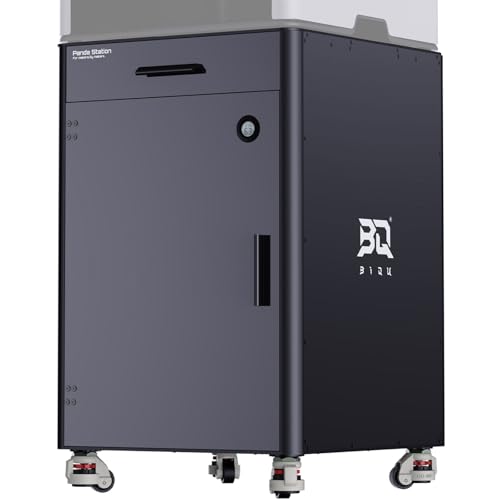
The Panda Station reimagines the enclosure as a mobile industrial workbench rather than a static box. Its 360-degree swivel wheels with locking feet let you roll the entire setup — printer, AMS units, filaments, and tools — from a workshop corner to a living room for supervised prints, then lock it solid with rubber feet for vibration-free printing. The industrial-grade aluminum and steel frame supports Bambu Lab P1P, P1S, X1C, X1E, A1, A1 Mini, and the newer H2 series machines.
The dual-layer pull-out drawers store up to 20 filaments or two AMS units, with pre-positioned routing ports and rubber grommets for dust-proof AMS power cable management. The top tool drawer measures 38 by 42 by 6 cm and accepts DIY-printed dividers for organizing nozzles, scrapers, and spare parts. The built-in hygrometer reports internal humidity so you know when to regenerate your desiccant.
The Panda Station does not include a ventilation fan or exhaust port kit — it relies on the user adding their own extraction system. The modular DIY holes on both sides make it easy to mount a third-party fan and duct, but this adds cost and complexity. Some units shipped without the advertised filament spool holder. For makers operating a Bambu Lab farm in a tight space where mobility and vertical storage are more important than pre-integrated fume extraction, this cabinet clears the clutter and keeps everything on wheels.
Why it’s great
- Rolling workstation with locking feet combines mobility with print stability
- Dual pull-out drawers hold 20 filaments or 2 AMS units with dust-proof routing
- Industrial aluminum/steel frame supports wide range of Bambu Lab printers
Good to know
- No ventilation system included — requires third-party fan and duct setup
- Some units missing advertised filament spool holder
- DIY holes for ventilation add-ons require extra purchases
FAQ
Can I use a 3D printer enclosure without ventilation for resin printing?
What size duct do I need for a 3D printer enclosure?
How often should I replace the carbon filter in my enclosure?
Will a ventilated enclosure also keep my filament dry?
Can I vent a 3D printer enclosure into my HVAC return?
Final Thoughts: The Verdict
For most users, the 3d printer enclosure with ventilation winner is the Crafit 3D Printer Cabinet because it integrates the only high-flow manual exhaust fan with a heavy steel frame, 48-spool storage, and a sealed internal environment that actually contains fumes. If you need thermal stability for a cold garage and a 180 CFM exhaust system, grab the Fungdo Large Enclosure. And for resin printers fitting two machines in one footprint, the YOOPAI Double-Wide Enclosure provides the dedicated VOC containment that fabric tents alone can’t deliver.