
Our readers keep the lights on and the weekend projects moving. As an Amazon Associate, I earn from qualifying purchases.
A family 3D printer needs to do more than just melt plastic — it needs to survive a curious child’s touch, produce toys that don’t shatter on first drop, and require zero calibration from parents who already have their hands full. The market is flooding with machines that demand constant tinkering, expose hot ends, or take hours to produce a single fidget spinner. The right choice delivers silent operation, enclosed safety, and prints that come off the bed ready to play.
I’m Rikta — the founder and writer behind FitlyFast. I’ve spent months analyzing print speeds, enclosure safety ratings, filament compatibility, and real-world failure rates across dozens of models to find the machines that truly work for families, not just for solo hobbyists.
After evaluating over 40 models for safety, speed, ease of use, and print durability, I’ve narrowed the field to the nine machines that deserve space in your home. This guide breaks down the best 3d printer for family use, covering kid-friendly features, real print quality, and which models keep parents sane.
How To Choose The Best 3D Printer For Family
Families face a different set of priorities than solo makers. A classroom full of children or a living room with a curious toddler means safety, noise, and reliability become non-negotiable. Here are the critical factors that separate a family-friendly printer from a workshop machine.
Enclosed or Open Frame
An open-frame printer exposes a hot nozzle reaching 200–280°C and moving parts like belts and lead screws. For families, an enclosed frame — either fully enclosed like the Bambu Lab P1S or partially enclosed like the Entina Tina2 Plus — creates a physical barrier that prevents accidental burns and keeps small fingers away from the print head. Enclosed designs also trap heat for better ABS and PETG prints, but the primary benefit for families is safety.
Print Speed vs. Kid Patience
A 250 mm/s printer like the AOSEED X-Maker Joy can finish a small fidget toy in about 20 minutes. A 600 mm/s machine like the Anycubic Kobra X or Flashforge Adventurer 5M Pro cuts that to roughly 10–12 minutes. The difference matters when a child is waiting for their latest creation. However, speed often comes with trade-offs in noise and vibration — faster machines need heavier frames and better vibration compensation to avoid shifting prints, as seen in the Elegoo Centauri Carbon reviews.
Auto-Leveling and First-Layer Reliability
Manual bed leveling is the single biggest frustration for beginners. The best family printers now include full-auto leveling systems that probe the bed at 25 to 49 points. The Bambu Lab A1 and A1 Mini do this automatically before every print. The Anycubic Kobra X uses the LeviQ 3.0 system with 49-point leveling, while the QIDI PLUS4 uses a pressure-sensing system. Avoid any printer that still relies on a paper-slip manual leveling process — it will cause failed prints and frustrated kids.
Filament Safety and Air Quality
Standard PLA is non-toxic and food-safe, making it the default for family projects. However, some advanced filaments like ABS and ASA release styrene fumes during printing. For home use, prioritize printers that support enclosed chambers with HEPA and carbon filtration, like the Flashforge Adventurer 5M Pro. The AOSEED X-Maker Joy is TÜV Rheinland ISO 16000-tested for low-VOC PLA emissions. Always check if the filament included with the printer is explicitly marked as kid-safe or low-odor.
Multi-Color Capability
Multi-color printing dramatically increases project variety — a child can print a rainbow-colored dragon or a two-tone car without painting. The Bambu Lab A1 and P1S support up to 16 colors with the AMS unit. The Creality K2 Combo also supports up to 16 colors with its CFS system. The Anycubic Kobra X offers four built-in colors expandable to 19. For families, a single multi-color upgrade is often more cost-effective than buying multiple single-color printers.
Quick Comparison
On smaller screens, swipe sideways to see the full table.
| Model | Category | Best For | Key Spec | Amazon |
|---|---|---|---|---|
| AOSEED X-Maker Joy AI+ | Mid-Range | AI-driven kid projects | 400 mm/s peak speed | Amazon |
| Bambu Lab A1 | Premium | High-speed family use | ≤48 dB noise level | Amazon |
| Entina Tina2 Plus | Mid-Range | Absolute beginner families | 250 mm/s fast printing | Amazon |
| Anycubic Kobra X | Premium | Multi-color family projects | 600 mm/s speed | Amazon |
| Elegoo Centauri Carbon | Premium | Heavy-duty family volume | 20,000 mm/s² acceleration | Amazon |
| Flashforge Adventurer 5M Pro | Premium | Quiet home use | HEPA + carbon filtration | Amazon |
| Bambu Lab P1S | Premium | Enclosed multi-color master | 500 mm/s speed | Amazon |
| Creality K2 Combo | Premium | Industrial-speed family queue | 600 mm/s speed | Amazon |
| QIDI PLUS4 | Premium | Engineering-grade family prints | 65°C heated chamber | Amazon |
In‑Depth Reviews
1. AOSEED X-Maker Joy AI+
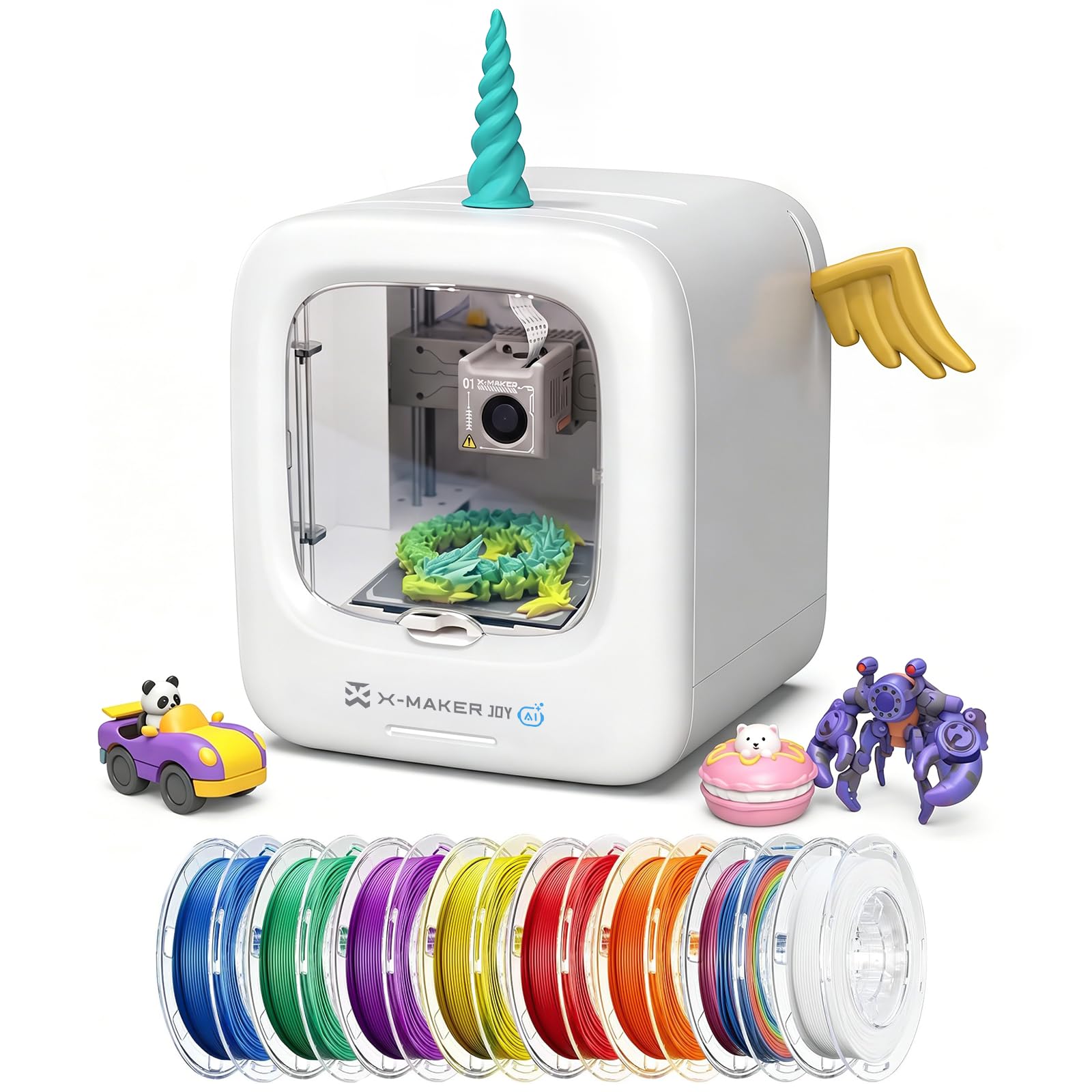
The AOSEED X-Maker Joy AI+ is purpose-built for families, not just adapted from a hobbyist machine. Its AI Doodle feature lets kids create custom 3D models using voice, text, or image prompts — no CAD skills needed. The machine comes with eight rolls of kid-safe, TÜV Rheinland ISO 16000-tested PLA filament, a magnetic build plate, and full enclosure design that keeps moving parts and hot components away from curious fingers.
Print speeds reach a peak of 400 mm/s, and small toy projects complete in roughly 20 minutes. The built-in camera supports real-time monitoring and automatic time-lapse video capture, so parents can check progress from their phone. The app-based control means an 8-year-old can start a print independently once the model is selected from the library of 8,000-plus designs.
A few users noted that small, thin fidget prints can be fragile, and the app interface, while intuitive, has occasional upload quirks with custom STL files. The quick-release nozzle and filament runout detection softens the learning curve for first-time families. Overall, this is the most thoughtful all-in-one package for a household with children who want to print independently.
Why it’s great
- AI-powered design eliminates need for CAD software
- Includes 8 rolls of filament and essential tools
- Enclosed frame adds safety for young kids
Good to know
- App-based model selection can feel restrictive for advanced users
- Some fragile prints break on first use; thicker walls are better
2. Bambu Lab A1

The Bambu Lab A1 delivers the quietest operation in its class at under 48 dB — quieter than a typical conversation. This makes it the best pick for families who want to run prints overnight or during homework time without the whir of a hobbyist machine. The active motor noise canceling and vibration compensation keep prints smooth and sound levels low, even at its 10,000 mm/s² acceleration.
Full-auto calibration handles bed leveling, Z-offset, and flow rate compensation without any user intervention. The 1-Clip quick-swap nozzle makes material changes fast, and the touchscreen interface is intuitive enough for a child to load a pre-sliced file. With a 256 x 256 x 256 mm build volume, it handles everything from miniatures to larger family projects like board game organizers or custom toys.
Long-term owners report consistent quality over thousands of hours, though the open-frame design means the hotend and moving parts remain accessible — not ideal for toddlers. Adding the AMS lite unlocks multi-color printing up to 16 colors, but the AMS unit is a separate purchase. For families prioritizing near-silent operation and non-stop reliability, the A1 is a strong contender.
Why it’s great
- Exceptionally quiet operation for home use
- Active flow rate compensation for consistent layers
- Touchscreen with simplified interface for beginners
Good to know
- Open-frame design requires supervision with small children
- AMS multi-color unit sold separately
3. Entina Tina2 Plus

The Tina2 Plus arrives fully assembled — no tools, no calibration, no fuss. Out of the box, it includes a TF card with preloaded models and a 1,500-plus model library via the Poloprint Cloud app. For families that want the lowest barrier to entry, this machine removes every technical hurdle. The compact 11.4 x 8.6 x 8.6-inch footprint fits on a standard desk or classroom shelf.
The ceramic hotend reaches temperature in 40 seconds, reducing waiting time for impatient young creators. Dual Z-axis and auto-leveling ensure reliable first layers, and the PEI spring steel build plate makes print removal tool-free. The structural safety design partially encloses high-temperature components, offering a middle ground between full enclosure and open-frame machines.
Customer feedback highlights occasional app connectivity issues and limited custom-STL uploading ability, which can frustrate older children or more advanced users. The included white filament only covers a few prints, so budgeting for extra PLA rolls from the start is wise. For the price, the Tina2 Plus offers the fastest path from box to first print of any machine in its tier.
Why it’s great
- Truly ready out of the box with preloaded models
- Compact, desk-friendly design for shared spaces
- Auto-leveling and dual Z-axis improve reliability
Good to know
- App can be slow and limited for custom file uploads
- WiFi connectivity issues reported with some units
4. Anycubic Kobra X
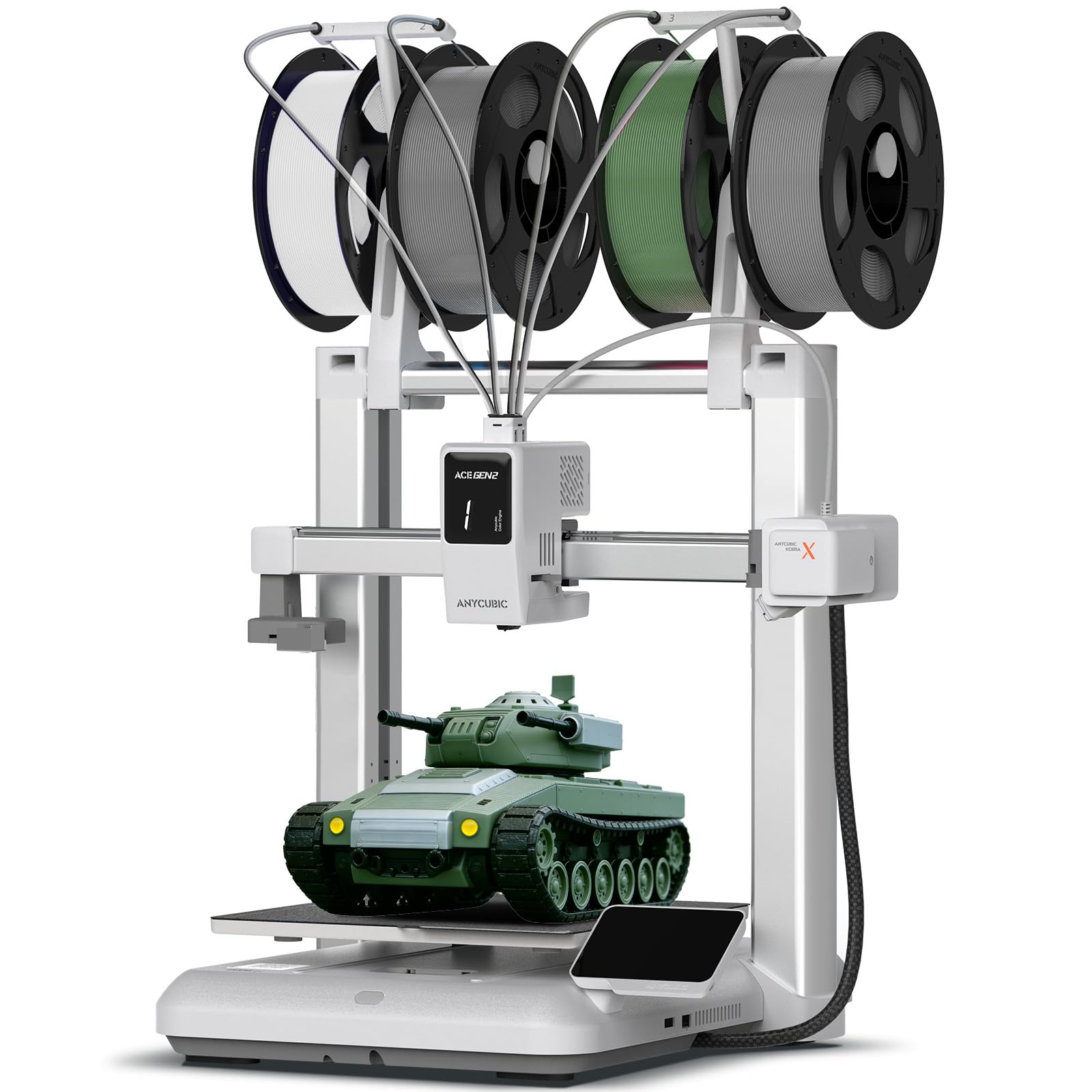
The Anycubic Kobra X is the first printer in its price range to integrate multi-color printing directly into the main unit, supporting four colors out of the box with expandability to 19 colors using up to four ACE 2 Pro units. For families, this eliminates the need to manually swap filaments mid-print or paint finished models — children can print a rainbow character or a two-tone toy in a single session.
The LeviQ 3.0 49-point auto-leveling system and vibration compensation ensure a perfect first layer without manual adjustment. At 600 mm/s, the Kobra X completes small toys in roughly 12 minutes, keeping kids engaged from start to finish. The 260 x 260 x 260 mm build volume is roomy enough for helmets, large props, or multiple smaller items in a single batch.
However, clearing a filament jam requires disassembly of the print head, which is more complex than the quick-swap nozzles on competing models. The 720P camera is positioned below the build plate, making real-time monitoring less useful. Some users report the AI spaghetti detection is inconsistent. For families committed to multi-color creativity, the Kobra X delivers unmatched color versatility at a competitive price.
Why it’s great
- Built-in 4-color printing without extra hardware
- 49-point auto-leveling for flawless first layers
- Quiet ≤48 dB operation for home use
Good to know
- Jam clearing requires complex print head disassembly
- Camera angle limits usable monitoring
5. Elegoo Centauri Carbon
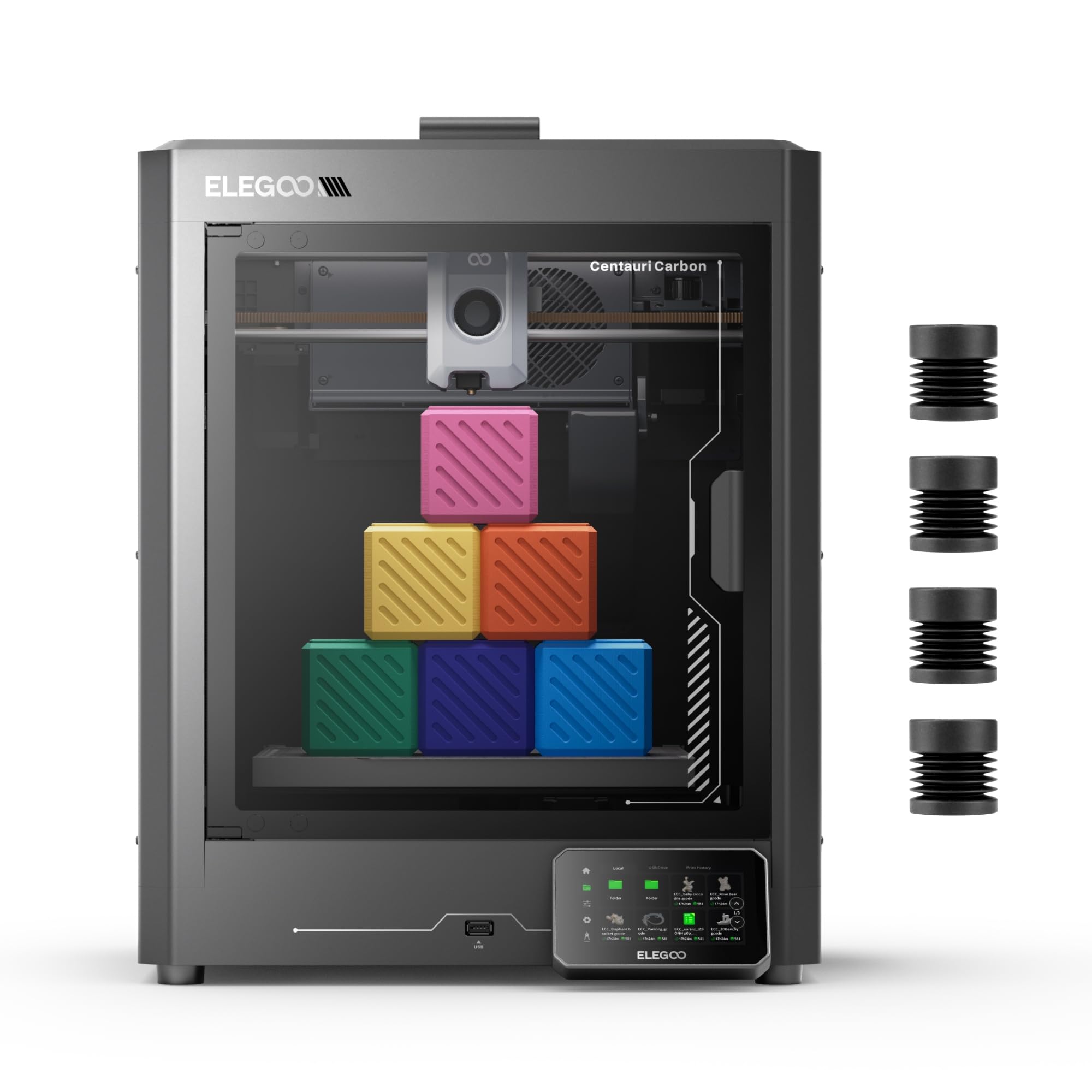
The Centauri Carbon pairs a rigid die-cast aluminum frame with CoreXY architecture, achieving speeds of 500 mm/s and acceleration of 20,000 mm/s². That translates to an 18-minute Benchy print — fast enough to keep a family of four cycling through projects without a full-day wait. The fully enclosed chamber and 320°C nozzle support tougher materials like carbon-fiber PLA for durable toys and functional parts.
Auto bed leveling, pressure advance, and automatic vibration compensation are all handled before each print. The dual-sided build plate includes a PLA-specific surface that provides strong adhesion even at lower temperatures. The built-in camera with dual LED lighting offers clear real-time monitoring, and time-lapse video capture is automatic.
Some users report significant vibration on lighter desks, so placing it on a sturdy table or concrete paver is recommended. A few early units experienced hotend communication errors, though Elegoo support resolved replacements via warranty. The machine is heavier at 38.5 pounds, which adds stability but reduces portability. For families who want pro-level speed without pro-level price, the Centauri Carbon is a compelling choice.
Why it’s great
- Rock-solid metal frame minimizes vibration artifacts
- High-temp 320°C nozzle for advanced filaments
- Remote monitoring with clear night vision video feed
Good to know
- Heavy unit needs stable, dedicated desk space
- Occasional hotend communication issues in early batches
6. Flashforge Adventurer 5M Pro

The Flashforge Adventurer 5M Pro is the only printer in its tier with a dual-circulation HEPA and carbon filtration system, making it the safest option for indoor family rooms. It prints PLA, ABS, PETG, and TPU, with the filter removing VOCs and ultrafine particles. The nozzle reaches 200°C in 35 seconds, and the one-click auto-leveling system detects platform height at multiple points for perfect first layers without rafts.
The Quick-Detachable nozzle system supports 0.25mm, 0.4mm, 0.6mm, and 0.8mm sizes — swap in seconds without tools. The Core XY all-metal frame supports 600 mm/s maximum travel speed and 20,000 mm/s² acceleration, producing detailed prints with clean edges. The Flash Maker app offers remote video monitoring and real-time progress tracking.
Reviews reveal some units arrived with calibration errors or damaged packaging, requiring a replacement. The filtration system is effective but the doors don’t seal completely, reducing some efficiency. The software setup requires a computer for the first use — the included installer may not work on the latest macOS versions. For families concerned about indoor air quality, this is the best choice, but it demands a stable operating environment and patience with initial setup.
Why it’s great
- HEPA + carbon filtration for cleaner indoor air
- Quick-swap nozzle in 1 click with no tools
- Wide material compatibility from PLA to carbon-fiber
Good to know
- Some units arrive with shipping damage or calibration issues
- Software setup requires a computer on older OS versions
7. Bambu Lab P1S

The Bambu Lab P1S delivers the closest experience to a prosumer printer repackaged for home use. Its fully enclosed body supports advanced filaments like ABS and ASA without warping, while keeping moving parts and hot surfaces isolated from children. With the optional AMS system, it prints up to 16 colors in a single job — making it the ultimate family machine for projects like multi-color nameplates, educational models, or custom gifts.
Print speed reaches 500 mm/s with 20,000 mm/s² acceleration, and setup takes about 15 minutes. Auto bed leveling handles the calibration automatically. Users report that the P1S works out of the box with zero tweaking, and long-term reliability is excellent — one reviewer logged 1,500 hours on a similar Bambu model without clogging or adhesion issues. The Bambu Studio software and MakerWorld library offer a massive catalog of pre-sliced models.
The price positions it as a premium option, especially when adding the AMS unit. Some users note that TPU prints can be tricky without specific settings, and the camera resolution is moderate for detailed monitoring. For families ready to invest in a multi-year creative tool with minimal maintenance, the P1S is the most capable enclosed machine in its price class.
Why it’s great
- Fully enclosed for safe, quiet operation
- Multi-color up to 16 prints with AMS unit
- Reliable, consistent performance over thousands of hours
Good to know
- AMS multi-color unit is a separate purchase
- TPU requires careful slicer tuning
8. Creality K2 Combo
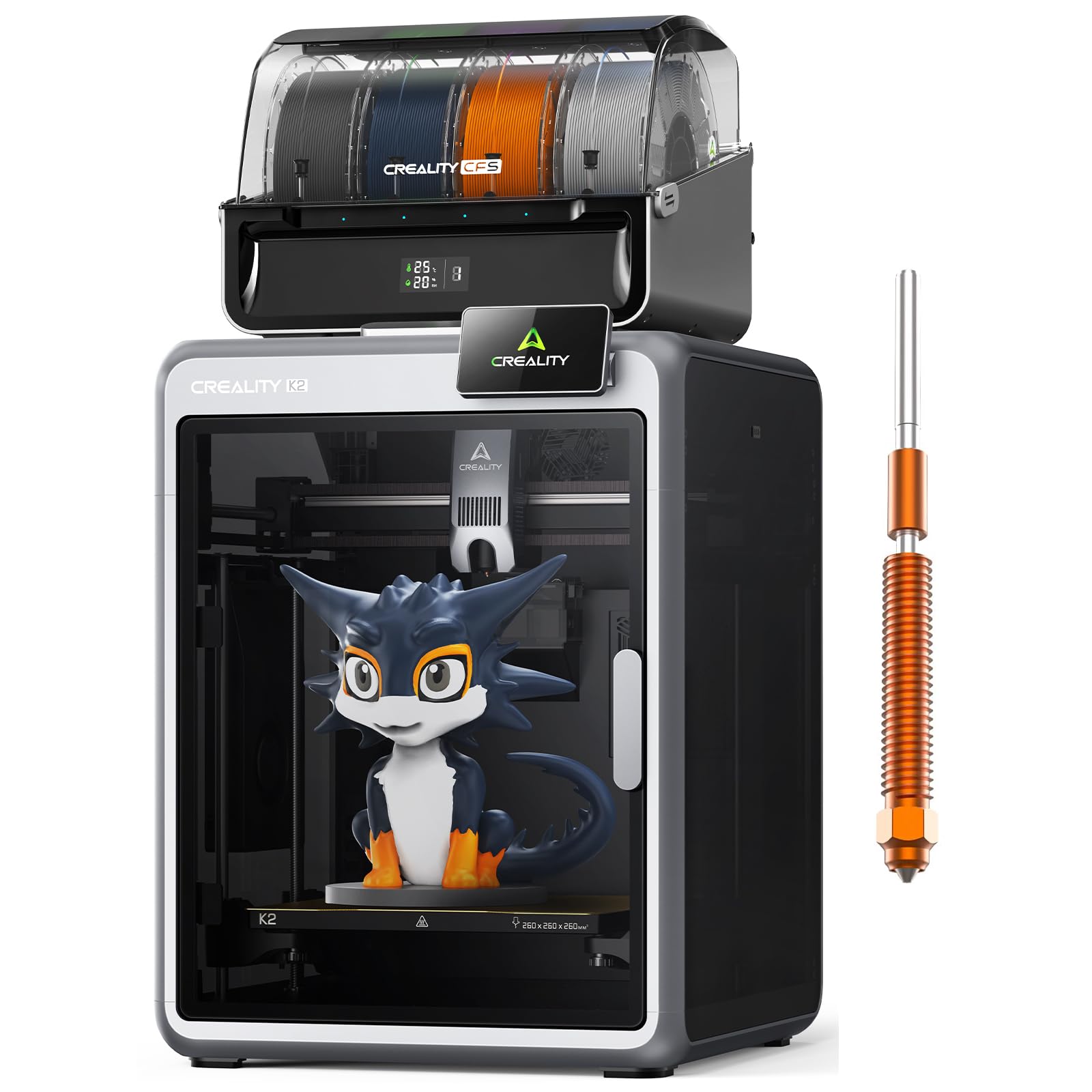
The Creality K2 Combo brings RFID-based filament auto-detection to the family segment. When a Creality RFID spool is loaded, the printer automatically reads the material profile and preset settings — no manual slicing parameters. The CFS (Creality Filament System) houses up to four spools and supports up to 16 colors when multiple units are connected. The airtight case includes desiccants to keep filament dry, which is especially useful in humid homes.
Print speeds hit 600 mm/s with 20,000 mm/s² acceleration, and the step-servo motors on the extruder and X/Y axis improve extrusion consistency. The chamber AI camera detects spaghetti failures and missing build plates. The die-cast aluminum frame and steel X-axis rail provide rigid stability for fast, detailed prints. The build volume of 260 x 260 x 260 mm is large enough for most family projects.
Some users note that the Creality app has limited free files, and custom STL purchases can be expensive for simple designs. The initial setup includes a screen installation that takes about an hour. A few units have experienced print adhesion issues or leveling inconsistencies, requiring support intervention. For families committed to the Creality ecosystem with RFID convenience, the K2 Combo is a solid choice.
Why it’s great
- RFID auto-detection eliminates slicer guesswork
- Airtight CFS box dries and stores filament safely
- Die-cast frame minimizes vibration at high speeds
Good to know
- App has limited free model library
- Setup takes an hour including screen installation
9. QIDI PLUS4

The QIDI PLUS4 is the machine for families who need to print functional parts — custom brackets, replacement gears, or durable toys that survive rough play. Its heated chamber reaches 65°C, enabling reliable prints with PPS-CF, PPA-CF, ABS, and Nylon, filaments known for warping in open-frame machines. The 370°C hotend with integrated nozzle handles these high-temp materials while reducing clogging risk.
The large print volume of 12 x 12 x 11 inches allows printing multiple models simultaneously, making batch toy production feasible for birthday parties or classroom projects. The independent dual motor Z-axis and 6mm thick aluminum bed ensure flatness and precision. Klipper firmware with LAN printing and a HD camera support remote monitoring.
Reviewers note that factory QC can be inconsistent — some units arrive with jammed hotends or leveling sensor issues. Qidi support resolves these via replacement parts, but the initial experience can frustrate beginners. The machine is not truly out-of-the-box for non-technical families; expect a few hours of setup and calibration before first prints. For families with a technically inclined parent who values engineering-grade materials, the PLUS4 is the most capable option.
Why it’s great
- 65°C heated chamber enables advanced, durable materials
- 370°C hotend supports PPS-CF and other high-temp filaments
- Large 12x12x11-inch volume for batch printing
Good to know
- Inconsistent factory QC requires patience with support
- Not beginner-friendly; expect a calibration curve
FAQ
Is PLA filament safe for children to handle?
Can a 7 or 8 year old operate a 3D printer independently?
What does auto bed leveling actually do for family use?
How much noise do these printers make inside a home?
Do I need to buy extra filament, or does the printer come with enough?
Final Thoughts: The Verdict
For most families, the 3d printer for family winner is the AOSEED X-Maker Joy AI+ because it combines AI-driven design, a built-in library of 8,000 models, enclosed safety, and eight rolls of kid-safe filament in a single box — no second purchases needed. If you want ultra-quiet operation and multi-color capability, grab the Bambu Lab A1. And for families who need durable parts from advanced filaments like carbon-fiber PLA, nothing beats the QIDI PLUS4.