
Our readers keep the lights on and the weekend projects moving. As an Amazon Associate, I earn from qualifying purchases.
The difference between a jewelry master that casts cleanly and one that leaves pinhole failures across your production run is measured in microns of XY resolution and the thermal stability of your Z-axis. For jewelers moving from hand-carved wax or outsourcing to a digital workflow, a printer must reliably reproduce sprue placement, sharp bezel seats, and intricate filigree without delamination—day after day. This guide breaks down every machine through the specific lens of the investment casting workflow, not general-purpose printing.
I’m Rikta — the co-founder and writer behind FitlyFast. After analyzing laser-sintered wax profiles, comparing LCD pixel grids against casting shrinkage rates, and mapping dozens of user-reported burnout successes across eleven resin printers, I’ve distilled what actually matters for jewelry production.
Whether you need a dedicated wax printer for your bench or a high-resolution machine that also handles prototypes and production masters, finding the right 3d printer for jewelry making comes down to matching XY detail, build envelope, and resin compatibility with your specific casting furnace and investment material.
How To Choose The Best 3D Printer For Jewelry Making
A jewelry printer must do more than print pretty models—it must produce masters that burn out cleanly, leave zero ash residue, and hold dimensional accuracy after casting. General-purpose resin printers often fail at the high viscosity of castable resins or lack the heated vats needed for consistent flow in small features. Focus on these four factors to avoid wasted resin and failed flasks.
XY Resolution and Pixel Size
For jewelry, look for a pixel size at or below 35 microns. A 10-inch 8K screen (around 28 microns) captures prong details and engraved textures. The newer 14K and 16K screens push into the 14–19 micron range, which is overkill for most casting but invaluable for micro-pave settings or fine scrollwork where every micron of crispness reduces hand-finishing time.
Build Volume and Z-Axis Stability
Jewelry models rarely need a large Z height, but a stable Z-axis prevents layer-shift on tall rings or bracelets. Dual linear rails and ball screws reduce wobble and ensure the build plate returns to the exact same position every layer. A build envelope around 8 x 5 x 9 inches comfortably fits a production plate of multiple rings, pendants, and earring sets.
Resin Heating and Viscosity Handling
Castable wax resins and high-temp engineering resins are thicker than standard hobby resins. A heated resin vat (30–45°C range) lowers viscosity, reduces peel forces on delicate supports, and cuts print failure rates dramatically. Machines without active heating require you to pre-warm resin bottles—an extra step that introduces inconsistency.
Software and Slicer Compatibility
Jewelry-specific supports and orientation tools matter. Most resin printers work with third-party slicers like Lychee Slicer or Chitubox, but some proprietary software (Halot Box, Photon Workshop) lacks the fine support tuning that jewelry models need. Ensure the printer’s file format is compatible with your preferred slicing environment before committing.
Quick Comparison
On smaller screens, swipe sideways to see the full table.
| Model | Category | Best For | Key Spec | Amazon |
|---|---|---|---|---|
| Phrozen Sonic Mighty 8K | Resin LCD | Detail-rich masters | 28 µm XY resolution | Amazon |
| FLASHFORGE Adventurer 5M Pro | FDM CoreXY | Prototypes & jigs | 600 mm/s travel speed | Amazon |
| Creality Halot-X1 Combo | Resin LCD | Micro-pave precision | 14 × 19 µm pixel size | Amazon |
| ELEGOO Centauri Carbon 2 Combo | FDM CoreXY | Multi-material prototypes | 500 mm/s speed | Amazon |
| ELEGOO Saturn 4 Ultra 16K | Resin LCD | Detail & ease-of-use | 16K / 10-inch LCD | Amazon |
| ANYCUBIC Photon Mono M7 PRO 14K | Resin LCD | High-speed casting | 13312×5120 px LCD | Amazon |
| Bambu Lab P1S Combo | FDM CoreXY | Multi-color wax jigs | 500 mm/s speed | Amazon |
| ANYCUBIC Photon P1 | Resin LCD | Dual-material masters | Ball screw Z | Amazon |
| Creality K2 Plus Combo | FDM CoreXY | Large jigs & fixtures | 350 mm³ volume | Amazon |
| Phrozen Sonic Mega 8K S | Resin LCD | High-volume production | 43 µm / 15-inch LCD | Amazon |
| Original Prusa XL 5-Head | FDM CoreXY | Industrial prototyping | 360 mm³ volume | Amazon |
In‑Depth Reviews
1. Phrozen Sonic Mighty 8K

The Phrozen Sonic Mighty 8K hits the sweet spot for jewelry work with a 28-micron XY resolution that reveals engraving lines and bezel corners without needing a 16K upgrade. Users report that at 0.020mm layer height, the detail is indistinguishable from 12K to the naked eye—crucial when your model’s sprue attachment points must be precise. The dual linear rails keep Z-axis movement steady across the 8.6 × 4.8 × 9.3 inch build volume, so a production plate of a dozen rings remains aligned print after print.
Out-of-box setup is straightforward: leveling holds well, and the test print comes out nearly perfect. Experienced jewelers note that cold temperatures can cause failures, easily solved with a mini heater near the vat. The printer integrates with both Lychee and Chitubox Pro, giving you full control over support placement and hollowing—both critical for reducing resin cost in lost-wax casting.
While the included camera has limited functionality, that’s a minor trade-off for a machine that delivers production-ready masters. Adding a flexible build plate and screen protector extends its lifespan significantly. For a jeweler transitioning from hand-carved wax, this is the most balanced entry into digital production.
Why it’s great
- 28 µm XY captures fine casting detail.
- Dual linear rails ensure stable layer alignment.
- Compatible with major slicers for support control.
Good to know
- Camera feature is minimal.
- Cold environments may require pre-heating resin.
2. FLASHFORGE Adventurer 5M Pro

The Adventurer 5M Pro is a FDM machine, so it does not directly cast like a resin printer, but its 600 mm/s speed and CoreXY all-metal frame make it an excellent sidekick for printing custom jigs, ring sizers, and prototype wax forms before committing to high-cost castable resin prints. The quick-detachable 280°C nozzle supports multiple diameters (0.25mm to 0.8mm), letting you balance speed and fine detail for functional prototypes.
The automatic bed leveling uses pressure sensing to detect platform height, eliminating the need for Z-axis calibration or a print raft. Setup from unboxing to first print is around ten minutes, and the integrated HEPA and carbon filters reduce fume exposure—a welcome feature if your printer shares a bench with finishing tools. The Flash Maker app adds remote monitoring and real-time progress tracking.
Software quirks exist: the included FlashPrint 5 slicer may not install on newer macOS versions, and some users report WiFi transfer issues that are resolved with Orca-Flashforge. The enclosed design handles PLA, PETG, and ABS well, but for jewelry-specific wax, you will still need a dedicated resin printer. Consider this a versatile complement, not a replacement.
Why it’s great
- Fast 600 mm/s speed for iterative prototypes.
- Auto bed leveling and tool-less model removal.
- HEPA filtration reduces bench-top fumes.
Good to know
- FDM only—not for direct casting.
- Software compatibility issues on some systems.
3. Creality Halot-X1 Combo
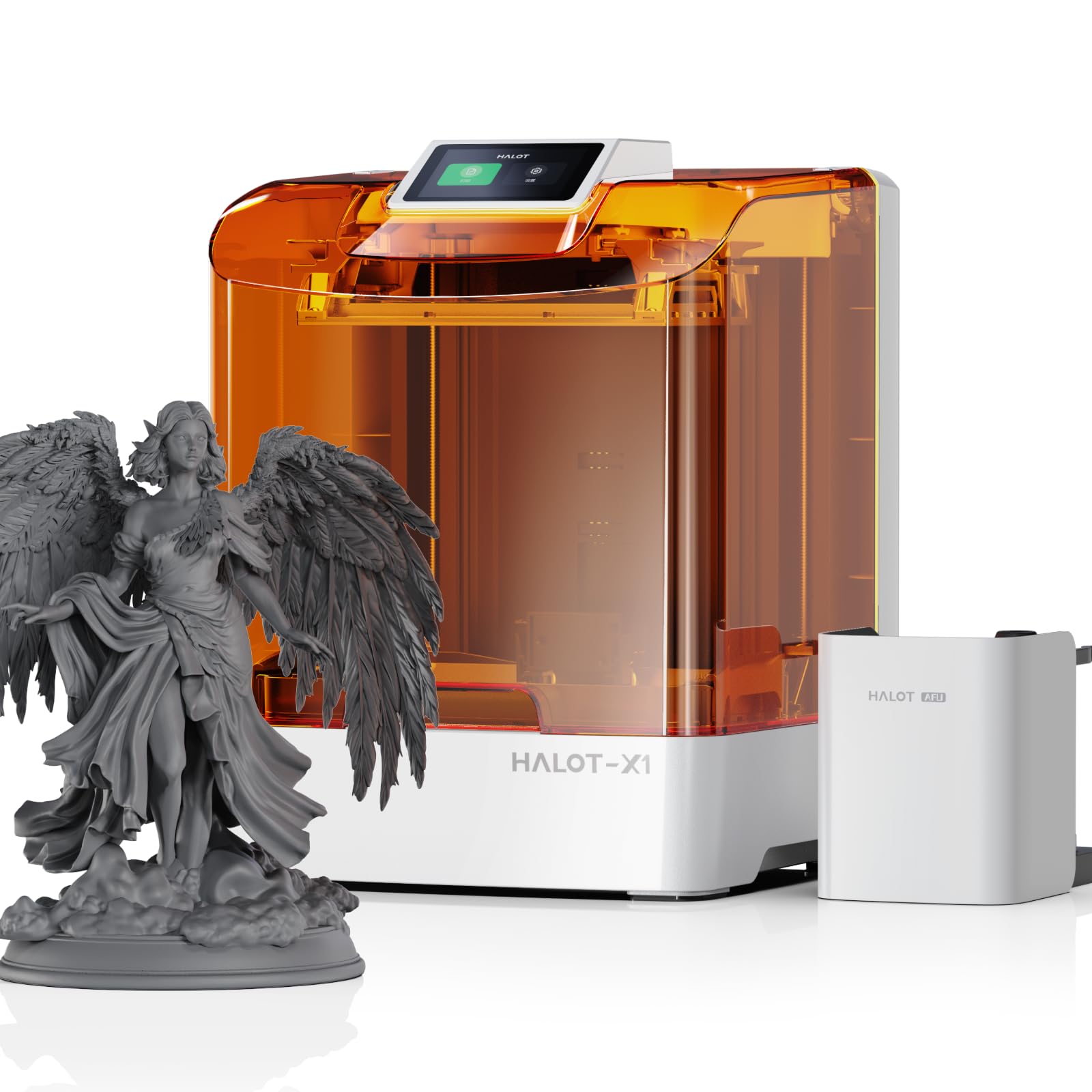
The Halot-X1 Combo pushes resolution to an extreme 14 × 19 micron pixel size using a 16K mono LCD—overkill for most jewelry, but transformative for micro-pave settings, textured bands, and models that demand zero post-processing. The 92 independent light zones activate UV LEDs only where needed, reducing overexposure and extending screen life, a direct benefit for jewelers who run long production batches.
Intelligent resin management is the standout feature: the vat heats to 30–45°C in about three minutes, lowering the viscosity of high-detail castable resins. RFID tag recognition automatically loads resin parameters, and a laser detection system feeds and recycles leftover resin. Real-time weight monitoring ensures you never run out mid-print. The top-down movable optical system means the build plate stays fixed, and the vat moves vertically—eliminating leveling entirely.
The primary weakness is the proprietary Halot Box slicing software, which some users report crashes on complex models. Creality’s support has been slow to respond on ticket issues. If you can work within Halot Box, the hardware is stellar; otherwise, consider this a high-risk, high-reward machine until the software matures.
Why it’s great
- 14 × 19 µm pixel size captures finest details.
- Heated vat with RFID auto-parameter loading.
- No manual leveling required.
Good to know
- Software may crash on complex models.
- Customer support response is slow.
4. ELEGOO Centauri Carbon 2 Combo
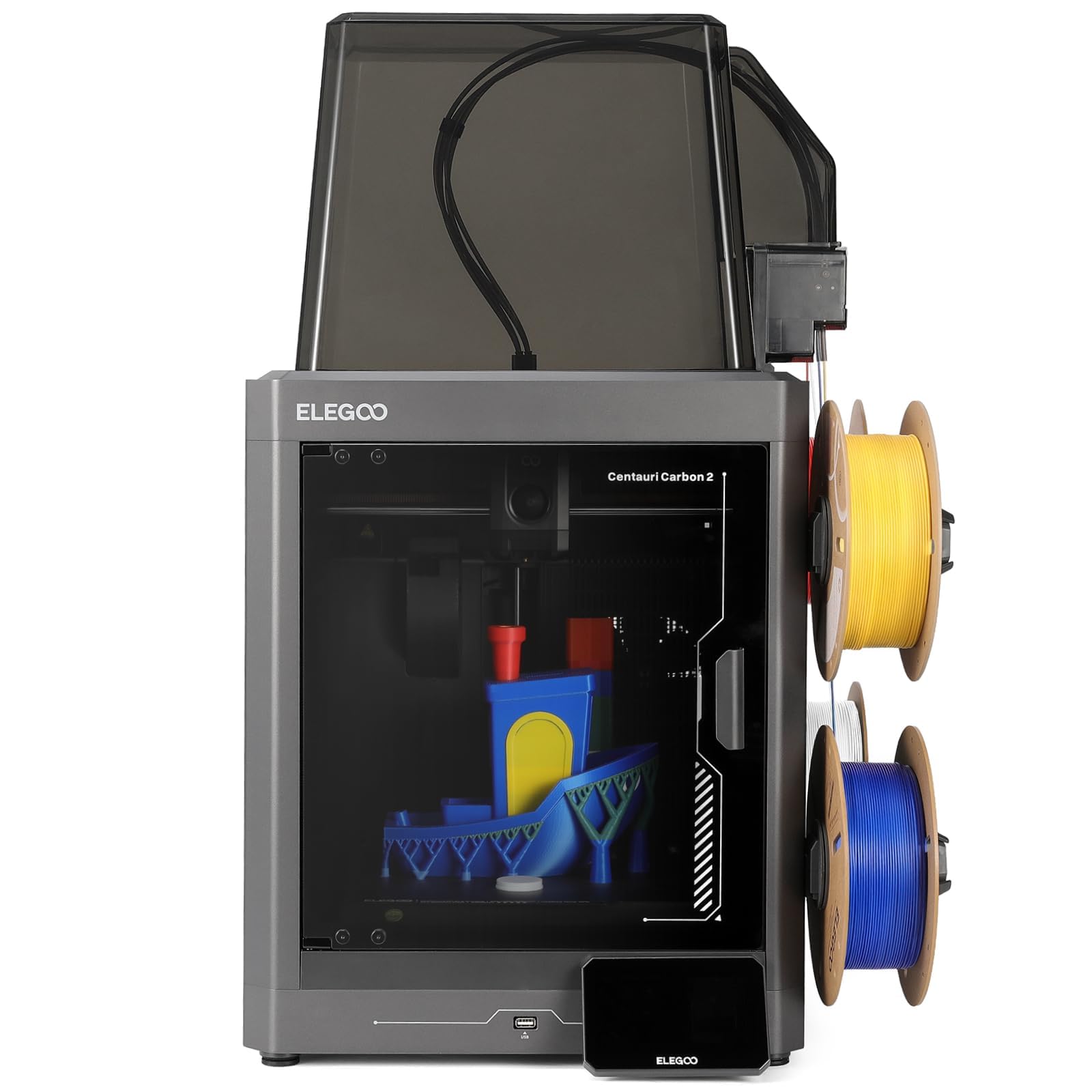
The Centauri Carbon 2 Combo is an FDM printer with a 4-color CANVAS system, making it ideal for prototyping multi-material jewelry packaging, display stands, or functional jigs that need color differentiation. The CoreXY frame and rigid aluminum build support 500 mm/s speeds with 20,000 mm/s² acceleration, producing smooth surfaces that rival injection-molded parts for non-cast applications.
The automated calibration suite includes 31 sensors for active vibration compensation and auto leveling—you load the filament, tap print, and walk away. The 256 mm³ build volume accommodates batch production of small accessories or large display trays. Material compatibility covers PLA, PETG, TPU, and even engineering-grade filaments like PC and PA, though TPU requires some extra equipment.
A minority of users report firmware issues and the “Glob of Death” after updates, and the closed ecosystem (no Klipper/Orca support) frustrates advanced users. For a jeweler who needs a reliable FDM companion for non-cast parts, the Centauri Carbon 2 offers excellent speed and color capability at a competitive price point.
Why it’s great
- 4-color printing for jigs and displays.
- 500 mm/s speed with vibration compensation.
- Large 256 mm³ build volume.
Good to know
- Firmware update can cause failures.
- Closed ecosystem limits customization.
5. ELEGOO Saturn 4 Ultra 16K
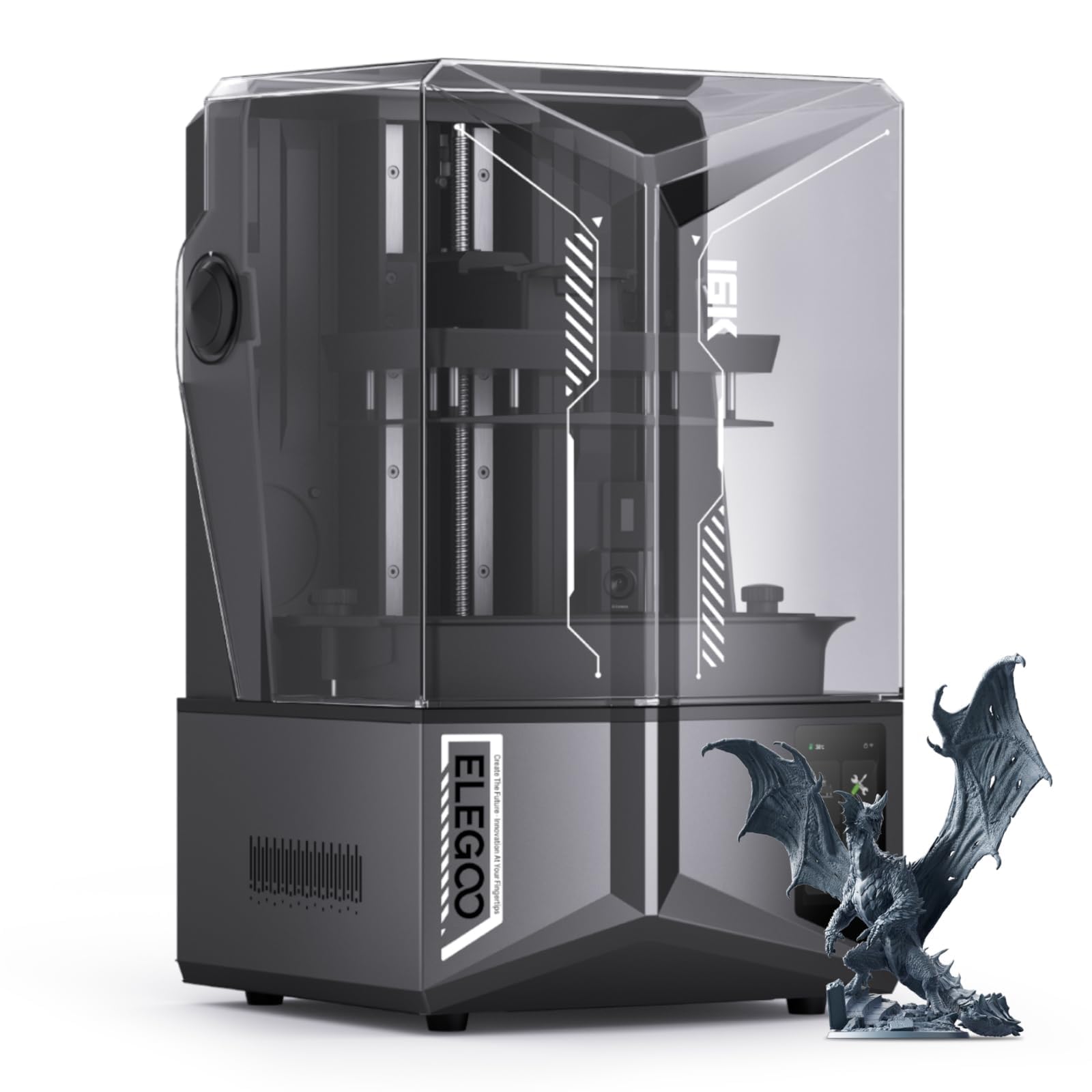
The Saturn 4 Ultra 16K is a plug-and-play resin printer that jewelers with zero 3D printing experience can run successfully on day one. The 16K monochrome LCD produces prints with individual hair and fabric texture—more than enough for the most intricate filigree. The tilting release technology reduces peel force, enabling 150 mm/h speeds without sacrificing the surface finish your castings depend on.
The smart tank heating system maintains resin at a steady 30°C, drastically reducing bubbles and layer separation in castable resins. The AI camera provides real-time monitoring and alerts for empty build plates or warped models. Users report that the first print out of the box is incredible, with details like stone-setting seats coming through cleanly. The build plate (8.33 × 4.66 × 8.66 inches) fits a full production run.
Some users needed to lightly sand the build plate for better adhesion and set base exposure to 40–45 seconds. The WiFi works most of the time, but firmware upgrades have occasionally caused unresolved setting issues. Overall, this is the most beginner-friendly high-resolution resin printer on the market.
Why it’s great
- 16K resolution with tilt release for speed.
- Heated vat at 30°C for consistent viscosity.
- AI camera with auto time-lapse.
Good to know
- Build plate may need light sanding for adhesion.
- Firmware updates can cause temporary issues.
6. ANYCUBIC Photon Mono M7 PRO 14K

The Photon Mono M7 PRO delivers a 14K resolution (13312×5120 pixels) with a 16.8 × 24.8 µm XY pixel size, capable of printing holes as small as 0.3 mm in diameter. Combined with a 170 mm/h speed on high-speed resin, this machine is built for jewelers who need rapid iteration on multiple ring designs without sacrificing the detail needed for clean burnout. The COB LighTurbo 3.0 system achieves over 90% light uniformity, reducing artifacts across the build plate.
The dynamic temperature-controlled resin vat maintains optimal viscosity, and the auto-fill feature enables automatic resin filling and one-key recycling, which minimizes waste when switching between castable and standard resins. Six types of intelligent detection (including build plate installation and release film lifespan) simplify the process and reduce downtime from user error. Many users upgraded from older Photon models and report dramatically fewer failures.
However, the advertised speed is based on high-speed resin at 0.1 mm layers—standard resins require longer light-off delays (up to 6 seconds versus 2 seconds on older models), which can triple print time if not dialed in. The UI can feel unresponsive, and the dark cover hides failures until you open it. Not ideal for absolute beginners, but powerful for those willing to tune settings.
Why it’s great
- 14K resolution with 0.3 mm hole capability.
- Heated vat and auto-fill system.
- Six intelligent detection sensors.
Good to know
- Standard resins may triple print time.
- UI can be unresponsive; failures hidden by dark cover.
7. Bambu Lab P1S Combo
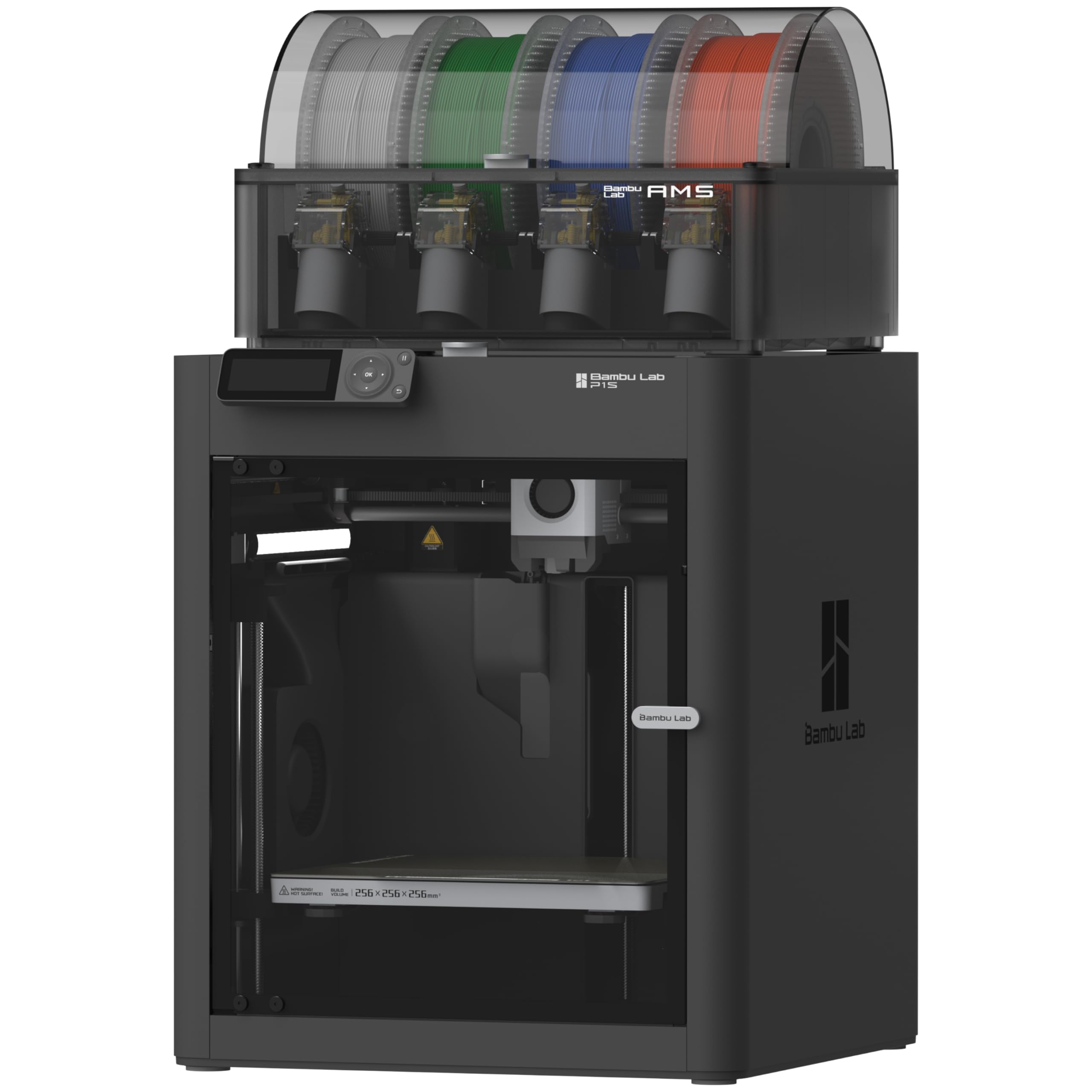
The Bambu Lab P1S Combo with AMS supports up to 16 colors/materials, making it the go-to FDM printer for jewelers who need multi-material wax-compatible prototypes or complex display fixtures. The enclosed CoreXY design reaches 500 mm/s with 20,000 mm/s² acceleration and auto bed leveling, producing quality that rivals resin prints for non-cast applications. Setup from box to first print takes about 15 minutes.
With a 95% success rate reported over hundreds of prints, the P1S is remarkably reliable. The AMS handles filament changes seamlessly, and the enclosed chamber allows advanced filaments like PC and nylon. The mobile app and remote monitoring give you peace of mind during long multi-color runs. Users praise its moderate noise levels and solid build quality.
The P1S is not direct-cast compatible—it’s an FDM printer. For jewelers who need a secondary machine for packaging, display stands, or functional prototypes while the resin printer handles masters, the P1S Combo is a premium but justifiable tool. The AMS system is strongly recommended from the start.
Why it’s great
- Up to 16 colors with AMS system.
- 95% success rate over hundreds of prints.
- Fast 500 mm/s with auto leveling.
Good to know
- FDM only—not for direct casting.
- Premium price with AMS.
8. ANYCUBIC Photon P1
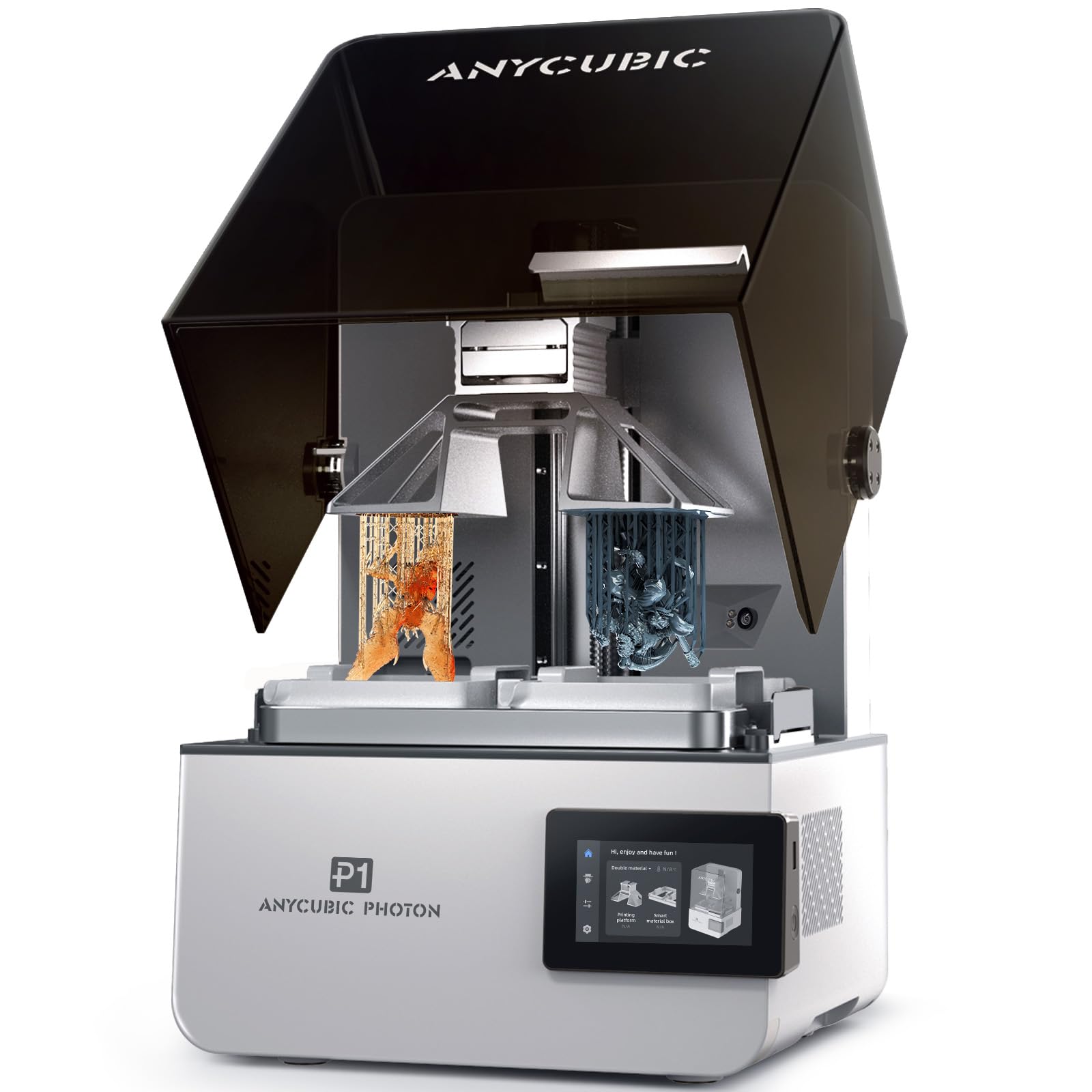
The Photon P1 bridges the gap between hobbyist and professional jewelry production with its dual-color/material printing capability, ball screw Z-axis, and dual linear rails that eliminate wobble on tall models. The 14K monochrome LCD (16.8 × 24.8 µm XY) delivers crisp detail, while Wave Release Technology reduces peel force by 60%, dramatically lowering failure rates on delicate ring shanks and earring hooks.
The heated vat handles resins up to 8,000 cps viscosity—40 times that of standard resins—meaning you can run engineering-grade castable materials straight out of the bottle without pre-warming. Smart Leveling 3.0 performs automatic self-checks before each print with real-time pressure feedback across four corners. The AI monitoring system verifies build plate installation and bottom layer separation, catching issues early.
The dual vat system allows you to print small models with less resin or simultaneously use different materials—switchable to a single vat for larger prints. Some users report that the Photon Workshop slicer crashes on complex models, but the print-to-print consistency makes this a strong choice for jewelers producing small batches of high-value masters.
Why it’s great
- Dual-color/material printing with ball screw Z.
- Heated vat handles up to 8,000 cps resins.
- Wave Release Technology reduces failures.
Good to know
- Proprietary slicer may crash on complex models.
- Learning curve for dual-color settings.
9. Creality K2 Plus Combo
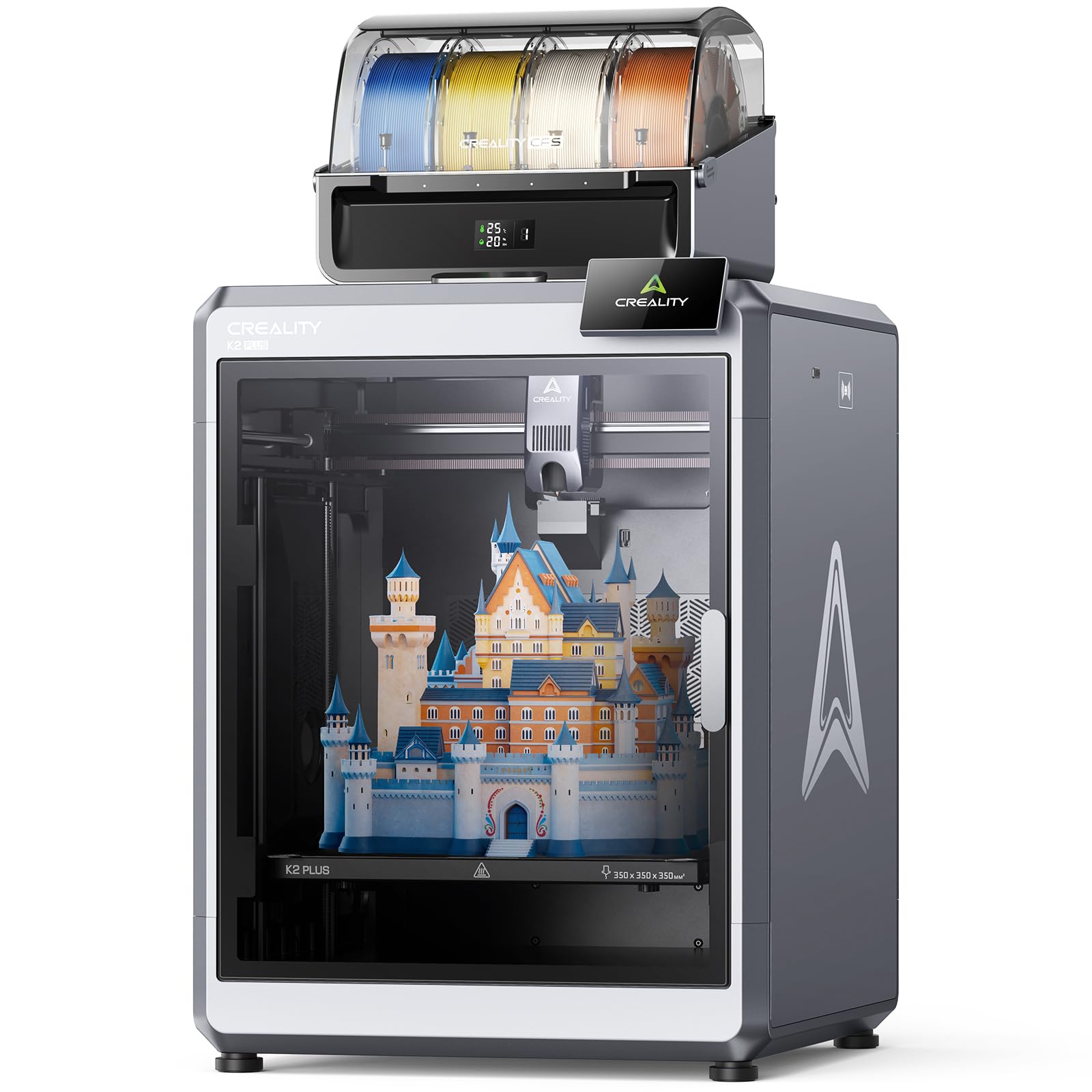
The K2 Plus Combo is a massive FDM printer with a 350 mm³ build volume and CFS multi-color system supporting up to 16 colors. For jewelers, this means batch-producing large display trays, casting flask fixtures, or multi-part assembly jigs in a single run. The 600 mm/s speed with 30,000 mm/s² acceleration is driven by industry-grade FOC step-servo motors, delivering high flow (40 mm³/s) and quiet operation.
The active chamber heating maintains up to 60°C, enabling warp-free ABS and ASA prints—useful for high-temperature casting accessories. The dual AI cameras monitor for spaghetti failure and flow rate optimization. The open-source root access allows custom firmware tweaks for experienced users. In real-world use, this printer has logged over 1,400 hours of continuous printing with proper maintenance.
The printer is extremely heavy (70.4 pounds) and requires two people to set up. Some early units had defective hot ends or firmware issues, though Creality’s support has improved. The CFS dislikes cardboard spools, requiring adapters. This is not a machine for fine jewelry masters, but for the support infrastructure around casting, it is unmatched.
Why it’s great
- 350 mm³ build volume for large jigs.
- 16-color CFS with RFID filament detection.
- Active 60°C chamber for warp-free prints.
Good to know
- Very heavy—70+ pounds.
- Some units had early hardware defects.
10. Phrozen Sonic Mega 8K S

The Sonic Mega 8K S is a production-scale resin printer built for commercial jewelry studios. Its massive 15-inch 8K LCD (43 µm XY resolution) can print 80 1/32 scale miniatures in 90 minutes—or a full batch of ring masters, earring sets, and pendants in a single run. The ACF film combined with TR300 High-Speed Resin delivers printing speeds up to 10 times faster than standard mid-size printers.
The space-saving lift-up lid design minimizes vertical clearance, and the built-in metal drip hanger lets you hang the build plate to recycle excess resin back into the vat—a zero-waste feature that directly saves material costs on expensive castable resins. The large build plate (12.99 × 7.28 × 11.81 inches) fits production molds and multi-part assemblies.
Reliability is mixed: some users report LCD ribbon cable failures after moving the printer, and customer support can take weeks to respond. The large build plate has holes that prevent using a flex plate. For a jeweler who needs high-volume production and can handle occasional maintenance, the Mega 8K S offers unbeatable throughput per print cycle.
Why it’s great
- Massive 15-inch LCD for batch production.
- 10x faster with ACF film and TR300 resin.
- Zero-waste resin drip hanger.
Good to know
- Reliability issues with ribbon cable and PSU.
- Flex plate not compatible due to holes.
11. Original Prusa XL 5-Head
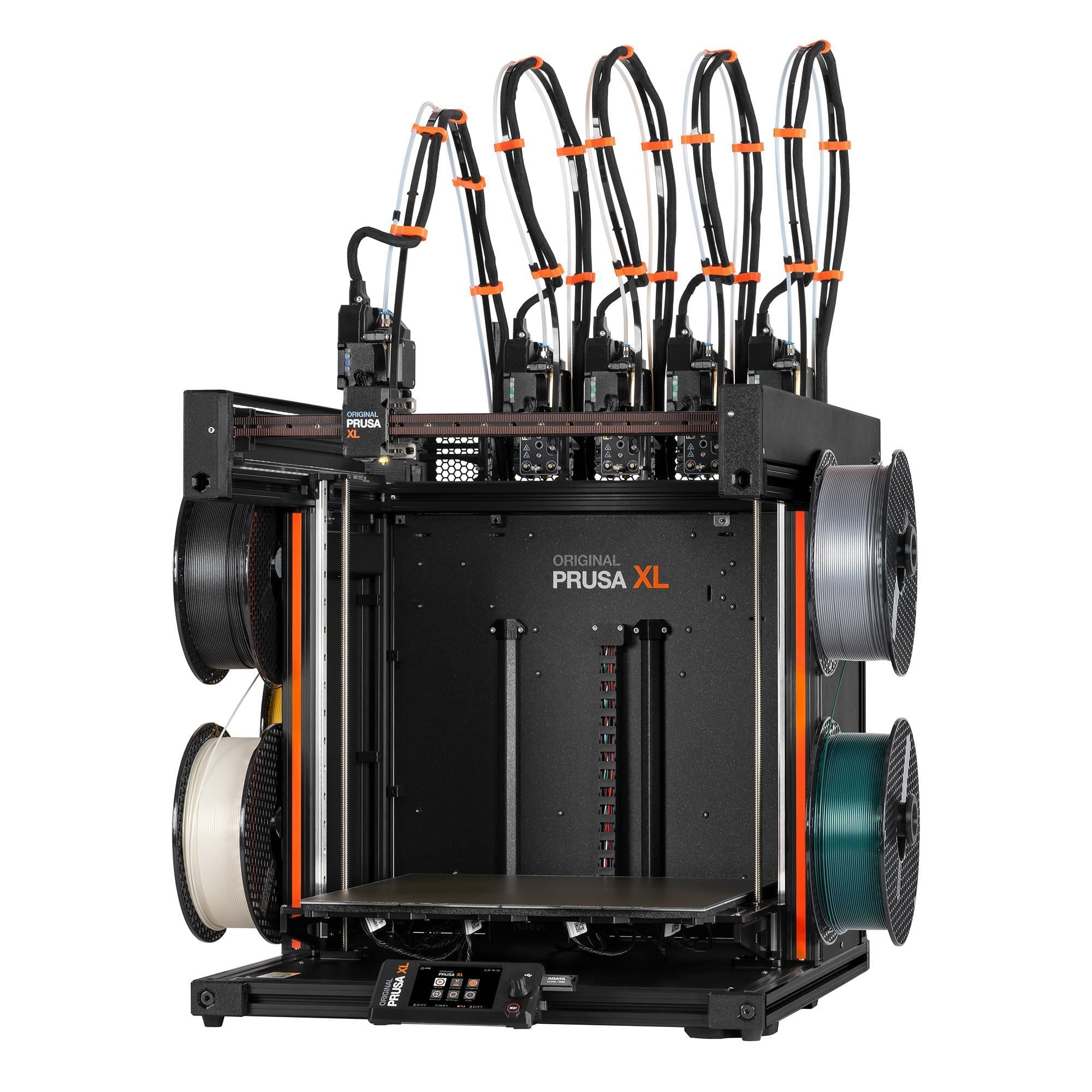
The Original Prusa XL with five independent toolheads is the most advanced FDM machine on this list, designed for professional environments requiring maximum material and color flexibility. With a 360 mm³ build volume, segmented heated bed, and CoreXY precision, this printer handles complex multi-material prototypes—like casting investment molds with dissolvable supports or functional display hardware for finished jewelry.
The five-tool system allows printing with up to five materials or colors in a single job, reducing assembly time for multi-component jigs. The smart tool management optimizes material efficiency, and the segmented heated bed reduces warping on large prints. It integrates seamlessly with Prusa’s open-source ecosystem, avoiding forced updates or proprietary logins—a significant advantage for studios that value control over their workflow.
Assembly is partially misleading: the extruder assembly and some fragile parts are packed separately and can take half a day to install. The Wi-Fi registration process may be buggy, and the UI feels clunky compared to competitors. The XL is also the most expensive option by a wide margin. For a jewelry studio that needs industrial-grade reliability and multi-material capability, the Prusa XL is an investment in long-term flexibility.
Why it’s great
- Five independent toolheads for multi-material.
- 360 mm³ volume with segmented heated bed.
- Open-source ecosystem with lifetime support.
Good to know
- Assembly is complex, takes half a day.
- Highest price point by far.
FAQ
Can I use my resin printer directly for lost-wax casting?
What XY resolution do I need for signet rings and bezel settings?
Is FDM printing useful for jewelry making at all?
How important is a heated resin vat for jewelry printing?
What build volume do I need for a production run of rings?
Final Thoughts: The Verdict
For most users, the 3d printer for jewelry making winner is the Phrozen Sonic Mighty 8K because its 28‑micron resolution, large build volume, and broad slicer compatibility cover every stage of the casting workflow without driving up costs. If you need dual‑material capability and industrial Z‑axis stability for high‑viscosity castable resins, grab the ANYCUBIC Photon P1. And for high‑volume production runs where throughput and zero‑waste resin recycling matter most, nothing beats the Phrozen Sonic Mega 8K S.