
Our readers keep the lights on and the weekend projects moving. As an Amazon Associate, I earn from qualifying purchases.
Small-scale resin printing demands precision that most FDM machines simply cannot deliver. Every layer, every edge, and every texture on a 28mm scale figure is defined by the printer’s XY resolution and light source stability, making these specs the true gatekeepers of quality. The wrong choice leaves you with models that require hours of cleanup, while the right one produces tabletop-ready pieces straight off the build plate.
I’m Rikta — the co-founder and writer behind FitlyFast. I’ve spent hundreds of hours analyzing LCD resolutions, light uniformity rates, release film technologies, and print speeds across the current generation of resin printers to find which ones consistently deliver clean, detailed miniatures.
Whether you are painting Warhammer armies, crafting D&D figures, or prototyping collectibles, the right resin printer determines how much detail survives the transfer from digital file to physical object. This guide breaks down the machines that handle that job best, helping you find the ideal 3d printer for miniatures.
How To Choose The Best 3D Printer For Miniatures
Selecting a resin printer for miniatures comes down to balancing resolution, build speed, and workflow convenience. Unlike printing functional parts, miniatures demand crisp edges, smooth curves, and visible texture on surfaces measured in millimeters. Here is what matters most.
XY Resolution and Pixel Size
The XY resolution defines how small the pixels are on the LCD screen. A lower micron number — like 17µm or 18µm — means the printer can render finer details like chainmail links or eye sockets on a 28mm figure. Resolutions of 8K, 10K, 14K, or 16K relate directly to this pixel size, not the total count of pixels. Always check the micron spec, not just the marketing number.
Light Source and Uniformity
A printer’s UV light source determines how evenly each layer cures. Matrix-style or COB (chip-on-board) light sources with Fresnel lenses reduce stray light and keep edges sharp. Light uniformity rates of 90% or higher mean less variation across the build plate, which translates to consistent quality from one corner of the plate to the other.
Release Film and Print Speed
Standard FEP film works fine but creates more suction force during the peel process, which can warp thin details or cause layer separation. ACF (All-Cutter Fluoropolymer) film and tilt release mechanisms reduce peel force and allow faster printing without sacrificing accuracy. If you plan on batch printing multiple miniatures per plate, these features save significant time.
Auto-Leveling and Heated Vats
Manual bed leveling on older resin printers adds a failure point for beginners. Modern machines with smart auto-leveling and factory calibration eliminate that headache. Heated vats keep resin at optimal viscosity — typically around 25°C — which prevents delamination and improves success rates in cooler environments. For miniature printers running overnight sessions, these features are essential.
Quick Comparison
On smaller screens, swipe sideways to see the full table.
| Model | Category | Best For | Key Spec | Amazon |
|---|---|---|---|---|
| ELEGOO Saturn 4 Ultra 16K | Premium | High-volume batch printing with super-fine detail | 15120x6230px (14×19µm XY) | Amazon |
| ANYCUBIC Photon P1 (Dual-Color) | Prosumer | Multi-material and engineering-grade miniatures | 13312x5120px (16.8×24.8µm XY) | Amazon |
| Creality Halot Mage S 14K | Mid-Range | Professional-grade detail on a larger build plate | 13320x5120px (16.8×24.8µm XY) | Amazon |
| Phrozen Sonic Mega 8K S | Industrial | Mass production of miniatures in single runs | 43µm XY / L12.99xW7.28xH11.81″ | Amazon |
| ANYCUBIC Photon P1 (Standard) | Prosumer | High-viscosity resin miniatures with minimal fuss | 13312x5120px (16.8×24.8µm XY) | Amazon |
| ELEGOO Mars 5 Ultra 9K | Mid-Range | Affordable, beginner-friendly miniature printing | 18µm XY / 150mm/h speed | Amazon |
| ANYCUBIC Photon Mono 4 Ultra 10K | Mid-Range | Ultra-smooth surfaces with COB light source | 9024x5120px (17×17µm XY) | Amazon |
| ANYCUBIC Photon Mono 4 Bundle | Value | First-time buyers needing a complete starter kit | 9024x5120px (17×17µm XY) | Amazon |
| Flashforge Adventurer 5M | Budget FDM | Prototyping and terrain where detail is secondary | CoreXY / 600mm/s / 0.1mm accuracy | Amazon |
In‑Depth Reviews
1. ELEGOO Saturn 4 Ultra 16K
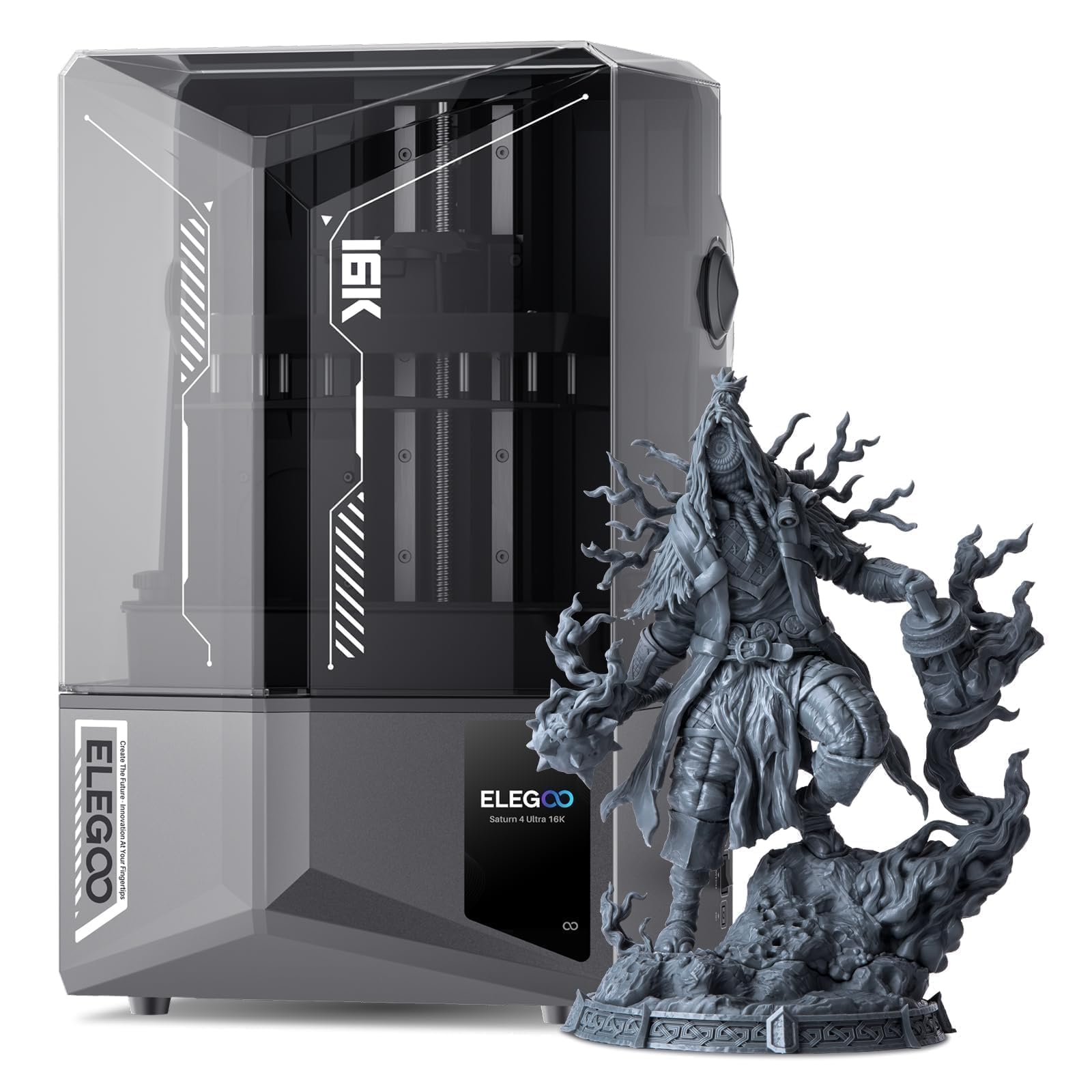
The Saturn 4 Ultra 16K sets the new standard for miniature printing with a staggering 15120 x 6230 pixel LCD that delivers a 14 x 19µm XY resolution — the smallest pixel size on this list. That translates to impossibly sharp edges, visible pore textures, and clean separation between tiny parts on a single plate. The automatic heated resin vat maintains 25°C to keep even thick resins flowing, while the tilt release mechanism prints at 150mm/h without relying on specialized films.
Built-in AI camera monitoring with integrated lighting lets you check print progress in any light, and the smart mechanical sensor detects resin shortages and leveling failures before they ruin a job. Power-on resume and WiFi cluster printing make this a serious tool for anyone running multiple printers. Users consistently report prints coming out perfectly without manual calibration, and the build volume of 8.33 x 4.66 x 8.66 inches handles large batches of 28mm figures in one go.
The unit weighs 35.4 pounds, so it stays planted on your workbench. Some early units had power brick defects, but ELEGOO support resolved replacements quickly. The stock slicer works fine, but third-party options like Chitubox Pro unlock more control. Resin odor is present as with any resin printer, so ventilation is still required.
Why it’s great
- Best XY resolution on the market for miniature detail
- Heated vat eliminates cold-weather print failures
- Tilt release enables fast, consistent batch printing
Good to know
- Heavy build — clear a permanent bench spot
- Some users received defective units requiring support
- Resin odor requires proper ventilation setup
2. ANYCUBIC Photon P1 (Dual-Color)
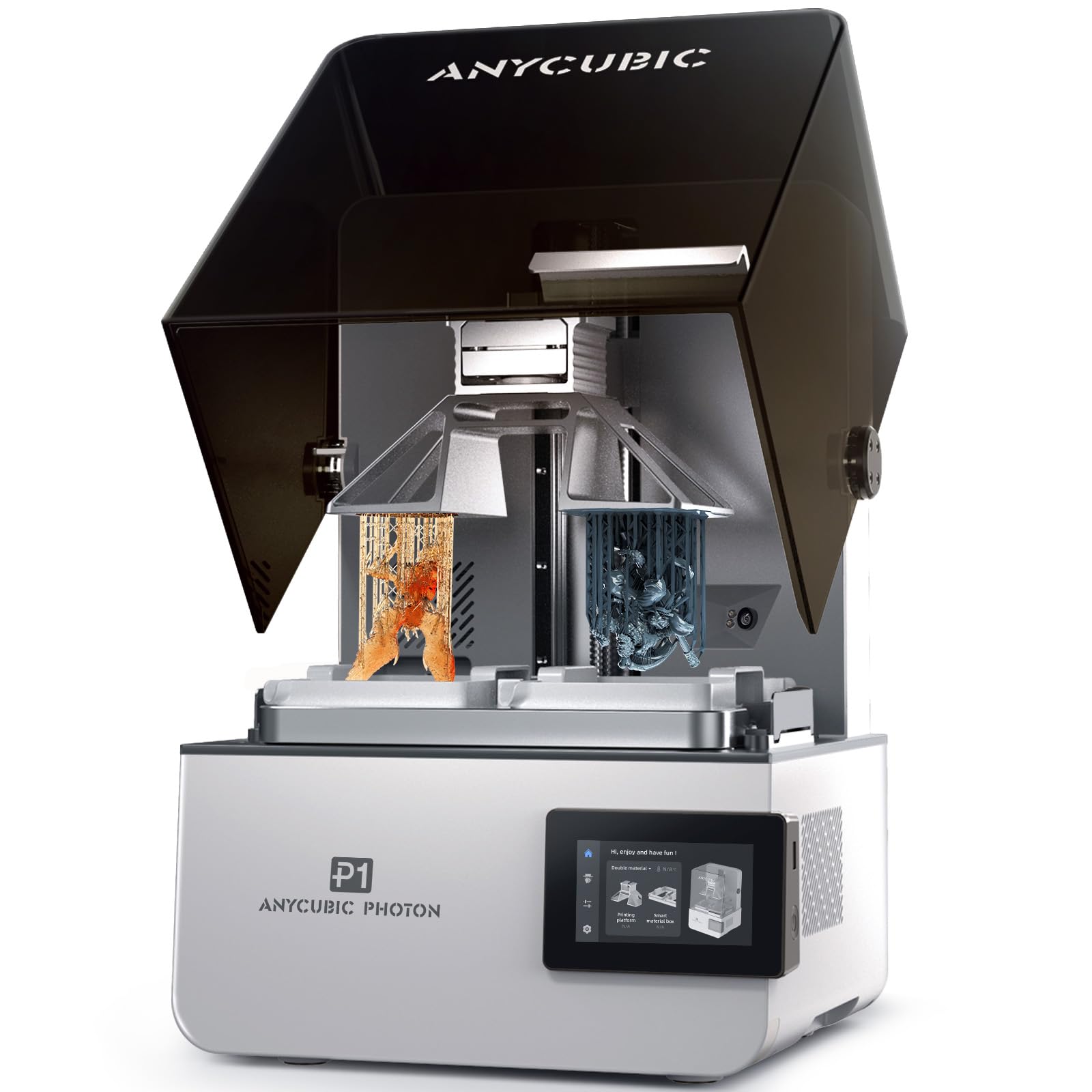
The Photon P1 in its dual-color variant is the only printer here that prints two materials or colors simultaneously, opening up multi-material miniatures with different hardness or tint in a single pass. The industrial ball screw and precision guide rails eliminate Z-wobble, producing layers as thin as 0.010mm with clean vertical walls. Wave Release Technology reduces peel force by 60%, which directly lowers support failure rates on delicate arms and weapon details.
The 14K LCD at 13312 x 5120 pixels (16.8 x 24.8µm XY) captures fine textures like scaled armor and facial features. It supports resins up to 8000 cps viscosity — 40 times thicker than standard resin — meaning you can print engineering-grade materials for functional miniature parts. Smart Leveling 3.0 handles calibration automatically, and the AI monitoring system checks for residual resin, leveling faults, and build plate installation before every print.
Dual-material printing requires a learning curve to configure properly, and the slicer may occasionally crash on complex files. The build volume of 8.78 x 4.96 x 9.05 inches is generous for a machine at this price tier. Some users noted static discharge issues damaging the cover, but ANYCUBIC support has been responsive with replacements.
Why it’s great
- Only printer here with native dual-color/material support
- Ball screw and rails deliver rock-solid layer consistency
- Handles high-viscosity industrial resins up to 8000 cps
Good to know
- Dual-color slicing is complex for beginners
- Slicer software occasionally crashes on large files
- Heavier than many mid-range options at 39 pounds
3. Creality Halot Mage S 14K

The Halot Mage S 14K pairs a 10.1-inch LCD with 13320 x 5120 pixels, giving you a massive 8.78 x 4.96 x 9.06 inch build volume while keeping the XY pixel size at a sharp 16.8 x 24.8µm. The Integral Light Source 3.0 ensures even UV curing across that entire surface, so miniatures in the corners look as clean as the ones in the center. Dynax+ mode pushes print speed to 150mm/h using closed-loop motor control and dual linear rails.
The laser-carved build plate provides strong adhesion, and the three-layer Pictor speed-release film reduces peel force by 35% to protect fragile prints. The built-in air purifier with activated carbon helps control resin odor, a rare factory inclusion. HALOT OS supports remote printing from phone or PC, and the 3-month Chitubox Pro membership helps new users dial in support settings.
Some users reported LCD spotting after several months, and replacement screens cost a significant portion of the printer’s value. The stock slicer is adequate but not as polished as Chitubox. The 27.5-pound unit is manageable on most desks, and community reports indicate consistent success with small objects like keychain miniatures and jewelry.
Why it’s great
- Large 10.1-inch screen for batch miniature printing
- Integrated carbon filter reduces resin odor
- 14K resolution at 150mm/h with Dynax+ mode
Good to know
- LCD durability concerns after extended use
- Screen replacement cost is high relative to printer price
- Slicer software is basic compared to alternatives
4. Phrozen Sonic Mega 8K S

The Sonic Mega 8K S is built for volume: a 15-inch LCD with 8K resolution (43µm XY) and a cavernous 12.99 x 7.28 x 11.81 inch build volume. Phrozen claims 80 detailed 1/32 scale miniatures in 90 minutes using their TR300 high-speed resin and ACF film. The lift-up lid design saves vertical space, and the heavy-duty metal drip hanger lets excess resin flow back into the vat between batches.
The 43µm pixel size is larger than the 14K and 16K options above, so this printer prioritizes throughput over absolute fine detail. For standard tabletop miniatures and props, the resolution is still excellent, but ultra-fine facial features or microscopic text will show less crispness than the Saturn 4 Ultra. The auto-refill system and large vat make this a serious production tool for studios.
Weight hits 57.3 pounds, so this is a permanent installation, not a portable unit. Warranty support has been mixed — some users report slow resolution times and shipping costs for replacement parts. The build plate has holes that prevent installation of a flexible plate, making print removal trickier with large flat parts. Overall, this is for users who need throughput above all else.
Why it’s great
- Massive build volume for high-volume miniature production
- ACF film and high-speed resin achieve fast print cycles
- Lift-up lid design fits tight workspaces
Good to know
- Lower XY resolution than 14K/16K competitors
- Very heavy — requires permanent dedicated bench
- Customer support response times reported as slow
5. ANYCUBIC Photon P1 (Standard)
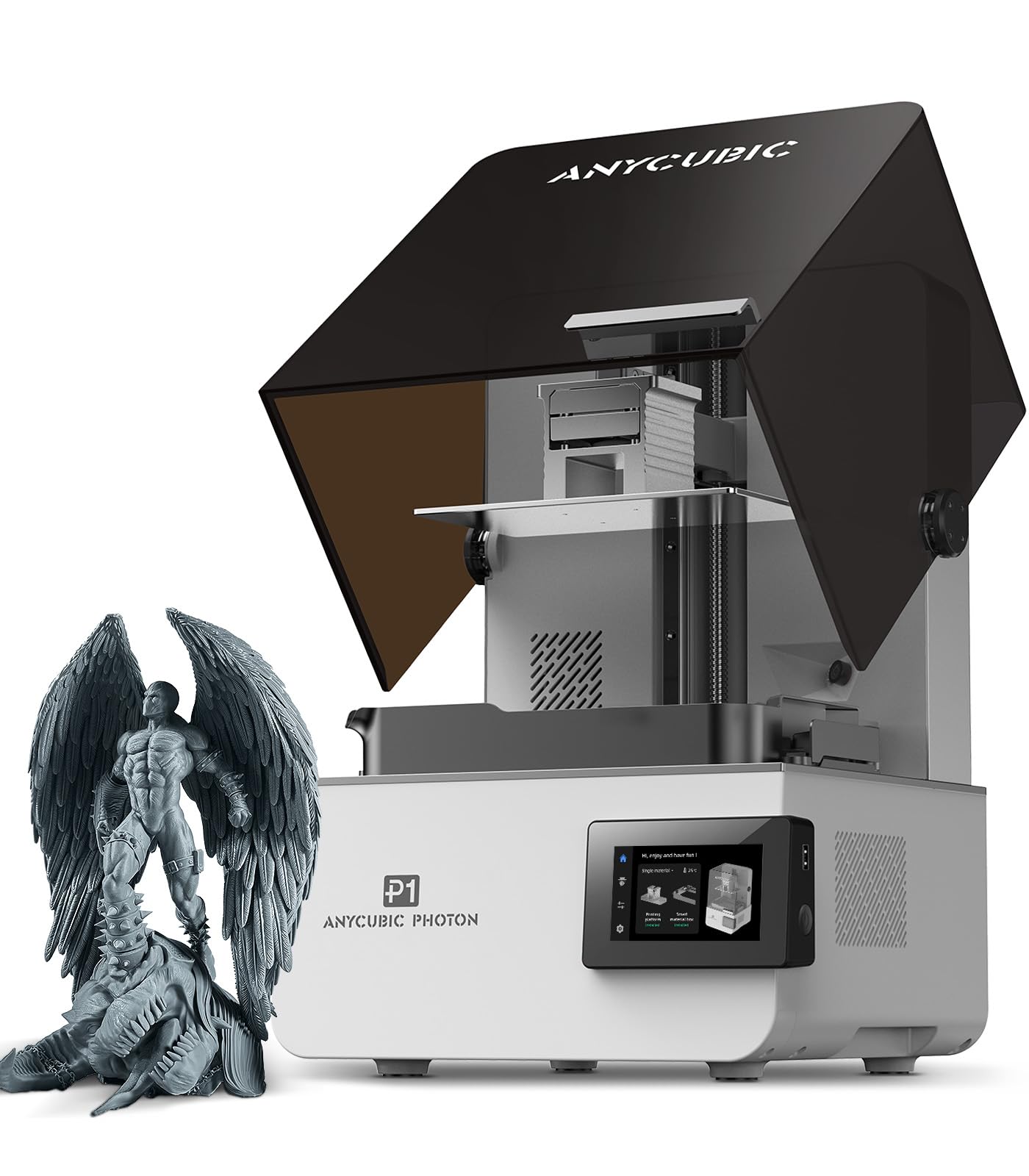
The standard Photon P1 shares the same 14K LCD, ball screw Z-axis, and Wave Release Technology as the dual-color version, minus the multi-material capability. That brings the price down while keeping the core print quality and reliability. The 13312 x 5120 pixel LCD with 16.8 x 24.8µm XY resolution produces crisp miniature details, and the 37.9-pound frame absorbs vibration better than lighter units.
Smart Leveling 3.0 is factory-calibrated, so the first print can start within minutes of unboxing. The AI monitoring checks for resin level, residue, and build plate installation, alerting you before failures cascade. Users report that the steel build plate is easy to clean and that layer lines at 0.010mm are virtually invisible. The slicer includes a useful calibration tool to fine-tune exposure times for different resins.
Some early units shipped with defective UV screens underneath the protective film, requiring replacement. The flat build plate does collect resin drips, though the Wave Release keeps peel force low enough that prints release cleanly. The unit is quiet enough for overnight use, and the 8.78 x 4.96 x 9.05 inch build volume accommodates large batches of miniatures.
Why it’s great
- Industrial-grade stability from ball screw and rails
- Precision down to 0.010mm layer height
- Factory-calibrated auto-leveling for instant setup
Good to know
- Some units shipped with defective UV screen
- Heavy at 37.9 pounds
- Flat build plate can collect resin between prints
6. ELEGOO Mars 5 Ultra 9K
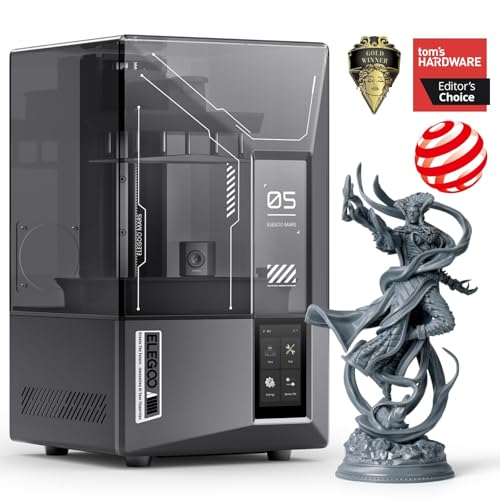
The Mars 5 Ultra 9K brings premium features like tilt release and AI camera monitoring to a price point accessible for serious beginners. The 7-inch 9K LCD delivers 18µm XY resolution, which is excellent for 28mm miniatures and captures fine details like belt buckles and weapon edges. Tilt release technology hits 150mm/h print speeds without the suction issues of standard FEP film.
Smart self-check and automatic leveling make this a true plug-and-print machine. The AI camera detects failures and alerts you via WiFi, and cluster printing support allows controlling multiple units from one interface. The 6.04 x 3.06 x 6.49 inch build volume is smaller than the Saturn line, but adequate for single miniatures or small batches. Chitubox Pro subscription included for three months helps new users.
The lid lacks hinges, which is a minor frustration for frequent vat access. The camera resolution is low enough that it can be blocked by large prints. Some users with older Mars 2 units report this as a massive upgrade. The 19.36-pound weight is moderate, and the overall footprint is compact enough for most workspaces.
Why it’s great
- Tilt release for fast, failure-free printing
- AI camera with WiFi monitoring at entry-level pricing
- Auto-leveling removes calibration headaches
Good to know
- Small build volume limits batch printing
- Lid does not have hinges for easy access
- Camera can be blocked by larger models
7. ANYCUBIC Photon Mono 4 Ultra 10K

The Photon Mono 4 Ultra uses a COB light source with Fresnel lenses to achieve light angles within 3°, eliminating stray light that causes layer blooming and fuzzy edges. The 7-inch 10K LCD at 9024 x 5120 pixels (17 x 17µm XY) delivers smooth surfaces with minimal rasterization. Combined with ACF film and an intelligent release algorithm, this printer reaches 120mm/h while maintaining high accuracy.
Five smart inspections cover printer auto-check, residual resin detection, leftover resin monitoring, failed print detection, and intelligent lifespan management. The 4.3-inch HD interface supports eight languages and provides clear feedback. The 6.04 x 3.42 x 6.49 inch build volume is compact but well-suited for small to medium miniature runs. Users report consistent print quality with multiple resin brands.
The stock FEP film is fragile and can be scratched by plastic spatulas during cleaning. Pre-mounted replacement films are inexpensive and widely available. Strong resin odor is present, requiring either an enclosure with a filter or a well-ventilated room. The lightweight 8.8-pound build makes it easy to move but also means it vibrates more than heavier units.
Why it’s great
- COB light source eliminates stray light artifacts
- 17µm XY for smooth, high-detail miniatures
- Five smart detection systems reduce waste
Good to know
- Stock FEP film scratches easily
- Strong resin odor requires ventilation
- Lightweight construction may cause vibration
8. ANYCUBIC Photon Mono 4 Bundle
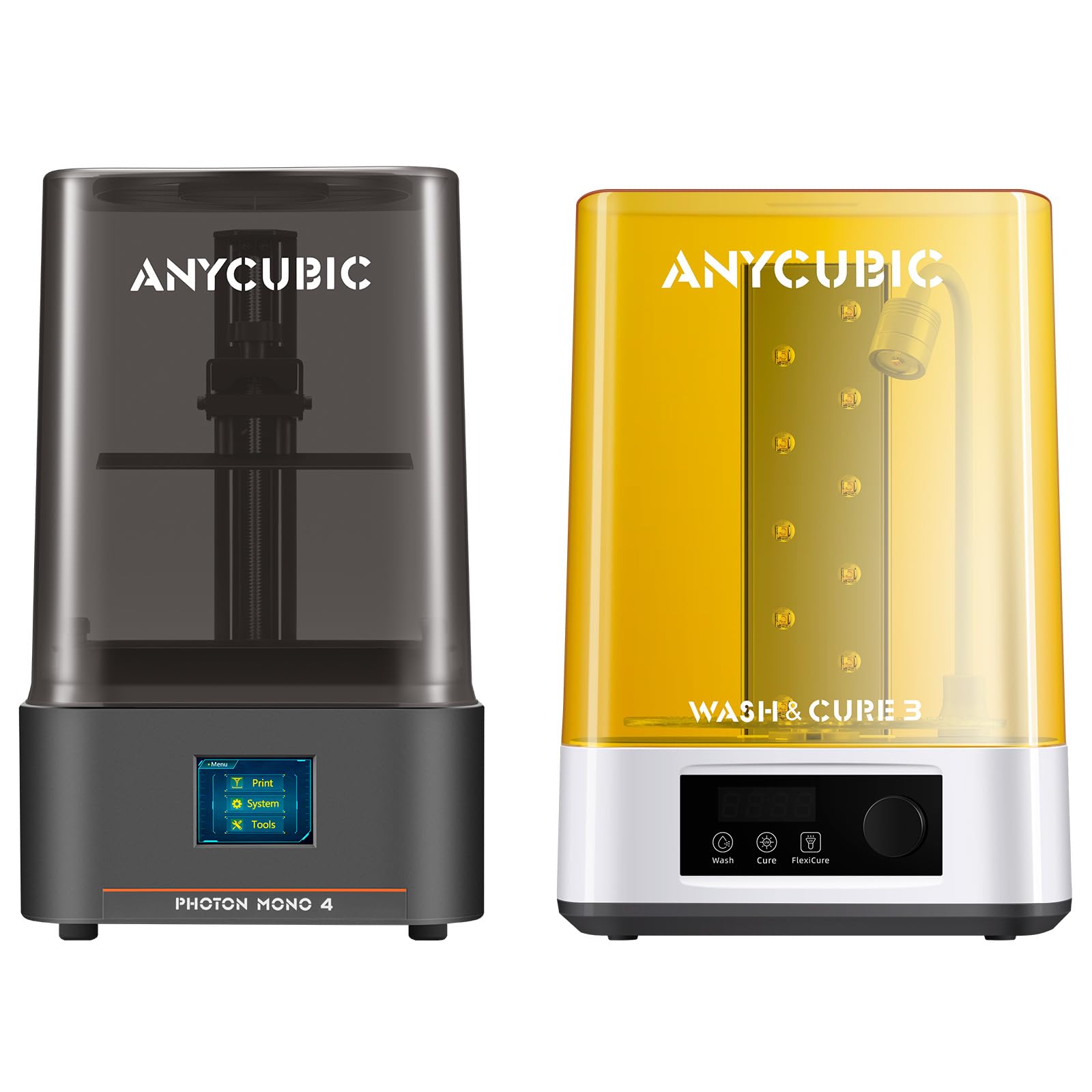
This bundle pairs the Photon Mono 4 with the Wash & Cure 3.0, giving new miniature printers a complete post-processing station out of the box. The Photon Mono 4 itself uses a 7-inch 10K LCD at 9024 x 5120 pixels (17 x 17µm XY) and ANYCUBIC’s LighTurbo matrix light source for even UV distribution that reduces visible layer lines. The build volume of 6.04 x 3.42 x 6.49 inches handles typical miniature sizes comfortably.
The Wash & Cure 3.0 features a 42% larger cleaning basket than the previous generation and a 4-liter bucket for washing multiple prints at once. The Flexicure gooseneck light delivers 30,000uW/cm² within 1-3 cm, which cures hard-to-reach areas like the underside of overhangs and garment hems. This saves significant time compared to using separate wash and cure stations.
The printer itself lacks the ACF film and COB light source found on the Mono 4 Ultra, so maximum speed is lower and stray light control is less precise. The bundle price is very competitive for the included accessories, making it a strong entry point. Users report that the process from print to cured model takes about half the time of separate units.
Why it’s great
- Includes Wash & Cure 3.0 for complete workflow
- 17µm XY resolution at a very accessible price
- Gooseneck curing light reaches model undersides
Good to know
- Lacks ACF film and COB source of the Ultra variant
- Maximum print speed is lower than Ultra models
- Build volume is moderate, not suited for large batches
9. Flashforge Adventurer 5M

The Adventurer 5M is an FDM printer, not a resin printer, and should be considered only for terrain, scatter, and structural elements where fine figure detail is not the priority. It uses a CoreXY frame with 600mm/s maximum speed and 20,000mm/s² acceleration for rapid prototyping of buildings, walls, and bases. The direct drive extruder with a 280°C hot end handles PLA, PETG, and ASA.
Auto bed leveling with 25-point detection and 0.01mm precision ensures reliable first layers. The PEI build plate with MagSwitch removal takes three seconds to pop off. The Quick-change Nozzle X system allows swapping between 0.25mm for fine terrain details and 0.8mm for large base plates in under 15 seconds. Klipper-based firmware provides remote monitoring via the Flashforge App.
This machine has no place in a miniature figure printing workflow — the layer lines and lack of XY resolution to capture small details make it unsuitable for figures. For complementing a resin printer with terrain and bases, it is a fast, reliable option. Some users reported USB port fragility and that cloud printing features are being phased out. Fans are loud at top speed.
Why it’s great
- CoreXY chassis for fast, stable terrain printing
- Quick-swap nozzle system for different detail levels
- PEI build plate with tool-free magnetic removal
Good to know
- FDM cannot match resin for figure detail
- USB port is fragile and easily damaged
- Loud fan noise at high print speeds
FAQ
What XY resolution is good enough for 28mm miniature figures?
Do I need a heated vat for printing miniatures in a cold room?
Final Thoughts: The Verdict
For most users, the 3d printer for miniatures winner is the ELEGOO Saturn 4 Ultra 16K because its 14×19µm XY resolution, heated vat, and tilt release produce batch-ready miniatures with no cleanup. If you want dual-color capability and industrial build quality, grab the ANYCUBIC Photon P1 (Dual-Color). And for high-volume production where throughput matters more than microscopic detail, nothing beats the Phrozen Sonic Mega 8K S.