
Our readers keep the lights on and the weekend projects moving. As an Amazon Associate, I earn from qualifying purchases.
Diving into 3D printing today means you can get a machine that delivers crisp, detailed parts at speeds that would have been unthinkable just a few years ago, without spending a small fortune. The real challenge is cutting through the marketing noise to find the model that balances raw speed, build volume, material flexibility, and reliability — all while staying within a sensible budget.
I’m Rikta — the co-founder and writer behind FitlyFast. I’ve spent countless hours analyzing printer specs, community feedback, and real-world failure rates to separate the workhorses from the headaches.
Whether you are upgrading from an old Ender or buying your very first machine, the 3d printer for the price should deliver consistent first layers, fast CoreXY motion, and enough material support to keep you creating, not calibrating.
How To Choose The Best 3D Printer For The Price
When shopping for a 3D printer where value is the primary filter, the biggest mistake is focusing solely on the print speed number while ignoring the motion system, hotend capability, and auto-calibration suite. A 600mm/s rating on a poorly-damped frame just produces faster failures. Here is what actually matters.
Motion System: CoreXY vs. Bedslinger
CoreXY printers move the print head in X and Y by coordinating two belts, while the bed only moves in Z. This design reduces moving mass on the Y-axis, enabling higher accelerations (up to 20,000 mm/s²) without ringing or ghosting. Bedslingers shift the entire print bed back and forth, which limits acceleration and introduces layer-shift risks at high speeds. For the price tier we’re analyzing, CoreXY is the architecture that consistently delivers speed with quality.
Auto Calibration: Leveling, Vibration Compensation, and Flow Rate
Full-auto bed leveling has become table stakes, but not all systems are equal. Look for models that combine inductive or strain-gauge probing with active vibration compensation (input shaping) and flow rate compensation. These three features work together to eliminate the dreaded first-layer failure and minimize surface artifacts like ringing. The more automated this process is, the less time you spend tweaking and the more time you spend printing.
Hotend and Material Compatibility
An all-metal hotend rated to at least 300°C is critical if you ever want to print PETG, ABS, polycarbonate, or carbon-fiber reinforced filaments. Machines limited to 260°C will restrict you to PLA and basic TPU. For the price, a 300°C+ direct-drive extruder with a hardened steel nozzle offers the best material flexibility without demanding a premium.
Quick Comparison
On smaller screens, swipe sideways to see the full table.
| Model | Category | Best For | Key Spec | Amazon |
|---|---|---|---|---|
| Bambu Lab P1S | Enclosed CoreXY | Multi-color & advanced materials | 500mm/s / 256mm³ build | Amazon |
| Creality K1C | Enclosed CoreXY | Carbon fiber & fast prints | 600mm/s / 300°C hotend | Amazon |
| ELEGOO Centauri Carbon | Enclosed CoreXY | Out-of-box reliability | 500mm/s / die-cast frame | Amazon |
| Anycubic Kobra X (Multicolor) | CoreXY Multicolor | Native 4-color printing | 600mm/s / 19-color max | Amazon |
| Creality K2 SE | CoreXY Open | Beginner-friendly speed | 600mm/s / 300°C hotend | Amazon |
| Bambu Lab A1 | Bedslinger | Ultra-quiet & beginner ease | 10k mm/s² / 256mm³ build | Amazon |
| Flashforge Adventurer 5M | CoreXY Open | Compact & quick setup | 600mm/s / 220mm³ build | Amazon |
| Geeetech M1S | Bedslinger Mini | Kids & absolute beginners | 250mm/s / 2.4″ LCD | Amazon |
In‑Depth Reviews
1. Bambu Lab P1S 3D Printer

The Bambu Lab P1S is the machine that redefines what “for the price” means in this category. Its fully enclosed CoreXY frame hits 500mm/s with 20,000 mm/s² acceleration while maintaining layer-to-layer precision that rivals printers costing three times as much. The auto bed leveling system is genuinely hands-off — users report consistently perfect first layers without manual intervention.
Multi-color expansion via the AMS unit is a major draw, allowing up to 16 colors or material types in a single print. The enclosure handles ABS and ASA without warping, and the Bambu Studio slicer provides a streamlined workflow from design to print. Several long-term reviewers note that after hundreds of hours, the P1S still produces clean benchies with minimal post-processing.
The trade-off is that the printer is heavy at nearly 39 pounds, requiring a sturdy table. Some users also mention that TPU can be finicky without specific tuning, but PLA and PETG print flawlessly out of the box. For the total package of speed, enclosure, and software ecosystem, this is the clear leader.
Why it’s great
- Fully enclosed for ABS/ASA with minimal warping
- Up to 16-color multi-material support
- Hands-off auto leveling with excellent first-layer adhesion
Good to know
- Requires separate AMS unit for multi-color
- TPU printing needs extra tuning
- Large footprint; needs a stable desk
2. Creality K1C 3D Printer

The Creality K1C is an evolution of the K1 line that focuses on material versatility, especially for carbon-fiber reinforced filaments. Its hardened steel nozzle and all-metal hotend rated to 300°C let you print PLA-CF and PETG-CF without worrying about nozzle wear. The enclosure includes an active carbon filter that scrubs fumes during high-temp printing.
Speed tops out at 600mm/s with 20,000 mm/s² acceleration, and the AI camera provides real-time monitoring with spaghetti detection. Users upgrading from the old Ender 3 report that the self-leveling and vibration compensation eliminate hours of manual setup. The Creality OS is Klipper-based and fully open-source, allowing advanced users to fine-tune parameters.
The main criticism revolves around bed adhesion: the included smooth sheet requires glue stick for PLA, and many users recommend upgrading to a textured PEI plate. A few units arrived with a missing spool holder. For those who want to print carbon fiber composites on a budget, the K1C is the most accessible option.
Why it’s great
- High-durability hardened steel nozzle for carbon fiber
- Active carbon filter for safer enclosed printing
- Open-source Klipper firmware for advanced tuning
Good to know
- Smooth sheet requires glue stick for PLA adhesion
- Some units missing accessories like spool holder
- Customer support can be slow for warranty claims
3. ELEGOO Centauri Carbon 3D Printer

ELEGOO’s Centauri Carbon stands out for its die-cast aluminum frame — a feature usually reserved for much more expensive machines. This rigid chassis minimizes vibration at high speeds, which translates directly to cleaner layers and fewer ringing artifacts. The printer ships fully assembled and pre-calibrated, so the unboxing-to-first-print time is under 20 minutes.
Its 320°C brass-hardened steel nozzle and enclosed chamber make it a strong candidate for advanced materials like carbon fiber PLA and PETG. The built-in 720p camera with dual LED lighting supports real-time monitoring and time-lapse capture. Reviewers consistently praise the bed adhesion: the dual-sided plate has a dedicated PLA-specific surface that grips well at lower bed temperatures.
On the downside, the printer is heavy (over 38 pounds) and shakes noticeably on lighter furniture. The ElegooSlicer app is functional but less polished than Bambu Studio. A small number of users reported hotend communication failures within the first week, though replacement units worked flawlessly afterward.
Why it’s great
- Die-cast aluminum frame for vibration damping
- 320°C hotend handles carbon fiber materials
- Dual-sided bed with PLA-specific adhesion surface
Good to know
- Heavy build; requires sturdy table
- Slicer software less refined than competitors
- Occasional hotend communication issues reported
4. Anycubic Kobra X 3D Printer
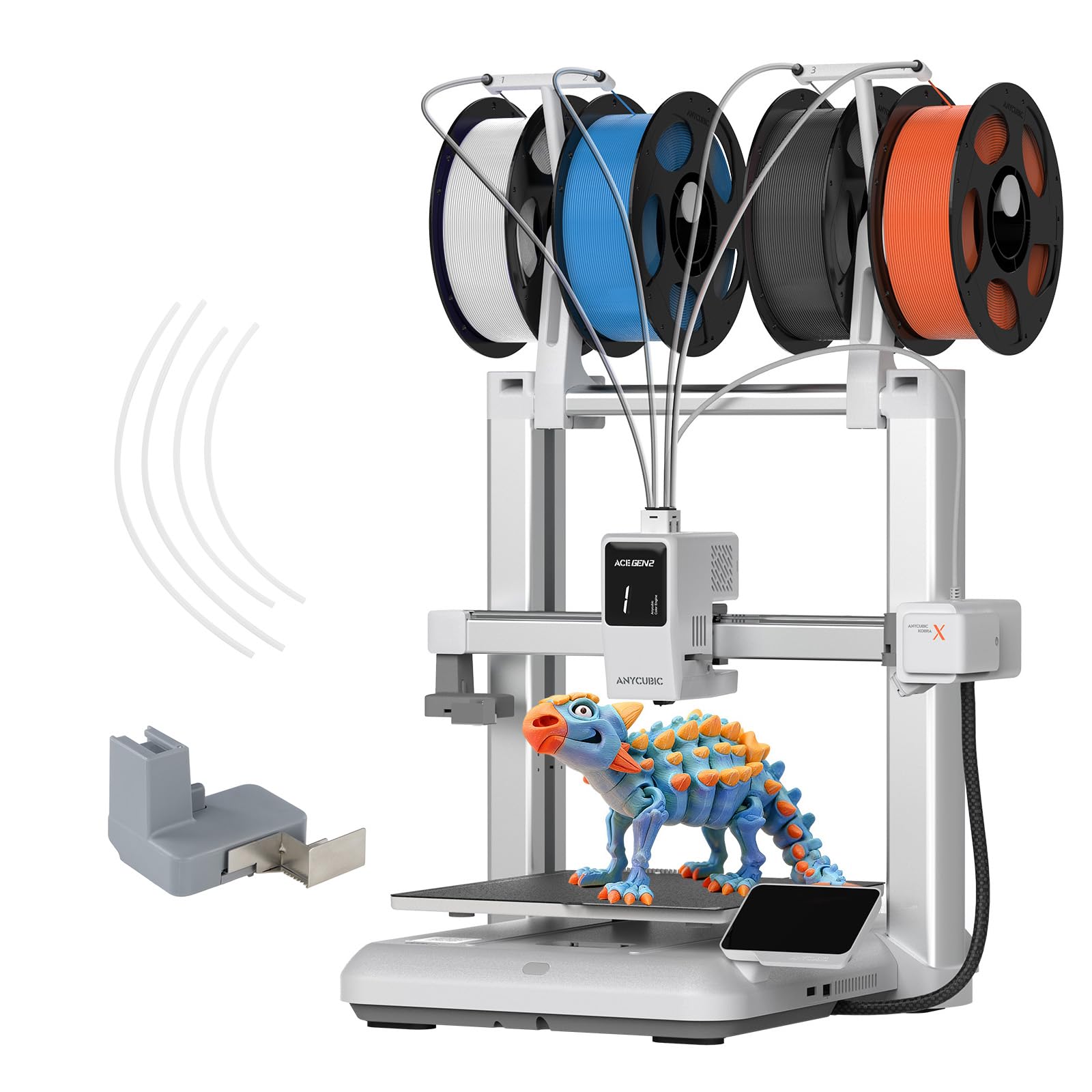
Anycubic’s Kobra X is one of the few printers in this price range that comes with native 4-color printing right out of the box, expandable to 19 colors with four ACE 2 Pro units. The Ace Gen 2 technology reduces purge waste significantly — a common pain point with multi-color systems. The 49-point LeviQ 3.0 auto-leveling system ensures the bed is flat to 0.02mm accuracy.
The printer reaches 600mm/s with active vibration compensation, producing crisp details even on tall, slender models. The AI camera provides spaghetti detection and foreign object alerts, which adds a layer of safety for unattended prints. Community feedback highlights the quiet operation at around 45dB and the solid adhesion without needing glue sticks.
The primary drawback is that the single extruder design still generates a fair amount of purge waste during color changes — some users print a dedicated waste bucket. The phone app could use smoother navigation. Despite these quirks, the Kobra X is the best entry point into hassle-free multi-color printing at this price tier.
Why it’s great
- Native 4-color printing with low purge waste
- 49-point LeviQ 3.0 auto-leveling system
- Very quiet operation at ~45dB
Good to know
- Single extruder creates purge waste with color changes
- Mobile app interface could be more polished
- Occasional quality control issues reported
5. Creality K2 SE 3D Printer
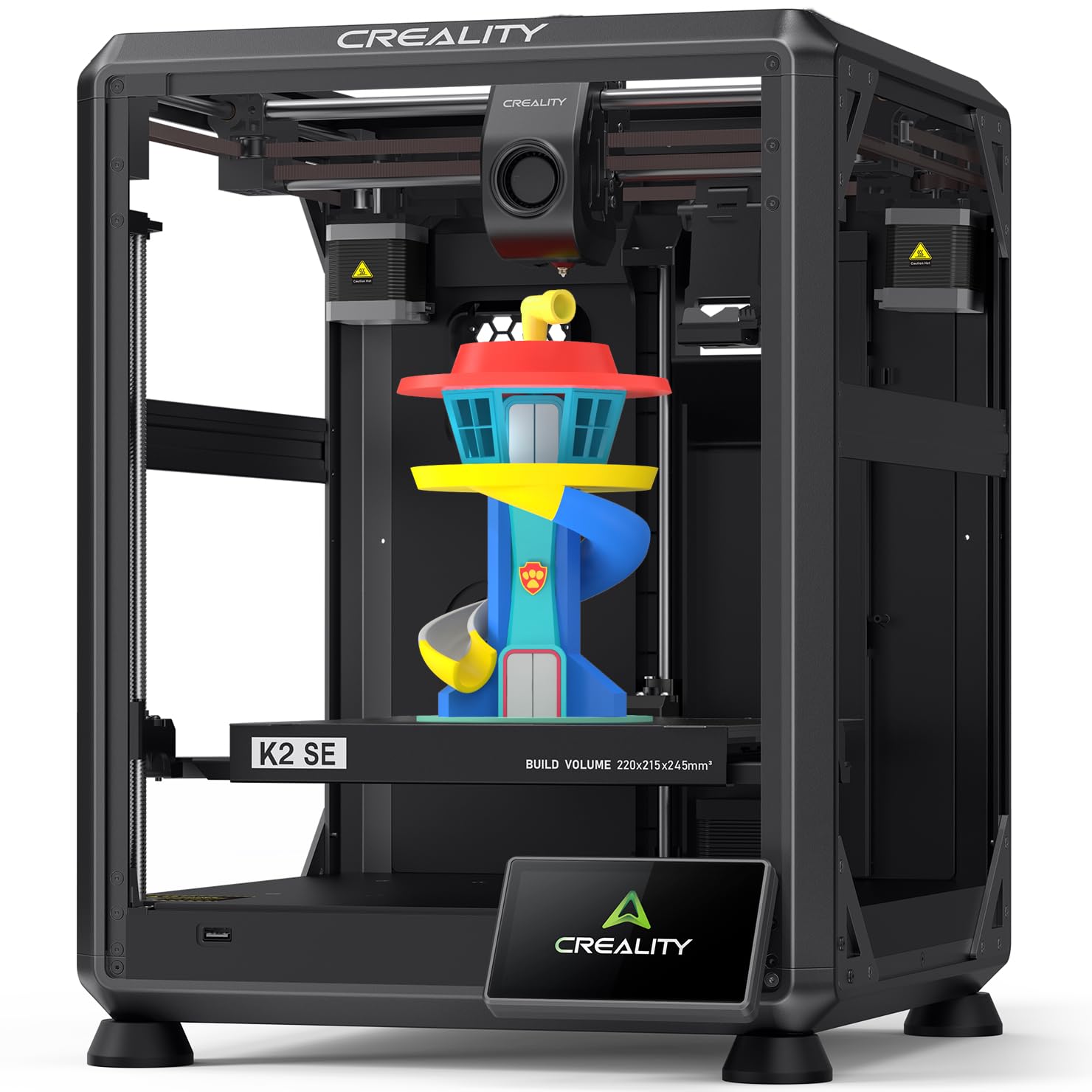
Creality positions the K2 SE as an accessible high-speed machine for families and newcomers. The CoreXY frame hits 600mm/s with 20,000 mm/s² acceleration, and the auto-calibration routine takes care of bed leveling, Z-offset, and vibration compensation before every print. Users report that even children can operate it successfully after a brief walkthrough.
The direct-drive extruder reaches 300°C and supports PLA, PETG, TPU, and ABS. The tri-metal nozzle combines a steel tip with a copper body and titanium alloy heatbreak, which blocks thermal creep. Pre-installed damping pads reduce vibration transfer to the table, keeping noise levels reasonable. The Creality Cloud app offers a library of pre-sliced models for instant printing.
The K2 SE is not enclosed, so printing ABS requires a separate enclosure or a well-ventilated space. Some reviewers noted that the instruction manual could be clearer, especially regarding removing foam packaging from under the bed. For a fast, easy-to-use machine that grows with a beginner’s skills, the K2 SE is a strong contender.
Why it’s great
- Ultra-fast auto-calibration for stress-free starts
- 300°C tri-metal nozzle resists clogging
- Great for kids and beginners with cloud app support
Good to know
- Open frame; not suitable for ABS without enclosure
- Manual could be more detailed on initial setup
- Some units shipped with voltage switch set incorrectly
6. Flashforge Adventurer 5M 3D Printer

The Adventurer 5M packs impressive specs into a small 14.3 x 15.8 x 17.6-inch footprint. The CoreXY motion system reaches 600mm/s with 20,000 mm/s² acceleration, and the full-auto one-click leveling simplifies setup dramatically. Experienced users who own multiple printers rate this as their favorite for quick, reliable PLA prints.
One standout feature is the quick-detachable 280°C nozzle that can be swapped in seconds without tools. The dual-sided PEI-coated plate provides strong adhesion for PLA, PETG, and TPU. Vibration compensation eliminates ghosting effectively, and the 50W hotend heater reaches 200°C in just 35 seconds. The filament run-out sensor and power-loss recovery add resilience for longer prints.
The trade-off is the modest 220mm³ build volume, which limits larger models. A small percentage of users reported inconsistent extrusion or bed adhesion issues that required firmware updates. For those who need a fast, compact printer for prototyping and small parts, this is an excellent choice.
Why it’s great
- Small footprint with full CoreXY performance
- Tool-free quick-swap nozzle design
- Filament run-out and power-loss recovery
Good to know
- Limited to 220mm³ build volume
- Occasional firmware and extrusion inconsistencies
- Wi-Fi connectivity can be finicky
7. Bambu Lab A1 3D Printer

The Bambu Lab A1 takes a different approach by using a bedslinger design rather than CoreXY, but it compensates with 10,000 mm/s² acceleration and active motor noise canceling that keeps noise below 48dB. This makes it the best option for shared living spaces or offices where noise matters. The full-auto calibration covers Z-offset, bed leveling, and flow rate compensation automatically.
The 256mm³ build volume gives you more room than the Flashforge Adventurer 5M, and the 1-Clip quick-swap nozzle simplifies filament changes. The Bambu ecosystem — including the mobile app and MakerWorld community — makes finding and printing models extremely beginner-friendly. Users consistently report zero failures after 30+ prints with no manual tinkering.
Because it is a bedslinger, you cannot push the same accelerations as a CoreXY machine without risking layer shifts. The A1 also lacks an enclosure, limiting advanced material use. For print quality, silence, and reliability straight out of the box, it is an exceptional value despite the simpler motion system.
Why it’s great
- Exceptionally quiet operation at ≤48dB
- Full-auto calibration with active flow compensation
- Beginner-friendly Bambu app and MakerWorld community
Good to know
- Bedslinger limits max acceleration
- No enclosure for advanced materials
- AMS Lite sold separately for multi-color
8. Geeetech M1S Mini 3D Printer
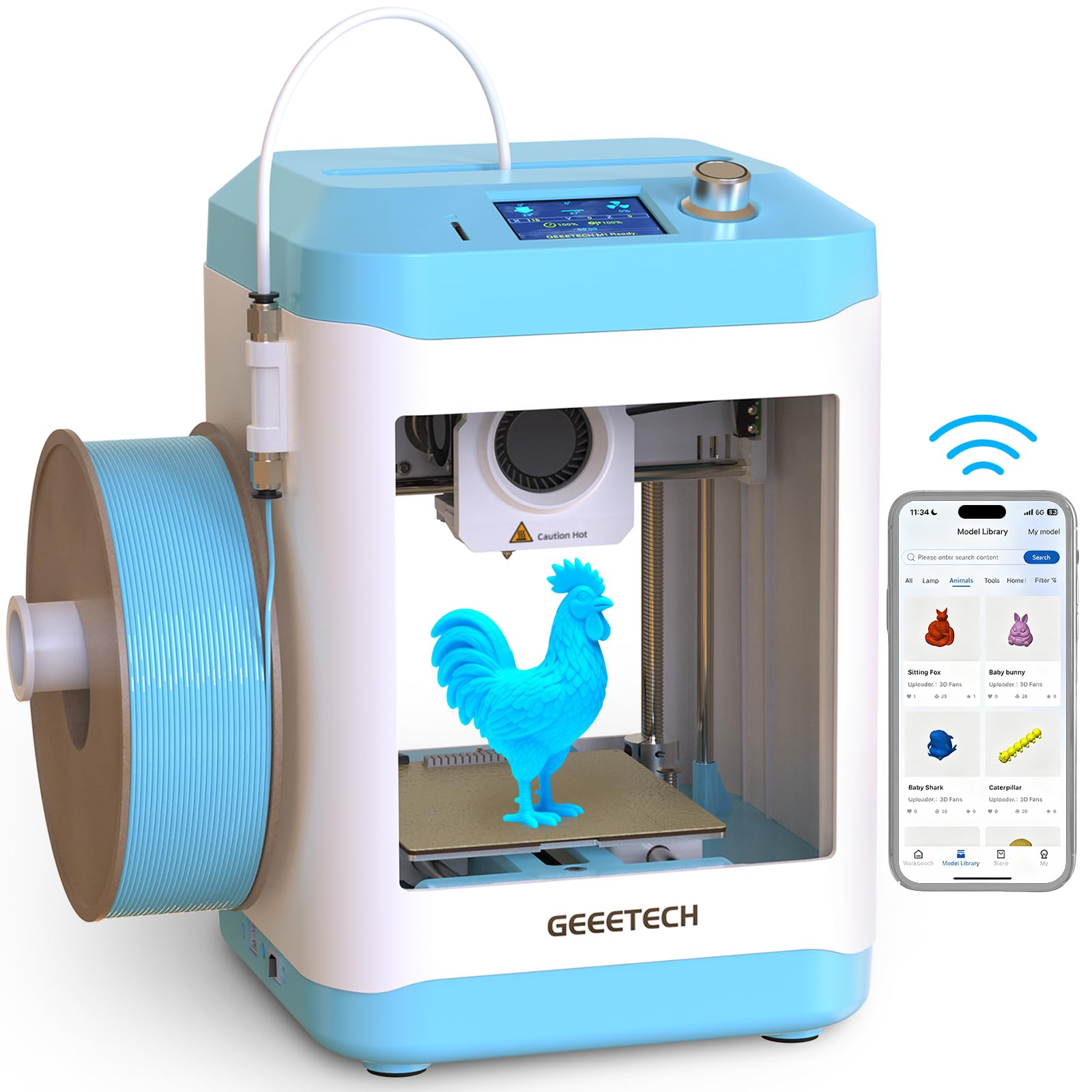
The Geeetech M1S is purpose-built for children and first-time users. It ships fully assembled with zero required setup — just plug it in, load filament, and start printing. The tiny build volume of 3.94 x 4.33 x 3.94 inches is limiting for large projects but perfect for toys, keychains, and small educational models. The 16-point auto-leveling ensures that even a 6-year-old can get a successful first layer.
A 50W hotend heater and direct-drive dual-gear extruder with a 1:5 gear ratio provide reliable extrusion for PLA and TPU. The 2.4-inch LCD screen and mobile app control make operation straightforward. The magnetic PEI build plate allows easy part removal. Geeetech includes a 12-month warranty and responsive support, which is reassuring for gift-givers.
The max speed of 250mm/s is modest compared to CoreXY machines, and the printer only accepts small filament spools (though a 1kg holder is available). A few users experienced defective units that required replacement, though support handled these quickly. For introducing a child to 3D printing safely and easily, the M1S is ideal.
Why it’s great
- Fully assembled and ready to print out of box
- Simple 16-point auto-leveling for reliable starts
- Excellent warranty and customer support
Good to know
- Very small build volume limits project size
- Max speed of 250mm/s is below average
- Some units require replacement due to defects
FAQ
What is the real difference between 300°C and 260°C hotends for a value printer?
Can I add multi-color printing to any of these printers later?
How much time should I expect for the first successful print?
Is a bedslinger printer a bad choice for high-speed printing?
Final Thoughts: The Verdict
For most users, the 3d printer for the price winner is the Bambu Lab P1S because it combines a fully enclosed CoreXY frame, 500mm/s speed, multi-color expansion potential, and a polish that reduces tinkering to near zero. If you want native multi-color printing without buying extra modules, grab the Anycubic Kobra X. And for absolute beginner-friendliness and classroom safety, nothing beats the Geeetech M1S.