
Our readers keep the lights on and the weekend projects moving. As an Amazon Associate, I earn from qualifying purchases.
Manually leveling a print bed with a piece of paper and four corner screws is a rite of passage, but it’s also the single biggest bottleneck between you and a successful first layer. Auto-leveling systems have evolved from a premium luxury to an essential feature, eliminating the guesswork and the warp-induced failures that plagued early desktop FDM. The real decision now is not whether to buy a printer with auto-leveling, but which sensor type, calibration routine, and overall platform delivers the most reliable, hassle-free experience for your specific projects.
I’m Rikta — the co-founder and writer behind FitlyFast. I have spent hundreds of hours analyzing market data, comparing sensor accuracy, build quality, and real-world user feedback across dozens of machines to bring you a honest, spec-driven guide to the most reliable models available.
After digging through thousands of verified reviews and cross-referencing every spec sheet, I’ve identified the nine machines that actually execute auto leveling in ways that remove friction rather than adding complexity.
How To Choose The Best 3D Printer With Auto Leveling
The phrase “auto-leveling” covers a wide range of technology from a simple inductive probe to a full nozzle-contact mapping system. Before you pick a model, you need to understand three pillars: the sensor type, the calibration grid density, and how the machine compensates for a warped bed during printing.
Sensor Type: Probe vs. Nozzle Touch
Inductive probes like the CR Touch are common and work on most metal beds but require a specific Z-offset calibration. Capacitive and nozzle-touch sensors (like the Qidi Q2 uses) can measure directly on any bed surface, including glass or smooth PEI, and often deliver better repeatability because the sensor is measuring the exact same point the filament will touch.
Grid Density and Compensation Software
A 16-point grid is usually enough for a small, flat bed, but if your plate has a slight warp, you want a denser mesh — 36 or even 49 points. The machine’s firmware then uses that mesh to dynamically adjust the Z height across the entire print area. Look for printers that apply this compensation on the fly rather than just setting a single average Z offset.
Speed, Acceleration, and Vibration Control
An auto-leveling system is only as good as the hardware that moves the gantry. If the printer has a loose frame or lacks vibration compensation, the calibration mesh becomes irrelevant the second the print head starts rapid acceleration. CoreXY machines with rigid die-cast frames and active input shaping (like accelerometer-based compensation) hold their calibration better at speeds above 200 mm/s.
Quick Comparison
On smaller screens, swipe sideways to see the full table.
| Model | Category | Best For | Key Spec | Amazon |
|---|---|---|---|---|
| Bambu Lab A1 | Bed Slinger | Beginner speed & multi-color | 10,000 mm/s² acceleration | Amazon |
| ELEGOO Centauri Carbon | CoreXY Enclosed | Out-of-box engineering filaments | Pre-calibrated auto leveling | Amazon |
| Creality K1C | CoreXY Enclosed | Carbon fiber & silent operation | Tri-metal Unicorn nozzle | Amazon |
| QIDI Q2 | CoreXY Enclosed | Heated chamber & wide material range | 65°C chamber; nozzle-touch sensor | Amazon |
| Anycubic Kobra X | Bed Slinger | Native multi-color with low purge | 49-point LeviQ 3.0 calibration | Amazon |
| FLASHFORGE Adventurer 5M | CoreXY Open | Small footprint & simple start | One-click auto leveling | Amazon |
| Creality Ender-3 V3 KE | Bed Slinger | Budget high-speed modding platform | CR Touch auto calibration | Amazon |
| Prusa MK4S | Bed Slinger | Reliable production & open-source | Load cell-based leveling | Amazon |
| QIDI Max4 Combo | CoreXY Enclosed | Large volume & industrial materials | Closed-loop motors; 30,000 mm/s² | Amazon |
In‑Depth Reviews
1. Bambu Lab A1

The Bambu Lab A1 redefines what a mid-range printer can do by automating every variable that usually requires a manual tweak. Its full-auto calibration handles Z-offset and bed leveling simultaneously, and the active flow rate compensation algorithm adjusts extrusion in real time based on sensor feedback. The result is a printer that produces sharp corners and smooth top layers straight out of the box with no user intervention.
With a maximum acceleration of 10,000 mm/s², the A1 is fast enough for practical prototyping, yet its active motor noise canceling keeps operation at or below 48 dB even during rapid moves. The 256 mm³ build volume is generous for a bed-slinger, and the 1-Clip quick swap nozzle makes material changes painless. Reviewers consistently highlight the short learning curve and the fact that the Bambu app makes finding and slicing models effortless.
Multi-color requires the optional AMS Lite unit, which adds cost and complexity, but the core printing experience is so polished that many users report zero failed prints in the first hundred hours. The A1 is the strongest all-around recommendation for anyone who wants a printer that just works.
Why it’s great
- Full-auto calibration eliminates all manual leveling guesswork.
- Active flow rate compensation ensures consistent extrusion across layers.
- Excellent noise isolation at under 48 dB.
Good to know
- Multi-color requires separate AMS Lite purchase.
- Bed-slinger design needs clearance behind the unit for Y-axis movement.
2. ELEGOO Centauri Carbon

The Centauri Carbon arrives fully assembled and pre-calibrated, meaning the auto-leveling system is tested at the factory before it reaches your desk. Its CoreXY frame uses a rigid die-cast aluminum chassis that minimizes vibrations, and the automatic vibration compensation works with pressure advance to keep the first layer consistent even at 500 mm/s.
The enclosed chamber supports high-temperature materials up to 320°C, and the brass-hardened steel nozzle handles carbon-fiber reinforced filaments without wear. A built-in camera with dual LED lighting allows real-time monitoring and time-lapse capture, and the dual-sided PEI plate has a PLA-specific surface that provides excellent adhesion at lower bed temperatures. Users report flawless first-layer results with the included default slicer profiles.
At 38.5 pounds, the Centauri Carbon is a heavy, solid machine that doesn’t walk even at full acceleration. The pre-calibration means you can unbox, load filament, and start printing within minutes, making it a strong choice for users who want engineering-grade results without spending hours on setup.
Why it’s great
- Fully assembled and pre-calibrated for immediate use.
- Die-cast frame and vibration compensation maintain calibration at high speeds.
- 320°C hotend handles advanced materials like carbon-fiber nylon.
Good to know
- Weight and enclosed design limit portability.
- Early units had some USB-C durability concerns addressed in later production.
3. Creality K1C

The Creality K1C offers a fully enclosed CoreXY platform with a silent mode that drops noise to 45 dB, making it one of the quietest high-speed printers available. Its auto-leveling uses the strain-sensor-based system that requires a single tap to map the bed, and the dynamic balancing of the printhead fans minimizes ringing during fast direction changes.
The clog-free direct extruder features a tri-metal Unicorn nozzle — steel-tipped copper with a titanium alloy heatbreak — that prevents blockages even with abrasive carbon-fiber filaments. The K1C also includes an AI camera as standard equipment, which monitors for spaghetti failures and allows real-time time-lapse recording. The activated carbon air filtration system effectively reduces fumes from ABS and other high-temp materials.
Users report that the K1C prints fast and reliably once initial setup is complete, though the Creality slicer ecosystem can be finicky with multi-color configurations. The enclosed chamber and hardened nozzle make the K1C a strong candidate for users who print carbon-fiber reinforced parts regularly.
Why it’s great
- Silent mode at 45 dB allows operation in shared spaces.
- Tri-metal nozzle resists clogs with abrasive filaments.
- AI camera provides real-time failure detection.
Good to know
- Multi-color CFS integration has documentation gaps.
- Initial firmware setup may require patience for beginners.
4. QIDI Q2
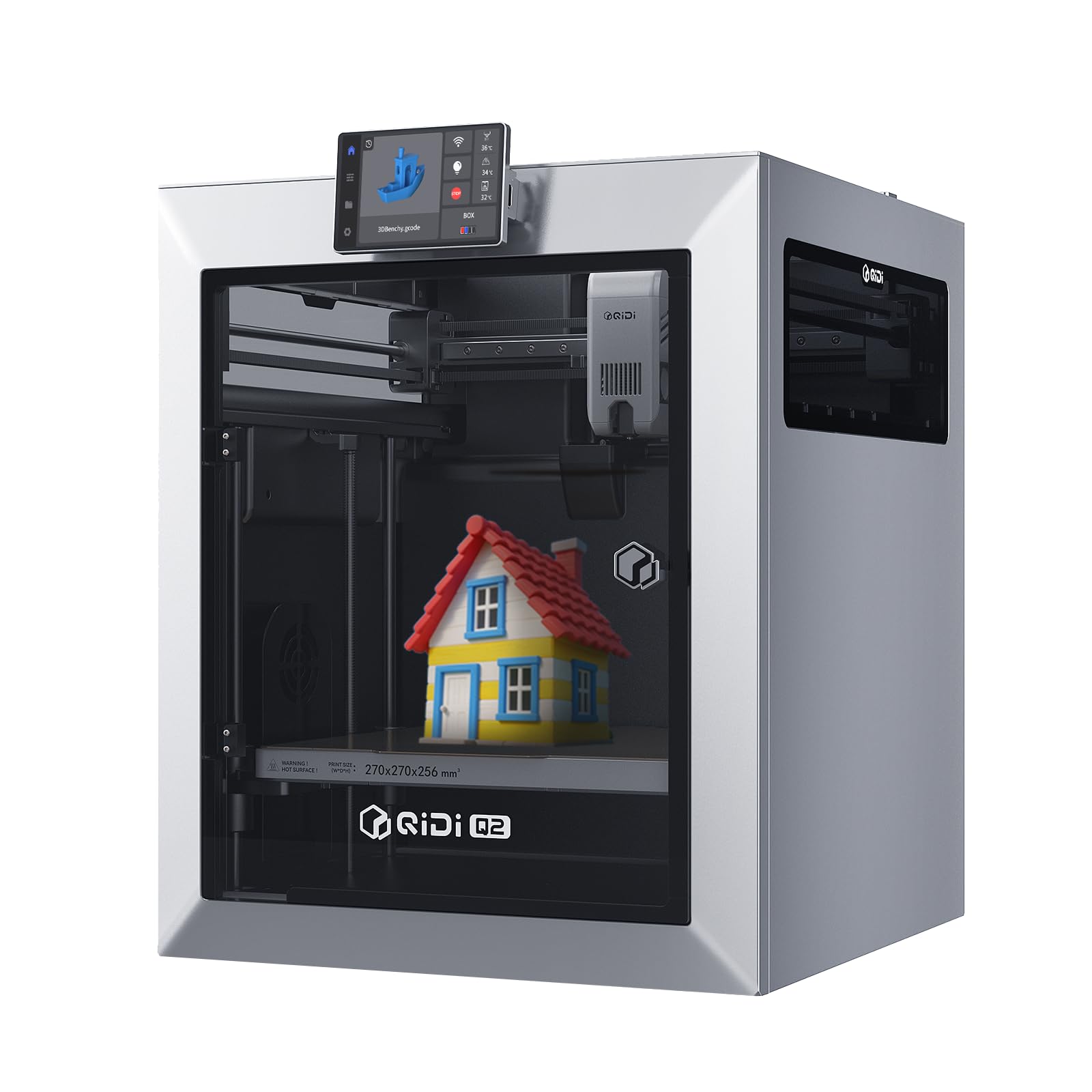
The QIDI Q2 uses the nozzle itself as the leveling sensor, which means the auto-leveling measures the exact point where filament will be deposited. This eliminates the Z-offset errors that can occur when a separate probe measures at a different physical location. The second-generation PTC heated chamber maintains a steady 65°C environment, reducing warp in ABS and nylon prints without requiring an additional enclosure.
The 1.5GT synchronous belt reduces vibration artifacts, producing surfaces that look injection-molded rather than layered. The triple filtration system (G3 pre-filter, H12 HEPA, activated carbon) makes it safe for indoor use with engineering materials. Users upgrading from the Q1 Pro report a 30% larger build volume, better chamber heating, and improved calibration consistency that reduces failed prints dramatically.
The Q2 supports up to 16-color multi-material printing with the optional QIDI BOX, which also includes dry-while-print technology to keep hygroscopic filaments stable. The combination of nozzle-touch leveling, consistent chamber temperature, and robust filtration makes the Q2 a top choice for users who print high-performance materials regularly.
Why it’s great
- Nozzle-touch sensor eliminates Z-offset guesswork.
- 65°C heated chamber ensures warp-free prints with high-temp materials.
- Triple filtration system reduces odor and particulates.
Good to know
- Some early firmware versions had UI language inconsistencies.
- Riser may be needed for brittle filaments to clear PTFE tube.
5. Anycubic Kobra X
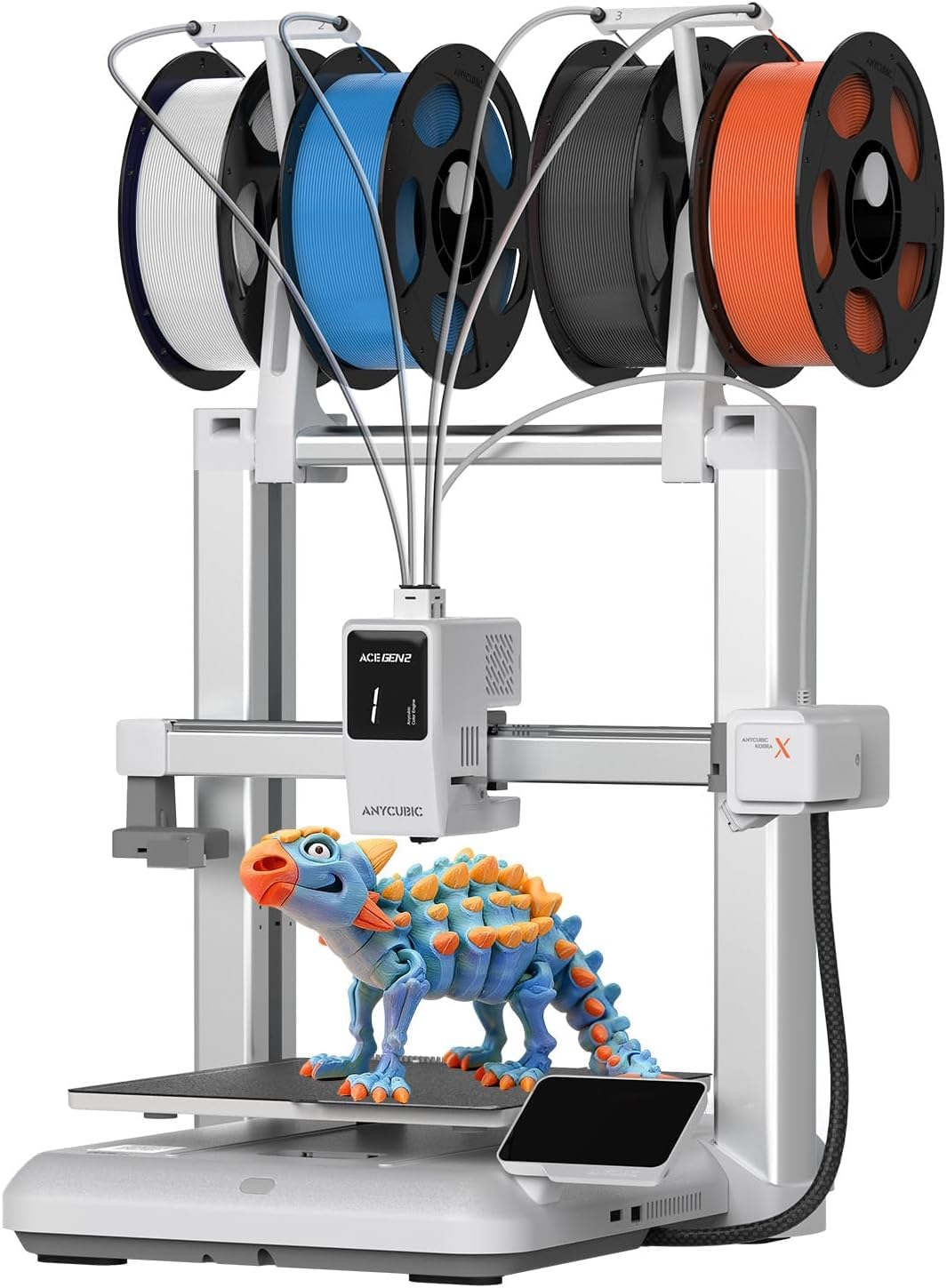
The Kobra X stands out by offering native 4-color printing without requiring a separate upgrade box. Its LeviQ 3.0 auto-leveling system uses a 49-point grid — the densest in this roundup — to map even subtle bed warps, ensuring that the first layer sticks across the full 260 mm³ build surface. The hardened steel nozzle and vibration compensation maintain quality at 600 mm/s.
The ACE 2 Pro system reduces purge waste by 81.25% compared to traditional multi-material units, cutting both material costs and print time. The top-mount spool holder frees up desk space, and the AI camera provides spaghetti detection and remote monitoring through the Anycubic app. Users report excellent results with PLA, PETG, and TPU, with zero adhesion issues over hundreds of hours of printing.
The Kobra X’s open software ecosystem works with standard slicers, avoiding the locked-in experience of proprietary platforms. It is a compelling choice for users who want vibrant multi-color models without spending on additional hardware or dealing with excessive filament waste.
Why it’s great
- Native 4-color printing with minimal purge waste.
- 49-point calibration grid captures complex bed warp.
- Open slicer compatibility avoids vendor lock-in.
Good to know
- ACE 2 Pro and ACE Pro are not interchangeable.
- Phone app could benefit from more UI polish.
6. FLASHFORGE Adventurer 5M

The Adventurer 5M packs a CoreXY motion system into a compact 14-inch footprint, making it one of the smallest high-speed printers on the market. Its one-click auto-leveling fully calibrates the bed in under a minute, and the vibration compensation eliminates ghosting even at the maximum 600 mm/s speed. The 50W heater brings the nozzle to 200°C in 35 seconds, reducing wait time between prints.
The direct-drive extruder produces a flow rate of 32 mm³/s, and the dual-sided PEI coating plate gives excellent adhesion for PLA, PETG, and TPU. Users consistently rate the setup experience as the fastest among entry-level machines, with many reporting their first successful print within 10 minutes of unboxing. The filament run-out sensor and power-loss recovery add an extra layer of reliability for long prints.
The build volume of 220 mm³ is the smallest in this lineup, which limits the size of single-piece prints but keeps the machine stable during rapid acceleration. The Adventurer 5M is the right choice for users with limited desk space who want CoreXY speed and automatic leveling without a large investment.
Why it’s great
- Very compact footprint for a CoreXY machine.
- Fast nozzle heating reduces overall print cycle time.
- One-click leveling is genuinely beginner-friendly.
Good to know
- Small build volume limits large single-part prints.
- Filament feed tube can cause tangles with sample spools.
7. Creality Ender-3 V3 KE

The Ender-3 V3 KE brings Creality’s CR Touch auto-leveling sensor to the classic Ender platform, offering multi-point calibration that eliminates the manual paper-leveling ritual. The Sprite direct extruder with a 60W ceramic heater reaches 300°C, making it capable of printing PETG, ABS, and TPU alongside standard PLA. The upgraded X-axis carriage with ball bearings ensures smooth, backlash-free motion.
With a maximum speed of 500 mm/s and acceleration of 8,000 mm/s², the V3 KE is significantly faster than previous Ender models. The firmware includes smart algorithms that mitigate ringing, though some users note that the stock fans are louder than average. The large modding community around the Ender platform means replacement parts and upgrades are widely available.
Setup takes about 10 minutes with the all-in-one design, though some units may require minor gantry squaring. The V3 KE is the strongest entry-level option for users who want the Ender ecosystem with modern auto-leveling and high-speed capability, accepting that some assembly quality control variability exists at this tier.
Why it’s great
- CR Touch sensor provides reliable multi-point auto-leveling.
- Sprite extruder handles a wide range of filaments up to 300°C.
- Massive aftermarket support and community resources.
Good to know
- Stock fans are louder than premium competitors.
- Some units require gantry adjustment out of the box.
8. Prusa MK4S
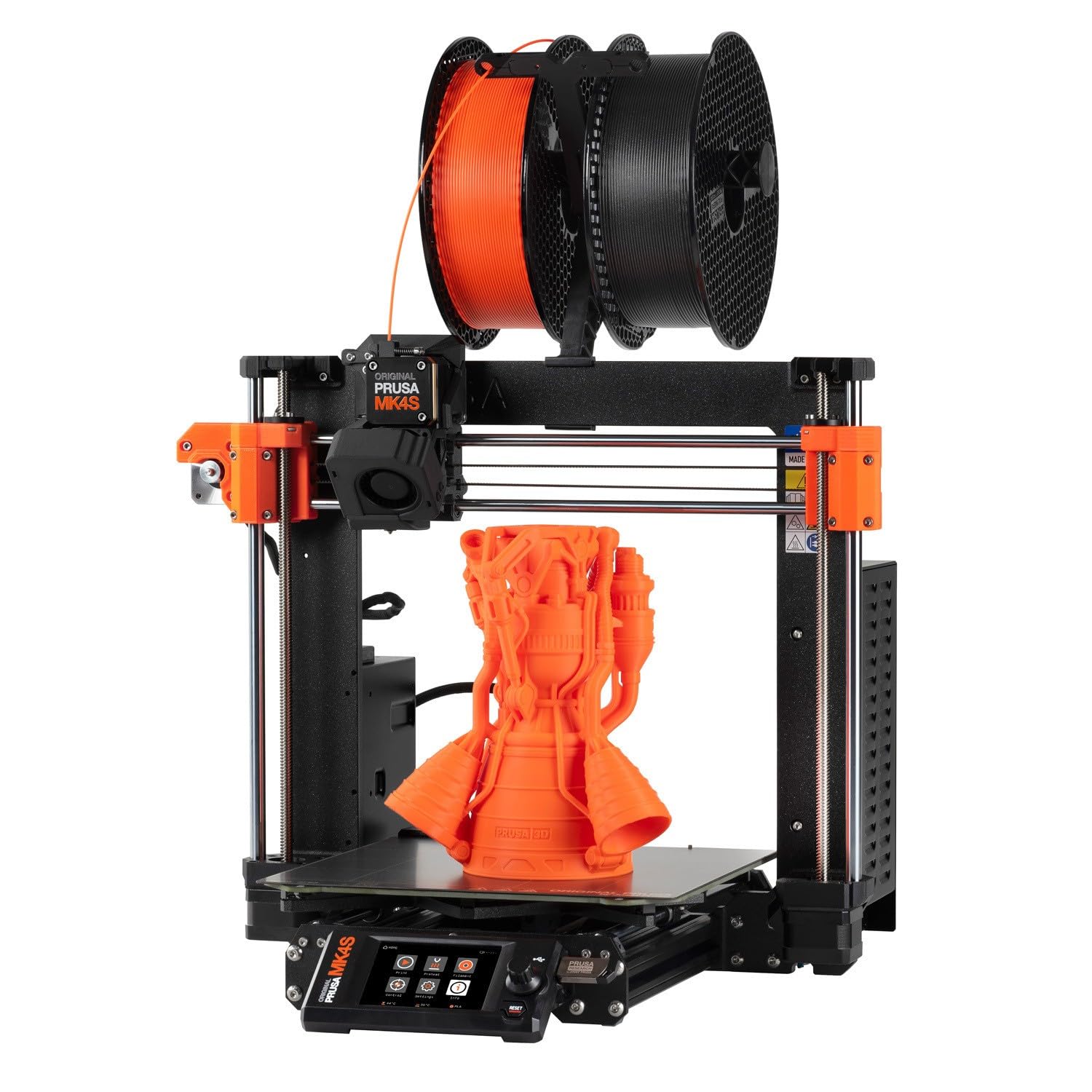
The Prusa MK4S uses a load cell sensor integrated into the hotend, which measures the actual force of the nozzle against the bed during calibration. This method is more accurate than inductive or capacitive probes because it directly measures the physical contact point. The input shaping firmware compensates for resonance, producing clean edges at higher speeds without the ghosting common on less rigid platforms.
The MK4S is built around reliability for production environments. The hotend, extruder, and motion system are designed for consistent day-to-day operation, and the open-source ecosystem allows full control over every parameter. Prusa Slicer profiles are pre-tuned for Prusament and third-party filaments, and the machine includes 1 kg of Prusament PLA Galaxy Black in the box. Users upgrading from older Prusa models report that the MK4S is noticeably faster and quieter.
The build volume of 250 x 210 x 220 mm is smaller than many CoreXY competitors, but the reliability and customer support from Prusa Research justify the higher cost for professionals who cannot afford downtime. The MK4S is the go-to choice for users who need a dependable workhorse for functional parts and prototyping.
Why it’s great
- Load cell-based leveling provides highly repeatable first layers.
- Open-source design allows full customization and long-term support.
- Professional-grade reliability for production environments.
Good to know
- Build volume is smaller than similarly priced CoreXY machines.
- Higher upfront cost compared to entry-level alternatives.
9. QIDI Max4 Combo
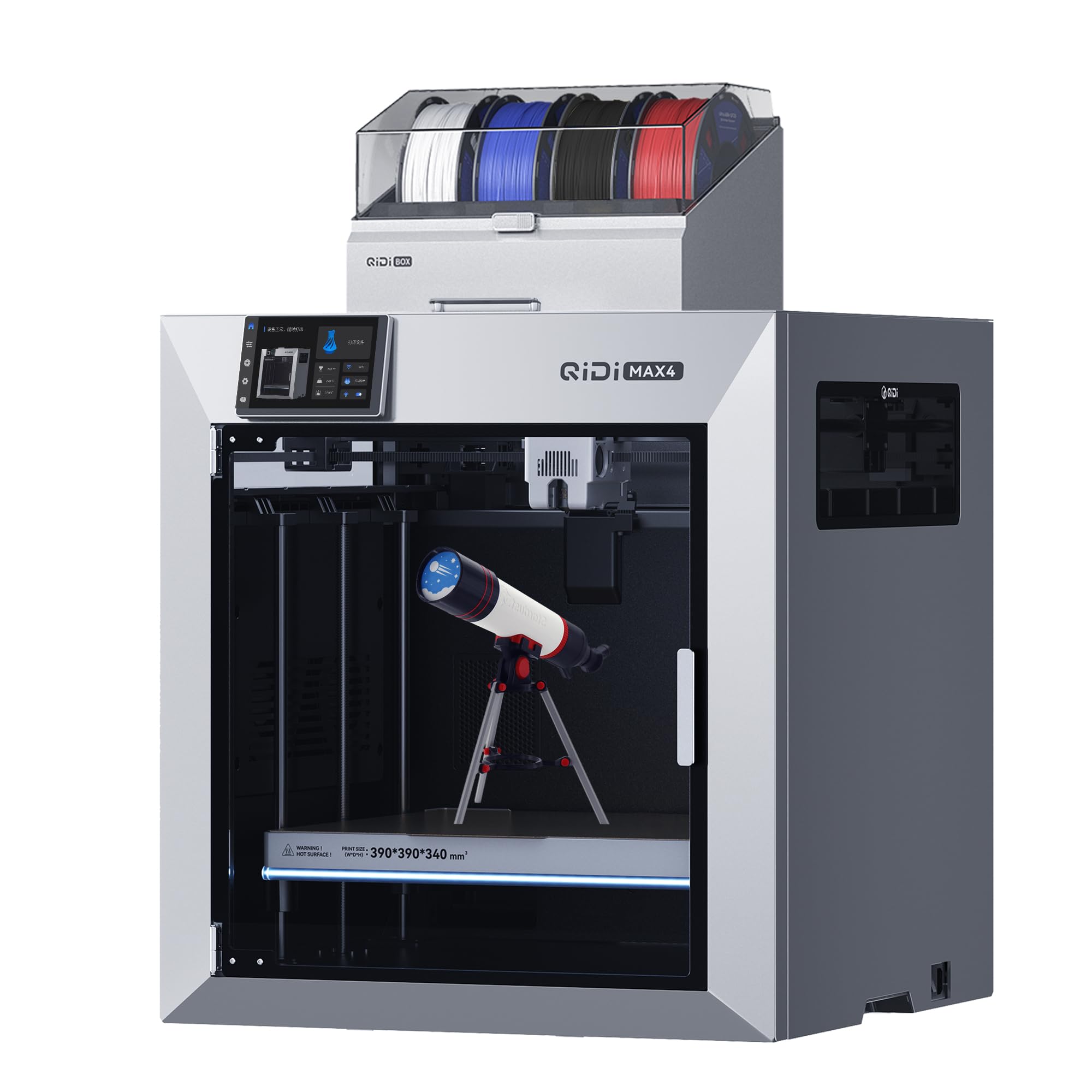
The QIDI Max4 Combo is designed for large-format industrial applications with a 390 x 390 x 340 mm build volume — 55% larger than its predecessor. The closed-loop motors on the X and Y axes ensure that the print head maintains accurate positioning even during rapid direction changes at 800 mm/s and 30,000 mm/s² acceleration. The 2 mm lead screw and anti-backlash nut on the Z-axis eliminate vertical play, producing surfaces with consistent layer lines.
The high-flow hotend delivers 40 mm³/s, and the hardened steel nozzle handles abrasive materials like carbon-fiber nylon and PPS-CF. The 65°C active heated chamber and Polar Cooler system create ideal conditions for high-temperature materials. The built-in AI camera detects failures like spaghetti and pauses printing automatically, and the QIDI BOX enables up to 16-color multi-material prints.
Users praise the Max4 for its ability to print large functional parts in engineering filaments without the warp that plagues smaller printers. The machine weighs 120 pounds and requires dedicated floor space, but for users who need to produce large, strong components, the Max4 Combo offers the highest capacity and material versatility in this lineup.
Why it’s great
- Massive build volume for industrial-scale parts.
- Closed-loop motors ensure accuracy at high speeds.
- Heated chamber supports high-temperature engineering materials.
Good to know
- Weight and size require dedicated workspace.
- Polar Cooler must be purchased separately.
FAQ
Does auto-leveling work on all print bed surfaces?
How often should I re-run auto-leveling?
Can I upgrade an older printer with an auto-leveling sensor?
Final Thoughts: The Verdict
For most users, the winner is the Bambu Lab A1 because its full-auto calibration, active flow rate compensation, and 10,000 mm/s² acceleration deliver perfect first layers with zero manual intervention. If you want an enclosed chamber for engineering materials and nozzle-touch leveling that never needs a separate Z-offset, grab the QIDI Q2. And for large-volume industrial parts that demand closed-loop motor accuracy and a 65°C chamber, nothing beats the QIDI Max4 Combo.