
Our readers keep the lights on and the weekend projects moving. As an Amazon Associate, I earn from qualifying purchases.
Jumping into resin 3D printing is an exercise in trust—trust that your printer will cure every layer without pulling the model off the build plate, trust that the screen resolution actually translates to smooth miniatures, and trust that the machine won’t introduce dimensional errors that ruin a 40-hour print run. This category demands a balance between XY resolution, light uniformity, and mechanical stability that no FDM printer can touch.
I’m Rikta — the founder and writer behind FitlyFast. Over the past decade, I’ve analyzed hundreds of desktop resin printers, comparing screen pixel density, release film durability, and real-world print success rates to separate marketing specs from proven hardware.
After sorting through the latest models, I settled on nine machines that define the current state of MSLA printing. Whether you are printing jewelry patterns or tabletop armies, this guide to the best 3d resin printer will help you choose a machine that delivers accurate layers every time you hit print.
How To Choose The Best 3D Resin Printer
Choosing a resin printer means matching your required detail level, build volume, and workflow speed to a specific screen technology and release system. Not every high-resolution screen produces reliable prints, and not every fast printer delivers consistent geometry. The following factors will help you filter the market to the right machine for your projects.
Screen Resolution and Pixel Size
The true measure of a resin printer’s detail is its XY pixel size. A 10K or 12K screen means little if the pixel pitch exceeds 20 microns—visible stepping on curved surfaces. Look for pixel sizes between 17 and 24 µm for smooth miniatures. Higher resolution screens also reduce the need for anti-aliasing in the slicer, preserving edge sharpness without post-processing.
Light Source Uniformity
COB (chip-on-board) light sources paired with Fresnel lenses deliver uniform UV light across the entire build area. A uniformity rate of 90% or higher prevents over-cured edges and under-cured centers. Without good light uniformity, even the highest-resolution screen will produce inconsistent layer adhesion and dimensional drift from the bottom to the top of a print.
Release Film and Peel Force
The film at the bottom of the resin vat determines how easily each cured layer releases from the screen. Standard FEP film creates high suction force, often pulling small features off the build plate. ACF (All-Cutter Fluoropolymer) film or tilt-release mechanisms drastically reduce peel force, allowing faster print speeds without losing adhesion on delicate supports.
Build Plate Leveling System
Manual leveling with a piece of paper works but adds a calibration step every time you change the vat or scrape off a print. Automatic leveling systems—either smart mechanical sensors or fixed build plates with pre-calibrated Z-stops—eliminate guesswork. The best systems detect residual resin on the screen and refuse to start if the plate isn’t clean, preventing LCD damage.
Quick Comparison
On smaller screens, swipe sideways to see the full table.
| Model | Category | Best For | Key Spec | Amazon |
|---|---|---|---|---|
| Anycubic Photon Mono 4 Ultra | Mid-Range | Balanced detail and speed | 17 x 17 µm XY resolution (10K) | Amazon |
| Elegoo Mars 5 Ultra | Mid-Range | Smart features & AI camera | 18 µm XY resolution (9K) | Amazon |
| Phrozen Sonic Mini 8K S | Mid-Range | Reliable beginner workhorse | 22 µm XY resolution (8K) | Amazon |
| Elegoo Saturn 3 12K | Mid-Range | Larger build volume value | 19 x 24 µm XY resolution (12K) | Amazon |
| Creality Halot-X1 Combo | Premium | Best screen durability & resin management | 14 x 19 µm XY resolution (16K) | Amazon |
| Creality Halot Mage S 14K | Premium | Fast 150mm/h with 14K quality | 16.8 x 24.8 µm XY resolution (14K) | Amazon |
| Anycubic Photon Mono M7 Pro | Premium | 170mm/h speed with auto-fill | 16.8 x 24.8 µm XY resolution (14K) | Amazon |
| Phrozen Sonic Mega 8K S | Premium | Industrial large-format production | 43 µm XY resolution (8K) | Amazon |
| TGM-7 Resin (5kg) | Material | Tough, durable miniatures | Flexural modulus 1500-2000 MPa | Amazon |
In‑Depth Reviews
1. Anycubic Photon Mono 4 Ultra 10K Resin 3D Printer

The Photon Mono 4 Ultra hits a sweet spot between resolution and speed that most printers in its class miss. The 10K screen delivers a 17 x 17 micron pixel pitch—one of the tightest XY resolutions available at this price—resulting in miniatures with no visible stepping even under direct light. The COB light source combined with Fresnel lenses achieves over 90% uniformity across the 7-inch mono LCD, so you get consistent layer curing from left edge to right edge.
The ACF release film is a genuine workflow upgrade. Unlike FEP films that require frequent tension adjustments, the ACF surface minimizes frosted texture and reduces peel force, allowing the printer to run at 120 mm/h without pulling models off supports. In real use, that speed held true for standard resin profiles with 0.05 mm layer height—meaning a 6-centimeter miniature finishes in under an hour.
Five intelligent inspections—resin residue detection, failed print detection, and lifespan management among them—catch common errors before they waste a whole build. The 4.3-inch touchscreen UI is responsive and supports eight languages, though the screen protector included in the box is tricky to install without trapping dust. Users consistently note strong resin odor, so an enclosure with active carbon filtration is recommended even if the lid seals better than entry-level printers.
Why it’s great
- Excellent 17 µm resolution captures fine detail on miniatures and jewelry
- ACF film reduces failures and allows reliable 120 mm/h printing
- Five automatic detection checks prevent wasted resin and print time
Good to know
- Screen protector installation requires patience to avoid bubbles
- Resin odor persists through the lid; ventilation or enclosure needed
2. Elegoo Mars 5 Ultra Resin 3D Printer
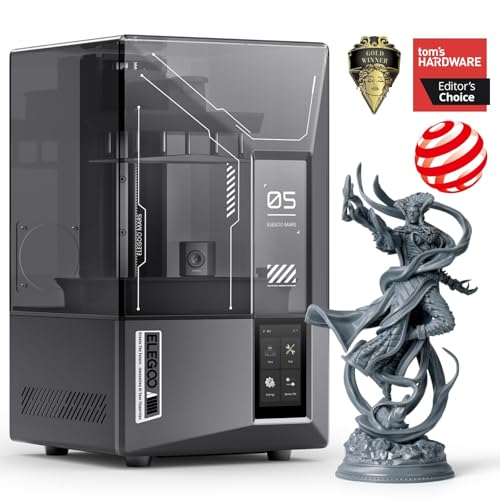
The Mars 5 Ultra stands out for its tilt-release technology—the vat tilts away from the build plate after each layer instead of lifting the entire plate. This design reduces peel force dramatically, allowing the printer to hit 150 mm/h without the layer-separation failures common to conventional Z-axis lift systems. The 7-inch mono LCD offers 18 µm XY resolution, slightly less dense than the Anycubic 4 Ultra but still sharp enough to render tiny armor rivets on 28 mm scale figures.
An onboard AI camera monitors each print in real time, alerting you if a model detaches from the supports or if the build plate is exposed. The detection is not perfect—camera resolution is modest and large prints can block the view—but it catches catastrophic failures early enough to save resin and time. With self-check diagnostics and automatic leveling, setup is genuinely plug-and-play. No paper-leveling ritual is needed.
Wi-Fi cluster printing is another differentiating feature: you can control multiple Mars 5 Ultras from a single device, which matters for small production studios running parallel builds. The lack of a hinged lid is a minor frustration, and the resin spout on the vat is rounded enough to drip between refills. Still, the tilt mechanism and AI sensing make this the most thoughtfully automated printer for the mid-range tier.
Why it’s great
- Tilt-release vat enables 150 mm/h with no layer separation
- AI camera catches failed prints before resin is wasted
- Automatic leveling and self-check make setup effortless
Good to know
- Camera can be obscured by tall or dense models
- Vat pouring spout design can be messy during resin changes
3. Phrozen Sonic Mini 8K S LCD Resin 3D Printer

The Sonic Mini 8K S is a no-frills printer that focuses on doing one thing reliably: printing high-quality 8K models every time. The 22 µm XY resolution is a step below the 10K/9K screens above, but in practice, the difference on tabletop miniatures is subtle—the real advantage here is the printer’s mechanical consistency. The precise Z-axis calibration maintains even layer height across the full 6.5 x 2.8 x 6.7 inch build volume, preventing the Z-layer wobble that ruins tall prints on less stable machines.
This printer uses a standard bottom-up FEP film vat instead of tilt-release or ACF film. That means print speeds cap at around 40-50 mm/h to avoid pulling models off supports, but the trade-off is a simpler vat design that is easier to clean and replace. Users report the build plate is slightly soft—a bent scraper can damage the surface—so use a plastic spatula and calibrate the Z offset carefully on the first setup.
One practical limitation is the lack of Wi-Fi: you must transfer sliced files via USB. For beginners who prefer a wired workflow, this reduces points of failure. The printer supports open-source slicers like Lychee, Chitubox, and Tango, so you are not locked into proprietary software. Customer support from Phrozen is responsive, and the unit is compact enough to fit on a standard desk shelf with ventilation.
Why it’s great
- Mechanical Z-axis stability produces even layers on tall models
- Compact footprint fits easily in ventilated enclosures
- Wide slicer compatibility with open-source software
Good to know
- Max recommended speed is lower due to standard FEP vat
- No Wi-Fi; requires USB for file transfer
4. Elegoo Saturn 3 MSLA 12K 3D Printer

The Saturn 3 12K offers the largest build volume at the most accessible price point among mid-range printers. The 10-inch mono LCD at 11520 x 5120 resolution produces 19 x 24 µm XY pixels—still very sharp for standard miniatures and terrain pieces. The COB light source with Fresnel collimating lens keeps light angle within 5° across the full surface, and users report consistent print quality from corner to corner without the light fall-off typical of older LED arrays.
Print speed is rated at 70 mm/h, which is moderate compared to newer tilt-release machines, but the advantage is a proven, stable printing process. The laser-carved build plate provides excellent first-layer adhesion, and the tempered glass screen protector (9H hardness) is a welcome addition for preventing LCD damage from resin leaks. Included Voxeldance Tango slicer is functional, though most users prefer to pair the printer with Chitubox or Lychee for better support generation.
The built-in air purifier helps control fumes, though active carbon filters need replacement every few weeks. A common complaint is the included USB drive: it is low-quality and prone to corruption, causing read errors mid-print. Swapping it for a name-brand drive solves the issue immediately. The 12K resolution makes the Saturn 3 a strong choice for wargaming terrain and large props where absolute smoothness matters less than build area.
Why it’s great
- 10-inch build volume fits large terrain in fewer batches
- COB Fresnel light delivers 90%+ uniformity across the plate
- Built-in air purifier reduces odor during long prints
Good to know
- Included USB drive is unreliable; replace before first use
- Speed maxes at 70 mm/h; slower than newer tilt systems
5. TGM-7 3D Printer Resin for Tabletop Miniatures (5kg)
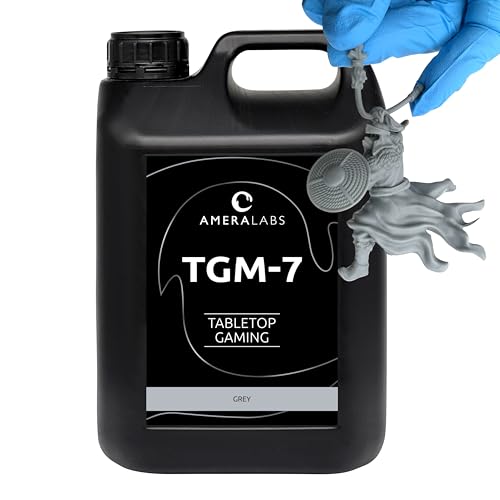
TGM-7 is not a printer—it is a photopolymer resin formulated specifically to solve the brittleness problem that plagues most standard resins. With a flexural modulus in the 1500-2000 MPa range, printed parts can bend slightly under stress rather than shatter. Tested across multiple printers (4K, 8K, and 12K screens), the resin holds fine details such as claws, antennae, and sword blades that typically snap off during support removal or tabletop play.
The resin cures to a satin finish that resembles injection-molded plastic, and the surface takes acrylic paint without primer. Post-curing requires longer UV exposure than standard clear or grey resins—about 3-5 minutes per side on a rotating turntable—but the resulting durability is worth the extra wait. The viscosity is thicker than average, so longer rest times (1-2 seconds after each layer) are recommended to let the resin settle before the next exposure.
The cost per kg is higher than standard resins, and the material is fussy with overhangs: unsupported islands cause failures if your slicer support density is too low. Two-stage cleaning (first a bath in dirty alcohol, then in clean alcohol) removes the waxy residue better than a single wash. For professional miniature makers who ship products or run long gaming sessions, the reduced breakage rate justifies the premium.
Why it’s great
- Exceptional impact resistance for delicate minis and thin parts
- Satin finish takes paint easily with no primer needed
- Consistent across different screen resolutions and printer brands
Good to know
- Higher viscosity requires longer rest times per layer
- Needs extended UV curing compared to standard resins
6. Creality Halot-X1 Combo Resin 3D Printer
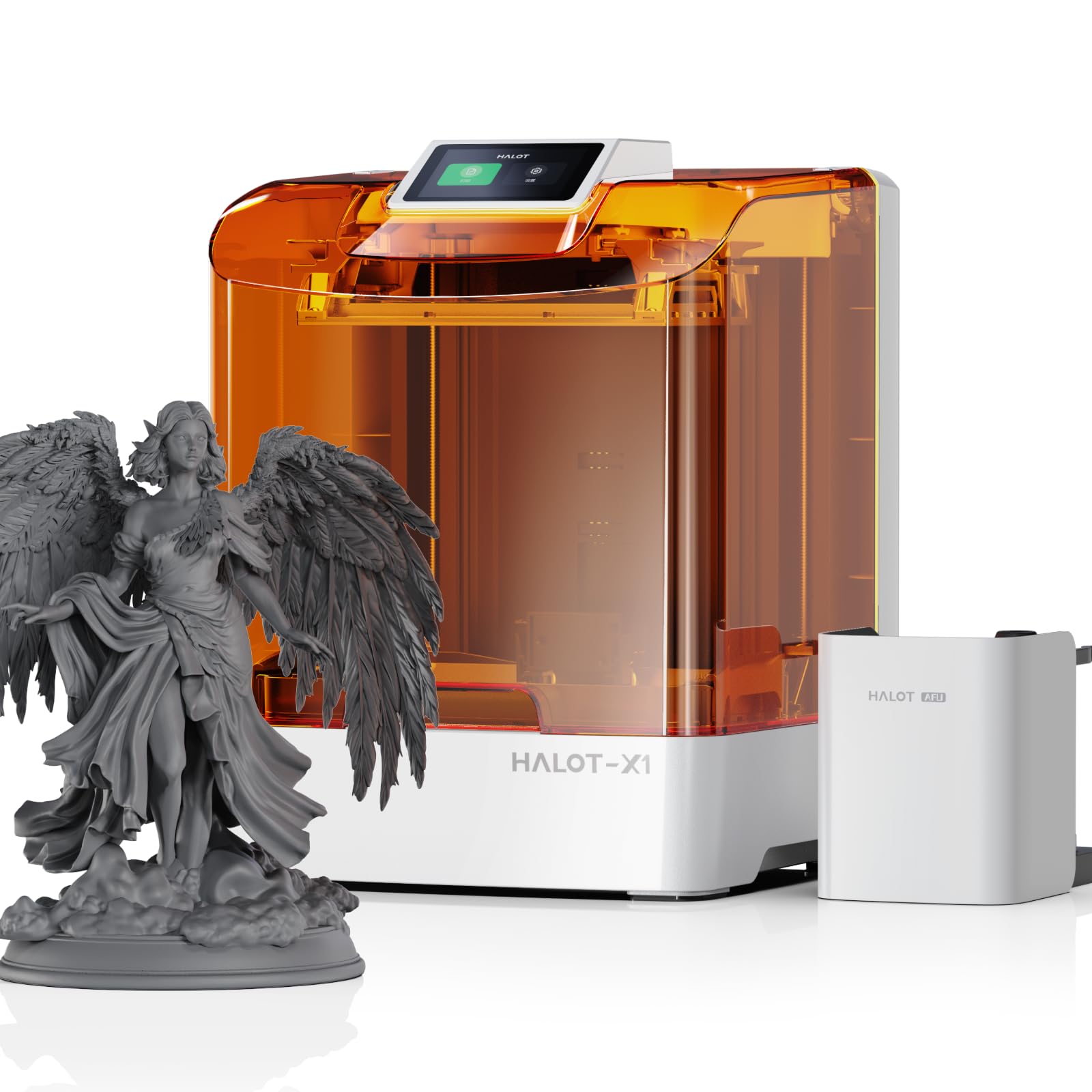
The Halot-X1 Combo sets a new ceiling for desktop MSLA with its 10.1-inch 16K mono LCD—15120 x 6230 resolution at 14 x 19 µm pixel pitch. Surface finish on test prints shows nearly no layering lines under 5x magnification, making it an ideal machine for jewelry masters and dental models where post-processing has to be minimal. The structural design eliminates traditional leveling: the build plate is fixed, and the optical module moves vertically on twin lead screws with 0.01 mm positioning precision.
The intelligent AFU resin management system is the standout feature. It heats resin to 30-45°C within three minutes, reducing viscosity for better flow in cold workshops. RFID tag recognition automatically loads resin parameters; laser detection monitors how much resin is left and can recycle leftover material from previous prints. The 92 independent UV light zones activate only where the model geometry requires exposure, reducing screen wear and light bleed around fine features.
Speed reaches 170 mm/h with the top-down optical system—the build plate stays still while the vat and light module move. This reduces the mass that must accelerate each layer, enabling faster cycle times. The twist-to-release build plate removes models without scraping, and the high-temp NACF release film lasts significantly longer than standard FEP. The proprietary Halot Box slicer works well with the printer, but users report occasional software crashes that require file re-slicing. Creality’s support responsiveness on software issues has been inconsistent.
Why it’s great
- 16K resolution with 14 µm pixels delivers jewelry-grade surface finish
- Heated resin vat and RFID parameter loading reduce failed prints
- Fixed build plate design removes leveling step entirely
Good to know
- Proprietary slicer software can be unstable; occasional crashes reported
- Premium build comes with a higher entry investment
7. Creality Halot Mage S 14K Resin 3D Printer

The Halot Mage S 14K drops the resin management system of the X1 but keeps a 10.1-inch display at 13320 x 5120 resolution (16.8 x 24.8 µm). The key differentiator is the Dynax+ speed mode: a closed-loop motor combined with dual linear rails allows the build plate to rise and lower at 150 mm/h without introducing Z-band artifacts. A 15-centimeter model that would take over two hours on a standard FEP printer finishes in just over an hour here.
The third-generation integral light source uses a refined COB array with a new lens design that maintains uniformity across the larger 8.78 x 4.96 x 9.06 inch build volume. Print adhesion is handled by a laser-carved build plate with a wire-drawn surface that offers 2.25 times the friction of smooth plates, reducing the need for heavy rafts. The three-layer Pictor speed-release film reduces peel force by 35% compared to standard FEP, supporting the claim that faster speeds do not require more supports.
The smart HALOT OS supports remote printing from phone or PC via the Creality Cloud platform. An included air purifier with activated carbon helps manage odor, though the filter needs replacing monthly with regular use. Users who print small objects and miniatures report excellent consistency over four months of use, but a few units developed screen spotting after six months. Screen replacement costs approach the price of a mid-range printer, so buying an extended warranty or extra screen protector is advisable.
Why it’s great
- Dynax+ mode cuts print time dramatically without quality loss
- Integrated light source 3.0 provides excellent UV uniformity
- Laser-carved build plate eliminates first-layer adhesion issues
Good to know
- Screen replacement cost is high relative to printer price
- Creality Cloud subscription status affected early shipping promotions
8. Anycubic Photon Mono M7 Pro 14K Resin 3D Printer

The Photon Mono M7 Pro is Anycubic’s answer to production-scale resin printing, combining a 14K 10.1-inch screen (13312 x 5120, 16.8 x 24.8 µm) with a heated automatic resin vat and auto-fill system that pumps material directly from the bottle. The COB LighTurbo 3.0 source includes front-facing reflectors that keep light angle within 3° and uniformity above 90%, translating to clean layer boundaries even at 170 mm/h printing speeds.
The dynamic temperature-controlled vat maintains the resin at optimal viscosity throughout the print, which is especially useful for high-speed profiles that require low-viscosity material. The resin auto-fill mechanism works well with a one-key recycling feature for unused material, though some units arrive with a non-functioning feeder that requires support intervention. When it works, it eliminates the need to pause prints to refill the vat during long runs.
Six intelligent detection systems—including build plate installation detection and release film lifespan management—give the printer a self-diagnostic layer that reduces user error. The print quality out of the box is excellent, but long-term reliability is inconsistent: some users report 100% failure rates after several months due to a broken print bed gear from leveling errors or false sensor warnings. The power button is also prone to failure in heavy-use environments. For the speed and build envelope, the M7 Pro is a strong tool, but its long-term durability is a gamble worth considering.
Why it’s great
- Heated vat and auto-fill reduce manual intervention for long prints
- COB LighTurbo 3.0 achieves <3° light angle for sharp layer edges
- Large 8.77 x 4.96 x 9.05 build volume for production batches
Good to know
- Auto-fill mechanism may malfunction on some units
- Long-term reliability has mixed user reports; consider extended warranty
9. Phrozen Sonic Mega 8K S LCD/MSLA Resin 3D Printer

The Sonic Mega 8K S is the largest desktop resin printer in this list, built for volume production of large objects or high-count batches of miniatures. The 15-inch 8K mono LCD delivers 43 µm XY resolution—lower than every other printer here—but the trade-off is a build area of 330 x 185 x 300 mm that can fit 80 1/32 scale miniatures in a single run. For casters, dental labs, and prop makers who need throughput over surface micro-detail, this is the only viable option.
Phrozen’s integration of ACF film and the option to use TR300 high-speed resin pushes print speed up to 10 times faster than standard mid-size printers. In practice, a full plate of 80 minis takes around 90 minutes, which is genuinely transformative for production schedules. The lift-up lid reduces vertical clearance needs, making it easier to fit into shelving units, and the built-in metal drip hanger lets excess resin drain back into the vat after printing—reducing material waste significantly.
The build plate has holes for structural reasons, which prevents the use of magnetic flex plates. Auto-refill works but some users found the mechanism inconsistent. The LCD ribbon cable is fragile; moving the printer or opening the base requires caution. When the machine works, it is quiet and reliable with excellent print fidelity at its resolution tier. When it fails—ribbon cable issues, PSU voltage problems—support turnaround can stretch to six weeks. For production studios, this is either an essential tool or a risky purchase depending on your tolerance for downtime.
Why it’s great
- Gigantic 33 x 18.5 cm build plate for large-scale batch production
- ACF film + TR300 resin enables 90-minute plates of 80 miniatures
- Lift-up lid and drip hanger save space and reduce resin waste
Good to know
- 43 µm resolution is lower than desktop alternatives; not for micro-detail work
- Fragile LCD ribbon cable and long warranty support times are concerns
FAQ
What layer height should I use for detailed miniatures?
How long do mono LCD screens typically last?
Do I need an enclosure for a resin printer?
Can I use any resin with any printer?
What causes prints to detach from the build plate?
Final Thoughts: The Verdict
For most users, the best 3d resin printer winner is the Anycubic Photon Mono 4 Ultra because it combines a genuine 17 µm pixel size, ACF release film, and intelligent detection at a price that does not force trade-offs on resolution or speed. If you want automated features like AI failure detection and tilt-release speed, grab the Elegoo Mars 5 Ultra. And for production-scale batch printing, nothing beats the Phrozen Sonic Mega 8K S.