
Our readers keep the lights on and the weekend projects moving. As an Amazon Associate, I earn from qualifying purchases.
You’ve dialed in your printer, mastered retraction settings, and still waste hours modeling simple parts from scratch. That gap between what you imagine and what you can model is precisely what the best 3D scanner for 3D printing eliminates — it captures real geometry in minutes and sends watertight STL files straight to your slicer.
I’m Rikta — the co-founder and writer behind FitlyFast. I spend my weeks cross-referencing point-cloud resolution specs, structured-light frequencies, and software export fidelity to separate production-ready scanners from toys.
This guide ranks eleven models by accuracy, workflow speed, and real-world surface handling so you can confidently pick the 3d scanner for 3d printing that matches your skill level and project scale.
How To Choose The Best 3D Scanner For 3D Printing
Picking the right scanner hinges on three factors: the size of objects you scan most, the surface reflectivity you deal with, and your tolerance for post-processing cleanup. A scanner that nails 0.02 mm accuracy on a matte plastic part may fail entirely on a polished engine block. Match the technology to your material reality.
Accuracy, Precision, and Point Distance
Accuracy (how close the model matches real dimensions) and precision (repeatability between scans) are not the same. Look for single-shot accuracy figures under 0.05 mm for engineering fits. Point distance — the spacing between measured points — determines resolution: 0.1 mm is fine for general parts, 0.05 mm or lower captures threads and embossed text.
Structured Light vs. Blue Laser Technology
Structured light (infrared or blue LED) excels on medium objects indoors, but struggles with sunlight and glossy finishes. Blue laser scanners cut through shiny and dark surfaces without spray, making them ideal for automotive components and reflective plastics. Dual-mode units give you both, but at a higher cost.
Software Ecosystem and Export Formats
A scanner is only as good as its mesh generation. Check that bundled software exports OBJ, STL, PLY, and 3MF directly. Proprietary paid modules (like Revo Design or Geomagic) add scan-to-CAD workflows but may be Windows-only. Mac users should verify full native support before buying — some premium scanners still lack stable macOS drivers.
Quick Comparison
On smaller screens, swipe sideways to see the full table.
| Model | Category | Best For | Key Spec | Amazon |
|---|---|---|---|---|
| Einstar Vega | Wireless All-in-One | Standalone outdoor scanning | 0.1 mm point distance | Amazon |
| Revopoint MIRACO Plus | All-in-One Portable | On-site photogrammetry | 0.02 mm + 0.05 mm/m accuracy | Amazon |
| Revopoint MetroY Pro | Industrial Blue Laser | Production-grade reverse engineering | 0.01 mm precision | Amazon |
| Creality Sermoon S1 | Pro Blue Laser | Large-scale engineering parts | 0.02 mm accuracy | Amazon |
| Revopoint MetroY | Industrial Blue Laser | Detailed metrology work | 0.01 mm precision | Amazon |
| EinScan SE v2 | Desktop Fixed | High-detail miniature scanning | 0.1 mm accuracy | Amazon |
| Einstar Pro | Handheld Structured Light | Medium-object color capture | 0.1 mm point distance | Amazon |
| Shining 3D Einstar | Handheld Structured Light | Hobbyist automotive & body scanning | 0.1 mm point distance | Amazon |
| Revopoint INSPIRE 2 Premium | Dual-Mode Wireless | Outdoor & multi-surface scanning | 0.03 mm precision | Amazon |
| Revopoint INSPIRE 2 Standard | Dual-Mode Wireless | Beginner-friendly color scanning | 0.03 mm precision | Amazon |
| 3DMakerpro Seal Lite | Budget Small-Format | Entry-level small objects | 0.02 mm accuracy | Amazon |
In‑Depth Reviews
1. Shining 3D Einstar Vega Wireless 3D Scanner

The Einstar Vega is a standalone powerhouse that removes the single biggest pain point of 3D scanning: being tethered to a PC. Its built-in 8-core CPU, 32 GB RAM, and 512 GB SSD let you scan, process, and store data entirely on the device. The 6.4-inch 2K AMOLED display gives you a live preview, and wireless transfer via Shining 3D Cloud means you can share projects without USB cables.
It uses dual scanning technologies — VCSEL for fast long-range (270-1500 mm) scanning at up to 20 FPS, and MEMS for high-detail short-range (100-350 mm) work at up to 15 FPS. The infrared light source handles dark surfaces and direct sunlight reliably, and the 48 MP RGB camera captures full color. Battery life exceeds one hour of continuous use, and it accepts power bank input for extended sessions.
Some users reported software bugs with StarView file transfers over USB 3.2, and the unit struggles with small, transparent, and highly reflective objects despite its advanced hardware. Marker-free tracking works well on feature-rich surfaces, but plain or curving geometry still benefits from adhesive dots. For professionals who need portable, cable-free scanning with zero laptop dependency, the Vega delivers a premium all-in-one experience.
Why it’s great
- Fully standalone operation — no computer required during capture.
- Dual VCSEL/MEMS scanning covers small to large objects efficiently.
Good to know
- Software bugginess with file transfers on certain USB configurations.
- Struggles with shiny, transparent, and small objects without spray or dots.
2. Revopoint MIRACO Plus 3D Scanner

The MIRACO Plus is the only consumer-accessible scanner with integrated photogrammetric metrology, using four carbon fiber scale bars and coded targets to achieve length accuracy of 0.02 mm + 0.05 mm per meter. This makes it a unique tool for large-object scanning where absolute dimensional fidelity matters more than raw point density. The quad depth camera system switches between Near mode for tiny threads and Far mode for machinery up to several meters.
Its 8-core 2.4 GHz processor and 32 GB RAM handle up to 10,000 frames onboard, and the 6-inch 2K AMOLED flip screen gives you a clear view from any angle. The infrared optical zoom (1.5x and 2x) reduces noise on complex surfaces, and Class 1 infrared laser allows direct face scanning without safety concerns. The 750-gram body is comfortable for one-handed use, and 65W fast charging reaches 80 percent in 35 minutes.
Battery life falls short of the claimed 2.5 hours — real-world continuous scanning drains it in about 90 minutes, especially with the flash LEDs active. macOS users have reported the device not appearing over USB on M1 MacBooks, requiring a specific older RevoScan version as a workaround. The photogrammetry kit adds weight to the carry case, but for dimensional-critical industrial projects, this is the only all-in-one that combines photogrammetry and structured light in a single device.
Why it’s great
- Built-in photogrammetry for high-accuracy large-object scanning.
- Fast 65W charging and fully portable standalone operation.
Good to know
- USB connectivity issues on some Mac configurations.
- Battery life below advertised duration when using LED flash.
3. Revopoint MetroY Pro 3D Scanner
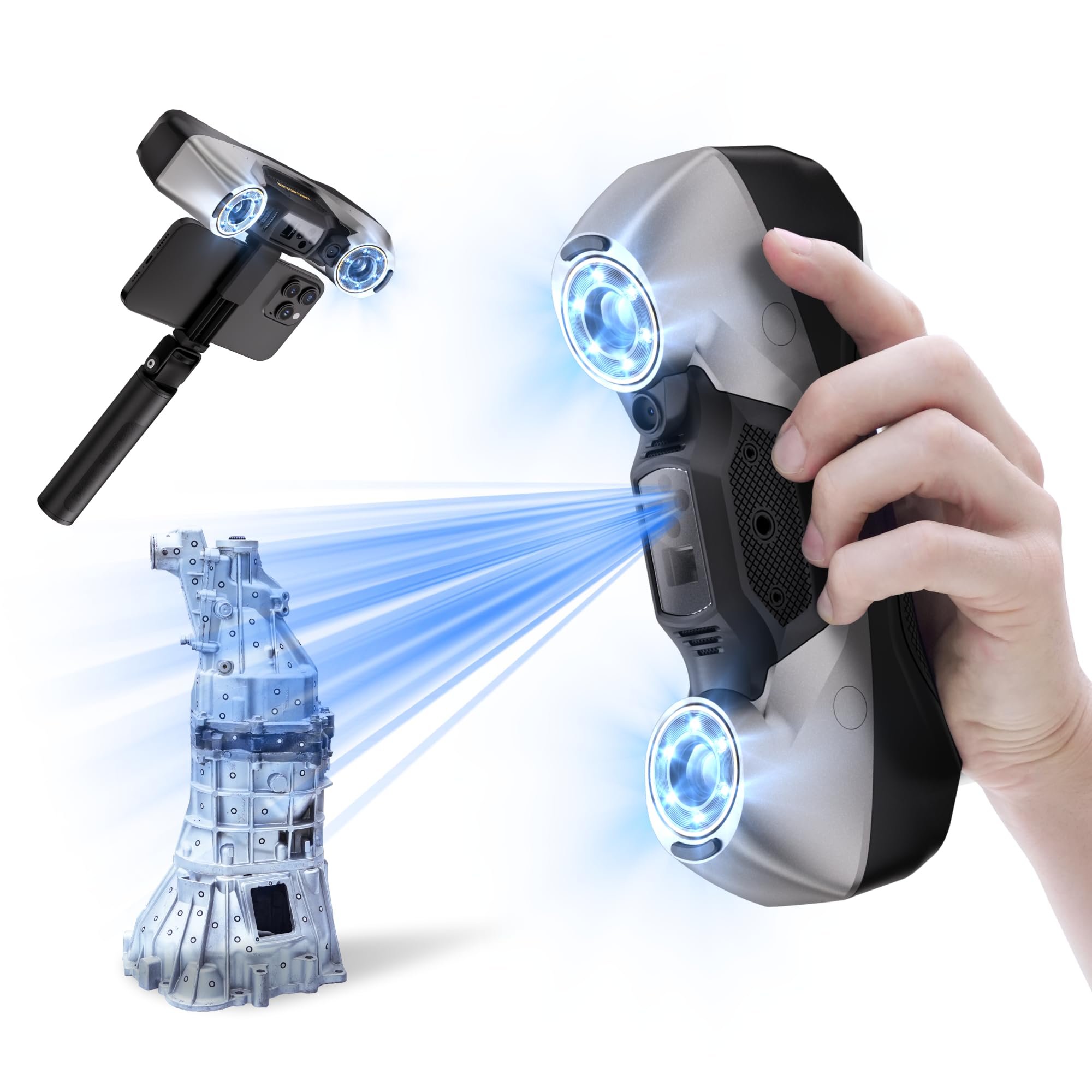
The MetroY Pro is the most feature-complete blue laser scanner under two thousand dollars. It packs five scanning modes: 34 cross-lines for surface capture, 15 parallel lines for detail, single-line deep-hole scanning, a 62-line full-field blue structured light mode for marker-free capture at up to 7 million points per second, and auto turntable mode. The 0.01 mm precision and 0.02 mm accuracy figures are backed by real volumetric accuracy of 0.02 mm + 0.04 mm per meter.
No scanning spray is needed in any laser mode, and the scanner handles shiny and dark materials directly. The built-in Wi-Fi 6 enables wireless PC connection and screen-casting to a phone or tablet for live monitoring. Real-time temperature sensors adjust fan speed to prevent accuracy drift during long sessions. The auto turntable mode is genuinely one-click — place the object, press start, and the scanner rotates and captures automatically.
The software suite (Revo Metro free, Revo Design and Revo Measure paid) is Windows-only and crashes on M-series Macs; wireless streaming is not supported on macOS at all. Some users report scan speed is slower than competing brands when stitching detailed surfaces, and the included USB cable can fail out of box. The learning curve for mode selection is steep — but for engineers who need industrial-grade blue laser data without paying five figures, this is the benchmark unit.
Why it’s great
- 62-line full-field mode enables marker-free ultra-fast scanning.
- Five scanning modes cover everything from deep holes to large surfaces.
Good to know
- No stable macOS support — effectively Windows-only for full functionality.
- Scan stitching speed lags behind some similarly priced competitors.
4. Creality Sermoon S1 3D Scanner
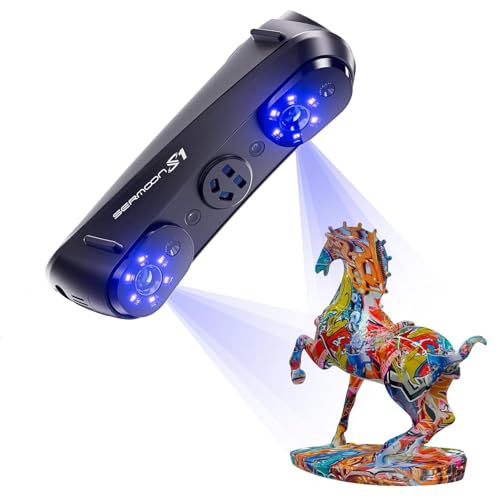
The Sermoon S1 is Creality’s answer to the professional blue laser market, offering an ultra-wide scanning range from 5 mm to 4,000 mm with a single device. This covers everything from tiny jewelry details to full automotive panels, eliminating the need for multiple specialty scanners. The triple blue laser system switches between 34 crossed lines for large objects, 7 parallel lines for detail, and single-line mode for deep holes and grooves.
Accuracy is rated at 0.02 mm with 0.08 mm per meter volumetric precision, and the 4-lens stereo vision system supports efficient marker-free tracking on feature-rich geometry. The 90 FPS capture rate is one of the fastest in its class, reducing scan time on large datasets. AI-assisted processing within the bundled software simplifies alignment and mesh cleanup, directly exporting to CAD and CAM workflows.
Reviewed user feedback is almost exclusively from marker accessories rather than the scanner itself, making long-term reliability data sparse. The 6.29-pound unit is heavier than handheld competitors like the MetroY Pro, and the learning curve for mode selection and optimal distance is significant. Marker-free tracking can still lose lock on plain or symmetrical surfaces, and the software is still maturing compared to established brands. For Creality loyalists with a mix of small and large projects, the Sermoon S1 delivers broad envelope coverage at a competitive spec sheet.
Why it’s great
- Unmatched 5 mm to 4,000 mm scanning range in a single device.
- 90 FPS capture rate speeds up large-part data collection.
Good to know
- Heavier than pure handheld competitors at over 6 pounds.
- Limited long-term user reviews — software ecosystem still maturing.
5. Revopoint MetroY 3D Scanner
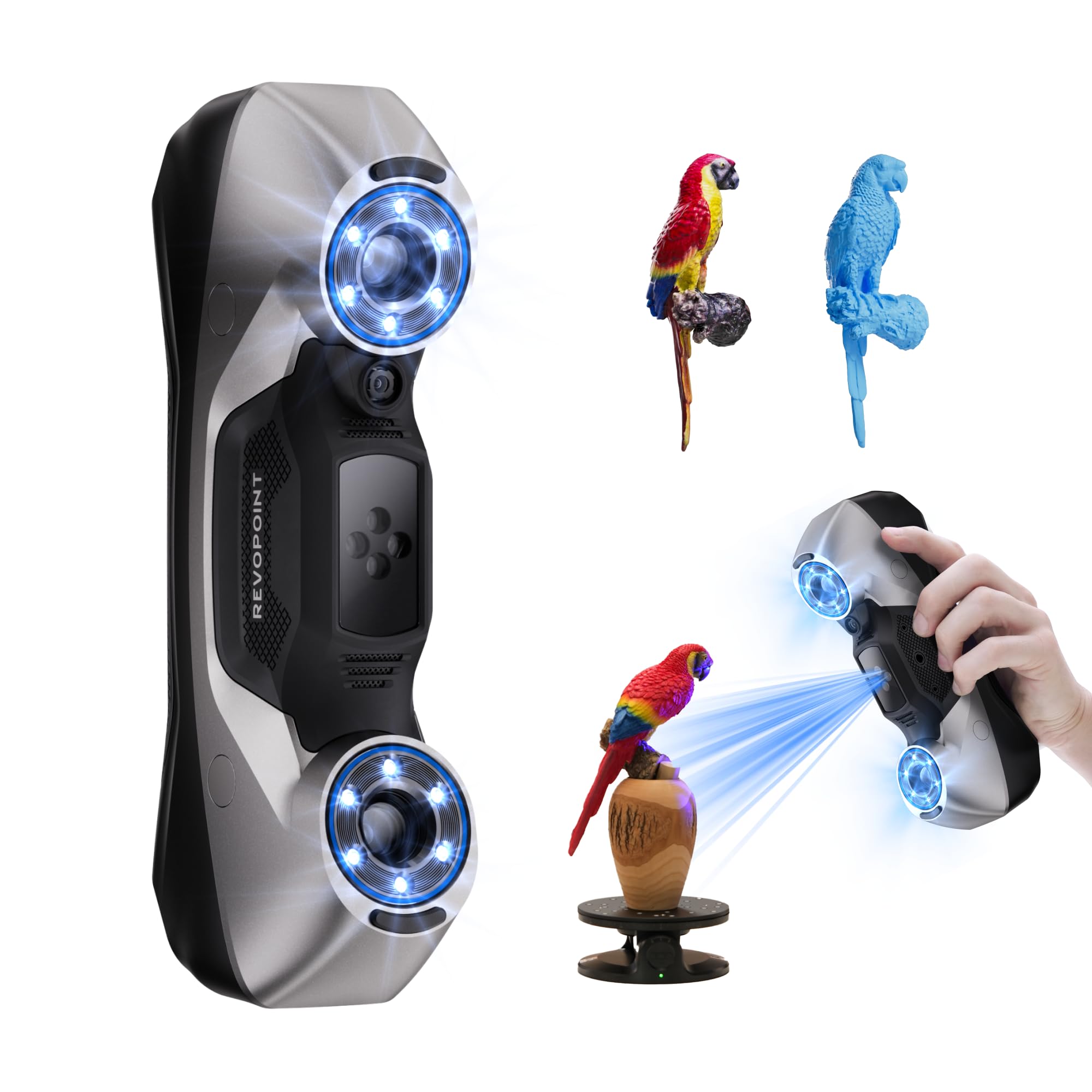
The standard MetroY retains the same 0.01 mm precision and 0.02 mm accuracy as the Pro version but with three scanning modes instead of five: 30 cross-laser lines for surface capture, 15 parallel lines for detail, and single-line deep-hole mode. It reaches up to 1.5 million points per second — enough for most reverse engineering tasks. The blue laser technology scans shiny and dark surfaces without spray, a genuine time saver for automotive and mechanical parts.
Wi-Fi 6 connectivity eliminates the USB cable during scanning, and real-time temperature monitoring prevents accuracy drift. The high-precision lithography calibration board offers 10-micron accuracy for consistent results. Users report excellent capture of fine textures (leather grain, machined surfaces) at about 60 FPS, with auto turntable sync enabling hands-free operation for small objects.
Mac compatibility is limited — Revo Metro crashes on M-series processors after a few minutes, and wireless streaming is unsupported on macOS. The software still has bugs in fusion and alignment workflows, and the included USB cable has shown intermittent connectivity failures. For Windows-based shops needing industrial-grade accuracy without the full-field mode of the Pro, the standard MetroY delivers the same core precision at a lower entry point.
Why it’s great
- Industrial-grade 0.01 mm precision at a mid-range price point.
- No scanning spray needed on shiny or dark surfaces in any mode.
Good to know
- Mac compatibility is severely limited — crashes on Apple Silicon.
- USB cable quality inconsistent; replacement may be needed.
6. EinScan SE Desktop 3D Scanner v2

The EinScan SE v2 is a desktop fixed-scanner built for precision miniature work rather than handheld flexibility. It offers two modes: Auto Scan captures objects in seconds at 0.1 mm accuracy, while Fixed Scan lets you slowly rotate small parts for maximum detail. The 0.17-0.2 mm point distance is coarser than blue laser alternatives, but the structured light source produces clean, watertight meshes for 3D printing without heavy cleanup.
Setup is genuinely beginner-friendly — automatic calibration eliminates manual adjustment, and the included ExScan software guides scanning, hole-filling, and mesh sharpening in a linear workflow. It handles objects as small as 30 mm in Auto Scan mode, making it ideal for miniatures, jewelry masters, and dental models. Direct upload to Sketchfab and 3D printer slicing software streamlines the pipeline from scan to print.
Lighting is critical — shiny and transparent objects cause data dropout, and outdoor use is not practical. Some units arrived with signs of prior use (debris in packaging), and a small number of users reported the scanner randomly shutting off after two days of operation. The fixed turntable setup also limits object size to roughly 200 mm diameter. For makers who primarily scan small, matte objects and want a reliable, low-fuss desktop station, the EinScan SE v2 is a proven workhorse.
Why it’s great
- Automatic calibration and one-click scanning for true plug-and-play.
- Excellent for sub-200 mm matte objects with clean watertight meshes.
Good to know
- Requires controlled indoor lighting; fails on shiny and glass surfaces.
- Some units arrived with quality control issues like random shutdowns.
7. EINSTAR Pro Handheld 3D Scanner

The Einstar Pro uses infrared VCSEL structured light with a built-in RGB camera for accurate full-color texture capture, making it a strong choice for cultural heritage, product design, and digital archiving where color fidelity matters as much as geometry. The 0.1 mm point distance is sufficient for medium-to-large objects, and the lightweight 1.1-pound body allows extended handheld use without fatigue.
The EXstar software includes automatic alignment and smart tracking, with data quality indicators that guide you toward cleaner captures. It exports OBJ, STL, PLY, ASC, and 3MF formats, ensuring broad compatibility with 3D printing slicers and CAD software. Users consistently praise the software’s polish relative to first-generation handheld scanners, and the price-to-performance ratio beats many older structured light units.
Small objects with simple geometry challenge the system — it loses tracking on featureless surfaces and requires a turntable or tracking dots for reliable results. System requirements are demanding: a high-end GPU and 32 GB of RAM are necessary for smooth operation. A few users experienced hardware failure out of box, and the ergonomics of the handheld design feel awkward during long sessions. For color-rich scanning of items the size of a shoe box or larger, the Einstar Pro delivers vibrant, geometry-accurate models.
Why it’s great
- Excellent full-color texture capture with built-in RGB camera.
- Lightweight design and polished software for medium object scanning.
Good to know
- Struggles with small, featureless objects without tracking aids.
- Demands a high-spec PC for smooth real-time tracking.
8. Shining 3D Einstar Handheld 3D Scanner
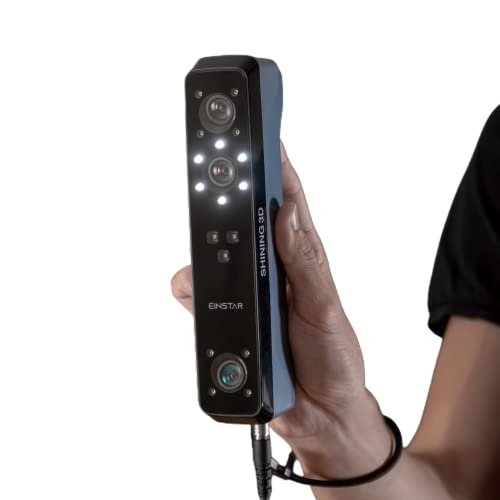
The original Einstar remains one of the most popular consumer-grade handheld scanners because it combines infrared VCSEL structured light with a dedicated “Hair Mode” for full-head human scanning. The three infrared projectors, two stereo depth cameras, and one RGB camera work together to capture high-density point clouds at 0.1 mm point distance, scanning at up to 14 FPS. Outdoor performance is stable in shaded conditions, and the single USB cable handles both power and data.
Tracking is remarkably robust — users report scanning dark gray automotive bumpers with tracking dots in poor lighting and getting professional-quality results comparable to scanners costing ten times more. The bundled EXstar software provides automatic alignment and data quality indicators. It exports to OBJ, STL, PLY, ASC, 3MF, and P3 formats, giving broad workflow flexibility for 3D printing and design.
The learning curve for optimal distance and movement speed is real — beginners often lose tracking on large flat surfaces until they learn to use tracking dots. The unit’s ergonomics are awkward (no tripod mount, forced hand position), and some units shipped with defective fans that fortunately didn’t affect performance. It struggles with shiny and transparent objects without spray. For the price, the Einstar is still the benchmark hobbyist tool under one thousand dollars, especially for automotive parts and human body scanning.
Why it’s great
- Robust tracking even on dark surfaces with minimal prep.
- Dedicated Hair Mode for full-head and body scanning.
Good to know
- Awkward ergonomics with no tripod mount.
- Requires practice to avoid tracking loss on plain surfaces.
9. Revopoint INSPIRE 2 3D Scanner (Premium)
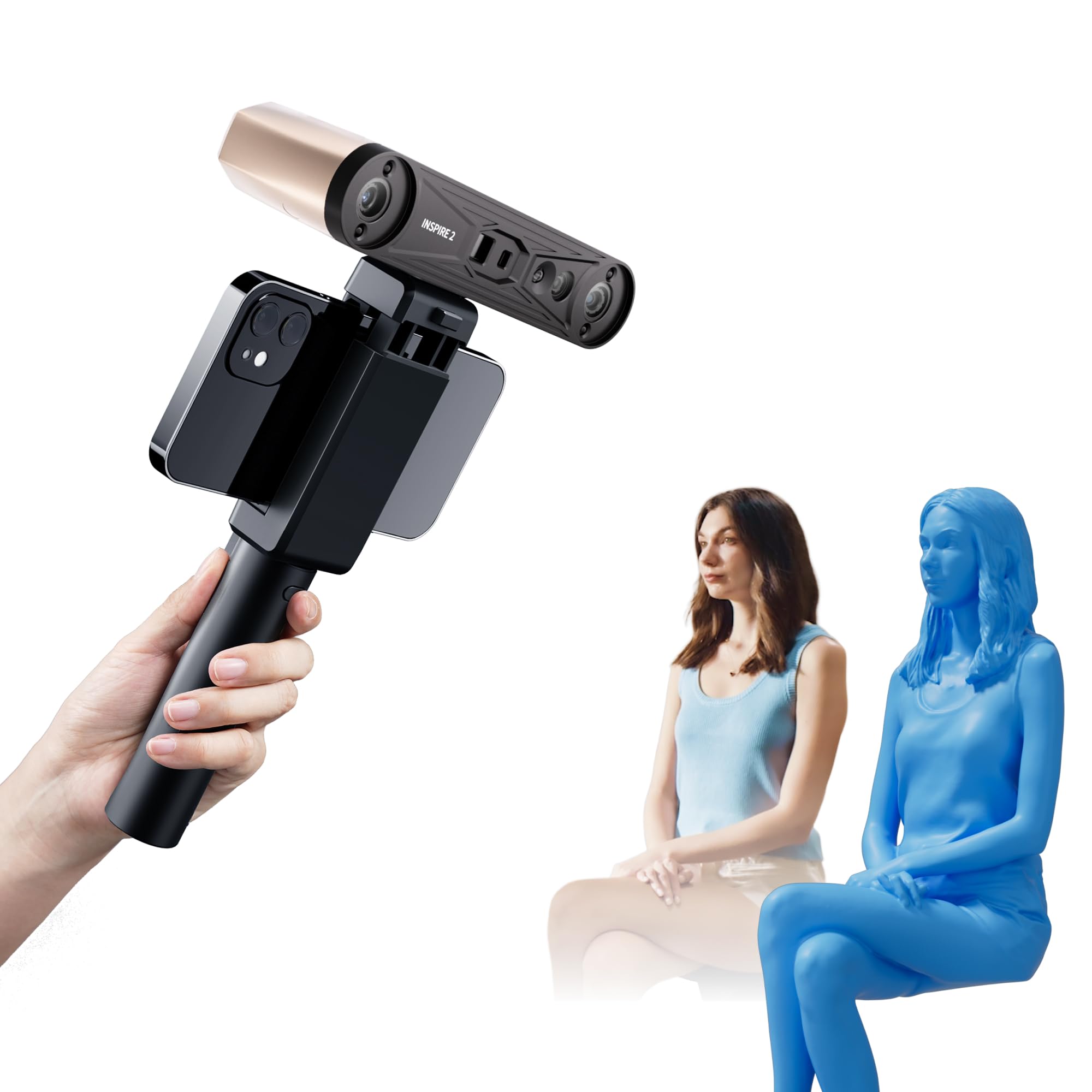
The INSPIRE 2 Premium package builds on the standard model by bundling accessories for a more complete out-of-box experience. It retains the same core specs: dual scanning modules (infrared structured light and multi-line laser), Wi-Fi 6 wireless connectivity, and an adjustable optical zoom (1.5x and 2x magnification) for capturing fine surface detail. The 0.03 mm precision and 0.05 mm accuracy figures are consistent across both versions.
The laser mode eliminates scanning spray on reflective and dark surfaces using 11 infrared laser lines, while structured light mode handles texture-rich objects efficiently. The unit weighs only 190 grams with an aerospace-grade aluminum alloy front panel, making it the most portable option in this list. The Revo Metro software guides scanning with clear feedback, and the included calibration board boosts point cloud accuracy by 75 percent.
The included sticky calibration dots are notoriously poor — they peel off and cause frustration during setup. Some users reported persistent software errors on custom PC builds with high-end specs (32 GB RAM, RTX 4700 Ti Super), requiring extensive troubleshooting. The Premium package extras (carrying case, additional markers) add value, but the core scanning experience mirrors the standard unit. For users who prioritize lightweight, wireless scanning across multiple environments, the INSPIRE 2 Premium is a safe bet if you budget for better tracking dots.
Why it’s great
- Ultra-light 190-gram design with Wi-Fi 6 wireless freedom.
- Dual scanning modes handle reflective and dark surfaces without spray.
Good to know
- Included calibration dots have poor adhesion and may need replacement.
- Software compatibility issues on some high-end custom PCs.
10. Revopoint INSPIRE 2 3D Scanner (Standard)
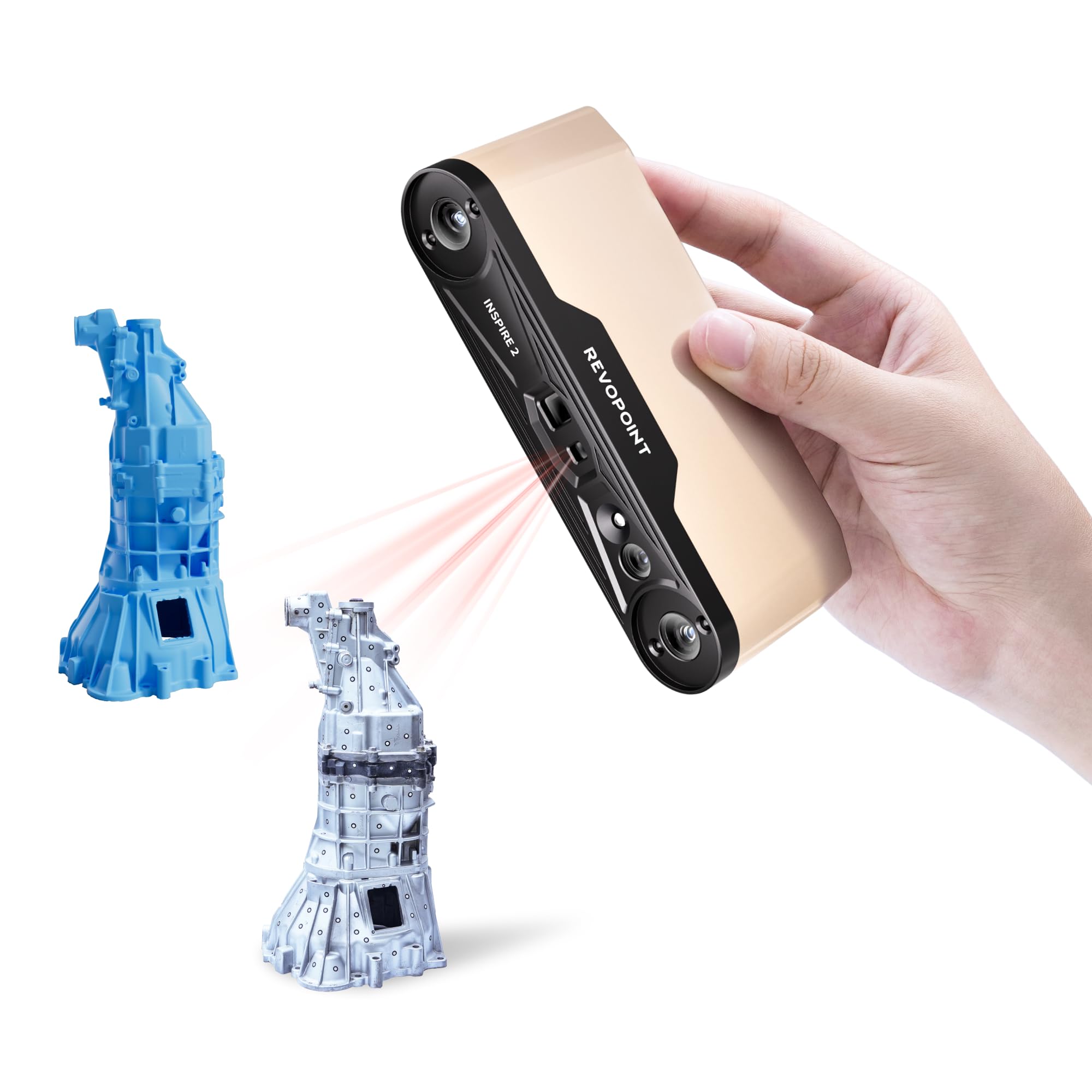
The standard INSPIRE 2 is the most balanced entry point into dual-mode 3D scanning, combining infrared structured light and multi-line laser in a 190-gram body. The 0.05 mm accuracy and 0.03 mm precision figures are impressive for this tier, and the built-in RGB camera captures full-color textures synchronized with the geometry. Wi-Fi 6 enables wireless scanning on iOS, Android, Windows, and macOS, making it the most cross-platform-friendly scanner on this list.
Users consistently report that default settings produce high-quality color scans on the first attempt, and the software provides clear step-by-step guidance. The calibration board and mini turntable included in the box let you start scanning immediately. The adjustable optical zoom (1.5x and 2x) helps resolve mixed-geometry surfaces like circuit boards and engraved text. Outdoor scanning works up to 20,000 lux in shaded conditions.
Scan speed in laser mode is slower than users expect — mapping reflective objects still takes patience even without spray. The calibration dots (same poor adhesive as the Premium version) cause frustration during setup. Some buyers experienced errors on high-spec PCs that required several calibration attempts before getting a first usable scan. For beginners who want a proven, lightweight, wireless scanner that works across all devices, the standard INSPIRE 2 package is the most cost-effective dual-mode entry point.
Why it’s great
- Cross-platform support across iOS, Android, Windows, and macOS.
- Full-color texture capture with 0.03 mm precision out of box.
Good to know
- Laser scan speed is slower than structured light mode.
- Calibration dot adhesive quality is poor and may require replacement.
11. 3DMakerpro 3D Scanner Seal Lite
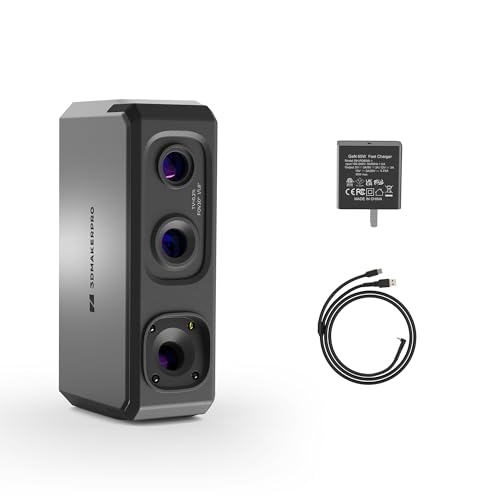
The Seal Lite from 3DMakerpro punches above its weight with a blue LED light source (400-500 nm wavelength) that projects finer structured light than typical infrared units, achieving 0.02 mm accuracy on small objects between 10 mm and 300 mm. It’s optimized for small-format scanning — jewelry, dental models, small mechanical parts — where sub-millimeter precision matters more than scanning speed. The 10 FPS frame rate is slow, but each capture carries high point density.
Scan-back and anti-shake features compensate for handheld movement, and the bundled JMStudio software provides visual tracking, error correction, and auto-alignment with lifetime free updates. Exports to OBJ, STL, PLY, and ASC formats. The 65W charger and data cable are included, and the small 1.54-pound body is easy to maneuver around tiny objects. For the price, the accuracy spec is genuinely competitive — matching scanners costing two to three times as much.
The learning curve is the steepest in this guide. The device requires a powerful PC, absolute stillness during capture, and careful lighting — black, shiny, or very small objects (under 10 mm) often fail without scanning spray. Users report that the provided documentation is insufficient, leading to dozens of wasted scans before getting usable results. The mono texture capture (no color) limits artistic applications. For patient entry-level users who need high-accuracy scans of small matte objects and are willing to invest time learning the workflow, the Seal Lite is a remarkable value proposition.
Why it’s great
- Exceptional 0.02 mm accuracy at a entry-level price point.
- Blue LED source captures finer detail than infrared on small objects.
Good to know
- Steep learning curve with poor documentation included.
- Mono texture only; fails on dark, shiny, and very small objects without spray.
FAQ
Can a 3D scanner directly create a printable STL file?
Do I need scanning spray for reflective or dark objects?
What computer specs do I need for 3D scanning?
Final Thoughts: The Verdict
For most users, the best 3d scanner for 3d printing winner is the Shining 3D Einstar Vega because it combines standalone wireless operation, dual scanning technologies, and professional-grade accuracy without requiring a PC. If you need industrial-grade blue laser precision for reverse engineering, grab the Revopoint MetroY Pro. And for budget-conscious beginners who want 0.02 mm accuracy on tiny objects, nothing beats the 3DMakerpro Seal Lite for pure value.