
Our readers keep the lights on and the weekend projects moving. As an Amazon Associate, I earn from qualifying purchases.
Dragging a 40-foot home on wheels to a remote site only to have your generator choke when the air conditioner kicks on is a special kind of frustration. The difference between a restful night in the wild and a hot, noisy disaster often comes down to how cleanly your portable power source handles the surge of an RV’s rooftop AC unit. Unlike open-frame construction generators, a true inverter model delivers stable sine-wave power, sips fuel, and keeps decibels low enough to avoid dirty looks from neighboring campsites.
I’m Rikta — the co-founder and writer behind FitlyFast. My research process for this guide involved cross-referencing hundreds of verified owner reports, analyzing real-world fuel consumption data, and comparing inverter THD ratings to separate the units that genuinely support an RV’s electrical system from those that over-promise on paper.
Whether you’re powering a travel trailer for a weekend getaway or need a reliable backup for your motorhome’s essential appliances, finding the right 4500 watt inverter generator for rv requires understanding starting wattage, noise profiles, and fuel flexibility more than any marketing sticker can tell you.
How To Choose The Best 4500 Watt Inverter Generator For RV
Buying a generator for your RV isn’t the same as grabbing one for a job site. You’re dealing with tightly packed campgrounds, noise restrictions, and a power panel that includes a converter that charges your house batteries. Understanding the specific specs that matter to an RV environment will keep you from buying an expensive paperweight.
Surge Watts Vs. Running Watts
Every RV air conditioner requires a massive burst of power to start its compressor before settling into a lower running load. A 13,500 BTU AC unit can need up to 2,800 starting watts even though it only draws around 1,500 watts once running. Always compare the surge wattage (often labeled as “starting watts”) against your combined starting load — not just the total running watts of your appliances.
Noise Level At Ear Level
Most manufacturers list decibel ratings measured at 23 feet with no load. In a real campsite, your generator sits closer, and under load the noise rises 5-10 dB. Look for units that advertise 58-63 dBA at rated load rather than no-load numbers. Anything above 65 dBA under load will likely draw complaints in quiet-hour-sensitive campgrounds.
Fuel Flexibility And Runtime
Dual-fuel capability (gasoline and propane) gives you backup fuel options if gas becomes scarce during a long trip. Propane burns cleaner and stores indefinitely, but it reduces peak wattage by roughly 10-15%. Tri-fuel models add natural gas for home standby use. Eco mode that throttles the engine down based on load makes a massive difference in runtime — expect 8-14 hours on a 2-gallon tank at quarter load.
RV-Specific Outlets And Parallel Readiness
You need a TT-30R (30-amp RV receptacle) on the panel for direct plug-in without adapters. A 5-20R duplex household outlet is useful for charging devices outside. Parallel capability lets you link two identical inverter generators to double output — useful if you upgrade to a larger RV later. Confirm the unit explicitly supports parallel operation with a sold-separately kit.
Weight, Wheels, And Handling
Inverter generators in this class range from 50 to 95 pounds. A telescoping handle with flat-free wheels turns a heavy unit into something you can roll across a gravel site alone. If you plan to load and unload the generator frequently, prioritize models under 60 pounds with integrated handles over bulkier units that are designed to sit in one spot.
CO Detection And Automatic Shutdown
Carbon monoxide poisoning is a real danger when running any combustion engine near an RV. Generators with CO sensors that automatically shut off the engine when dangerous CO levels build up are not optional anymore — they are life-saving. Look for terms like “CO Watchdog,” “CO Shield,” or “CO Alert” in the specifications. This feature is now standard on most reputable inverter models.
Quick Comparison
On smaller screens, swipe sideways to see the full table.
| Model | Category | Best For | Key Spec | Amazon |
|---|---|---|---|---|
| Champion 4500-Watt | Inverter | Heavy commercial RV use | 14-hr runtime / 61 dBA | Amazon |
| Cummins Onan P4500I | Inverter | Remote start comfort | Remote start / 224cc engine | Amazon |
| WEN DF480iX | Dual-Fuel Inverter | Dual-fuel reliability | 4800W surge / electric start | Amazon |
| BILT HARD Dual Fuel | Dual-Fuel Inverter | Budget dual-fuel quietness | 58 dBA / CO sensor | Amazon |
| A-iPower SUA4300iD | Dual-Fuel Inverter | Compact dual-fuel inverter | 7.5-hr runtime / 63 dBA | Amazon |
| AIVOLT 4300W | Inverter | Ultra-lightweight travel | 50.7 lbs / LCD display | Amazon |
| ERAYAK 4500W | Inverter | Parallel-ready value | 54 lbs / 60.5 dBA | Amazon |
| WEN 56477i | Inverter | Entry-level RV power | 4000W rated / 72.7 lbs | Amazon |
| Generac GP5500E | Portable Gas | Heavy-duty home backup | 6875W surge / PowerRush | Amazon |
| GENMAX GM10500iETC | Tri-Fuel Inverter | Whole-house tri-fuel power | 10500W surge / remote start | Amazon |
| Generac GP8000E | Tri-Fuel Portable | Home standby tri-fuel | 12500W surge / COsense | Amazon |
In‑Depth Reviews
1. Champion Power Equipment 4500-Watt Inverter Generator

The Champion 4500-Watt inverter generator earns the top spot because it balances real-world endurance, noise control, and user-friendly features specifically for RV owners. Its 212cc engine produces 4,500 starting watts and 3,500 running watts, which comfortably handles a 15,000 BTU RV AC unit plus a refrigerator and lights simultaneously. The 2.3-gallon fuel tank delivers up to 14 hours of runtime at quarter load, meaning you can run it through an entire night without waking up to refuel.
Noise output sits at 61 dBA — roughly the volume of a normal conversation — which keeps neighbors happy during quiet hours. The Intelligauge panel shows voltage, frequency, and operating hours in real time, giving you precise feedback on your power draw. CO Shield carbon monoxide auto shutoff adds a critical safety layer that responsible campers should never skip.
At 92.2 pounds, this is not the lightest inverter in the class, but the integrated wheels and folding handle make rolling it across a gravel campsite manageable. Multiple verified reviews from food truck operators and full-time RVers running AC units for days straight report zero shutdown issues, reinforcing its reputation for reliability under continuous load.
Why it’s great
- Exceptional 14-hour runtime at 25% load
- 61 dBA noise level keeps campground relations smooth
- Intelligauge provides live power draw data
Good to know
- Heavier than many competitors at 92 lbs
- Parallel kit sold separately
2. Cummins Onan P4500I Portable Inverter Generator
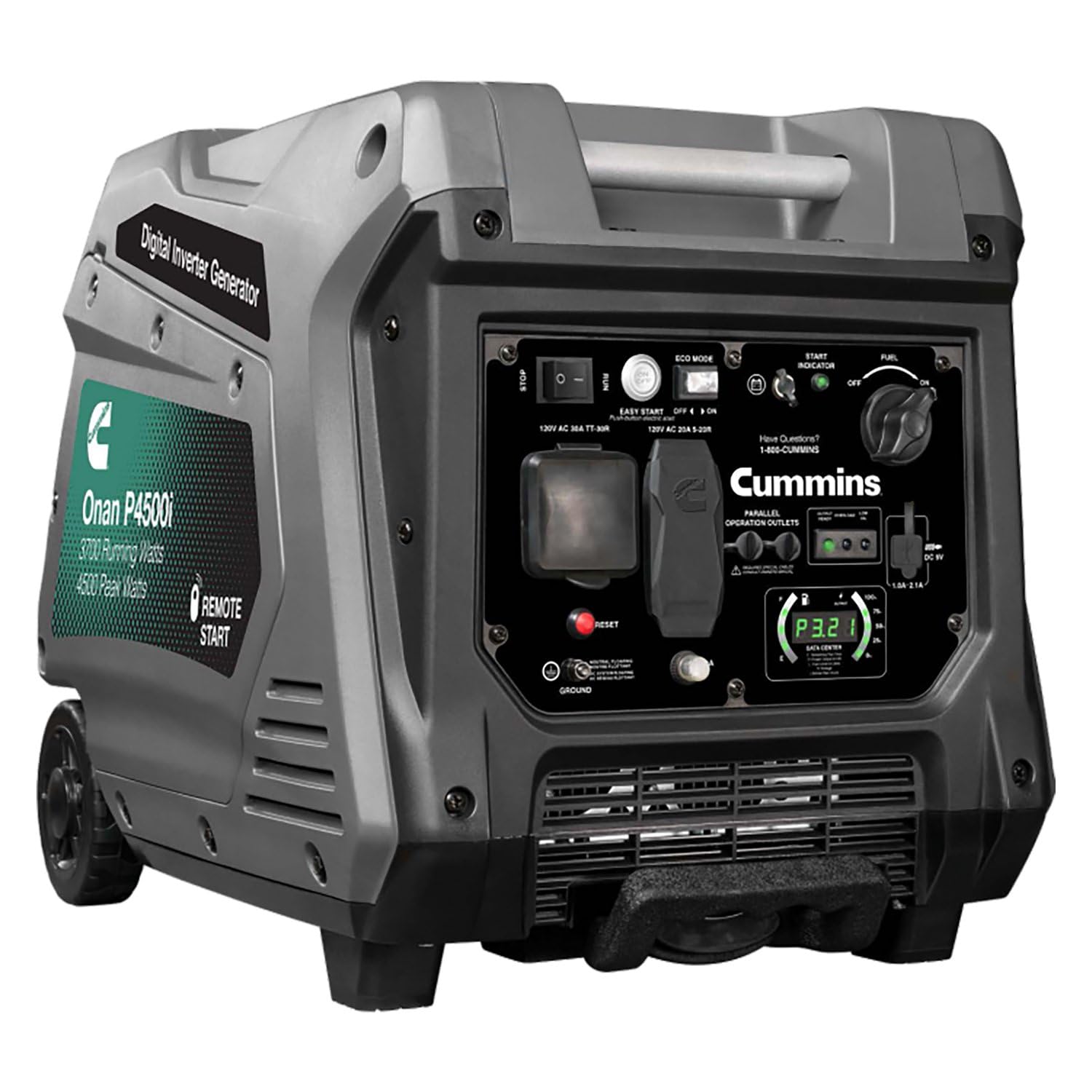
Cummins brings decades of generator engineering expertise into the Onan P4500I, a unit purpose-built for the RV market. The 224cc OHV 4-stroke engine delivers 4,500 peak watts with a 30-amp TT-30R outlet that plugs directly into your RV’s shore power cord. The standout feature here is the remote start key fob — you can fire it up from inside your camper on a cold morning without pulling on boots.
Noise levels are genuinely low enough that campground neighbors have reported not realizing it was running. The electronic ignition includes a backup recoil pull cord for peace of mind. Dual 5V USB ports keep phones and tablets charged, and parallel capability lets you pair a second P4500I for up to 50 amps of output.
At roughly 98 pounds, it’s heavier than many inverter models, but the telescoping handle and large wheels make transport tolerable on level ground. Verified owners living in extreme cold (-15°F) report flawless starting, and many highlight the voltage stability — staying locked at 120V even under heavy load. Oil changes are the primary service hassle due to a tight drain plug clearance, but the trade-off for long-term reliability is worth it.
Why it’s great
- Remote key fob start is a game-changer for RV comfort
- Voltage stays at 120V under load for sensitive electronics
- Proven reliability in extreme temperatures
Good to know
- Heavy at 98 lbs — plan for wheeled transport
- Oil drain plug access is tight
3. WEN DF480iX 4800-Watt Dual Fuel Inverter Generator
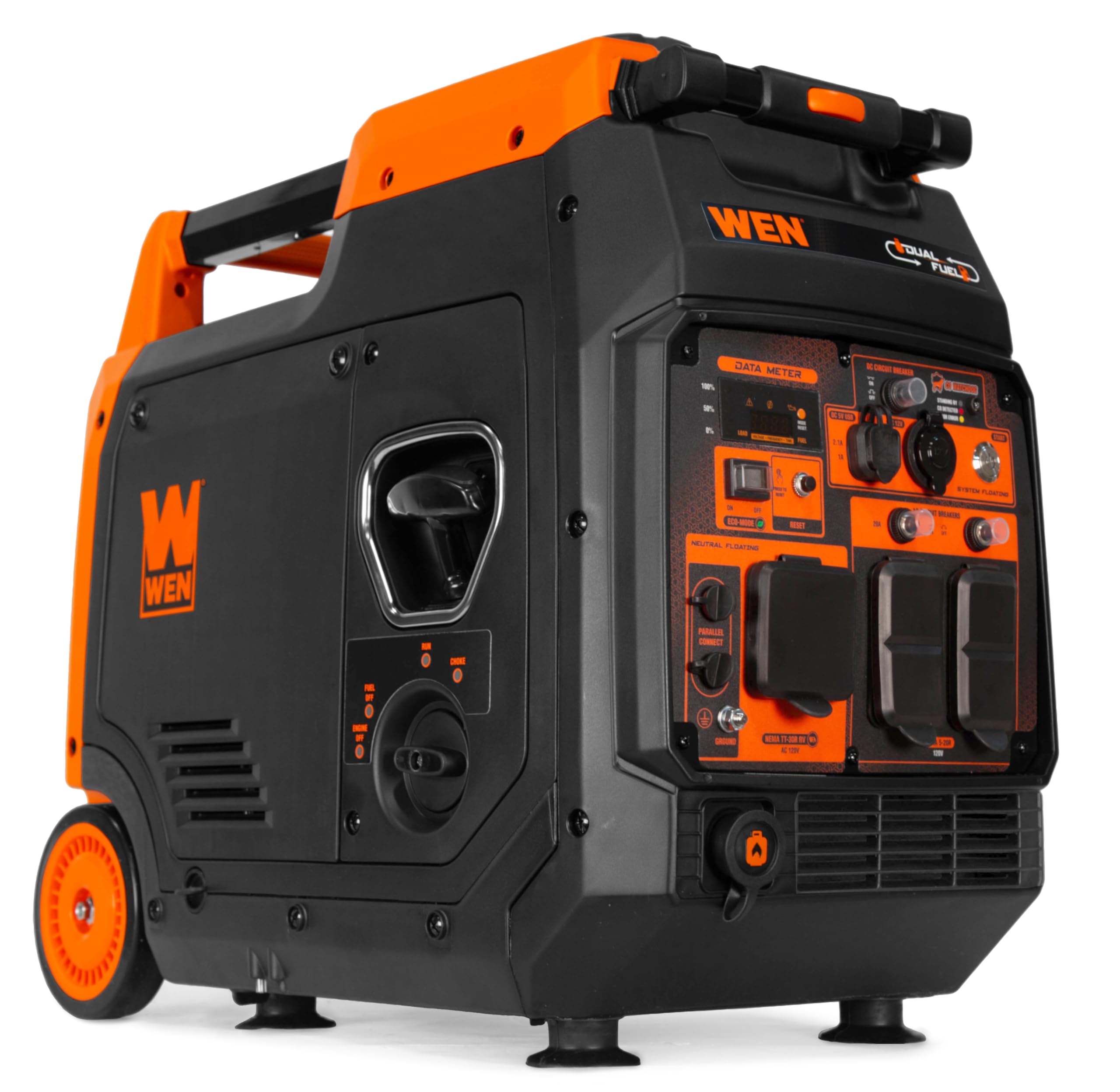
The WEN DF480iX upgrades the standard WEN inverter formula by adding dual-fuel flexibility and electric start without pushing into premium price territory. The 224cc engine produces 4,800 surge watts on gasoline and 4,320 surge watts on propane, with the same 4,000 rated watts on both fuels. This means you can run your RV’s AC, fridge, and converter off propane without sacrificing meaningful power output.
Noise output stays conversation-level quiet, and the WEN Watchdog CO Shutdown Sensor provides automatic protection against carbon monoxide buildup. The fuel shut-off feature is a smart maintenance addition — it lets you run the carburetor dry before storage, preventing gummed-up fuel lines. The control panel includes a TT-30R RV receptacle, two USB ports, and four standard 120V outlets.
Weighing 78.5 pounds with onboard wheels and a telescoping pull handle, it’s lighter than the Champion while still offering dual-fuel versatility. Verified owners praise the easy electric start and note that after an 8-hour break-in on propane, the unit ran a refrigerator, portable AC, lights, and TV for a full week without hiccups. A few users mention the wheels rattle slightly under operation, but that’s a minor irritation for the value delivered.
Why it’s great
- Dual-fuel with identical rated watts on propane
- Electric start with backup recoil pull
- Fuel shut-off extends engine life
Good to know
- Wheels can rattle during operation
- Magnetic dip stick recommended for break-in
4. BILT HARD Dual Fuel Inverter Generator 4500W
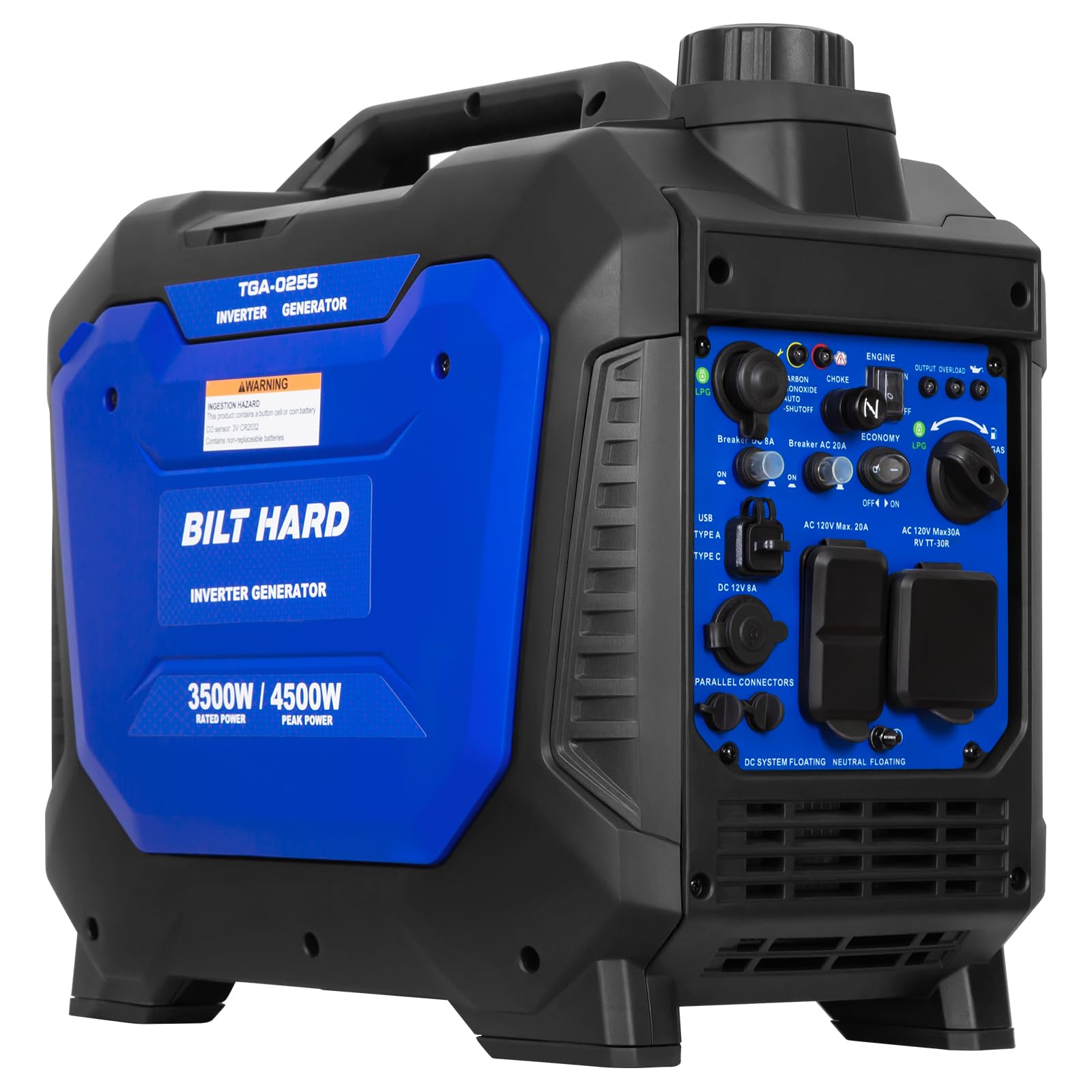
BILT HARD delivers a genuinely quiet dual-fuel inverter that hits 58 dBA at 23 feet — one of the quietest ratings in this class. The 141cc engine produces 4,500 peak watts on gasoline and 4,150 on propane, with 3,500 and 3,200 running watts respectively. That’s enough to run a 13,500 BTU RV AC plus a few lights and a refrigerator on propane without exceeding the rated load.
The integrated CO sensor provides automatic shutdown if carbon monoxide levels become unsafe, and ECO mode throttles the engine speed based on load to save fuel and reduce noise further. The control panel includes a TT-30R 30-amp RV outlet, a duplex household outlet, dual USB ports, and a 12V 8A DC output. Parallel capability allows linking two units for double the power.
At 57.7 pounds, this is one of the lighter dual-fuel inverters in the category, making it practical for solo campers who need to load and unload frequently. Verified owners report the rubber feet effectively dampen vibration, keeping noise down even on hard surfaces. A few reviews note that the setup instructions can be cryptic, but once running, the generator proves fuel-efficient and reliable for multi-day trips.
Why it’s great
- Exceptionally quiet at 58 dBA
- Lightweight and portable at under 58 lbs
- Dual-fuel flexibility with propane hose included
Good to know
- Setup instructions can be unclear
- Peak wattage drops on propane
5. A-iPower SUA4300iD Dual Fuel Inverter Generator

A-iPower’s SUA4300iD packs dual-fuel capability into a compact frame that measures just 19.7 x 12.2 x 18.5 inches. The 149cc engine delivers 4,300 starting watts and 3,450 running watts on gasoline, with 3,900 starting and 3,100 running on propane. The low-idle technology and ECO mode stretch the 1.6-gallon tank to 7.5 hours at quarter load — adequate for overnight runs without refueling.
Noise is rated at 63 dBA, which is acceptable for campground use but slightly louder than the quietest models in this guide. The control panel includes a CO sensor indicator light, an L5-30R 30-amp twist-lock outlet, a duplex 5-20R household outlet, and a 12V DC port. The generator ships with a 30-amp RV adapter and parallel cables, adding value out of the box.
Verified owners highlight the fuel efficiency on propane, with one user documenting a successful natural gas conversion that slashed operating costs. The telescoping handle and flat-free wheels make it easy to maneuver despite the 50-pound weight class. A small number of owners reported fuel leaks after transport, so double-checking the carburetor and tank seals before first use is a smart precaution.
Why it’s great
- Compact dimensions save storage space in an RV compartment
- Includes RV adapter and parallel cables
- Runs efficiently on propane with low THD
Good to know
- Some units reported fuel leaks during transport
- 63 dBA is slightly louder than top-tier quiet models
6. AIVOLT 4300W Inverter Generator
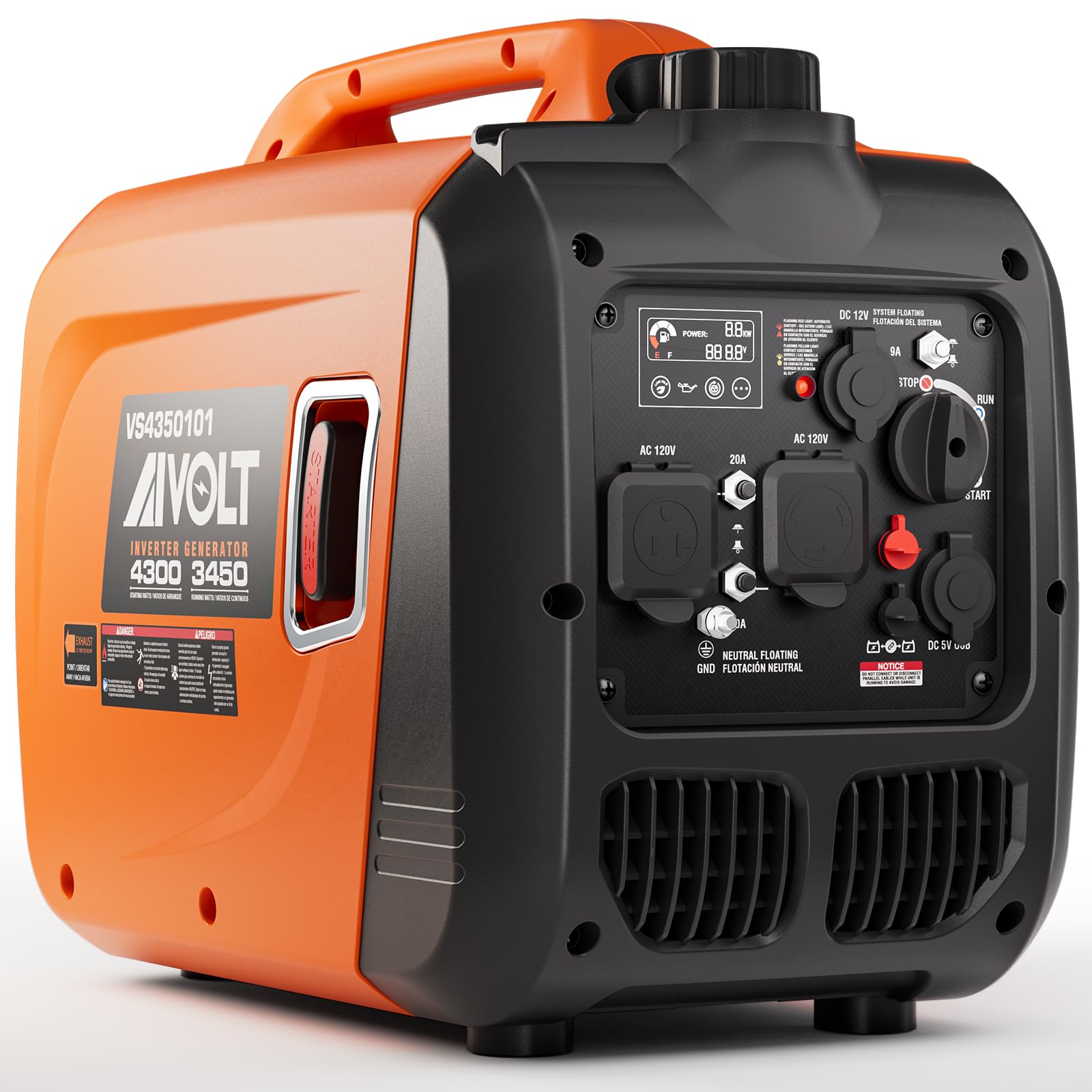
AIVOLT’s generator is marketed as 20% lighter and 10% smaller than comparable units, and the numbers back it up: 50.7 pounds with dimensions that fit easily into an RV pass-through storage compartment. The 149cc copper-wound engine produces 4,300 starting watts and 3,450 running watts, making it capable of starting a 13,500 BTU RV AC unit without struggling.
The LCD display is a standout feature at this price tier — it shows oil level warnings, fuel level, overload indicators, and operating status on a single screen. CO Alert technology automatically shuts the unit down if carbon monoxide reaches unsafe levels. The control panel includes a 30-amp locking outlet, a standard household outlet, a 12V DC port, and both Type-A and Type-C USB ports.
Noise output is rated at 60 dBA, which is competitive, though some owners measured 72-73 dB at 5 feet under load — realistic for any generator in this class. The included RV adapter and battery charging cable add convenience. A small but notable fraction of owners report units failing after very short run times or arriving with defective voltage output, suggesting quality control can be inconsistent.
Why it’s great
- Extremely lightweight for the power output
- Informative LCD display for monitoring
- CO Alert safety shutoff built in
Good to know
- Inconsistent quality control reported
- Oil not included — purchase separately
7. ERAYAK 4500W Portable Inverter Generator

ERAYAK’s 4500P inverter generator is built around portability and parallel-ready flexibility. At 54 pounds with an integrated handle, it’s one of the lightest units to offer true 50-amp parallel output when paired with a second unit. The 208cc engine delivers 4,500 peak watts and 3,500 running watts, and low THD (0.2%-1.2%) makes it safe for laptops, CPAP machines, and RV battery chargers.
Noise sits at a respectable 60.5 dBA, and ECO mode dynamically adjusts engine speed based on load to improve fuel economy. The panel includes a TT-30R RV outlet, two standard 120V AC outlets, a 12V cigarette lighter port, USB-A and USB-C ports, and separate 20A and 30A circuit breakers for overload protection. Electric start with recoil backup adds convenience.
Fuel consumption is a highlight — 0.21 gallons per hour at 25% load means a full tank can last through a weekend of moderate use. Verified owners in food trucks and construction settings praise the lightweight build and quiet operation, though a few critical reviews report the pull cord breaking after limited use. The 3-year limited warranty with lifetime technical support provides some recourse if issues arise.
Why it’s great
- Very lightweight at 54 lbs for easy transport
- 50A parallel-ready with two-unit setup
- Incredibly low THD for sensitive electronics
Good to know
- Some reports of pull cord failure
- Not returnable through Amazon in all cases
8. WEN 56477i 4800-Watt Inverter Generator

The WEN 56477i is the entry-level inverter that started many RV owners’ journey into clean portable power. The 224cc engine delivers 4,800 surge watts and 4,000 rated watts, which is actually slightly higher than many 4,500-watt nominal competitors. The TT-30R RV receptacle lets you plug directly into your camper, and the four three-prong 120V outlets provide plenty of capacity for external appliances.
The WEN Watchdog CO Shutdown Sensor meets modern safety standards, and the fuel shut-off feature allows the carburetor to run dry before storage — a simple maintenance step that prevents gummed-up fuel passages. Noise levels are described by owners as “conversation-level” and suitable for campground use. The telescoping pull handle and onboard wheels make the 72.7-pound unit manageable on packed ground.
Verified owners confirm it runs a refrigerator, TV, lights, and small appliances during outages without struggling. The three-year warranty provides reasonable peace of mind at this price point. The main limitation is that it runs on gasoline only, so you won’t have propane backup if stations are closed during a long trip. For weekend campers who stick to developed campgrounds with fuel access, this is a solid value proposition.
Why it’s great
- Higher rated watts (4,000) than many 4,500W nominal units
- Fuel shut-off extends carburetor life
- Proven reliability from a trusted brand
Good to know
- Gasoline only — no dual-fuel flexibility
- 72.7 lbs is heavier than lighter inverter models
9. Generac GP5500E Portable Gas Generator
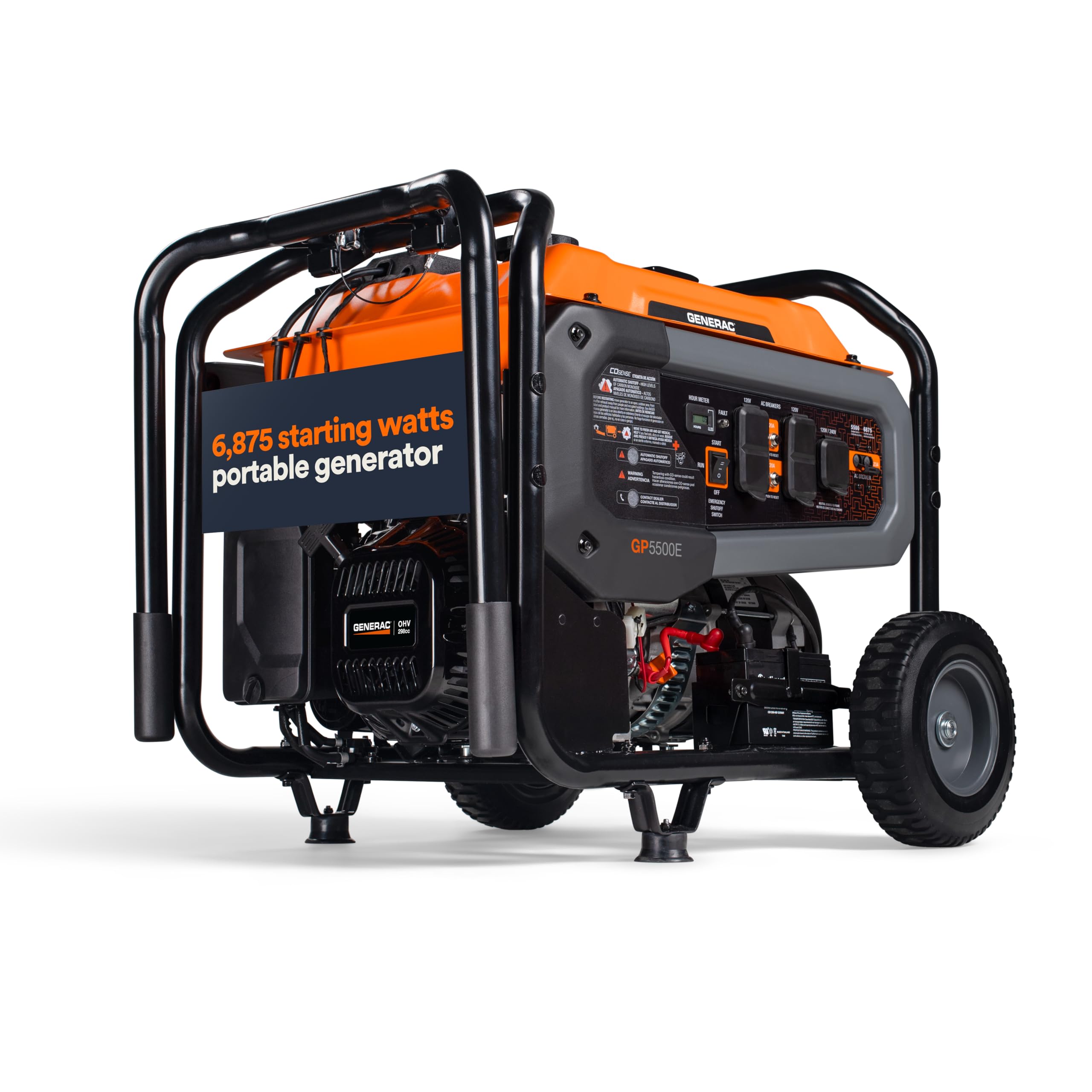
Generac’s GP5500E is an open-frame portable generator, not an inverter, but it earns a mention for RV owners who prioritize raw power over quiet operation and clean sine wave output. PowerRush Advanced Technology delivers 40% more starting capacity, with 6,875 starting watts — enough to handle the surge of a 15,000 BTU RV AC unit plus a microwave running simultaneously. The OHV engine with a large steel fuel tank provides up to 11 hours of runtime at 50% load.
The COsense technology detects dangerous carbon monoxide levels and automatically shuts the engine down, which is a crucial safety feature for any portable generator used near an RV. Electric start with a included battery eliminates pull-cord frustration, especially in cold weather. The hour meter helps track maintenance intervals, and low-oil shutdown protects the engine from damage.
At 163 pounds with a steel-tube cradle and never-flat wheels, this is not a unit you want to load and unload frequently. It’s best suited for RVers who can leave it in a truck bed or tow-behind cargo platform. The noise output is substantially higher than inverter models — expect 75-80 dBA under load. If campground quiet hours matter to you, this is not the right choice, but for serious emergency backup power at home or in remote off-grid situations, the GP5500E delivers unmatched capacity.
Why it’s great
- Massive 6,875 surge watts handles heavy loads
- PowerRush technology for 40% more starting capacity
- COsense automatic carbon monoxide shutoff
Good to know
- Very heavy at 163 lbs — not for frequent moving
- Open-frame design is loud for campgrounds
10. GENMAX GM10500iETC Tri-Fuel Inverter Generator

The GENMAX GM10500iETC is a tri-fuel inverter generator that delivers 10,500 starting watts on gasoline, 9,500 on propane, and 8,400 on natural gas — far exceeding the 4,500-watt class but relevant for RV owners who want whole-home backup capacity. The 458cc engine with forced lubrication and an oil filter is designed for sustained high-output operation, and the inverter technology keeps THD below 3% for sensitive electronics.
The control panel is the most comprehensive in this lineup: a 50-amp 14-50R outlet, a 30-amp L14-30R, four 20-amp household outlets, a 12V DC port, parallel connectors, and a voltage transfer switch for 120V/240V simultaneous use. Remote start via key fob, electric start, and ATS automatic control add premium convenience. The neutral floating design works with a bonding plug (sold separately) for home standby use.
At roughly 160 pounds with large dimensions, this is a stationary unit best kept on a trailer or in a permanent outdoor cabinet. Verified owners report it runs entire homes including 3-ton central AC units and well pumps on natural gas with whisper-quiet inverter operation. A few units arrived with defects, and there is no printed manual included, but the three-year warranty and lifetime technical support provide coverage for the investment.
Why it’s great
- Tri-fuel versatility with natural gas option
- 50-amp RV outlet for direct high-power connection
- Remote start and ATS compatible
Good to know
- Very heavy and large — requires permanent placement
- Some units have quality control issues
11. Generac GP8000E Tri-Fuel Portable Generator
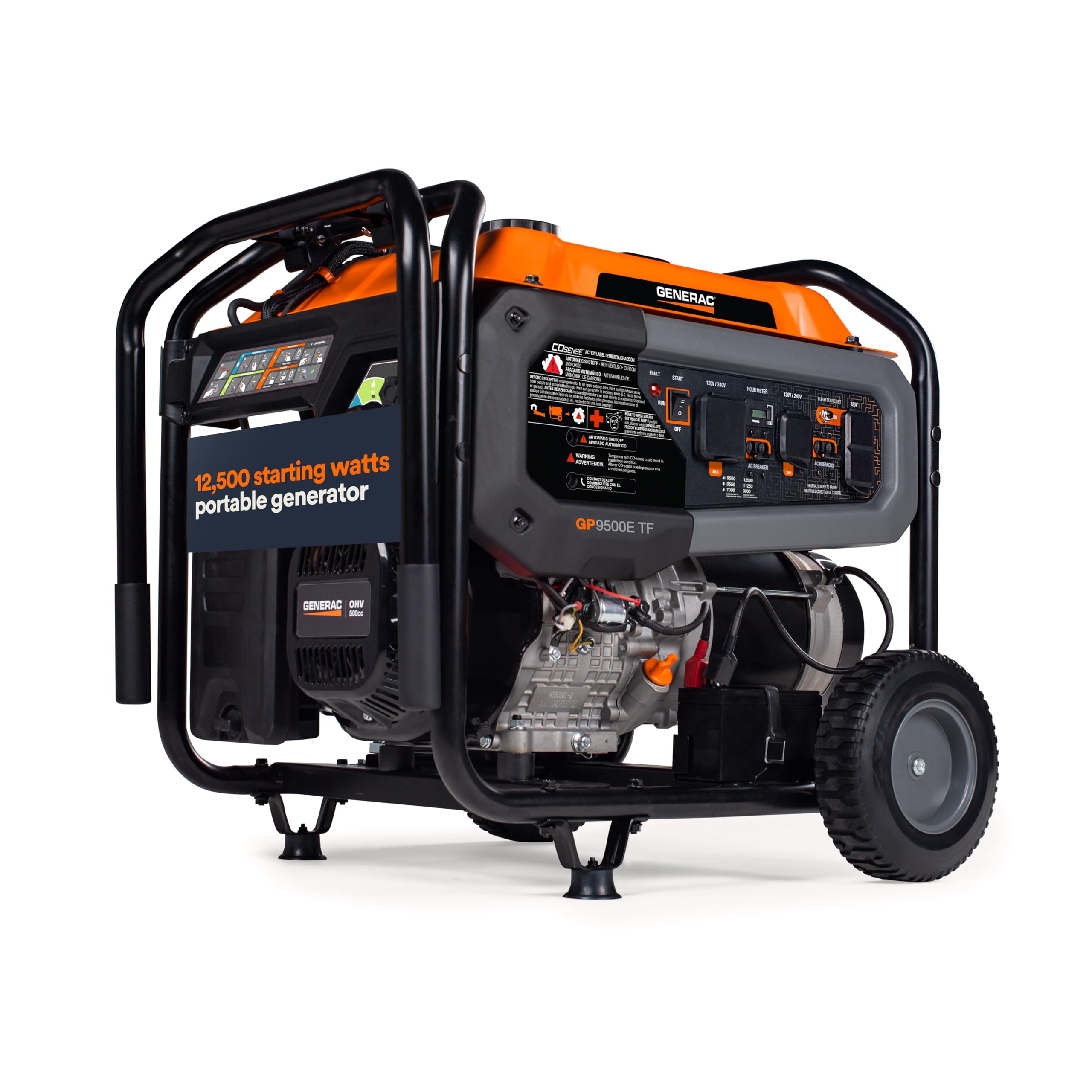
Generac’s GP8000E (listed as 12,500 starting watts) is a tri-fuel portable generator that runs on gasoline, propane, or natural gas, with a fuel source selector that switches seamlessly between them without shutting down. While not an inverter generator, this unit targets RV owners who also want a home standby solution. The OHV engine and large steel fuel tank deliver up to 10.5 hours of runtime at 50% load on gasoline.
COSense technology provides automatic carbon monoxide detection and shutdown. The electric start with included battery eliminates pull-start hassle, and the covered outlets offer protection against weather and debris on job sites or in truck beds. The rugged steel-tube cradle and heavy-duty never-flat wheels are built to survive rough transport conditions.
At 227 pounds, this is the heaviest unit in the list and is best suited for stationary placement or trailer mounting. The noise level is significantly higher than inverter models — typical for an open-frame construction generator. If your primary need is backup power for a large RV plus home essentials during extended outages, the tri-fuel flexibility is valuable. For quiet campground use, this is not the right tool.
Why it’s great
- Tri-fuel with seamless fuel switching
- Massive 12,500 surge watts for heavy loads
- Rugged build with covered outlets
Good to know
- Extremely heavy at 227 lbs — stationary use only
- Open-frame design is loud for camping
FAQ
Can a 4500-watt inverter generator run my RV air conditioner?
What is the difference between an inverter generator and a conventional generator for RV use?
How many hours will a 4500-watt inverter generator run on a tank of gas?
Do I need a dual-fuel generator for my RV?
Final Thoughts: The Verdict
For most users, the 4500 watt inverter generator for rv winner is the Champion Power Equipment 4500-Watt because it delivers the best combination of runtime, quietness, real-world reliability, and owner satisfaction for RV-specific use. If you want dual-fuel flexibility with electric start, grab the WEN DF480iX. And for remote-start convenience and premium build quality, nothing beats the Cummins Onan P4500I.