
Our readers keep the lights on and the weekend projects moving. As an Amazon Associate, I earn from qualifying purchases.
A 49-key MIDI keyboard hits the sweet spot between a cramped 25-key layout and a sprawling 61-key workstation. It gives you enough range for two-handed chord voicings and bass lines without devouring your entire desk. Yet the market is flooded with controllers that share the same key count but differ wildly in key action, build quality, and DAW integration. Choosing the wrong one means fighting stiff springs, missing pads, or software that refuses to map correctly.
I’m Rikta — the founder and writer behind FitlyFast. I’ve spent years analyzing the hardware specs, user workflows, and build tolerances that separate a fluid music-making tool from a frustrating paperweight.
After comparing seven of the most popular models on key feel, connectivity, and bundled software, this guide ranks the absolute best 49 key midi keyboard for every type of producer and performer.
How To Choose The Best 49 Key MIDI Keyboard
Choosing a 49-key controller is a compromise between portability and playability. You need to decide which trade-offs you will accept before you look at brand names or software bundles.
Key Action: Synth-Action vs. Semi-Weighted
Synth-action keys use a spring to return the key to its resting position. They are lighter, quieter, and easier to play fast, repetitive synth leads on, but they lack the resistance that piano players expect. Semi-weighted keys add a small metal weight under each key, giving a heavier, more controlled feel that mimics an acoustic piano more closely. Beginners often assume heavier is always better, but if you play primarily virtual synths and organ sounds, synth-action is actually more responsive.
DAW Integration Depth
Not all controllers talk to your software equally. Some, like the Nektar Impact GX49, use custom scripts to auto-map transport controls and mixer faders directly into your DAW. Others rely on generic MIDI learn, which forces you to manually assign every knob and slider every session. For Ableton Live users, the Novation Launchkey MK4 offers the deepest two-way integration of any controller on this list, including clip launching and device control straight from the hardware.
Pads, Faders, and Encoders
If your workflow includes finger drumming, you need velocity- and pressure-sensitive pads with a satisfying response. A spongy pad bank kills your timing. Similarly, the number of faders and encoders matters most if you regularly tweak synth parameters or mixer levels in real time. A controller with only pitch and mod wheels is enough for basic note entry; a unit with eight knobs and nine faders transforms your studio session.
Quick Comparison
On smaller screens, swipe sideways to see the full table.
| Model | Category | Best For | Key Spec | Amazon |
|---|---|---|---|---|
| Arturia KeyLab Essential mk3 | Premium | Deep DAW control & sound library | 2.5″ LCD + 2000 Analog Lab V presets | Amazon |
| Novation Launchkey 49 MK4 | Premium | Ableton Live workflow & FSR pads | 16 FSR pads with polyphonic aftertouch | Amazon |
| M-AUDIO Oxygen 49 MKV | Mid-Range | NKS integration & Smart Chord | Smart Chord/Scale + NKS support | Amazon |
| Nektar Impact LX49+ | Mid-Range | Mixer-style control surface | 9 faders + 8 knobs + 8 drum pads | Amazon |
| Nektar Impact GX49 | Entry-Level | Plug-and-play simplicity | Nektar DAW integration scripts | Amazon |
| M-AUDIO Keystation 49 MK3 | Entry-Level | Budget-friendly & lightweight build | Volume fader + transport buttons | Amazon |
| midiplus AK490 | Budget | Lowest cost 49-key option | MIDI out DIN + pitch/mod wheels | Amazon |
In‑Depth Reviews
1. Arturia KeyLab Essential mk3

The Arturia KeyLab Essential mk3 sits at the top of the 49-key tier because it bundles a genuinely premium software library with hardware that feels considered at every touchpoint. The 2000 presets in Analog Lab V cover everything from vintage analog polysynths to modern orchestral hybrids, and they are immediately playable because the controller’s 2.5-inch LCD screen gives you real-time feedback on parameter names and values. No other controller at this size offers a display this useful for navigating patch libraries without looking at your computer monitor.
The keybed uses synth-action keys with a springy, responsive feel that reviewers consistently describe as excellent for the price bracket. The eight RGB-backlit pads respond to both velocity and pressure, making them usable for drum programming and clip launching. The arpeggiator, Scale Mode, and Chord Mode are built directly into the hardware rather than hidden in software menus, which speeds up sketching ideas dramatically.
On the connectivity side, you get USB-C, traditional 5-pin MIDI out, and a sustain pedal input. The included software also features Ableton Live Lite, two premium piano plugins (UVI Model D and NI’s The Gentleman), and subscriptions to Loopcloud and Melodics. The installation process for the bundled software is the only real hurdle — you will need to create multiple accounts — but the value of the sound library alone justifies the effort.
Why it’s great
- Massive 2000-preset Analog Lab V library included, covering decades of synth sounds.
- Bright 2.5-inch LCD provides instant visual feedback during patch browsing and parameter tweaking.
- Built-in arpeggiator, chord, and scale modes accelerate composition without needing a computer.
Good to know
- Software activation requires multiple user accounts across Arturia and partner platforms.
- Lacks polyphonic aftertouch, a feature found on some competing premium controllers.
2. Novation Launchkey 49 MK4
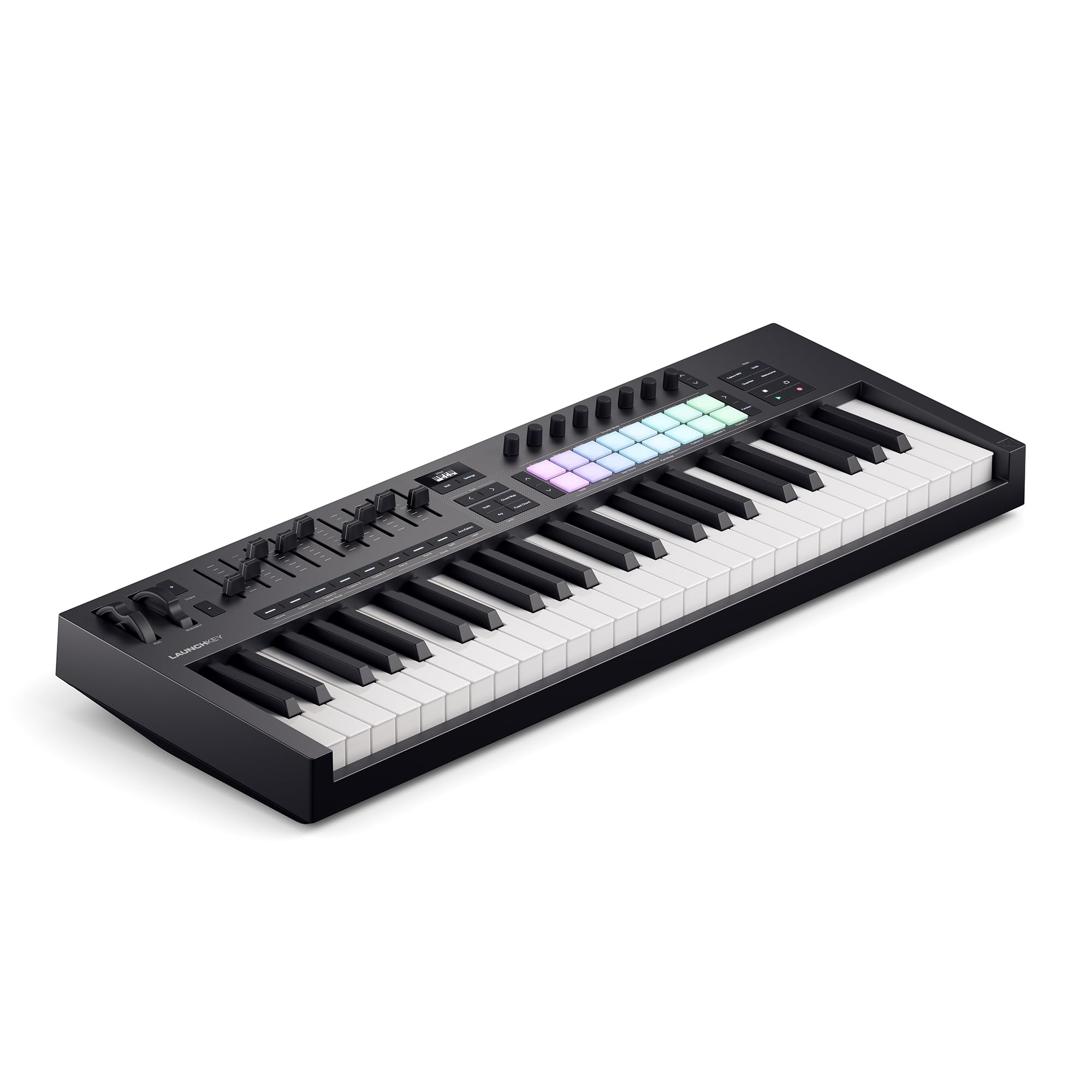
The Novation Launchkey 49 MK4 is engineered specifically for the Ableton Live workflow. The 16 FSR (Force Sensing Resistor) pads are a class above the rubber-dome pads found on most competitors — they respond to the slightest touch with zero latency and support polyphonic aftertouch, meaning each pad can trigger multiple parameters simultaneously depending on where you press. This makes them equally suited for finger drumming, clip launching, and step sequencing.
The keybed is semi-weighted, offering a noticeably heavier feel than the synth-action Arturia or M-Audio units. This is a deliberate choice for piano players who want resistance under their fingers. The arpeggiator, Scale Mode, and Chord Mode are all present, and the integration with Ableton Live is deeper than any other controller on this list — transport controls, device parameters, and session view clip launching all work out of the box without manual mapping.
Bundled software includes Ableton Live Lite, Cubase LE, Novation Play, and sound packs from GForce, Klevgrand, and Native Instruments. The hardware is USB-powered, compact enough for a backpack, and built with a reassuring weight that suggests it will survive regular transport. The main complaint from users is that the bundled software installation process involves multiple third-party accounts, and Reason DAW users report mapping issues that require a firmware update to resolve.
Why it’s great
- 16 FSR pads with polyphonic aftertouch offer genuinely expressive control for drums and effects.
- Two-way Ableton Live integration works instantly with no manual MIDI mapping required.
- Semi-weighted keybed provides a satisfying weighted feel for players transitioning from acoustic pianos.
Good to know
- Native integration is best with Ableton Live; other DAWs need manual or generic MIDI mapping.
- Software bundle requires multiple accounts and downloads before you can access all included sounds.
3. M-AUDIO Oxygen 49 MKV

The M-AUDIO Oxygen 49 MKV (the fifth generation of the Oxygen line) distinguishes itself with Native Kontrol Standard (NKS) integration, a partnership between M-Audio and Native Instruments. NKS support means the controller can browse and control Native Instruments presets directly from its front panel — you scroll through Komplete sound libraries using the display and knobs without touching your mouse. This is a rare feature at this price point and makes the MKV the best choice for producers invested in the Native Instruments ecosystem.
The keyboard features 49 velocity-sensitive synth-action keys with a solid, reliable feel. Two banks of eight backlit drum pads sit above the pitch and mod wheels, and the eight assignable knobs plus nine assignable faders give you hands-on control over any virtual instrument parameter. The Smart Chord and Smart Scale modes are useful for songwriters who want to stay in key without music theory expertise, and the built-in arpeggiator adds motion to simple chord progressions.
The bundled software suite is generous — Ableton Live Lite, MPC Beats, Hybrid 3, Mini Grand, and five Akai Professional MPC expansion packs. The catch is the software installation process, which requires separate accounts on InMusic, M-Audio, and Native Instruments hubs. Users report spending several hours downloading and registering. Once that is done, the hardware itself is class-compliant and works immediately as a plug-and-play MIDI device.
Why it’s great
- NKS integration gives direct hands-on control over Native Instruments Komplete sound libraries.
- Smart Chord and Smart Scale modes simplify music theory for quick sketching and composition.
- 8 knobs and 9 faders offer deep tactile control over synth parameters and mixer channels.
Good to know
- Software installation is time-consuming, requiring multiple accounts and lengthy downloads.
- Keys are synth-action, not semi-weighted, which may feel too light for piano-oriented players.
4. Nektar Impact LX49+

The Nektar Impact LX49+ is the most feature-dense controller in the mid-range tier. The selling point is Nektar DAW Integration — a set of custom scripts that auto-map the entire control surface to popular DAWs including Studio One, Bitwig, Reaper, and Logic Pro. In Studio One, the faders instantly control track volumes and the transport buttons work without any configuration.
The keybed is synth-action with velocity sensitivity. User reviews consistently note that the keys are responsive and have a good weight for the price, though some mention a slightly spongy feel when fully engaged. The drum pads are backlit and velocity-sensitive, making them usable for beat production, but they are not as responsive as the FSR pads on the Novation Launchkey MK4. The included Bitwig 8-Track license and five Cherry Audio plugins boost the overall value considerably.
Build quality is solid — the chassis has a reassuring weight and the faders feel smooth under the fingers. The LX49+ works with all major DAWs via generic MIDI, but the deep integration features require the Nektar DAW Integration software, which only supports specific DAW versions. Users on less common DAWs may find the faders and knobs require manual mapping.
Why it’s great
- 9 dedicated faders provide a genuine mixing console workflow for DAW control.
- Nektar DAW Integration scripts auto-map transport, mixer, and instrument controls in major DAWs.
- Bundled Bitwig 8-Track and Cherry Audio plugins add immediate software value.
Good to know
- Deep DAW integration only works with specific supported DAWs; generic MIDI mode is less intuitive.
- Drum pad sensitivity is good but not at the level of premium FSR-based controllers.
5. Nektar Impact GX49

The Nektar Impact GX49 strips away the pads, faders, and knobs of its LX+ sibling and focuses on what matters most: a solid keybed with zero-latency DAW integration. The 49 synth-action keys are velocity-sensitive and have what many users describe as a heavy but not uncomfortably stiff feel. The real draw is the Nektar DAW Integration layer — this is one of the few entry-level controllers that auto-maps transport controls and basic mixer functions directly into software like Reason, Reaper, and Studio One without manual MIDI learning.
The form factor is compact and light, making it an excellent travel companion for producers who need full-size keys without the bulk. The pitch and modulation wheels are positioned above the keys in the classic layout, and the sustain pedal input accepts any standard momentary pedal. The included Bitwig 8-Track license provides a fully functional DAW to get started immediately.
User feedback is overwhelmingly positive on the keybed feel, with several reviewers noting it feels heavier and more controlled than the M-Audio Keystation MK3. The main trade-off is the absence of drum pads and assignable controllers. If your workflow is strictly keyboard parts and you don’t need to finger-drum or tweak synth parameters from the hardware, the GX49 offers the best key feel and software integration at its price tier.
Why it’s great
- Nektar DAW Integration provides auto-mapped transport and mixer control in major DAWs.
- Compact, lightweight design with full-size 49 keys makes it easy to pack for travel or small desks.
- Keybed action is heavier than most synth-action controllers, giving a more controlled feel.
Good to know
- No drum pads, faders, or knobs — purely a keyboard controller with transport control.
- Keys may feel spongy when fully depressed to users accustomed to premium semi-weighted keybeds.
6. M-AUDIO Keystation 49 MK3

The M-AUDIO Keystation 49 MK3 is the entry-level benchmark that defines what a no-frills controller should be. It has 49 full-size velocity-sensitive synth-action keys, a single volume fader, directional and transport buttons, and pitch/mod wheels. That is the complete feature set. There are no drum pads, no knobs, no LCD screen — just the essentials for playing virtual instruments and controlling basic DAW transport.
The keybed is quiet and light, which makes it ideal for organ players or producers who prioritize fast synth lines over weighted resistance. The build is impressively lightweight, and the compact footprint fits easily on a cluttered desk. The bundled software includes Ableton Live Lite, MPC Beats, XPand2, Mini Grand, Velvet, and a free Skoove lesson subscription, which is a remarkable software value at this tier.
Where the MK3 stumbles is setup. While it is advertised as plug-and-play, multiple users report that Windows 11 requires a MIDI-OX workaround to recognize the controller properly. macOS and iOS users tend to have a smoother experience. If you are a Windows user, be prepared for potential driver headaches. Once running, the hardware itself is reliable and has a three-year track record of zero hardware failures in user reviews.
Why it’s great
- Very lightweight and compact, ideal for small studios and mobile setups.
- Bundled software package includes Ableton Live Lite and multiple AIR Music Tech instruments.
- Quiet synth-action keys suit fast organ and synth playing without mechanical noise.
Good to know
- Windows 11 users frequently report setup issues requiring a MIDI-OX workaround.
- No drum pads, knobs, or assignable controls — purely a keyboard and transport interface.
7. midiplus AK490

The midiplus AK490 is the stone-cold budget champion of the 49-key world. It delivers the absolute minimum viable feature set — 49 velocity-sensitive keys, pitch wheel, modulation wheel, octave up/down buttons, a sustain pedal jack, and a 5-pin MIDI out DIN port — at a price that undercuts everything else on this list by a significant margin. The inclusion of a full-sized 5-pin MIDI out is actually a rare feature at this level, letting you connect directly to hardware synthesizers and sound modules without a USB host.
The keybed is velocity-sensitive, and user reviews consistently describe the build as sturdy for the cost. The keys are stiffer than average, with some reviewers noting a “slightly squishy” feel with stiff springs. This is not a controller for nuanced piano expression, but for basic note input, beat programming, and controlling virtual synths, the AK490 gets the job done. It is plug-and-play on Windows 10 and macOS with no driver installation needed.
The trade-offs are clear: no drum pads, no knobs, no faders, no bundled software beyond the manual and USB cable. The chassis feels utilitarian rather than premium. If you need a backup controller, a teaching tool, or a secondary keyboard for a hardware synth setup, the AK490 is a smart, no-regret purchase. For a primary production controller, the extra investment in a Nektar or M-Audio model will pay off in key feel and workflow speed.
Why it’s great
- 5-pin MIDI out DIN jack allows direct connection to hardware synthesizers without a computer.
- Rock-bottom price point makes it an affordable entry into 49-key MIDI control.
- Sturdy build for the cost, with a heavier chassis than many ultra-budget plastic controllers.
Good to know
- Key action is noticeably stiffer and less refined than mid-range and premium controllers.
- No drum pads, encoders, faders, or bundled software — a pure keyboard controller.
FAQ
What is the difference between synth-action and semi-weighted keys?
Can I use a 49-key MIDI controller without a computer?
Will a 49-key controller work with an iPad?
How many keys do I need for home studio production?
Final Thoughts: The Verdict
For most users, the best 49 key midi keyboard winner is the Arturia KeyLab Essential mk3 because it combines a responsive keybed, a massive included sound library, and a rare LCD screen that keeps you focused on music instead of your monitor. If you want the deepest Ableton Live integration and best drum pads on the market, grab the Novation Launchkey 49 MK4. And for a budget-conscious producer who needs a no-frills controller that simply works with all major DAWs, nothing beats the Nektar Impact GX49.