
Our readers keep the lights on and the weekend projects moving. As an Amazon Associate, I earn from qualifying purchases.
Specs are compiled from manufacturer listings and verified buyer reviews and can change over time — please confirm the key details on the product page before buying.
If you live in a spot where cable internet never arrived, or you just want a failover that keeps your home office online when the wired line goes down, a 4G router is the bridge. The right one turns a cellular signal into a dependable home network, but the wrong pick can leave you fighting slow speeds, dropped connections, and confusing setup menus. This guide walks through five models that actually deliver, with honest trade-offs for each.
I’m Rikta — the founder and writer behind FitlyFast. This guide is built by comparing the manufacturers’ published specifications and the patterns across verified customer reviews, so you get each pick’s real strengths and trade-offs instead of marketing spin.
If you are setting up internet in an RV, a remote cabin, or just want a backup line, the right 4g router depends on matching its cellular band support (the specific frequencies your carrier uses), Wi-Fi speeds, and battery capacity to your exact location and how you use it.
Quick Picks
- GL-X2000 (Spitz Plus) Cellular Gateway — Best Overall
- GL.iNet GL-E750V2 (MUDI) — Travel Champion
- GL-X750V2 (Spitz) — Failover Favorite
- GL.iNet GL-XE300 (Puli) — Global IoT Gateway
- Cudy Unlocked Outdoor 4G LTE Cat 4 Modem Router (LT500) — Outdoor Survivor
How To Choose The Best 4G Router
Picking a 4G router is different from buying a standard home router. The biggest factor is not Wi-Fi range but cellular compatibility — your router must use the same frequency bands (the specific radio channels) as your carrier’s towers. The second decision is if you need portability (a built-in battery) or raw performance (outdoor antennas and PoE, which is Power over Ethernet, letting you power the router through the network cable).
Carrier Certification and Band Support
Not every unlocked 4G router works well with every carrier. Some models are certified by AT&T or T-Mobile, which means they are guaranteed to work with those networks’ specific LTE bands. For rural coverage in North America, look for models that support bands 12, 17, and 71 (T-Mobile’s extended-range bands) and bands 2, 4, and 5 (AT&T’s core coverage). Without these, you might get a signal bar but no usable speed.
External Antenna Connectivity
A router with SMA connectors lets you attach high-gain external antennas. This is the single biggest upgrade you can make for weak-signal locations. Buyers report that outdoor-mounted antennas can improve signal strength by over 20 dB compared to a phone, and mounting the whole unit outdoors adds roughly 10 dB more gain. If you are in a fringe area, detachable antennas are non-negotiable.
Battery or No Battery
Portable 4G routers pack batteries that let you take internet on road trips or keep it running through short power outages. But a built-in battery adds weight and heat. If your router will sit in a closet as a backup line, skip the battery and pick a unit designed for continuous wall-powered operation.
Quick Comparison
| Model | Best For | Data Transfer Rate | Frequency Band | Battery Capacity | Amazon |
|---|---|---|---|---|---|
| GL-X2000 (Spitz Plus) | High-speed Wi-Fi 6 home/RV | 2402 Megabits Per Second | 5 GHz | None | Amazon |
| GL-E750V2 (MUDI) | Travel hotspot with long battery | 433 Megabits Per Second | 5 GHz | 7000mAh | Amazon |
| GL-X750V2 (Spitz) | AT&T/T-Mobile failover | 750 Megabits Per Second | 5 GHz | None | Amazon |
| GL-XE300 (Puli) | IoT gateway / industrial backup | 300 Megabits Per Second | 2.4 GHz | 5000mAh | Amazon |
| Cudy LT500 Outdoor | Outdoor / remote cabin / farm | 150 Megabits Per Second | 2.4 GHz | None | Amazon |
In‑Depth Reviews
1. GL-X2000 (Spitz Plus) Cellular Gateway
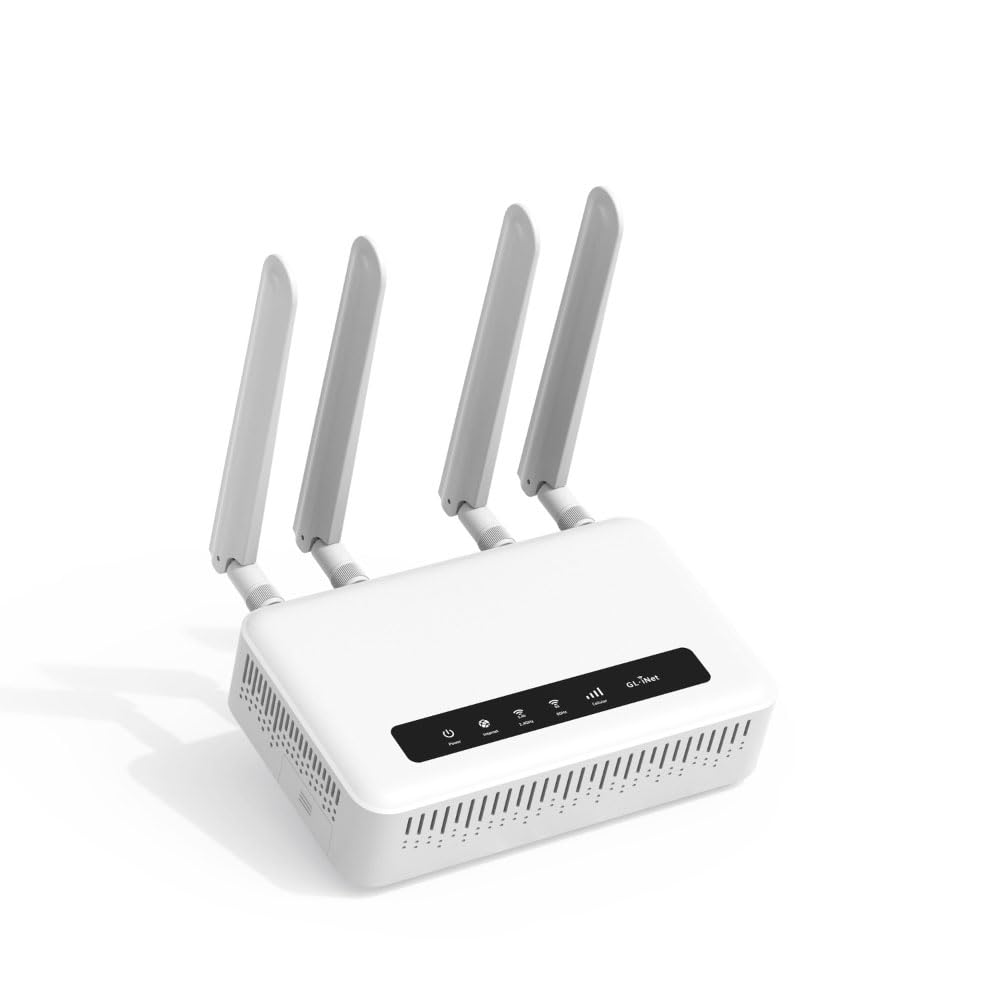
The fastest Wi-Fi and the smartest failover in one compact box, built for home or RV.
This is the only pick on the list with Wi-Fi 6, so your phones, laptops, and streaming devices get faster real-world throughput in crowded airspace. The GL-X2000 hits a combined wireless speed of up to 574Mbps on 2.4GHz plus 2402Mbps on 5GHz — a big jump over older AC routers. It also packs dual-SIM slots with single standby, so you can keep two carrier SIMs and set failover priorities between Cellular, Ethernet, Repeater, and Tethering. If one carrier drops, the router switches to the other without you lifting a finger.
Owners mention easy out-of-box setup with a Verizon SIM (just changed the APN), and RV owners say it integrates neatly with their Winegard 360 antenna. It is certified by both AT&T and T-Mobile, and the CAT 12 modem uses three-carrier aggregation (DL 3CA) to combine available bands for better speeds in fringe areas. The four SMA connectors let you swap or upgrade external antennas. On the security side, it hits a max VPN speed of 190 Mbps for WireGuard and 30 Mbps for OpenVPN — meaning your encrypted tunnel won’t throttle your connection.
What stands out
- Wi-Fi 6 delivers 2402 Megabits Per Second on 5GHz, outperforming every other model here on wireless speed.
- Dual-SIM with automatic carrier failover keeps internet alive if one network goes down.
- Four SMA connectors for external antennas, giving you room to boost weak signals.
One watch-out
- A few buyers had trouble maintaining a stable AT&T connection and reported no support response; carrier compatibility may require some initial tuning.
- No built-in battery — this unit needs constant wall power or a 12V RV circuit.
Who this fits: Anyone wanting the fastest wireless speed in a 4G router, especially RV owners or home users who want carrier diversity (dual-SIM failover) and future-proof Wi-Fi 6 without moving to 5G.
Where it falls short: If you need a battery for portable trips or you expect plug-and-play AT&T setup without tinkering, the Spitz Plus may need more manual configuration than you want.
2. GL.iNet GL-E750V2 (MUDI)

A pocket-sized travel hotspot with enough battery to last a workday away from the wall.
The GL-E750V2 is built for people who move: it weighs 285g, measures about the size of a phone, and packs a 7000mAh battery, versus 5000mAh in the GL-XE300 (Puli) model below. That translates to roughly 8 hours of continuous usage, enough for a hotel day, a co-working session, or a road-trip lunch break without hunting for an outlet. It runs dual-band Wi-Fi at 300Mbps on 2.4GHz plus 433Mbps on 5GHz, so you can park on the less congested 5GHz band when you need stable video calls.
The MUDI also doubles as a travel router for hotel Wi-Fi: you can connect to the hotel’s wired jack or public Wi-Fi, run a firewall, and tunnel everything through a VPN before it leaves the device. The built-in OpenVPN and WireGuard support makes it easy to secure your browsing on a sketchy cafe network. Buyers mention it works with Google Fi SIM (just change the APN to t-mobile), and one owner got speeds of 10–20 up and 50 down on a Metro by T-Mobile unlimited plan after setting TTL to 65. The USB-C port replicator and included worldwide plug adapters (US, EU, UK, AU) underline the travel-first design.
Battery capacity comparison: The 7000mAh battery is larger than the 5000mAh battery in the GL-XE300, making this the better pick when you cannot count on a power outlet.
The ideal match: Frequent travelers, digital nomads, and anyone who needs a secure personal Wi-Fi bubble in hotels, cafes, or Airbnbs — the battery and compact size make it a natural grab-and-go.
The trade-off: Some buyers found the device runs warm during extended use, and the battery weight (for its size) is noticeable compared to ultra-light hotspots. It also relies on internal antennas, so it cannot match an outdoor unit’s signal reach in truly remote areas.
3. GL-X750V2 (Spitz)

The certified AT&T/T-Mobile workhorse for a rock-solid backup WAN that costs a fraction of enterprise gear.
The Spitz is a 4G router that does one thing exceptionally well: sit quietly as a secondary connection and jump in when your main cable or fiber drops. It ships with the Quectel EC25-AFFA CAT4 module and is AT&T certified, meaning it is officially tested for AT&T IoT data plans. The data transfer rate hits 750 Megabits Per Second combining its 2.4GHz and 5GHz bands, and the dual Ethernet ports (10/100M) let you wire a single device directly. Customers note it works as a backup WAN on an Omada network with a Google Fi data SIM (T-Mobile), calling the failover smooth though slightly slow. Another owner replaced a costly Cradlepoint unit with this, praising the clean interface and SMS support — no subscription fees.
The device includes two SMA antennas for cellular, plus a MicroSD slot that supports up to 128GB for local file serving. OpenVPN and WireGuard are pre-installed and work with 30+ VPN providers. One note from the reviews: the firmware ships at version 3.104 and upgrading can be risky (some units cannot upgrade without bricking), so only update if you are comfortable with OpenWrt recovery methods. Also, while it works plug-and-play with T-Mobile SIMs, some buyers found AT&T and Cricket required extra steps like IMEI registration or 3G SIM swaps.
low-maintenance fit
- AT&T certified and T-Mobile compatible; supports all major North American LTE bands for wide rural coverage.
- OpenVPN and WireGuard pre-installed — secure VPN tunnels without extra hardware.
- MicroSD slot up to 128GB adds local network storage for a backup server.
Known friction points
- Firmware updates can brick the unit if not done carefully; older firmware configs get wiped on upgrade.
- No automatic band switching — you have to manually select the LTE band for best performance.
Best suited for: Home or small-office users who need a reliable, low-cost cellular failover that stays connected for months without attention — especially if you already use T-Mobile or Google Fi and want a no-subscription backup.
Less ideal if: You want the fastest possible cellular speeds (the CAT4 module is entry-level) or you dislike firmware risk. AT&T users should expect some initial compatibility fiddling.
4. GL.iNet GL-XE300 (Puli)

A battery-backed IoT gateway that converts 4G to 2.4GHz Wi-Fi for your remote sensors and devices.
The Puli is designed for industrial IoT use — think remote monitoring, sensor networks, or automation projects that need a cellular bridge. It runs only on 2.4GHz Wi-Fi (unlike the dual-band models above), but that is often fine for smart home gadgets and industrial controllers that do not support 5GHz anyway. The built-in 5000mAh battery keeps the network alive during short outages or lets you deploy it in the field without immediate power. Its data transfer rate is 300 Megabits Per Second on the single 2.4GHz band.
Reviewers point out extremely easy setup (~2 minutes) and praise the VPN kill switch plus the ability to combine multiple internet sources (4G LTE, LAN, and Wi-Fi repeater) into one reliable connection.
The GoodCloud remote management platform lets you monitor real-time statistics, manage clients, and even remote-SSH into IoT devices from anywhere. However, some shoppers say that the firmware V4 removed the file-sharing feature, so adding NAS-like functionality requires a microSD card or USB drive and manual OpenWrt configuration. A few users found the interface slow and had trouble staying connected to cellular — a risk if you need 100% uptime.
Best with a tech-savvy owner: While the initial setup is fast, unlocking the Puli’s full potential (file sharing, complex routing) needs OpenWrt knowledge. It is a capable tool, not a consumer appliance.
Reach for this if: You are running a sensor network, remote camera, or IoT project that needs 4G connectivity and a battery buffer, and you are comfortable with OpenWrt-level configuration.
Look elsewhere if: You want a simple home Wi-Fi router or a travel hotspot with fast 5GHz Wi-Fi (the faster, less-crowded band). This router uses only a single-band 2.4GHz radio (the slower but longer-range band), and its advanced features require a learning curve, so it is a specialized device for tech-savvy users.
5. Cudy Unlocked Outdoor 4G LTE Cat 4 Modem Router (LT500)

The weatherproof 4G router that mounts on a pole or wall and feeds internet to your remote outbuildings.
The Cudy LT500 is built for outdoor life — it has an IP65-rated waterproof housing and 4KV lightning protection, so it can sit on a pole, shed, or farm gate without shelter. It converts 4G LTE Cat 4 signal to dual-band AC1200 Wi-Fi (2.4GHz and 5GHz) and passes power and data over a single Ethernet cable using 24V passive PoE (the injector is included). That means you can run one cable up to 50 feet or more to where the best signal lives. The two detachable 5dBi cellular antennas give you the option to swap in higher-gain antennas for weak-signal areas.
Buyers report that the large external antennas provide over 20 dB better RSRP (Reference Signal Received Power) than a phone, and mounting the unit outdoors adds roughly 10 dB of signal gain compared to placing it indoors. The Cat 4 modem caps download speed at 150 Megabits Per Second, which is slower than the CAT 12 or Wi-Fi 6 models above but perfectly usable for streaming, web conferencing, and remote camera feeds. A few owners note the wall mount is substandard and the unit needs weatherproofing tape or O-rings on the antenna connections to stay sealed long-term. Customer support issues and a short refund window were also flagged by one reviewer.
Where it excels
- IP65 rating and lightning protection allow permanent outdoor installation without a separate weatherproof box.
- Passive PoE means a single Ethernet cable carries both power and data — clean installs at distance.
- Detachable SMA antennas let you upgrade to high-gain antennas for extremely weak signals.
Its limitations
- 4G LTE Cat 4 only (150 Megabits Per Second max) — not future-proof if faster cellular becomes available in your area.
- Lacks factory weatherproofing on the antenna connections; you will want to add dielectric grease or tape for long-term outdoor use.
- No battery backup — a power outage kills the connection unless you add a UPS.
Who should buy it: If your home’s cellular signal is weak indoors but strong just 20 feet up on a pole, this outdoor unit captures that signal and beams Wi-Fi back inside. Also a natural fit for farms, remote cabins, and construction trailers where cable internet is not an option.
Who should skip it: If you need the fastest 4G speeds (over 150 Mbps) or you want a portable battery-powered device you can take on the road, this stationary outdoor box is not the right shape.
Understanding the Specs
Cellular Category (Cat 4 vs Cat 6 vs Cat 12)
This number tells you how fast and efficiently the router talks to the cell tower. A Cat 4 modem (like inside the Cudy LT500 and the GL-X750V2 Spitz) tops out around 150 Mbps download — fine for streaming and video calls. A Cat 12 modem (like the GL-X2000 Spitz Plus) uses three-carrier aggregation (DL 3CA) to combine multiple signal bands at once, boosting total throughput and reliability in weaker signal zones. Higher Cat numbers generally mean better rural performance because the modem can stitch together whatever fragments of signal it can find.
Frequency Band: 2.4GHz vs 5GHz
Routers broadcast Wi-Fi on two radio bands. 2.4GHz travels farther through walls but is slower and more crowded (neighbors, Bluetooth, microwaves). 5GHz is faster and less congested but has a shorter range. A dual-band router gives you both: use 2.4GHz for reach and 5GHz for speed. The single-band routers in this list (Puli, Cudy LT500 on one band) save cost but limit your flexibility, especially if you have many devices competing for airtime.
FAQ
Will any 4G router work with my existing SIM card?
How do I know which 4G LTE bands my carrier uses in my area?
Can I use a 4G router without a landline or cable internet?
What is the difference between a 4G router and a mobile hotspot?
How long does a 4G router battery last away from power?
Do 4G routers support VPNs?
Can I mount a 4G router outdoors for better signal?
What is PoE and why does it matter for outdoor 4G routers?
Is Wi-Fi 6 worth getting on a 4G router?
What does dual-SIM mean on a 4G router?
Final Thoughts: The Verdict
For the majority of shoppers, the 4g router winner is the GL-X2000 Spitz Plus because it combines the fastest Wi-Fi 6 wireless performance with dual-SIM failover and strong VPN speeds in a compact package. If you want a travel-friendly hotspot with all-day battery life, grab the GL-E750V2 MUDI. And for a rugged outdoor installation where signal reach matters more than speed, the Cudy LT500 delivers with its PoE-powered IP65 weatherproof design.
How We Picked
We do not accept paid placement. Every pick is matched to a real buyer and a real use-case; we do not hands-on test units.
Sources & Methodology
Specifications: manufacturer listings and product documentation. Review insights: verified customer reviews, as of July 2026. Pricing: not shown on this page (it changes often); check the current price via the retailer link.
As an Amazon Associate, FitlyFast earns from qualifying purchases. This does not affect which products we feature.