
Our readers keep the lights on and the weekend projects moving. As an Amazon Associate, I earn from qualifying purchases.
Choosing a 4K audio receiver means deciding which HDMI 2.1 ports you actually need and whether room correction software like Dirac Live or Audyssey is worth the jump. Most buyers pick a unit that is either overpowered for their space or missing the codec support for their gaming console. This guide is built to match real-world speaker setups with the right amplifier stage and modern video pass-through capabilities.
I’m Rikta — the co-founder and writer behind FitlyFast. I’ve spent hundreds of hours analyzing the published specifications, certified power ratings, and real-world user signal-chain reports across the entire 4K audio receiver market to separate the models that deliver clean, audible power from those that rely on marketing wattage.
Your home cinema deserves a hub that passes 4K HDR without handshake issues and drives your speakers with headroom to spare. This guide identifies the best 4k audio receiver for each common room size and use case.
How To Choose The Best 4K Audio Receiver
Every 4K audio receiver sits at the intersection of video passthrough capability and audio channel count. Before you look at brand or price, define the number of speakers you plan to run and the video sources you own. A 5.2 channel receiver with HDMI 2.1 is a different tool than a 9.2 channel unit with premium room correction, even if both support 4K HDR.
Channel Count and Speaker Configuration
The first number tells you how many main speakers the receiver can power and process. A 5.2 unit drives left, center, right, surround left, and surround right plus two subwoofers. A 7.2 adds rear surrounds for a more enveloping bubble. If you want height channels for Dolby Atmos, look for a 5.2.2 or 7.2.2 designation, which uses two of the available channels for overhead or up-firing speakers. Never buy more channels than your room layout can physically accommodate — unused amplifier channels add no value.
HDMI Version and Video Features
HDMI 2.1 is the current baseline. It enables 4K video at 120 frames per second, essential for modern gaming consoles and PC gaming, and supports eARC for lossless audio pass-through from your TV. Check that the receiver supports HDCP 2.3 copy protection and HDR formats like Dolby Vision and HDR10+. Some units label “HDMI 2.1” but only run 24Gbps bandwidth instead of the full 40Gbps, limiting 4K/120Hz to compressed color. Confirm the specific bandwidth rating in the technical data sheet.
Room Correction Systems
Room correction software uses a microphone to measure how your speakers interact with the actual space and applies filters to flatten frequency response. Basic systems like YPAO handle distance and level adjustment. Mid-range options like Audyssey MultEQ provide multi-point measurement and filter application. Premium systems like Dirac Live analyze the full impulse response and correct time-domain issues, dramatically improving bass integration and stereo imaging. If your room has irregular shape or reflective surfaces, a receiver with Dirac Live or Audyssey MultEQ XT32 is worth the premium.
Power Output Realities
Manufacturers often quote power at a single channel driven or at a low impedance with high distortion. The spec that matters is the FTC-rated power with two channels driven at 8 ohms from 20Hz to 20kHz with no more than 0.08% total harmonic distortion. A receiver rated for 100 watts per channel under this standard will drive most tower speakers to satisfying levels in a medium room. Budget units that quote high wattage numbers typically cannot sustain that power into real speaker loads without audible distortion.
Quick Comparison
On smaller screens, swipe sideways to see the full table.
| Model | Category | Best For | Key Spec | Amazon |
|---|---|---|---|---|
| Denon AVR-S770H | 7.2 Channel | Balanced 7.1 Home Theater | 75W x 7 (8 ohm, 2ch driven) | Amazon |
| Denon AVR-S970H | 7.2 Channel | 8K Gaming & Turntable | 90W x 7 (8 ohm, 2ch driven) | Amazon |
| Onkyo TX-NR7100 | 9.2 Channel | Dirac Live Room Correction | 100W x 9 (8 ohm, 2ch driven) | Amazon |
| Sony STRAZ1000ES | 7.2 Channel | Sony 360 Spatial Sound | 100W x 7 (8 ohm, 2ch driven) | Amazon |
| Yamaha RX-V6A | 7.2 Channel | MusicCast Multi-Room | 100W x 7 (8 ohm, 1ch driven) | Amazon |
| Onkyo TX-NR6100 | 7.2 Channel | THX Certified 5.1.2 | 100W x 7 (6 ohm, 1ch driven) | Amazon |
| Yamaha RX-V4A | 5.2 Channel | Compact 5.1 with MusicCast | 80W x 5 (8 ohm, 1ch driven) | Amazon |
| Pioneer VSX-935 | 7.2 Channel | Dolby Atmos Height Virtualization | 80W x 7 (8 ohm, 1ch driven) | Amazon |
| JBL MA310 | 5.2 Channel | Budget-Friendly 5.1 Setup | 60W x 5 (8 ohm, 2ch driven) | Amazon |
| Sony STRDH590 | 5.2 Channel | Entry-Level 4K Pass-Through | 725W total, 6 ohm, 1KHz | Amazon |
| Marantz NR1510 | 5.2 Channel | Slim Chassis, Phono Input | 50W x 5 (8 ohm, 2ch driven) | Amazon |
In‑Depth Reviews
1. Denon AVR-S770H

The Denon AVR-S770H hits the sweet spot for a 7.1 or 5.1.2 home theater with 75 clean watts per channel. Its Audyssey MultEQ room correction measures at multiple points and applies filters that tighten bass and center dialogue significantly better than basic auto-setup systems found on entry-level receivers. The unit supports full HDMI 2.1 bandwidth at 40Gbps, enabling 4K/120Hz HDR from a PS5 or Xbox Series X without color compression.
Setup is guided through the on-screen interface, and the included Audyssey microphone stand makes calibration straightforward. The HEOS platform gives you Spotify, TIDAL, and Pandora streaming plus multi-room sync with Denon Home speakers. For vinyl enthusiasts, the phono input accepts a moving magnet turntable directly.
Some users report that the remote takes time to learn, and the advanced menu for speaker crossovers and channel trims is buried in the system settings rather than on the main screen. The firmware updates over Wi-Fi, but a few units have experienced HDMI handshake issues that require a full power cycle to resolve. For the majority of buyers building a balanced 7.1 theater, the AVR-S770H delivers the most features per watt.
Why it’s great
- Full 40Gbps HDMI 2.1 with 4K/120Hz and eARC
- Audyssey MultEQ room correction improves bass and imaging
- Built-in phono input for turntable
Good to know
- Advanced menu navigation is not intuitive
- Firmware updates can be slow over Wi-Fi
2. Denon AVR-S970H

The AVR-S970H steps up to 90 watts per channel across seven channels, giving it meaningful headroom for towers with lower sensitivity ratings. The additional watts matter most in medium-to-large rooms where reference-level peaks demand transient power without clipping. Like its sibling, it carries full 40Gbps HDMI 2.1 ports with support for VRR, ALLM, and QFT for lag-free gaming.
The built-in phono stage is tested to work cleanly with vintage turntables, and the HEOS app allows streaming to up to 32 zones if you build a Denon Home multi-room ecosystem. Users note the receiver runs cooler than comparable Onkyo units, with chassis temperatures hovering around 80 degrees Fahrenheit during extended movie playback. Dynamic Volume and Dynamic EQ from Audyssey let you tailor the sound for late-night listening without losing dialogue clarity.
Zone 2 power output is limited — using it drops the main room to 5 channels instead of 7. The remote lacks a dedicated TV power button, so you cannot program it to turn your display on and off directly. For gamers who need the extra wattage and turntable owners who want a single-box solution, the S970H justifies its position above the S770H.
Why it’s great
- 90W per channel handles lower-sensitivity speakers
- Full HDMI 2.1 gaming features (VRR, ALLM, QFT)
- Clean phono stage and HEOS multi-room
Good to know
- Zone 2 reduces main room to 5.1
- Remote lacks TV power button
3. Onkyo TX-NR7100
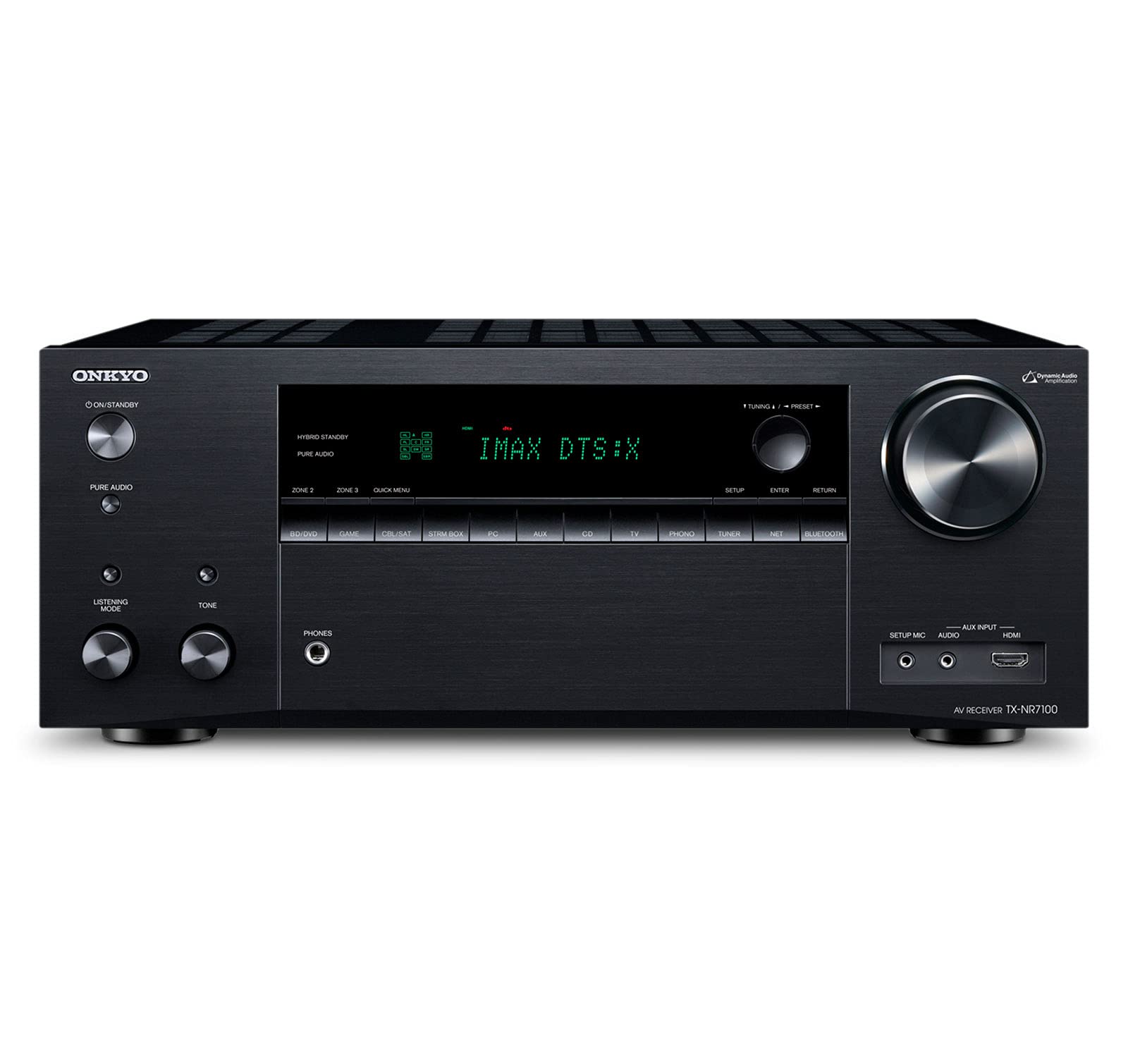
The Onkyo TX-NR7100 is the most affordable receiver to include Dirac Live room correction out of the box. Dirac Live analyzes the full impulse response of your speaker-room interaction and applies correction filters that fix time-domain smearing, delivering bass that is tighter and imaging that is more precise than Audyssey MultEQ XT32. This matters enormously in rooms with irregular dimensions or if your seating position is not equidistant from all speakers.
With nine channels of processing, you can run a 5.1.4 Atmos setup or a 7.1.2 configuration. The three HDMI outputs include a dedicated zone 2 output, allowing different 4K content in a second room. The receiver is THX Certified Select, meaning it meets strict distortion and output standards for reference-level home theater playback in medium-sized rooms. Gamers benefit from 4K/120Hz pass-through and VRR support across all input ports.
Dirac Live calibration is time-consuming — the recommended PC application process takes 30 to 45 minutes with multiple microphone positions. The remote is not backlit, and a small percentage of units have experienced HDMI processor failures after extended use. For the buyer who prioritizes room correction accuracy over anything else, the TX-NR7100 is unmatched at its price point.
Why it’s great
- Full Dirac Live room correction with impulse response analysis
- 9 channels for 5.1.4 Atmos or 7.1.2
- THX Select Certified with 6 HDMI 2.1 inputs
Good to know
- Dirac setup requires a computer and time
- Reported HDMI reliability concerns on some units
4. Sony STRAZ1000ES

Sony’s 360 Spatial Sound Mapping is the distinctive feature on the STRAZ1000ES. It creates phantom height and surround channels that fill gaps in your speaker layout, making a 5.1.2 system sound like a 7.1.4 array. The effect is most convincing with native Dolby Atmos content, where the algorithm places objects in three-dimensional space with unusual precision for a receiver that lacks physical rear height channels.
The unit delivers 100 watts per channel into 8 ohms with two channels driven, and the Digital Cinema Auto Calibration IX system measures up to 32 points to correct for room reflections and speaker distance. Sony includes a backlit remote, which relieves a common frustration found on competitors. Integration with Sonos systems is certified, so you can keep an existing Sonos ecosystem running alongside the receiver.
The ES series omits HDR10+ support, which matters if you own a Panasonic or Philips TV that favors that format over Dolby Vision. The chassis runs hot during operation — many owners add an external USB fan for ventilation. For the listener who values the immersive bubble that 360 Spatial Sound Mapping creates, the STRAZ1000ES offers a unique experience no other manufacturer replicates.
Why it’s great
- 360 Spatial Sound Mapping creates phantom height channels
- Backlit remote and Sonos certified
- 32-point calibration microphone included
Good to know
- No HDR10+ support
- Runs hot and may need external cooling
5. Yamaha RX-V6A

The Yamaha RX-V6A is built around the MusicCast multi-room system, which allows you to group the receiver with Yamaha wireless speakers and stream different sources to different rooms from one app. The seven HDMI inputs include three 8K-capable ports (40Gbps), making this receiver ready for future 8K sources while supporting 4K/120Hz HDR gaming today. YPAO R.S.C. room correction with multipoint measurement handles distance and level adjustment reliably.
Dolby Atmos and DTS:X are both supported, and the Height Virtualization feature creates up-firing effects without physical height speakers — useful if you cannot install ceiling channels. The build quality is robust, with a clean front panel and a volume knob that provides smooth, tactile feedback. Users report that the receiver drives 4-ohm speaker loads without overheating, a sign of a well-designed amplifier stage.
The setup menu feels dated compared to competitors, with text-heavy screens that require scrolling through submenus for basic adjustments like speaker crossover and trim levels. A small number of units have exhibited HDMI switching delays when cycling through inputs. For the multi-room music enthusiast who also wants solid home theater performance, the RX-V6A delivers the most streaming flexibility.
Why it’s great
- MusicCast multi-room with wireless speaker support
- Three 8K/40Gbps HDMI inputs
- Stable 4-ohm speaker drive capability
Good to know
- Menu interface is text-heavy and slow
- HDMI switching delay reported on some units
6. Onkyo TX-NR6100
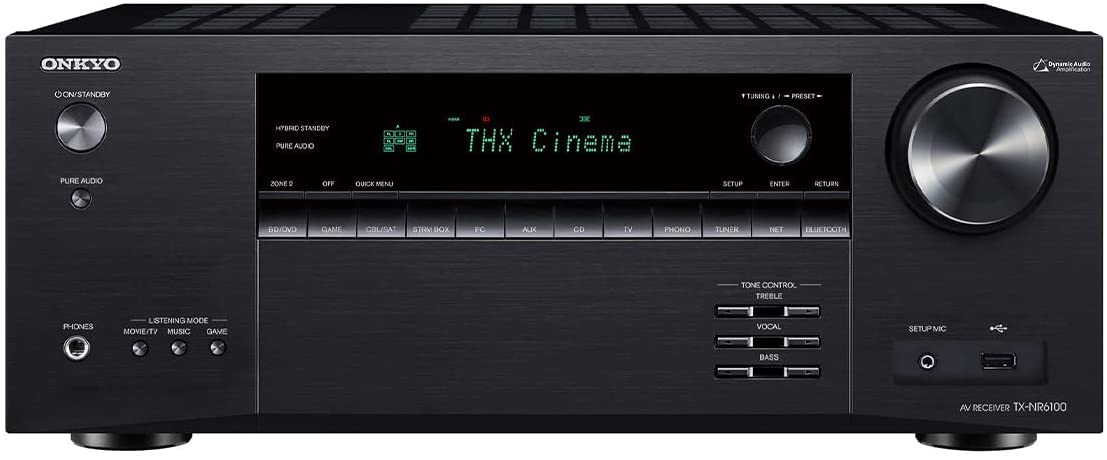
THX Select certification on the TX-NR6100 means the receiver meets rigorous distortion, output, and noise-floor standards for a reference-level home theater in a medium room. It includes 210 watts per channel (6 ohm, 1 kHz, 1ch driven), which translates to loud, clean output with high-sensitivity speakers. The unit supports Dolby Atmos and DTS:X with 5.2.2 channel configuration, plus IMAX Enhanced mode for IMAX-encoded discs.
Eight HDMI inputs provide ample connectivity for gaming consoles, streaming devices, and a Blu-ray player. 4K/120Hz and VRR support ensure smooth gaming with modern consoles. Users report that the Onkyo sounds more dynamic than comparable Denon units in the same price tier, with a wider soundstage and punchier bass response. The AccuEQ room calibration performs basic adjustments well, though it lacks the sophistication of Dirac Live or Audyssey.
The remote is not backlit, and the fan inside the chassis is audible during quiet movie passages — a clicking cycle every 30 minutes has been noted by several long-term owners. Inputs 4 through 6 are limited to 4K bandwidth (no 8K). For the buyer who wants a THX-certified foundation for a 5.1.2 system and values dynamic headroom, the TX-NR6100 delivers with authority.
Why it’s great
- THX Select certified for reference-level playback
- Dynamic, punchy sound compared to competitors
- Eight HDMI inputs with 4K/120Hz gaming support
Good to know
- Fan noise and clicking reported in quiet scenes
- Remote lacks backlighting
7. Yamaha RX-V4A

The Yamaha RX-V4A is a 5.2 channel receiver that packs MusicCast streaming, AirPlay 2, and HDMI 2.1 with eARC into a compact chassis. It handles 4K/60Hz signals smoothly, and the 8K60B label on the HDMI ports ensures backward compatibility with the latest sources. YPAO automatic room calibration measures speaker distances and levels in a few minutes, delivering a balanced soundstage without manual intervention.
Voice control works with Alexa, Google Assistant, and Siri, making it easy to switch inputs or adjust volume hands-free. The receiver drives bookshelf and tower speakers with clean, detailed sound — owners report excellent clarity with B&W and Klipsch speakers. Spotify Connect and TIDAL integration happen directly through the MusicCast app, bypassing Bluetooth compression.
HDMI switching has been problematic for some users, with reports of the receiver failing to pass 4K video to certain displays or experiencing handshake dropouts. The small remote buttons are hard to locate in low light. For a compact 5.1 system that prioritizes streaming services and voice control, the RX-V4A offers a well-rounded feature set at a mid-range entry point.
Why it’s great
- MusicCast multi-room with AirPlay 2 and Spotify Connect
- YPAO calibration provides quick, reliable setup
- Voice control with Alexa, Google, and Siri
Good to know
- HDMI handshake issues reported with some displays
- Remote buttons are small and not backlit
8. Pioneer VSX-935
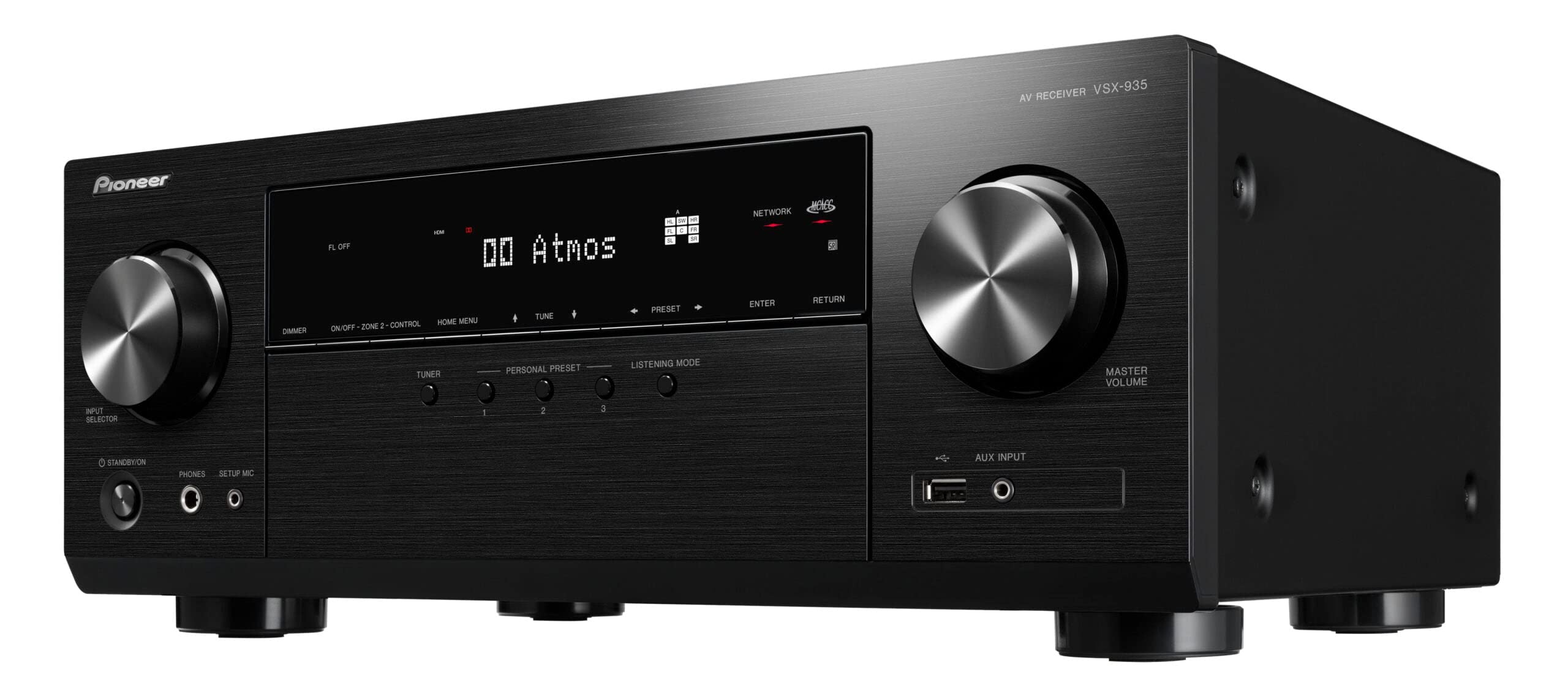
The Pioneer VSX-935 uses Dolby Atmos Height Virtualization to simulate overhead effects from standard ear-level speakers, making it a strong choice for rooms where ceiling installation is impossible. The 7.2 channel amplifier powers a 5.1.2 configuration with real height speakers if you choose to install them, or you can rely on the virtualization engine alone. HDMI 2.1 inputs support 4K/120Hz and 8K/60Hz pass-through for future-proof gaming.
Bi-directional Bluetooth lets you stream music to the receiver or send the receiver’s audio to wireless headphones — useful for late-night listening without disturbing others. The remote is RF-based, meaning it works through walls and cabinets without line of sight. Owners report crisp, clear dialogue and a spacious soundstage that exceeds expectations for the price category.
The Bluetooth implementation is two-way but finicky — some users find the pairing process unintuitive, and there is no dedicated Bluetooth button on the front panel. A few units have arrived with display or sound issues that required replacement. For the shopper who needs height virtualization without ceiling speakers and appreciates RF remote range, the VSX-935 delivers unique value.
Why it’s great
- Dolby Atmos Height Virtualization for no-ceiling rooms
- RF remote works through walls
- Bi-directional Bluetooth with headphone support
Good to know
- Bluetooth two-way setup is unintuitive
- QC variability with some defective units
9. JBL MA310

The JBL MA310 is a 5.2 channel receiver that focuses on core functionality at a controlled price point. It delivers 60 watts per channel with 5.2 native decoding of Dolby and DTS formats, and the shallow chassis depth fits media consoles where full-size receivers do not. HDMI ARC simplifies TV audio connection, and four HDMI inputs handle the essential sources: a streaming box, a game console, a Blu-ray player, and a cable box.
Setup is performed through the on-screen display, and the JBL auto-calibration adjusts speaker levels and distances for a balanced starting point. Users powering in-wall speakers and budget towers note that the sound quality is impressive for the investment, with clean highs and controlled bass when paired with a powered subwoofer. Bluetooth 5.1 with Low Energy provides wireless streaming from any smartphone.
The receiver does not feature HDMI 2.1, limiting gaming to 4K at 60Hz without VRR support. The remote is not backlit, and some owners find the auto-shutoff default frustrating — it kicks in after 20 minutes of inactivity unless changed in the menu. For a straightforward 5.1 system where 4K pass-through and decent amplification are the only requirements, the MA310 works reliably.
Why it’s great
- Shallow chassis fits tight media cabinets
- HDMI ARC for easy TV audio connection
- Clean sound with 5-channel surround decoding
Good to know
- HDMI 2.0 only (no 4K/120Hz or VRR)
- Auto shut-off default is short and menu change required
10. Sony STRDH590
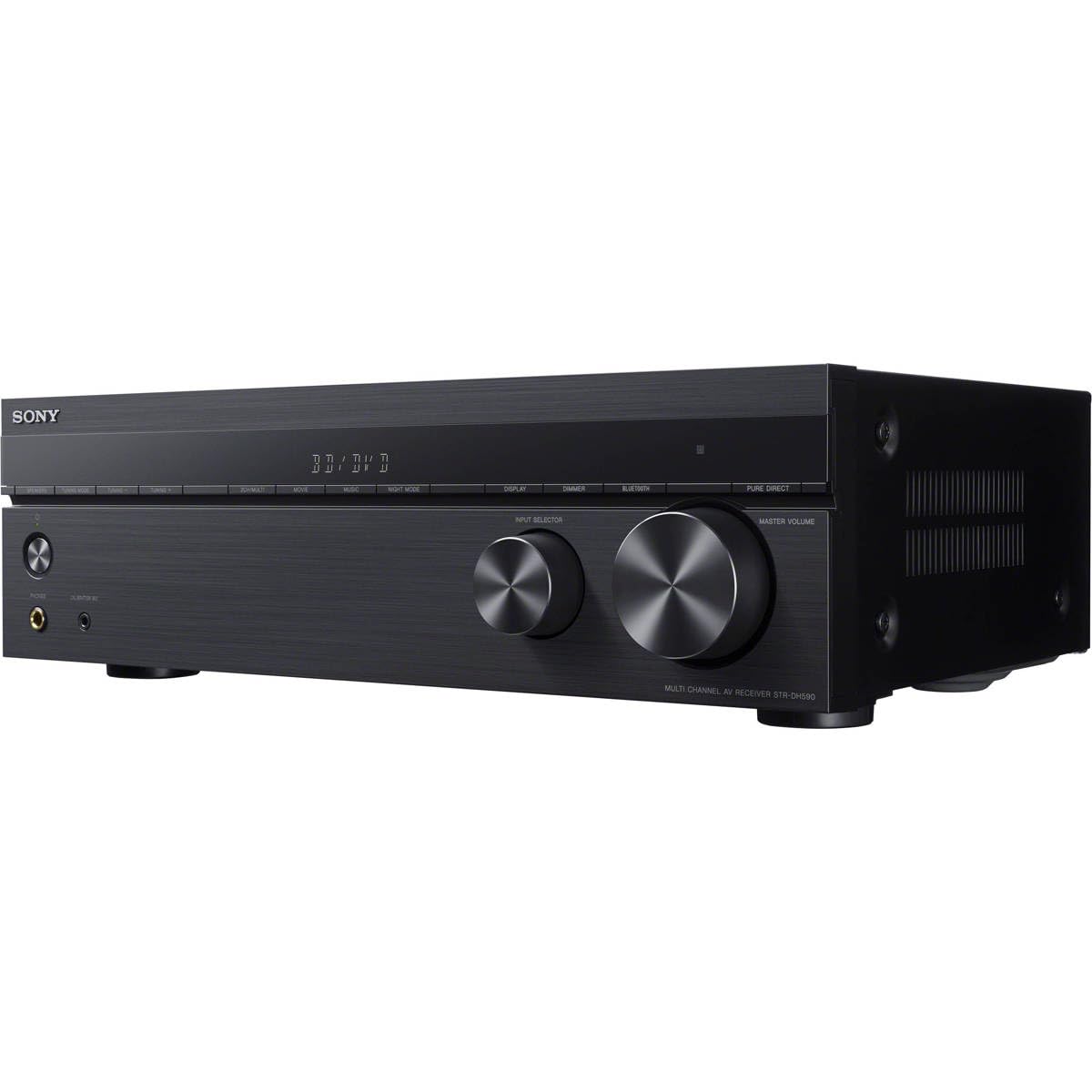
The Sony STRDH590 is an entry-level 5.2 channel receiver that provides 4K HDR pass-through with HDCP 2.2 support at an accessible starting point. Its S Force PRO front surround technology creates a virtual surround effect from just two front speakers, useful for small rooms or starter setups. The unit includes a built-in FM tuner and a 1/4-inch headphone jack for private listening.
Setup is straightforward via the on-screen menu, and the auto-calibration microphone adjusts speaker levels and distances in a few minutes. Users report clean sound with KEF and Optimus speakers, and the analog input jacks accommodate legacy components like CD players and tape decks. The slim chassis generates less heat than larger receivers and fits into standard AV furniture without ventilation concerns. The digital preset modes for stadium, concert, and jazz environments add a fun twist to music playback.
The receiver lacks HDMI 2.1, HDMI eARC, and any streaming platform — you need an external device for Spotify or TIDAL. The analog input jacks are closely spaced, making it difficult to grip RCA plugs during connection. For the buyer building a first 4K system with only a Blu-ray player and a game console, the STRDH590 covers the essentials without complexity.
Why it’s great
- Virtual front surround works with 2 speakers
- 4K HDR pass-through with HDCP 2.2
- Low heat output in a slim chassis
Good to know
- No HDMI 2.1, no eARC, no streaming
- Tight spacing on analog input jacks
11. Marantz NR1510

The Marantz NR1510 is a 5.2 channel receiver packed into a 4-inch tall chassis that fits easily into shallow or open-sided entertainment units. It includes a moving magnet phono input for turntable connection, making it a rare slim receiver that supports vinyl playback directly. The 50 watts per channel are conservatively rated and deliver clean, musical sound that many owners describe as making their existing speakers sound like an upgrade.
HEOS built-in enables multi-room streaming with Spotify, TIDAL, and TuneIn, plus voice control through Alexa, Google Assistant, and Siri. The six HDMI inputs all support 4K/60Hz HDR with eARC and Dolby Vision, though they are limited to HDMI 2.0 bandwidth rather than 2.1. The advanced graphical setup assistant walks you through connection and calibration step by step, reducing the learning curve for first-time AV receiver buyers.
HDMI 2.0 means no 4K/120Hz gaming support from a PS5 or Xbox Series X. The chassis runs warm during use and requires at least three inches of ventilation above the top panel. For the listener who wants a compact, attractive receiver with turntable support and excellent sound quality for music and movies, the NR1510 delivers a premium aesthetic and audio performance.
Why it’s great
- Slim 4-inch chassis fits shallow cabinets
- Built-in phono input for turntable
- HEOS multi-room streaming and voice control
Good to know
- HDMI 2.0 only (no 4K/120Hz gaming)
- Runs warm; needs ventilation space above
FAQ
How many HDMI 2.1 ports do I need for a PS5 and Apple TV 4K?
Can I use a 4K audio receiver with a standard 1080p TV?
What is the practical difference between Dolby Atmos with height speakers and virtual height virtualization?
Do I need a separate amplifier if my receiver is 60 or 75 watts per channel?
Final Thoughts: The Verdict
For most users, the best 4k audio receiver winner is the Denon AVR-S770H because it combines full HDMI 2.1 bandwidth, Audyssey MultEQ room correction, and a phono input at a balanced price point that works for 7.1 or 5.1.2 setups. If you want Dirac Live room correction that transforms difficult rooms, grab the Onkyo TX-NR7100. And for a slim chassis with turntable support that still sounds premium, nothing beats the Marantz NR1510.