
Our readers keep the lights on and the weekend projects moving. As an Amazon Associate, I earn from qualifying purchases.
The difference between amateur-looking footage and a professional-grade finished video often comes down to three things: stabilization, sensor size, and the lens’s optical reach. Whether you’re capturing a travel documentary, filming a sports event, or building a YouTube channel, the camera you choose dictates every creative constraint you’ll face in the field. A camcorder that can’t hold a steady frame in low light or falters on autofocus during a fast zoom will waste your time and ruin your clips.
I’m Rikta — the co-founder and writer behind FitlyFast. I’ve spent hundreds of hours analyzing technical specifications, comparing sensor architectures, and studying real-world performance data across dozens of models in this category to separate genuine pro features from marketing hype.
Whether you need a pocket gimbal camera for daily vlogging or a broadcast-ready body for live event production, this guide breaks down the critical specs, ergonomic trade-offs, and hidden limitations you must know before choosing your best 4k camcorder.
How To Choose The Best 4K Camcorder
Selecting a 4K camcorder is a trade-off between physical size, sensor performance, stabilization method, and lens range. Understanding these four pillars will prevent you from overpaying for specs that don’t match your shooting environment.
Sensor Size vs. Low-Light Performance
A larger sensor gathers more light, which directly reduces noise at higher ISO settings. A 1-inch CMOS sensor (found on premium pocket gimbal models and pro camcorders like the Canon XA70 and Panasonic HC-X2) will deliver significantly cleaner footage in dimly lit venues, sunsets, or indoor event halls compared to a 1/2.3-inch or 1/2.5-inch sensor. If you shoot mostly outdoors in daylight, a smaller sensor with good lens optics can still produce excellent results. For indoor or evening work, prioritize a 1-inch sensor or larger.
Optical Zoom: The Only Zoom That Matters
Digital zoom crops into the sensor and degrades resolution — it is a marketing number, not a real capability. Optical zoom is what brings distant subjects into clear, detailed view. A camcorder with 15x to 20x optical zoom (like the Canon VIXIA HF G70 or the Panasonic HC-X2) gives you genuine reach for sports, wildlife, or stage performances. Pocket gimbal cameras with fixed wide-angle lenses cannot zoom optically; they rely on cropping or lossless digital zoom that works only at specific resolutions. If you need to get close without moving your feet, optical zoom is non-negotiable.
Stabilization: Gimbal vs. Electronic vs. Optical
Three-axis mechanical gimbal stabilization (as in the DJI Osmo Pocket 3 and Insta360 Luna Ultra) delivers the smoothest footage for walking, running, or handheld pans. It physically moves the camera module to cancel shake, so there is no image crop or loss of field of view. Optical image stabilization (OIS) inside the lens shifts glass elements, which is effective for small corrections on traditional camcorders but cannot match gimbal-level smoothness for active movement. Electronic stabilization (EIS) crops the frame and can introduce a floating or warped effect in high-motion scenarios. Match the stabilization type to your typical movement: gimbal for walking-and-talking vlogs, OIS for locked-off tripod or slow pan shots.
Audio Inputs and Codec Depth
Professional productions demand high-fidelity audio and color-grading flexibility. Camcorders with XLR inputs (such as the Canon XA70) allow you to connect broadcast-quality microphones without adapters. Meanwhile, a 10-bit 4:2:2 internal recording profile (available on the Blackmagic Pocket Cinema Camera 4K and the Panasonic HC-X2) provides the tonal latitude needed for color correction without banding or posterization. If you plan to grade your footage or need pristine audio, these features justify the price jump over entry-level consumer bodies.
Quick Comparison
On smaller screens, swipe sideways to see the full table.
| Model | Category | Best For | Key Spec | Amazon |
|---|---|---|---|---|
| DJI Osmo Pocket 3 Vlog Combo | Pocket Gimbal | Vlogging & travel | 1-inch CMOS, 4K/120fps | Amazon |
| Insta360 Luna Ultra | Pocket Gimbal | Cinematic 8K vlogging | 1-inch + 1/1.3″ dual Leica lenses | Amazon |
| Xtra Muse | Pocket Gimbal | Budget gimbal shooting | 1-inch CMOS, 4K/120fps | Amazon |
| DJI Osmo Action 6 | Action Camera | Underwater & high-impact sports | 1/1.1″ sensor, 8K, f/2.0–f/4.0 | Amazon |
| Sony FDR-AX43 | Traditional Handycam | Family events & travel | 20x optical zoom, Balanced OIS | Amazon |
| Canon VIXIA HF G70 | Traditional Handycam | Event recording with time stamp | 20x optical zoom, DIGIC DV6 | Amazon |
| ORDRO M5 | Handheld Gimbal | Entry-level vlogging | 3-axis gimbal, 5K/30fps | Amazon |
| Xtra Edge Pro Dual Battery Bundle | Action Camera | Outdoor adventures | 65ft waterproof, 4K/60fps | Amazon |
| Blackmagic Pocket Cinema 4K | Cinema Camera | Film & post-production | 4/3″ sensor, 13 stops DR | Amazon |
| Canon XA70 Pro | Professional Handycam | Interviews & live streaming | 1″ sensor, 15x optical, XLR | Amazon |
| Panasonic HC-X2 | Professional Handycam | Broadcast & events | 1″ sensor, 20x optical, SDI | Amazon |
In‑Depth Reviews
1. DJI Osmo Pocket 3 Vlog Combo
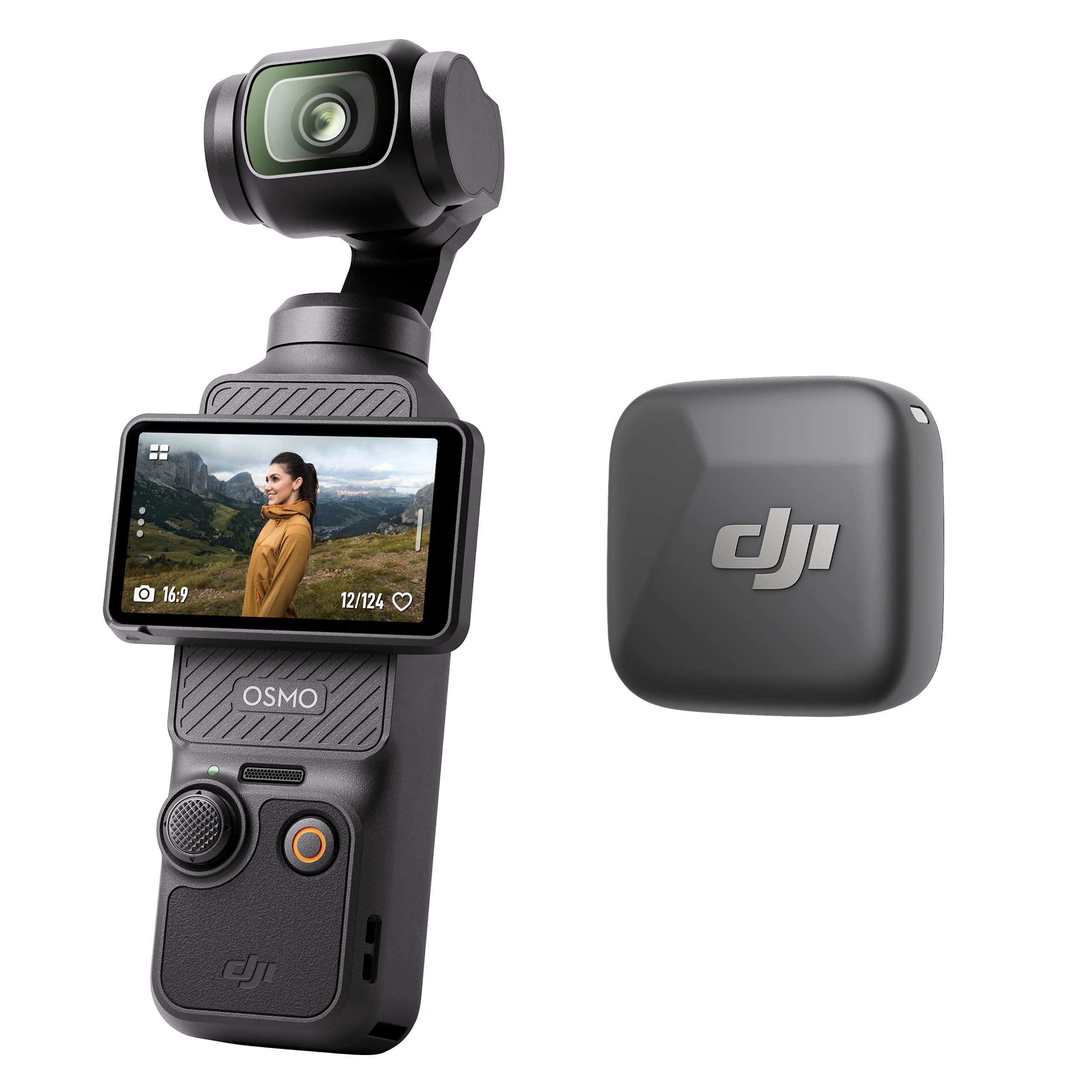
The DJI Osmo Pocket 3 remains the benchmark for pocket-sized 4K capture thanks to its 1-inch CMOS sensor and true 3-axis mechanical gimbal. This combination delivers cinematic stabilization — the camera physically floats the lens module so that walking, running, or panning produces fluid footage without the cropped-in, warpy look of electronic stabilization. The ActiveTrack 6.0 subject tracking keeps you or a moving target center-frame even during dynamic movement, making solo vlogging effortless. Recording at up to 4K/120fps lets you create smooth slow-motion clips without sacrificing resolution.
The Vlog Combo bundle includes a DJI Mic Mini transmitter, which pairs directly to the Pocket 3 using DJI OsmoAudio technology — no receiver dongle required. This tight integration means the camera automatically switches audio channels when you turn on the mic, and the battery life of the Mic Mini covers full-day shoots. The rotating 2-inch touchscreen also flips for vertical video framing, a practical feature for multi-platform content creators who post to both YouTube and TikTok or Instagram Reels.
Where the Pocket 3 falls short is optical reach: its fixed wide-angle lens cannot zoom optically, so distant subjects appear small unless you crop in post-production, which lowers effective resolution. Additionally, the battery is sealed and non-user-swappable, so long event coverage requires a power bank tethered via the USB-C PD port. For narrative vloggers and travel creators who prioritize stabilization and color depth (D-Log M 10-bit), these trade-offs are easily managed. For sports and wildlife shooters needing zoom, a traditional handycam is more suitable.
Why it’s great
- True 3-axis mechanical gimbal delivers class-leading smoothness
- 1-inch sensor provides excellent low-light performance and detail
- Seamless DJI Mic Mini integration with no receiver
Good to know
- No optical zoom; relies on digital crop
- Non-replaceable battery requires external power for long sessions
2. Panasonic HC-X2

The Panasonic HC-X2 is a professional shoulder-mount camcorder engineered for news, corporate video, and event production where reliability and optical performance are non-negotiable. Its 1-inch MOS sensor records 4K 60p 4:2:2 10-bit internally, giving colorists the latitude to push shadows and highlights in post without introducing banding artifacts. The integrated 24.5mm wide-angle lens with 20x optical zoom provides genuine telephoto reach, reaching an equivalent of 490mm at the long end — essential for capturing speakers on stage or athletes on a field without moving the tripod.
Broadcast connectivity is a standout feature here: the HC-X2 includes a 3G-SDI output for sending a clean feed to a live switcher or an external monitor, plus an HDMI output and built-in Ethernet for wired live streaming. Dual XLR inputs with independent volume controls let you connect a wireless lavalier and a shotgun mic simultaneously, recording each to separate channels for post-production flexibility. The 5-axis HYBRID O.I.S. stabilization works effectively for handheld work, though it cannot match the fluidity of a mechanical gimbal for walking shots.
The primary drawback for enthusiasts is the price — this is a genuine professional tool with a professional cost. It also ships without a battery, so you must budget for multiple V-Mount or BP-style packs. The autofocus system, while accurate, is contrast-detection rather than phase-detect, which can hunt slightly in very low light or low-contrast scenes. For filmmakers who need a robust, feature-complete camcorder for daily client work, the HC-X2 justifies its investment through durability and expanded interface options.
Why it’s great
- 20x optical zoom with wide 24.5mm starting angle
- 3G-SDI output and Ethernet for live broadcast workflows
- 4:2:2 10-bit internal recording for robust color grading
Good to know
- No battery included in the box
- Contrast-detect AF can struggle in dim conditions
3. Insta360 Luna Ultra
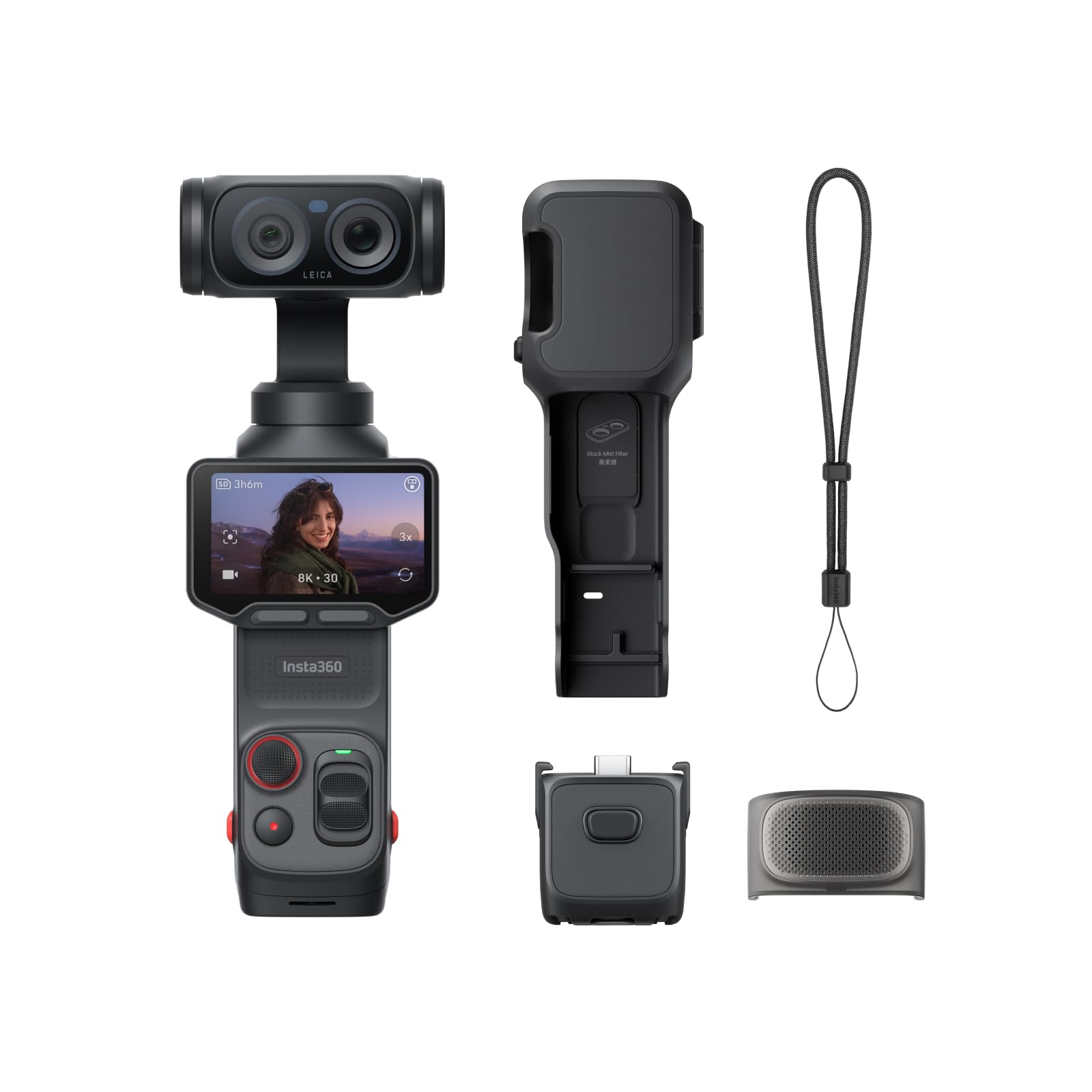
The Insta360 Luna Ultra pushes the pocket gimbal concept further by integrating dual Leica lenses — a 1-inch main sensor for wide-angle and a 1/1.3-inch telephoto sensor offering up to 6x lossless zoom with natural optical bokeh. This dual-lens design solves the biggest limitation of other pocket cameras: the ability to get closer to the subject without degrading image quality. It records 8K HDR video at 30fps with Dolby Vision support, capturing 14 stops of dynamic range that preserves highlight and shadow detail in high-contrast scenes like sunsets or indoor windows.
The detachable 2-inch OLED touchscreen is a genuinely innovative feature for solo creators. You can remove the screen and control the camera wirelessly from up to 20 meters away, which is incredibly useful for group vlogging, tripod-based monologues, or mounting the camera in tight spaces where you can’t see the screen. The 3-axis gimbal stabilization pairs with AI subject tracking to keep you centered while walking or moving. With a battery that lasts up to 4 hours and fast charging to 80% in 23 minutes, downtime between shoots is minimal.
Early adopter reports mention firmware-related glitches, such as a “switch to touchscreen” message freezing the camera and teething issues with zoom transitions. The camera also requires a micro SD card with high write speeds, and the remote screen connection can be disrupted by debris on the contact pins. These are beta-era quirks that Insta360 will likely resolve through updates, but for now, they introduce a reliability gap compared to the more mature DJI Osmo Pocket 3. If you need 8K resolution and optical zoom range in a gimbal body, this is the only current option.
Why it’s great
- Dual Leica lenses provide real optical zoom and bokeh
- Detachable touchscreen for remote framing up to 20m away
- 8K Dolby Vision with 14-stop dynamic range
Good to know
- Early firmware can cause freezing and zoom glitches
- Requires fast micro SD; contact pins need cleaning
4. Blackmagic Pocket Cinema Camera 4K Power Bundle

The Blackmagic Pocket Cinema Camera 4K (BMPCC 4K) is a cinema camera first and a camcorder second, designed around the Micro Four Thirds lens mount that allows you to use interchangeable glass from Olympus, Panasonic, Sigma, and others. Its 4/3-inch sensor delivers 13 stops of dynamic range and dual native ISO up to 25,600, making it the best choice on this list for controlled lighting environments where you need maximum flexibility in color grading. The Power Bundle includes two additional LP-E6 batteries and a dual charger, which is essential since the stock battery life is limited to roughly 45 minutes of recording.
Recording options are extremely versatile: you can write 12-bit Blackmagic RAW internally to CFast 2.0 or SD UHS-II cards, or connect an external SSD via USB-C for extended recording times without card swaps. The included DaVinci Resolve Studio license (normally a significant expense) unlocks professional color tools. The 5-inch touchscreen is bright and detailed, eliminating the need for an external monitor for framing and focus checks. Mini XLR input with phantom power lets you connect a boom mic or high-end shotgun for broadcast-level audio.
The trade-off for this image quality is ergonomic. The BMPCC 4K lacks a built-in lens, built-in ND filters, and any form of optical zoom — you must rig it with a cage, rods, and external power for field use, which quickly becomes heavier and more complex than a traditional camcorder. Autofocus performance is also limited compared to modern phase-detect systems; manual focus is the reliable method. This camera belongs in the hands of serious filmmakers who already own MFT lenses and understand raw workflows, not casual event shooters.
Why it’s great
- 13-stop dynamic range and dual native ISO for cinema-grade flexibility
- 12-bit Blackmagic RAW internal recording with DaVinci Resolve license
- Interchangeable MFT lens mount for creative customization
Good to know
- No built-in lens or ND filters; requires additional rigging
- Short battery life demands extra packs or external power
5. Canon XA70 Pro Camcorder

The Canon XA70 bridges the gap between high-end consumer camcorders and professional broadcast cameras by packing a 1-inch CMOS sensor with Dual Pixel CMOS AF (phase-detection) into a compact handycam body. The 15x optical zoom lens starts at a wide 25.5mm equivalent, and the DIGIC DV6 processor enables 4K UHD recording in XF-AVC or MP4 formats. Phase-detection autofocus makes this camcorder exceptionally responsive when tracking moving subjects like presenters pacing a stage or children running through a park — no hunting, no pulsing.
Professional audio is handled by the detachable handle unit with two XLR terminals, each with independent gain control and phantom power. This eliminates the need for external audio recorders or adapters when using a lavaliere and a shotgun mic simultaneously. The XA70 also supports UVC live streaming over USB-C, allowing you to send a clean 1080p video feed directly to a computer for webinars, church services, or live events without a capture card. The built-in infrared and optical image stabilization is sufficient for handheld work at the wide end, though it struggles to suppress shake fully at maximum telephoto.
The biggest complaint among users is the low-resolution EVF and LCD monitor, which makes it difficult to judge fine focus or color accuracy in the field. The three ND filter options (1/4, 1/16, 1/64) are helpful for controlling exposure in bright light, but the filters themselves have been reported to produce a barely visible effect, which limits their utility. For run-and-gun documentary work where autofocus reliability and XLR audio matter more than pixel-peeping the viewfinder, the XA70 is a strong mid-range professional choice.
Why it’s great
- Dual Pixel CMOS AF delivers fast, reliable phase-detection autofocus
- Dual XLR inputs with phantom power on the detachable handle
- UVC live streaming over USB-C without a capture card
Good to know
- Low-resolution viewfinder and LCD make critical focus checking difficult
- ND filters have minimal visible effect on footage
6. Sony FDR-AX43 UHD 4K Handycam

The Sony FDR-AX43 is a traditional handycam that prioritizes optical reach and stabilized long-range shooting. Its 20x optical ZEISS Vario-Sonnar T zoom lens extends to 30x Clear Image Zoom in 4K and 40x in HD, making it an ideal choice for parents filming school plays, travelers capturing wildlife, or documenters of sports events where the subject is far away. The Balanced Optical SteadyShot image stabilization uses a floating lens element to correct shake across five axes, and it works admirably for handheld pans and moderate walking — though it won’t match a gimbal for running shots.
The 1/2.5-inch Exmor R CMOS sensor and BIONZ X processor prioritize good color science and low noise at base ISO, but they are physically smaller than the 1-inch sensors found in premium models, so low-light performance degrades noticeably above ISO 1600. The camcorder includes Fast Intelligent AF, which locks onto faces quickly in good light, but it is a contrast-detection system that can lose lock in dim environments. Built-in Wi-Fi and NFC enable remote control via a smartphone app and easy file transfer, though the app interface feels dated compared to modern camera companion apps.
Physical ergonomics are a mixed bag. The battery pack protrudes from the rear of the body, which makes the camera feel unbalanced on a selfie stick or small tripod. The camcorder also has no internal memory, so you must provide a memory card before first use. Date and time reset quickly after battery removal, a minor annoyance for archival purposes. For the user who wants a point-and-shoot 4K handycam with genuine 20x optical zoom and reliable stabilization for daytime outdoor events, the AX43 delivers solid, predictable performance without complicated menus.
Why it’s great
- 20x optical zoom with Clear Image Zoom for digital reach
- Balanced Optical SteadyShot provides smooth handheld pans
- Compact, familiar handycam form factor
Good to know
- Small 1/2.5-inch sensor leads to noise in low light
- Protruding battery makes it awkward on selfie sticks
7. Canon VIXIA HF G70

The Canon VIXIA HF G70 is a traditional camcorder that serves event and wedding videographers who need long recording times, manual control rings, and a time-stamp on-screen display (OSD) for legal or archival purposes. The 1/2.3-inch 4K UHD CMOS sensor paired with the DIGIC DV6 processor produces sharp 4K/30fps footage with natural Canon color science, and the 20x optical zoom lens provides real telephoto reach at the long end. An 8-blade aperture creates cinema-style bokeh for out-of-focus highlights, a feature usually reserved for higher-end camcorders.
One of the strongest selling points is the UVC livestreaming capability, which lets you plug the camera into a PC or Mac via USB-C and immediately use it as a high-quality webcam for live services, lectures, or streaming events — no capture card or additional software required. The dual SD card slots support relay or simultaneous recording, which is crucial for ceremonies or performances that cannot be paused for card swaps. The Hybrid AF system with face detection locks onto subjects quickly and smoothly in good light, though it can hunt in very low-contrast scenes.
The primary weakness is low-light performance: the small 1/2.3-inch sensor shows visible gain noise above ISO 800, and the image becomes significantly softer above ISO 1600. Reviewers report background jitter in 4K autofocus, which resolves when switching to 1080p. The lack of an external ND filter system means you must rely on electronic shutter adjustment to control exposure in bright sunlight. For shooters who work primarily in well-lit indoor environments or daytime outdoor events and need reliable long-session recording with optical zoom, the HF G70 is a cost-effective workhorse.
Why it’s great
- 20x optical zoom with 8-blade aperture for natural bokeh
- UVC livestreaming via USB-C for instant webcam use
- Dual SD card slots for relay and simultaneous recording
Good to know
- Smaller sensor struggles with noise above ISO 800
- 4K autofocus can show background jitter; better in 1080p
8. Xtra Muse

The Xtra Muse positions itself as a budget-friendly alternative to the DJI Osmo Pocket 3, offering many of the same headline specs — a 1-inch CMOS sensor, 4K resolution at 120fps, and a 3-axis mechanical gimbal — at a significantly lower cost. The 2-inch touchscreen rotates for horizontal or vertical framing, and the Master Follow feature uses face and object tracking to keep you centered while moving. For beginner vloggers or casual travel shooters who want gimbal-smooth footage without paying the DJI premium, the Muse delivers usable results straight out of the box.
True 10-bit X-Log color mode enables basic color grading, though the dynamic range is noticeably narrower than the DJI Pocket 3 — highlight clipping occurs faster in high-contrast scenes. The battery lasts approximately 161 minutes, which is adequate for a day of casual shooting, and the included handle with a 1/4-inch thread allows standard tripod mounting. Autofocus and subject tracking are responsive in good light but can lose lock on fast-moving subjects, especially in scenes with low contrast between the subject and background.
Build quality and accessory compatibility are where the cost savings become apparent. The gimbal’s stabilization is effective but not as fluid as the DJI equivalent; micro-jitters can appear during fast pans. Several users report that DJI Pocket 3 accessories work with the Muse’s body dimensions, which is helpful since the Muse has fewer dedicated accessories available. For the creator who needs pocketable gimbal footage on a strict budget and is willing to accept slightly softer tracking and narrower dynamic range, the Xtra Muse represents the entry point into this form factor.
Why it’s great
- 1-inch sensor with 3-axis mechanical gimbal at an entry-level price
- Rotating touchscreen for horizontal and vertical shooting
- 10-bit X-Log color mode for basic grading
Good to know
- Stabilization less fluid than DJI Pocket 3; micro-jitters in fast pans
- Dynamic range narrower than premium competition
9. DJI Osmo Action 6 Enhanced Combo
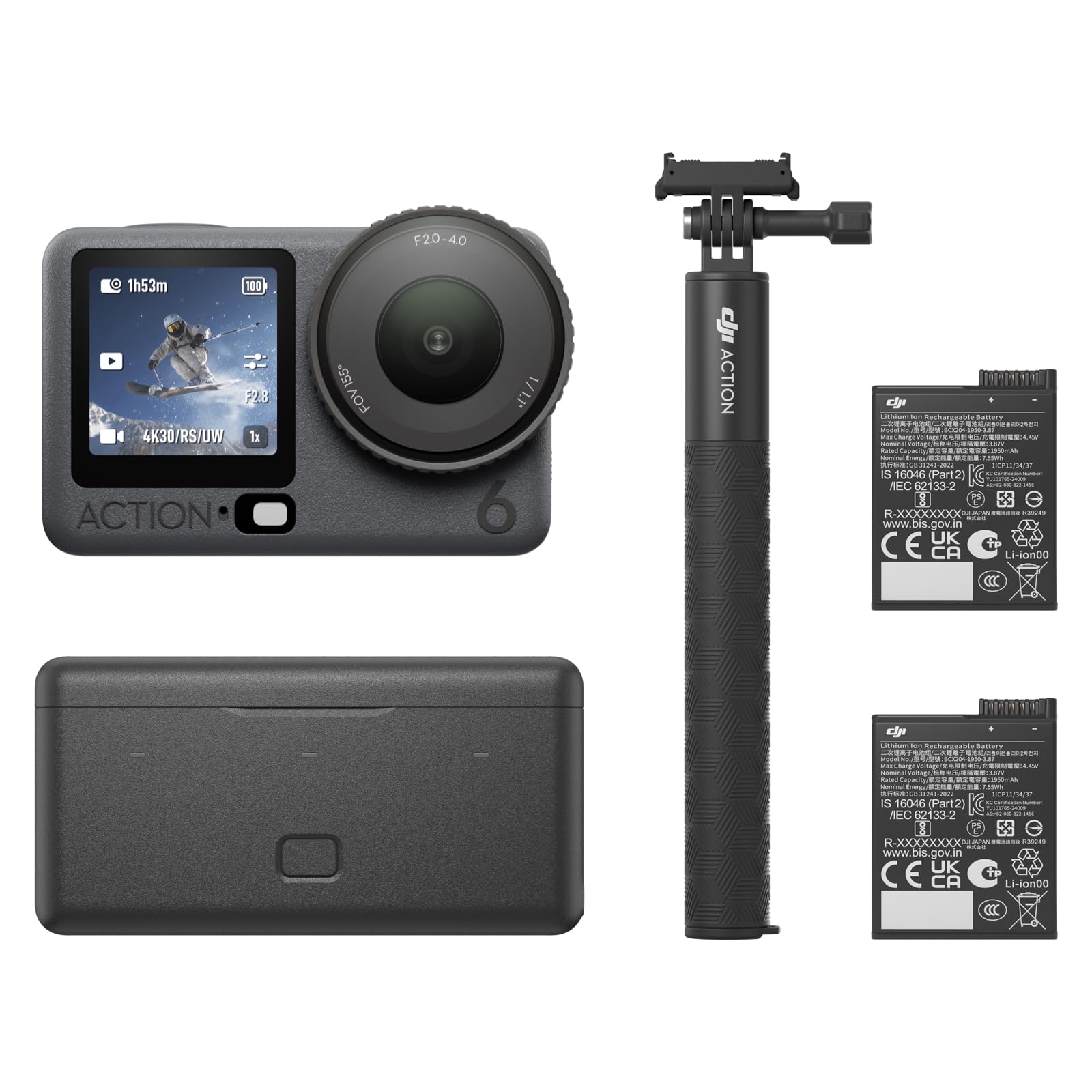
The DJI Osmo Action 6 is an action camera built for immersive, high-impact scenarios — diving, biking, skiing, and POV vlogging. Its stand-out feature is a variable aperture (f/2.0 to f/4.0), a first in the action camera category, which allows the camera to physically stop down in bright conditions to maintain sharpness and reduce overexposure without relying solely on electronic shutter adjustments. The 1/1.1-inch square sensor captures 8K video at up to 30fps, delivering vivid colors and excellent detail, though the 8K mode produces large files and generates heat during extended recording.
The Enhanced Combo includes two Extreme Batteries, a multifunctional battery case, and a 1.5-meter extension rod, making it suitable for full-day outings. RockSteady 3.0 and HorizonSteady stabilization keep the horizon level even during aggressive movement — the HorizonSteady mode corrects 360-degree roll-axis shakes, which is critical for first-person shots where you want the world to stay upright. The camera is waterproof to 20 meters without a housing, and the included 50GB of internal storage means you can start recording immediately even without a micro SD card.
Audio remains the weakest link: the internal mics capture wind noise and muffled dialogue during high-speed activities. DJI recommends connecting two Mic Mini transmitters (sold separately) for clean audio, which adds cost and complexity. For creators who need a rugged, waterproof camera for sports and underwater work and already prioritize stabilization and lens aperture flexibility over audio fidelity, the Action 6 is the most technically advanced option in the action form factor.
Why it’s great
- Variable f/2.0–f/4.0 aperture controls exposure without ND filters
- Waterproof to 20m without housing for diving and swimming
- HorizonSteady keeps the horizon level during 360° rolls
Good to know
- Internal microphones are wind-prone; external mics recommended
- 8K recording generates heat and large file sizes
10. ORDRO M5 Handheld Camera
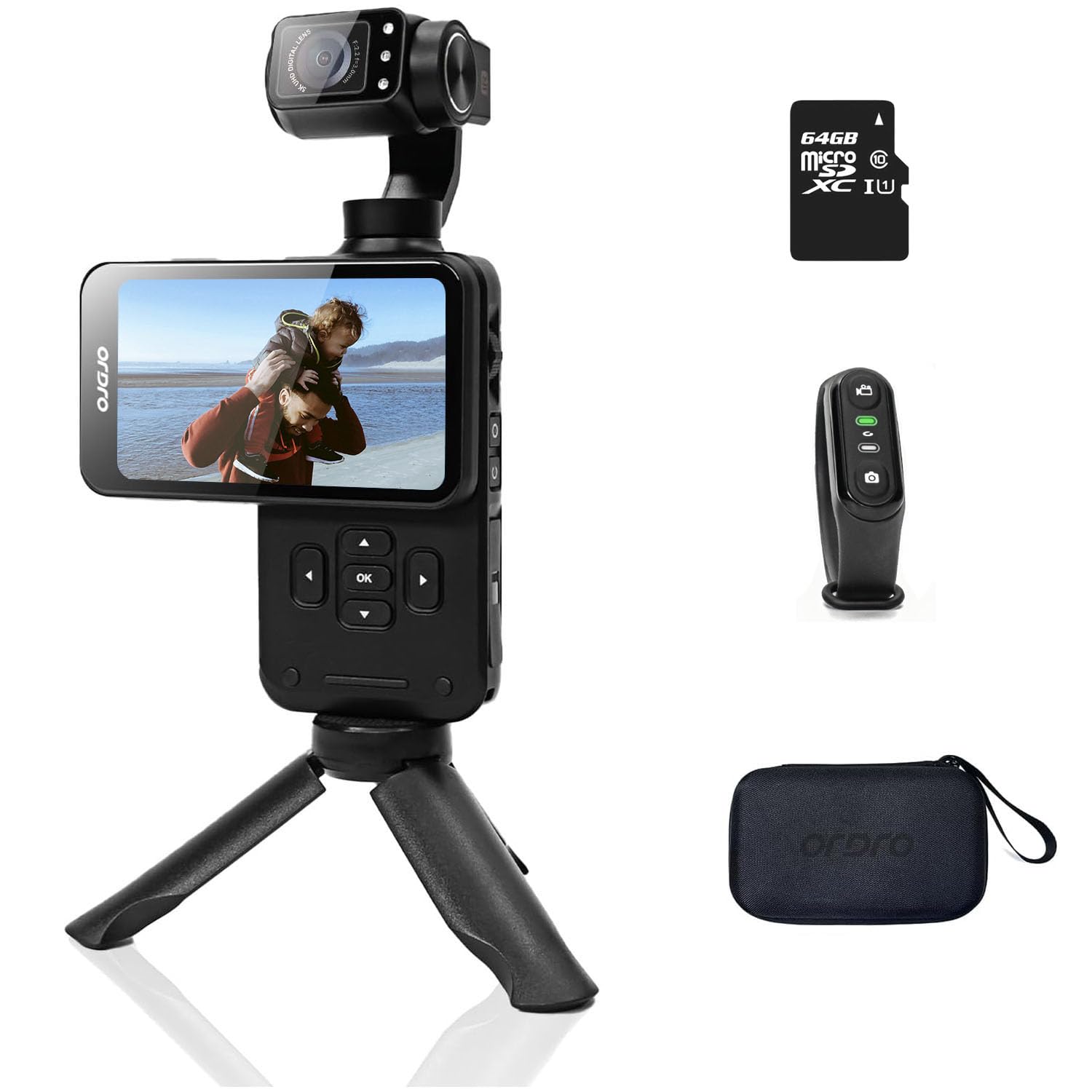
The ORDRO M5 is an ultra-compact handheld camera built around a 3-axis gimbal, a 1/2.5-inch CMOS sensor, and the ability to record up to 5K at 30fps or 4K at 60fps. Its form factor is smaller than a traditional camcorder, measuring roughly 6.2 inches long, making it easy to slip into a bag for everyday carry. The M5 ships with a 64GB micro SD card, a mini stand, a remote control, and a carrying bag — a comprehensive starter kit that removes the immediate need for additional purchases. The 180-degree rotating lens and 120-degree wide viewing angle are well-suited for vlogging and self-recording.
WiFi functionality via the “OD Cam” app allows remote preview, control, and file transfer from your smartphone, while the USB-C connection supports webcam mode for streaming and video calls. The built-in IR night vision captures black-and-white footage in total darkness, a niche feature that can be useful for wildlife observation or nighttime surveillance. However, this camera’s video quality is overstated in the marketing materials: 5K resolution is interpolated rather than native, and low-light performance is noticeably poor due to the small sensor size, with visible noise and compression artifacts in dim scenes.
Audio quality is another significant compromise — the internal microphone produces thin, hollow sound, and the lack of a headphone jack makes real-time monitoring impossible. An external microphone via the USB-C port improves audio, but this blocks the ability to charge simultaneously. For the absolute beginner looking for an affordable gimbal camera to learn composition and movement without risking a significant investment, the ORDRO M5 works as a training tool. It is not suitable for professional projects or low-light environments.
Why it’s great
- Complete bundle includes memory card, remote, and case
- 3-axis gimbal for beginner-level smooth footage
- IR night vision for total darkness shooting
Good to know
- 5K is interpolated, not native; low-light performance is weak
- Internal audio is poor; external mic needed for usable sound
11. Xtra Edge Pro Dual Battery Bundle
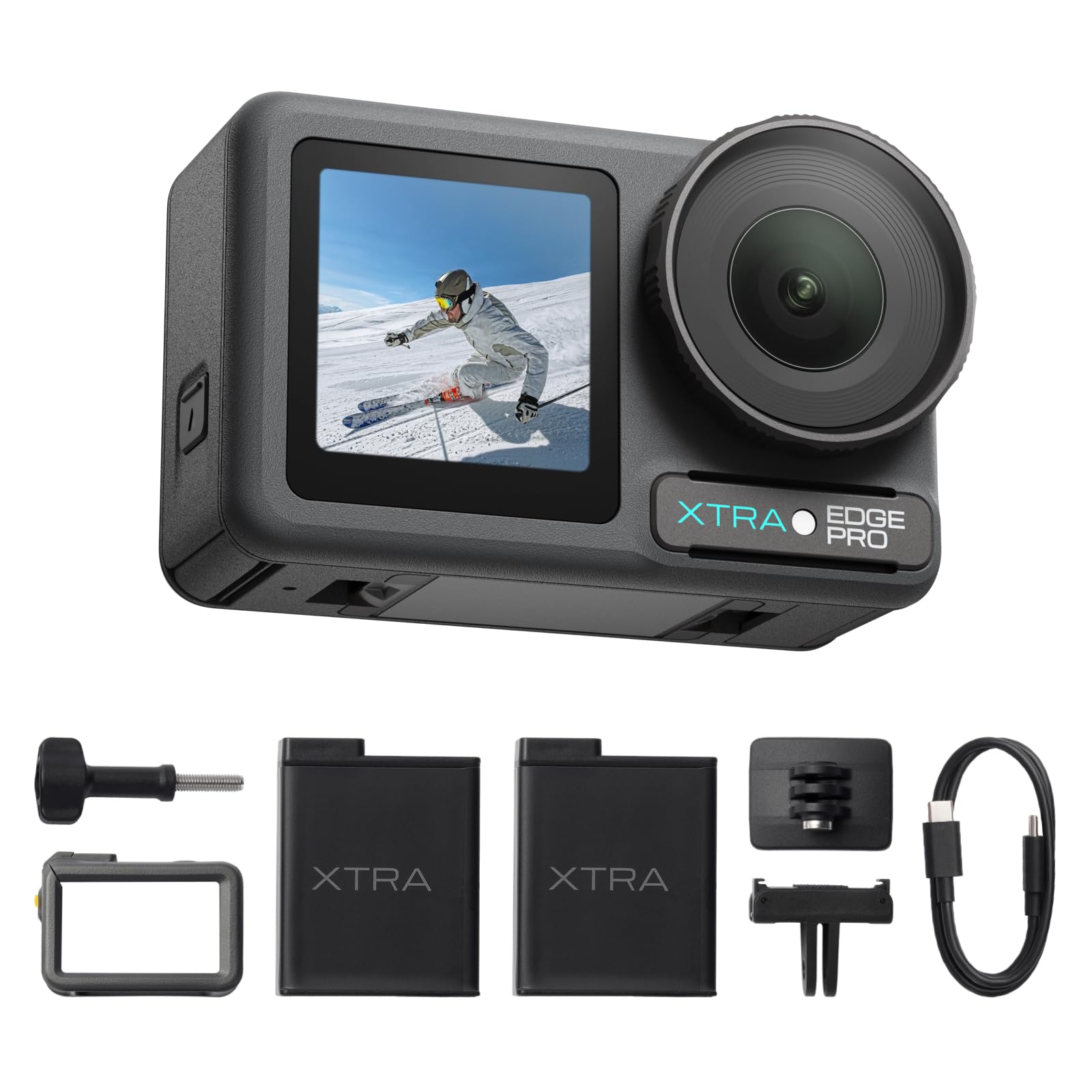
The Xtra Edge Pro is an action camera designed to deliver outdoor and underwater footage at a budget-friendly price point. Its 1/1.3-inch sensor is larger than typical entry-level action cameras, which helps with light gathering and detail capture in well-lit conditions. The camera records 4K video at 60fps and includes Night View Mode for improving low-light scenes, though performance in actual darkness is limited by noise and reduced dynamic range. The 65-foot waterproof rating without a housing makes it suitable for snorkeling, swimming, and rain exposure — a strong selling point for budget-conscious water sports enthusiasts.
The Dual Battery Bundle includes a cold-resistant battery that extends total runtime to roughly 240 minutes, plus a dual-facing mount adapter and protective frame. Rock-solid stabilization features — 360 Lock, TiltGuard, and MotionMaster — work to reduce shake during biking and running, and they do an admirable job at this price tier. Compatibility with DJI accessories is a practical bonus, as it allows users to leverage existing mounts and gimbals without proprietary purchases. The accompanying Xtra Atto built-in media system enables quick editing and sharing directly from the camera.
Image stabilization in this price range is electronic, not mechanical, so there is a visible crop and some jelly-like warping during aggressive movements. The wide-angle lens introduces fisheye distortion at the edges, which is common in budget action cameras and can be corrected in post. For the user who wants a waterproof 4K camera for casual outdoor recording — biking, beach days, family pool sessions — without spending on premium brands, the Xtra Edge Pro bundle provides excellent value.
Why it’s great
- 65ft waterproof rating for swimming and snorkeling
- Large 1/1.3-inch sensor for better light capture in its class
- Dual battery bundle provides extended field runtime
Good to know
- Electronic stabilization shows crop and warping in high motion
- Fisheye distortion at wide angle requires post-processing correction
FAQ
Is a 1-inch sensor in a pocket camera better than a 1/2.3-inch sensor in a larger handycam?
Can a pocket gimbal camera replace a traditional camcorder for event videography?
What does 10-bit 4:2:2 recording mean for my footage?
How important is in-body versus lens-based stabilization?
Do I need a camcorder with XLR audio inputs?
Final Thoughts: The Verdict
For most users, the best 4k camcorder winner is the DJI Osmo Pocket 3 because it combines a 1-inch sensor with true 3-axis gimbal stabilization in a pocketable form factor that works out of the box for vloggers, travelers, and content creators. If you need professional optical zoom and XLR audio, grab the Panasonic HC-X2. And for cinema-grade raw recording with interchangeable lenses, nothing beats the Blackmagic Pocket Cinema Camera 4K.