
Our readers keep the lights on and the weekend projects moving. As an Amazon Associate, I earn from qualifying purchases.
A gaming TV isn’t just a screen — it’s the cockpit of your entire setup. The wrong panel introduces input lag, crushes black levels during dark scenes, and fails to keep up with the 120Hz output of modern consoles. The right one makes every match feel fluid, every HDR highlight pop, and every quick-time event register as fast as your reflexes.
I’m Rikta — the co-founder and writer behind FitlyFast. I’ve spent years dissecting TV panels, refresh rates, HDMI 2.1 compatibility, and HDR formats to separate true gaming TVs from marketing fluff dressed as “game mode.”
This guide narrows the field to the panels that actually deliver low latency, high refresh, and proper VRR support, all to help you find the best 4k gaming tv for your console, PC, or hybrid rig.
How To Choose The Best 4K Gaming TV
Not every 4K TV handles gaming well. You need a panel that prioritizes low input lag, a high native refresh rate, and proper HDMI 2.1 support to get the most out of your console or gaming PC. Here are the essential specs to evaluate before you buy.
Native Refresh Rate vs Motion Smoothing
A true 120Hz or 144Hz native panel refreshes the image 120 or 144 times per second. This cuts motion blur dramatically and makes fast-paced games like shooters and racers feel responsive. Avoid TVs that advertise “effective” or “motion rate” numbers — those use frame insertion tricks that can actually increase input lag. Always look for the native refresh rate in Hertz listed in the technical specifications.
HDMI 2.1: The Non-Negotiable Port for Modern Gaming
HDMI 2.1 delivers up to 48Gbps of bandwidth, enabling 4K resolution at 120Hz with HDR, Variable Refresh Rate (VRR), and Auto Low Latency Mode (ALLM) simultaneously. Without it, your PS5 or Xbox Series X will cap at 4K/60Hz or force you to choose between HDR and high frame rates. Look for at least two HDMI 2.1 inputs so you can connect a console and a PC without swapping cables.
Panel Technology: OLED vs Mini-LED vs QLED
OLED panels offer perfect blacks, infinite contrast, and pixel-level response times under 0.1ms — ideal for dark-room gaming. Mini-LED and QLED panels get brighter, sustain higher peak HDR brightness for longer, and cost less per inch. If your room has lots of ambient light, a premium Mini-LED set may outperform OLED. If you game mostly at night, OLED’s contrast advantage is unmatched.
Quick Comparison
On smaller screens, swipe sideways to see the full table.
| Model | Category | Best For | Key Spec | Amazon |
|---|---|---|---|---|
| Hisense 55″ U8 Series | Mini-LED | High-brightness HDR gaming | Native 165Hz / 5000 nits peak | Amazon |
| Samsung 42″ OLED S90F | OLED | Perfect blacks & fast pixel response | QD-OLED / 4K 144Hz | Amazon |
| Sony 77″ BRAVIA XR8B | OLED | PS5 integration and upscaling | XR Processor / 4K 120Hz | Amazon |
| LG 77″ OLED evo C5 | OLED | Cinematic gaming with Dolby Vision | OLED evo / Alpha 9 Gen8 AI | Amazon |
| Panasonic 77″ Z8 Series | OLED | Filmmaker-accurate HDR for games | Master OLED PRO / 144Hz | Amazon |
| Samsung 75″ Neo QLED QN90C | Mini-LED QLED | Bright-room gaming & sports | Neural Quantum / 4K 120Hz | Amazon |
| iFFALCON 55″ MiniLED | Mini-LED | Entry-level 144Hz gaming | Native 144Hz / 4x HDMI 2.1 | Amazon |
| TCL 55″ T7 Series | QLED | Color volume & 144Hz gaming | QLED / 120Hz native / 240Hz VRR | Amazon |
| Roku 65″ Plus Series | Mini-LED QLED | Simplified UI & streaming apps | Mini-LED / Dolby Vision / VRR | Amazon |
| Amazon 55″ Ember Series | Mini-LED QLED | Fire TV ecosystem & Alexa+ | Mini-LED / 144Hz / FreeSync Pro | Amazon |
| Sony BRAVIA 2 II 55″ | LED | PS5 auto HDR mapping | 4K Processor X1 / PS5 features | Amazon |
In‑Depth Reviews
1. Hisense 55″ U8 Series ULED Mini-LED 4K UHD Smart Google TV (55U8QG)
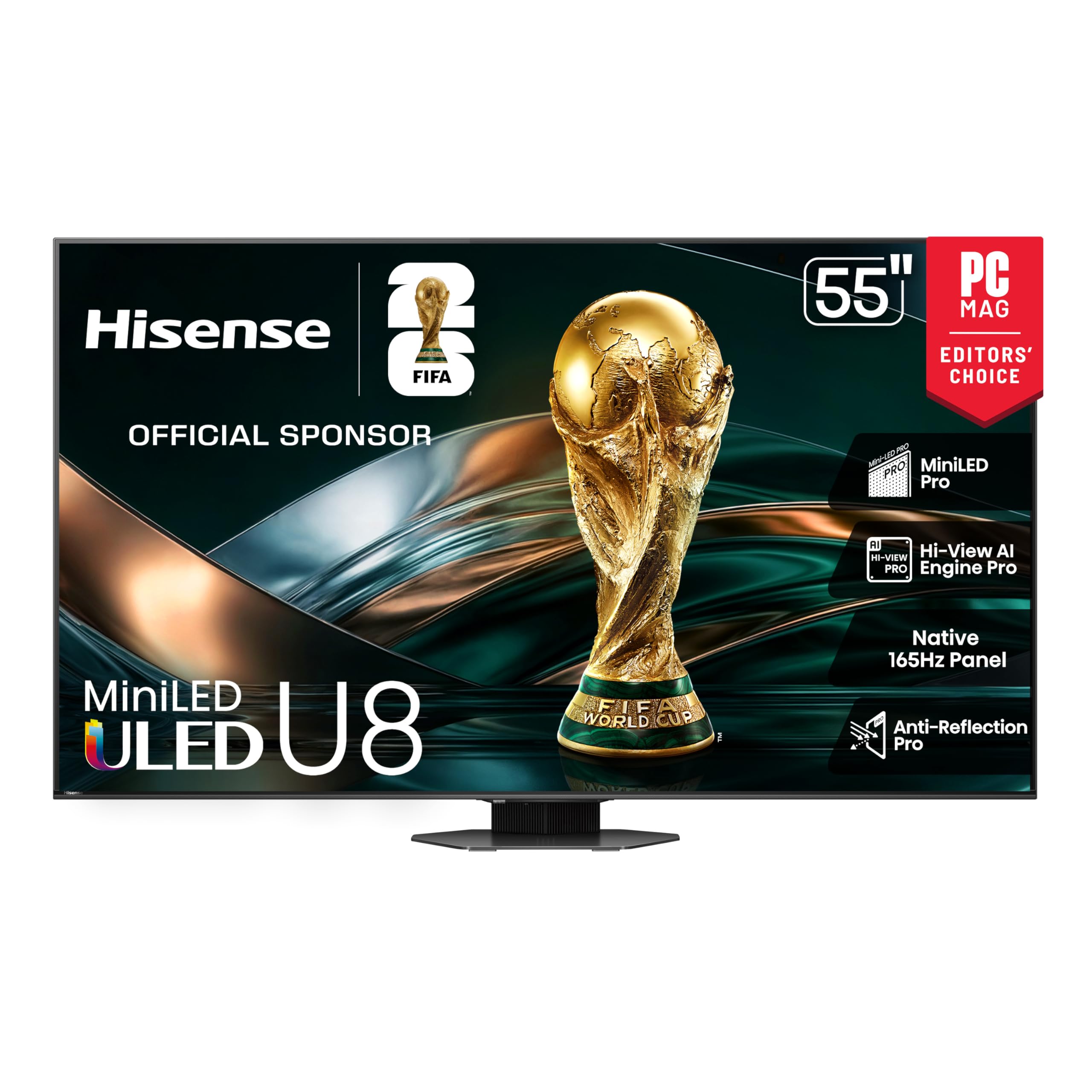
The Hisense U8 Series obliterates the price-to-performance ceiling for gaming TVs. Its native 165Hz panel with VRR scaling up to 288Hz delivers buttery motion that keeps pace with high-refresh PC gaming while fully supporting PS5 and Xbox Series X at 4K/120Hz. The 5000-nit peak brightness combined with up to 5600 local dimming zones produces HDR highlights so intense they feel almost tactile — neon signs in Cyberpunk 2077 genuinely glow against inky black backdrops.
The 4.1.2-channel audio system with Dolby Atmos and up-firing speakers creates a sense of height that standard TV speakers can’t match. The Game Bar overlay gives you on-screen control over VRR, refresh rate, and latency settings without leaving your game. With three HDMI 2.1 ports plus a USB-C input capable of 4K@165Hz from a PC, this set future-proofs your desk or living room against the next generation of consoles and GPUs.
Some users report periodic software glitches requiring a power cycle, and the Google TV interface occasionally feels sluggish with heavy app switching. But at this brightness and refresh rate combination, no other mid-range option challenges the U8 for raw gaming performance.
Why it’s great
- Industry-leading 5000-nit peak brightness for HDR gaming
- Native 165Hz panel with FreeSync Premium Pro certification
- 4.1.2 channel audio with Dolby Atmos built-in
Good to know
- Google TV software can become unresponsive over time
- Requires calibration out of the box for accurate color
2. Samsung 42-Inch Class OLED S90F 4K Smart TV (2025 Model)

Samsung’s S90F brings QD-OLED technology — quantum dots layered over an OLED panel — to a 42-inch form factor that fits neatly on a desk or in a compact gaming den. The NQ4 AI Gen3 processor uses 128 neural networks to upscale 1080p content to near-4K clarity, and Motion Xcelerator 144Hz ensures tear-free VRR gameplay up to 4K/144Hz. The per-pixel luminance control eliminates blooming entirely, so subtitles over a dark screen remain perfectly legible without halos.
Color volume is a standout advantage of QD-OLED over traditional WOLED panels. Red, green, and blue primaries hit higher saturation levels before clipping, making saturated game worlds like those in Ratchet & Clank: Rift Apart feel almost hyper-real. The anti-reflective coating reduces ambient light impact, though direct sunlight can still wash out near-black details. The gaming hub consolidates Xbox Game Pass, NVIDIA GeForce NOW, and Amazon Luna into a single launcher — convenient for cloud gamers.
Owners praise the virtually instant pixel response (under 0.1ms) that eliminates motion blur completely. However, the screen glass is thin and fragile; mounting requires care, and the anti-reflective coating can be scratched by abrasive cleaning. For a dedicated gaming space with controlled lighting, the S90F delivers reference-class OLED performance in a size that doesn’t dominate a room.
Why it’s great
- QD-OLED delivers unmatched color volume and perfect blacks
- 144Hz VRR with FreeSync Premium Pro support
- Compact 42-inch size fits desktop gaming setups
Good to know
- Fragile screen edges require careful handling
- Anti-reflective coating can be damaged by improper cleaning
3. Sony 77 Inch OLED 4K Ultra HD TV BRAVIA XR8B Smart Google TV

Sony’s BRAVIA XR8B is engineered specifically as a PlayStation 5 companion. Exclusive features like Auto HDR Tone Mapping and Auto Genre Picture Mode communicate directly with the console to optimize brightness and picture mode without manual adjustment. The XR Processor analyzes each frame in real time, boosting texture detail in low-resolution assets and enhancing face clarity during dark cutscenes. For PS5 owners, this is the most seamless gaming TV experience available.
The 77-inch OLED panel with over 8 million self-lit pixels delivers pure black levels that make HDR games like Horizon Forbidden West look volumetric — shadowy forests have genuine depth rather than flattened gray zones. XR OLED Motion analyzes movement vectors per pixel to keep fast camera pans smooth without introducing soap-opera artifacts. The Acoustic Surface Audio+ system vibrates the screen to produce sound that feels like it originates from the on-screen action, adding directional cues to game audio without a separate soundbar.
The primary limitation is the panel’s brightness: OLED can’t match the sheer luminance of Mini-LED for very bright rooms. Some users note that built-in audio is merely acceptable compared to dedicated speakers. But for anyone whose gaming life revolves around a PS5, the XR8B offers deep integration that no other brand replicates.
Why it’s great
- PS5 exclusive Auto HDR Tone Mapping for instant optimization
- Perfect OLED black levels with XR Motion processing
- Acoustic Surface Audio for directional game sound
Good to know
- OLED brightness is lower than Mini-LED in bright rooms
- Built-in speakers are decent but not for immersive audio
4. LG 77-Inch Class OLED evo AI Super Upscaling 4K C5 Series Smart TV (OLED77C5PUA, 2025)

LG’s C5 OLED evo refines the formula that made the C-series the default recommendation for home theater gamers. The Alpha 9 AI Processor Gen8 uses deep learning to upscale streaming content to near-4K quality while preserving film grain and texture — a nuanced approach that avoids the overly smooth “video look” of aggressive processing. Brightness Booster amplifies light output from each pixel without increasing power draw, giving the C5 noticeably brighter highlights than the previous C4 generation.
The 77-inch screen size creates an enveloping field of view for cinematic single-player titles. Dolby Vision gaming at 4K/120Hz is supported across all four HDMI 2.1 ports, so you can keep your console, PC, and soundbar all connected without compromise. VRR works with both AMD FreeSync and NVIDIA G-Sync, covering every GPU ecosystem. Filmmaker Mode automatically disables motion smoothing when detecting movies inside games like The Last of Us Part I, preserving the creator’s original frame rate intent.
The biggest drawback — mentioned in multiple verified reviews — is the remote control. LG’s “magic” pointer remote lacks a dedicated mute button and feels gimmicky compared to traditional designs. Some users also note that the OLED panel may suffer from temporary image retention if the same HUD element stays on screen for hours, though this fades quickly.
Why it’s great
- Four full-bandwidth HDMI 2.1 ports for multi-device setups
- Brightness Booster improves OLED HDR peak output
- Deep learning upscaling preserves film grain and texture
Good to know
- Remote control design is divisive and lacks mute button
- Potential temporary image retention with static HUD elements
5. Panasonic Z8 Series (2025) 77-inch OLED 4K Ultra HD Smart Fire TV (77Z8BAP)
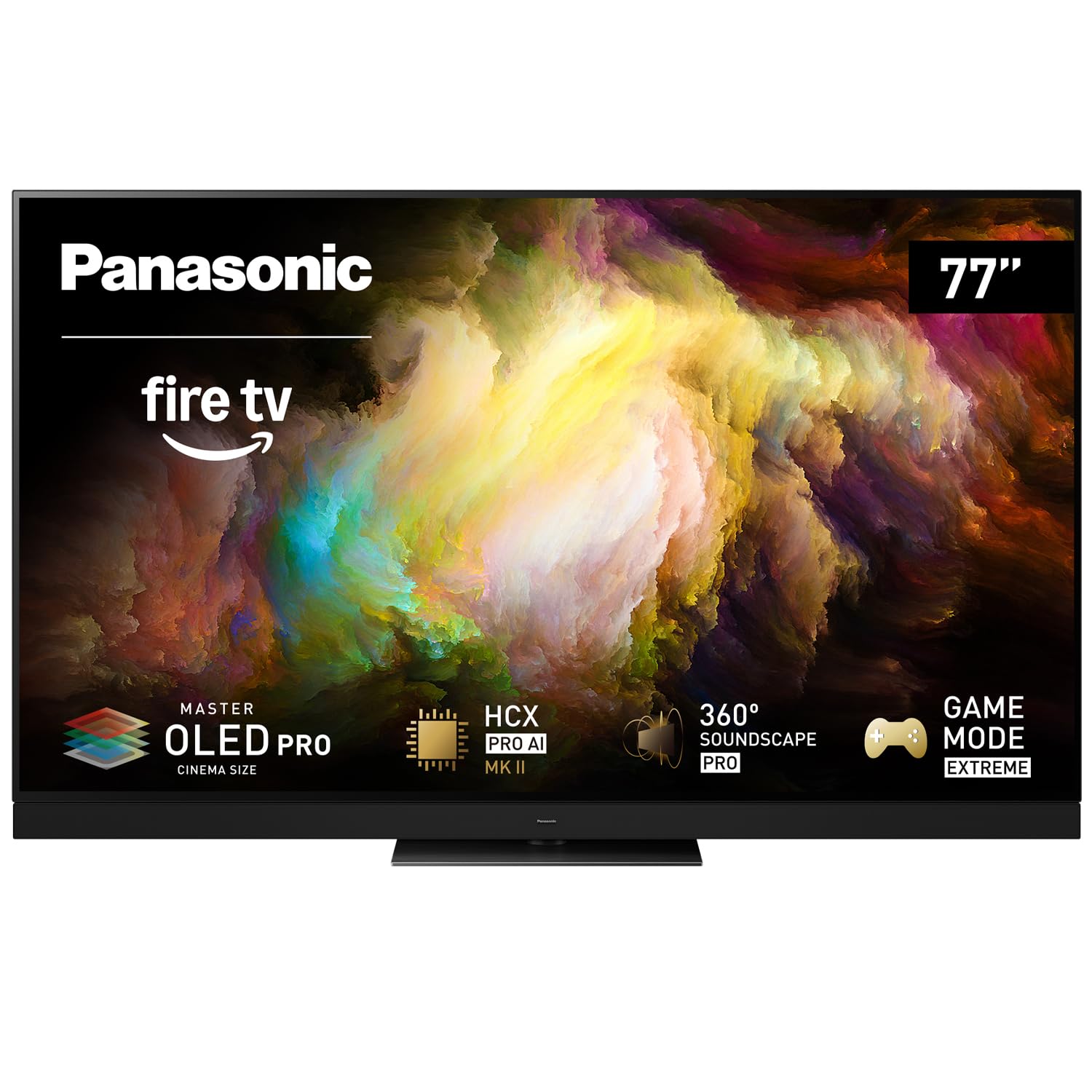
Panasonic brings its legendary Hollywood-reference-grade color science to the gaming space with the Z8 Series. The Master OLED PRO panel uses micro-lens-array technology to boost light output while maintaining the brand’s trademark accuracy out of the box — no calibration required for Filmmaker Mode. The HCX Pro AI Processor MKII analyzes content scene-by-scene to apply Dolby Vision IQ and HDR10+ Adaptive adjustments that account for room brightness, so you get consistent HDR whether you game at noon or midnight.
Game Mode Extreme supports HDMI 2.1 at 144Hz with AMD FreeSync Premium and NVIDIA G-SYNC compatibility, covering high-refresh PC gaming alongside console titles. The 360 Soundscape Pro audio system, tuned by Technics, uses front-array, upward, and side-firing speakers to create a 5.1.2-channel bubble of sound that tracks on-screen movement. The Game Control Board lets you see input lag, refresh rate, and VRR status at a glance without exiting your game.
The trade-off is weight — the 77-inch model approaches 100 pounds, so wall mounting is a two-person job. The built-in Fire TV interface is functional but lacks the polish of LG’s WebOS or Samsung’s Tizen. For gamers who prioritize color accuracy and HDR tone mapping above all else, the Z8 offers studio-grade performance that competitive panels rarely match.
Why it’s great
- Reference-grade color accuracy with Dolby Vision IQ and HDR10+ Adaptive
- Micro-lens-array OLED for higher brightness with accuracy
- 360 soundscape with Technics-tuned audio creates immersive bubble
Good to know
- Extremely heavy — requires two people for safe mounting
- Fire TV interface is basic and lacks advanced customization
6. SAMSUNG 75-Inch Class Neo QLED 4K QN90C Series Quantum HDR+ (QN75QN90C, 2023 Model)

The QN90C is Samsung’s premier Mini-LED QLED panel built for gamers who play in bright rooms. The anti-glare coating with Ultra Viewing Angle technology keeps contrast intact even when sunlight streams through a window — a scenario where most OLEDs lose detail. The Neural Quantum Processor 4K upscales lower-resolution content to near-4K using AI scene-by-scene analysis, and Motion Xcelerator Turbo+ delivers smooth 4K/120Hz gameplay with FreeSync Premium Pro support.
Quantum Matrix with Mini LEDs means thousands of tiny backlights controlled individually, producing deep blacks without the blooming that plagues edge-lit LCDs. Samsung Gaming Hub aggregates cloud gaming services and console inputs into a single dashboard. The Object Tracking Sound+ system creates virtual surround that follows action on screen, and Q-Symphony lets the TV’s speakers work in tandem with a compatible Samsung soundbar for fuller sound staging.
The main concerns revolve around the smart interface — Samsung’s Tizen OS pushes advertisements on the home screen, and input switching via HDMI ARC can be unreliable with external audio receivers. Some users report that the solar-powered remote stops charging over time. For sheer brightness and anti-reflective performance, however, this is one of the most versatile gaming TVs for mixed-lighting rooms.
Why it’s great
- Excellent anti-glare coating for bright room gaming
- Mini-LED backlight with minimal blooming
- Q-Symphony pairs TV speakers with soundbar for expanded sound
Good to know
- Tizen interface pushes advertisements on home screen
- HDMI ARC input switching can be frustrating with receivers
7. iFFALCON 55″ 4K MiniLED Smart TV (55U85)
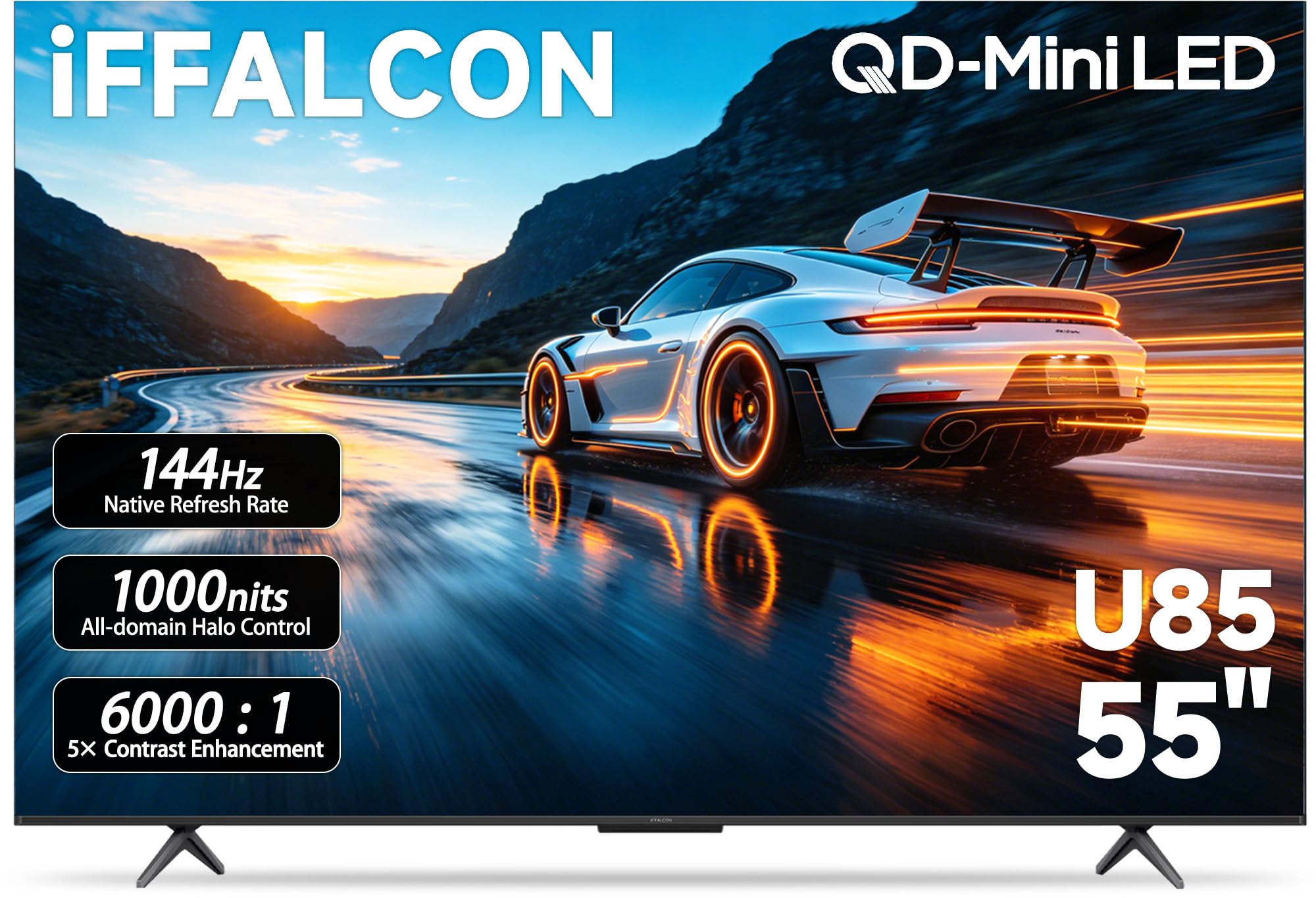
The iFFALCON 55U85 proves that a native 144Hz panel with four HDMI 2.1 inputs doesn’t require a premium budget. The Mini-LED backlight with local dimming and a 6,000:1 contrast ratio produces respectable black levels that approach — but don’t match — OLED depth. With FreeSync Premium Pro certification for tear-free gameplay and 240Hz VRR mode for competitive shooters, it handles fast-paced titles like Call of Duty and Overwatch 2 without visible stutter.
Dolby Vision Gaming and IMAX Enhanced certification ensure HDR accuracy across streaming and disc-based content. The 2.1-channel 50W audio system (with a dedicated 20W woofer) delivers enough low-end for explosions and ambient soundtracks without needing an external subwoofer. Google TV with hands-free Alexa and Google Assistant keeps the interface familiar and responsive, with Chromecast and AirPlay 2 support for wireless casting from any device.
Verified buyers report that the panel is slightly thicker than ultra-slim competitors, and the stand feels less premium than that of higher-end sets. The UI occasionally benefits from a restart after prolonged use, but for a 55-inch gaming TV with a true 144Hz refresh rate and multiple HDMI 2.1 ports, the value-to-performance ratio is difficult to beat.
Why it’s great
- Native 144Hz panel with FreeSync Premium Pro
- Four HDMI 2.1 inputs for multi-console setups
- 50W audio with dedicated woofer for built-in bass
Good to know
- Chassis is thicker than premium ultra-slim models
- Stand build quality feels basic for long-term use
8. TCL Amazon Exclusive 55 Inch Class T7 Series 4K QLED HDR Smart Google TV (55T7, 2025 Model)

TCL’s T7 Series brings QLED quantum dot color to the budget-mid-range segment with a native 120Hz panel that supports VRR up to 240Hz at lower resolutions. The AIPQ Pro Processor optimizes color, contrast, and clarity intelligently, and HDR PRO+ with Dolby Vision and HDR10+ ensures broad format support. The Motion Rate 480 with MEMC frame insertion smooths fast-moving content without introducing distracting artifacts in game mode.
The TCL is an Amazon exclusive, which means it’s optimized for the Prime Video ecosystem and integrates seamlessly with Alexa voice commands. Google TV provides access to all major streaming services, and the four HDMI inputs — one with eARC — give you enough ports for a console, PC, and soundbar. The panel covers nearly the entire DCI-P3 color space, making game worlds look vibrant without oversaturation.
As with many budget QLED sets, the direct LED backlight lacks the local dimming density of Mini-LED — expect some blooming around bright objects on dark backgrounds. Some users also find the 55-inch model’s stand to be wobbly on unstable surfaces. For those prioritizing color volume and a high refresh rate over perfect black levels, the T7 delivers where it counts for gaming.
Why it’s great
- QLED quantum dot color coverage of DCI-P3 space
- Native 120Hz panel with VRR up to 240Hz
- Four HDMI inputs with eARC for soundbar connectivity
Good to know
- Direct LED backlight shows blooming on dark scenes
- Stand stability is average on uneven surfaces
9. Roku Smart TV – 65-Inch Plus Series, Mini-LED TV (2025 Model)
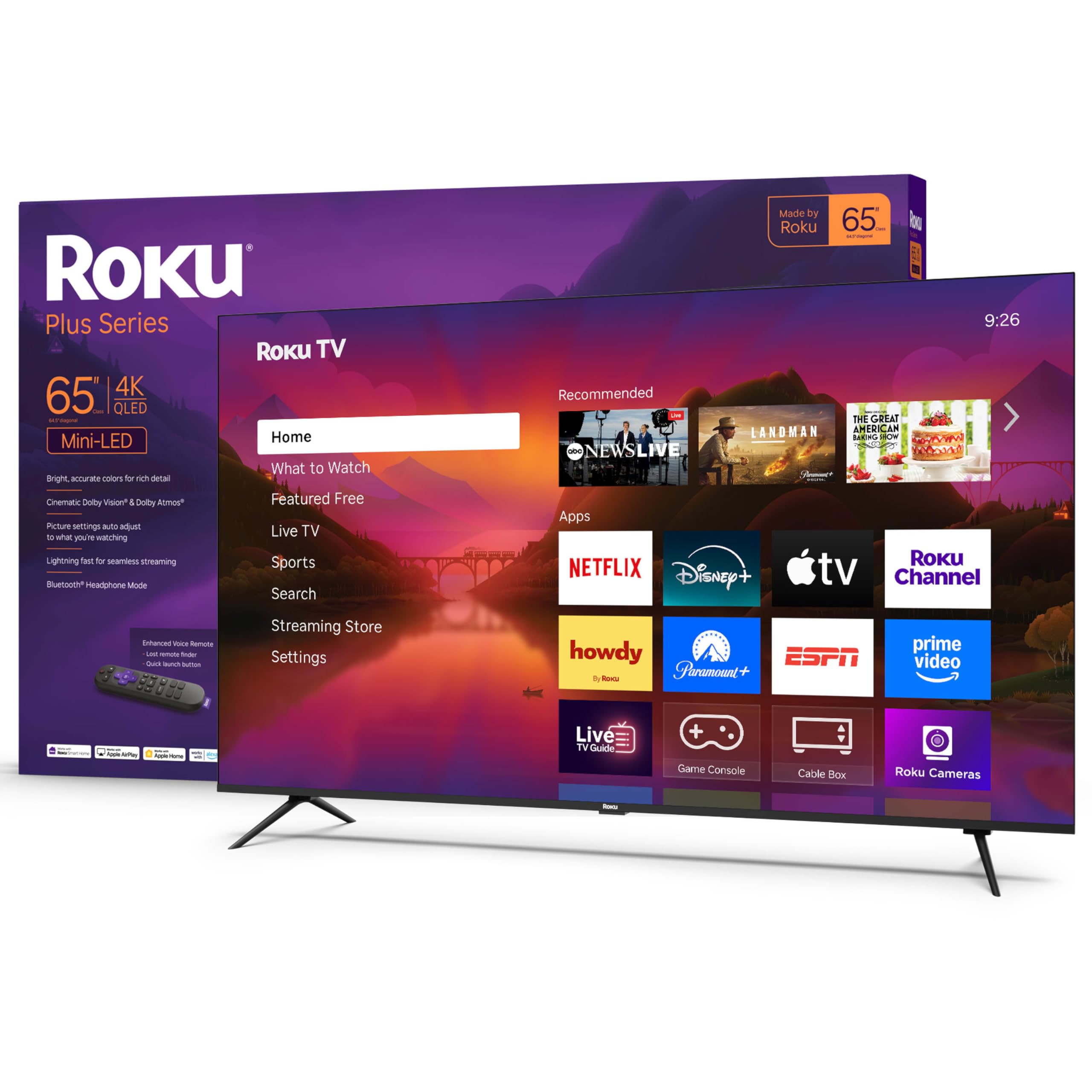
Roku’s Plus Series simplifies the gaming TV equation by combining a Mini-LED QLED panel with the most intuitive operating system on the market. The 65-inch screen uses Mini-LED backlighting to improve contrast and reduce blooming compared to standard LED, and Dolby Vision support ensures HDR gaming content looks punchy. Roku Smart Picture Max uses AI to clean up lower-resolution signals and automatically adjust sharpness scene-by-scene — useful for older consoles or streaming compressed titles.
The Roku OS is the star here: no ads on the home screen, no laggy menus, and automatic software updates that add new features without bloat. The Enhanced Voice Remote includes a lost-remote finder, programmable shortcut buttons, and hands-free voice search across 500+ free channels. Bluetooth headphone mode lets you game without waking others — a feature often relegated to expensive soundbars.
Gamers expecting ultra-low input lag will be satisfied, though the Roku Plus doesn’t target the competitive 144Hz crowd — it’s a 60Hz panel with VRR support. The built-in subwoofer produces better-than-average bass for an integrated system, but audiophiles will still want a dedicated soundbar. For casual and mid-core gamers who prioritize a frustration-free interface, the Roku Plus is a refreshingly simple choice.
Why it’s great
- Clean, ad-light Roku OS with automatic updates
- Mini-LED backlight improves contrast over standard LED
- Bluetooth headphone mode for private late-night gaming
Good to know
- 60Hz panel — no high-refresh option for competitive gamers
- Audio is solid but bass extension is limited
10. Amazon Ember 55″ Mini-LED Series with Fire TV (newest model)
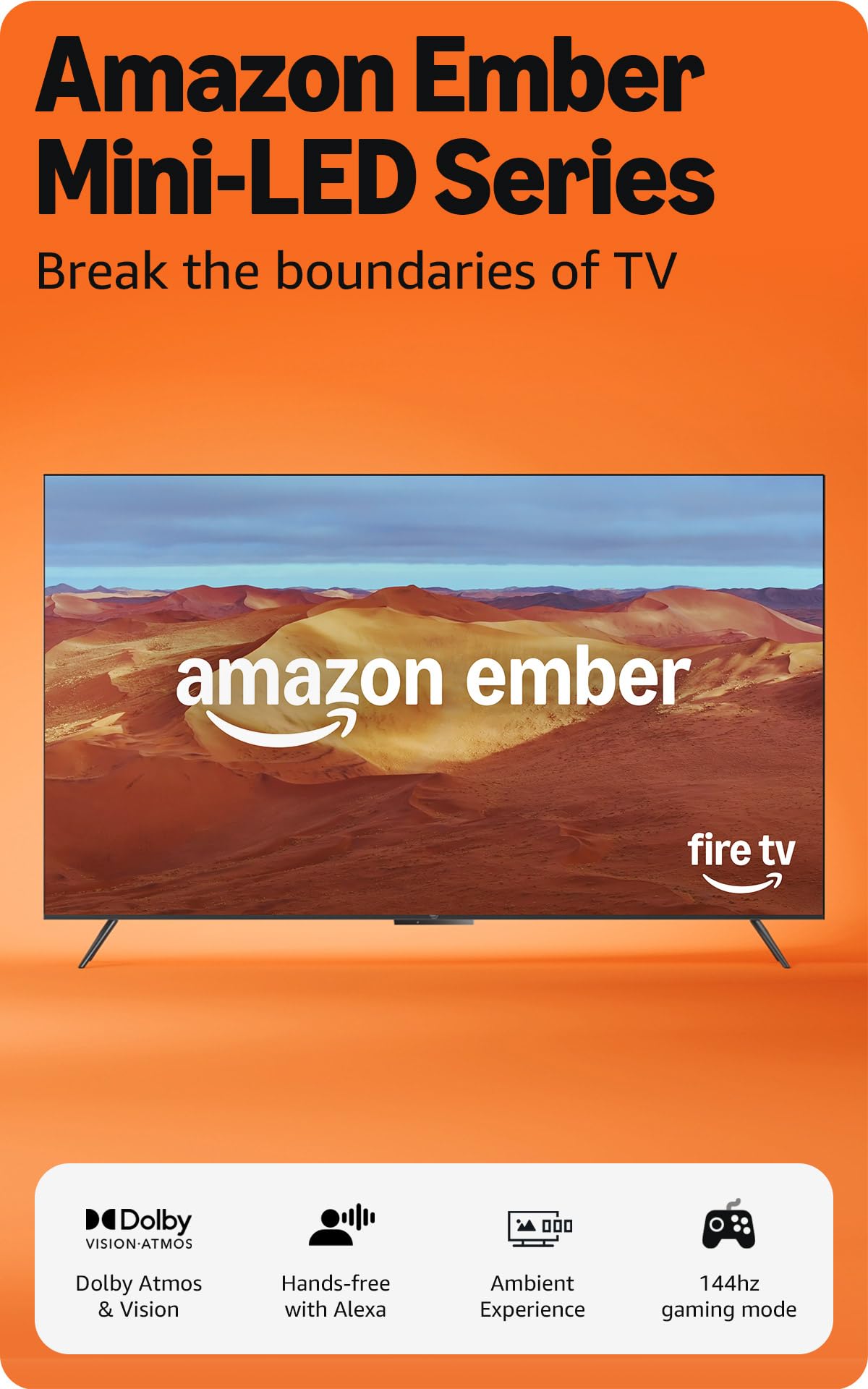
The Amazon Ember Mini-LED Series is designed for gamers already immersed in the Fire TV and Alexa ecosystem. The 55-inch QLED Mini-LED panel with 512 local dimming zones and 1400 nits peak brightness approaches OLED-level contrast in mixed lighting. The 144Hz panel with AMD FreeSync Premium Pro certification delivers tear-free, low-latency gameplay across PS5, Xbox Series X, and PC. Dolby Vision IQ and HDR10+ Adaptive adjust picture settings based on room ambient light — a thoughtful feature for day-to-night gaming sessions.
Fire TV’s 2026 interface update streamlines navigation with dedicated content categories and Alexa+ voice recommendations. The “Instantly On” Omnisense technology wakes the display when you enter the room, displaying artwork or the last-used input without a cold boot. The 2.1 Dolby Atmos audio system provides clear dialogue and surprising low-end punch for built-in speakers.
Performance issues surface in verified reviews: the interface can become painfully slow after software updates, forcing some users to rely on an external Fire Stick 4K Max for responsiveness. The home screen is cluttered with Amazon ads and promoted content, which can feel intrusive. If you value a snappy OS above all, the Ember may frustrate — but for visual quality and deep Alexa integration, it’s a compelling choice.
Why it’s great
- 512 dimming zones with 1400 nits peak brightness
- 144Hz panel with FreeSync Premium Pro certification
- Omnisense wake sensor for instant-on experience
Good to know
- Fire TV interface can become sluggish after updates
- Home screen heavily promotes Amazon ads and content
11. Sony BRAVIA 2 II 55 Inch 4K Ultra HD LED Smart TV with Google TV (K-55S20M2)

Sony’s BRAVIA 2 II is the most affordable entry point into the brand’s PS5-optimized ecosystem. The 4K Processor X1 delivers lifelike colors and sharp details at a 60Hz native refresh rate — adequate for story-driven single-player games that don’t demand competitive frame rates. Exclusive PS5 features like Auto HDR Tone Mapping and Auto Genre Picture Mode carry over from the more expensive XR models, ensuring consistent HDR performance without manual calibration.
The Game Menu consolidates all gaming picture settings, assist features, and VRR status into one overlay. Motionflow XR keeps motion blur low in 30fps titles, and 4K XR-Reality PRO upscales 1080p content to near-4K. Google TV with Apple AirPlay 2 and Google Cast provides smooth streaming across devices. Eco Dashboard keeps power consumption low — the TV stays barely warm during extended sessions.
The LED backlight lacks local dimming, so black levels in dark rooms are more gray than deep. The 60Hz panel also means you won’t get the full 120fps output from PS5 or Xbox Series X. Some users report freezing requiring a physical unplug to reset. For budget-conscious gamers who prioritize PS5 integration and Sony’s color science over raw refresh rate, this set makes sense as a secondary or bedroom TV.
Why it’s great
- Exclusive PS5 Auto HDR Tone Mapping for plug-and-play HDR
- Sony’s 4K X1 Processor delivers accurate colors and detail
- Low power consumption with Eco Dashboard control
Good to know
- 60Hz panel caps refresh rate below console potential
- No local dimming — black levels are average in dark rooms
FAQ
Does my PS5 or Xbox Series X actually need HDMI 2.1 for 4K gaming?
What is the difference between OLED, QLED, and Mini-LED for gaming?
Can I use a 144Hz gaming TV as a computer monitor?
What refresh rate is ideal for competitive versus single-player gaming?
Final Thoughts: The Verdict
For most users, the best 4k gaming tv winner is the Hisense 55″ U8 Series because it delivers a native 165Hz panel, 5000-nit peak brightness, and 4.1.2-channel Dolby Atmos audio at a price that undercuts every competitor with similar specs. If you want near-instant pixel response and perfect blacks for dark-room gaming, grab the Samsung 42″ OLED S90F. And for PS5-optimized features and the best auto-HDR implementation, nothing beats the Sony 77″ BRAVIA XR8B.