
Our readers keep the lights on and the weekend projects moving. As an Amazon Associate, I earn from qualifying purchases.
Specs are compiled from manufacturer listings and verified buyer reviews and can change over time — please confirm the key details on the product page before buying.
Trying to run a game on a 4K monitor but seeing stutters or low frame rates? You need a graphics card that can push that many pixels smoothly. The right card handles the high resolution without overheating your PC or emptying your wallet. This guide covers three cards that deliver proper 4K gaming, sticking to real specs and user experiences instead of marketing buzz.
I’m Rikta, the writer behind FitlyFast. This guide uses the manufacturers’ published specifications and patterns from verified customer reviews to give you each card’s real strengths and trade-offs.
Whether you are building a new PC or upgrading from a lower resolution, you need a card that balances raw power with acceptable noise and heat. Here is what to look for in a 4k graphics card for gaming that works with your setup and your style of play.
Quick Picks
- ASRock Radeon RX 9070 XT Challenger 16GB OC — Best Overall
- XFX Swift AMD Radeon RX 9070 OC Triple 90mm Fan — Best Value
- PNY GeForce RTX 4080 Super 16GB Verto OC Triple Fan — Premium Pick
How To Choose The Best 4K Graphics Card For Gaming
Gaming at 4K (3840 x 2160 pixels) demands more from your GPU than any other resolution. You are pushing four times the pixels of 1080p (1920 x 1080), which means the card’s raw compute speed, memory bandwidth, and cooling system all have to work together to keep frames smooth and noise low.
Prioritize Boost Clock And Memory Speed
The boost clock (measured in MHz — millions of cycles per second) tells you how fast the card can run under load, and the memory type (GDDR6 vs GDDR6X — the latest standards for video RAM) determines how quickly textures load. For 4K, look for a boost clock above 2500 MHz and at least 16GB of high-bandwidth memory so you can crank settings without stuttering.
Match The Cooling To Your Case And Noise Tolerance
Triple-fan designs keep temperatures lower under sustained loads, but they also take up space. Check the card length against your case clearance, and pay attention to fan curves (pre-set speeds) that let you dial down noise during lighter games.
Quick Comparison
| Model | Best For | Boost Clock | Memory | Cooling | Amazon |
|---|---|---|---|---|---|
| ASRock RX 9070 XT Challenger | High-FPS 4K Native | 2970 MHz | 16GB GDDR6 | Triple Fan | Amazon |
| XFX Swift RX 9070 OC | Best Value & Efficiency | 2700 MHz | 16GB GDDR6 | Triple Fan | Amazon |
| PNY RTX 4080 Super Verto OC | Ray Tracing & DLSS 3 | 2565 MHz | 16GB GDDR6X | Triple Fan | Amazon |
In‑Depth Reviews
1. ASRock Radeon RX 9070 XT Challenger 16GB OC
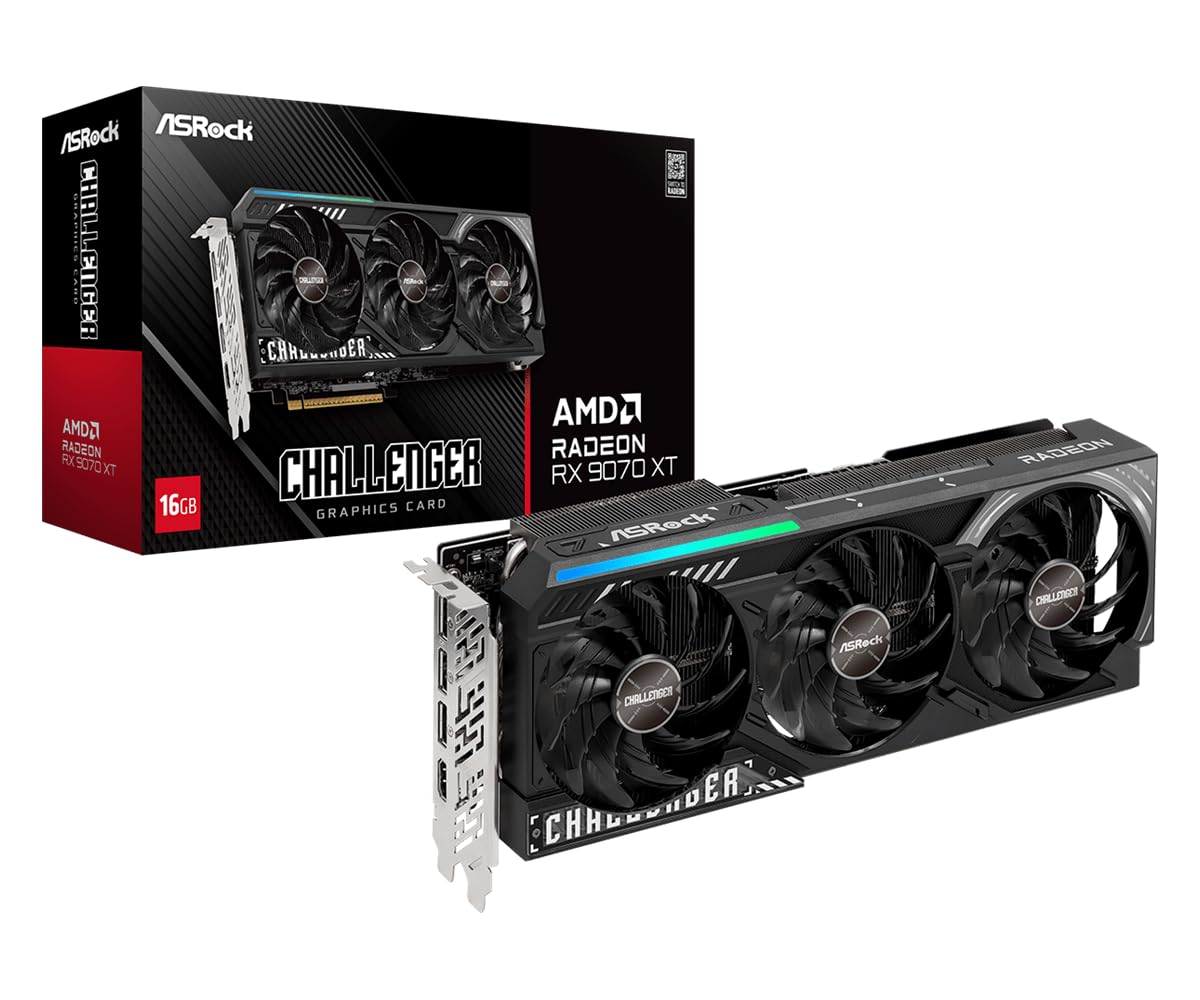
The high-clock champion that keeps 4K gameplay smooth without breaking conversation.
You want the fastest native 4K frame rates without relying on upscaling tricks. This card uses AMD’s latest RDNA 4 architecture (the chip design) with a boost clock up to 2970 MHz, which is 270 MHz higher than the XFX Swift’s 2700 MHz. That extra speed means it pushes more raw frames per second in demanding games like Apex Legends. Buyers report it holds a steady 60fps at native 4K, so number plates and distant enemies stay sharp. The 16GB of GDDR6 memory on a 256-bit bus handles huge texture files without stuttering or pausing to load.
The triple-fan cooling system includes a 0dB silent mode that stops the fans completely during light use, so you hear nothing at idle — perfect for quiet browsing. It also supports PCIe 5.0 (the newest motherboard connection), meaning it is ready for future motherboards without bottlenecking. One reviewer noted that an AMD driver update temporarily hurt performance on a multi-monitor setup, but a manual reinstall of the previous driver fixed it cleanly.
What Sticks Out
- Highest boost clock among the three (2970 MHz vs 2700 MHz)
- 0dB fan stop for dead-silent idle
- PCIe 5.0 support for future-proof builds
One Trade-Off
- ASRock RGB software can lose connection and become buggy
- Requires a 750W+ power supply; measure your case depth first
Reach for it if: you want the strongest native 4K performance in a mid-premium price tier, with room to grow into PCIe 5.0 boards.
The catch: the lighting software is not reliable, and the card is long enough that it may not fit compact cases without measuring.
2. XFX Swift AMD Radeon RX 9070 OC Triple 90mm Fan

The quiet workhorse that delivers strong 4K and 1440p without the RGB fuss.
If you care more about silence and efficiency than flashy lights, this XFX card is the sensible pick. Its boost clock of 2700 MHz is 270 MHz behind the ASRock’s 2970 MHz, so the ASRock is clearly faster, but the XFX holds its own in real-world gaming. Owners mention the fans stay quiet as long as they are below 50% speed, keeping temperatures under 60°C, with a maximum power draw of 300W — meaning it runs cooler and uses less electricity than the PNY RTX 4080 Super in many scenarios. A memory speed of 1440 MHz helps load textures quickly at 1440p and 4K. One buyer mentioned using undervolting (lowering the voltage to reduce power and heat), making this a strong pick for anyone mindful of power bills. On paper, it has a 2700 MHz boost clock versus the PNY’s 2565 MHz boost clock, though the gap narrows in ray-traced titles. One note of caution: a single buyer reported a rough RMA experience (return authorization) with XFX support, though a goodwill replacement was ultimately sent.
Why It Wins
- Very quiet under load (fans under 50%, temps below 60°C)
- No coil whine reported and no LEDs for a clean look
- Great price-to-performance vs the XT variant
The Downside
- Warranty service through XFX is hit-or-miss based on owner experiences
- Not as fast as the 9070 XT in raw 4K frame rates
Best fit when: you prioritize a silent, cool-running card and want to save money compared to the XT models.
A better match for budget builders who do not need the absolute highest 4K frame rates and can tolerate occasional support delays.
3. PNY GeForce RTX 4080 Super 16GB Verto OC Triple Fan

The ray-tracing beast that uses smart upscaling to keep frame rates high at 4K.
You want the best ray-traced visuals—like realistic reflections and shadows—and you are willing to pay for it. This card uses NVIDIA’s Ada Lovelace architecture with a boost clock of 2565 MHz, which is 135 MHz lower than the XFX’s 2700 MHz in raw speed. But what it loses in clock it makes up for with DLSS 3 (NVIDIA’s AI upscaling tech that boosts frame rates) and faster GDDR6X memory. Customers note excellent 4K gaming performance, hitting 60+ FPS on medium/high settings and well over 100 FPS with DLSS enabled. In ray-tracing heavy games like Alan Wake 2, it manages 60+ FPS with DLSS and frame generation (a feature that creates extra frames).
The 16GB of GDDR6X memory delivers up to 736GB/sec of bandwidth, which makes a difference in texture-rich open worlds at 4K — so forests and city streets stay detailed without blur. Reviewers point out it runs cool—under 67°C in most loads—though the included anti-sag bracket (a support arm to stop the card bending) does not always fit with the 12VHPWR power adapter (the new standard power connector). One owner mentioned the stock fan curve (the pre-set speed) is noisy, but a custom curve in MSI Afterburner (a free tuning tool) cleans it up easily.
Where It Excels
- DLSS 3 pushes 4K frame rates past 100 FPS in supported titles
- GDDR6X memory with high bandwidth (736GB/sec) for detailed textures
- Runs cool under 67°C for sustained gaming sessions
Where It Falls Short
- Large card (13 inches, 3 slots) and bulky power adapter may need case modification
- Stock fan curve is noisy until adjusted manually
Choose this if: ray tracing and DLSS 3 are your top priorities for a premium 4K experience, and you have the case space to accommodate it.
The price tag is your biggest real limit; this is the most expensive pick. Also, if your case cannot fit a 13-inch triple-slot card without removing drive cages, look at the smaller ASRock or XFX instead.
Understanding the Specs
Boost Clock Speed
This is the maximum speed the GPU runs at when under load, measured in MHz (millions of cycles per second). A higher boost clock, like the ASRock’s 2970 MHz, means the card can push more frames per second in demanding 4K scenes — so fast-moving games like racing titles stay smooth. For smooth 60 FPS gameplay, look for a boost clock above 2500 MHz.
Memory Type and Bandwidth
GDDR6 and GDDR6X are the two main memory types for video RAM. GDDR6X is faster, offering higher bandwidth (measured in GB/sec, like the 736GB/sec on the PNY 4080 Super), which helps load high-resolution textures quicker — so huge open-world landscapes render without hesitation. For 4K gaming, 16GB of memory is the balance to avoid texture pop-in or stuttering.
FAQ
Can a 4K graphics card run all games at 60 FPS at native 4K?
Do I need a new power supply for a 4K graphics card?
What is the difference between DLSS 3 and FSR for 4K gaming?
Will a 16GB graphics card be enough for 4K gaming in 2026?
Does a higher boost clock always mean better 4K performance?
How do I know if a graphics card will fit in my PC case?
What is the best 4K graphics card for a quiet gaming setup?
Can I use a 4K graphics card for content creation or streaming?
Final Thoughts: The Verdict
For most buyers, the 4k graphics card for gaming winner is the ASRock Radeon RX 9070 XT Challenger because it offers the highest boost clock of 2970 MHz for smooth native 4K at a mid-premium price. If you want quiet, efficient performance and great value, grab the XFX Swift RX 9070 OC. And for premium ray tracing and DLSS 3 support, the standout is the PNY RTX 4080 Super Verto OC.
How We Picked
We do not accept paid placement. Every pick is matched to a real buyer and a real use-case; we do not hands-on test units.
Sources & Methodology
Specifications: manufacturer listings and product documentation. Review insights: verified customer reviews, as of July 2026. Pricing: not shown on this page (it changes often); check the current price via the retailer link.
As an Amazon Associate, FitlyFast earns from qualifying purchases. This does not affect which products we feature.