
Our readers keep the lights on and the weekend projects moving. As an Amazon Associate, I earn from qualifying purchases.
You have a 4K monitor with a high refresh rate, and you are tired of turning down settings to get smooth frames in demanding titles. The difference between a graphics card that merely outputs 4K and one that delivers playable frame rates at ultra settings is a gap of hundreds of dollars and dozens of frames per second. Finding the right balance of VRAM, core count, and architecture for native or upscaled 4K is the defining decision for your entire build.
I’m Rikta — the co-founder and writer behind FitlyFast. I’ve spent countless hours analyzing GPU benchmarks, thermal reports, and real-world gaming data to cut through the marketing noise and identify the cards that actually deliver on their 4K promises.
Forget the spec sheets and launch-day hype — this guide focuses on tested performance and real value. Whether you are chasing the highest frame rates or the best price-to-performance ratio, you need the best 4k graphics card for your specific use case and budget tier.
How To Choose The Best 4K Graphics Card
Selecting a card for 4K gaming is more demanding than picking one for 1440p or 1080p. The jump in pixel count (over 8 million pixels per frame) requires a combination of raw compute power, sufficient memory bandwidth, and enough video memory to hold those high-resolution textures. You cannot just pick the card with the highest clock speed; you need to consider architecture, cooling, and upscaling technology as part of a single decision.
VRAM Capacity and Memory Bandwidth
At 4K, textures and shaders consume significantly more video memory. A card with 12GB is a baseline for current-gen titles, but many demanding games already exceed this at ultra settings. For headroom and future-proofing, target 16GB or more. Memory bandwidth, measured in GB/s, determines how fast the GPU can feed data to those cores. A wider memory bus (256-bit or higher) paired with fast GDDR6 or GDDR7 memory is essential for smooth 4K frame pacing.
Upscaling Technology: DLSS vs FSR
No current card renders every 4K frame natively at ultra settings without some compromise. Nvidia’s DLSS (Deep Learning Super Sampling) uses dedicated Tensor Cores and AI to reconstruct frames from a lower internal resolution, offering a significant performance boost with minimal visual loss. AMD’s FSR (FidelityFX Super Resolution) uses a spatial upscaling algorithm and works across more hardware. For 4K gaming, DLSS 3.5 and the newer DLSS 4 provide a measurable edge in both frame rate and image quality, especially in ray-traced titles.
Ray Tracing Performance and Cooling
Ray tracing at 4K is a heavy computational load. Nvidia’s RT Cores (especially the 3rd and 4th generation) handle this workload more efficiently than AMD’s current implementation, resulting in higher frame rates when ray tracing is enabled. A card that runs cool under sustained load not only protects longevity but also maintains boost clocks. Look for triple-fan solutions or premium vapor-chamber coolers if you plan on long sessions with demanding titles.
Quick Comparison
On smaller screens, swipe sideways to see the full table.
| Model | Category | Best For | Key Spec | Amazon |
|---|---|---|---|---|
| XFX Swift RX 9070 XT | Mid-Range | Best Overall Value | 16GB GDDR6, 2970 MHz Boost | Amazon |
| ASRock Challenger RX 9070 XT | Mid-Range | Great for 1440p/4K | 16GB GDDR6, PCIe 5.0 | Amazon |
| GIGABYTE RTX 4070 WF3 OC | Mid-Range | Power Efficient 4K Entry | 12GB GDDR6X, Single 8-Pin | Amazon |
| ASUS Prime RX 9070 XT OC | Mid-Range | Quiet & Cool Operation | 16GB GDDR6, 2.5-Slot | Amazon |
| Sapphire Nitro+ RX 9070 XT | Mid-Range | Premium Build & Cooling | 16GB GDDR6, 3060 MHz Boost | Amazon |
| MSI RTX 5070 Ti Ventus 3X | Mid-Range | DLSS 4 Sweet Spot | 16GB GDDR7, 256-bit | Amazon |
| PNY RTX 5080 Epic-X OC | Premium | High-End 4K Gaming | 16GB GDDR7, DLSS 4 | Amazon |
| GIGABYTE RTX 5080 Gaming OC | Premium | Overclocking & Cooling | 16GB GDDR7, WINDFORCE | Amazon |
| NVIDIA RTX 5080 FE | Premium | SFF & Reference Design | 16GB GDDR7, 2-Slot | Amazon |
| VIPERA RTX 4090 FE | Enthusiast | Raw Unmatched Power | 24GB GDDR6X, Ada Lovelace | Amazon |
| ASUS ROG Astral RTX 5090 | Enthusiast | Ultimate 4K Performance | 32GB GDDR7, Quad Fan | Amazon |
In‑Depth Reviews
1. XFX Swift AMD Radeon RX 9070 XT Triple Fan
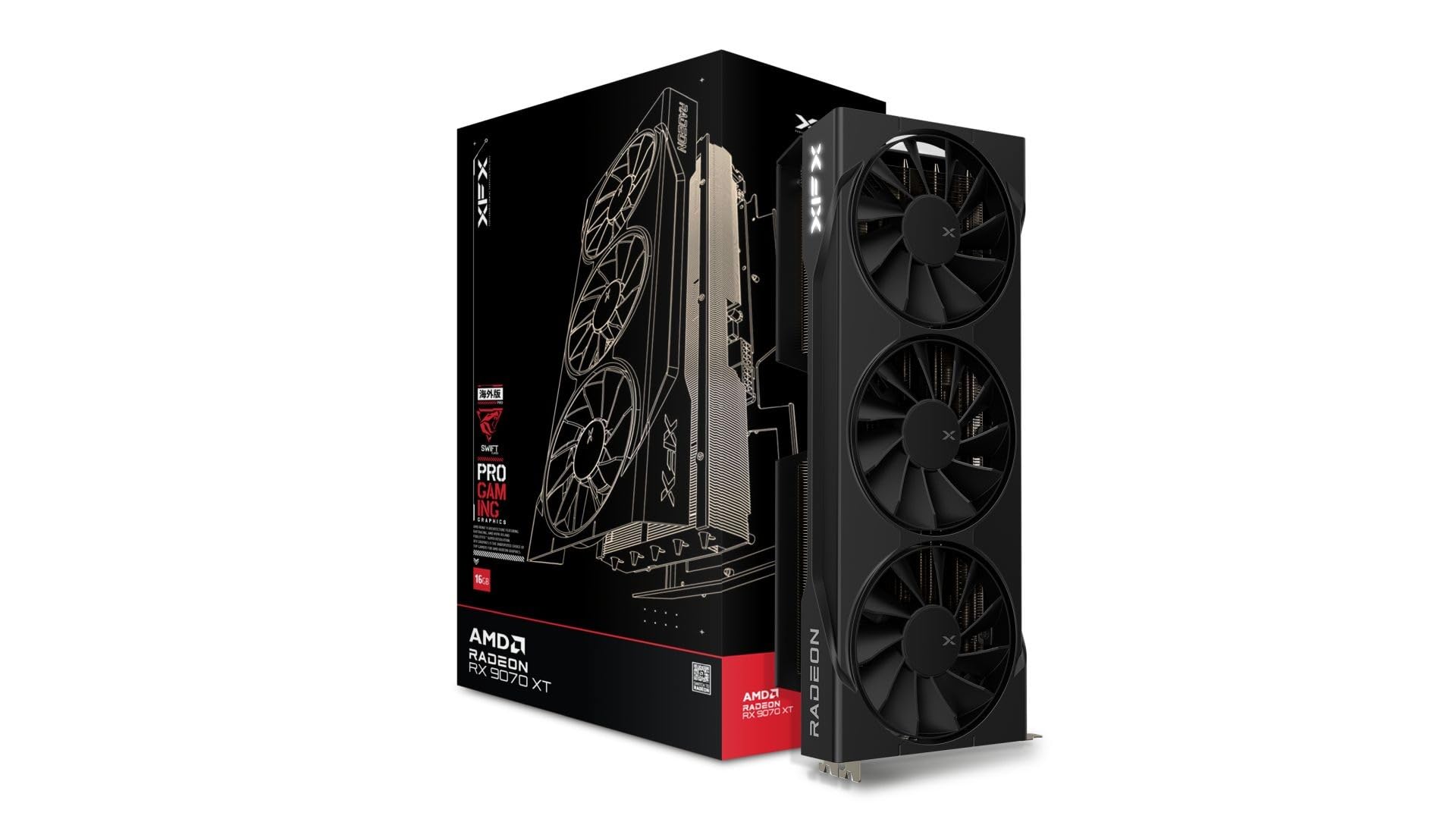
The XFX Swift RX 9070 XT is a standout in the mid-range 4K space, offering 16GB of GDDR6 memory and a boost clock up to 2970 MHz. This combination allows it to handle demanding titles at 4K with high settings, and it shines at 1440p where it delivers buttery-smooth frame rates. The triple-fan cooling solution keeps temperatures well in check even during extended sessions, and the card’s build quality feels solid for its price position.
Real-world testing shows this card provides a substantial performance uplift over previous-generation Radeon cards, making it an excellent upgrade path for those on RX 6000 series or older Nvidia cards. The RDNA 4 architecture brings improved ray tracing performance, though it still trails Nvidia’s latest RT Cores in heavily ray-traced scenes. For pure rasterization and high-resolution gaming without ray tracing, this is a formidable performer.
Users consistently praise the quiet operation and the value proposition it offers. The card runs cool, with reported idle temperatures in the low 30s Celsius and load temperatures remaining below 70 degrees with proper case airflow. The only caveat is its physical size — it is a long card that requires a spacious case and a 750W power supply or higher.
Why it’s great
- Excellent price-to-performance ratio for 4K gaming
- Quiet and effective triple-fan cooling solution
- 16GB VRAM provides good headroom for modern titles
Good to know
- Ray tracing performance lags behind Nvidia competitors
- Large physical footprint may not fit smaller cases
- Requires a robust power supply of 750W or more
2. ASRock Radeon RX 9070 XT Challenger 16GB OC
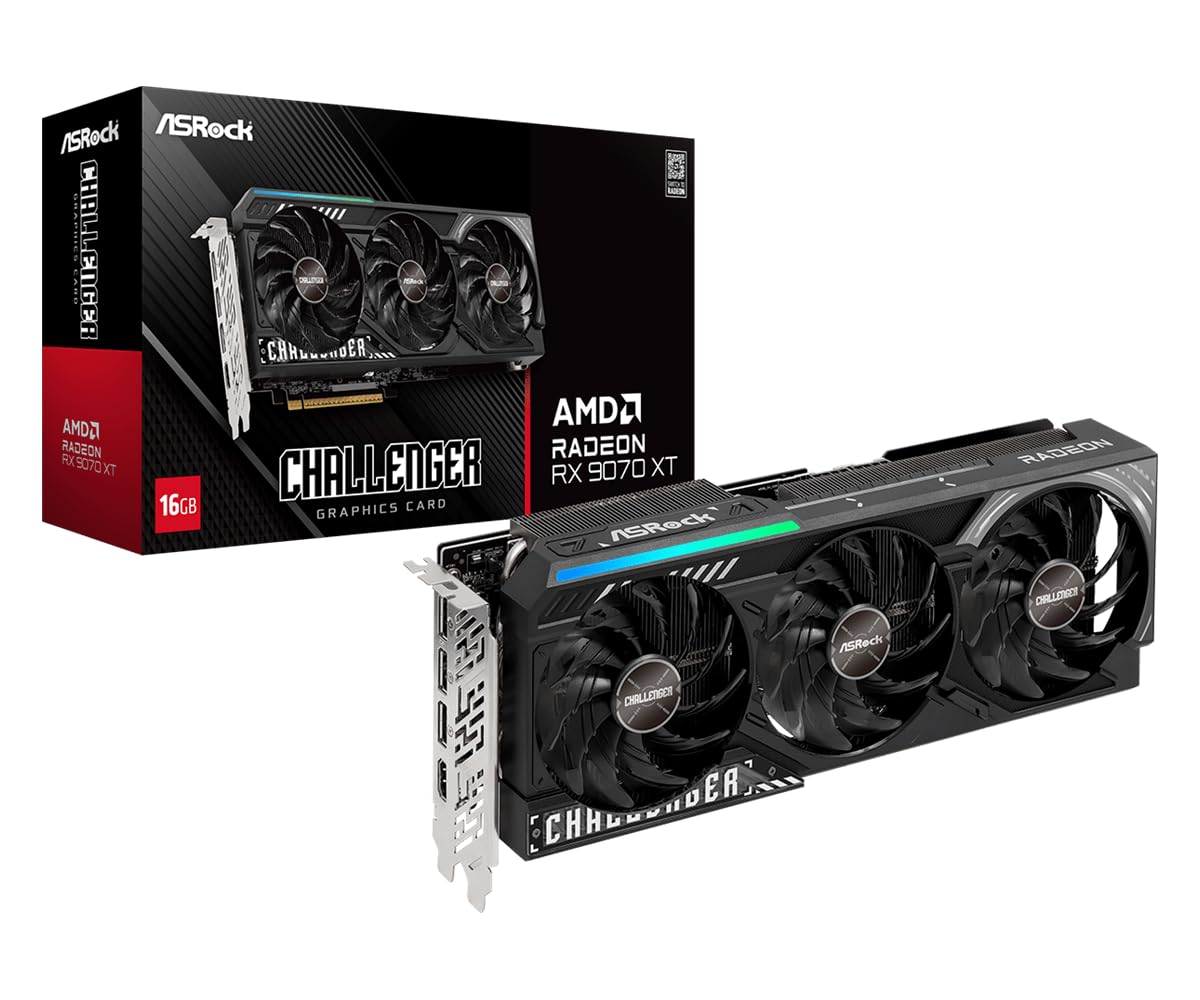
The ASRock Challenger RX 9070 XT shares the same core silicon as the XFX Swift but distinguishes itself with a different cooling solution and a slightly different power delivery design. With a boost clock of 2970 MHz and 16GB of GDDR6 on a 256-bit bus, this card delivers smooth 4K gaming in most titles and truly excels at 1440p ultra settings. The three DisplayPort 2.1a outputs are a welcome addition for those with high-refresh-rate monitors.
The triple-fan cooling system with 0dB silent technology is a highlight — the fans stop entirely during light workloads, making it an excellent choice for an office or quiet gaming environment. Under load, the card remains reasonable in noise levels for a mid-range GPU. The metal backplate adds structural rigidity and assists with heat dissipation, which is important for sustained gaming sessions.
User feedback points to stable performance out of the box, with many noting that undervolting via AMD Adrenaline further improves thermals without sacrificing performance. The white LED lighting is not customizable, which may disappoint some builders, but the performance is what matters here. It is a solid mid-range option for anyone building a new system or upgrading from an older card.
Why it’s great
- 0dB fan mode for silent operation at idle
- Excellent 1440p performance with strong 4K capability
- Three DisplayPort 2.1a outputs for modern monitors
Good to know
- LED lighting cannot be customized or turned off
- Requires a 750W power supply minimum
- Large size may challenge cable management
3. GIGABYTE GeForce RTX 4070 WINDFORCE OC 12G

The GIGABYTE RTX 4070 WINDFORCE OC is an entry-level 4K card that relies heavily on DLSS 3 to make 4K gaming viable. With 12GB of GDDR6X memory, it is at the lower edge of VRAM for 4K, meaning some titles at ultra textures may exceed its buffer. However, its power efficiency is remarkable — it draws significantly less power than comparable AMD cards, and the single 8-pin power connector means many users will not need a PSU upgrade.
The WINDFORCE triple-fan cooling system is effective and quiet, with reported load temperatures rarely exceeding 70 degrees Celsius. The card supports NVIDIA’s DLSS 3, which includes Frame Generation, effectively doubling frame rates in supported titles. For games like Cyberpunk 2077 with ray tracing, DLSS is almost mandatory to achieve playable 4K frame rates, but the visual results are impressive for this price tier.
Users appreciate the low power draw and the cool running temperatures, which make it an excellent choice for air-cooled systems. The 12GB VRAM is a limitation for future titles, but for current-gen gaming with DLSS enabled, it performs admirably. The lack of RGB is a plus for those who prefer a clean, understated build aesthetic.
Why it’s great
- Exceptional power efficiency and low heat output
- DLSS 3 delivers strong 4K Frame Generation
- Single 8-pin power connector simplifies installation
Good to know
- 12GB VRAM may limit texture settings in future 4K titles
- Native 4K performance without DLSS is limited
- Not ideal for heavy ray tracing at 4K without DLSS
4. ASUS Prime AMD Radeon RX 9070 XT 16GB OC Edition

The ASUS Prime RX 9070 XT OC Edition takes a more measured approach to cooling with a 2.5-slot design, making it more compatible with smaller cases than some of the chunkier cards on this list. Despite the slimmer profile, the Axial-tech fans with a smaller hub and longer blades generate solid downward air pressure. The phase-change GPU thermal pad is a clever inclusion that improves heat transfer from the die to the heatsink.
Power draw is impressively controlled, with some user reports indicating around 180-190 watts under typical gaming stress. This lower power consumption translates to lower temperatures, with idle temps in the high 20s to low 30s Celsius and load temps staying in the mid-50s to low 60s Celsius. The 0dB technology ensures the fans are silent during light gaming or desktop use, which is a significant quality-of-life improvement for many users.
The card is praised for its Linux compatibility and solid out-of-box performance. The lack of RGB is another deliberate choice that appeals to minimalist builders. Performance is on par with other RX 9070 XT cards, making it a viable option for 4K gaming at high settings. The only trade-off is that the 2.5-slot cooler may run slightly warmer under sustained heavy loads compared to thicker triple-slot designs.
Why it’s great
- Slimmer 2.5-slot design fits more cases
- Excellent thermal performance with phase-change pad
- Very quiet operation with 0dB fan mode
Good to know
- May run slightly warmer than 3-slot alternatives under heavy load
- Build quality feels slightly less premium than ASUS ROG line
- Warranty support feedback is mixed from users
5. Sapphire 11348-01-20G Nitro+ RX 9070 XT Gaming OC

The Sapphire Nitro+ RX 9070 XT is widely regarded as the premium variant of the RX 9070 XT lineup, featuring a higher boost clock of 3060 MHz out of the box. This translates to a noticeable performance edge in both 4K and 1440p gaming, often outperforming reference-clocked cards by several percentage points. The 16GB GDDR6 memory on a 256-bit bus provides ample bandwidth for 4K textures.
The cooling solution is exceptional — the triple-fan design with a large heatsink keeps the card running cool and quiet even under sustained loads. User reports note the lack of coil whine, which is a common complaint with some high-end cards. The build quality feels solid, with a metal backplate and a clean aesthetic that looks good in any build. The card also includes two HDMI 2.1 outputs and two DisplayPort outputs, offering flexibility for multi-monitor setups.
Performance improvements over the RX 6750 XT are reported to be 60-90% faster, making this a massive generational leap. It handles 4K 120Hz gaming comfortably in most titles, though ray tracing performance still lags behind Nvidia’s latest offerings. The main downside is the large physical size and weight — it requires a support bracket to prevent sagging and needs a spacious case with good airflow.
Why it’s great
- Higher factory boost clock for better out-of-box performance
- Excellent cooling with quiet, no coil whine operation
- Premium build quality with clean aesthetics
Good to know
- Very large and heavy, requires support bracket
- Ray tracing trails Nvidia competition
- Premium pricing elevates it above standard RX 9070 XT cards
6. MSI Gaming RTX 5070 Ti 16G Ventus 3X OC

The MSI RTX 5070 Ti Ventus 3X OC is powered by NVIDIA’s Blackwell architecture and features 16GB of cutting-edge GDDR7 memory on a 256-bit bus. This card represents the sweet spot for 4K gaming in the current generation, offering raw performance that often rivals or exceeds the previous generation’s RTX 4080 Super. The TORX Fan 5.0 design with linked fan blades creates consistent high-pressure airflow to keep the card cool under load.
DLSS 4 is a game-changer here, with Multi Frame Generation providing substantial frame rate boosts in supported titles. The card is also SFF-Ready, meaning it fits into smaller form-factor cases while still delivering enthusiast-level performance. The nickel-plated copper baseplate efficiently captures heat from both the GPU and memory modules, ensuring stable operation even during extended gaming sessions.
Users report that the card stays under 65 degrees Celsius even under full load, and it runs quietly thanks to the effective cooling solution. The included adjustable support bracket is a thoughtful addition given the card’s length. It is consistently praised as the best price-performance ratio available for high-refresh 4K gaming, with some users noting it outperforms the RTX 4090 in titles that utilize DLSS 4 Frame Generation.
Why it’s great
- Excellent 4K performance with DLSS 4 support
- Runs cool and quiet under sustained loads
- 16GB GDDR7 memory is future-proof for 4K
Good to know
- High demand may affect availability
- Requires good case airflow for optimal thermals
- Price is at the upper end of the mid-range segment
7. PNY NVIDIA GeForce RTX 5080 Epic-X ARGB OC Triple Fan
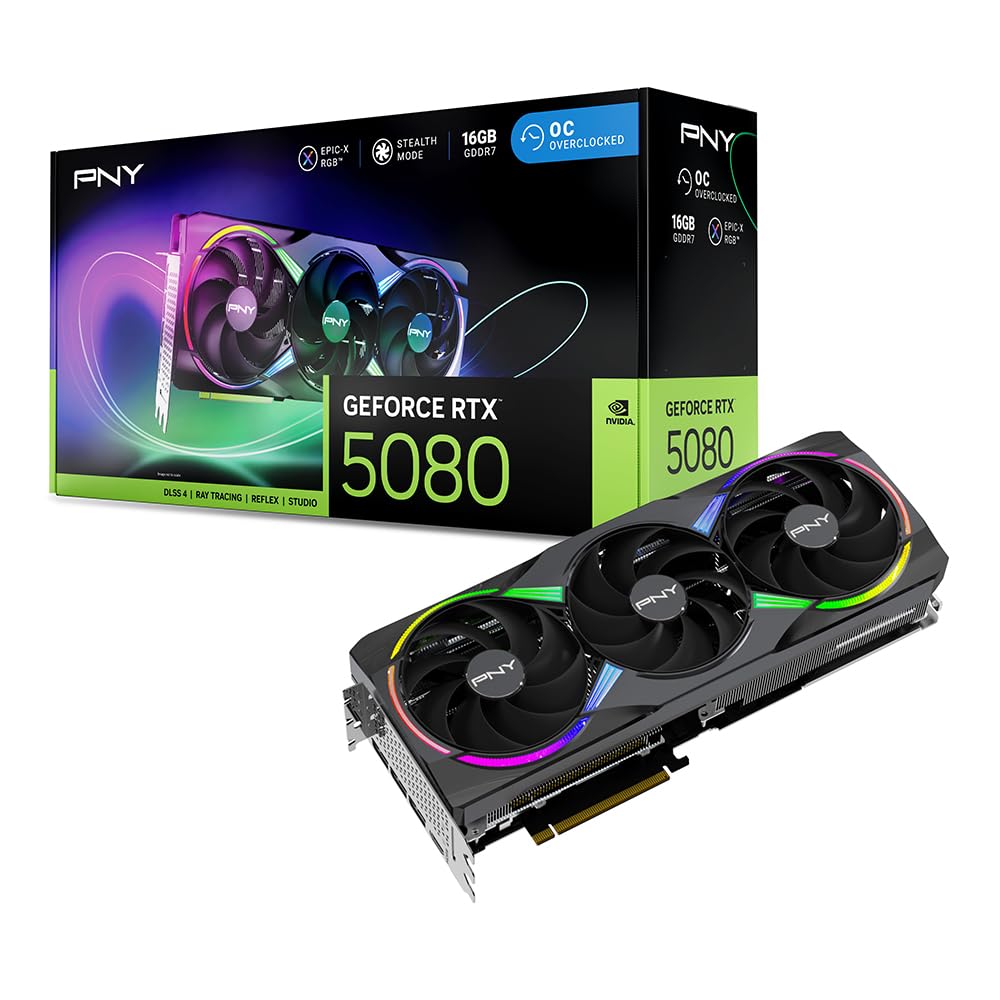
The PNY RTX 5080 Epic-X ARGB OC is a premium card that delivers enthusiast-class 4K performance without reaching the stratospheric pricing of the RTX 5090. With 16GB of GDDR7 memory and a boost clock of 2775 MHz, it handles 4K max settings in demanding titles with ease. The triple-fan cooling solution with ARGB lighting provides both aesthetics and thermal performance, keeping the card cool during heavy workloads.
NVIDIA’s DLSS 4 on the Blackwell architecture is a standout feature, offering Multi Frame Generation that can dramatically boost frame rates in supported titles. The card also benefits from NVIDIA Reflex 2 with Frame Warp, which reduces system latency for competitive gaming. For content creators, the RTX 5080 series offers significant acceleration in video editing, 3D rendering, and AI workloads through the NVIDIA Studio platform.
Users generally praise the performance and build quality, noting that it runs quiet and includes an anti-sag bracket and RGB control. However, there are isolated reports of receiving previously opened units, which is a concern given this card’s premium positioning. Performance-wise, it delivers 187-212 FPS at max settings in Cyberpunk 2077 with DLSS enabled, showcasing its raw power for 4K gaming.
Why it’s great
- Excellent 4K gaming performance with high frame rates
- DLSS 4 Multi Frame Generation for future titles
- Quiet operation with effective triple-fan cooling
Good to know
- Large card requires a spacious case
- Some quality control concerns with returned units
- Premium pricing, though below the 5090
8. GIGABYTE GeForce RTX 5080 Gaming OC 16G

The GIGABYTE RTX 5080 Gaming OC is built for users who want to push beyond stock performance. The WINDFORCE cooling system is a proven design that keeps temperatures low even when overclocking the card. Users report stable overclocks reaching 3150 MHz on the GPU core and 3000 MHz on the memory, providing a tangible performance uplift over standard clocks.
With 16GB of GDDR7 memory and a 256-bit bus, this card has the bandwidth and capacity to handle any current 4K title at ultra settings. DLSS 4 and NVIDIA Reflex 2 provide the software ecosystem to maximize frame rates and minimize latency. The card also supports PCIe 5.0 for maximum bandwidth with compatible motherboards, ensuring no bottlenecks in data transfer.
The physical size of this card is substantial, measuring over 13 inches long. It requires careful case planning, especially regarding front radiator clearance. Despite its size, it stays cool and quiet under load, with temperatures hovering around 60-65 degrees Celsius. Users upgrading from the RTX 3000 series report a solid improvement, though the generational leap is less dramatic than moving from 2000 to 3000 series.
Why it’s great
- Strong overclocking headroom for extra performance
- Excellent WINDFORCE cooling keeps temps low
- 16GB GDDR7 is well-suited for 4K gaming
Good to know
- Very large card — verify case compatibility
- RGB implementation is minimal and underwhelming
- Price premium over the Founders Edition
9. NVIDIA GeForce RTX 5080 Founders Edition

The NVIDIA RTX 5080 Founders Edition is the reference design, and it is remarkably compact for the performance it delivers. With a 2-slot design, it fits in cases where third-party cards with massive heatsinks will not. The boost clock of 2806 MHz and 16GB of GDDR7 memory provide all the power needed for high-fidelity 4K gaming, including ray tracing at max settings with DLSS enabled.
The cooler is surprisingly effective for such a slim profile, with users reporting that the card stays cool even under sustained loads. The build quality is excellent, and the card does not require an additional support bracket, which simplifies installation. It supports the full suite of NVIDIA technologies including DLSS 4, Reflex 2, and the Blackwell architecture benefits.
Performance at 1440p is exceptional, with users reporting 120-240+ FPS at max settings with ray tracing enabled. At 4K, it delivers smooth, playable frame rates in demanding titles. The main concern is pricing — the Founders Edition is often listed above MSRP by third-party sellers, which erodes its value proposition compared to custom AIB cards that offer better cooling for a similar price.
Why it’s great
- Compact 2-slot design fits in more cases
- Excellent build quality from NVIDIA
- No additional support bracket needed
Good to know
- Often priced above MSRP by resellers
- Cooler may not match custom AIB thermals under heavy loads
- Limited overclocking headroom compared to partner cards
10. VIPERA NVIDIA GeForce RTX 4090 Founders Edition

The RTX 4090 Founders Edition remains one of the most powerful consumer graphics cards ever made, even after the introduction of the RTX 50 series. With 24GB of GDDR6X memory on a 384-bit bus, it has both the capacity and bandwidth to handle 4K gaming at ultra settings without breaking a sweat. The Ada Lovelace architecture with DLSS 3 ensures it remains relevant for years to come.
This card is a beast for 4K gaming, delivering native high frame rates in almost any title. It also excels in content creation workflows, with 3D rendering, video editing, and AI workloads all benefiting from the massive compute power and VRAM capacity. The integrated support for NVIDIA Studio drivers ensures stability for professional applications.
Users praise its performance and reliability, noting that it handles demanding workloads like LLM inference and Blender rendering with ease. The cooling is effective and quiet for the amount of heat it generates. The main drawback is the pricing — the 4090 is very expensive, and its position as a previous-generation card means it faces stiff competition from the newer RTX 5080 and 5090 offerings, though its 24GB VRAM gives it an edge in memory-sensitive tasks.
Why it’s great
- Unmatched raw performance for 4K gaming and creation
- 24GB VRAM is ideal for high-res textures and AI workloads
- Quiet and effective Founders Edition cooling
Good to know
- Very expensive, pricing often exceeds MSRP
- Previous-generation architecture, though still powerful
- Large card requiring good case airflow
11. ASUS ROG Astral NVIDIA GeForce RTX 5090 32GB OC Edition

The ASUS ROG Astral RTX 5090 is the absolute pinnacle of consumer 4K graphics performance. With 32GB of GDDR7 memory, a quad-fan cooling design, and a patented vapor chamber, it is built for the most demanding users who want uncompromising 4K performance. The Blackwell architecture with DLSS 4 ensures this card will handle any title at max settings with ray tracing enabled for years to come.
The cooling solution is extreme — the quad-fan design with a milled heatspreader moves massive amounts of air, keeping the card surprisingly cool given the thermal output. The 3.8-slot design is massive, but it allows for a heatsink and fin array that efficiently dissipates heat. The phase-change GPU thermal pad ensures optimal heat transfer between the die and the cooler, maintaining high boost clocks under sustained loads.
Performance is staggering, with users reporting over 200 FPS in competitive titles and smooth 4K gaming in demanding single-player games. The 32GB VRAM is future-proof for AI workloads, large language models, and ultra-high-resolution texture packs. The card is massive — over 14 inches long and weighing 5 pounds — requiring careful case planning and a strong support bracket. It is overkill for casual users, but for those who demand the absolute best, it delivers.
Why it’s great
- Unmatched 4K gaming performance with highest frame rates
- 32GB VRAM is future-proof for AI and creative workloads
- Exceptional cooling with quad-fan vapor chamber design
Good to know
- Extremely large and heavy — verify case compatibility
- Very expensive, targeted at enthusiasts only
- Overkill for casual or mid-range gaming needs
FAQ
How much VRAM do I need for 4K gaming in 2025?
Is DLSS better than FSR for 4K gaming?
What power supply do I need for a high-end 4K graphics card?
How important is PCIe 5.0 for 4K graphics cards?
Final Thoughts: The Verdict
For most users, the best 4k graphics card winner is the XFX Swift RX 9070 XT because it offers an excellent balance of 4K performance, 16GB VRAM, and value without breaking the bank. If you want DLSS 4 and superior ray tracing performance, grab the MSI RTX 5070 Ti Ventus 3X. And for uncompromising, absolute maximum 4K performance, nothing beats the ASUS ROG Astral RTX 5090.