
Our readers keep the lights on and the weekend projects moving. As an Amazon Associate, I earn from qualifying purchases.
Choosing a 4K HDR TV today means deciding between Mini-LED’s blinding brightness and OLED’s perfect black levels, all while dodging the fake 120Hz panels that only fool the spec sheet. The wrong pick leaves you with washed-out highlights during a sunset scene or motion blur that ruins a fast-break goal.
I’m Rikta — the co-founder and writer behind FitlyFast. I’ve spent years analyzing television hardware specs, from local dimming zone counts to HDMI 2.1 bandwidth ceilings, to separate marketing fluff from real-world performance.
After comparing over a dozen 4K HDR TVs across Mini-LED, QLED, and OLED technologies, one model consistently delivers the best balance of contrast, color volume, and gaming fluidity under real room lighting. This guide breaks down what matters most so you can find the best 4k hdr tv for your setup without wasting money on unnecessary features.
How To Choose The Best 4K HDR TV
The decision starts with your room’s ambient light. In a bright living room, a Mini-LED panel with high nits and anti-glare coating will outperform an OLED that struggles to fight sunlight. In a dedicated media room, OLED’s per-pixel dimming delivers the deepest blacks and highest contrast ratio, making it the clear winner for cinematic HDR.
Local Dimming Zones Are the Real Spec
Peak brightness numbers grab headlines, but the number of local dimming zones determines how precisely the TV can light up a tiny flame while keeping the surrounding night sky black. A TV with 600 zones will show noticeably less blooming around subtitles than one with 48 zones. Entry-level Mini-LEDs often skimp here, so check the zone count, not just the “Mini-LED” sticker.
HDMI 2.1 Isn’t Just for Gamers
Full 48Gbps HDMI 2.1 ports unlock 4K at 144Hz with VRR, but the bigger win for non-gamers is eARC support for lossless Dolby Atmos passthrough to a soundbar or receiver. Many mid-range TVs include only one full-bandwidth port, so count which ports you actually need for your Xbox, PS5, PC, and audio system before buying.
Upscaling Matters More Than Native Resolution
Most of what you watch — cable TV, YouTube, older streaming content — isn’t native 4K. The TV’s upscaling engine determines whether 1080p content looks soft or surprisingly sharp. Sony’s XR Processor and Samsung’s NQ4 AI Gen3 chip lead the pack here. Budget TVs often make 1080p look muddy, so read upscaling reviews if you watch a lot of non-4K content.
Panel Type and Viewing Angle
VA panels offer strong contrast but narrow viewing angles — colors wash out past 30 degrees off-center. IPS panels keep color accuracy from the side but sacrifice black depth. OLED and QD-OLED panels maintain perfect contrast and color at wide angles, making them the best choice for open floor plans where viewers sit off to the side.
Quick Comparison
On smaller screens, swipe sideways to see the full table.
| Model | Category | Best For | Key Spec | Amazon |
|---|---|---|---|---|
| LG C4 OLED | OLED | Cinematic black levels & 144Hz gaming | 4x HDMI 2.1 | Amazon |
| Samsung S90F | QD-OLED | Bright-room OLED with vibrant color | NQ4 AI Gen3 | Amazon |
| Sony BRAVIA 8 | OLED | Movie accuracy & PS5 integration | XR Processor | Amazon |
| TCL QM7K | Mini-LED | High brightness with deep local dimming | 2,500 zones | Amazon |
| Hisense U6 | Mini-LED | Bright room with Fire TV ecosystem | 600 zones | Amazon |
| Samsung M70H | Mini-LED | Samsung ecosystem & free TV Plus | 60Hz panel | Amazon |
| iFFALCON 55U85 | Mini-LED | Value 144Hz gaming with HDMI 2.1 | 4x HDMI 2.1 | Amazon |
| Sony BRAVIA 2 | LED | PS5 Auto HDR Tone Mapping | Motionflow XR | Amazon |
| Roku Plus Series | Mini-LED | Easiest OS & free channel library | Mini-LED + QLED | Amazon |
| VIZIO M-Series | QLED | Entry-level QLED with Dolby Vision | Full Array | Amazon |
| TOSHIBA C350 | LED | Affordable 75-inch screen | Fire TV built-in | Amazon |
In‑Depth Reviews
1. LG C4 OLED

The LG C4 is the benchmark for OLED performance in 2024, packing over 8 million self-lit pixels that hit true black on individual diodes. With the a9 AI Processor Gen7 handling upscaling and motion interpolation, 1080p content gains noticeable clarity without the soap-opera artifact that plagues cheaper chips. The 144Hz native refresh rate pairs with NVIDIA G-Sync and AMD FreeSync Premium to eliminate screen tearing during PC or console gameplay.
HDR highlights punch well above the C4’s peak brightness rating thanks to 100% Color Volume and Dolby Vision support. The Filmmaker Mode preserves the director’s intended color temperature and frame rate, making it a strong pick for purists. Four full-bandwidth HDMI 2.1 ports mean you can connect a PS5, Xbox Series X, soundbar, and PC without juggling cables — a rarity even at this level.
The Magic Remote with pointer-style cursor simplifies navigation through webOS 24, though the interface loads slightly slower than Google TV competitors. The slim chassis leaves almost no bezel visible, and the panel stays cool even during long sessions. The built-in subwoofer delivers surprising low-end punch for on-board audio, enough for casual viewing before you invest in a dedicated sound system.
Why it’s great
- Perfect blacks with zero blooming in dark room
- Four HDMI 2.1 ports for multi-device setups
- Smooth 144Hz VRR with G-Sync and FreeSync
Good to know
- WebOS 24 can feel sluggish compared to Google TV
- Bright room performance limited; not ideal for sunlit windows
- Burn-in risk if used as static PC monitor for hours daily
2. Samsung S90F

The Samsung S90F uses QD-OLED technology to merge the high brightness of quantum dots with the per-pixel black levels of OLED. The NQ4 AI Gen3 processor analyzes each scene through 128 neural networks to boost brightness in real time, making HDR specular highlights like sunlight through trees pop without clipping. This panel handles ambient light better than traditional WRGB OLEDs, so it stays watchable in a living room with curtains open.
Motion Xcelerator 144Hz provides tear-free VRR gaming up to 4K, and the Game Bar gives quick access to refresh rate overlays and input lag meters. The Upscaling Pro engine cleans up 1080p and 1440p content aggressively, reducing edge artifacts on lower-bitrate streams. The Q-Symphony feature syncs with compatible Samsung soundbars to use the TV speakers as a center channel, creating a wider soundstage for dialogue-heavy scenes.
The anti-reflective coating reduces glare effectively, but it is also delicate — cleaning with anything abrasive leaves permanent micro-scratches visible under direct light. The minimalist SolarCell remote charges via ambient light and includes a built-in mic for Alexa, though it lacks the number keypad some users prefer for channel surfing on cable boxes.
Why it’s great
- QD-OLED delivers OLED blacks with higher brightness
- AI upscaling makes 1080p look near-4K
- 144Hz VRR with excellent input lag
Good to know
- Anti-reflective coating scratches easily
- Only two HDMI 2.1 ports
- Remote lacks number buttons
3. Sony BRAVIA 8

The Sony BRAVIA 8 leverages the XR Processor to apply real-time scene analysis that adjusts color, contrast, and clarity frame-by-frame. The XR OLED Motion feature inserts black frames at high frequency to reduce perceived judder in 24p film content, making panning shots across landscapes appear smooth without introducing the unnatural fluidity of interpolation. The XR Triluminos Pro expands the color gamut to cover nearly 100% of the DCI-P3 color space, rendering skin tones and foliage with exceptional accuracy.
PS5 owners benefit from two exclusive features: Auto HDR Tone Mapping, which calibrates the HDR signal during initial console setup to match the panel’s luminance curve, and Auto Genre Picture Mode, which automatically switches to game mode when a controller is detected and reverts to cinema mode for streaming apps. The Acoustic Surface Audio+ technology uses actuators behind the screen to vibrate the glass itself, producing sound that feels like it originates from the on-screen action rather than from bottom-firing speakers.
The Google TV interface integrates streaming apps, live channels, and Sony’s Bravia Core service, which offers high-bitrate 4K streams of Sony Pictures films. The included credits for Bravia Core give access to recent releases at higher bitrates than Netflix or Disney+ typically deliver. The panel is heavy due to the acoustic actuator array, so wall-mounting requires a sturdy bracket and two-person installation.
Why it’s great
- Best-in-class upscaling and motion handling
- PS5 Auto HDR Tone Mapping is seamless
- Acoustic Surface delivers unique sound imaging
Good to know
- Heavy chassis; difficult to wall-mount alone
- Google OS can feel buggy with OTA content
- Premium price for OLED without 144Hz panel
4. TCL QM7K
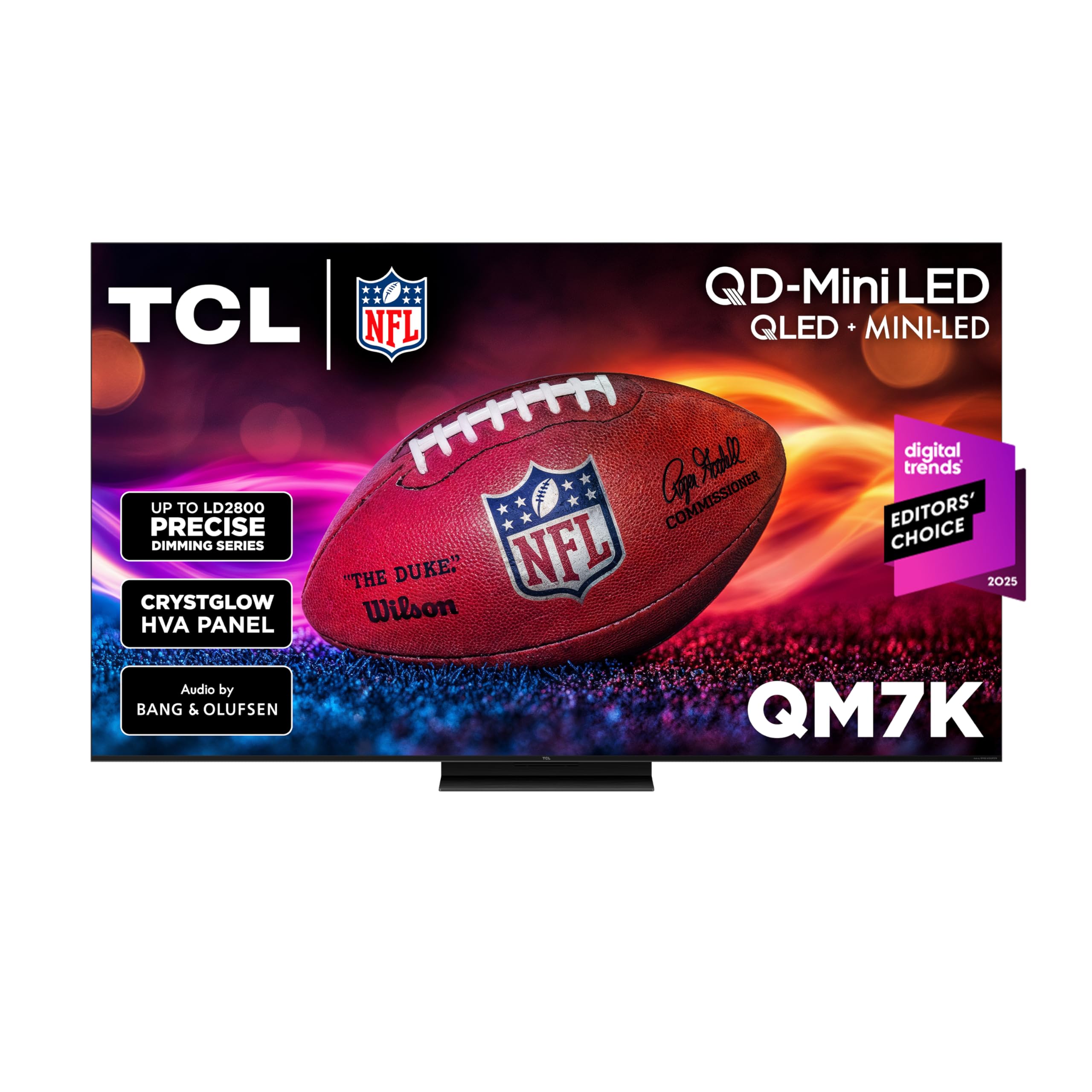
The TCL QM7K packs up to 2,500 local dimming zones using the Halo Control System, which combines high-energy LED microchips with condensed micro lenses to minimize blooming around bright objects on dark backgrounds. The CrystGlow HVA panel features an anti-reflective layer that keeps blacks deep even when a lamp is on in the same room — a common pain point for standard VA panels. Peak brightness exceeds 2,000 nits in small window highlights, making Dolby Vision content look explosive without clipping specular detail.
The 144Hz native refresh rate supports VRR up to 240Hz through DLG (Dual Line Gate) mode, which drops resolution to improve responsiveness for competitive PC gaming. The Google TV interface is snappy and free of excessive bloatware compared to some competitors. The Onkyo 2.1-channel audio system includes a dedicated subwoofer that produces noticeable low-end rumble during action sequences, though the dialogue clarity falls short of dedicated soundbar setups.
The remote feels light and cheap compared to the premium build of the television itself. The Bang & Olufsen audio partnership does not extend to the sound quality — it is merely a licensing badge rather than a hardware collaboration, so buyer expectations should be tempered. For the zone count and brightness, this is the strongest Mini-LED performer below the OLED price point.
Why it’s great
- Up to 2,500 dimming zones for minimal blooming
- Very high peak brightness for HDR highlights
- Excellent anti-glare coating for bright rooms
Good to know
- Cheap-feeling remote control
- Sound quality mediocre; soundbar recommended
- Google TV includes bloatware apps
5. Hisense U6
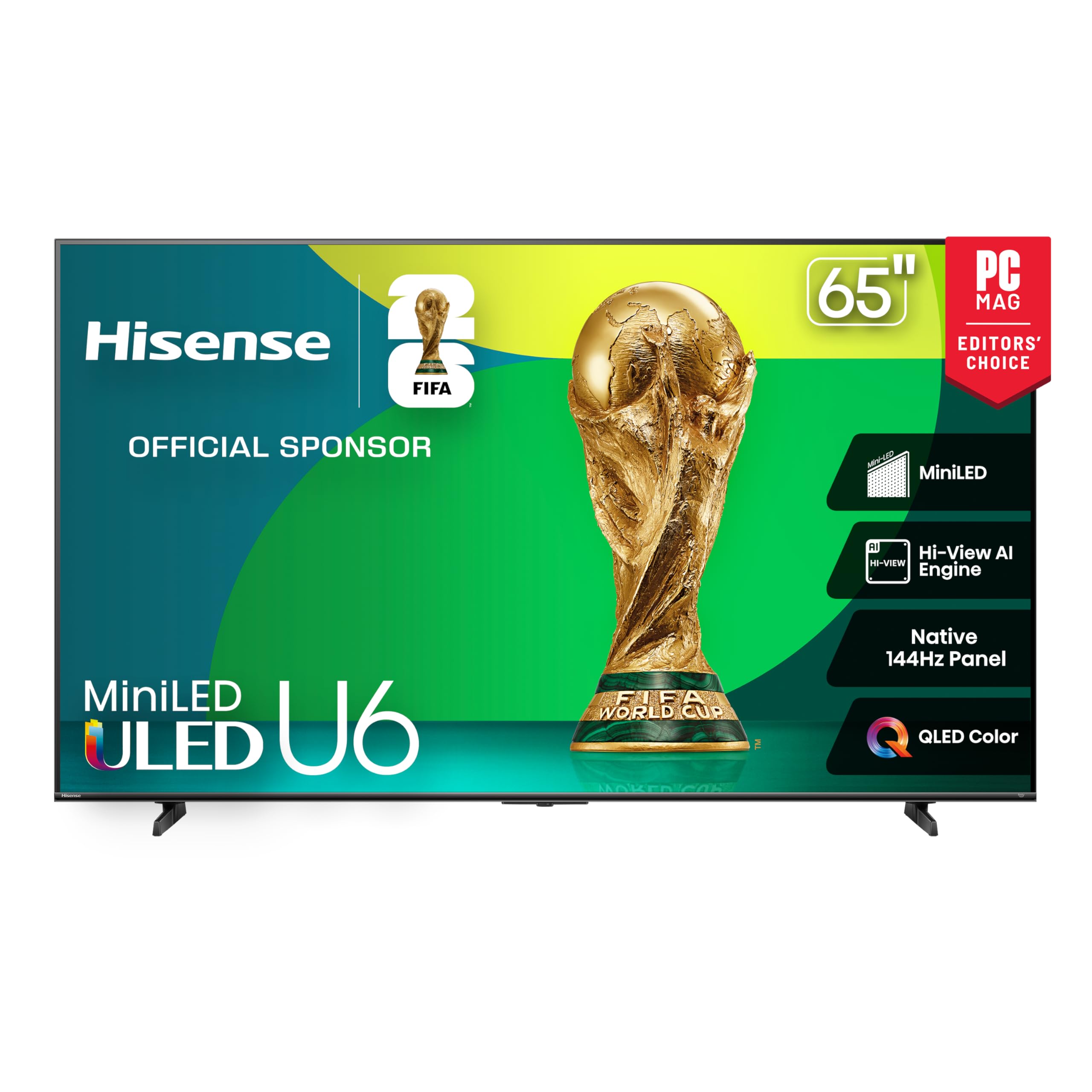
The Hisense U6 brings Mini-LED technology with up to 600 local dimming zones and a peak brightness of 1,000 nits, making it one of the brightest options in the mid-range segment. The Hi-View AI Engine processes picture, sound, and energy usage simultaneously, automatically adjusting scene contrast and color temperature based on ambient light. The native 144Hz panel with Motion Rate 480 clears up fast-moving sports without visible stutter, and AMD FreeSync Premium keeps frame tearing at bay during gameplay.
The built-in subwoofer delivers substantial low-end presence for a television speaker system, easily filling a medium-sized living room without external audio. The Fire TV interface puts Alexa front and center, allowing voice control of streaming apps, smart home devices, and live TV. The Total HDR Solution covers Dolby Vision IQ, HDR10+ Adaptive, HLG, and Advanced HDR by Technicolor, ensuring compatibility across all major content sources.
Only two of the four HDMI ports support the full 48Gbps bandwidth needed for 144Hz at 4K, which may limit multi-console gaming setups. The initial setup requires an Amazon account even for basic functionality, and the first software update can hang if the Wi-Fi connection is unstable — a factory reset via holding the Back and Right buttons for ten seconds resolves the issue.
Why it’s great
- Excellent built-in sound with subwoofer
- 600 dimming zones reduce blooming significantly
- Supports every major HDR format
Good to know
- Only 2 of 4 HDMI ports are full 2.1 144Hz
- First-time update can freeze without factory reset
- Requires Amazon account for full features
6. Samsung M70H
The Samsung M70H uses Mini-LED backlighting combined with the Pure Spectrum Color engine to reproduce one billion color shades, delivering rich reds and deep blues without the luminance boost you get from premium Mini-LED models. The Supreme Mini-LED Dimming technology divides the backlight into numerous zones, producing deeper contrast than standard LED panels, though the zone count falls well short of TCL or Hisense competitors at similar prices. The Motion Xcelerator with DLG 120Hz uses frame duplication to simulate smoother motion, but the native panel is 60Hz, so fast-paced games will not hit true 120Hz clarity.
The Samsung TV Plus service provides 2,700 free streaming channels including live sports, news, and on-demand movies — all without a subscription. The Soccer Mode adjusts motion processing and green saturation to make turf appear more vibrant and player movement clearer, a niche feature for football fans. The Gaming Hub aggregates cloud gaming services like Xbox Cloud Gaming and GeForce Now into a single launchpad, though performance depends on internet latency rather than the TV hardware.
The remote control requires near line-of-sight aiming to register commands, and initial startup takes ten to twelve seconds before the home screen appears. The default post-startup screen is Samsung TV Plus rather than the last-used HDMI input, which annoys users who primarily watch cable or streaming boxes. For the price, the panel delivers decent HDR contrast but the 60Hz limitation and slow UI make it a tough recommendation for gamers or impatient viewers.
Why it’s great
- Free Samsung TV Plus includes 2,700 channels
- Mini-LED dimming improves contrast over standard LED
- Soccer Mode optimizes motion for football fans
Good to know
- Native 60Hz panel; DLG is frame duplication, not true 120Hz
- Slow startup up to 12 seconds
- Remote needs direct line of sight to work
7. iFFALCON 55U85
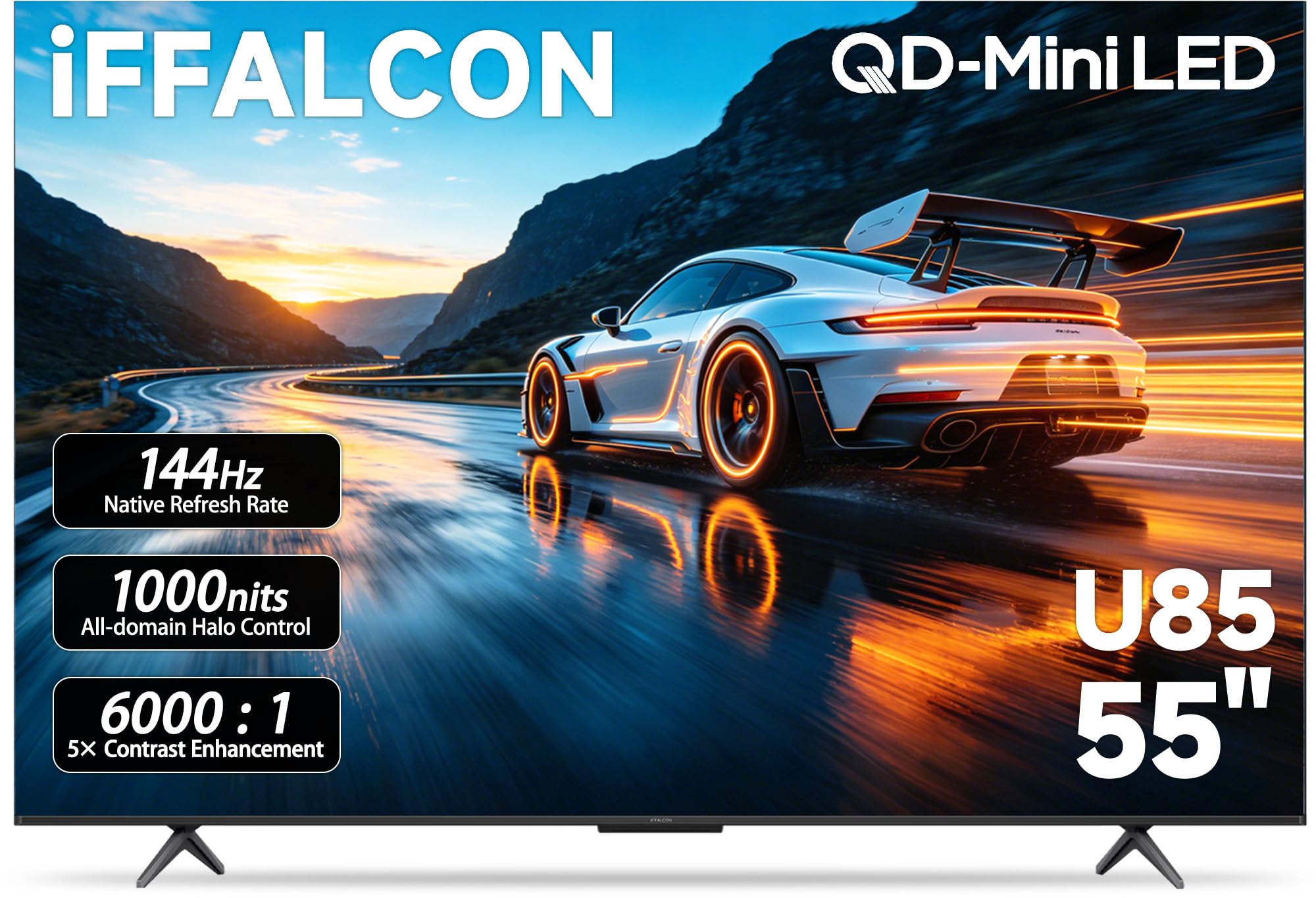
The iFFALCON 55U85 is engineered specifically for console and PC gaming, offering a native 144Hz panel with VRR support up to 288Hz and FreeSync Premium Pro certification. The 6,000:1 contrast ratio combined with local dimming produces deep blacks for a Mini-LED panel, while the 1,000-nit peak brightness makes HDR gaming pop — neon signs in Cyberpunk 2077 appear intensely bright without washing out dark alley textures. The Dolby Vision Gaming mode configures picture settings automatically when a console switches to HDR, so you do not have to toggle between Game and Movie modes manually.
Four HDMI 2.1 ports provide full 48Gbps bandwidth across two inputs for 4K at 144Hz and two more for 4K at 60Hz, enough to connect a PS5, Xbox Series X, gaming PC, and soundbar simultaneously. The 50W 2.1-channel audio system (30W stereo plus 20W woofer) fills a bedroom or small living room with immersive Dolby Atmos sound. The hotel mode and IP/IR control make it a rare choice for commercial installations like Airbnb or conference rooms, where menu locking and remote management are requirements.
The Google TV interface is clean and responsive, outpacing LG’s webOS and Samsung’s Tizen in day-to-day navigation speed. The physical build feels slightly less premium than the Samsung S90F, with a thicker bezel and lighter plastic back panel. The remote lacks a dedicated input button, requiring an extra menu dive to switch between connected devices — a minor annoyance during daily use.
Why it’s great
- Four HDMI 2.1 ports for multi-device gaming setups
- Native 144Hz with VRR up to 288Hz
- Hotel mode for commercial installations
Good to know
- Build quality feels less premium than competitors
- No dedicated input button on remote
- Thicker bezel than ultra-slim OLED models
8. Sony BRAVIA 2

The Sony BRAVIA 2 is an entry-level 4K LED TV that benefits from the same 4K Processor X1 found in higher-end Sony models, bringing accurate color reproduction and reliable upscaling to a more accessible price point. The 4K XR-Reality PRO upscales 1080p and 720p content to near-4K resolution, preserving texture detail in faces and fabric that budget competitors often blur into smooth patches. The Motionflow XR technology inserts interpolated frames to reduce judder during sports broadcasts and action movies, though aggressive settings can introduce the soap-opera effect that some viewers dislike.
The exclusive PlayStation 5 features — Auto HDR Tone Mapping and Auto Genre Picture Mode — mirror the functionality of the premium BRAVIA 8, automatically optimizing HDR brightness and switching to Game Mode when the PS5 is active. The Eco Dashboard consolidates energy-saving settings in a single menu, making it easy to reduce power consumption without digging through multiple submenus. The Google TV platform provides broad app support and built-in Chromecast for casting from mobile devices.
The LED panel has inherent limitations: black levels appear grayish in dark rooms compared to any OLED or Mini-LED alternative, and the 60Hz refresh rate caps gaming at 60fps. The TV ships with the default “warm” color temperature set too yellow, requiring manual calibration in the picture settings menu. For PS5 owners on a tight budget, the exclusive integrations provide real value, but the panel’s contrast ratio cannot compete with Mini-LED options at a similar price.
Why it’s great
- PS5 Auto HDR Tone Mapping works flawlessly
- Sony upscaling cleans up low-res content effectively
- Low power consumption with Eco Dashboard
Good to know
- 60Hz panel limits gaming to 60fps
- Black levels look gray in dark rooms
- Requires manual color calibration out of box
9. Roku Plus Series

The Roku Plus Series combines Mini-LED backlighting with a QLED quantum dot layer to produce vibrant color saturation and high contrast ratios, all wrapped in the famously simple Roku operating system. The Mini-LED array enables deeper black levels than standard edge-lit LED TVs, though the zone count is modest compared to dedicated Mini-LED brands like TCL or Hisense. The Dolby Vision support ensures compatible streaming content displays accurate brightness mapping and color grading without crushed shadows or blown-out highlights.
The Roku Enhanced Voice Remote includes a lost remote finder feature that plays a chime from the remote when you press a button on the TV itself — a practical touch for anyone who has searched couch cushions. The platform offers over 500 free channels through the Roku Channel, including live news, sports, and Roku Originals, reducing the need for a cable subscription. The Bluetooth Headphone Mode lets you connect wireless headphones directly to the TV for private late-night viewing without disturbing others.
The Roku Smart Picture Max uses AI to analyze incoming signals and adjust sharpness, color, and contrast automatically, but power users may find the settings menu too basic for fine-tuning. The built-in subwoofer adds bass presence for a television speaker, though the overall sound profile still lacks the clarity and width of even an entry-level soundbar. The lack of a USB 3.0 port limits local media playback speed for high-bitrate files from external drives.
Why it’s great
- Roku OS is the simplest and fastest smart TV interface
- Lost remote finder saves hours of frustration
- Bluetooth Headphone Mode for private listening
Good to know
- Limited local dimming zones compared to competition
- Picture settings menu lacks advanced calibration options
- No USB 3.0 for high-speed local playback
10. VIZIO M-Series

The VIZIO M-Series delivers a genuine QLED panel with Quantum Color technology that reproduces over a billion color hues, making it one of the most color-accurate options under most mid-range price points. The full-array backlight distributes LEDs evenly across the entire screen, eliminating the flashlight effect and uneven brightness that plagues edge-lit TVs. Dolby Vision Bright Mode boosts luminance and color saturation specifically for HDR content, producing a punchy image that competes well with brighter rooms, though the peak brightness is lower than Mini-LED alternatives.
The IQ Active Processor provides intelligent 4K upscaling that improves the clarity of HD and 1080p content, though it does not match the sophistication of Sony’s XR or Samsung’s NQ4 chips. The VRR support with AMD FreeSync reduces screen tearing when connected to an Xbox or PC, but the panel is limited to 60Hz, so gamers targeting 120fps will need to look elsewhere. The Vizio SmartCast platform aggregates streaming apps and supports voice control through Amazon Alexa and Google Assistant.
Long-term reliability is a mixed bag based on user reports — some units experience power supply failure after two to three years of heavy use, while others run without issues for four years. The remote control feels basic with limited shortcut buttons. The M-Series remains a strong entry point for buyers who want QLED color volume and Dolby Vision support without paying for Mini-LED or OLED, provided they accept the 60Hz refresh rate limitation.
Why it’s great
- QLED delivers vibrant color at an accessible price
- Full-array backlight improves uniformity
- Dolby Vision Bright Mode enhances HDR
Good to know
- 60Hz panel limits gaming to 60fps
- Mixed long-term reliability reports
- SmartCast OS is slower than Roku or Google TV
11. TOSHIBA C350

The TOSHIBA C350 is a budget-oriented 4K LED TV that prioritizes screen size over advanced picture technology, offering a 75-inch panel at a price that undercuts most competitors. The LED backlight delivers adequate brightness for daytime viewing in a living room, but the lack of local dimming means black levels appear grayish during dark movie scenes and subtitles glow with visible blooming. The 60Hz refresh rate handles typical streaming and broadcast content without issue, but fast-moving sports show noticeable motion blur and gaming feels sluggish without VRR support.
The Fire TV operating system integrates live over-the-air channels, streaming apps, and Alexa voice control into a unified home screen, making content discovery straightforward even for less tech-savvy users. The setup process is quick, and the remote provides dedicated buttons for Prime Video, Netflix, Disney+, and Hulu. The out-of-box “warm” color temperature leans yellow, but adjusting the picture preset to “Normal” or “Vivid” resolves the tint.
The built-in speakers produce surprisingly full sound for the price class, with enough volume to fill a medium room without external audio. The HDMI ports are limited to 2.0 bandwidth, capping external device support at 4K 60Hz without eARC for lossless audio passthrough. For buyers whose priority is maximum screen real estate on a tight budget, the C350 delivers a watchable big picture, but anyone who values contrast, motion clarity, or gaming features should save for a higher-tier model.
Why it’s great
- 75-inch screen at a very accessible entry price
- Fire TV interface is easy to set up and use
- Built-in speakers sound better than expected
Good to know
- No local dimming; black levels look gray
- 60Hz panel with no VRR for gaming
- HDMI 2.0 ports limit bandwidth
FAQ
Is OLED better than Mini-LED for a bright living room?
Do I need HDMI 2.1 if I only watch streaming apps?
What is the difference between QLED and Mini-LED?
Can a 60Hz TV still look smooth for sports?
How important is Dolby Vision vs. regular HDR10?
Final Thoughts: The Verdict
For most users, the best 4k hdr tv winner is the LG C4 OLED because it delivers perfect black levels, excellent HDR handling, and four full HDMI 2.1 ports for multi-device setups. If you want higher brightness for a sunlit room and richer color saturation, grab the Samsung S90F. And for cinema-accurate motion processing and seamless PS5 integration, nothing beats the Sony BRAVIA 8.