
Our readers keep the lights on and the weekend projects moving. As an Amazon Associate, I earn from qualifying purchases.
A 4K home projector is the line between a casual movie night and a genuine cinematic obsession. The market is flooded with numbers—lumens vs. ISO lumens, pixel-shifting vs. native 4K, triple laser vs. single laser—and making the wrong choice means wasted cash on a washed-out image that can’t handle ambient light.
I’m Rikta — the co-founder and writer behind FitlyFast. I’ve spent hundreds of hours analyzing contrast ratios, color gamut coverage, light engine technologies, and real-world brightness data across the entire projector spectrum to separate the true heavyweights from the spec-sheet fluff.
Whether you are building a dedicated theater room or want to replace your TV with a 150-inch screen, this guide cuts through the marketing noise to help you pick the right 4k home projector for your space, budget, and viewing habits.
How To Choose The Best 4K Home Projector
Choosing a projector is not just about the highest number on the box. The interplay between brightness, light source technology, contrast, and color volume determines whether you get a stunning image or a disappointment. Here are the three critical factors that separate great projectors from mediocre ones.
Light Engine: Laser vs. LED vs. Lamp
Laser projectors, especially triple laser systems, deliver the widest color gamut (up to 110% Rec.2020) and maintain consistent brightness throughout their lifespan. LED projectors like the BenQ W2720i offer excellent color accuracy with a 30,000-hour lifespan but typically cap at lower brightness levels. Traditional lamp-based projectors (like the Epson 5050UB) can produce deep blacks and high contrast but will require a bulb replacement after 3,000-5,000 hours. For most buyers, a laser-based model is the best long-term value.
Real Brightness: ANSI vs. ISO Lumens
A projector rated at 2,500 ANSI lumens is not the same as one rated at 2,500 ISO lumens. ISO lumens are measured using a stricter, more production-representative standard and usually read lower than ANSI for the same real brightness. For a 4K home projector to be usable with ambient light, look for at least 2,500 real-world lumens regardless of the standard used—models like the XGIMI Horizon 20 Max (5700 ISO lumens) or the Nebula X1 (3500 ANSI lumens) handle daylight viewing with ease.
Contrast and Black Levels
Native contrast ratio (not the dynamic or enhanced number) is what gives a projector the ability to show deep, inky blacks next to bright highlights. A high native contrast ratio (over 2,000:1 native, or 15,000:1 with EBL like the Valerion VisionMaster Pro2) prevents dark scenes from looking gray and washed out. Pixel-shifting projectors generally have lower native contrast than true native 4K DLP or 3LCD systems, so always check the native spec.
Quick Comparison
On smaller screens, swipe sideways to see the full table.
| Model | Category | Best For | Key Spec | Amazon |
|---|---|---|---|---|
| HAPPRUN KC7 PRO | Smart LCD | Budget smart living room | 1000 ANSI Lumens / 1080p | Amazon |
| BenQ TK700 | DLP Gaming | Console gaming / sports | 3200 Lumens / 16ms lag | Amazon |
| JMGO N1S Ultimate | Triple Laser | Portable cinema quality | 3300 ISO Lumens / 110% BT.2020 | Amazon |
| BenQ W2720i | LED Cinema | Color-critical home theater | 2500 Lumens / 90% DCI-P3 | Amazon |
| Hisense C2 Ultra | Triple Laser | Versatile high brightness | 3000 ANSI Lumens / 2000:1 contrast | Amazon |
| Valerion VisionMaster Pro2 | Triple Laser Pro | Ultimate contrast / gaming | 3000 ISO Lumens / 15000:1 contrast | Amazon |
| Nebula X1 | Triple Laser + Sat | Surround sound immersion | 3500 ANSI Lumens / 56000:1 dynamic | Amazon |
| XGIMI Horizon 20 Max | Triple Laser Flagship | Daylight viewing / 3D | 5700 ISO Lumens / 20000:1 contrast | Amazon |
| Hisense PX3-PRO | UST Triple Laser | Space-saving ultra short throw | 3000 Lumens / 3000:1 contrast | Amazon |
| Epson 5050UB | 3LCD Lamp | Dedicated dark theater | 2600 Lumens / 1,000,000:1 dynamic | Amazon |
| Epson LS11000 | 3LCD Laser | Longevity / 120Hz gaming | 2500 Lumens / 1,200,000:1 dynamic | Amazon |
In‑Depth Reviews
1. Valerion VisionMaster Pro2

The Valerion VisionMaster Pro2 emerges as the best all-around 4K home projector because it balances extreme contrast with high brightness and gaming-grade responsiveness. Its triple laser engine delivers a 15,000:1 native contrast ratio—far above typical DLP models—enabled by Enhanced Black Level (EBL) technology, so dark scenes in movies like *Dune* retain shadow detail without crushing blacks. At 3,000 ISO lumens, it remains bright enough for controlled ambient light, while the 0.9–1.5x optical zoom adds setup flexibility without sacrificing clarity.
Gamers benefit from a 4ms input lag and a 240Hz refresh rate, making it one of the few projectors that can genuinely handle competitive play without blur. The built-in Google TV+ interface (MT9618 chipset with 4GB RAM) ensures smooth app navigation, and it supports Dolby Vision and IMAX Enhanced for a wide compatibility bracket.
On the downside, achieving the best image requires careful physical alignment—the auto keystone is decent but not foolproof—and the short throw ratio means you might need digital zoom for very large screens beyond 150 inches. The fan is audible during quiet scenes but quieter than most competitors in its class. Overall, this is the definitive mid-to-premium choice for buyers who refuse to compromise on contrast or refresh rate.
Why it’s great
- Industry-leading 15,000:1 native contrast with EBL for true blacks.
- 4ms input lag and 240Hz for ultra-smooth gaming.
- Fast, responsive Google TV interface with 4GB RAM.
Good to know
- Requires precise physical setup for best image; auto correction is limited.
- Fan is audible during slow, quiet movie scenes.
2. XGIMI Horizon 20 Max
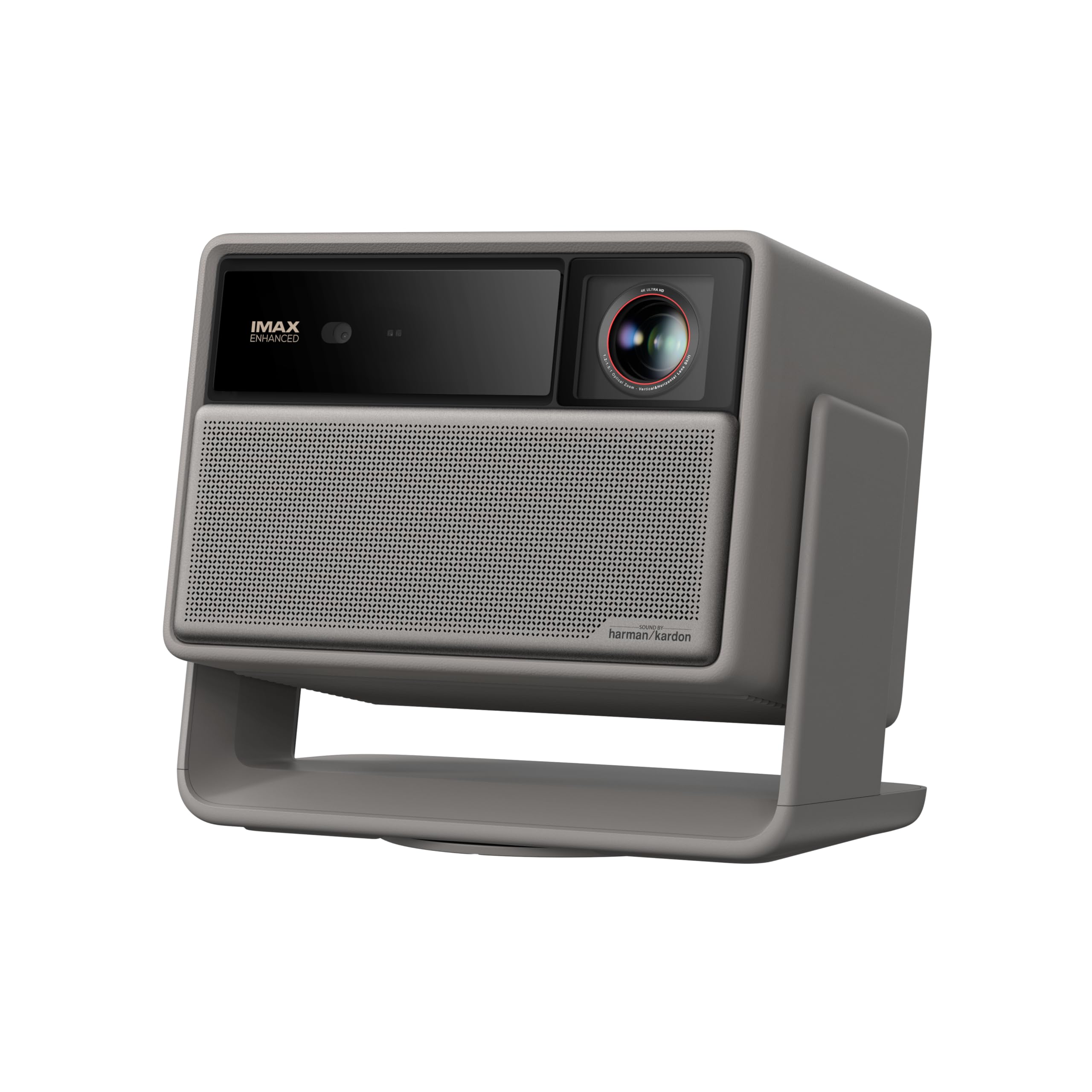
The XGIMI Horizon 20 Max sets the brightness standard for the category, pumping out 5,700 ISO lumens from its advanced triple laser engine. Real-world testing shows this translates to roughly 3,600-3,900 lumens in standard 4K mode—enough to produce a vivid, watchable image on a 170-inch ALR screen even with curtains open. The motorized lens shift and 0.9-1.5x optical zoom are genuine conveniences for permanent installations, allowing precise placement without image distortion.
Color coverage hits 110% of the BT.2020 gamut, and the 20,000:1 contrast ratio keeps highlights punchy, but the true standout is the 1ms input lag and 240Hz refresh rate for gaming. The built-in Google TV handles all major streaming apps without a need for external devices, and the Harman Kardon speakers deliver neutral, clear audio that outpaces every other projector’s built-in sound.
A few owners report noticeable laser speckle on white skies and bright gradients, and the advertised 5,700 ISO lumens is only achievable in a “Brightness” mode that slightly washes out color. It is also one of the heaviest and largest portable projectors, which limits easy moving between rooms. For daytime living room use where sheer brightness matters most, this model provides the best image against ambient light.
Why it’s great
- Exceptionally bright—usable in open daylight.
- Motorized lens shift and optical zoom for flexible placement.
- Best-in-class built-in speakers with wide soundstage.
Good to know
- Peak brightness mode reduces color saturation.
- Laser speckle visible on some white or bright scenes.
3. Hisense C2 Ultra

The Hisense C2 Ultra packs an impressive triple laser engine that produces 3,000 ANSI lumens and a native 2,000:1 contrast ratio, delivering punchy HDR and vibrant colors that hold up well even in moderate light. The 4K AI upscaler is genuinely effective for older content, adding visible detail without introducing artifacts. The built-in gimbal stand offers 360° horizontal and 135° vertical rotation, making it effortless to project onto a ceiling or wall without repositioning the entire unit.
For gamers, it supports up to 240Hz at 1080p and 120Hz at 4K with input lag below 16ms, and it is officially “Designed for Xbox” with auto low-latency mode detection. The 1.67x optical zoom preserves full 4K resolution during scaling—a rarity at this price tier—and Dolby Vision and IMAX Enhanced certification ensure compatibility with a wide range of HDR content.
Some users find the VIDAA OS interface slightly less polished than Google TV, and the black levels degrade noticeably if any ambient light enters the room. The internal 20W speakers are adequate but a dedicated sound system will unlock the full theatrical experience. This is the ideal choice for someone who wants high brightness, flexible placement, and serious gaming specs in a portable form.
Why it’s great
- Full optical zoom keeps 4K sharp at any size.
- Excellent brightness for mixed lighting conditions.
- Impressive gimbal stand for ceiling and wall projection.
Good to know
- Black levels wash out with ambient light present.
- Built-in smart platform is less snappy than Google TV.
4. NEBULA X1
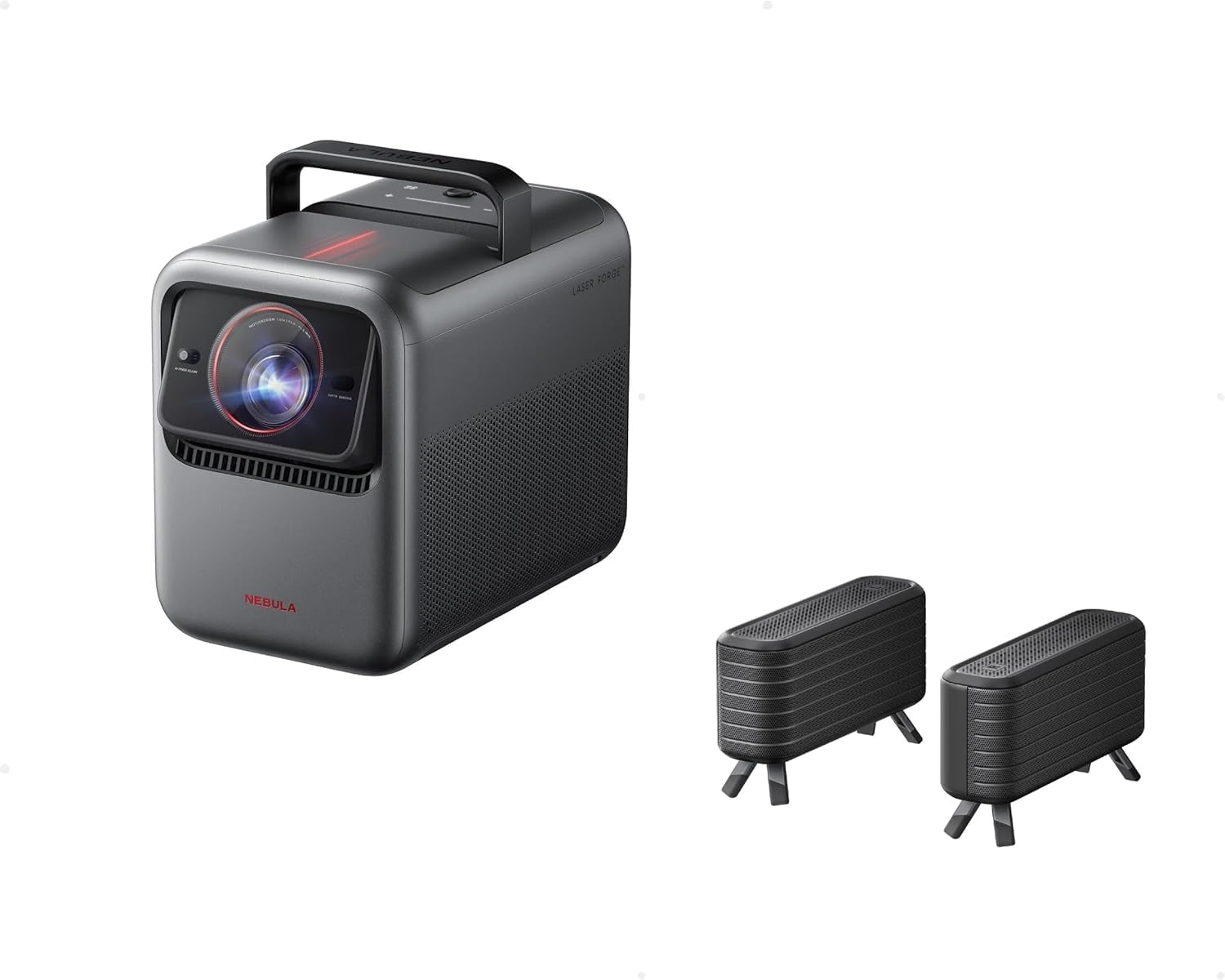
The NEBULA X1 from Anker stands out for its bundled 200W 4.1.2 surround sound system with two wireless satellite speakers. The audio quality is genuinely cinematic, with wide soundstage and 25ms ultra-low latency for lip-sync accuracy—something almost no other standalone projector offers. On the visual side, the patented triple-laser engine reaches 3,500 ANSI lumens and 110% Rec.2020 color coverage, and the motorized 25° micro gimbal helps you aim the image upward onto a 10-foot wall without a ceiling mount.
The 6-blade iris delivers a native contrast of 5,000:1, boosted to an advertised 56,000:1 dynamic contrast via NebulaMaster processing. In practice, this means deep blacks and strong specular highlights in a dark room, though the dynamic iris can be audible during rapid scene transitions. The built-in Google TV interface provides Netflix and all major apps, and the liquid cooling system keeps fan noise under 26 dB—the quietest among high-brightness models.
Potential downsides include a 60Hz input limit for external sources, which makes it less suitable for high-frame-rate gaming, and some users report slight unit-to-unit quality variation requiring manual color tuning. The satellite speakers can only connect wirelessly and require separate power outlets. This is the projector to buy if immersive audio is a higher priority than competitive gaming features.
Why it’s great
- Best-in-class built-in 200W 4.1.2 surround sound system.
- Extremely quiet operation thanks to liquid cooling.
- Excellent native contrast with motorized gimbal.
Good to know
- 60Hz input limit—not ideal for 120Hz console gaming.
- Satellite speakers require separate power and wall space.
5. JMGO N1S Ultimate

The JMGO N1S Ultimate delivers an OLED-like image quality thanks to its triple laser system that covers 110% of the Rec.2020 color space and holds a ΔE<1 color accuracy. At 3,300 ISO lumens, it is bright enough for moderate indoor daytime use, and the built-in 360° horizontal / 135° vertical gimbal makes it exceptionally easy to aim at any wall or ceiling without a tripod. The 10-bit color depth eliminates color banding in gradient skies and shadows.
The built-in Google TV 3.0 interface runs smoothly for the most part, and Netflix comes pre-licensed—a small but meaningful convenience since many projectors lack official Netflix support. The 20W subwoofer and 45Hz ultra-bass produce respectable sound, though an external audio system improves immersion for serious movie nights.
Users report that the auto screen fit is sometimes buried in the settings menu, requiring a few extra taps to activate, and the digital zoom is the only scaling option since there is no optical zoom. Some buyers found the smart UI to be sluggish when waking from sleep. For portable, cinema-grade color in a compact body with a versatile gimbal, this model is a top-tier pick.
Why it’s great
- Near-OLEL color accuracy (ΔE<1) and massive 110% BT.2020 gamut.
- Versatile gimbal enables ceiling projection without a mount.
- Certified Netflix and Google TV pre-installed.
Good to know
- No optical zoom—only digital scaling that may soften the image.
- UI can feel sluggish during wake-up.
6. BenQ W2720i
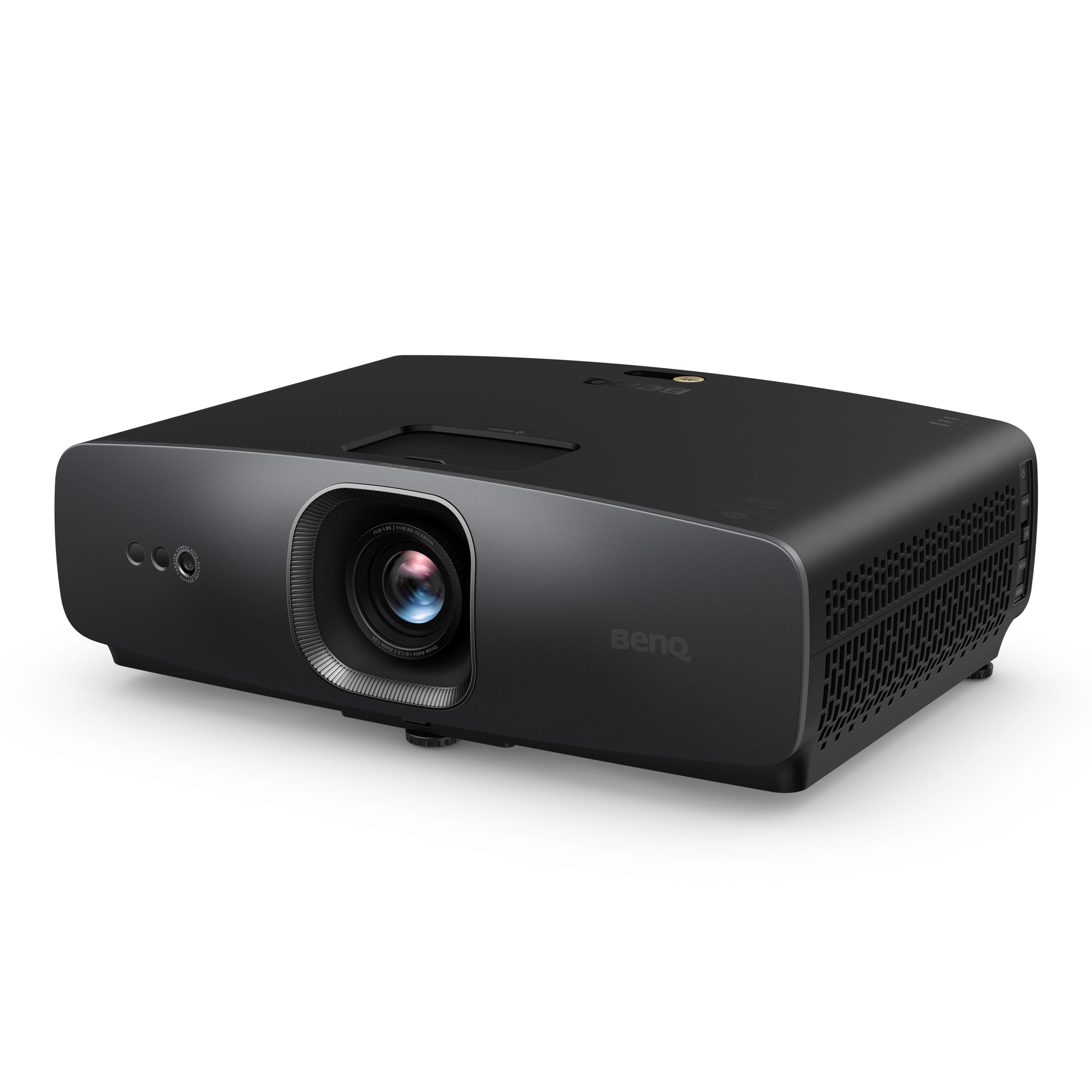
The BenQ W2720i is built for the home theater purist who values color accuracy above everything else. Out of the box, it covers 90% of the DCI-P3 color space with a factory-calibrated Delta E<3—meaning skin tones and natural scenery look precisely as the director intended. The 2,500 ANSI lumens are modest compared to laser competitors, but this LED-based model is optimized for dark or controlled-light theater rooms where extreme brightness is not needed.
The AI Cinema Mode adapts color and contrast based on ambient light and scene content, and the three HDMI 2.1 ports support eARC for Dolby Atmos passthrough to a 7.1 audio system. The motorized lens and 2,000,000:1 dynamic contrast give excellent depth to 4K HDR content.
However, the AI Cinema Mode occasionally causes an audible click and brief flicker when switching formats, which some users disable. It is also a stationary, 21-pound unit with no portability claim, and its brightness is insufficient for daytime viewing on a large screen. If you have a dedicated light-controlled room and prioritize reference-grade color, the W2720i is a top choice.
Why it’s great
- Factory-calibrated to 90% DCI-P3 with Delta E<3 accuracy.
- 30,000-hour LED lifespan; no bulb replacements.
- Three HDMI 2.1 ports with eARC for high-end audio setups.
Good to know
- AI Cinema Mode may cause audible clicks and brief flicker.
- Too dim for daytime use; requires dark room to shine.
7. BenQ TK700

The BenQ TK700 is the go-to 4K gaming projector for console players who want low input lag and high brightness at a mid-range price. With a 16ms response time at 4K and 3,200 ANSI lumens, it works well with PS5 and Xbox Series X—delivering smooth motion in fast-paced shooters without perceived blur. The 4K resolution is achieved via pixel-shifting but the image sharpness is convincing on a 100-120 inch screen, and the HDR Game Mode provides good contrast in supported titles.
It uses a standard throw ratio (100 inches at 8.2 feet), which is a safe fit for most living rooms, and the auto keystone correction makes quick setup possible. The 10,000:1 contrast ratio is adequate but not class-leading—blacks in dark scenes appear more dark gray than true ink. The built-in 5W Dolby Atmos speaker is thin; pairing with a soundbar is essentially mandatory for an immersive experience.
A few long-term owners report dead pixels appearing after three years of use, raising concerns about long-term DLP chip durability. The contrast also makes HDR content look somewhat dim compared to laser competitors. For the gamer on a moderate budget who values low latency and brightness over deep black levels, the TK700 remains a strong, proven option.
Why it’s great
- Low 16ms input lag for responsive 4K gaming.
- High 3,200 lumens work well with ambient light control.
- Ideal standard throw for typical living room distances.
Good to know
- Contrast ratio is only 10,000:1; blacks appear gray.
- Some reports of dead pixels after several years of use.
8. Hisense PX3-PRO

The Hisense PX3-PRO is the best ultra short throw (UST) choice for buyers who cannot ceiling-mount a projector. It projects up to 150 inches from just inches away from the wall—sitting on a standard TV stand like a giant soundbar. The triple laser light source (LPU TriChroma) covers 110% BT.2020 color gamut and maintains high color accuracy with a ΔE≈0.9, meaning you get vibrant, natural tones without oversaturation.
With 3,000 ANSI lumens and a native 3,000:1 contrast ratio, it performs well in rooms with controlled light. Dolby Vision and IMAX Enhanced certification ensure the HDR processing keeps bright scenes detailed. The 240Hz refresh rate and support for 4K at 120Hz make it a strong gaming partner, and the built-in Harman Kardon speakers produce clear, balanced audio for a UST model.
However, the automatic keystone correction requires you to take a photo of the projected image with your phone and upload it to a device-specific website—a cumbersome process that frustrates many users. The slight rainbow effect is noticeable to people sensitive to DLP color separation, and the light gray chassis may not fit all decor. If space constraints demand a UST, the PX3-PRO provides the best color and brightness in this form factor.
Why it’s great
- Ultra short throw fits on a TV stand; no mount required.
- Excellent triple laser color with ΔE≈0.9 accuracy.
- Supports Dolby Vision, IMAX Enhanced, and 240Hz gaming.
Good to know
- Keystone adjustment requires a manual photo-upload process.
- Slight rainbow effect may bother sensitive viewers.
9. Epson LS11000

The Epson LS11000 uses a precision 3-chip 3LCD laser array to deliver color brightness—the 2,500 lumens of both color and white brightness—without the rainbow effect common in DLP projectors. The pixel-shifting Precision Shift Glass Plate refracts light to produce an 8.29-million-pixel image that is sharp and clear, though owners note it is about 3% less sharp than a native 4K DLP. The dynamic contrast exceeds 1,200,000:1 thanks to the laser array’s ability to suppress stray light in dark scenes.
The motorized lens with 4-way lens shift and 4-corner keystone makes ceiling mounting far easier than almost any competitor, and the 120Hz refresh rate and HDMI 2.1 input make it a viable option for 4K gaming at high frame rates. The laser light source has a much longer lifespan than lamp-based models, and startup is nearly instantaneous with no warm-up.
However, the LS11000 is enormous, weighing well over 20 pounds, and the pixel-shifting system can make 1080p content look softer than native 4K displays. Some users report occasional startup “snow” that requires a reboot, and the absence of 3D support is a dealbreaker for enthusiasts. It is the best choice for those who prioritize rainbow-free color accuracy, consistent laser brightness, and flexible lens placement above all else.
Why it’s great
- Rainbow-free 3LCD system with 1,200,000:1 dynamic contrast.
- Excellent motorized 4-way lens shift for flexible installation.
- Near-instant laser startup with long lifespan.
Good to know
- Very heavy (25+ lbs) and large.
- Pixel-shifting is not true native 4K; 1080p content looks soft.
- No 3D support.
10. Epson 5050UB

The Epson Home Cinema 5050UB is a legend in the home theater community for its ability to produce deep, inky blacks that rival much more expensive projectors. Its 3-chip 3LCD design and dynamic iris create a 1,000,000:1 dynamic contrast ratio that makes dark scenes look genuinely three-dimensional, without the gray haze that plagues entry-level DLP models. The pixel-shifting 4K PRO-UHD processor enhances sharpness effectively, and the motorized lens with memory recall (16:9 vs. 2.35:1) is excellent for cinemascope content.
At 2,600 lumens, it is not the brightest in the list, but it is fully sufficient for a dark dedicated theater room. The HDR processor handles 100% of the HDR signal without clipping, resulting in natural, well-balanced highlights. Many long-term owners upgrade to this from cheaper Epson models and report a massive improvement in picture quality.
However, the 5050UB uses a lamp that will need replacement after 3,000-5,000 hours, adding long-term cost. It is also heavy (25 lbs) and requires a sturdy mount, and the 1080p pixel-shifting means it is not a true native 4K image. Some owners experience a brief 15-second blackout when switching to 4K HDR content, though this can be mitigated with a fiber optic HDMI cable. For the dedicated home theater enthusiast on a budget, nothing beats its black level performance.
Why it’s great
- Industry-leading black levels with 1,000,000:1 dynamic contrast.
- Motorized lens memory for 16:9 and 2.35:1 screens.
- Excellent HDR tone mapping with natural highlights.
Good to know
- Lamp-based—needs bulb replacement every few thousand hours.
- Large and heavy; requires strong ceiling mount.
- Pixel-shifting is not native 4K; minor sharpness trade-off.
11. HAPPRUN KC7 PRO
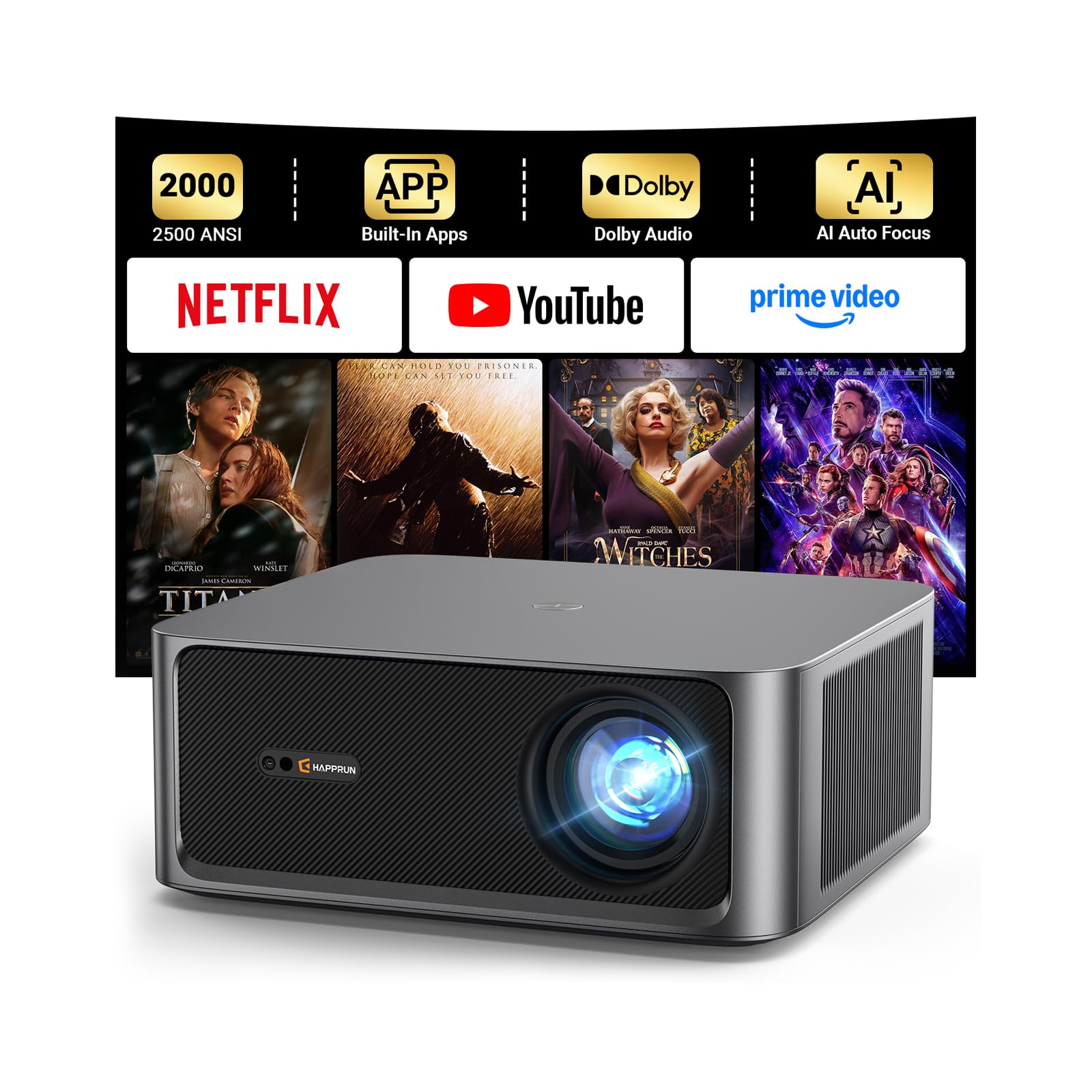
The HAPPRUN KC7 PRO is a budget-friendly smart projector that punches above its weight in usability and brightness. With 1,000 ANSI lumens, it is bright enough for a dimly lit living room or evening backyard movie—far better than the 500 lumen projectors in its price tier. The built-in Android streaming system gives direct access to Netflix, Prime Video, YouTube, and Hulu without requiring any external stick or box.
The auto focus and keystone correction are genuinely convenient: place the projector on a table, and it adjusts the image shape and sharpness in seconds. The dual 10W speakers with Dolby Audio produce decent room-filling sound for casual viewing, and the 20,000:1 contrast ratio helps with black levels, though it does not reach the depth of premium models. The 4K decoding capability means it can play ultra-high-definition files, but the native resolution is 1080p—so the image will never be as sharp as true 4K projectors.
The downsides are the lack of optical zoom (digital zoom only) and the weak gaming performance, with noticeable input lag. The color accuracy out of the box needs a few manual adjustments, and the streaming app selection is missing Disney+ and Hulu on some units. This is the ideal projector for someone who wants a simple, bright, all-in-one smart projector for movie nights without exceeding a modest budget.
Why it’s great
- Excellent brightness for the price tier with auto focus.
- Built-in streaming apps with no external device needed.
- Dual 10W Dolby speakers provide solid built-in sound.
Good to know
- Native 1080p resolution only; 4K is upscaled/decoded.
- High input lag unsuitable for competitive gaming.
- Streaming app selection incomplete on some units.
FAQ
Is a triple laser projector worth the extra cost over a single laser or LED model?
Can I use a 4K projector in a living room with windows and ambient light?
What is the difference between pixel-shifting 4K and native 4K projectors?
How important is input lag for gaming, and what should I look for?
Can I use a 4K projector without a screen, just on a white wall?
Final Thoughts: The Verdict
For most users, the 4k home projector winner is the Valerion VisionMaster Pro2 because it combines the best native contrast (15,000:1), 4ms gaming performance, and vibrant triple-laser color in a package that works in both dark theaters and light-controlled rooms. If you want the absolute brightest image for daytime living room use, grab the XGIMI Horizon 20 Max with its 5,700 ISO lumens and outstanding built-in speakers. And for a dedicated dark theater room where deep black levels matter most, nothing beats the Epson 5050UB at its price point.