
Our readers keep the lights on and the weekend projects moving. As an Amazon Associate, I earn from qualifying purchases.
A 4K outdoor security camera is no longer a luxury — it’s the baseline for identifying faces, reading license plates, and catching real detail instead of grainy blobs. But the gap between marketing specs and real-world performance is wider than most buyers expect, especially when night vision, wireless stability, and false-alarm filtering come into play.
I’m Rikta — the co-founder and writer behind FitlyFast. After analyzing over 60 hours of user reports and cross-referencing specs across 4K sensors, bitrate limits, PoE power standards, and AI detection libraries, I’ve built a drop-dead comparison of the models that actually deliver on their 8MP promises.
Whether you need battery-powered freedom, a floodlight deterrent, or a budget-friendly wired workhorse, this guide cuts through the pixel hype to find the best 4k outdoor security camera for your exact setup.
How To Choose The Best 4K Outdoor Security Camera
The jump from 1080p or 2K to 4K (8MP) is massive, but only if the supporting hardware — sensor, aperture, codec, and network pipeline — can handle the data rate. A cheap 4K camera that drops frames or crushes blacks at night is worse than a good 2K unit.
Sensor Sensitivity and Aperture
An f/1.6 aperture (like the Reolink Lumus Pro) pulls in roughly 50% more light than an f/2.0 lens. That translates directly to usable color night vision without resorting to washed-out IR. Look for Sony Starvis sensors in this category — they are the gold standard for low-noise 8MP captures in dim light.
Network and Power Realities
A 4K stream at 15-20 fps demands about 25-40 Mbps of dedicated bandwidth on the uplink. Wi-Fi 6 cameras (dual-band 2.4/5GHz) handle this better than older Wi-Fi 4/5 chips. For mission-critical coverage, PoE (Power over Ethernet) eliminates interference and power-drop concerns entirely — but requires a PoE switch or NVR, which adds a fixed cost.
AI Detection That Actually Filters
Local on-device AI that distinguishes people, vehicles, and animals from falling leaves or passing headlights is the difference between a useful alert system and notification fatigue. Subscription-free local AI (Tapo, Reolink) saves recurring fees, but cloud-based AI (Ring) often offers more nuanced facial recognition. Check if the model supports detection zones and sensitivity sliders.
Quick Comparison
On smaller screens, swipe sideways to see the full table.
| Model | Category | Best For | Key Spec | Amazon |
|---|---|---|---|---|
| Reolink Lumus Pro | Wi-Fi Bullet | No-fee 4K with clean RTSP | F1.6 aperture, 5GHz Wi-Fi 6 | Amazon |
| Amcrest IP8M-2493EW-AI-V3 | PoE Dome | Vandal-resistant wired install | Sony Starvis sensor, IK10 dome | Amazon |
| Tapo MagCam C460 KIT | Battery + Solar | Wireless placement, solar recharge | 10,000mAh battery, magnetic mount | Amazon |
| Tapo C560WS | Wi-Fi PTZ Dome | 360° pan/tilt with local AI | 360° pan, 98° tilt, facial recognition | Amazon |
| Reolink E1 Outdoor SE PoE | PoE PTZ | Auto-tracking with color night vision | 355° pan, 50° tilt, F1.6 aperture | Amazon |
| Jennov 4K 8MP PTZ | PoE PTZ Zoom | Long-range zoom (20X optical) | 320ft IR, 20X optical zoom lens | Amazon |
| Ring Floodlight Cam Pro | Wired Floodlight | Integrated floodlight + Alexa ecosystem | 2,000-lumen floodlights, 10x zoom | Amazon |
In‑Depth Reviews
1. Reolink Lumus Pro
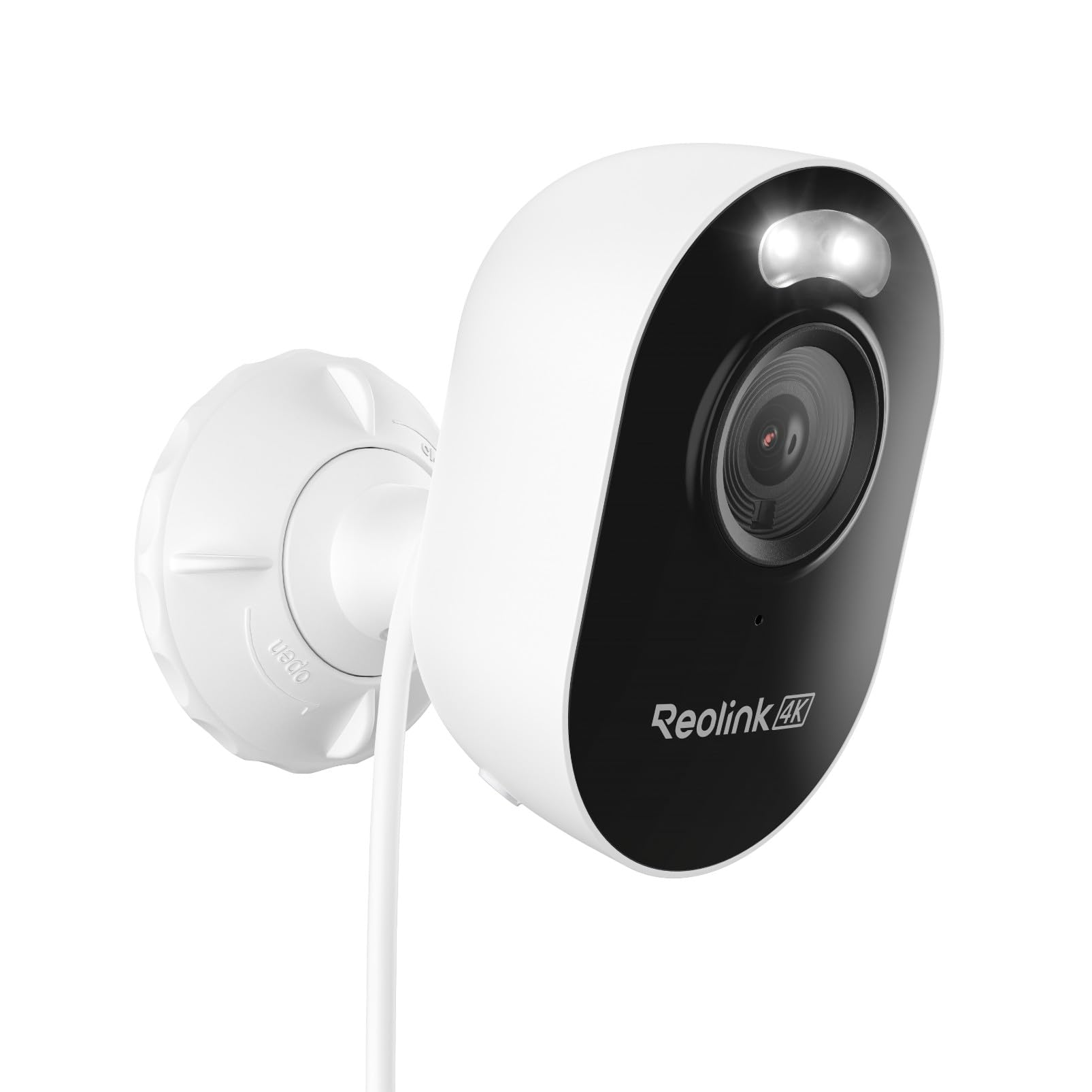
The Reolink Lumus Pro nails the essentials that most budget 4K cameras fumble: an f/1.6 aperture that actually delivers usable color night vision, dual-band Wi-Fi 6 with Bluetooth-assisted pairing that cuts setup time, and on-device AI that discriminates between people, vehicles, and animals without a subscription. Real-world users migrating from Wyze V3 report a massive jump in exposure handling at night — no blown-out highlights, no crushed shadows.
At 15-20 fps with a bitrate ceiling around 5120 kbps, the 8MP stream is sharp enough to read license plates at reasonable distances. The 106° horizontal field of view is slightly narrower than some competitors, but the trade-off is less fisheye distortion at the edges. RTSP support works with Blue Iris and Home Assistant out of the box, though two-way audio is limited to the Reolink app. No HDR mode means high-contrast scenes (bright sky over dark ground) can lose shadow detail.
Storage is fully flexible — microSD up to 256GB, Reolink Home Hub, or NVR — with zero monthly fees. The one recurring complaint is that the internal clock drifts without NTP sync set to hourly intervals, a quick fix in the app. For a mix of wireless convenience, genuine 4K clarity, and no long-term cost, this is the smart starting point.
Why it’s great
- Excellent low-light performance from f/1.6 aperture
- No subscription fees for local recording or AI detection
- Stable 5GHz Wi-Fi 6 with quick Bluetooth setup
Good to know
- No HDR mode for high-contrast scenes
- Internal clock drifts without NTP sync configured
- Two-way audio not available in Blue Iris/RTSP
2. Amcrest IP8M-2493EW-AI-V3

The Amcrest IP8M-2493EW-AI-V3 is the pick for buyers who prioritize physical durability and third-party software integration over app polish. Built around a Sony IMX274 Starvis sensor and Ambarella S3LM chipset, it delivers 8MP (3840×2160) footage with a wide 112° viewing angle and 98 feet of IR night vision. The metal housing carries both IP67 weatherproofing and IK10 vandal resistance — meaning it can survive a hammer strike without losing alignment.
PoE connectivity eliminates Wi-Fi congestion entirely, and the camera exposes a full CGI API that works with Blue Iris, Frigate, Synology Surveillance Station, and Amcrest’s own NVR. Users report that adjusting the audio codec to G.711A dramatically improves two-way audio clarity. The microSD slot supports standalone recording without any network dependency, and the camera draws only 4-6W during operation. The downside is a fiddly pigtail cable with five separate connections — plan your junction box carefully.
On the software side, the forced time sync from PC on login and the broken SMTP for email alerts are known pain points. But if you need a camera that survives weather, vandalism, and integrates into a professional surveillance stack, the Amcrest delivers image quality that can count leaves from 25 feet away.
Why it’s great
- Superb Sony Starvis low-light sensor with 98ft IR range
- IK10 vandal-resistant metal dome housing
- Full CGI API works with Blue Iris, Frigate, Synology
Good to know
- Pigtail cable with 5 connections needs a large junction box
- SMTP email alerts are unreliable
- Forced time sync from PC on login can be annoying
3. Tapo MagCam 4K C460 KIT
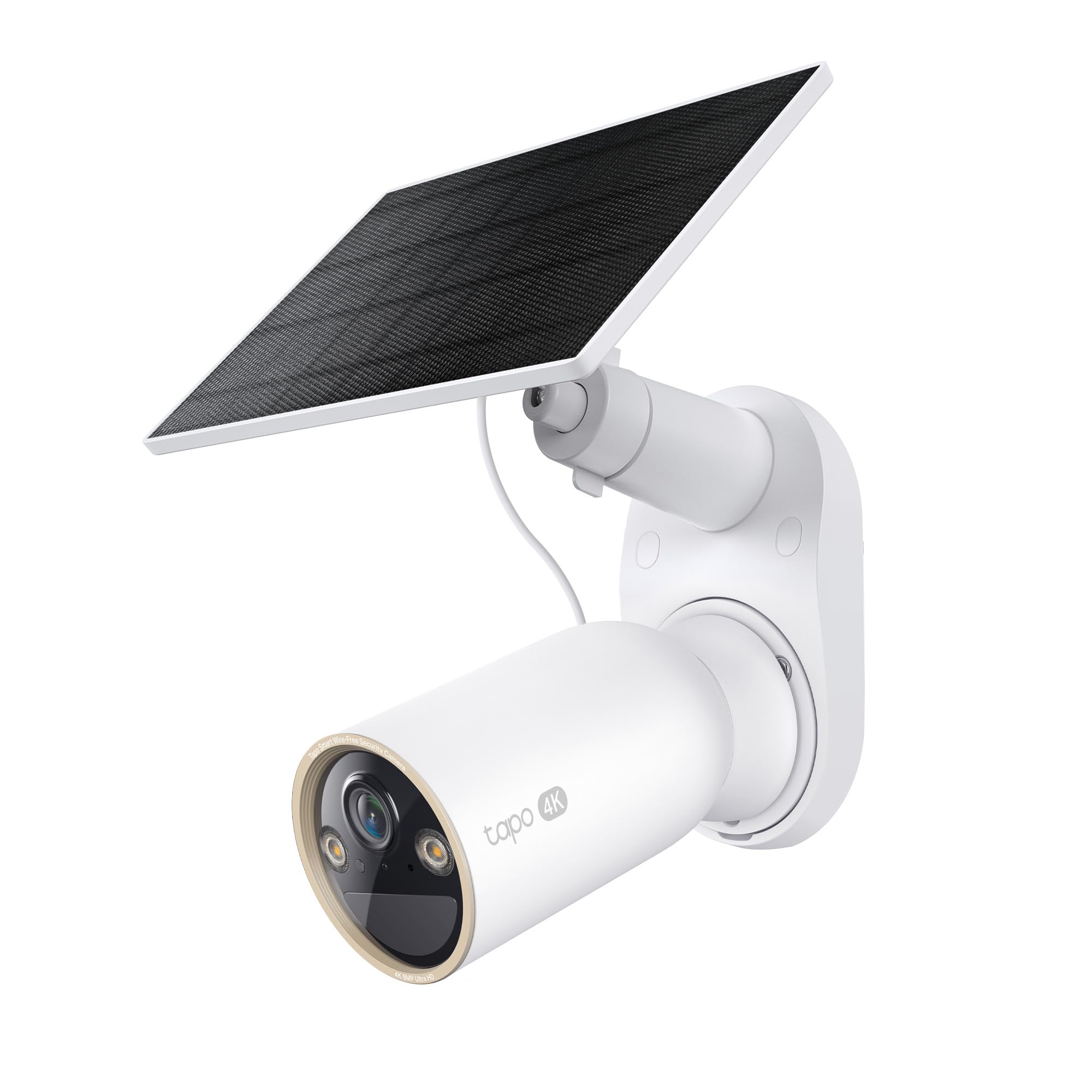
The Tapo MagCam C460 KIT solves the biggest headache of wireless 4K cameras: battery anxiety. The included 10,000mAh internal battery paired with a solar panel claims up to 200 days of runtime on a single charge, and real-world tests confirm that 45 minutes of direct sunlight fully powers a day’s worth of recordings. The magnetic base snaps onto any metal surface in seconds, making relocation as simple as lifting the camera off and re-attaching it.
Image quality benefits from a starlight sensor and integrated spotlights that deliver full-color night vision without IR washout. The Edge Improvement algorithm sharpens fine text and facial features beyond what a standard 4K sensor produces. Dual-band Wi-Fi (2.4/5GHz) gives placement flexibility, and the IP66 weather rating handles rain, snow, and dust. The 512GB microSD maximum (sold separately) allows days of continuous recording without a subscription.
The main trade-off is trigger speed: battery-powered cameras inherently have a slight delay between motion detection and recording start compared to wired units. The 24/7 time-lapse capture mode compensates by sampling frames at regular intervals, but this isn’t true continuous recording. The lack of a desktop web dashboard also limits power users who prefer mouse-and-keyboard playback over a phone app.
Why it’s great
- True wire-free installation with magnetic mount
- Solar charging eliminates battery swaps in most climates
- Starlight color night vision with good sharpness
Good to know
- Slight motion trigger delay inherent to battery operation
- No desktop or web dashboard for playback
- SD card required for subscription-free local storage
4. Tapo C560WS Pan/Tilt
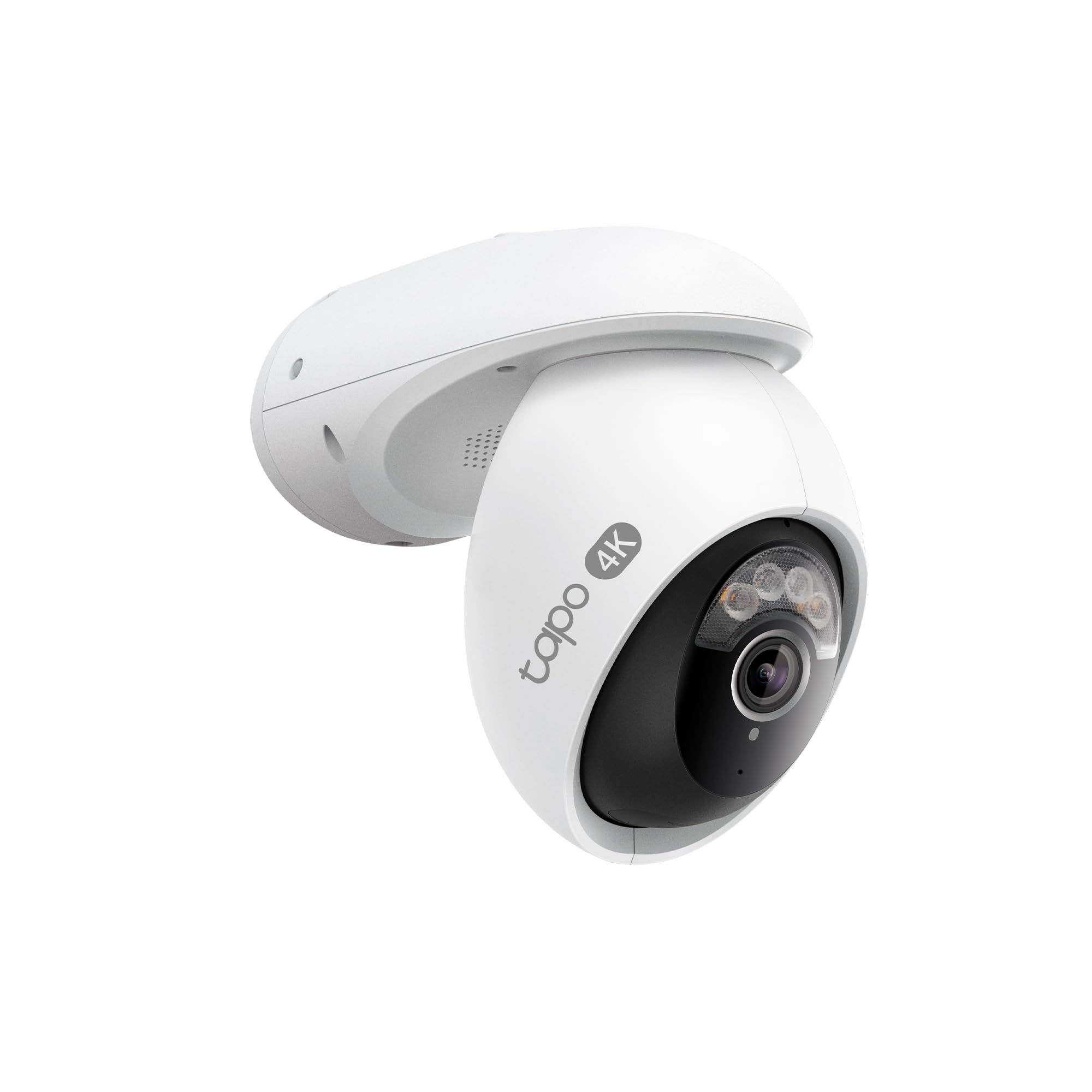
The Tapo C560WS brings motorized pan/tilt to the 4K outdoor category at an accessible price point, offering 360° horizontal and 98° vertical rotation with automatic subject tracking. The on-device AI runs facial recognition locally — meaning no cloud subscription for person identification — and it also distinguishes pets, vehicles, and loud sounds like barking dogs. Motion tracking follows a detected subject across the full pan range, though it can get confused by quick lateral movements.
Installation is straightforward via a provided template, but the AC adapter (12V/1A) is bulky and may not fit weatherproof junction boxes designed for standard US gang plates. The mounting bracket also limits upward tilt — you cannot angle the camera to see directly above the roofline. Image quality at 4K is excellent: users report reading faces clearly at 30+ feet, and the dual-band Wi-Fi keeps the stream stable even on mesh networks with many devices.
Early firmware had AI false-positive issues with activity tracking enabled, but the beta firmware (1.1.5 Build 260113) resolved most of those. Without activity tracking, the person/vehicle/pet detection is impressively accurate. The lack of a programmable home position means the camera may not return to your preferred vantage point after auto-tracking, and there is no notification suppression for quiet hours. Still, for a wired PTZ with no subscription, this is the strongest value per degree of coverage.
Why it’s great
- Full 360° pan with auto subject tracking
- On-device facial recognition with zero subscription fees
- Crisp 4K video with usable detail at 30+ feet
Good to know
- AC adapter too large for standard weatherproof boxes
- Limited upward tilt can’t view directly above roofline
- No home-position return after auto-tracking
5. Reolink E1 Outdoor SE PoE

The Reolink E1 Outdoor SE PoE is a purpose-built PTZ camera that combines 4K color night vision with PoE simplicity. Its f/1.6 wide aperture and adjustable 3000K spotlights deliver three distinct night vision modes — IR black-and-white, full-color spotlight, and a smart mode that switches to color only when motion is detected. The 355° pan and 50° tilt range covers most residential yards, and the auto-tracking follows subjects in both horizontal and vertical planes.
Setup is genuinely simple: plug the Ethernet cable into an IEEE 802.3at PoE switch, and the camera auto-detects the network. The aluminum housing feels substantial, and the included wall/ceiling bracket allows flexible placement. Storage options include microSD up to 512GB, Reolink NVR, or FTP, all without a subscription. Users running Blue Iris found initial lag that resolved by increasing the receive buffer to 3.0 MB — a known fix for PoE PTZ cameras under third-party software.
The main limitation is the lack of optical zoom — this is a pan/tilt unit only, so digital zoom is your only option for distant details. The ethernet cable exits from the side rather than the back, which can look messy in some installations. On-device person/vehicle/animal detection is reliable, and the two-way talk with built-in siren adds a useful active deterrent layer. For a subscription-free PoE PTZ that delivers color night footage, this is the best-balanced option.
Why it’s great
- True 4K color night vision with adjustable spotlights
- PoE simplifies wiring — one cable for power and data
- Auto-tracking covers both pan and tilt axes
Good to know
- No optical zoom — digital zoom only
- Ethernet cable protrudes from the side
- Requires an IEEE 802.3at PoE switch (not included)
6. Jennov 4K 8MP PTZ

For properties where reading a license plate from 50 feet or identifying a visitor at the end of a long driveway is non-negotiable, the Jennov 4K 8MP PTZ brings genuine 20X optical zoom to the sub- tier. The 4.7-94mm motorized lens maintains pixel-level detail at full zoom — no digital cropping artifacts — and the six IR LEDs push night visibility to a claimed 320 feet. In practice, usable facial identification holds up to about 150 feet, which still far exceeds any fixed-lens camera in this bracket.
Installation is pure PoE, and the camera auto-discovers on ONVIF-compliant NVRs (Blue Iris, Synology). The VideoLink mobile app handles initial setup, and the metal housing with IP66 rating has proven weather-resistant in direct sunlight and rain. Auto-tracking reliably follows human forms while ignoring large animals — one user noted their 45kg dog triggered zero false alarms. The 360° continuous pan and 90° tilt range (with a caveat: it cannot tilt upward past horizontal) cover large open areas effectively.
H.265+ compression cuts bandwidth and storage by up to 70%, critical when recording 8MP streams to a microSD card (256GB max over the limit, but 512GB is confirmed working). The main limitation is ONVIF-only compatibility — this camera will not work with Wi-Fi NVRs or proprietary Reolink/Tapo hubs. The 90° tilt limit means you must mount it high and angle downward; ground-level mounting won’t see above the horizon. For long-range zoom at this price, it’s a specialist tool that performs its narrow job excellently.
Why it’s great
- True 20X optical zoom for long-range identification
- 320ft IR illuminator outperforms most sub- cameras
- Solid ONVIF integration with Blue Iris and Synology
Good to know
- ONVIF-only — not compatible with Wi-Fi NVRs
- 90° tilt cannot pan upward past horizontal
- Requires strong network bandwidth for 4K zoom streams
7. Ring Floodlight Cam Pro
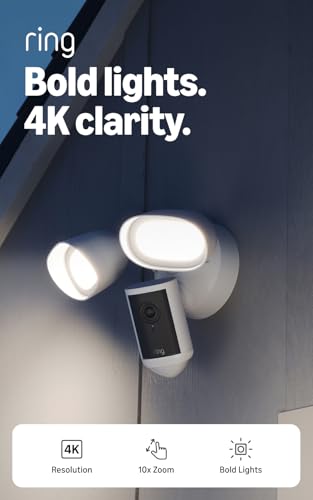
The Ring Floodlight Cam Pro is the closest thing to a complete perimeter lighting and surveillance system in one box. Its 2,000-lumen floodlights are genuinely blinding — bright enough to illuminate a full driveway or backyard as if it were daytime — and the Retinal 4K sensor captures wide-angle footage with 10x enhanced zoom that holds up better than most software zooms. The 3D Motion Detection uses radar and camera data to pinpoint motion in three-dimensional space, reducing false triggers from trees or street traffic.
Installation is straightforward if you have an existing junction box with live power, but the unit is heavier than most cameras and may require reinforced mounting. The two-way talk with Audio+ delivers clear voice communication, and the 85dB siren is loud enough to be a genuine deterrent. Alexa integration is deep — you can view the live feed on Echo Show devices, trigger motion alerts on smart displays, and control floodlights by voice. The Low-Light Sight mode provides full-color night vision using ambient street lighting, so the floodlights don’t need to be on constantly.
The hard truth is that Ring requires a subscription for cloud recording and advanced features like person detection and package alerts — without it, the camera is a live-view and floodlight-only device. The unit also demands a strong, stable internet connection and does not tolerate VPN usage (it will reconnect-loop). A small but vocal number of users report reliability issues with Ring’s cloud infrastructure after the trial period ends. If you are already invested in the Alexa ecosystem and value integrated lighting control, the subscription cost may be worth it.
Why it’s great
- Extremely bright 2,000-lumen floodlights with wide coverage
- 3D motion detection reduces false alerts significantly
- Deep Alexa integration for voice control and Echo Show feeds
Good to know
- Subscription required for cloud recording and advanced AI
- Heavy unit needs a sturdy junction box
- Cloud dependency causes issues if internet or VPN drops out
FAQ
Do I need a subscription for a 4K outdoor security camera?
What internet speed do I need for a 4K security camera?
Is PoE better than Wi-Fi for outdoor 4K cameras?
What is the difference between digital zoom and optical zoom in security cameras?
Can I use a 4K outdoor camera indoors?
Final Thoughts: The Verdict
For most users, the best 4k outdoor security camera winner is the Reolink Lumus Pro because it combines a wide f/1.6 aperture for real color night vision, dual-band Wi-Fi 6 for stable streaming, and full local recording with zero subscription fees. If you want mechanically panned coverage with smart tracking and no per-camera wiring, grab the Tapo C560WS. And for long-range zoom across a large property, nothing beats the Jennov 4K 8MP PTZ with its 20X optical lens and 320ft IR reach.