
Our readers keep the lights on and the weekend projects moving. As an Amazon Associate, I earn from qualifying purchases.
Finding a television that balances streaming performance, picture quality, and interface speed can feel like a compromise. The reality is that a streaming-first TV needs more than just a high-resolution panel—it demands an intelligent operating system, robust HDR compatibility, and a processing engine that can handle variable bitrate content from Netflix, Prime Video, and live sports apps without stuttering or crushing detail.
I’m Rikta — the founder and writer behind FitlyFast. I spend my time dissecting display specifications, comparing local dimming zone counts, measuring response times, and evaluating streaming platform ecosystems to separate real performance from marketing noise.
After methodically examining 11 models from Roku, Hisense, TCL, LG, Samsung, Sony, and Panasonic, this guide identifies the single 4k tv for streaming that delivers the best combination of picture accuracy, smart platform fluidity, and long-term value for the way people actually watch content today.
How To Choose The Best 4K TV For Streaming
Not every 4K panel is optimized for streaming. The difference between a frustrating experience and a seamless one comes down to four critical factors that directly affect what you see on screen when you open Netflix, YouTube, or a live sports service.
Smart TV Platform Speed and App Support
The operating system is the gatekeeper to your content. Roku offers the cleanest interface with automatic updates and the widest free channel selection. Google TV and Fire TV provide deeper integration with voice assistants and personalized recommendations but require more initial setup. LG’s webOS and Samsung’s Tizen are polished but have smaller free-channel ecosystems. Choose the platform that matches your tolerance for menus and ads.
HDR Format Compatibility and Brightness
Streaming services deliver HDR in different formats. Dolby Vision is the most common premium HDR format on Netflix and Disney+. HDR10+ is used by Prime Video. Dolby Vision IQ and HDR10+ Adaptive adjust the picture based on ambient light in the room—a feature that prevents crushed blacks during daytime viewing. Peak brightness above 600 nits makes HDR highlights pop; entry-level panels below 400 nits struggle with specular details.
Refresh Rate and Motion Handling
Standard streaming content is 24fps or 30fps, which a 60Hz panel handles perfectly. A 120Hz or 144Hz native panel becomes important if you watch live sports or game on a console. Native high-refresh panels (not interpolated) eliminate judder during fast panning shots in action movies and reduce motion blur during football broadcasts.
Local Dimming and Black Level Performance
Full Array Local Dimming (FALD) or Mini-LED backlighting controls brightness zones independently, producing deeper blacks and higher contrast. OLED achieves perfect black by turning off pixels individually. For streaming in a dark room, OLED or a Mini-LED panel with at least 100 dimming zones provides the most cinematic image. Entry-level edge-lit TVs show visible blooming around bright subtitles in dark scenes.
Quick Comparison
On smaller screens, swipe sideways to see the full table.
| Model | Category | Best For | Key Spec | Amazon |
|---|---|---|---|---|
| Roku Plus Series 55″ | Mini-LED QLED | Streaming simplicity and value | Mini-LED backlighting with Dolby Vision | Amazon |
| Roku Select Series 65″ | QLED | Large screen on a budget | Direct LED backlight with HDR10 | Amazon |
| Hisense U6 55″ | Mini-LED QLED | Bright room HDR performance | Up to 1000 nits and 600 dimming zones | Amazon |
| TCL T7 55″ | QLED | Universal streaming and gaming | 120Hz panel with MEMC frame insertion | Amazon |
| Samsung M7 43″ | Smart Monitor | Desk streaming and multitasking | USB-C with 65W charging and Samsung TV Plus | Amazon |
| LG B5 55″ OLED | OLED | Cinematic streaming in dark rooms | Self-lit pixels and Alpha 8 AI processor | Amazon |
| TCL Q7 85″ | QLED | Home theater scale and gaming | Full Array Pro with 200+ dimming zones | Amazon |
| Sony Bravia 5 65″ | Mini-LED | Premium upscaling and PS5 integration | XR Processor with AI and XR Triluminos Pro | Amazon |
| Panasonic Z8 77″ OLED | OLED | Reference-grade color and cinema audio | Master OLED PRO with 144Hz and MLA | Amazon |
| Samsung QN70F 85″ | Neo QLED Mini-LED | Oversized bright-room streaming | NQ4 AI Gen2 upscaling to 4K | Amazon |
| Sony Bravia 8 65″ OLED | OLED | Director-approved picture accuracy | XR OLED Motion and Acoustic Surface Audio+ | Amazon |
In‑Depth Reviews
1. Roku Plus Series 55-Inch Mini-LED QLED
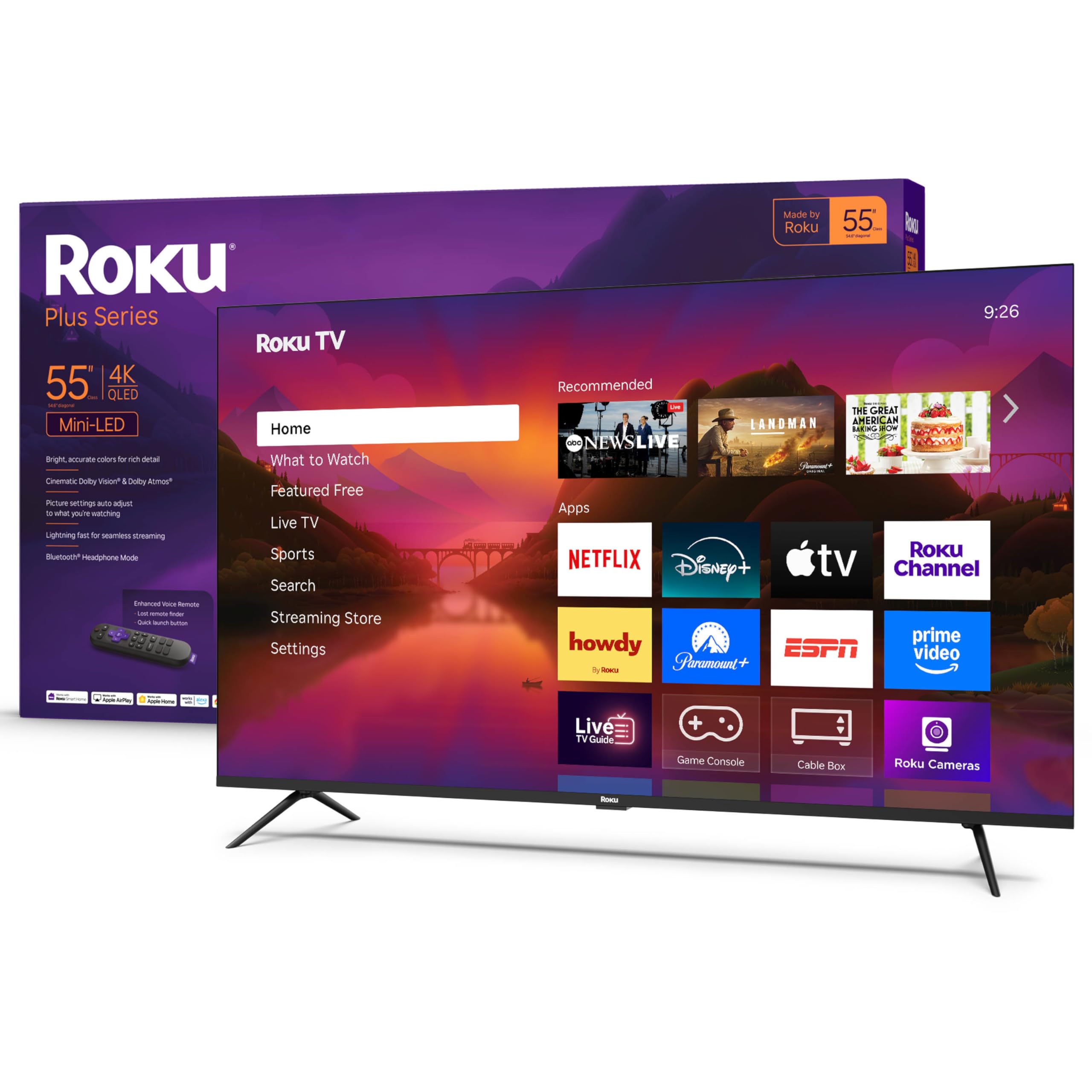
The Roku Plus Series combines a Mini-LED backlight with a QLED panel and Dolby Vision support, delivering vibrant colors and high contrast at a price point that undercuts most competitors. The 55-inch model uses hundreds of tiny LEDs to control brightness zones, producing deep blacks and punchy highlights that make Dolby Vision content on Netflix and Disney+ look genuinely cinematic. The Roku Smart Picture Max AI engine cleans up incoming signals and adjusts color and sharpness per scene without user intervention.
The Roku OS is the star here—clean, fast, and updated automatically. The home screen puts apps front and center with no deep menu digging, and the enhanced voice remote includes a lost remote finder and Bluetooth headphone mode for private listening. Built-in Dolby Atmos processing and a subwoofer produce fuller sound than typical TV speakers, making dialogue clear during quiet scenes and action sequences impactful.
The USB port keeps bias lights powered for about 10 minutes after shutdown, which is a minor nuisance for those running ambient lighting. The interface is intentionally simple—users who want heavy customization or gaming-focused overlays may find it basic. For pure streaming simplicity at this price, the Plus Series is the most complete package available.
Why it’s great
- Mini-LED + QLED produces excellent contrast and color volume for HDR streaming
- Roku OS is the fastest and most intuitive streaming platform tested
- Voice remote with lost remote finder and Bluetooth headphone mode adds real convenience
Good to know
- USB port keeps bias lights on for ~10 minutes after TV is turned off
- Basic settings menu lacks deep calibration options found on premium brands
2. Roku Select Series 65-Inch QLED
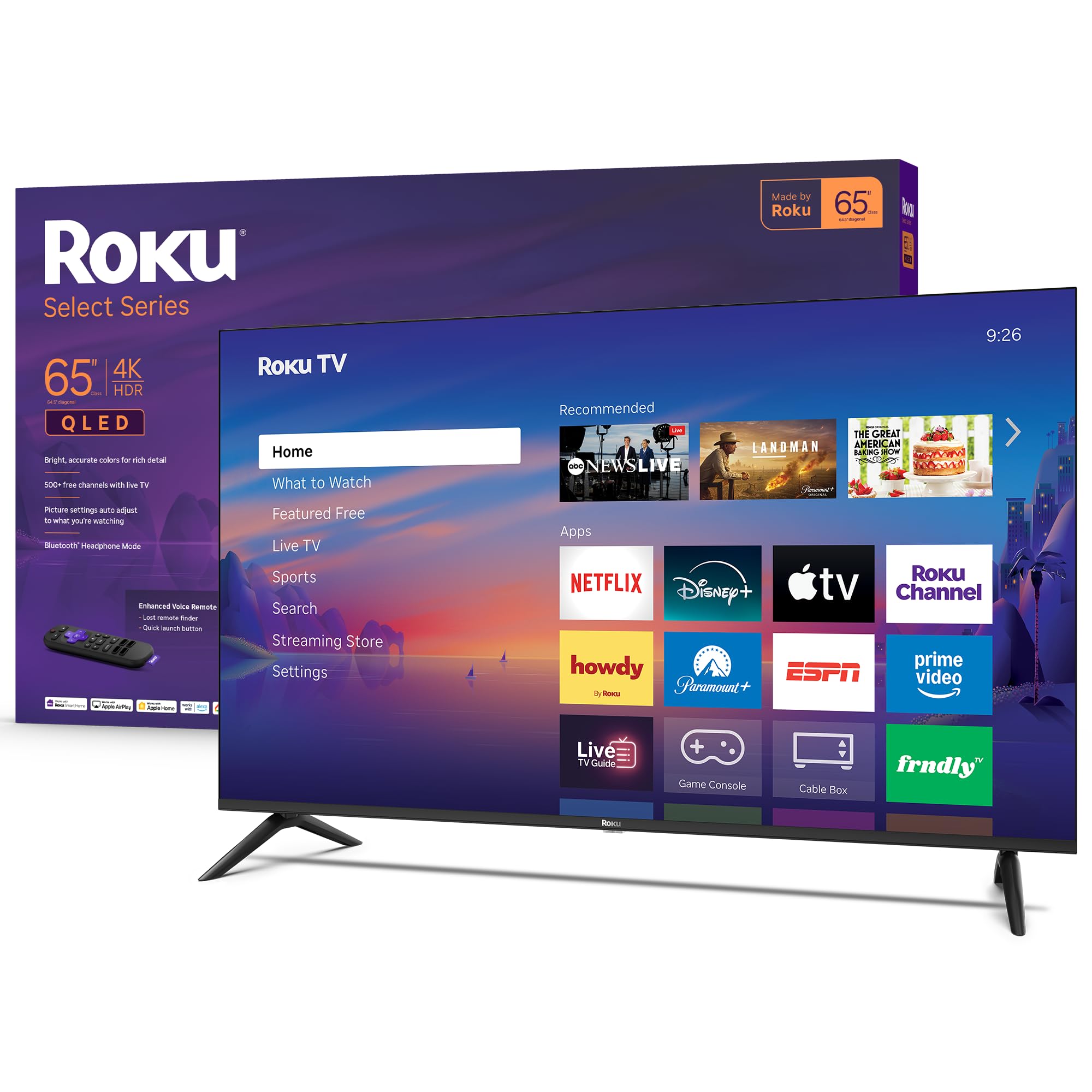
The Select Series delivers a 65-inch QLED screen with HDR10 support and the same excellent Roku OS found on the Plus Series, but uses a Direct LED backlight instead of Mini-LED. This means contrast is good but not as deep as the Plus model—blooming around bright text in dark scenes is visible. What you gain is a massive screen size at a budget-friendly price point that punches well above its weight for everyday streaming of YouTube, live news, and standard HDR content.
The frameless design keeps the bezel minimal, and the enhanced voice remote includes shortcut buttons for popular streaming services. Setup takes minutes: plug in, connect to Wi-Fi, log into your streaming accounts, and start watching. The interface remains snappy even after weeks of use, and automatic software updates ensure you never miss new app releases.
Sound quality is adequate for a large room but lacks the subwoofer depth of the Plus Series—dialog-heavy content remains clear. For the price-per-inch ratio, particularly in a living room or family room where absolute contrast perfection is secondary to screen real estate, the Select Series is a compelling choice.
Why it’s great
- 65-inch QLED panel at an entry-level price point is unmatched for screen size value
- Roku OS provides the smoothest streaming experience with minimal bloatware
- Frameless design modernizes any room setup
Good to know
- Direct LED backlight lacks the local dimming depth of Mini-LED or OLED options
- Built-in speakers miss low-end bass; a soundbar is recommended for movies
3. Hisense U6 55-Inch Mini-LED QLED
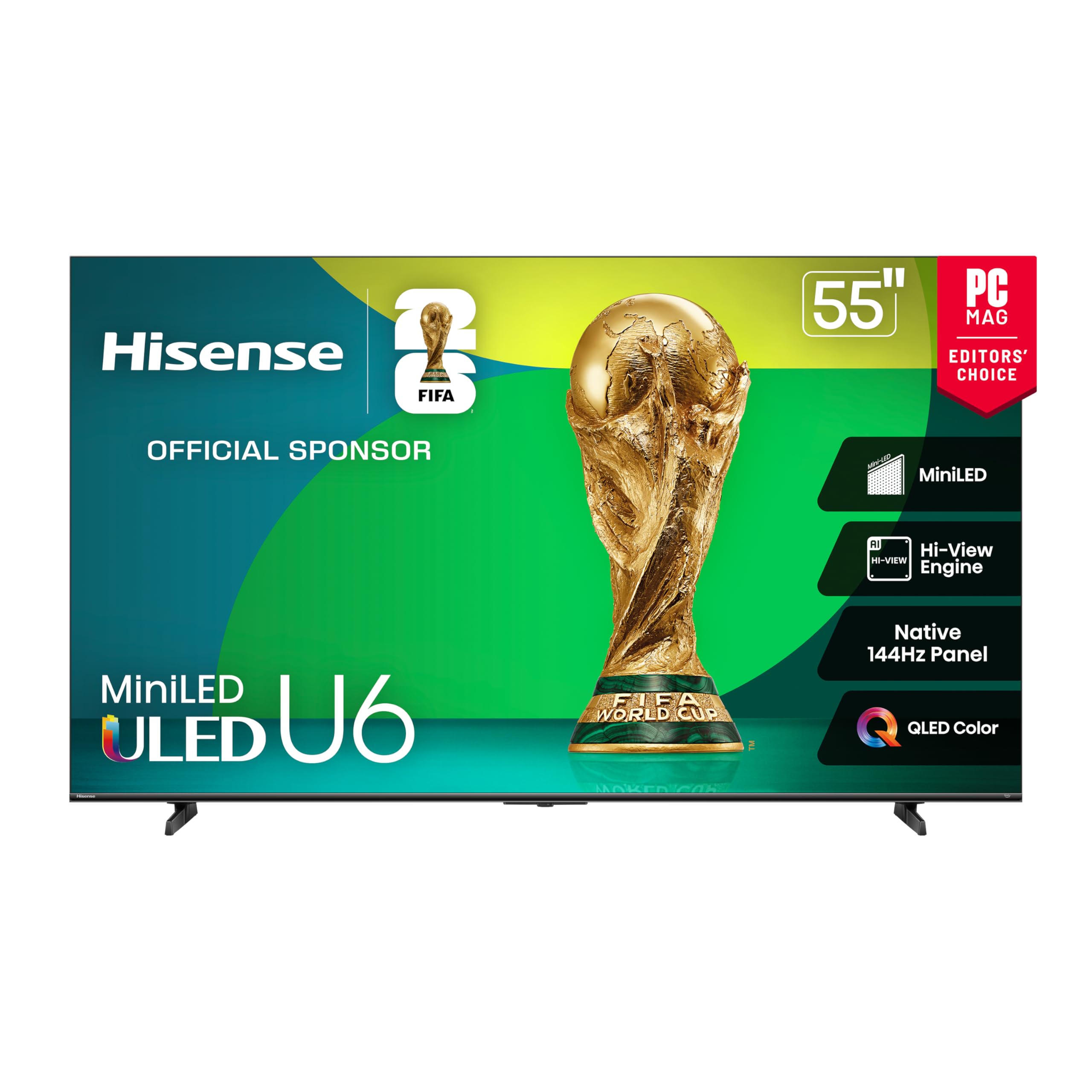
The Hisense U6 is a jaw-dropping performer for its price tier, packing up to 1000 nits peak brightness and up to 600 local dimming zones into a 55-inch chassis. In a bright living room with large windows, this Mini-LED panel maintains punchy highlights and deep blacks that edge-lit competitors simply cannot match. Dolby Vision IQ and HDR10+ Adaptive adjust the picture based on ambient light, preventing crushed shadows during daytime viewing—a critical advantage for all-day streamers.
The native 144Hz panel and AMD FreeSync Premium support make this an excellent secondary display for cloud gaming or console use, but the primary draw is HDR streaming performance. The Hi-View AI Engine upscales 1080p and 1440p content cleanly, and the built-in subwoofer delivers surprising bass depth without external speakers. The Fire TV interface puts Alexa front and center, which is convenient if you’re already in the Amazon ecosystem.
The headphone jack does not function on some units, which is a known issue reported by multiple users. The Fire TV interface also requires an Amazon account for full feature access, which may frustrate users who prefer a neutral platform. For raw brightness and zone-count performance, the U6 is unmatched in this price bracket.
Why it’s great
- 1000 nits peak brightness with 600 local dimming zones destroys competitors in bright rooms
- Dolby Vision IQ and HDR10+ Adaptive provide exceptional daytime HDR performance
- Built-in subwoofer delivers room-filling bass without an external soundbar
Good to know
- Headphone jack is non-functional on some units per user reports
- Fire TV interface requires Amazon account for full streaming feature access
4. TCL T7 55-Inch QLED Google TV

The TCL T7 strikes a strong balance between streaming performance and gaming capability with its native 120Hz panel, QLED color gamut, and Google TV interface. Motion Rate 480 with MEMC frame insertion eliminates judder during fast-paced sports broadcasts and action sequences, making live streaming of football and basketball noticeably smoother than on standard 60Hz panels. Dolby Vision and HDR10+ are both supported, covering the major streaming HDR formats without compromise.
Google TV organizes content from across your subscribed services into a single home screen, reducing the time spent jumping between apps. The included voice remote works with Google Assistant, Alexa, and Apple HomeKit, giving you flexibility regardless of your smart home ecosystem. The four HDMI inputs include one with eARC for easy soundbar connection, and Wi-Fi 5 keeps the streaming pipeline stable even at 4K bitrates.
The T7 requires an internet connection and Google account setup before you can access any HDMI inputs, which can be annoying if you only want to plug in a streaming stick or console out of the box. The built-in speakers are acceptable for casual viewing but benefit from an external audio system for serious movie nights.
Why it’s great
- 120Hz native panel with MEMC delivers buttery-smooth sports streaming motion
- Google TV interface unifies streaming apps from multiple subscriptions on one screen
- Dolby Vision and HDR10+ dual-format support covers all major streaming services
Good to know
- Mandatory internet and Google account setup required before using HDMI inputs
- Built-in speakers are adequate but a soundbar significantly improves the audio experience
5. Samsung M7 43-Inch Smart Monitor

The Samsung M7 blurs the line between TV and monitor, offering a 43-inch 4K UHD display with USB-C connectivity that delivers 65W charging to a connected laptop. This makes it the ideal streaming display for a desk setup—pull up Netflix or YouTube on one half of the screen while working on documents on the other. Samsung TV Plus provides 2700+ free channels of live news, sports, and entertainment without any subscription or antenna.
The NQ4 AI Gen2 processor upscales 1080p streaming content cleanly, and the 5000:1 contrast ratio from the VA panel delivers solid black levels for a monitor-style display. The Active Voice Amplifier adjusts audio volume based on ambient room noise, which is surprisingly useful in a home office environment. The solar-powered remote is a thoughtful touch that removes the need for disposable batteries.
The 60Hz refresh rate is sufficient for streaming and office work but feels sluggish for fast-paced gaming. The built-in speakers are treble-heavy and lack bass, making an external Bluetooth speaker or soundbar nearly mandatory for an enjoyable movie-watching experience. For desk-based streaming and productivity multitasking, the M7 is uniquely capable.
Why it’s great
- USB-C with 65W power delivery simplifies desk setup with a single cable
- Samsung TV Plus offers thousands of free live channels with no subscription
- Active Voice Amplifier automatically adjusts dialogue volume in noisy environments
Good to know
- 60Hz refresh rate feels sluggish for fast-paced gaming content
- Built-in speakers lack bass; external audio is recommended
6. LG B5 55-Inch OLED

The LG B5 is your entry point into OLED streaming without breaking the bank. Self-lit pixels deliver perfect blacks, infinite contrast, and stunning color volume that makes Dolby Vision content from Netflix and Disney+ look three-dimensional. The Alpha 8 AI Gen2 processor detects the type of content you’re watching and automatically optimizes picture and sound settings, removing the need for manual calibration for most streaming scenarios.
With four HDMI 2.1 inputs, NVIDIA G-Sync, and AMD FreeSync Premium, the B5 is equally capable for console gaming between streaming sessions. The 0.1ms response time eliminates motion blur entirely, and the 120Hz refresh rate handles fast-paced content without judder. webOS 25 provides a clean, personalized smart TV experience with over 350 free LG Channels available without signing up for anything.
The B5 is not as bright as the C-series or G-series models, making it less ideal for very bright rooms with direct sunlight on the screen. The built-in speakers are improved over previous OLED generations but still lack the bass depth of a dedicated sound system.
Why it’s great
- Perfect black levels and infinite contrast deliver the most cinematic streaming experience available
- Four HDMI 2.1 inputs with G-Sync and FreeSync support future-proof for gaming
- AI processor automatically optimizes picture per content type without manual tweaking
Good to know
- Lower peak brightness than C-series OLEDs struggles in brightly lit rooms
- Built-in speakers are improved but still benefit from a soundbar for bass response
7. TCL Q7 85-Inch QLED

The TCL Q7 in 85 inches is a statement piece. With Full Array Pro local dimming across over 200 zones, this QLED panel delivers deep blacks and bright highlights that approach OLED territory in controlled lighting conditions. Dolby Vision IQ adjusts the HDR picture based on room brightness, ensuring that the massive screen looks good whether you’re watching during the day or at night. The native 120Hz panel and Game Accelerator 240 (up to 240Hz VRR) make this a dual-purpose home theater and gaming powerhouse.
Google TV provides a unified streaming experience across Netflix, Prime Video, Disney+, and Hulu, and the voice remote supports hands-free search. The ultra-thin bezel design makes the 85-inch screen feel immersive without dominating the room visually. Motion Rate 480 with MEMC frame insertion keeps fast-moving sports and action movies smooth and artifact-free.
The sheer size and weight require planning for delivery and setup—the TV needs a wide console or professional wall mounting. The Google TV interface includes some advertising on the home screen, which may bother users who prefer the cleaner Roku experience. For the price, no other 85-inch model offers this many dimming zones and gaming features.
Why it’s great
- 200+ local dimming zones on an 85-inch panel provide near-OLED contrast at a fraction of the cost
- Game Accelerator 240 with VRR handles high-refresh-rate console gaming seamlessly
- Dolby Vision IQ adjusts HDR to ambient room lighting automatically
Good to know
- Massive size and weight require professional installation and a sturdy stand or wall mount
- Google TV interface includes advertising on the home screen
8. Sony Bravia 5 65-Inch Mini-LED

The Sony Bravia 5 sets the standard for streaming upscaling excellence. The XR Processor with AI technology analyzes every frame in real-time, upscaling 1080p and 1440p streaming content from services like YouTube and Prime Video to near-4K clarity without introducing artifacts. XR Triluminos Pro delivers billions of accurate real-world colors, and the Mini-LED backlight with XR Backlight Master Drive produces captivating brightness with minimal blooming—a rare combination for LED technology.
Google TV is integrated seamlessly, and the Sony-specific features for PlayStation 5—Auto HDR Tone Mapping and Auto Genre Picture Mode—make this the best TV for PS5 streaming and gaming simultaneously. The IMAX Enhanced and DTS:X support provide a cinema-grade audio experience when paired with a compatible sound system. Sony Pictures CORE includes free credits to redeem 4K UHD movies.
Only 2 of the 4 HDMI ports support HDMI 2.1, which may be limiting if you own multiple HDMI 2.1 devices. The premium price reflects the processing power and brand reputation rather than raw zone count or brightness numbers. For users who value picture processing accuracy above all else, this is the top choice.
Why it’s great
- Industry-leading XR AI upscaling makes heavily compressed streaming content look pristine
- XR Triluminos Pro delivers the most accurate real-world color reproduction in its class
- Exclusive PS5 features and Sony Pictures Core credits add tangible value for Sony ecosystem users
Good to know
- Only 2 of 4 HDMI ports support HDMI 2.1 bandwidth
- Premium pricing reflects processing power over raw panel specs like zone count
9. Panasonic Z8 77-Inch OLED
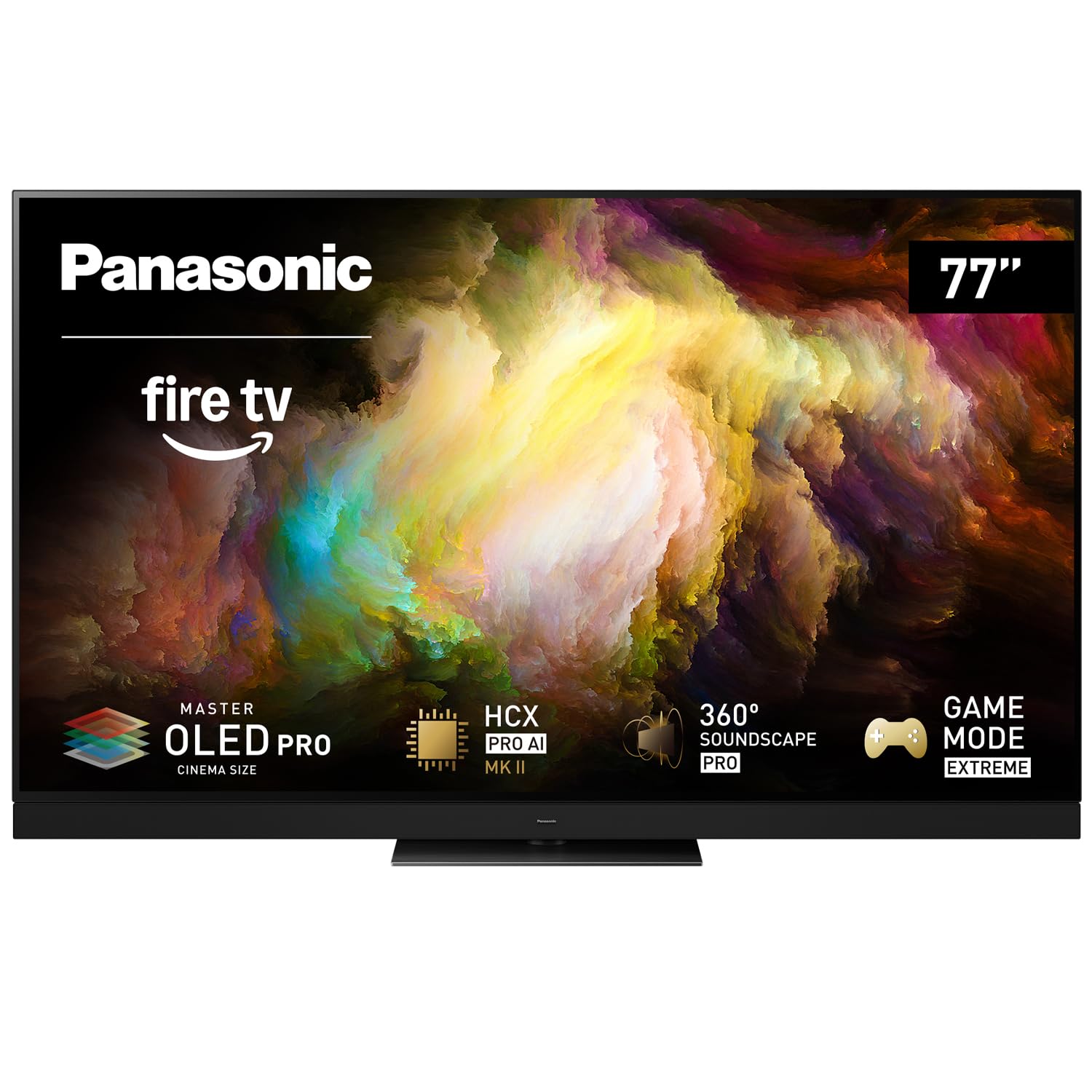
Panasonic returns to the US market with the Z8, a 77-inch OLED that rivals the best from Sony and LG. The Master OLED PRO panel with micro-lens-array technology delivers enhanced brightness—a traditional weakness of OLED—while maintaining perfect blacks and infinite contrast. The HCX Pro AI Processor MKII provides reference-grade color accuracy, and Filmmaker Mode reproduces content exactly as the director intended without motion smoothing or artificial sharpening.
The 360 Soundscape Pro system tuned by Technics is the best built-in audio of any TV in this guide. Front-array, upward-firing, and side-firing speakers create a convincing Dolby Atmos bubble that often eliminates the need for a separate soundbar. Game Mode Extreme supports HDMI 2.1, 144Hz refresh rate, VRR, AMD FreeSync Premium, and NVIDIA G-SYNC, making this a serious gaming OLED as well.
The Fire TV interface is functional but less polished than webOS or Google TV, and the remote lacks a dedicated input button, making source switching cumbersome. The 77-inch panel is extremely heavy—approximately 100 pounds—requiring a sturdy stand or professional wall mounting. For color purists and home theater enthusiasts, this is the best OLED value available.
Why it’s great
- Master OLED PRO with MLA technology delivers OLED blacks with significantly enhanced brightness
- 360 Soundscape Pro audio system eliminates the need for a separate soundbar for most rooms
- Filmmaker Mode provides reference-grade color accuracy for director-intended streaming
Good to know
- Very heavy at ~100 pounds; requires professional installation for safe mounting
- Fire TV remote lacks a dedicated input button, making source switching less convenient
10. Samsung QN70F 85-Inch Neo QLED

The Samsung QN70F combines an 85-inch screen with Neo QLED Mini-LED technology and the NQ4 AI Gen2 processor, which uses 20 neural networks to upscale content to 4K. Quantum Matrix Technology precisely controls Mini-LED cells to produce deep blacks and bright highlights with minimal blooming—an impressive feat at this screen size. Samsung TV Plus offers 2700+ free channels, making this a turnkey streaming solution without any subscription.
Motion Xcelerator 144Hz handles fast-paced sports and high-frame-rate content smoothly, and the AI-powered picture enhancement adjusts brightness dynamically to improve contrast in real-time. The ultra-slim design and Samsung Vision AI features, including 3D Map View for smart home device control, add smart home integration that other TVs don’t match. The built-in speakers are clear and loud enough for a large living room without sounding tinny.
The Samsung smart TV platform lacks Dolby Vision support, relying on HDR10+ instead. This means certain Dolby Vision streams on Netflix and Disney+ will fall back to standard HDR10, missing the dynamic metadata that Dolby Vision provides. The remote is slim and feels small in hand, which takes some getting used to.
Why it’s great
- 85-inch Neo QLED panel with Quantum Matrix Technology delivers stunning contrast at massive scale
- NQ4 AI Gen2 upscaling with 20 neural networks provides excellent clarity on compressed streams
- Samsung TV Plus offers thousands of free channels with no subscription required
Good to know
- No Dolby Vision support; HDR10+ is the primary HDR format
- Slim remote is small and may feel less ergonomic than competitors
11. Sony Bravia 8 65-Inch OLED

The Sony Bravia 8 delivers the OLED experience that home theater enthusiasts dream about. Over 8 million self-lit pixels create pure black levels that make HDR streaming content from Apple TV+ and Netflix look like a cinema screen. XR Contrast Booster 15 enhances brightness on small highlights, making specular reflections in water or glassware pop without washing out the surrounding blacks. XR Triluminos Pro reproduces billions of accurate real-world colors that no QLED panel can match in color volume.
Acoustic Surface Audio+ uses actuators behind the screen to generate sound directly from the display, creating a unique immersive effect where dialogue and effects seem to come from the on-screen action. Google TV integrates streaming apps cleanly, and the exclusive PS5 features—Auto HDR Tone Mapping and Auto Genre Picture Mode—optimize picture settings automatically when a PlayStation 5 is connected. Sony Pictures Core includes credits for 4K UHD movie rentals.
The Google TV operating system requires accepting multiple privacy agreements during initial setup, which some users find intrusive. The Bravia 8 also has a known issue where it intermittently turns on or off by itself, though Sony support can adjust settings to mitigate this. For the absolute best streaming picture quality money can buy, the Bravia 8 is the benchmark.
Why it’s great
- Perfect black levels and XR Contrast Booster 15 produce the most impactful HDR streaming image available
- Acoustic Surface Audio+ creates immersive sound directly from the screen surface
- Exclusive PS5 integration and Sony Pictures Core credits add premium ecosystem value
Good to know
- Google TV requires multiple privacy agreements during initial setup
- Intermittent auto on/off issue reported by some users; Sony support can assist
FAQ
Does Dolby Vision matter more than HDR10 for streaming?
Is a 120Hz or 144Hz panel necessary for watching movies and TV shows?
How many local dimming zones do I need for good HDR streaming?
Can I use a 4K TV as a computer monitor for streaming and work?
Why do some smart TVs show advertising on the home screen?
Final Thoughts: The Verdict
For most users, the 4k tv for streaming winner is the Roku Plus Series 55-Inch because it delivers Mini-LED contrast, Dolby Vision, and the cleanest streaming platform at a price that leaves room for a good soundbar. If you want deeper blacks and perfect contrast for a dark home theater, grab the LG B5 55-Inch OLED. And for massive screen presence and high brightness in a bright living room, nothing beats the Hisense U6 55-Inch Mini-LED.