
Our readers keep the lights on and the weekend projects moving. As an Amazon Associate, I earn from qualifying purchases.
Recording in true 4K resolution isn’t just about more pixels—it’s about having the flexibility to crop, stabilize, and color grade your footage without losing detail. Whether you’re filming interviews, live streams, travel vlogs, or nursing a cinematic project, the sensor size, bit rate, and stabilization system of your camera determine whether your final output looks professional or just like an upscaled phone clip.
I’m Rikta — the co-founder and writer behind FitlyFast. I’ve spent hundreds of hours analyzing spec sheets, cross-referencing real-world test footage, and comparing sensor technologies across the widest possible price spectrum to separate marketing claims from actual 4K performance.
This guide cuts through the noise to help you match a camera to your actual workflow. Whether you prioritize optical zoom range, gimbal-like stabilization, or interchangeable lens flexibility, you’ll find the right tool among our curated picks for the best 4k video camera for your needs.
How To Choose The Best 4K Video Camera
Selecting a 4K camera that matches your production needs means looking past the resolution number alone. Sensor size, stabilization type, audio inputs, and zoom mechanics each play a decisive role in whether the camera performs in your specific shooting environment—whether that’s a studio, a lecture hall, a hiking trail, or a live stage.
Sensor Size and Low-Light Performance
The physical size of the image sensor—measured from 1/2.3-inch (common in consumer camcorders) up to APS-C and 1-inch (found in premium mirrorless and pro camcorders)—directly governs how much light each pixel can gather. A 1-inch sensor captures roughly four times the light of a 1/2.3-inch sensor at the same aperture, producing cleaner shadows and less noise when recording indoors, at dusk, or under stage lights. For any serious hybrid shooting, prioritize a 1-inch or larger sensor.
Optical Zoom vs. Digital Zoom vs. Interchangeable Lenses
Optical zoom uses physical glass to magnify the image without losing resolution. A camcorder with a 20x or 60x optical zoom can bring distant subjects into frame at full 4K quality. Digital zoom, in contrast, crops and upscales the image—avoid depending on it for critical shots. Interchangeable-lens mirrorless cameras offer flexibility but require a separate telephoto purchase; a superzoom bridge camera or camcorder is often more practical for event, sports, or wildlife recording out of the box.
Stabilization for Handheld Shooting
Shaky footage destroys the illusion of 4K clarity. Three stabilization types exist: optical image stabilization (OIS) inside the lens, gimbal stabilization via a motorized three-axis system, and electronic stabilization that crops the frame. For walking shots or run-and-gun vlogging, a built-in gimbal (like on pocket cameras) delivers the smoothest results. For long zoom shots, lens-based OIS is essential. Electronic stabilization should be a secondary feature, not your primary plan.
Audio Inputs and Recording Quality
Video without quality audio is half a production. Look for a 3.5mm external microphone jack as the minimum. For professional workflows, dual XLR inputs with phantom power allow you to connect boom mics or mixing boards directly. Built-in stereo microphones are fine for casual clips, but for interviews, live music, or podcast recordings, dedicated audio inputs are non-negotiable.
Quick Comparison
On smaller screens, swipe sideways to see the full table.
| Model | Category | Best For | Key Spec | Amazon |
|---|---|---|---|---|
| Panasonic HC-X20 | Pro Camcorder | News & Events | 1.0-inch Sensor, 20x Optical Zoom | Amazon |
| Canon VIXIA HF G70 | Prosumer Camcorder | Timestamp Recording | 20x Optical Zoom, OSD Time Stamp | Amazon |
| Sony FDR-AX43 | Consumer Camcorder | Handheld Stabilization | Built-in Gimbal, Balanced OIS | Amazon |
| Sony Alpha ZV-E10 | Mirrorless Vlog | Vlogging & Streaming | APS-C 24.2MP, 6K Oversampled 4K | Amazon |
| Canon EOS R100 | Entry Mirrorless | Beginner Photography | APS-C 24.1MP, Dual Pixel AF | Amazon |
| Panasonic LUMIX FZ80D | Bridge Camera | Extreme Telephoto | 60x Optical Zoom, 20–1200mm | Amazon |
| DJI Osmo Pocket 3 | Gimbal Camera | Pocket-Sized Vlogging | 1-inch CMOS, 4K/120fps | Amazon |
| Zoom Q8n-4K | Audio Recorder | Music & Podcasts | 2 XLR Inputs, 4-Track Audio | Amazon |
| Xtra Muse | Pocket Gimbal | Budget Vlogging | 1-inch CMOS, 3-Axis Gimbal | Amazon |
| TONGVEO PTZ System | PTZ Conference | Meeting Rooms | 20x Zoom, AI Auto-Tracking | Amazon |
| Acuvar 6K Camcorder | Budget Camcorder | Entry-Level Content | 18x Digital Zoom, 64MP Stills | Amazon |
In‑Depth Reviews
1. Panasonic HC-X20

The Panasonic HC-X20 is a professional-grade camcorder that brings a 1.0-inch MOS sensor into a body balanced for shoulder-mounted or tripod work. The 15-megapixel effective resolution allows 4K 60p capture with a wide 24.5mm lens and a 20x optical zoom that reaches out to a 35mm equivalent of 490mm. The built-in 5-Axis HYBRID O.I.S. keeps handheld footage steady even at the telephoto end, while the Face Detection AF/AE ensures subjects remain sharp in interviews or event coverage.
Dual XLR inputs with phantom power let you connect professional microphones or line-level sources directly, and the camera supports versatile streaming protocols including RTMP for live broadcasts. The triple manual ring system (focus, zoom, iris) gives you tactile control without digging into menus, which is critical when you’re running a single-camera interview or documentary setup. The HEVC codec keeps file sizes manageable without sacrificing 4:2:2 10-bit color depth.
For news, corporate filming, or event videography where reliability and image quality are non-negotiable, the HC-X20 delivers a complete package. The auto exposure can occasionally darken the image near strong light sources, but manual mode corrects this quickly. This is a tool built for consistent, repeatable professional work.
Why it’s great
- 1-inch sensor with excellent low-light performance for a camcorder
- 20x optical zoom with 5-axis stabilization for steady telephoto work
- Dual XLR inputs and professional streaming protocols included
Good to know
- Auto balance can underexpose near bright lights; manual mode recommended
- Higher upfront cost, but justified for regular professional use
2. Canon VIXIA HF G70

The Canon VIXIA HF G70 combines a 1/2.3-inch 4K UHD CMOS sensor with a DIGIC DV 6 image processor, outputting crisp 4K30 footage that holds up well in good lighting. The 20x optical zoom benefits from Canon’s advanced image stabilization, making it usable for long-distance shots at events or nature scenarios. The 8-blade aperture creates smoother, cinema-style bokeh compared to typical 6-blade camcorder designs.
A standout feature is the On-Screen Display timestamp recording, which embeds date, time, and timecode directly into the original video file—essential for legal, evidence, or archival documentation. The UVC livestreaming function lets you connect directly to a PC or Mac via USB for HD streaming without additional capture hardware. Dual SD card slots provide backup or extended recording capacity.
Low-light performance is a known limitation; once gain exceeds +4 dB, noise becomes visible, and at +10 dB the image softens considerably. For indoor productions, a strong lighting setup is required. The Hybrid AF system with face detection works well in good light, making this camcorder a strong choice for daytime outdoor shoots and timestamp-focused documentation.
Why it’s great
- On-screen timecode and timestamp recording for professional documentation
- UVC livestreaming direct to PC/Mac without extra hardware
- Sharp 20x zoom with effective image stabilization
Good to know
- Poor low-light performance; needs strong lighting indoors
- HDMI output and webcam mode are limited to 1080p, not 4K
3. Sony FDR-AX43

The Sony FDR-AX43 Handycam is built around a Balanced Optical SteadyShot system that functions like a built-in gimbal, keeping footage remarkably stable during walking shots or handheld pans. The 1/2.5-inch Exmor R CMOS sensor and BIONZ X processor record 4K video with natural color accuracy and good dynamic range. The 20x optical zoom extends to 30x in 4K and 40x in HD using Clear Image Zoom without noticeable generational loss.
The 26.8mm wide-angle ZEISS Vario-Sonnar T lens is useful for capturing wide establishing shots, and Fast Intelligent AF tracks focus reliably in most conditions. The built-in Wi-Fi and NFC enable quick remote control via smartphone for tripod shooting. The Highlight Movie Maker feature automatically creates highlight reels from recorded clips, a time-saver for event shooters.
The battery protrudes from the back, making the camera less comfortable for selfie-stick or gimbal mounting. For point-and-shoot users who prioritize stabilization above all else, the AX43 delivers exceptional smoothness without requiring a separate gimbal rig.
Why it’s great
- Balanced Optical SteadyShot provides gimbal-like stabilization
- 20x optical zoom with Clear Image Zoom up to 40x HD
- Fast Intelligent AF works reliably in most scenarios
Good to know
- Battery protrudes awkwardly from back; less ideal for compact rigs
- Date/time resets when battery is removed for a short period
4. Sony Alpha ZV-E10
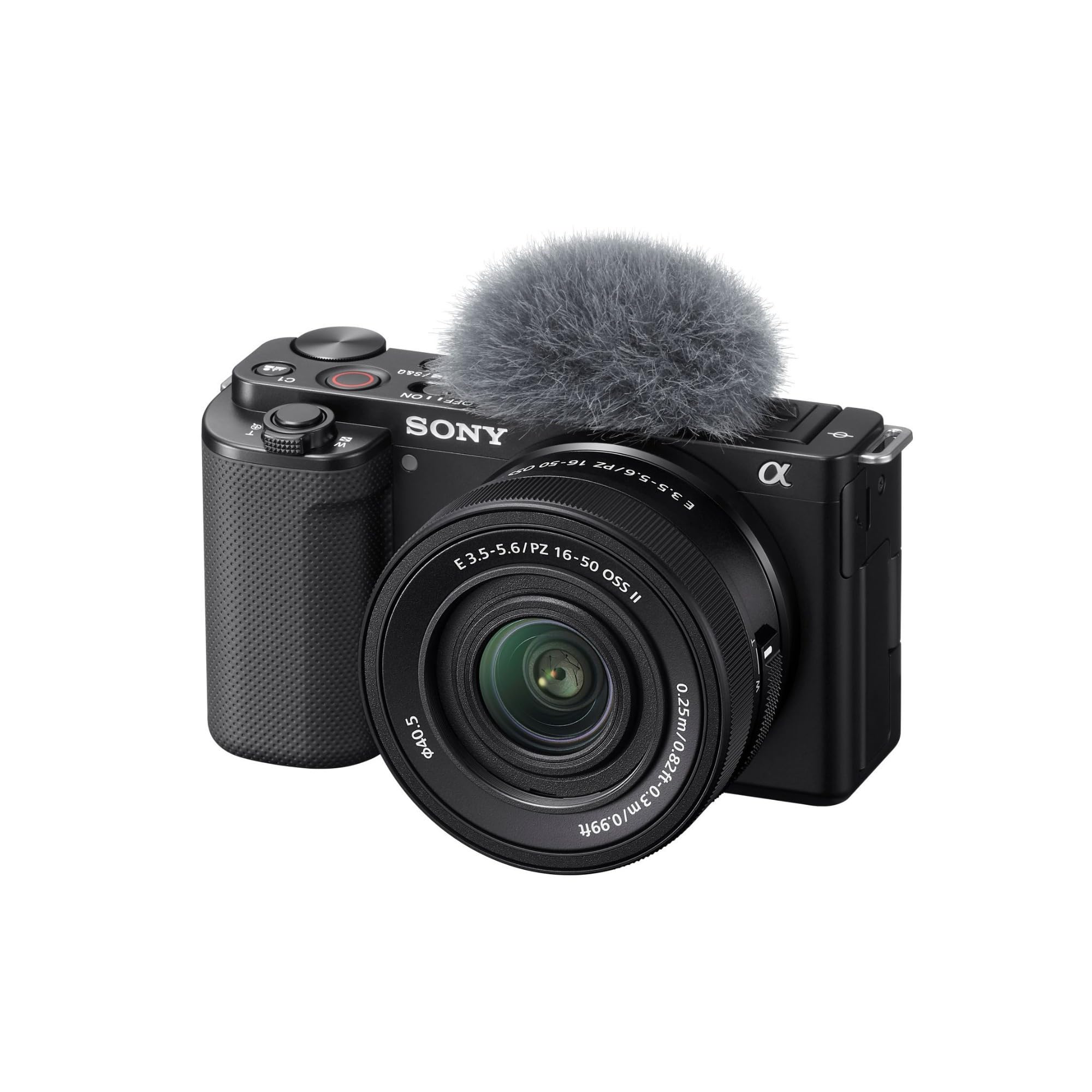
The Sony ZV-E10 is a mirrorless vlog camera built around a 24.2-megapixel APS-C Exmor CMOS sensor and a BIONZ X processor. The 4K footage is oversampled from a 6K readout with full pixel readout and no pixel binning, which results in noticeably sharper detail and better color separation than standard 4K from smaller sensors. The Product Showcase Setting transitions focus from your face to an object instantly, perfect for review or demonstration videos.
The Background Defocus button toggles shallow depth of field on and off with a single press, helping vloggers achieve a professional look without manual aperture adjustments. The camera can live stream via a single USB cable to a computer without any extra hardware or software, and the 425-point phase-detection autofocus system covers nearly the entire frame, locking onto eyes, faces, and animals reliably.
The kit lens (Sony E PZ 16-50mm F3.5-5.6 OSS II) offers optical stabilization but is not exceptionally fast in low light. The body lacks in-body image stabilization, so users relying on handheld shots will want a stabilized lens or a gimbal. The ZV-E10 is a strong entry point into interchangeable-lens 4K video for creators who want APS-C depth of field and professional autofocus.
Why it’s great
- Oversampled 4K from 6K readout for superior sharpness
- Product Showcase and Background Defocus one-button features
- 425-point phase-detect AF for reliable face/eye tracking
Good to know
- No in-body stabilization; requires stabilized lens or gimbal
- Kit lens is serviceable but not ideal for low-light scenarios
5. Canon EOS R100

The Canon EOS R100 is the smallest and lightest body in the EOS R series, pairing a 24.1-megapixel APS-C CMOS sensor with a DIGIC 8 processor. The 4K video recording is capped at 24 fps, which suits cinematic-style clips but not fast-action or smooth panning. The Dual Pixel CMOS AF covers 143 zones with human face and eye detection, making focus reliable for vlogging and casual interviews when using compatible lenses.
The body is highly portable at just over 300g without the lens, and the beginner-friendly GUI with custom quick menus makes it easy to navigate settings. The kit includes an RF-S18-45mm F4.5-6.3 IS STM lens with optical stabilization and a versatile zoom range. Continuous shooting reaches 6.5 fps in One-Shot AF, useful for capturing stills alongside video.
The lack of in-body image stabilization means handheld 4K footage can be shaky without a stabilized lens. The touchscreen is not fully articulating, which limits selfie-style framing. For new users entering the RF mount system who prioritize stills over video, the R100 provides an affordable entry point, but dedicated video shooters will want higher frame rates and more stabilization.
Why it’s great
- Compact and lightweight body for easy travel
- Dual Pixel CMOS AF with face and eye detection
- Excellent image quality for stills at this price point
Good to know
- 4K limited to 24 fps; no 60p option
- No in-body stabilization; no fully articulating screen
6. Panasonic LUMIX FZ80D

The Panasonic LUMIX FZ80D is a bridge camera that packs a 60x optical zoom (20–1200mm equivalent) into a lightweight, travel-friendly body. The 2,360K-dot electronic viewfinder ensures clear framing even in bright sunlight, and the POWER O.I.S. system effectively suppresses hand-shake vibration at the extreme telephoto end. The 4K Photo mode lets you extract 8-megapixel stills from 4K video, a useful feature for capturing fleeting wildlife or sports moments.
The Post Focus feature allows you to select the focal point after the shot is taken, which is surprisingly handy for macro or detail shots where manual focus is tricky. The camera supports 4K video recording with decent daytime quality, and the contrast-detect autofocus with 39 points works quickly in good light. The built-in flash and hotshoe provide flexibility for event photography.
Low-light performance is the FZ80D’s weakest area; images become grainy even at moderate ISO levels, and the small 1/2.3-inch sensor struggles once the sun drops. The user interface is functional but not particularly intuitive, and the camera lacks built-in Wi-Fi for quick file transfers. For outdoor photographers who need extreme reach in a compact form factor, the FZ80D is a capable tool within its bright-light sweet spot.
Why it’s great
- 60x optical zoom provides exceptional reach in a compact body
- POWER O.I.S. keeps telephoto shots usable handheld
- Post Focus and 4K Photo modes add creative flexibility
Good to know
- Small sensor produces grain in low light
- No built-in Wi-Fi; interface can be unintuitive
7. DJI Osmo Pocket 3

The DJI Osmo Pocket 3 is a pocket-sized camera with a 1-inch CMOS sensor that records 4K video at up to 120 fps, delivering smooth slow motion with remarkable detail. Its built-in 3-axis mechanical gimbal provides stabilization that rivals much larger rigs, making walking, running, or panning shots look professionally smooth. The 2-inch rotatable touchscreen switches between horizontal and vertical orientation instantly, ideal for cross-platform content creation.
ActiveTrack 6.0 keeps subjects centered in the frame even during dynamic movement, and the D-Log M color profile with 10-bit depth captures over a billion colors for advanced color grading in post-production. The Creator Combo includes the DJI Mic 2 transmitter, a wide-angle lens, a battery handle, and a mini tripod, making it a ready-to-go vlogging setup. The built-in stereo recording is clear, and the OsmoAudio feature lets you connect directly to two DJI Mic 2 transmitters wirelessly.
The gimbal is mechanically delicate; rough handling or drops can damage the stabilization system, and the small sensor size means it still struggles in very dim conditions compared to larger cameras. The battery handle is necessary for extended shooting sessions. For creators who prioritize portability and stabilization above all else, the Osmo Pocket 3 is the gold standard in its category.
Why it’s great
- 1-inch sensor with 4K/120fps and excellent gimbal stabilization
- D-Log M 10-bit color for serious post-production grading
- Creator Combo includes wireless mic, wide lens, and battery handle
Good to know
- Gimbal is fragile; not designed for rough handling
- Battery handle is needed for all-day shooting sessions
8. Zoom Q8n-4K

The Zoom Q8n-4K is uniquely designed as a video recorder for musicians, podcasters, and live streamers who prioritize audio fidelity. It records 4K video at 30 fps alongside up to four simultaneous audio tracks, including two XLR inputs with phantom power for professional microphones or direct mixing-board feeds. The F2.8 wide-angle lens with 150-degree coverage and five field-of-view presets adapts to indoor, outdoor, nighttime, and concert lighting scenarios.
The interchangeable capsule system allows you to swap the built-in microphone capsule to match the recording environment—from stereo condenser mics to shotgun capsules. The USB streaming mode lets you use the Q8n-4K as a webcam for live streaming while recording locally to an SD card. The flip-out screen and Bluetooth remote control app make solo recording easier, and the battery life is exceptional for continuous recording.
The video quality is the Q8n-4K’s primary trade-off; it is noticeably grainy in low light, and true 4K resolution is only available at the widest field of view. There is no zoom function—only preset field-widths—and the sensor’s performance in dimly lit venues requires professional lighting to match the audio quality. For users whose workflow starts and ends with high-quality audio accompanied by serviceable video, the Q8n-4K is a purpose-built tool.
Why it’s great
- Two XLR inputs with phantom power for professional audio capture
- Interchangeable microphone capsules adapt to recording scenarios
- 4-track simultaneous recording for multi-source productions
Good to know
- Video quality is grainy in low light; requires strong lighting
- No optical zoom; only preset field-of-view widths
9. Xtra Muse

The Xtra Muse is a budget-friendly pocket camera that pairs a 1-inch CMOS sensor with a 3-axis gimbal stabilizer, capturing 4K video at up to 120 fps. The stabilization system effectively removes shake during walking, running, or hiking, closing the gap to the DJI Osmo Pocket 3 at a lower entry point. The 2-inch touchscreen is responsive and rotates for both horizontal and vertical framing, making it practical for social media content creators.
Face and object tracking keep the subject centered during movement, and the fast autofocus locks on quickly in most lighting conditions. The 10-bit X-Log color profile records over a billion colors and provides a flat log profile for advanced color grading. The battery lasts approximately 161 minutes, and the USB-C PD charging allows quick top-ups. The included carrying bag, wrist strap, and threaded handle cover the basics for mobile shooting.
DJI Microphone 2 transmitters do not auto-connect via Bluetooth—a recent firmware update addresses some compatibility, but it is not as seamless as the native DJI ecosystem. The image quality in very low light shows noise above ISO 1600, and the stabilization can struggle during abrupt whip pans. For budget-conscious vloggers who want a 1-inch sensor and built-in gimbal, the Xtra Muse delivers surprising capability.
Why it’s great
- 1-inch CMOS and 3-axis gimbal for smooth, detailed 4K
- 10-bit X-Log color for professional grading flexibility
- Long battery life with USB-C fast charging
Good to know
- DJI Mic pairing is not seamless; may need firmware tweaks
- Low-light performance noisy above ISO 1600
10. TONGVEO PTZ System
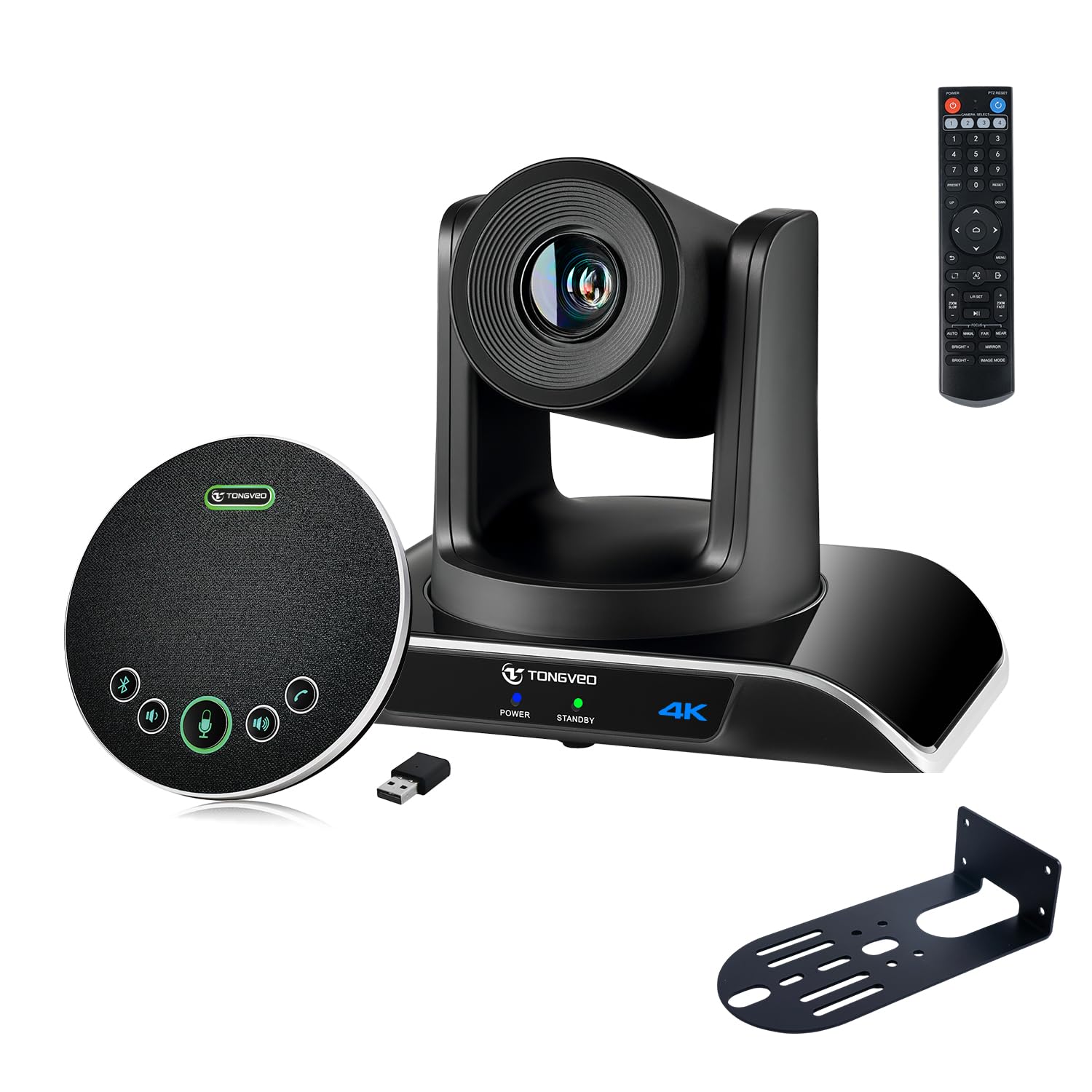
The TONGVEO 4K PTZ Conference Room Camera System is an all-in-one solution that combines a 20x zoom PTZ camera with a Bluetooth speakerphone. The camera delivers 4K/30fps via its 1/2.8-inch CMOS sensor and supports HDMI, USB 3.0, and LAN outputs for flexible connectivity. The AI auto-tracking uses humanoid and face recognition to lock onto and follow speakers as they move, making it ideal for large meeting rooms, lecture halls, and church services.
The speakerphone features four microphone arrays with a 5-meter pickup range and full-duplex audio, allowing natural conversation without clipping. It connects via USB, Bluetooth 5.0, or a wireless dongle, and includes a 2400mAh battery for 6–8 hours of continuous use. The camera supports POE, RTSP, and RTMP for professional streaming, and it is compatible with Zoom, Teams, OBS, WebEx, and other major platforms.
The speakerphone audio quality is sufficient for small to medium rooms but can distort at high volume in larger spaces. AI tracking works well when a single speaker is in frame, but multiple moving subjects can confuse it momentarily. For organizations seeking a turnkey PTZ system with integrated audio, the TONGVEO provides strong value compared to separate components.
Why it’s great
- 20x optical zoom with AI auto-tracking for solo speakers
- All-in-one kit includes PTZ camera and Bluetooth speakerphone
- Supports POE, RTSP, and RTMP for flexible streaming setups
Good to know
- Speakerphone can distort at high volume in larger rooms
- AI tracking may struggle with multiple moving subjects in frame
11. Acuvar 6K Camcorder

The Acuvar camcorder is an entry-level kit that includes the camera body, twin 64GB SD cards, a 50-inch tripod, external LED fill light, shotgun microphone, dual chargers, and a carrying case. It claims to capture 6K video and 64MP stills, with 18x digital zoom. The built-in Wi-Fi connects to the “XDV PRO” app for remote control and file transfer, and the webcam mode allows live streaming directly via USB.
The kit emphasizes value for beginners who need everything in one box—the included accessories eliminate the need for separate purchases. The 4500mAh battery supports up to three hours of recording, and the camera can record while charging. The external microphone improves audio clarity compared to the built-in mic, and the LED fill light helps in dimmer environments.
Multiple user reports indicate that the actual video resolution, particularly at maximum digital zoom, falls short of 4K standards and resembles lower-resolution footage. The autofocus is inconsistent, and the claimed 6K recording is not substantiated by the sensor specifications. For absolute beginners who want a complete accessory bundle at the lowest possible entry cost, the Acuvar kit provides a starting point, but expectations should be managed regarding image quality.
Why it’s great
- Comprehensive bundle includes tripod, mic, lights, and extra batteries
- Long 3-hour battery life with recording-while-charging support
- Webcam mode and Wi-Fi app control for streaming and remote shooting
Good to know
- Video resolution does not meet true 4K standards in practice
- Autofocus is slow and inconsistent in many shooting scenarios
FAQ
Is 4K at 24 fps good enough for professional work?
Do I need a camera with XLR audio inputs?
What does oversampled 4K mean and why should I care?
Can I use any 4K camera as a webcam for live streaming?
How important is bit depth for 4K color grading?
Final Thoughts: The Verdict
For most users, the best 4k video camera is the Panasonic HC-X20 because its 1-inch sensor, 20x optical zoom, dual XLR inputs, and professional streaming support cover the widest range of serious production needs. If you want pocket-sized portability with gimbal-stabilized 4K, grab the DJI Osmo Pocket 3. And for untethered event or wildlife stills and video with extreme reach, nothing beats the Panasonic LUMIX FZ80D.