
Our readers keep the lights on and the weekend projects moving. As an Amazon Associate, I earn from qualifying purchases.
Expanding your storage with a 4TB NVMe drive isn’t just about adding space—it’s about eliminating the constant shuffle of deleting games to make room for new ones, or waiting for massive project files to transfer. A single 4TB drive can hold your entire current-gen game library, your 8K video projects, and your OS boot drive all in one slot, offering a convenience that multiple smaller drives simply can’t match.
I’m Rikta — the co-founder and writer behind FitlyFast. I’ve sifted through the dense performance data and real-user feedback on the current 4TB NVMe landscape to identify which drives deliver on their promised speeds and which compromises you should know about before buying.
After analyzing over a dozen models across both PCIe Gen4 and Gen5 interfaces, I’ve built this guide to help you cut through the marketing claims and find the best 4tb nvme for your specific workflow, whether you’re a gamer, a video editor, or a data hoarder.
How To Choose The Best 4TB NVMe
Choosing a 4TB NVMe means balancing raw sequential speed against sustained write performance, thermal design, and endurance. The wrong pick could leave you with a drive that throttles mid-transfer or fails to keep up with your creative pipeline.
Interface Generation: Gen4 vs Gen5
PCIe Gen5 drives offer sequential reads above 12,000 MB/s, nearly doubling Gen4’s 7,000 MB/s ceiling. This matters most for video editors moving huge RAW files or data scientists processing large datasets. For pure gaming, the load-time difference between a high-end Gen4 and a Gen5 drive is often under a second, making the Gen4 a smarter value if budget is a concern.
DRAM and Cache Architecture
DRAM on an NVMe acts as a high-speed address map, reducing latency for random read/write operations. Drives like the Samsung 990 EVO Plus use Host Memory Buffer (HMB) technology to borrow system RAM, which works well for most users but can cause performance dips in sustained heavy workloads. Drives with a dedicated DRAM cache maintain consistent speeds during large file transfers.
Thermal Management
Gen5 drives generate significant heat under load and absolutely require an aftermarket heatsink—many don’t include one in the box. Gen4 drives typically run cooler and can operate effectively with a motherboard’s built-in M.2 shield. Always check if the drive includes a graphene label, a copper foil layer, or a full heatsink solution before you buy.
Endurance and Warranty
Endurance is measured in Total Bytes Written (TBW). A 4TB drive with a 2,400 TBW rating is rated for about 1.3GB of writes every day for five years. If you’re doing constant video rendering or database work, aim for a drive with at least 1,800 TBW. Most premium models offer a 5-year warranty, which should give you confidence in your investment.
Quick Comparison
On smaller screens, swipe sideways to see the full table.
| Model | Category | Best For | Key Spec | Amazon |
|---|---|---|---|---|
| Crucial T710 4TB | Gen5 | Creative Workloads | 14,900 MB/s Read | Amazon |
| WD_Black SN8100 4TB | Gen5 | AI & High-Speed Tasks | 14,900 MB/s Read | Amazon |
| Corsair MP700 PRO 4TB | Gen5 | Raw Gen5 Speed | 12,400 MB/s Read | Amazon |
| Samsung 990 EVO Plus 4TB | Gen4/5 | Reliable Daily Driver | 7,250 MB/s Read | Amazon |
| Sabrent Rocket 4 4TB | Gen4 | PS5 Expansion | 7,450 MB/s Read | Amazon |
| Teamgroup MP44 4TB | Gen4 | Mid-Range Value | 7,000 MB/s Read | Amazon |
| Fanxiang S880E 4TB | Gen4 | Budget Gaming | 7,000 MB/s Read | Amazon |
| Kingston NV3 4TB | Gen4 | Secondary Storage | 6,000 MB/s Read | Amazon |
| Fikwot FX660 4TB | Gen4 | Entry-Level Upgrade | 5,000 MB/s Read | Amazon |
In‑Depth Reviews
1. Crucial T710 4TB

The Crucial T710 is a Gen5 powerhouse delivering sequential read speeds up to 14,900 MB/s and writes up to 13,800 MB/s using Micron’s G9 TLC NAND. In real-world testing with sustained mixed workloads exceeding 600,000 files, one user reported cutting a data pipeline runtime from roughly an hour to just 28 minutes—a testament to its non-throttling performance under pressure.
This drive is optimized for Intel 13th/14th Gen and AMD Ryzen 7000 platforms, and it includes a one-month Adobe Creative Cloud subscription plus Acronis True Image for easy migration. The AES-256-bit hardware encryption with TCG Opal 2.01 support is a welcome security layer for professionals handling sensitive data.
Keep in mind that the T710 requires a compatible Gen5 slot and an aftermarket heatsink—neither is included in the box. While backward compatible with Gen4 slots, you’ll only get Gen4 speeds. The 2,400 TBW endurance rating is solid for a 4TB drive, but if you need even higher write endurance for constant rendering, check the WD_Black SN8100 below.
Why it’s great
- Blazing 14,900 MB/s read speed
- Sustained performance without throttling
- AES-256 encryption with TCG Opal support
Good to know
- Requires separate Gen5 heatsink
- Premium pricing for Gen5 tier
2. WD_Black SN8100 4TB
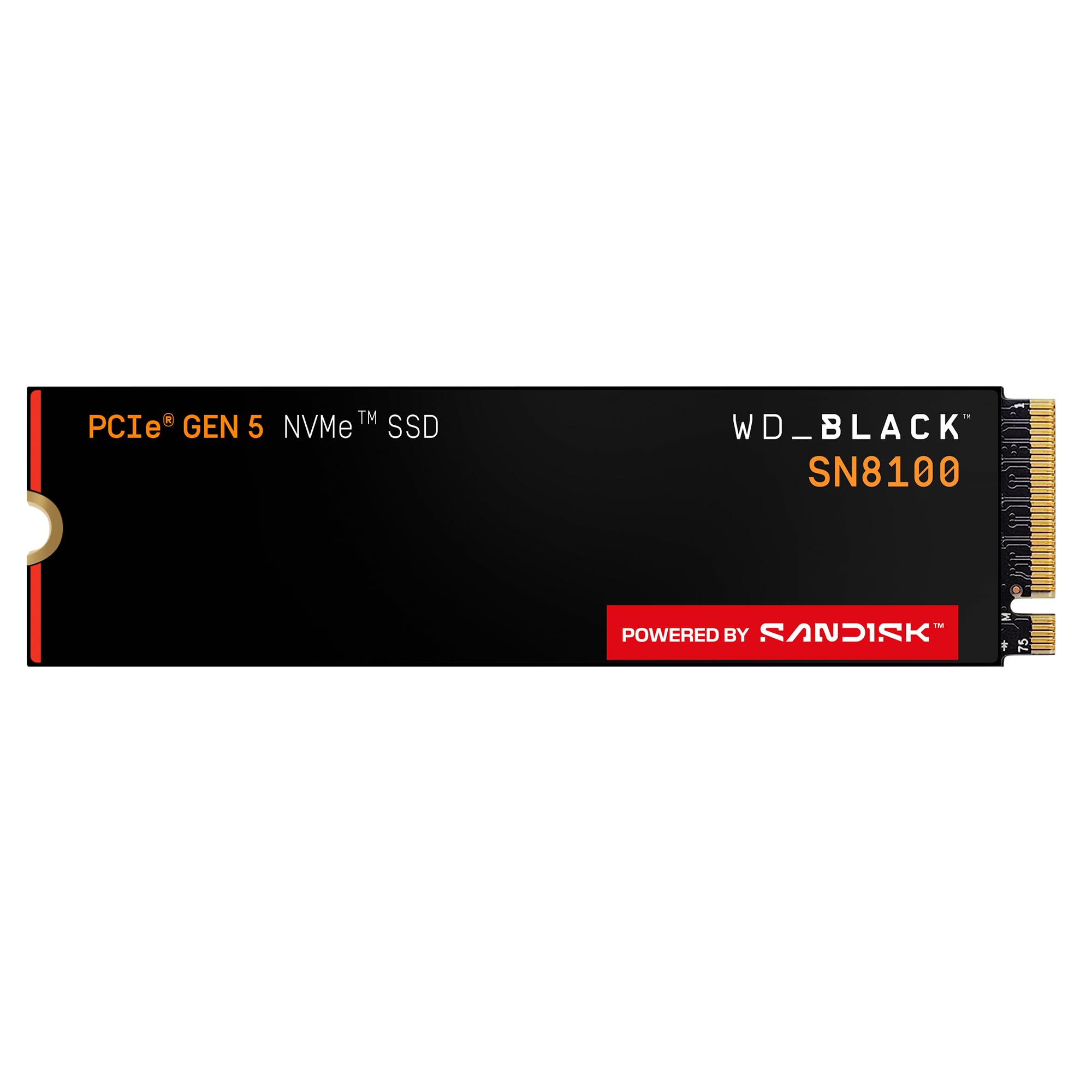
The WD_Black SN8100 matches the Crucial T710’s 14,900 MB/s read ceiling but pushes write speeds even higher at 14,000 MB/s for the 4TB model, making it the current speed leader in the 4TB NVMe segment. It leverages Western Digital’s latest TLC 3D CBA NAND and delivers over 2,300,000 random IOPS, which translates to near-instantaneous responsiveness in demanding multitasking scenarios.
Power efficiency is a standout feature—WD claims over 100% more efficiency than their previous Gen4 drive, averaging under 7.5W during operation. Users report that in a Gen5 gaming build with a Ryzen 9 7950X, the SN8100 achieves around 10,500 MB/s in real-world writes and thermals staying cool at roughly 82°F under load, which is excellent for a Gen5 drive.
The drive comes with the Sandisk Dashboard for monitoring health and firmware updates, plus Acronis True Image for data migration. It’s a pure Gen5 drive designed for desktop PCs—laptop compatibility is possible but depends on your system’s thermal headroom. The price reflects its position as a top-tier performer, but for users who live in 8K video or AI model training, the investment is justified.
Why it’s great
- Highest write speed at 14,000 MB/s
- Excellent power efficiency for Gen5
- Low operating temperatures
Good to know
- Premium price point
- Requires Gen5 motherboard for full speed
3. Corsair MP700 PRO 4TB

The Corsair MP700 PRO offers a different Gen5 proposition with 12,400 MB/s sequential reads and 11,800 MB/s writes, powered by the NVMe 2.0 interface. Users report excellent benchmark scores on Ryzen 9 platforms, with the drive running cool even after months of daily use—a pleasant surprise for a Gen5 drive that doesn’t include a heatsink in the box.
Built with high-density 3D TLC NAND, the MP700 PRO is designed for gamers and creators who want Gen5 speed without paying the absolute top-tier premium. The drive supports Microsoft DirectStorage for compatible games, allowing the GPU to talk directly to the SSD for blistering asset loading. It’s backward compatible with Gen4 slots, making it a future-proof option if you plan to upgrade your motherboard later.
The only notable drawback is the software—Corsair’s SSD Toolbox has been described as bare-bones and outdated compared to Samsung’s Magician or the Sandisk Dashboard. You’ll also need to budget for a quality aftermarket heatsink, as the drive doesn’t include one and Gen5 heat output demands proper cooling to maintain peak speeds.
Why it’s great
- Fast 12,400 MB/s Gen5 speed
- DirectStorage ready
- Runs cool with proper heatsink
Good to know
- No included heatsink
- Software interface is outdated
4. Samsung 990 EVO Plus 4TB

The Samsung 990 EVO Plus bridges the Gen4 and Gen5 worlds, supporting both PCIe 4.0 x4 and PCIe 5.0 x2 interfaces for broader compatibility. With sequential reads up to 7,250 MB/s and writes up to 6,300 MB/s, it’s not the fastest Gen5 drive, but its Intelligent TurboWrite 2.0 and HMB technology ensure snappy performance for daily tasks like booting Windows in about 8 seconds or loading Cyberpunk 2077 in roughly 9 seconds.
Samsung’s reputation for reliability is backed by the Magician software, which provides easy firmware updates, drive health monitoring, and encryption management. The nickel-coated controller improves thermal efficiency, and users consistently report low operating temperatures even without an aftermarket heatsink—the motherboard’s built-in M.2 shield is usually sufficient.
This drive is DRAM-less, relying on HMB to borrow system memory for cache management. For most gamers and general users, this is invisible, but if you frequently move huge files (100GB+) in sustained sequential writes, you’ll notice a dip after the SLC cache fills. The price is in the upper mid-range, reflecting the Samsung brand tax, but the long-term reliability and software ecosystem are hard to beat.
Why it’s great
- Excellent software with Magician
- Runs cool without extra heatsink
- Dual Gen4/5 compatibility
Good to know
- DRAM-less design (HMB)
- Premium price for Gen4 speeds
5. Sabrent Rocket 4 4TB

The Sabrent Rocket 4 delivers competitive Gen4 speeds of 7,450 MB/s read and 6,400 MB/s write, with a slim single-sided M.2 2280 design that fits perfectly in PS5 console slots and slim laptops without clearance issues. Users report that it runs slightly cooler than competing Gen4 drives, often requiring no extra heatsink beyond what the motherboard or PS5 bay provides.
With up to 1,000K/950K random IOPS, the Rocket 4 handles heavy multitasking workloads admirably. Sabrent’s reputation for reliability is reinforced by users deploying it as a read cache in NAS units, where the high TBW rating offers peace of mind for continuous operation. Compatibility extends across Windows, macOS, and Linux, making it a flexible choice for multi-platform users.
The one caveat is that the 64MB DRAM cache is relatively small for a 4TB drive—larger than DRAM-less designs but smaller than what some competitors offer. This means sustained large-file transfers may slow down after extended writes. It’s also a Gen4 drive, so if you’re building a high-end workstation with a Gen5 slot, you’re leaving performance on the table.
Why it’s great
- Single-sided for PS5 and slim laptops
- Runs cooler than many Gen4 drives
- Broad OS compatibility
Good to know
- Small 64MB DRAM cache
- Gen4 only—no Gen5 future-proofing
6. Teamgroup MP44 4TB

The Teamgroup MP44 strikes a strong balance between price and performance, offering Gen4 speeds up to 7,000 MB/s read and 6,000 MB/s write with an SLC cache for improved sustained performance. Buyers who upgraded from a 1TB drive report being pleasantly surprised by the speed and reliability, calling it a great value proposition in the mid-range segment.
A graphene heat dissipation label is applied to the NAND flash, which works well with a motherboard heatsink to keep temperatures in check. Teamgroup uses recyclable packaging, a nice touch for environmentally conscious builders. The MP44 is suitable for desktops and laptops, and users have deployed them in high-performance servers with no issues.
Performance is not top-tier—you won’t match the Samsung 990 Pro’s random IOPS or the FireCuda 530’s endurance ratings—but for the price, the real-world difference in gaming loads and boot times is negligible for most users. If you’re building a mid-range gaming rig or a content creation workstation on a budget, this is a solid pick.
Why it’s great
- Strong price-to-performance ratio
- Graphene label aids heat dissipation
- Recyclable packaging
Good to know
- Not top-tier random IOPS
- SLC cache can fill under sustained write
7. Fanxiang S880E 4TB

The Fanxiang S880E delivers Gen4 speeds up to 7,000 MB/s read and 6,000 MB/s write, making it a strong contender for gamers expanding PS5 storage or building a secondary gaming drive. Users report that it runs smoothly in PS5 consoles, with ample space for a full game library and simple tool-less installation.
Thermal management uses a graphite-coated copper foil layer and an aluminum foil layer on the label, which helps maintain performance under sustained gaming loads. The drive is built with 3D NAND flash from a manufacturer with over 20 years of experience, backed by a 5-year service commitment. In a PCIe 3.0 slot, users still see around 3,000 MB/s sequential throughput—still a massive upgrade over SATA SSDs.
The main downside is that the drive is not compatible with macOS, which limits its use to Windows and PlayStation ecosystems. Some users also noted that while speeds are fast, the sustained write performance after the SLC cache fills is lower than premium DRAM-equipped drives. As a budget-conscious option for pure gaming, it’s hard to beat.
Why it’s great
- Fast Gen4 speeds at a lower price
- Effective thermal control layer
- Solid PS5 compatibility
Good to know
- Not compatible with macOS
- Sustained writes slower after cache fills
8. Kingston NV3 4TB

The Kingston NV3 is a no-frills Gen4 drive offering sequential read speeds up to 6,000 MB/s, designed for users who want a reliable capacity upgrade without paying for peak performance. It uses 3D NAND and a PCIe 4.0 x4 interface, delivering a noticeable speed bump over SATA SSDs—boot times drop dramatically, and game loading becomes near-instant.
Power efficiency is a strong point, making it a good candidate for laptops where battery life matters. Users report it runs cool even under moderate load, and the drive’s shock resistance adds durability for portable builds. The NV3 is best suited as a secondary storage drive for games and media rather than an OS boot drive where sustained random write performance matters more.
The main limitation is that the NV3 is a DRAM-less design using HMB, and performance can slow significantly after 5-10 minutes of continuous heavy writes. It’s also a pure Gen4 drive, so if you have a Gen5 slot, you’re not maximizing your motherboard’s potential. For a simple, reliable storage expansion, it gets the job done without fuss.
Why it’s great
- Reliable, low-power operation
- Great for laptop upgrades
- Shock resistant
Good to know
- DRAM-less (HMB) can throttle
- Slower sustained write speeds
9. Fikwot FX660 4TB

The Fikwot FX660 is an entry-level Gen4 drive with read speeds up to 5,000 MB/s and writes up to 4,500 MB/s, using dynamic SLC cache to boost performance. It’s compatible with desktop PCs, laptops, and PS5, and comes with instructions, screws, and a screwdriver for hassle-free installation.
The drive features a graphene heat dissipation sticker to help manage temperatures, and Fikwot includes two intelligent management systems: Auto-Adaptive Temperature Regulation and Power Efficiency Management, which help control power draw and heat output. Users have deployed it successfully in PS5 consoles and as secondary gaming storage, noting it stores large game libraries with room to spare.
The 5,000 MB/s read speed is significantly lower than the 7,000 MB/s drives in the mid-range, meaning large file transfers will take noticeably longer. A user also reported a port incompatibility issue due to a Key E M.2 slot on their motherboard—always double-check your motherboard’s M.2 slot key type before purchase.
Why it’s great
- Lowest price point in the 4TB market
- Includes mounting hardware
- PS5 compatible
Good to know
- Only 5,000 MB/s read speed
- Check motherboard M.2 key type
FAQ
Will a Gen5 NVMe work in a Gen4 slot?
Is 4TB overkill for a gaming PC?
What does DRAM-less mean and should I avoid it?
Do I need a heatsink for a 4TB NVMe?
Can I use a 4TB NVMe in a PS5?
Final Thoughts: The Verdict
For most users, the best 4tb nvme winner is the Crucial T710 because it delivers top-tier Gen5 sequential speeds, sustained performance without throttling, and includes useful extras like Adobe CC and Acronis software—making it the most complete package for creators who need raw speed every day. If you want the absolute highest write speeds and best power efficiency for professional workloads, grab the WD_Black SN8100. And for a pure gaming PC or PS5 expansion at a sensible price, nothing beats the Sabrent Rocket 4 with its single-sided design and reliable Gen4 performance.