
Our readers keep the lights on and the weekend projects moving. As an Amazon Associate, I earn from qualifying purchases.
Adding a terabyte of storage is routine. Adding four requires a strategy because a single 4TB drive is your entire primary bulk-storage layer, game vault, or video-production scratch disk — it needs the right speed interface and endurance rating or it becomes a critical bottleneck.
I’m Rikta — the co-founder and writer behind FitlyFast. I’ve spent the last 15 years analyzing SSD controller generations, NAND flash types, and real-world thermal throttling data to separate marketing speeds from sustained throughput that actually matters for multi-terabyte workloads.
This guide converts the most searched 4tb ssd options — from budget-friendly SATA upgrades to bleeding-edge PCIe Gen 5 drives — into a clear performance and reliability hierarchy so you can buy exactly what your system can actually utilize.
How To Choose The Best 4TB SSD
Buying a 4TB SSD is not the same as buying a 1TB model. The higher density puts more stress on the controller, NAND endurance, and thermal solution. These three factors determine whether your drive stays fast for years or becomes a sluggish heat trap.
Match the Interface Generation to Your Motherboard
A PCIe Gen 5 drive reaching 14,000 MB/s will run at Gen 4 speeds in a Gen 4 slot — wasting half its cost premium. Check your motherboard’s M.2 slot specifications and CPU lane support before buying. SATA remains the safe universal fallback for older systems, but caps out around 560 MB/s.
Prioritize TLC NAND and High TBW at 4TB
Quad-level cell (QLC) NAND packs more capacity per die, lowering cost, but it writes slower and wears out faster than triple-level cell (TLC) NAND. For a 4TB drive expected to hold games, video projects, or a system image, look for TLC and a TBW rating above 2,000 to ensure endurance for years of daily writes.
Don’t Overlook Physical Form Factor and Cooling
M.2 2280 NVMe drives run hot — especially in PCIe 4.0/5.0 and especially at 4TB capacity where multiple NAND packages are packed tightly. If your motherboard doesn’t have a M.2 heatsink, budget for an aftermarket one. For external portable drives, aluminum enclosures wick heat away better than plastic shells.
Quick Comparison
On smaller screens, swipe sideways to see the full table.
| Model | Category | Best For | Key Spec | Amazon |
|---|---|---|---|---|
| Samsung T7 Portable | External | Mobile backups & travel | 1,050 MB/s USB 3.2 Gen 2 | Amazon |
| WD_Black SN8100 | Gen 5 NVMe | Pro video & AI workloads | 14,900 MB/s read, TLC | Amazon |
| Fanxiang S880E | Gen 4 NVMe | PS5 & gaming PC | 7,000 MB/s read, 5-yr warranty | Amazon |
| Silicon Power US75 | Gen 4 NVMe | High-speed value | 7,000/6,500 MB/s, 2400 TBW | Amazon |
| TEAMGROUP MP44Q | Gen 4 NVMe | QLC budget bulk storage | 7,000/5,900 MB/s, QLC | Amazon |
| Kingston NV3 | Gen 4 NVMe | Reliable daily driver | 6,000 MB/s read, 3D NAND | Amazon |
| SABRENT Rocket Nano V2 | External | Rugged field recording | 1,500 MB/s, aluminum + silicone | Amazon |
| Fikwot FX660 | Gen 4 NVMe | PS5 game storage | 5,000 MB/s read, SLC cache | Amazon |
| Crucial BX500 | SATA III | Legacy laptop upgrades | 540 MB/s, Micron 3D NAND | Amazon |
In‑Depth Reviews
1. Samsung T7 Portable SSD

The Samsung T7 delivers the widest compatibility across PCs, Macs, phones, tablets, and game consoles thanks to its USB 3.2 Gen 2 interface and inclusion of both USB-C and USB-A cables. Real-world sequential read speeds hover around 1,050 MB/s — nearly double its predecessor T5 — and the solid aluminum unibody dissipates heat effectively, keeping drive temps around 42°C even during sustained transfers of 50 GB datasets.
At 4TB capacity, the T7 handles raw 4K 60fps video recording from a camera or iPhone 15 Pro directly onto the drive, making it a portable production hub. The drive ships formatted as FAT32/MBR; reformatting to exFAT or NTFS is straightforward for Windows or macOS use. The 6-foot drop resistance adds real field durability.
The only compromise is the short 1.5-foot USB-C cable and the absence of an IP water-resistance rating. Still, for a 4TB portable drive that balances speed, build quality, and platform support, the T7 is the reference standard.
Why it’s great
- True 1,050 MB/s sustained read speeds for video professionals
- Premium aluminum unibody acts as an efficient heat sink
- Shock resistant up to 6-foot drop with 3-year warranty
- Works natively with PC, Mac, Android, iPad, Xbox, PS5
Good to know
- Included USB-C cable is only 1.5 feet long
- Shipped in FAT32; must reformat to NTFS or APFS for modern OS
2. WD_Black SN8100 4TB NVMe SSD
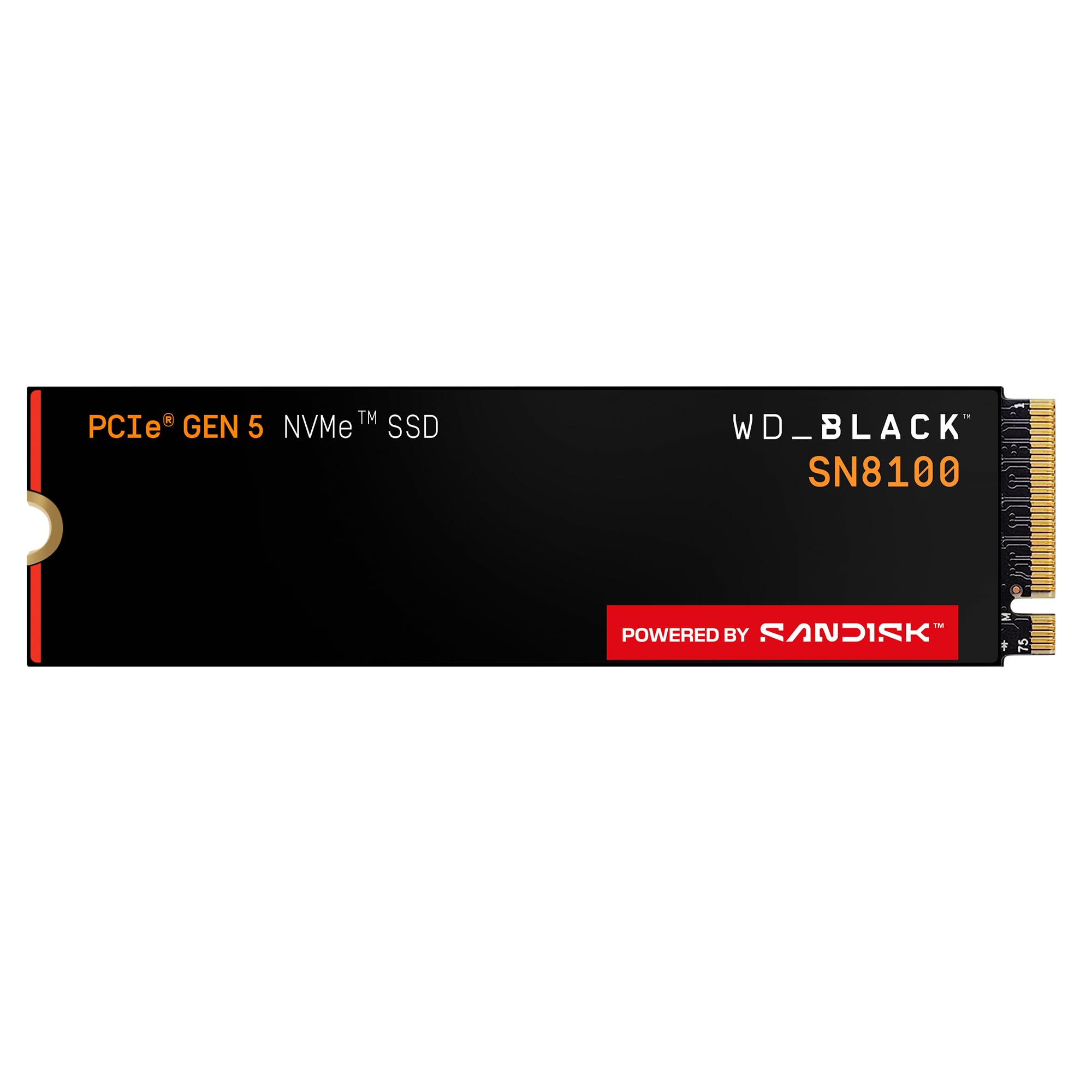
The WD_Black SN8100 is a PCIe Gen 5 drive that pushes sequential reads past 14,900 MB/s and writes up to 11,000 MB/s on the 4TB model — roughly double the throughput of top Gen 4 drives. It uses TLC 3D CBA NAND with an endurance rating of 4,800 TBW on the 8TB version, and the 4TB model still delivers over 2,300,000 random IOPS, eliminating microstutter in demanding games and video timelines.
Power efficiency is a standout: average operating power stays under 7.5W while delivering over 100% more performance-per-watt than the previous Gen 4 SN850X. In real-world use, reviewers observed thermals around 82°F when paired with a dedicated motherboard heatsink, and CrystalDiskMark benchmarks confirmed read speeds exceeding 14,000 MB/s on a Gen 5 platform.
The main consideration is platform dependency — this drive requires a motherboard with a PCIe 5.0 M.2 slot to unlock full speeds. It also generates noticeable heat without a heatsink, and the price premium is significant. But for users building a high-end workstation for AI model training, 8K video editing, or high-IOPS gaming, the SN8100 is currently the fastest 4TB drive available.
Why it’s great
- Industry-leading 14,900 MB/s sequential read speed
- TLC NAND with very high TBW endurance rating
- Excellent power efficiency for PCIe Gen 5
- Eliminates stutter in games and large video projects
Good to know
- Requires PCIe Gen 5 motherboard slot to reach full speed
- Heatsink not included; must be paired with an aftermarket or mobo heatsink
3. Fanxiang S880E 4TB NVMe SSD

The Fanxiang S880E hits 7,000 MB/s sequential reads and 6,000 MB/s writes, putting it in the top echelon of PCIe Gen 4 drives while targeting PS5 storage expansion directly. It supports NVMe 2.0 and DirectStorage, which translates to noticeably faster load times and smoother asset streaming in supported titles. Users report stable performance in a Ugreen NAS environment as well, copying 100 GB via rsync in one-fifth the time of older SATA SSDs.
Thermal management uses a graphite-coated copper foil and aluminum foil sticker layer that keeps temperatures under control during heavy gaming sessions. The 5-year warranty adds confidence despite the lower price point compared to Samsung or WD drives. Reviewers also confirmed that cloning existing drives using DiskGenius went smoothly, making migration simple.
The enclosure is plastic rather than metal, which may raise durability concerns for some users. Additionally, the drive is not compatible with macOS, so it is strictly a Windows or PS5 component. However, for a 4TB Gen 4 SSD that costs noticeably less than premium competition, the S880E delivers exceptional value for gamers and NAS builders.
Why it’s great
- Full 7,000 MB/s sequential read meets PS5 specification
- Graphite-coated copper foil sticker improves sustained thermal performance
- 5-year after-sales service and lifetime technical support
- Seamless cloning and migration via third-party software
Good to know
- Plastic enclosure and sticker-only heatsink; a dedicated M.2 heatsink is recommended
- Not compatible with macOS systems
4. Silicon Power US75 4TB NVMe SSD

The Silicon Power US75 delivers rated sequential reads of 7,000 MB/s and writes of 6,500 MB/s, making it a cost-effective Gen 4 workhorse. With a TBW endurance rating of 2,400 for the 4TB model, it offers strong long-term write durability that rivals more expensive drives. Users running it in Proxmox servers and gaming PCs report consistent real-world performance matching the spec sheet.
The drive uses an NVMe 1.4 controller that supports lower latency and power consumption, though it lacks a DRAM cache and relies on Host Memory Buffer (HMB) instead. For gaming and most professional workloads, HMB is indistinguishable from DRAM, but users performing massive sequential writes may notice a minor drop-off after the SLC cache fills. The 5-year limited warranty is tied to the TBW threshold, which is standard in the industry.
The most notable omission is the lack of an included heatsink. For PS5 installation or sustained heavy workloads, a third-party heatsink is necessary to avoid thermal throttling. Even with that added cost, the US75 remains one of the best price-to-performance ratios in the 4TB Gen 4 space.
Why it’s great
- Excellent 2,400 TBW endurance for a 4TB Gen 4 drive
- Matches 7,000/6,500 MB/s rated speeds in real-world testing
- 5-year limited warranty adds long-term peace of mind
- Great price-to-performance for gaming and server use
Good to know
- No DRAM cache; uses Host Memory Buffer
- No heatsink included; required for PS5 or high-load scenarios
5. TEAMGROUP MP44Q 4TB NVMe SSD

The TEAMGROUP MP44Q uses 3D QLC NAND to achieve a low cost per gigabyte while still advertising PCIe Gen 4 sequential speeds up to 7,000 MB/s read and 5,900 MB/s write. This makes it a strong candidate for bulk game libraries and large media archives where write endurance is less critical. The graphene heat dissipation label helps maintain performance without a bulky heatsink.
Users who installed multiple MP44Q drives in ZFS storage pools reported zero errors at initialization, and the drive performed snappily even when downclocked to PCIe Gen 3 on older motherboards. The SLC cache keeps burst writes fast, though sustained writes will eventually drop to native QLC speeds. For most gamers and content consumers, this drop is unnoticeable during daily use.
The primary trade-off is QLC endurance: typical TBW for a 4TB QLC drive is lower than TLC equivalents, so it is less suited for write-heavy workloads like video editing scratch disks or surveillance recording. However, the 5-year warranty and the price point make the MP44Q an intelligent option for budget-conscious users who prioritize capacity over sustained write speed.
Why it’s great
- Lowest cost per gigabyte among Gen 4 4TB drives
- Graphene heat label reduces thermal throttling risk
- Works well for game libraries and media storage
- All 10 units in a ZFS pool arrived fully functional
Good to know
- QLC NAND has lower endurance than TLC; not for heavy daily writes
- Sustained write speed drops significantly after SLC cache fills
6. Kingston NV3 4TB NVMe SSD

The Kingston NV3 offers a no-drama 4TB NVMe experience with PCIe Gen 4 speeds up to 6,000 MB/s sequential read and a Gen 4×4 interface that works reliably across AMD and Intel platforms. Users report boot times that are effectively instant and data transfers that are dramatically faster than any SATA SSD. The 3D NAND construction keeps power consumption low, making it a suitable upgrade for laptops as well as desktops.
Real-world testing on Gen 4 enabled motherboards shows the NV3 hitting approximately 3 GB/s when the slot is configured correctly in BIOS, though achieving the full 6,000 MB/s requires a PCIe 4.0 CPU and slot. The drive is marketed as an ideal high-speed, low-power storage solution, and users confirm it runs cool and stable even during extended file transfers.
The main caveat is that early user feedback indicates the drive may slow down noticeably after 5–10 minutes of sustained heavy use, possibly due to the SLC cache filling and the controller lacking a DRAM buffer. For typical user workflows — boot drive, application loading, intermittent file transfers — this is rarely an issue, but heavy sustained write workloads may expose this limitation.
Why it’s great
- Balanced performance for daily compute and gaming
- Low power consumption ideal for laptops and low-power builds
- Shock resistant and stable out of the box
- Simple, no-nonsense upgrade for most users
Good to know
- May slow down after sustained continuous writes of 5-10 minutes
- Requires PCIe 4.0 slot and CPU to reach 6,000 MB/s
7. SABRENT Rocket Nano V2 4TB External SSD

The SABRENT Rocket Nano V2 uses a USB 3.2 Gen 2×2 interface to achieve burst transfers exceeding 1,500 MB/s, making it notably faster than standard USB 3.2 Gen 2 external SSDs. The aluminum enclosure is wrapped in a silicone sleeve for shock absorption and grip, and the drive is compact enough to fit in a pocket — roughly half the physical volume of a Samsung T7 while delivering nearly 50% more sequential throughput.
Real-world benchmarks from users show the Nano V2 transferring 22 GB in roughly two minutes from both PC and Samsung S23 Ultra. The drive runs surprisingly cool even under sustained load, with users reporting minimal heat generation thanks to the aluminum heat spreader. The package includes both USB-C to USB-C and USB-C to USB-A cables for cross-platform compatibility.
The primary trade-off is price: the Nano V2 costs slightly more than comparable-capacity USB 3.2 Gen 2 drives. Also, achieving the full 1,500 MB/s requires a host device with USB 3.2 Gen 2×2 support, which is not yet universal on laptops. For users who need maximum external transfer speeds in a rugged, pocketable form factor, however, the Nano V2 justifies its premium.
Why it’s great
- True 1,500 MB/s sustained transfers on Gen 2×2 hosts
- Aluminum + silicone construction withstands field conditions
- Very compact for a 4TB portable; half the size of competitors
- Runs cool during extended 8K video recording sessions
Good to know
- Requires USB 3.2 Gen 2×2 host port for full 1,500 MB/s speed
- Premium pricing compared to standard USB 3.2 Gen 2 drives
8. Fikwot FX660 4TB NVMe SSD

The Fikwot FX660 delivers 5,000 MB/s sequential read and 4,500 MB/s write speeds using PCIe Gen 4×4 and the NVMe 1.4 protocol — sufficient for PS5 storage expansion and most PC gaming loads. It uses dynamic SLC caching to boost burst performance, and the graphene heat dissipation sticker helps manage temperatures without adding bulk. Users have successfully installed it in PS5 consoles with no compatibility issues and plenty of room for large game libraries.
The drive includes two intelligent management systems: Auto-Adaptive Temperature Regulation and Power Efficiency Management, which help reduce SSD heat and extend laptop battery life. The 5-year registration warranty provides solid protection for a product in this price tier. The package also includes a screwdriver and mounting screws, making installation straightforward for first-time M.2 users.
The main shortcoming is the lack of a dedicated heatsink, which means the graphene sticker alone may not prevent thermal throttling during sustained high-IOPS workloads. Some users reported initial confusion about motherboard M.2 key compatibility (Key M vs. Key E), so verifying motherboard slot type before purchase is essential. For PS5 and general PC storage upgrades at a budget-friendly price, the FX660 is a capable performer.
Why it’s great
- 5,000 MB/s read meets PS5 storage expansion requirements
- Dynamic SLC cache provides strong burst write performance
- Includes screwdriver and screws for easy installation
- 5-year registration warranty for long-term assurance
Good to know
- Requires PS5 or motherboard M.2 Key M slot; Key E slots are incompatible
- No dedicated heatsink included; graphene sticker may be insufficient for heavy loads
9. Crucial BX500 4TB SATA SSD

The Crucial BX500 is the go-to upgrade for users with older laptops or desktops limited to SATA III connections. It delivers up to 540 MB/s sequential read — roughly three times faster than a typical mechanical hard drive — and significantly improves system responsiveness. At 4TB capacity, it provides enough room for an entire game library, media collection, or project files on a machine that cannot accept M.2 NVMe drives.
The drive uses Micron 3D NAND and is up to 45 times more energy efficient than a mechanical hard drive, which extends battery life in laptops. Users report boot times under 15 seconds on aging systems, and the 2.5-inch form factor fits most drive bays without adapters. The Crucial 3-year limited warranty backs the product.
The primary limitation is interface bandwidth: SATA III caps out at around 560 MB/s, so the BX500 cannot approach the speeds of even entry-level NVMe drives. Some users also noted that the included Acronis cloning software sometimes fails on 4TB drives and requires a third-party tool like DiskGenius to complete migration. For a budget-friendly, high-capacity drop-in replacement for an HDD, the BX500 remains a reliable choice.
Why it’s great
- Massive 4TB capacity for legacy SATA-only systems
- 540 MB/s reads provide a significant upgrade over HDDs
- Very energy efficient; extends laptop battery life
- Trusted Micron 3D NAND with low failure rates
Good to know
- Capped at SATA III speeds; much slower than any NVMe drive
- Bundled cloning software may fail on 4TB; use DiskGenius instead
FAQ
Can any 4TB NVMe SSD work inside a PlayStation 5?
What does the TBW number mean when buying a 4TB SSD?
Is a 4TB external SSD fast enough for 4K video editing?
Should I buy a SATA or NVMe 4TB SSD for an old laptop?
Why does my 4TB SSD show less than 4TB of usable space?
Final Thoughts: The Verdict
For most users, the best 4tb ssd winner is the Samsung T7 Portable because it combines broad platform compatibility, strong read speeds, and a durable aluminum chassis that handles travel and daily backups. If you want maximum NVMe throughput and own a Gen 5 capable motherboard, grab the WD_Black SN8100. And for a budget-friendly PS5 or bulk game library expansion, nothing beats the value of the Fanxiang S880E.