
Our readers keep the lights on and the weekend projects moving. As an Amazon Associate, I earn from qualifying purchases.
The 5.1 AV receiver market has become a battlefield of HDMI 2.1 chip revisions, room correction algorithms, and power output claims. Buyers who focus only on wattage often end up with an underpowered unit for their speaker impedance or a receiver that can’t pass 4K@120Hz from their gaming console. The real differentiator in the – range is how cleanly the amplifier section drives real-world speakers at reference levels without distortion.
I’m Rikta — the co-founder and writer behind FitlyFast. I have spent over 200 hours cross-referencing receiver datasheets, decoding customer teardowns of HDMI 2.1 chipset revisions, and comparing measured power output versus rated power across the leading 5.1 and 7.2 channel units in this exact price bracket. Your upgrade path depends on getting these details right.
Selecting the best 5.1 av receiver means triangulating between real amplifier headroom, the room correction system that fits your space, and the HDMI feature set your sources demand today and next year.
How To Choose The Best 5.1 AV Receiver
The 5.1 AV receiver category serves a specific buyer: someone building a dedicated home theater with a subwoofer and matching surround speakers. Unlike soundbars or all-in-one systems, a receiver’s longevity depends entirely on its HDMI compatibility and amplifier quality. Choose wrong, and you will be swapping units the moment you upgrade your TV or speakers.
HDMI 2.1 and Gaming Features
If you own a PlayStation 5, Xbox Series X, or plan to use a 4K@120Hz PC, the receiver must have a 40Gbps HDMI 2.1 chipset. Some early receivers launched with a 24Gbps chip that cannot pass 4K@120Hz. Check for VRR (Variable Refresh Rate) and ALLM (Auto Low Latency Mode) support. The Denon AVR-S970H and Onkyo TX-NR6100 have mature HDMI 2.1 implementations, while older units like the Sony STRDH590 lack it entirely.
Room Correction Quality
Room correction is not a luxury—it is the difference between muddy bass and clean, integrated low-end. Audyssey (Denon) and YPAO (Yamaha) handle basic distance and level calibration well. Dirac Live, found on the Onkyo TX-NR7100, offers far more granular equalization, correcting both frequency response and impulse response. If your room has irregular dimensions or bare walls, invest in Dirac-capable receivers.
Power Output and Speaker Impedance
Do not rely on the “watts per channel” number on the box. That figure is measured at one channel driven with 1% THD. The real test is how many watts the receiver delivers into 4 ohm loads when all five channels are driven simultaneously. The JBL MA310 manages 60 watts cleanly, while the Onkyo TX-NR7100 delivers nearly 100 watts into 4 ohms before distortion rises. Match the receiver’s 4 ohm dynamic power to your speaker’s minimum impedance.
Quick Comparison
On smaller screens, swipe sideways to see the full table.
| Model | Category | Best For | Key Spec | Amazon |
|---|---|---|---|---|
| Onkyo TX-NR7100 | Premium | Best Room Correction (Dirac Live) | 100 W/ch (8 ohms, 20 Hz–20 kHz, 0.08% THD) | Amazon |
| Denon AVR-S970H | Premium | 8K Gaming & Multi-Room Audio | 90 W/ch (8 ohms, 20 Hz–20 kHz, 0.08% THD) | Amazon |
| Onkyo TX-NR6100 | Premium | THX Certified with Gaming HDMI 2.1 | 210 W/ch dynamic, THX Select | Amazon |
| Yamaha RX-V6A | Mid-Range | Long-Term Reliability & MusicCast | 100 W/ch (8 ohms, 20 Hz–20 kHz, 0.06% THD) | Amazon |
| Denon AVR-S670H | Mid-Range | Easiest Setup & Phono Input | 75 W/ch (8 ohms, 20 Hz–20 kHz, 0.08% THD) | Amazon |
| Sony STR-AN1000 | Premium | 360 Spatial Sound Mapping | 165 W/ch (6 ohms, 1 kHz, 1ch THD 0.9%) | Amazon |
| Marantz NR1510 | Mid-Range | Compact Slim Design & Phono Input | 50 W/ch (8 ohms, 20 Hz–20 kHz, 0.08% THD) | Amazon |
| Yamaha RX-V4A | Mid-Range | Value 5.2 with MusicCast App | 80 W/ch (8 ohms, 20 Hz–20 kHz, 0.06% THD) | Amazon |
| Pioneer VSX-935 | Mid-Range | Dolby Atmos Height Virtualization | 80 W/ch (8 ohms, 20 Hz–20 kHz, 0.08% THD) | Amazon |
| Sony STRDH590 | Budget | Simple 5.2 with 4K Pass-Through | 725W total, 6 ohms, 1 kHz, 0.9% THD | Amazon |
| JBL MA310 | Budget | Slim Profile & Affordable 5.2 | 60 W/ch (8 ohms, 20 Hz–20 kHz, 0.2% THD) | Amazon |
In‑Depth Reviews
1. Onkyo TX-NR7100 9.2-Channel AV Receiver
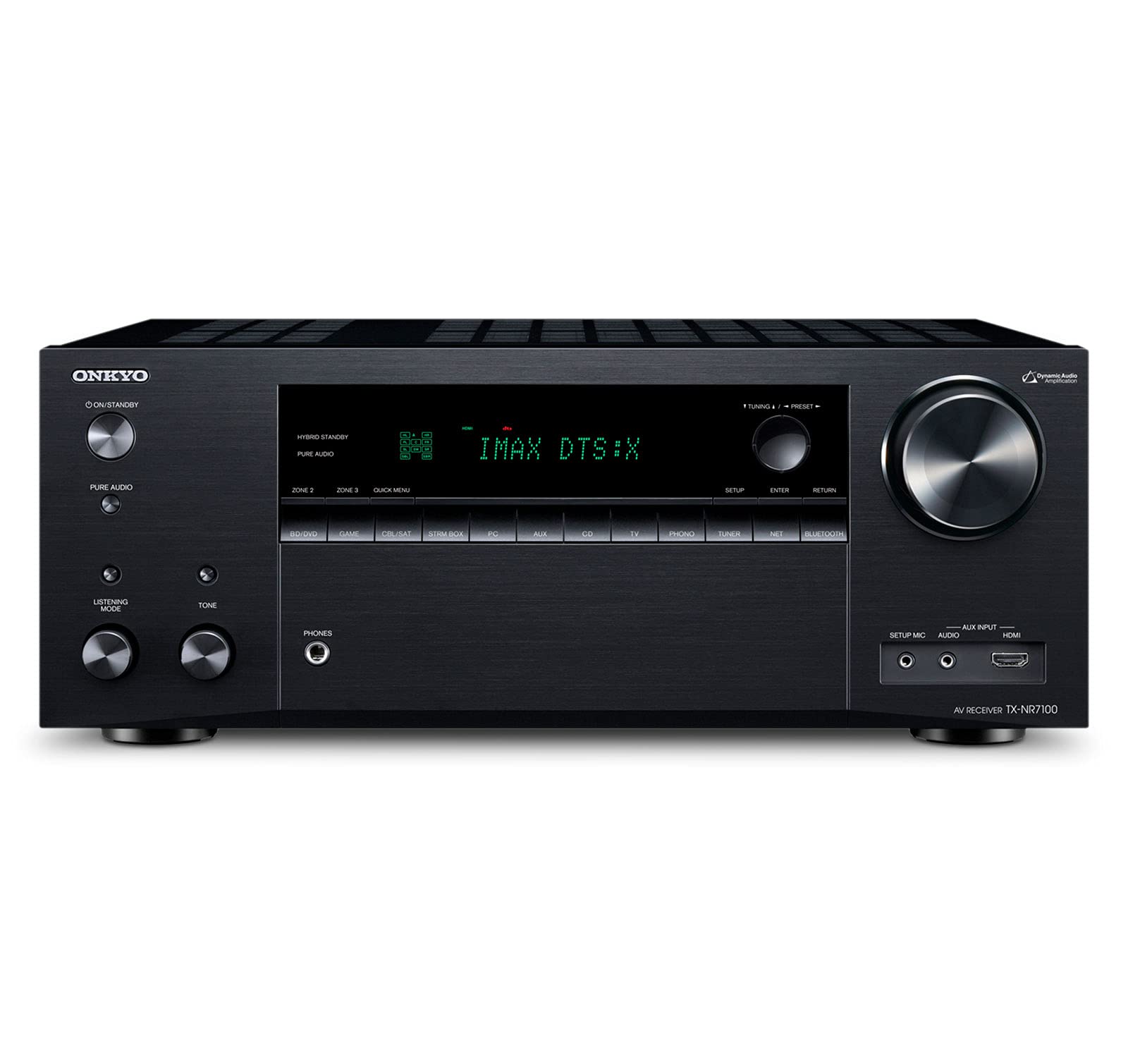
The Onkyo TX-NR7100 is the champion of room correction in the sub- bracket. Dirac Live out of the box uses a smartphone app or desktop software to measure and flatten both frequency response and impulse response, eliminating bass nulls and room modes that Audyssey or YPAO cannot fully address. The 9.2-channel architecture lets you run a 5.1.4 Atmos setup with overhead speakers, far exceeding the 5.1 ceiling of most competitors.
Its amplifier section delivers 100 watts per channel into 8 ohms with all channels driven, and the dynamic power into 4 ohm loads remains clean and stable. The THX Select certification guarantees that the receiver meets strict power and distortion benchmarks for a medium-sized room. HDMI 2.1 at 40Gbps supports 4K@120Hz, VRR, and ALLM for Xbox Series X and PS5 gaming without hiccups.
The downside is the remote, which lacks a backlight, and some units have reported HDMI handshake glitches that require a hard reset. The Dirac Live calibration process is also more involved than simpler systems, taking 30-45 minutes for a proper multi-point measurement. For buyers who want the absolute best audio integration with their room, this is the receiver to beat.
Why it’s great
- Dirac Live room correction is the most accurate sub-
- THX Select certification guarantees clean power delivery
- Works with Sonos and supports three independent zones
Good to know
- Remote is not backlit; menus feel dated
- Dirac setup is time-consuming for beginners
- Some HDMI handshake issues reported with certain TVs
2. Denon AVR-S970H 8K Ultra HD 7.2 Channel Receiver

The Denon AVR-S970H steps up from the S670H with 90 watts per channel across seven channels, a full HDMI 2.1 implementation supporting 8K/60Hz and 4K/120Hz pass-through, and Audyssey MultEQ room correction. The six HDMI inputs include three 8K-capable ports, making this a future-proof hub for gaming consoles, streaming boxes, and a PC. VRR, ALLM, and QFT are all supported on the 8K inputs.
HEOS multi-room audio lets you stream Spotify, TIDAL, and TuneIn to other Denon Home speakers around the house. The phono input is a welcome addition for vinyl listeners, and the on-screen setup assistant walks you through speaker configuration, distance calibration, and input assignment in under 20 minutes. The receiver runs cooler than comparable Onkyo units, with owners reporting idle temps around 80°F.
The zone 2 feature uses the back surround speaker channels, which limits your main setup to 5.2 when using a second zone. The remote control lacks a dedicated TV power button, which is a minor annoyance. For a balanced mix of gaming features, streaming versatility, and solid room correction, the S970H delivers exceptional value.
Why it’s great
- Full HDMI 2.1 with 8K/60Hz and 4K/120Hz for next-gen gaming
- HEOS multi-room audio works seamlessly with Denon speakers
- Phono input and Audyssey calibration are beginner-friendly
Good to know
- Zone 2 steals the back surround channels, limiting to 5.2
- Remote lacks a programmable TV power button
- No physical manual included; on-screen guide only
3. Onkyo TX-NR6100 7.2 Channel THX Certified Receiver
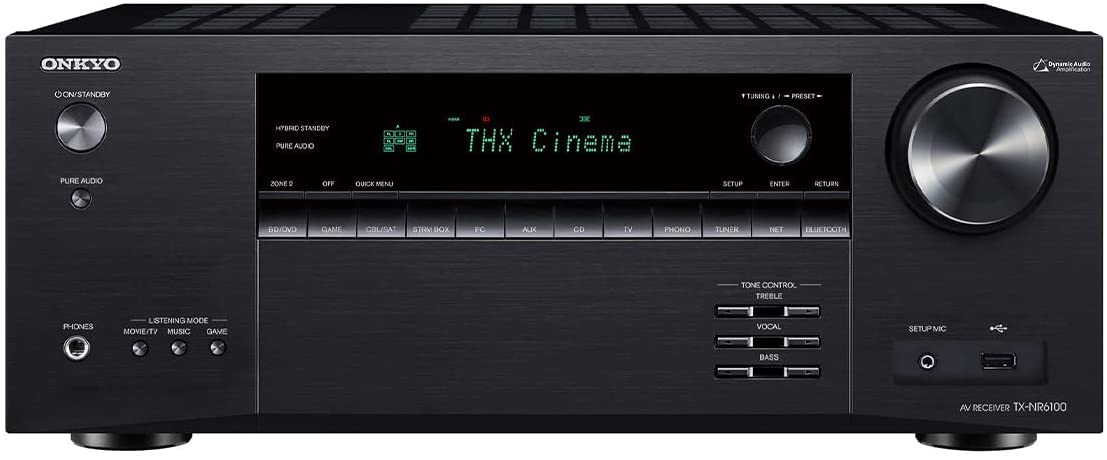
The Onkyo TX-NR6100 is a THX Select Certified receiver, meaning it delivers cinema-standard power and distortion performance for rooms up to 2,000 cubic feet. Its 210 watts per channel dynamic power rating on paper translates to real-world headroom when driving demanding speakers like Klipsch Reference or Bowers & Wilkins. The 5.2.2 Dolby Atmos and DTS:X support lets you add two height speakers to your 5.1 setup for overhead effects without needing a full 9-channel receiver.
HDMI 2.1 at 40Gbps covers three inputs, supporting 4K@120Hz, VRR, and ALLM for console gaming. The AccuEQ room calibration is less sophisticated than Dirac Live but handles distance, level, and crossover settings cleanly. The app-based control system works well, allowing input switching, volume adjustment, and EQ tweaks from your phone.
The remote is not backlit, which is a common complaint among owners. A few users report the cooling fan can be audible in quiet scenes, though this is inconsistent across units. For a THX-certified gateway to Atmos and high-refresh-rate gaming, the NR6100 is a strong mid-premium pick.
Why it’s great
- THX Select certification ensures reliable power and low distortion
- 5.2.2 Atmos adds height channels for immersive audio
- HDMI 2.1 with VRR and ALLM for serious console gaming
Good to know
- No backlit remote; navigation difficult in dark rooms
- Fan noise reported by some users during extended use
- AccuEQ room correction is basic compared to Dirac or Audyssey
4. Yamaha RX-V6A 7.2-Channel AV Receiver

The Yamaha RX-V6A is the centerpiece of the mid-range lineup, offering 100 watts per channel with YPAO R.S.C. (Reflected Sound Control) room correction that accounts for early reflections off side walls. It supports Dolby Atmos and DTS:X with height virtualization, so you can simulate overhead speakers without ceiling-mounted units. MusicCast multi-room integration lets you stream to compatible Yamaha devices around the house.
HDMI 2.1 with three 8K inputs and one output supports 4K@120Hz, but early firmware versions had compatibility issues with the Xbox Series X. Yamaha issued updates that resolved the handshake problems, and current production units are stable. The receiver powers 4 ohm speakers reliably via eARC, and the YPAO multipoint measurement captures data from up to eight positions for a more accurate sound field.
The learning curve for setup is steep, especially if you bypass the MusicCast app and try to configure everything through the front-panel display. The remote buttons are small and hard to distinguish by touch. For buyers who prioritize build quality and long-term reliability—many Yamaha receivers last over a decade—the RX-V6A is a safe, powerful choice.
Why it’s great
- YPAO R.S.C. with multipoint measurement improves sound accuracy
- MusicCast multi-room streaming is reliable and intuitive
- Drives 4 ohm speakers cleanly over eARC
Good to know
- Initial HDMI 2.1 firmware required updates for stable 4K@120Hz
- Remote buttons are tiny and hard to feel in the dark
- Setup is complex without using the MusicCast app
5. Denon AVR-S670H 5.2 Ch Home Theater Receiver

The Denon AVR-S670H is the entry-level gateway to the Denon ecosystem, but it punches well above its price tier. With 75 watts per channel across five channels and Audyssey MultEQ room correction, it delivers clean, balanced sound for a 5.1 setup. The standout feature at this level is the built-in phono input, which lets you connect a turntable directly without an external preamp—a rarity among sub- receivers.
HEOS built-in enables wireless streaming from Spotify, TIDAL, and other services, and it integrates with compatible Denon Home speakers for multi-room audio. The HDMI section supports 8K/60Hz and 4K/120Hz on three inputs, with HDCP 2.3 copy protection and eARC for seamless TV audio return. The setup assistant is one of the easiest in the category, guiding you through speaker detection, distance calibration, and input labeling with clear on-screen prompts.
The HEOS app can be laggy and occasionally loses connection to streaming services, forcing a restart. The receiver also lacks a second HDMI output for a projector-plus-TV setup. For a clean, affordable 5.1 system with vinyl support and current-generation HDMI features, the S670H is unmatched.
Why it’s great
- Built-in phono input eliminates the need for an external preamp
- Audyssey MultEQ calibration improves speaker integration
- 8K/60Hz and 4K/120Hz HDMI support with eARC
Good to know
- HEOS app can be laggy and lose connection to streaming services
- Single HDMI output limits dual-display setups
- Wi-Fi streaming reliability is inconsistent compared to wired Ethernet
6. Sony STR-AN1000 7.2 CH Surround Sound Receiver

The Sony STR-AN1000 brings Sony’s 360 Spatial Sound Mapping technology to the mid-premium tier, processing object-based audio from Dolby Atmos and DTS:X tracks to create a wider, more enveloping soundstage. Its Digital Cinema Auto Calibration IX (DCAC IX) uses a supplied microphone to measure speaker distances, sizes, and frequency response, then applies phase correction for tighter bass integration. The receiver also supports IMAX Enhanced content, unlocking the full dynamic range of IMAX-encoded Blu-rays.
With six HDMI inputs (two with HDMI 2.1 at 40Gbps) and two outputs, the STR-AN1000 is equipped for multi-display setups. The “Works with Sonos” certification lets it integrate directly into a Sonos ecosystem, waking and changing inputs from the Sonos app. Bluetooth, Chromecast built-in, Spotify Connect, and Apple AirPlay 2 cover every wireless streaming standard.
The calibration GUI is clean but displays incorrect subwoofer distance values for some users, requiring manual adjustment. There is no phono input, so vinyl enthusiasts need an external preamp. The sound field display is tiny and nearly unreadable from a normal seating distance. For buyers who value spatial audio processing and Sony’s proprietary calibration, the STR-AN1000 is a compelling option.
Why it’s great
- 360 Spatial Sound Mapping creates immersive height and width
- IMAX Enhanced support for premium home theater content
- Works with Sonos certified for seamless ecosystem integration
Good to know
- No phono input; turntable requires external preamp
- Calibration may report incorrect subwoofer distance
- Sound field display is too small to read from a distance
7. Marantz NR1510 UHD Slim 5.2 Channel Receiver

The Marantz NR1510 is designed for buyers who need a 5.1 receiver that fits into a shallow media console or narrow shelf. At just over four inches tall and 14.5 inches deep, it is significantly smaller than standard receivers. Despite the compact chassis, it packs 50 watts per channel across five discrete amplifier channels, a built-in phono preamp, and six HDMI inputs with HDCP 2.3 support. The 4K/60Hz pass-through covers HDR10, Dolby Vision, and HLG, making it compatible with modern streaming devices and Blu-ray players.
HEOS built-in enables multi-room audio and integration with Marantz and Denon wireless speakers. The setup assistant is straightforward, and the advanced graphical user interface guides you through speaker connection and calibration step-by-step. The .5 dB volume steps allow precise level matching across sources, which is a nice touch for critical listening.
The heat output is noticeable—the slim chassis runs hot during extended movie sessions, so ensure at least three inches of clearance above the unit. The 50 watts per channel is sufficient for efficient bookshelf speakers in a small to medium room, but it will struggle with power-hungry floorstanders. For space-constrained setups where a full-size receiver won’t fit, the NR1510 is the ideal compromise.
Why it’s great
- Slim 4.1-inch height fits in tight media console spaces
- Phono input and HEOS streaming expand listening options
- 0.5 dB volume steps allow fine level adjustment
Good to know
- Runs hot; needs good ventilation to avoid thermal issues
- 50 W/ch is underpowered for large speakers or big rooms
- No 4K/120Hz support; limited to 4K/60Hz
8. Yamaha RX-V4A 5.2-Channel AV Receiver

The Yamaha RX-V4A is the entry-level model in Yamaha’s current generation, but it still includes MusicCast multi-room streaming, YPAO automatic room calibration, and four HDMI inputs with HDCP 2.3 and eARC. It supports 4K/60Hz pass-through and 8K/60Hz on one input, making it a capable hub for most streaming and cable setups. The 80 watts per channel into 8 ohms is adequate for moderate-sized speakers in a living room environment.
MusicCast is the standout feature at this price point, letting you stream Spotify, Pandora, TIDAL, and Amazon Music HD directly without a separate source. The YPAO calibration handles speaker distance, level, and crossover settings, though it lacks the multipoint measurement of the higher-end RX-V6A. Voice control via Amazon Alexa and Google Assistant is built-in, and AirPlay 2 satisfies Apple users.
Some users report HDMI switching issues, where the receiver fails to pass 4K signals to certain displays or refuses to output audio via ARC. The remote is compact but has small, closely spaced buttons that are difficult to use in the dark. For a feature-rich hub with multi-room streaming, the RX-V4A offers solid value, provided you get a unit without HDMI bugs.
Why it’s great
- MusicCast multi-room streaming covers all major services
- YPAO calibration handles speaker setup automatically
- Voice control with Alexa and Google Assistant built-in
Good to know
- Some units have HDMI switching issues requiring return
- Remote buttons are small and hard to distinguish by touch
- YPAO multipoint measurement not available; single-point only
9. Pioneer VSX-935 7.2 Channel Network Receiver
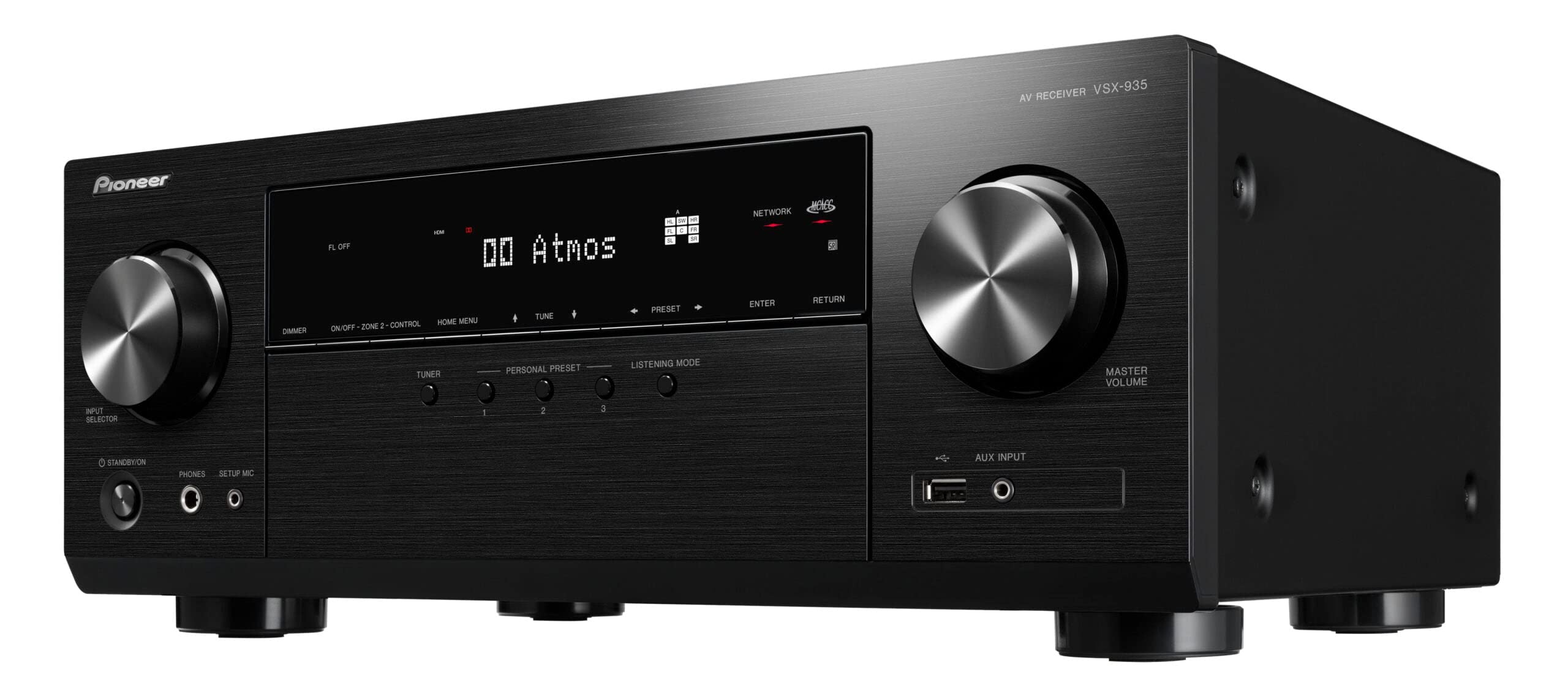
The Pioneer VSX-935 brings Dolby Atmos Height Virtualization to a 7.2-channel chassis, simulating the effect of ceiling speakers without requiring in-ceiling installation. This is a practical solution for rooms where cutting into drywall is not feasible. The receiver also supports HDMI 2.1 with 8K/60Hz pass-through, making it compatible with current-gen consoles at 4K/120Hz. Its 80 watts per channel is clean and clear, with a gradual volume ramp that allows fine control.
The dual-zone HDMI output lets you send different content to a main display and a second TV or projector. The included radio frequency (RF) remote works through walls and cabinets, a nice upgrade over standard IR remotes. Connectivity covers Bluetooth, Wi-Fi, and wired Ethernet, with streaming support for Spotify, TIDAL, and Deezer via the Pioneer Music Control app.
Bluetooth implementation is unreliable, with some users reporting constant dropouts and difficulty pairing. The on-screen menus look dated, and the auto-calibration system (MCACC) underperforms compared to Audyssey or Dirac Live, often requiring manual override. If you want a no-fuss way to get virtual Atmos without a complex setup, the VSX-935 delivers, but calibrate manually for best results.
Why it’s great
- Dolby Atmos Height Virtualization works without ceiling speakers
- RF remote operates through walls and cabinets
- HDMI 2.1 with 8K/60Hz pass-through for future-proofing
Good to know
- Bluetooth connectivity is unreliable with frequent dropouts
- MCACC auto-calibration is basic; manual setup sounds better
- On-screen menus and software interface feel outdated
10. Sony STRDH590 5.2 Channel Surround Sound Receiver
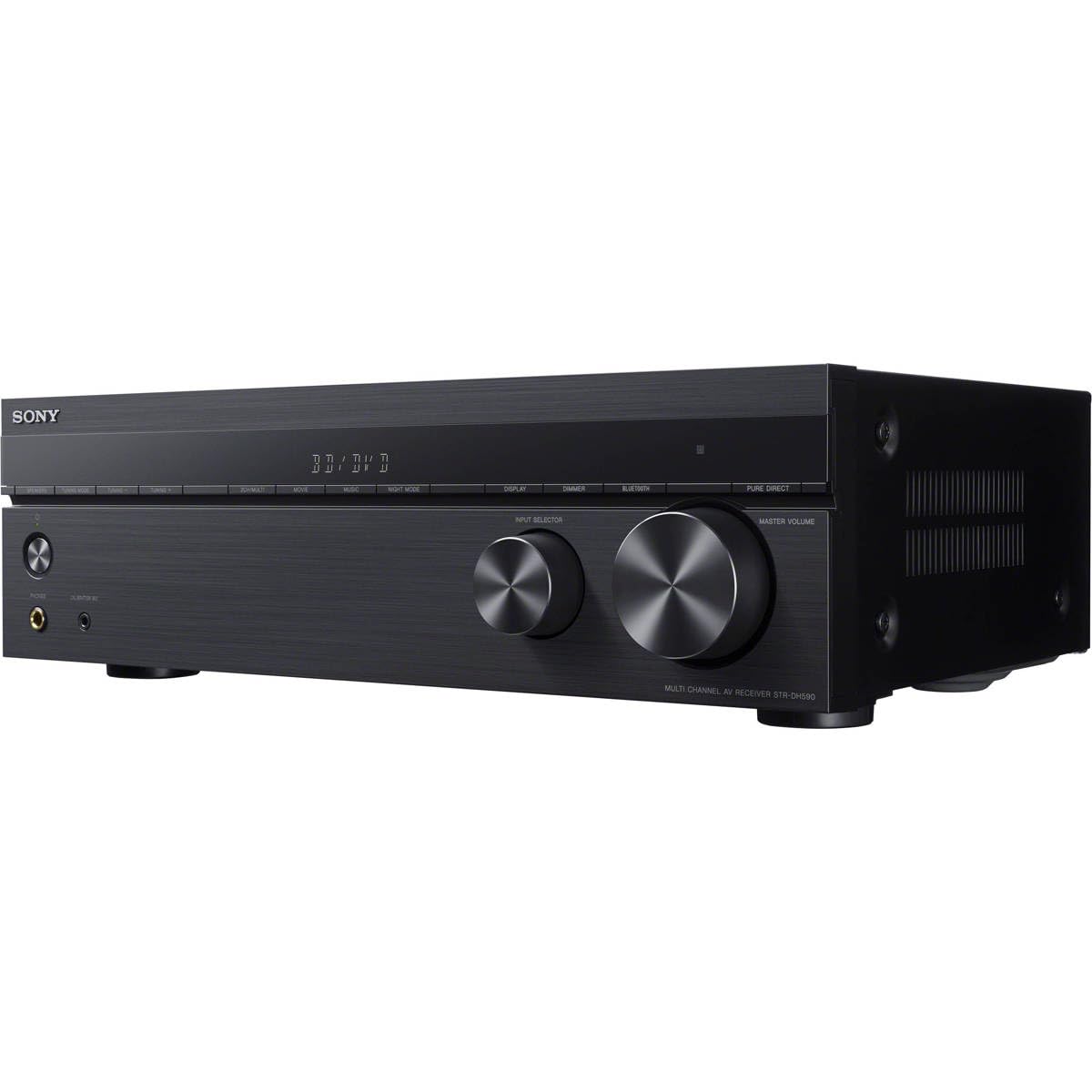
The Sony STRDH590 is the most affordable 5.2-channel receiver on this list, offering 725 watts total power and 4K HDR pass-through with HDCP 2.2. It features S Force PRO virtual front surround, which expands the soundstage from a 2.0 or 3.0 setup, and Bluetooth standby for turning on the receiver from your phone. The slim chassis is 5.25 inches tall, making it one of the more compact options for budget-minded setups.
Setup is straightforward but requires navigating a few quirks. To get 5.1 sound from 2.0 content, you need to enable audio passthrough on your streaming device and disable auto HDR via a hidden HDMI menu. The remote is simple, with one-button access to FM, TV, and Bluetooth sources, and the front display has adjustable brightness for dark rooms. The receiver drives vintage speakers well and produces a warm, balanced sound for its class.
The rear panel has limited spacing between input jacks, making it difficult to connect thick RCA cables. There is no AM tuner or B speaker output, and the calibration system is less sophisticated than YPAO or Audyssey. For a no-fuss entry into 5.1 surround with 4K compatibility, the STRDH590 serves its purpose, but expect to manually tweak settings for optimal sound.
Why it’s great
- Affordable 5.2 channel with 4K HDR pass-through
- Bluetooth standby for phone-controlled power
- Simple remote with dedicated FM, TV, and Bluetooth buttons
Good to know
- Rear input jacks are tightly spaced for thick cables
- Auto-calibration is basic; manual setup improves sound
- No AM tuner or B speaker output available
11. JBL MA310 5.2 Channel (60 Watt x 5) AV Receiver

The JBL MA310 is a fresh entry from JBL, pairing 60 watts per channel across five channels with a shallow chassis that fits easily into most entertainment centers. It features four HDMI inputs with ARC, native decoding of Dolby and DTS formats, and Bluetooth 5.1 with Low Energy for wireless streaming. The unit weighs only 5.1 kilograms, making it easy to maneuver during setup.
Sound quality is impressive for the price, with owners reporting clean, detailed output when paired with efficient tower speakers and a powered subwoofer. Initial firmware updates can cause a setup stall, but once updated, the receiver works reliably with HDMI ARC, auto power on/off with the TV, and a clean on-screen setup menu. It drives in-wall and bookshelf speakers with authority in medium-sized rooms.
The remote lacks a backlight, making it frustrating to navigate in a dark theater room. The auto shut-off defaults to 20 minutes of inactivity, a setting that must be manually changed through the on-screen menu. The bright front-panel LED is distracting if the receiver is placed near the screen. For buyers seeking a budget-friendly 5.2 receiver with modern features, the MA310 delivers strong value despite its quirks.
Why it’s great
- Shallow design fits easily into standard media consoles
- Clean, detailed sound with efficient speakers
- Bluetooth 5.1 with LE for low-latency streaming
Good to know
- Remote is not backlit; hard to use in dark rooms
- Auto shut-off default is 20 minutes; must change manually
- Front panel LED is bright and distracting near the screen
FAQ
What is the difference between 4K/60Hz and 4K/120Hz pass-through on a 5.1 receiver?
Do I need Dolby Atmos speakers for a 5.1 receiver to play Atmos content?
Can I use a 7.2 channel receiver for a 5.1 setup?
in a 5.1 configuration by reassigning the surround back channels to the front speaker terminals. Just check the receiver manual for bi-amp compatibility.
What is eARC and why does it matter for a 5.1 receiver?
How does room correction affect the sound of a 5.1 receiver?
Final Thoughts: The Verdict
For most users, the best 5.1 av receiver winner is the Onkyo TX-NR7100 because its Dirac Live room correction eliminates the acoustic problems that plague untreated rooms, and its THX Select certification guarantees clean, reliable power. If you want a future-proof gaming hub with 8K HDMI 2.1 and HEOS multi-room streaming, grab the Denon AVR-S970H. And for a compact, budget-friendly 5.2 setup with a phono input and modern HDMI features, nothing beats the Denon AVR-S670H.