
Our readers keep the lights on and the weekend projects moving. As an Amazon Associate, I earn from qualifying purchases.
Fitting a complete surround sound system without a single speaker cabinet touching your floor or cluttering your walls is the core promise of any 5.1 in-ceiling system. The challenge is matching the right woofer size, tweeter material, and dispersion pattern to your room’s dimensions so voices stay anchored to the screen while helicopters convincingly circle overhead. Getting the crossover points and amplification wrong turns a clean installation into a muddy, directionless mess.
I’m Rikta — the co-founder and writer behind FitlyFast. I’ve spent hundreds of hours analyzing the acoustic specs, driver materials, and real-world installation constraints that actually determine whether an in-ceiling surround system delivers the immersive bubble buyers are wiring up their ceilings to achieve.
Whether you are building a dedicated media room or upgrading a living space to hidden theater audio, this guide breaks down the top contenders to help you select the best 5.1 in-ceiling surround sound system for your setup.
How To Choose The Best 5.1 In-Ceiling Surround Sound System
Choosing an in-ceiling system is different from buying a soundbar or a set of bookshelf speakers. Your speakers will live inside drywall or acoustic panels, so decisions about driver size, tweeter composition, and passive versus powered subwoofers need to be made before you cut the first hole.
Woofer Size and Ceiling Depth
The majority of serious in-ceiling surrounds use an 8-inch woofer. An 8-inch driver moves enough air to reproduce mid-bass punch for explosions and low-frequency effects without needing a massive enclosure depth. Check the mounting depth of the speaker against your ceiling joist cavity — most 8-inch models require between 4 and 5 inches of clearance. A 6.5-inch woofer fits tighter spaces but sacrifices some bottom-end authority and may need a higher crossover point to the subwoofer.
Tweeter Material and Dispersion
A pivoting tweeter is the single most important feature for in-ceiling surround placement. A fixed tweeter aimed straight down forces listeners to sit in a narrow sweet spot. Swiveling tweeters let you point the high-frequency energy toward the listening area, even when the speaker is installed in a ceiling far from the seating position. Titanium dome tweeters deliver a bright, crisp top end that excels for movie effects but can sound fatiguing on poor recordings. Silk dome tweeters are smoother and more forgiving for music playback. Ring radiators offer a middle ground with wide, even dispersion and detailed, non-fatiguing highs.
Passive vs. Powered Subwoofers
Nearly all in-ceiling speaker sets ship with passive subwoofers — meaning they have no built-in amplifier and must be driven by an external amplifier or a separate subwoofer amplifier. A passive subwoofer placed in the ceiling can effectively pressurize a room, but it needs adequate power from the receiver or a dedicated amp. Budget sets often include passive subs rated for lower wattage; premium sets may include larger passive drivers that demand a more capable external amplifier to achieve their full extension.
Quick Comparison
On smaller screens, swipe sideways to see the full table.
| Model | Category | Best For | Key Spec | Amazon |
|---|---|---|---|---|
| Sonos In-Ceiling by Sonance | Premium Passive | Whole-home multi-room | 25mm tweeter / 165mm woofer | Amazon |
| Polk Audio Vanishing 80 F/X-LS | Mid-Range Surround | Dedicated home theater surrounds | 8″ Dynamic Balance driver | Amazon |
| Klipsch CDT-5800-C II | Premium Entry | High-efficiency theater sound | 1″ Titanium / 8″ Cerametallic | Amazon |
| Theater Solutions TST87 | Mid-Range Value | Complete 7.2 kickstart bundle | 8″ Woven Fiber woofers | Amazon |
In‑Depth Reviews
1. Sonos In-Ceiling by Sonance

The Sonos In-Ceiling by Sonance was engineered for the Sonos Amp ecosystem, which gives it a significant advantage in multi-room streaming and automated room correction. The 165mm woofer and 25mm tweeter deliver a frequency response of 36 Hz to 20 kHz with DSP engaged, meaning the full sonic spectrum is covered when paired with the proper amplifier. The 90-degree nominal coverage angle ensures even dispersion, and the maximum SPL of 110 dB at one meter is sufficient for medium-to-large rooms without audible strain. The installation depth is 120 millimeters, making it a realistic fit for standard ceiling joists.
Trueplay optimization is the defining software feature here. By using the microphone on a compatible iOS device, the Amp measures the room’s size, construction, and furnishings, then automatically adjusts the EQ curve to compensate for reflective surfaces or dead spots. This calibration matters more for in-ceiling speakers than for bookshelf models because the sound is entering the room from a non-traditional angle and the listener cannot physically adjust the speaker’s toe-in. The result is consistent, natural tonality from any seat in the room.
The physical design prioritizes invisibility. The round grille can be painted to match the ceiling texture, and the bezel protrudes only a few millimeters from the drywall surface. Connectivity is entirely through the Sonos Amp — the speakers themselves are passive, so the intelligence, amplification, and wireless streaming all live in the external box. This setup is ideal for users who want whole-home audio with zone control, but it does require the Amp investment to unlock the full feature set.
Why it’s great
- Trueplay room correction optimizes in-ceiling placement automatically.
- Paintable grille blends into any ceiling finish.
- Wide 90-degree dispersion covers the entire listening area.
Good to know
- Requires Sonos Amp for operation — no standalone passive use.
- Lower max SPL compared to larger dedicated theater drivers.
2. Polk Audio Vanishing 80 F/X-LS (Pair)

The Polk Audio Vanishing 80 F/X-LS is designed specifically for surround channel duty in a 5.1 or 7.1 configuration, not for general whole-home music playback. The key differentiator is the dual-port bandpass enclosure integrated into the speaker frame, which extracts more low-end output from the 8-inch Dynamic Balance woofer than a typical open-back ceiling speaker can achieve. The two 0.75-inch ring-radiator tweeters are arranged to create a wide, diffused high-frequency field that mimics the effect of a dipole speaker, making pan effects across the rear of the room sound smooth and continuous rather than point-source localized.
Installation gains an advantage from the rotating cam system, which allows a single-cut, drop-in fit without needing to access the cavity from above. The grille is magnetically secured and paintable, protruding only seven millimeters from the ceiling. Because these are sold as a pair, they are a direct fit for the rear channels of a 5.1 in-ceiling setup. Owners consistently mention that the ring radiator tweeter produces a “reserved” high end that works well in bright, reflective rooms where a titanium tweeter might sound harsh.
The enclosure design here does mean the speaker is deeper than a typical open-back in-ceiling model. Before cutting, measure the available cavity depth and verify that there are no joists, pipes, or wiring blocking the path. Pair these with a quality powered subwoofer — the 8-inch woofer handles mid-bass cleanly, but it is not designed to reproduce the deepest LFE effects that a dedicated subwoofer manages effortlessly.
Why it’s great
- Dual-port bandpass enclosure extends bass response beyond open-back designs.
- Ring radiator tweeters deliver smooth, non-fatiguing highs for bright rooms.
- Rotating cam system simplifies drop-in installation.
Good to know
- Deep mounting depth requires adequate ceiling cavity clearance.
- Sold as a pair only — a full 5.1 setup requires multiple purchases.
3. Klipsch CDT-5800-C II (Pair)

The Klipsch CDT-5800-C II brings the brand’s signature Controlled Dispersion Technology into a ceiling-mounted form factor. The 1-inch titanium dome tweeter and 8-inch Cerametallic woofer are both mounted on pivoting yokes, which allows you to angle the sound cone toward the listening area — a critical feature for a ceiling speaker that might be installed far forward of the seating row. The pivoting design compensates for the vertical offset between the speaker plane and the listener’s ears, keeping the high frequencies and mid-bass punch aligned at the correct angle.
The treble and mid-bass attenuation switches mounted on the front baffle give the installer fine-grained tonal control without needing an external equalizer. If the room has heavy carpet and drapes that absorb high frequencies, the treble switch can be set to boost; if the room is all hard surfaces, a cut setting prevents brightness from becoming fatiguing. The SlimTrim magnetic grille sits nearly flush against the ceiling, and the included cardboard template makes marking the cutout straightforward for a drywall saw.
The efficiency of the Cerametallic woofer and titanium tweeter means these speakers produce high output with lower amplifier power than many competitors — a meaningful advantage when driving multiple ceiling channels from a single receiver section. The pair format works perfectly for the left and right surround or height channels in a 5.1.2 or 5.1.4 system. Owners report that the controlled dispersion creates a noticeably wider sweet spot than fixed-driver ceiling speakers, making this a strong choice for rooms with off-axis seating.
Why it’s great
- Pivoting tweeter and woofer allow precise sound aiming toward the listening area.
- On-board treble and mid-bass switches enable room-specific tonal tuning.
- High efficiency delivers loud, clean output from modest amplifier power.
Good to know
- Bright signature may sound aggressive in untreated reflective rooms.
- Pair packaging requires separate purchase for center channel.
4. Theater Solutions TST87 7.2 Set

The Theater Solutions TST87 set is the most comprehensive bundle in this guide, containing four 8-inch in-ceiling speakers (TS80W), two 8-inch in-ceiling rear speakers (TS80C), one center channel (TSLCR5), and two passive 10-inch subwoofers (TS1000) — all for a price that undercuts most single-pair premium options. The woven Fiber cone woofers and pivoting Silk Titanium dome tweeters are consistent across the satellite speakers, which simplifies timbre matching across the entire soundstage. The center channel uses a 5.25-inch woofer with a PEI dome tweeter, designed to anchor dialogue to the screen position.
The critical installation detail: the two passive subwoofers require an external amplifier. A standard AV receiver’s built-in subwoofer pre-out is not sufficient to drive these directly; you must connect a standalone subwoofer amplifier between the receiver and the passive subs. Owners who missed this requirement during planning had to pause installation and source a separate amp. The frequency response of the satellites is decent for the price tier, but the 8-inch woofers in open-back ceiling cavities do not produce the same low-end weight as the Polk or Klipsch enclosed designs.
The pressure-lock mounting system clamps the speakers to the drywall without requiring access above the ceiling, which is a genuine time-saver for retrofit installations. The included cut-out templates and removable grilles are standard but well-executed. For anyone building a dedicated theater on a strict budget, this kit delivers nine drivers for the cost of two premium models. The trade-off is in refinement: the tweeters are not as articulate as the ring radiators or titanium domes found on higher-priced speakers.
Why it’s great
- Includes nine speakers total, covering all channels plus two passive subs.
- Pressure-lock mounting eliminates need for ceiling cavity access.
- Consistent driver materials across satellites aid timbre matching.
Good to know
- Passive subwoofers require a separate external amplifier — not plug-and-play.
- Open-back woofer design produces less bass authority than enclosed competitors.
5. ULTIMEA Skywave X40 5.1.2ch
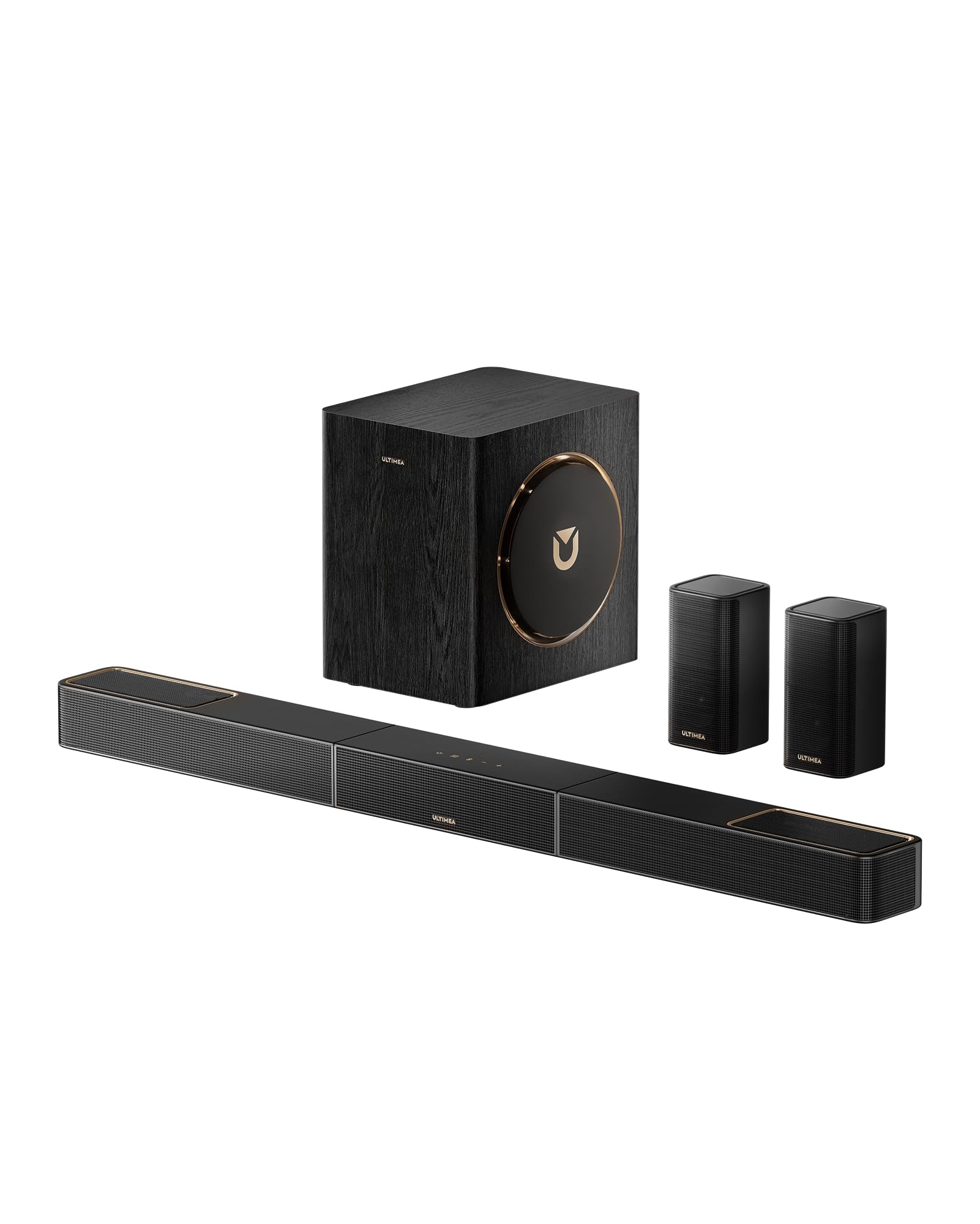
The ULTIMEA Skywave X40 is not a true in-ceiling speaker set in the traditional sense — it is a soundbar-based 5.1.2 system with wireless surround speakers and a wood-veneered 6.5-inch subwoofer. It earns a place in this guide because the surround speakers are fully wireless (dual 5 GHz transmission), eliminating the cable runs through the ceiling that many buyers of in-ceiling systems want to avoid. The GaN amplifier delivers 530 watts peak with 98% efficiency, and the NEURACORE DSP processes 24-bit/192 kHz audio with less than 0.5% distortion across up to 17 channels.
The system includes two up-firing drivers that bounce sound off the ceiling to create the height layer for Dolby Atmos. The gravitational bass technology uses an enlarged waveguide to push the subwoofer down to 35 Hz, producing clean low-end extension without the port chuffing that smaller subwoofer enclosures generate at high output. The soundbar chassis is 43 inches wide with a rose gold metal grille, designed to sit beneath a television rather than live inside the ceiling structure.
For buyers who want a dramatic audio upgrade without cutting holes in their ceiling and running speaker wire through joists, the Skywave X40 is the most practical route to 5.1.2 surround. The wireless surround speakers need power outlets nearby, but they do not require a physical connection back to the soundbar. The 4K HDR pass-through preserves video quality from source devices, and the HDMI eARC connection simplifies control with a single remote.
Why it’s great
- Fully wireless surround speakers eliminate need for ceiling wire installation.
- GaN amplifier delivers clean power with minimal heat and low distortion.
- Up-firing drivers create effective Atmos height effects without physical ceiling speakers.
Good to know
- Not a true in-ceiling speaker solution — uses soundbar and up-firing drivers.
- Wireless surrounds require nearby power outlets for each speaker.
6. Klipsch Reference Cinema Dolby Atmos 5.1.4

The Klipsch Reference Cinema 5.1.4 system provides a complete package: four satellite speakers with integrated Dolby Atmos up-firing drivers, a center channel, and a powered 8-inch subwoofer. The Tractrix 90×90 degree horn technology paired with aluminum tweeters maintains the Klipsch signature bright, articulate high end that cuts through room noise. Each of the four satellites includes an up-firing driver, so the system delivers four discrete height channels — two from the front and two from the rear — creating a more immersive hemisphere of sound than systems with only front up-firing drivers.
Wire management requires standard 16-gauge speaker wire, and the push-lock binding posts accept banana plugs or bare wire. The subwoofer is the weak link in this package. The built-in digital amplifier is adequate for a small to medium room, but owners report that the sub loses definition and impact below about 35 Hz, meaning deep LFE effects in action movies do not hit with the authority that a larger, ported subwoofer would deliver. Setting crossover points at 90 Hz for the center and 100 Hz for the satellites helps integrate the subwoofer smoothly and reduces strain on the small satellite woofers.
The plastic satellite enclosures are sturdy but clearly a step down from the all-wood construction of Klipsch’s higher-end Reference series. The magnetic grilles and copper-colored drivers maintain the premium visual identity of the brand. For buyers who want a complete, one-box Atmos system with height channels included and are willing to upgrade the subwoofer later, this is a logical starting point.
Why it’s great
- Includes four Atmos up-firing drivers for front and rear height effects.
- Tractrix horn technology delivers clear, detailed high-frequency response.
- Complete system includes center, surrounds, and powered subwoofer.
Good to know
- Subwoofer lacks deep extension and impact below 35 Hz for large rooms.
- Plastic satellite cabinets feel less premium than full wood enclosures.
7. SAMSUNG Q990D 11.1.4ch Soundbar

The SAMSUNG Q990D is an 11.1.4-channel soundbar system with a wired subwoofer and wireless rear speakers, each containing forward, side-firing, and up-firing drivers. It supports Wireless Dolby Atmos, which allows the rear speakers to receive height-channel data without an HDMI cable running to the rear of the room. The system uses SpaceFit Sound Pro to automatically analyze the room’s dimensions and acoustic surface properties, then calibrates the output of each channel to achieve even frequency response across the listening area.
The Q-Symphony feature enables the soundbar to use the speakers built into compatible Samsung televisions as additional channels, creating a wider front soundstage than the soundbar alone could produce. Game Mode Pro activates automatically when a connected console sends a game signal, engaging the up-firing channels and optimizing the EQ for 3D audio positioning. The included subwoofer is a wireless 8-inch driver that produces satisfying bass down to approximately 32 Hz, sufficient for most home theater content without needing a separate subwoofer.
A documented issue exists with audio dropouts when using HDMI eARC, specifically with certain LG television models. Owners report that switching to standard ARC (non-eARC) resolves the problem but limits bandwidth for high-bitrate audio. Samsung has not issued a universal firmware fix. For buyers using a Samsung television, the Q-Symphony integration and seamless eARC handshake make this the most polished soundbar option available at this price tier.
Why it’s great
- 11.1.4 channel count delivers comprehensive surround and height coverage.
- Q-Symphony integration with Samsung TVs expands the front soundstage.
- Wireless Dolby Atmos eliminates rear-channel HDMI cable runs.
Good to know
- Intermittent eARC audio dropout reported with some non-Samsung TV brands.
- Wired subwoofer requires a power outlet and a wire connection to the soundbar.
8. Nakamichi Shockwafe 11.2.6ch
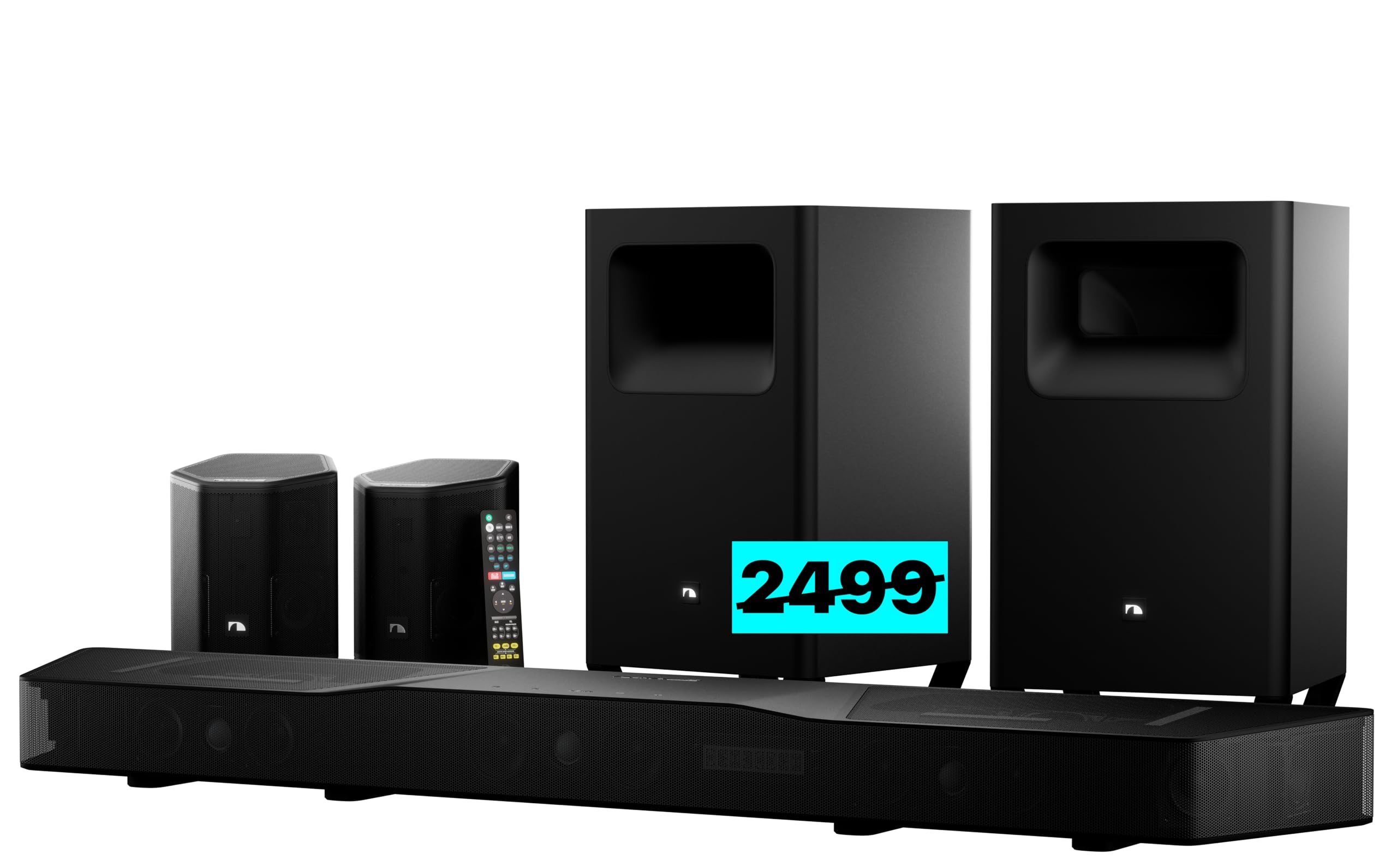
The Nakamichi Shockwafe 11.2.6ch system is a soundbar-based alternative to a full separates setup, featuring a 54-inch main bar, dual 10-inch wireless subwoofers, and bipolar surround speakers that fire sound from both the side and upward to simulate six discrete surround channels. The 11.2.6 architecture includes six discrete height channels that create a convincing overhead sound bubble, and the bipolar design of the surrounds wraps the rear soundstage in diffuse ambient effects rather than localized point-source imaging.
The dual 10-inch subwoofers are the heavy artillery here. Each subwoofer uses a flared port to reduce turbulence at high output levels, and the pair together produce clean, tactile bass that pressurizes medium and large rooms effectively. The system handles Dolby Atmos and DTS:X with automatic format detection, and the AHD Ultra engine manages channel steering and object placement through the bipolar surrounds. The soundbar features HDMI eARC plus two HDMI 2.1 inputs that support 4K 120Hz, Dolby Vision, and HDR10+ pass-through for gaming and 4K playback.
Setup is plug-and-play: the wireless subs and surrounds connect to the soundbar automatically out of the box. The system ships in three boxes due to the physical size of the dual subwoofers, and the soundbar alone weighs over 32 pounds, so a sturdy media console or entertainment stand is required. Owners consistently report that the system delivers theater-scale impact without the complexity of a separate AV receiver and in-ceiling wire installation, making it the most direct path to high-output home theater for buyers who cannot cut into their ceilings.
Why it’s great
- Dual 10-inch subwoofers produce deep, room-pressurizing low-end output.
- Bipolar surround speakers create a diffuse, immersive rear soundstage.
- HDMI 2.1 inputs support 4K 120Hz and Dolby Vision for gaming.
Good to know
- Very large and heavy components require substantial furniture and space.
- Not compatible with physical in-ceiling speaker installation.
9. Sony BRAVIA Theater Quad HT-A9M2

The Sony BRAVIA Theater Quad HT-A9M2 abandons the traditional soundbar form factor entirely. Instead, it consists of four wireless speaker modules, each containing four drivers (two for the main channels and two for height effects), totaling 16 individual speaker units. The control box houses the processing hardware and connects to the television via HDMI eARC. The system uses 360 Spatial Sound Mapping technology to create up to 12 phantom speakers, generating a fully virtualized surround field that adapts to the room dimensions and speaker placement.
Sound Field Optimization runs automatically after setup, using the built-in microphones in each speaker module to measure distance, angle, and reflective surfaces. The system then adjusts delay and level for each driver to create a seamless hemisphere of sound. The phantom center channel works convincingly — dialogue stays anchored to the screen even when the physical left and right speakers are positioned well wide of the television. The support for Dolby Atmos, DTS:X, and IMAX Enhanced ensures compatibility with the most demanding object-based audio soundtracks.
The quad speakers are designed to be placed on stands or wall-mounted, not installed in the ceiling. Each speaker requires a power outlet, but the wireless audio link to the control box eliminates the need for speaker wire. Owners report that the software setup can be finicky with Wi-Fi congestion and that the HDMI CEC handshake occasionally causes the system to switch to TV speakers. A dedicated Sony subwoofer (sold separately) is necessary to achieve deep low-end extension below 30 Hz. For buyers who prioritize phantom channel accuracy and spatial mapping over maximum SPL, this system represents a unique approach to surround sound that sidesteps the need for physical in-ceiling installation.
Why it’s great
- 360 Spatial Sound Mapping creates phantom channels for a massive virtual soundstage.
- Automatic room calibration adjusts placement and delay for each module.
- Four wireless modules eliminate speaker wire runs entirely.
Good to know
- Requires a separate Sony subwoofer for deep bass below 30 Hz.
- Software setup can be affected by Wi-Fi congestion and CEC issues.
10. ULTIMEA Skywave X100 Dual 9.2.6 THX
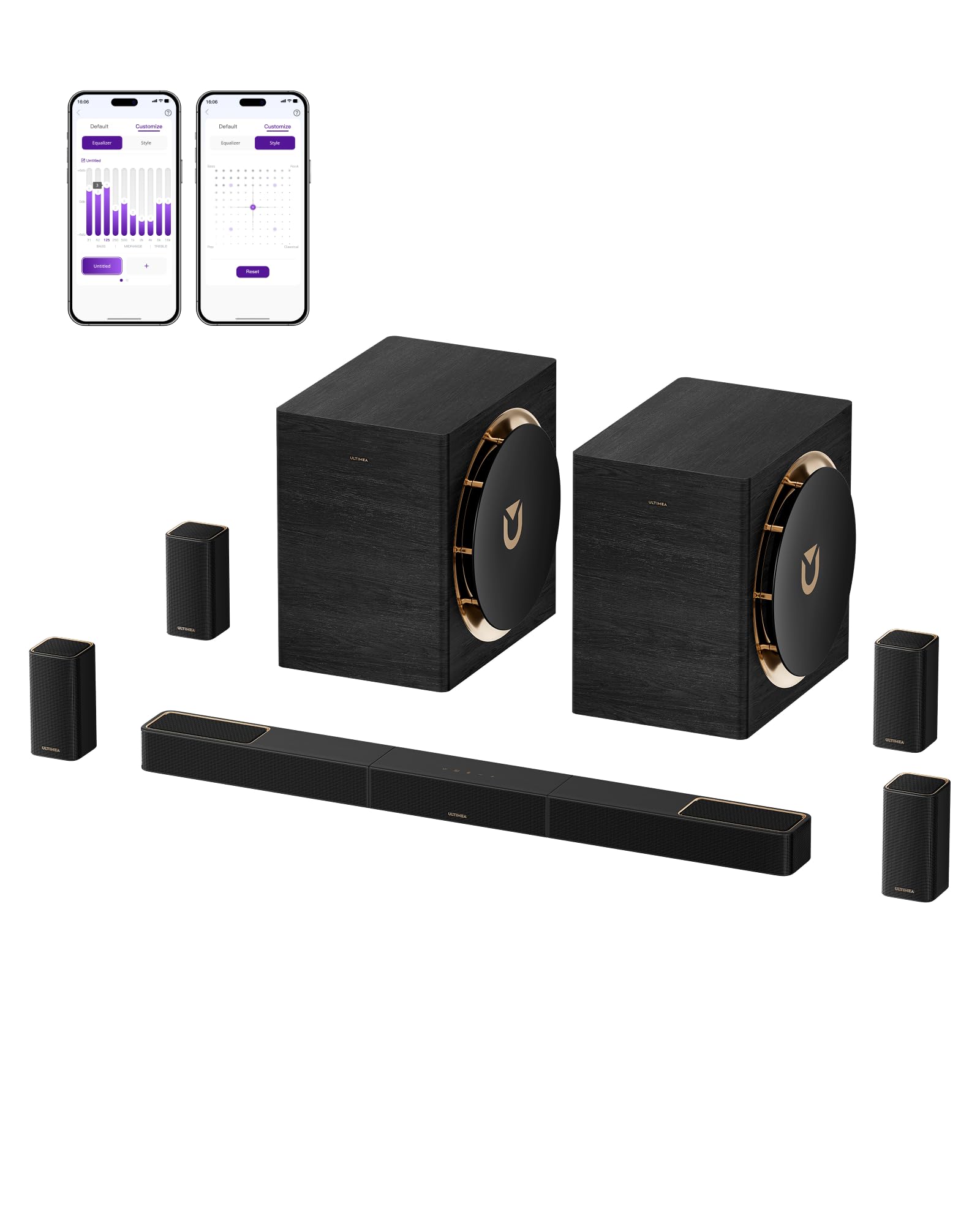
The ULTIMEA Skywave X100 Dual is a THX-tuned 9.2.6-channel soundbar system that competes directly with the Nakamichi Shockwafe. It includes a main bar, four wireless surround speakers, and two 10-inch wireless subwoofers. The CineMesh Dual 5 GHz wireless architecture maintains latency below 20 milliseconds across all channels, which means the surround speakers and subwoofers stay synchronized with the soundbar without perceptible delay. The Gravus Ultra-Linear Bass Technology extends the low-frequency response down to 18 Hz, which is the deepest extension of any system in this guide.
The NeuraCore processing engine runs at 2,000 MIPS on a 24-bit/192 kHz signal path, handling object rendering for both Dolby Atmos and DTS:X soundtracks. The GaN amplifier delivers 2,000 watts peak output with reduced thermal loss compared to traditional Class-D amplification. Individual surround level control allows each satellite to be adjusted independently, compensating for asymmetrical room layouts where one surround speaker is closer to the seating position than the other.
Owners praise the immediate setup and the app-based control for volume, sound profiles, and surround level balance. The subwoofer bass is reported as powerful and clean, though one owner received a unit with weak bass and received a replacement through customer service. The system does not support DTS:X for some users, though the manufacturer specifies DTS:X compatibility in the documentation. The 90-pound shipping weight requires two people to unbox and position the components. For buyers who want a THX reference-level calibration without installing speakers into the ceiling structure, this system offers the closest approximation to a dedicated theater processor setup.
Why it’s great
- THX-tuned calibration delivers reference-level tonal accuracy for film soundtracks.
- Dual 10-inch subs with Gravus technology reach down to 18 Hz.
- Individual surround level control compensates for asymmetric room layouts.
Good to know
- Heavy system (90+ pounds) requires two people for setup and positioning.
- Customer reports indicate intermittent subwoofer quality control issues.
11. Nakamichi Dragon 11.4.6ch
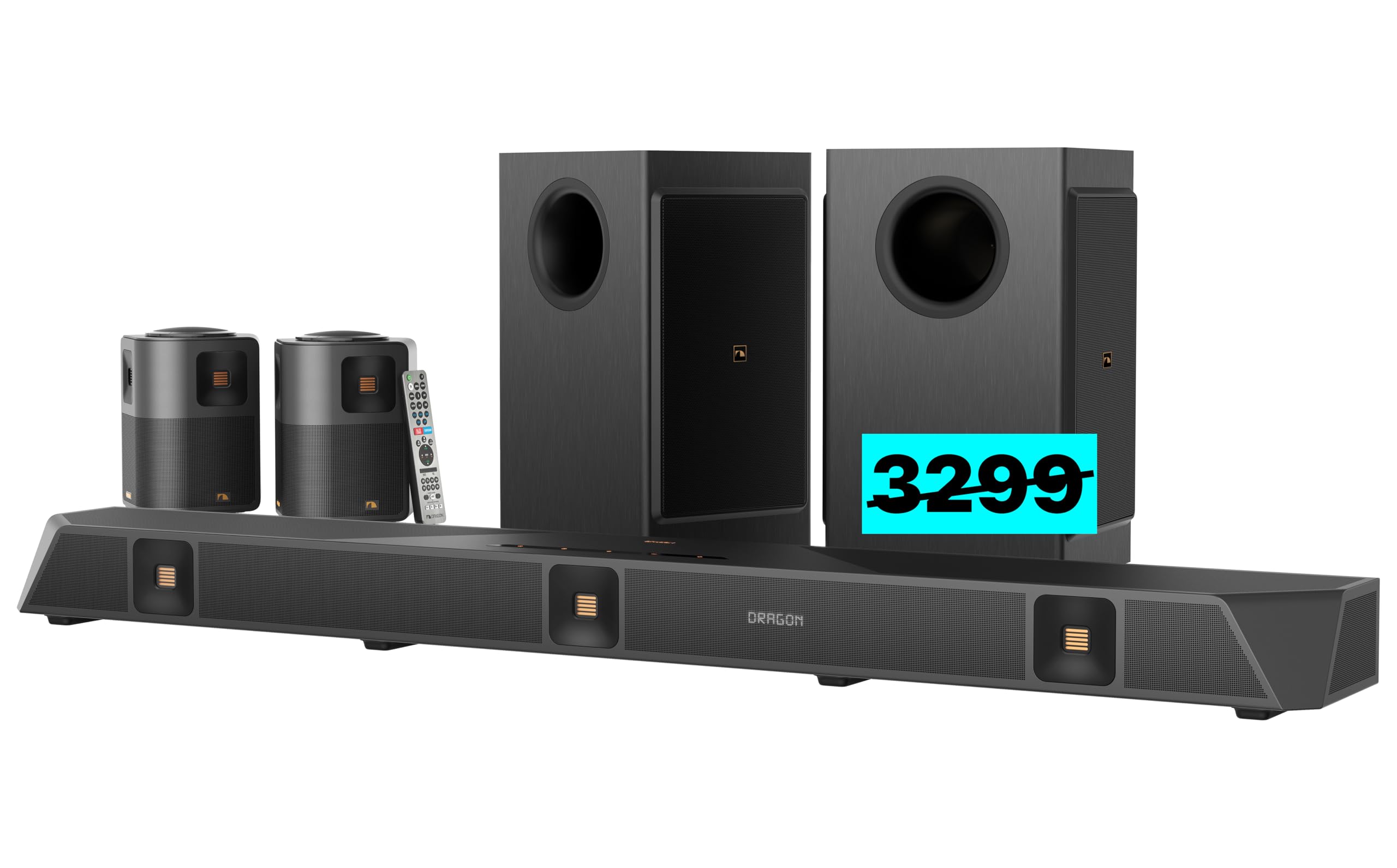
The Nakamichi Dragon 11.4.6ch is the highest-spec soundbar-based system in this guide, engineered with a Pro Cinema Engine that supports Dolby Atmos up to 24.1.10 channel mapping and DTS:X Pro up to 30.2 channel mapping. The 58-inch main bar uses custom HiFi Air Motion Tweeters (AMTs) instead of conventional dome tweeters. An AMT folds a pleated diaphragm to accelerate air more efficiently than a dome, resulting in lower distortion and faster transient response at high frequencies — an important advantage for reproducing the sizzle of rain and the air of ambient environmental effects in Atmos soundtracks.
The dual-opposing 8-inch subwoofers are positioned to cancel cabinet vibration, reducing physical resonance in the enclosures and keeping the bass output clean and articulate. The bipolar Omni-Motion surround speakers use a PerfectHeight mechanism that locks the overhead effects to the listener’s ear level regardless of the speaker’s vertical placement. The system supports up to four wireless subwoofers through scalable bass architecture, allowing users to add additional subwoofers for larger rooms. Rear tops with side height projection produce six discrete height channels that create a true three-dimensional sound bubble around the listener.
Setup takes roughly 45 minutes and involves three large boxes. The system uses HDMI eARC with three HDMI 2.1 inputs, supporting 4K 120Hz and Dolby Vision passthrough. The subwoofer crossover should be set to 120 Hz to eliminate boominess and integrate smoothly with the AMT-equipped soundbar. Owners consistently report that the Dragon produces a soundstage that rivals dedicated AVR-based systems at several times the price, with clear dialogue, deep controlled bass, and precise spatial imaging. The primary limitation is the lack of native Wi-Fi streaming — firmware updates require a USB stick — but for pure home theater impact, this is the most capable soundbar-style system currently available.
Why it’s great
- Air Motion Tweeters deliver high-frequency detail and transient speed beyond conventional dome tweeters.
- Scalable bass architecture allows up to four subwoofers for large rooms.
- Bipolar surrounds with PerfectHeight mechanism lock overhead effects to the sweet spot.
Good to know
- Heavy, multi-box setup requires at least two people and a large media console.
- No native Wi-Fi; firmware updates require physical USB stick connection.
FAQ
What is the ideal woofer size for a 5.1 in-ceiling surround system?
Can I use any AV receiver with passive in-ceiling speakers?
Do I need a separate amplifier for passive in-ceiling subwoofers?
Final Thoughts: The Verdict
For most users, the best 5.1 in-ceiling surround sound system winner is the Polk Audio Vanishing 80 F/X-LS because its dual-port bandpass enclosure and ring radiator tweeters deliver exceptional surround imaging and bass extension from a flush-mount ceiling form factor. If you want whole-home multi-room integration with automatic room calibration, grab the Sonos In-Ceiling by Sonance paired with a Sonos Amp. And for maximum impact without cutting into your ceiling, the Nakamichi Dragon 11.4.6ch soundbar system is the uncompromising high-end choice that rivals dedicated processor-based setups.