
Our readers keep the lights on and the weekend projects moving. As an Amazon Associate, I earn from qualifying purchases.
Stepping up from budget desktop speakers or 4-inch nearfields to a true 5-inch studio monitor is the moment your mixes stop lying to you. A 5-inch driver delivers enough low-end extension to judge basslines and kick drums without needing a subwoofer, yet remains compact enough for a desk setup. The jump in accuracy reveals frequency masking, phase issues, and tonal imbalances that smaller drivers simply gloss over.
I’m Rikta — the co-founder and writer behind FitlyFast. My analysis of this category involved cross-referencing hundreds of verified customer reviews with published frequency response measurements and driver material science to identify which monitors deliver genuinely transparent playback for critical listening.
Whether you are a bedroom producer, a podcast editor, or a hobbyist mixing engineer, choosing the right nearfield reference speakers is a long-term investment in your hearing. This guide will help you find the best 5 inch studio monitors that match your room and your budget.
How To Choose The Best 5 Inch Studio Monitors
Selecting the right nearfield monitor is less about wattage and more about how the speaker’s design interacts with your listening environment. The three factors that separate a useful monitor from a misleading one are its frequency response flatness, its bass port architecture, and its ability to compensate for desk or wall reflections.
Driver Material and Cabinet Construction
The woofer cone material directly affects how the monitor reproduces transients — the sharp attack of a snare or a plucked bass string. Lightweight aramid or glass-fiber composites (used by KRK and Focal) offer stiffness without mass, reducing cone breakup at higher volumes. Woven-paper cones (common in Yamaha and JBL designs) provide a more traditional, slightly softer transient that many engineers prefer for long listening sessions. The cabinet should be made from medium-density fiberboard (MDF) rather than plastic to minimize resonances that color the midrange.
Room EQ and Placement Flexibility
No two rooms sound the same, and a monitor that works in a treated studio may sound boomy or hollow on a cluttered desk. Look for models with high-frequency and low-frequency shelving switches — typically ±2 dB adjustments — that let you compensate for boundary gain when the speaker sits close to a wall. Some monitors also offer acoustic space presets (desktop, bookshelf, open room) that internally adjust the crossover behavior.
Amplifier Topology and Connectivity
Bi-amped designs — where a dedicated amplifier drives the woofer and a separate one drives the tweeter — reduce intermodulation distortion and give you cleaner sound at higher SPLs. Class D amps run cooler and are more efficient, while Class A/B amps are traditionally prized for their smoother, more musical distortion profile. For inputs, balanced TRS or XLR connections reject electrical noise better than RCA, which is important if your audio interface cables run near power strips or monitors.
Quick Comparison
On smaller screens, swipe sideways to see the full table.
| Model | Category | Best For | Key Spec | Amazon |
|---|---|---|---|---|
| JBL 305P MkII (Pair) | Premium | Transparent nearfield mixing | 41W x 2 Class-D, Image Control Waveguide | Amazon |
| Yamaha HS5 (Pair) | Premium | Flat, uncolored reference monitoring | 45W LF + 25W HF bi-amp, 54Hz–30kHz | Amazon |
| Focal Alpha 50 Evo (Single) | Premium | Detailed transient attack, nearfield precision | 35W LF + 25W HF Class D, Slatefiber woofer | Amazon |
| Edifier MR5 (Pair) | Mid-Range | Hi-Res wired/wireless desktop studio work | 3-way active, 110W RMS, 46Hz–40kHz | Amazon |
| KRK Classic 5 (Pair) | Premium | Bass-heavy genres with KRK signature low-end | Glass-aramid composite woofer, soft-dome tweeter | Amazon |
| ADAM Audio T5V (Single) | Mid-Range | Open, detailed high frequencies with U-ART tweeter | U-ART folded ribbon tweeter, HPS waveguide | Amazon |
| PreSonus Eris 5BT (Pair) | Mid-Range | Bluetooth 5.0 convenience and versatile desk use | 100W Class AB, 5.25-inch woven-composite woofer | Amazon |
| Pioneer DJ DM-50D (Pair) | Entry-Level | DJ practice and casual listening with bass boost | 5-inch active driver, production/DJ mode switch | Amazon |
| Pioneer DJ DM-40D (Pair) | Entry-Level | Compact desk setup for mixed DJ/production use | 4-inch woofer, DECO convex diffuser for highs | Amazon |
In‑Depth Reviews
1. JBL 305P MkII (Pair)

The JBL 305P MkII delivers about as close to a flat, honest nearfield response as you can get without stepping into three-figure-per-speaker territory. Each monitor uses dual 41-watt Class-D amplifiers driving a 5-inch woofer with a Slip Stream rear port, which reduces port chuffing at higher volumes — a meaningful advantage when you are pushing the low end during a mix session.
The patented Image Control Waveguide is the standout feature here: it creates a wide, forgiving sweet spot that lets you pan vocals and instruments with confidence without constantly bobbing your head to find the center. The Boundary EQ and HF Trim switches on the back are genuinely useful for desks pushed against a wall — they trim the low-mid bump that rear ports can excite.
On the connectivity side, you get XLR and ¼-inch TRS balanced inputs, which is exactly what you need for a clean signal path from a Focusrite or similar audio interface. The MDF cabinet is robust for the price, and the 100-hour burn-in test JBL runs on each unit means pair consistency is reliable out of the box. Owners consistently report that these monitors reveal flaws in their previous mixes within the first hour of listening.
Why it’s great
- Exceptionally wide stereo sweet spot from the waveguide design
- Boundary EQ and HF trim allow real room compensation
- Quiet, hiss-free Class-D amplification at moderate levels
Good to know
- Requires balanced XLR or TRS cables (not included)
- Some users find the rear port placement too close to a wall without engaging the Boundary EQ
2. Yamaha HS5 (Pair)

The Yamaha HS5 is the monitor that engineers recommend when they say “get something boring.” That is a compliment — the HS series has built a reputation on purposely avoiding any flattering EQ curve. The 5-inch cone woofer and 1-inch dome tweeter are bi-amped with 45 watts for the low end and 25 watts for the highs, giving you 70 watts of total amplification that stays clean up to moderate SPLs.
What makes the HS5 special is the absence of hype. The low end reaches down to 54 Hz, which is respectable for a 5-inch driver, but the response is dry and fast — you will hear the pitch of a kick drum rather than the thump of a resonating cabinet. The XLR and TRS inputs accept both balanced and unbalanced signals, and the rear-panel room control (three settings for high and low frequencies) is simple but effective for different room placements.
Pairing these with a Focusrite or similar audio interface is almost mandatory because the HS5 is so honest that any noise or coloration from your DAC becomes immediately audible. Many owners also note that adding the Yamaha HS8S subwoofer later creates a near-perfect 2.1 system for serious mastering work. The white-cone aesthetic is divisive, but the low-resonance MDF cabinet is universally praised.
Why it’s great
- Neutral, uncolored sound ideal for critical mixing decisions
- Bi-amped architecture reduces intermodulation distortion
- Compact footprint fits easily on smaller desks
Good to know
- Rear port needs 6–8 inches of space from the wall to avoid bass bloom
- No Bluetooth or wireless inputs — strictly wired
3. Focal Alpha 50 Evo (Single)

The Focal Alpha 50 Evo uses a 5-inch Slatefiber woofer — a material developed by Focal that combines recycled carbon fibers with non-woven paper to produce a cone that is both lightweight and extremely rigid. The result is transient response that feels faster and more incisive than most competitors in this range. The 1-inch aluminum tweeter handles highs up to 22 kHz with a slight forward character that works well for catching sibilance or high-hat timing issues in a mix.
At 60 watts RMS (35W LF + 25W HF), the Alpha 50 Evo is not the loudest monitor in this roundup, but it excels in nearfield listening where you sit 2–3 feet away. The adjustable LF and HF shelving filters go beyond simple ±2 dB switches — they offer stepped detents that let you dial in exact room compensation without guesswork. The laminar port design reduces turbulence noise, which is noticeable when you are working on bass-heavy material at moderate levels.
Connectivity includes TRS, XLR, and RCA inputs, which gives you the flexibility to connect up to three sources simultaneously — useful for switching between a DAW, a phone, and a secondary media player. The cabinet is made from MDF with a black vinyl finish, and the included mounting inserts make wall or ceiling rigging straightforward. Focal sells these individually, so you need to buy two for a stereo pair, but the consistency between units is tight.
Why it’s great
- Slatefiber woofer delivers exceptional transient clarity
- Three input types (TRS, XLR, RCA) for flexible routing
- Stepped room EQ controls are precise and reliable
Good to know
- Sold as a single unit — you must buy two for stereo
- Aluminum tweeter may sound slightly bright in highly reflective rooms
4. Edifier MR5 (Pair)

The Edifier MR5 distinguishes itself by being a true 3-way active design in a 5-inch form factor — most monitors at this size are 2-way. In addition to the 5-inch long-throw woofer, you get a dedicated 3.75-inch midrange driver and a 1-inch silk dome tweeter. This means the crossover points can be carefully managed across three bands instead of two, which reduces intermodulation distortion in the critical vocal range.
The MR5 supports Hi-Res Audio up to 24-bit/96 kHz both wired and wirelessly (via LDAC), and Bluetooth 6.0 with multi-point connectivity lets you stream from two devices. The rear-panel room compensation goes beyond basic EQ: the Edifier ConneX app gives you Low Cut-Off, Desktop Control, and Acoustic Space presets that adjust the internal DSP rather than just shelving filters. For a desk environment, the Desktop Control mode specifically attenuates the boundary reflection bump around 200 Hz.
Peak SPL hits 101 dB at 1 meter, which is plenty for nearfield work. The MDF cabinet is finished in white with copper-accented drivers, and the front-panel 3.5mm headphone output with its own amplifier is a welcome convenience. Owners note that the app is mediocre but that the speakers sound excellent straight out of the box with no EQ needed.
Why it’s great
- Rare 3-way active crossover for this size class
- App-based room compensation with actual DSP presets
- Bluetooth 6.0 with LDAC for high-resolution wireless streaming
Good to know
- App controls can be finicky and are not strictly necessary
- White finish may not suit all studio aesthetics
5. KRK Classic 5 (Pair)

The KRK Classic 5 brings the familiar KRK low-end philosophy — a glass-aramid composite woofer that is stiff and lightweight, optimized to produce punchy, tight bass rather than full sub-bass extension. The soft-dome tweeter with an optimized waveguide delivers highs up to 35 kHz, which is beyond human hearing but ensures the driver’s behavior is well into its smooth range by 20 kHz.
What sets the Classic 5 apart is the adjustable low-frequency control: you can run the monitor flat, or engage the +2 dB KRK bass boost that has become a signature sound in hip-hop and electronic music production. This is not a simple EQ bump — it is a carefully sculpted low-end curve that helps you feel the kick without overwhelming the mix. The high-frequency adjustment also gives you three positions to tame or accentuate the top end depending on your room’s absorption.
The pair comes bundled with XLR cables and a phone holder, which is a nice value-add. XLR and ¼-inch TRS inputs are available, and the monitor’s rear port is designed to work with a moderate wall distance. Owners consistently praise these for their ability to make mixing enjoyable without sacrificing accuracy — they are forgiving enough for long sessions but revealing enough for critical work.
Why it’s great
- Glass-aramid cone provides excellent stiffness-to-weight ratio
- Adjustable low-frequency contour with the signature KRK boost
- Bundled XLR cables and phone holder add immediate value
Good to know
- KRK boost can mask mix issues if left engaged during critical mastering
- Some users prefer the previous generation’s more neutral voicing
6. ADAM Audio T5V (Single)
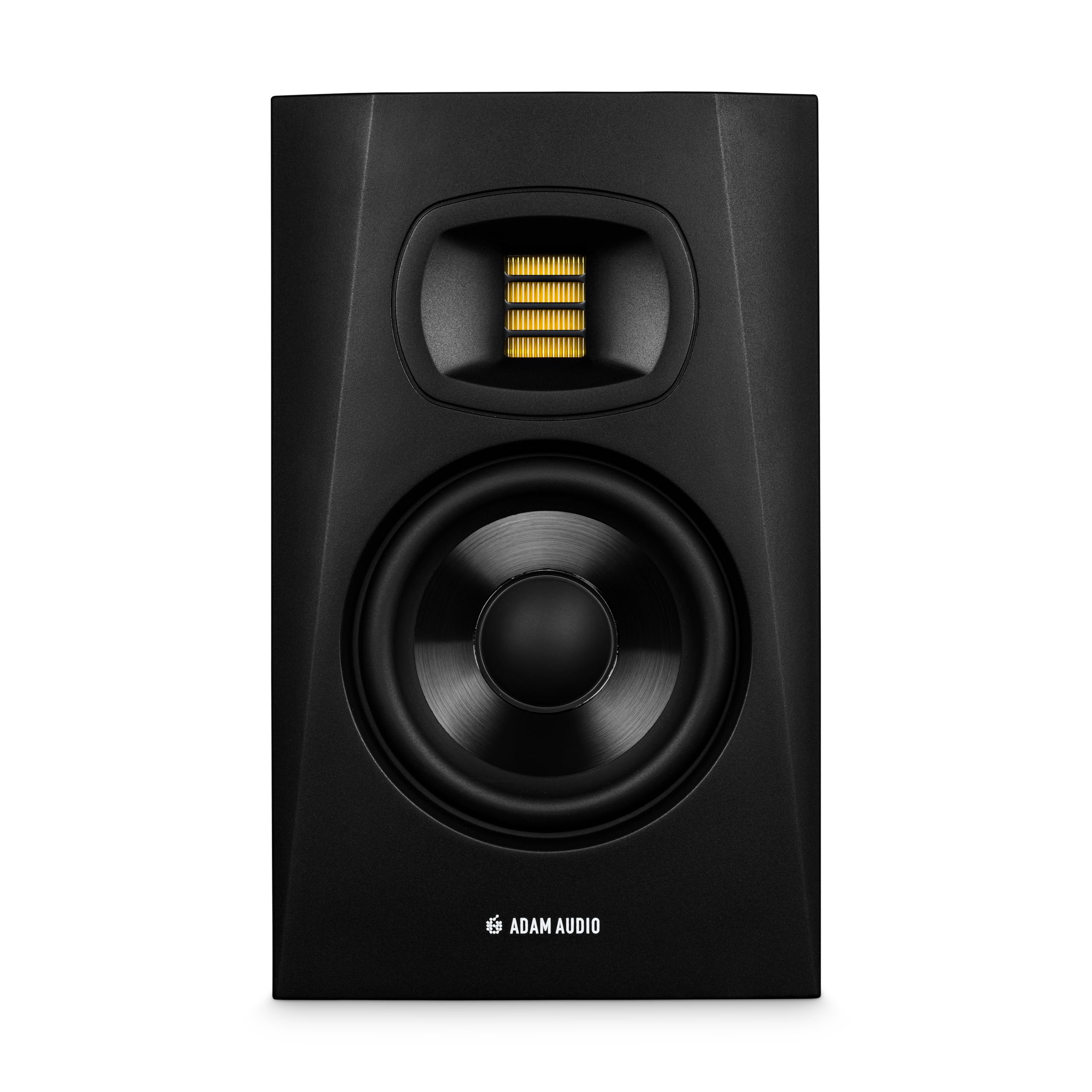
The ADAM Audio T5V uses the brand’s proprietary U-ART (Ultra Accelerated Ribbon Technology) tweeter, a folded ribbon design that moves air four times faster than a conventional dome tweeter. The result is a high-frequency response that feels open and detailed without the harshness that some metallic dome tweeters can produce. The HPS (High Propagation Spherical) waveguide controls dispersion to create a wide sweet spot while reducing comb filtering from desk reflections.
The 5-inch woofer uses a multi-layer mineral-loaded paper cone that strikes a balance between rigidity and natural damping. The rear-firing bass reflex port is paired with DSP-based high and low-shelf filters that let you dial in compensation for room boundaries. The cabinet is beveled to minimize edge diffraction, which is a refinement often found in more expensive monitors.
Connectivity is limited to XLR and RCA inputs — no TRS — which may require an adapter for some interfaces. The T5V is sold as a single unit, so you need to purchase two. Despite the lack of balanced TRS, the sound quality is praised by owners for its clarity at lower volumes, making it ideal for apartment studios where you cannot monitor loudly.
Why it’s great
- U-ART ribbon tweeter delivers exceptionally detailed highs
- HPS waveguide improves stereo imaging in untreated rooms
- DSP-based room EQ filters are precise and effective
Good to know
- No TRS input — XLR and RCA only
- Lacks some sub-bass weight compared to larger-woofer competitors
7. PreSonus Eris 5BT (Pair)

The PreSonus Eris 5BT takes the well-regarded Eris nearfield platform and adds Bluetooth 5.0 for cable-free streaming from a phone or tablet. The 5.25-inch woven-composite woofer delivers tight bass with decent extension for its size, and the 1-inch ultra low-mass silk-dome tweeter produces smooth, non-fatiguing highs. Total system power is 100 watts of Class AB amplification (50 watts per speaker), providing plenty of headroom for nearfield monitoring.
Acoustic tuning controls on the rear panel include high-frequency and low-frequency shelving filters, and the front-panel ⅛-inch TRS aux input and headphone output make daily interaction convenient. The power saver mode that engages after 40 minutes of idle time is a thoughtful addition for desk setups where you might walk away frequently.
Owners consistently note that the wired sound quality is noticeably better than Bluetooth — a difference attributed to Bluetooth 5.0’s codec limitations rather than the speakers themselves. For critical mixing, use the balanced ¼-inch TRS or unbalanced RCA inputs. The Eris 5BT is best for producers who want the flexibility of wireless convenience without sacrificing the option for a clean wired signal chain.
Why it’s great
- Bluetooth 5.0 with reliable connectivity for casual listening
- Silk-dome tweeter reduces listening fatigue during long sessions
- Multiple input types accommodate various source devices
Good to know
- Bluetooth audio quality lags behind wired connections
- Class AB amplifier runs warmer than Class D alternatives
8. Pioneer DJ DM-50D (Pair)

The Pioneer DJ DM-50D is designed specifically for the DJ workflow rather than pure music production. The 5-inch active drivers are tuned with a bass boost that gives you more low-end thump for beatmatching and track previews, and the accessible switch on the front panel lets you toggle between production mode (flatter response) and DJ mode (enhanced low-end and high-end presence).
The connectivity options include RCA and aux inputs, plus a headphone jack on the front for cue monitoring. The cabinet is sleek black MDF with a modern aesthetic that pairs well with Pioneer’s DDJ controllers. Owners note that the speakers get impressively loud for their size — one reviewer reported a house party that drew police attention.
The key trade-off is that the sound is not neutral enough for serious mixing or mastering. The pronounced upper mids and boosted bass can mask frequency balance issues in your production. If your primary use is DJ practice and track selection at home with occasional production checking, the DM-50D works well. For critical mixing, look elsewhere in this list.
Why it’s great
- Dedicated DJ and production mode switch for different use cases
- Bass boost adds punch for dance music previewing
- Matches Pioneer DJ controllers aesthetically and functionally
Good to know
- No balanced inputs — RCA and aux only
- Not neutral enough for critical mixing or mastering
9. Pioneer DJ DM-40D (Pair)

The Pioneer DJ DM-40D is technically a 4-inch monitor but earns a spot here as an entry-level gateway for producers on small desks or tight budgets. The 2-way sound mode switches between DJ and production DSP settings, and the DECO convex diffuser on the tweeter helps create a wider stereo image despite the smaller drivers. The class D amplifier operates at 96 kHz sampling, keeping the noise floor low.
The connectivity is straightforward — RCA and mini-jack inputs with a front-panel headphone socket — and the time-aligned woofer and tweeter ensure that frequencies arrive at your ears simultaneously, reducing phase smear. The 4-inch woofer produces distortion-free sound at moderate volumes, but you will hit the woofer’s excursion limits earlier than with a true 5-inch monitor.
Owners praise the DM-40D for its clarity during DJ practice and its compact footprint. However, the limited bass extension and slightly colored voicing make these more suitable for track selection and casual listening than for final mix decisions. If your budget can stretch to a 5-inch monitor, you will gain meaningful low-end accuracy.
Why it’s great
- DECO diffuser improves stereo imaging for a small driver
- 2-way sound mode adapts to DJ or production needs
- Compact size fits cramped desk setups
Good to know
- 4-inch driver limits bass extension and maximum SPL
- Sound is not neutral enough for mastering work
FAQ
Do I need an audio interface to use 5 inch studio monitors?
How far should 5 inch studio monitors be from the wall?
Can I use 5 inch studio monitors for casual music listening?
Final Thoughts: The Verdict
For most users, the 5 inch studio monitors winner is the JBL 305P MkII (Pair) because it combines the widest sweet spot in the category with boundary EQ controls that actually work on a real desk. If you want absolute frequency neutrality for mastering work, grab the Yamaha HS5 (Pair). And for transient detail and build quality that justifies the premium, nothing beats the Focal Alpha 50 Evo.