
Our readers keep the lights on and the weekend projects moving. As an Amazon Associate, I earn from qualifying purchases.
When the cell signal drops out on a remote trail, a job site, or during an emergency, a 5-watt walkie talkie becomes your only thread to the group. The difference between a frustrating day of garbled audio and seamless coordination comes down to build quality, receiver sensitivity, and the right balance of power and battery life. This guide cuts through the noise to find the handhelds that actually deliver on their range claims.
I’m Rikta — the co-founder and writer behind FitlyFast. I’ve spent countless hours analyzing transmitter specs, battery chemistries, and real-world user range reports to separate the rugged performers from the overhyped shelf-fillers.
Whether you are equipping an off-road convoy, a construction crew, or a backcountry hiking group, this deep dive into the best 5 watt walkie talkie options will help you pick a radio that communicates as far and as clearly as you need it to.
How To Choose The Best 5 Watt Walkie Talkie
Not all 5-watt radios are created equal. The advertised wattage is just one part of the equation — real-world range depends heavily on the antenna, receiver sensitivity, and the environment you are operating in. Here are the critical factors to evaluate before you buy.
Receiver Architecture: Superheterodyne vs. SDR
The receiver inside the radio determines how well it can pick up weak signals from far away. A superheterodyne receiver, used in radios like the Wouxun KG-905G Plus, is more selective and sensitive than a software-defined radio (SDR). This means you get clearer audio and a longer usable range, especially in noisy urban or forested environments. SDR radios are cheaper to manufacture but often suffer from desensitization when multiple signals are present.
Durability & Environmental Sealing
For outdoor use, the IP rating tells you how well a radio is sealed against the elements. An IP67 rating certifies that the unit is dust-tight and can survive immersion in up to one meter of water for 30 minutes. Radios with IP54 or IP66 ratings offer splash and dust resistance but cannot be fully submerged. If you are on the water, near rivers, or in heavy rain, an IP67 or better rating is a wise investment.
Battery Capacity and Charging Options
A 5-watt transmitter draws significant current when keyed up. Look for a battery capacity of at least 1500mAh to get through a full day of moderate use. USB-C charging has become a game-changer, allowing you to top up from a power bank, vehicle charger, or laptop. Some models still rely on proprietary drop-in chargers, which can be limiting in the field. If you plan multi-day trips, the ability to swap batteries or charge via USB-C is essential.
Repeater Compatibility and Channel Count
For GMRS radios, repeater capability is what takes your range from a few miles to dozens of miles across rough terrain. Radios that support repeater channels let you piggyback on existing infrastructure to communicate over mountain ridges and far valleys. The number of channels, while important for organizing groups, is secondary to whether the radio supports repeater splits and CTCSS/DCS tone programming.
Quick Comparison
On smaller screens, swipe sideways to see the full table.
| Model | Category | Best For | Key Spec | Amazon |
|---|---|---|---|---|
| BTECH GMRS-PRO | Premium | Tech-forward users & GPS location sharing | IP67, Bluetooth, GPS, 2600mAh | Amazon |
| Midland GXT67 Pro | Premium | Rugged overlanding & off-road use | IP67 sealed chassis, repeater capable | Amazon |
| Wouxun KG-905G Plus | Mid-Range | Pure performance with superheterodyne receiver | Superheterodyne, IP66, Bluetooth | Amazon |
| Midland MXT105 MicroMobile | Mid-Range | Vehicle base station & convoy use | 15 GMRS channels, external antenna | Amazon |
| BTECH GMRS-V2 | Mid-Range | Customizable channels & CHIRP programming | 200 channels, USB-C, IP54 | Amazon |
| Retevis RB48 | Entry-Level | Water sports, kayaking, & floating radios | IP67, floats, MIL-STD-810H | Amazon |
| SAMCOM FPCN30A | Entry-Level | Job site group call & commercial use | 20 UHF channels, group call, 1500mAh | Amazon |
In‑Depth Reviews
1. BTECH GMRS-PRO

The BTECH GMRS-PRO is the most feature-dense 5-watt handheld on the market for its price. Beyond standard GMRS and repeater support, it packs Bluetooth audio and data connectivity, GPS-based location sharing, a built-in digital compass, and full NOAA weather monitoring. It connects to a smartphone app for easy channel programming and text messaging, making it a true smart radio for off-grid communication.
The IP67 dust and water protection rating ensures it survives mud, rain, and temporary submersion — crucial for trail riders and hikers. The 2600mAh battery delivers around 14 hours of mixed use, and USB-C charging allows you to recharge from portable power banks. The audio clarity is excellent, and users consistently report hitting repeaters 20 miles away with the stock antenna.
Some trade-offs exist: the belt clip is notoriously hard to install, and the menu system can feel a bit sluggish when navigating between features. The build quality, while solid, does not feel as premium as some of the higher-priced competitors. Still, for anyone who wants GPS, texting, and Bluetooth integration in a waterproof 5W form factor, this is the undisputed value champion.
Why it’s great
- GPS location sharing and texting via Bluetooth app
- IP67 waterproof and dustproof for tough environments
- USB-C charging and long 2600mAh battery life
Good to know
- Belt clip is difficult to install and remove
- Menu interface can be slow when scrolling
2. Midland GXT67 Pro

The Midland GXT67 Pro is engineered for overlanders, off-roaders, and anyone who needs a radio that can survive a serious beating. Its fully integrated IP67 chassis is sealed shut — no removable battery door to leak — and it is designed to be washed off in a sink after a muddy day on the trail. This is a radio built for dust, mud, and full submersion in up to three feet of water.
It pushes the full 5-watt GMRS limit and supports repeater connectivity for extending range far beyond line-of-sight. The controls are refreshingly simple: oversized buttons and a high-visibility backlit display that you can operate with gloves on. It pairs seamlessly with Midland’s MicroMobile series for vehicle-to-spotter communication. The included hard travel case, desktop charger, and AC/DC adapters make it an all-in-one expedition kit.
The main downside is the fixed antenna, which limits your ability to upgrade for extra range. The higher price point also puts it firmly in the premium tier, though the build quality matches professional-grade Motorola units. If your priority is a radio that will not fail in extreme conditions, the GXT67 Pro is your best bet.
Why it’s great
- Fully sealed IP67 chassis with no battery door vulnerability
- Repeater capable for extended range beyond hills
- Comes with hard case, desktop charger, and car adapter
Good to know
- Fixed antenna cannot be upgraded for more range
- Higher price point compared to other 5W handhelds
3. Wouxun KG-905G Plus
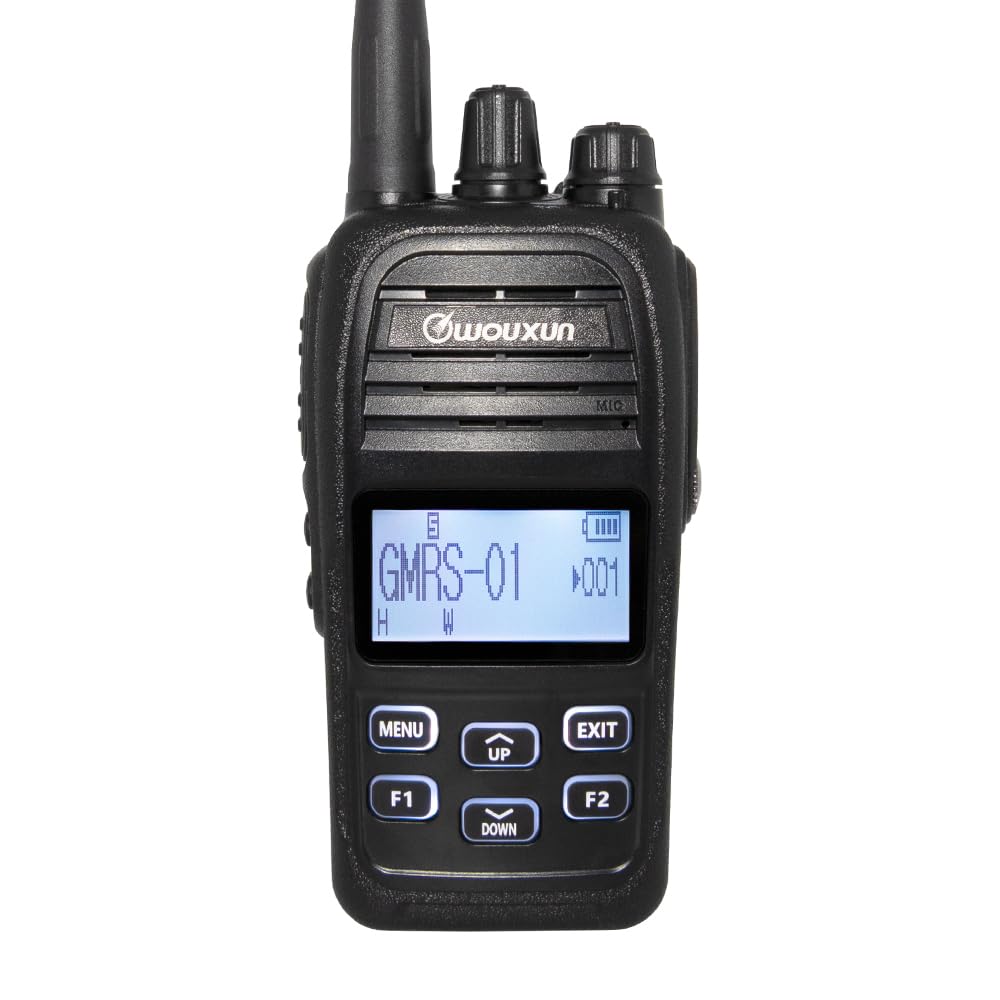
The Wouxun KG-905G Plus is the go-to choice for radio enthusiasts who value receiver performance above all else. Its superheterodyne receiver architecture is significantly more selective than the SDR-based receivers found in most budget radios. This means it can pull weak signals out of noisy environments and maintain clear audio at longer distances — a genuine advantage in dense forests or urban canyons.
It comes pre-programmed with 22 GMRS simplex channels and 8 repeater channels right out of the box, and supports up to 256 custom channels with 16 groups via PC programming. The IP66 rating protects against powerful water jets and dust, making it suitable for heavy rain and dusty trails. The high-visibility display is easy to read in direct sunlight, a feature often overlooked but vital for field use.
The unit is heavier than many competitors due to the robust chassis, and the Bluetooth feature is limited to audio accessories rather than full app integration. The menu system, while logical, does require some manual reading to master. For those who prioritize audio clarity and raw signal sensitivity, this radio outperforms many options at twice the price from an audio standpoint.
Why it’s great
- Superheterodyne receiver offers superior signal clarity
- Easy out-of-box setup with pre-loaded GMRS channels
- High-visibility display readable in direct sunlight
Good to know
- Heavier than many other 5W handheld models
- Bluetooth limited to audio, no app pairing
4. Midland MXT105 MicroMobile
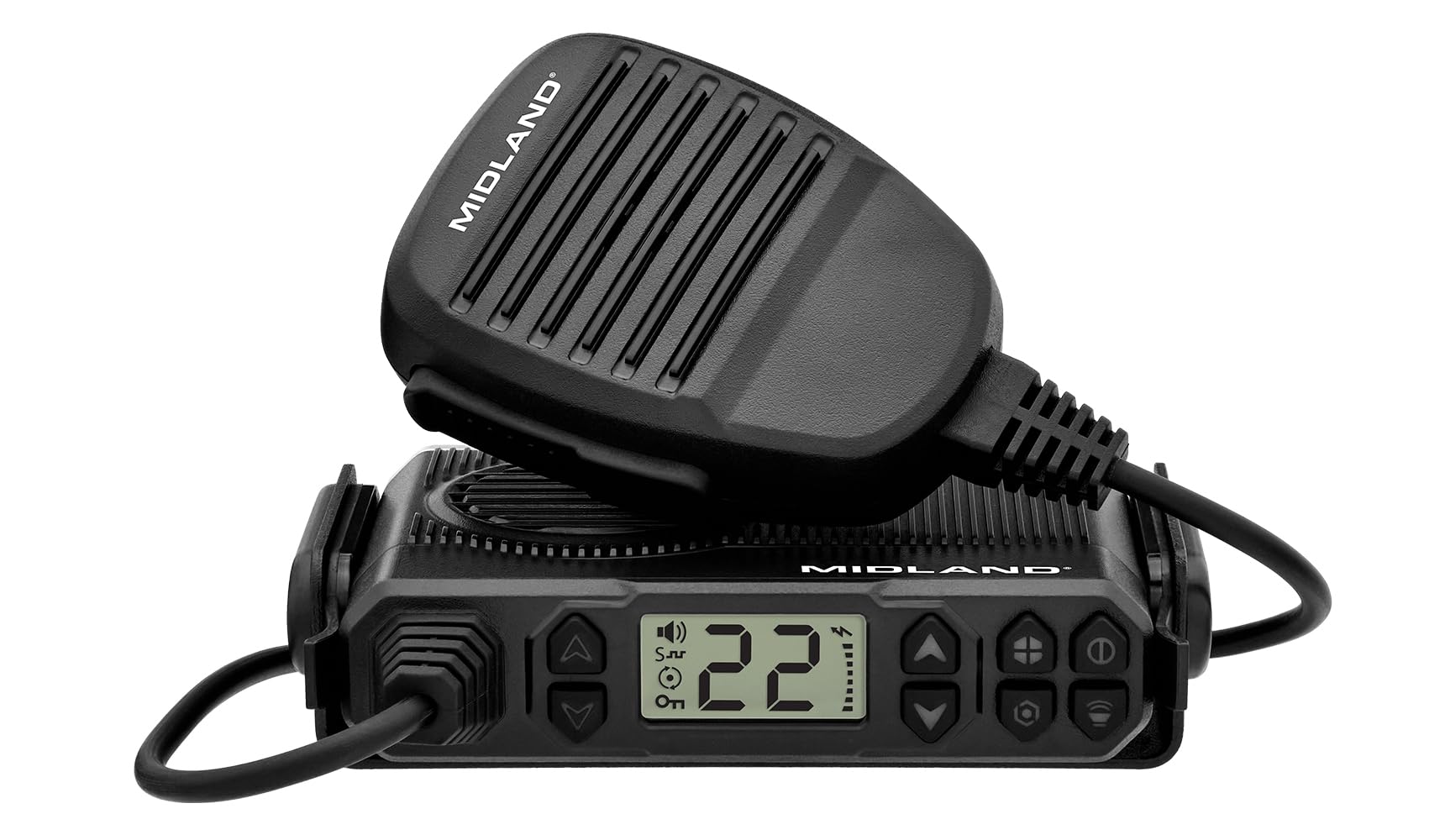
The Midland MXT105 is a 5-watt mobile radio, not a handheld, designed specifically for permanent or semi-permanent installation in a vehicle. Its compact control head can be mounted on the dashboard or center console, while the external magnetic mount antenna gives it a significant range advantage over handhelds by placing the antenna outside the vehicle’s metal cage.
It operates on 15 GMRS high/low power channels and supports 142 CTCSS/DCS privacy codes to filter out chatter. The full NOAA weather scan and alert feature automatically locks onto the strongest weather channel and sounds an alarm for severe weather. Users consistently report excellent audio clarity with zero interference, and the unit is praised for its dead-simple plug-and-play installation — no programming required.
The provided magnetic antenna is functional but has been criticized as looking and feeling cheap, and some users experienced range limitations until replacing it with a higher-gain option. The radio has also been known to lock up on a setting occasionally, requiring a power cycle to reset. For off-road convoys and farm vehicles where a dedicated mobile rig is needed, the MXT105 is a proven performer.
Why it’s great
- External antenna for superior vehicle-to-vehicle range
- True plug-and-play with no programming required
- NOAA weather scan and alert for severe weather
Good to know
- Stock antenna feels cheap and may need upgrading
- Occasional lock-up requiring a power cycle
5. BTECH GMRS-V2

The BTECH GMRS-V2 offers a remarkable balance of features and affordability. With 200 fully customizable channels, CHIRP programming support, and dual-band VHF/UHF scanning, it punches well above its price point. The USB-C charging is a modern convenience that makes field recharging easy, and the included desktop charger gives you a reliable home base option.
Its IP54 weather resistance protects against dust and splashes, making it suitable for camping, hiking, and general outdoor use. The dual PTT controls allow you to monitor two channels simultaneously, and the NOAA weather broadcast receiver keeps you informed of changing conditions. Users report reliable reception and the ability to connect to distant repeaters with just a simple antenna swap.
The battery indicator is known to be misleading — it shows full until the voltage drops sharply near the end — so relying on the voltage readout is recommended. The included antenna works fine for most use, but upgrading to a longer antenna noticeably improves range. For budget-conscious buyers who want advanced features and the ability to customize, the GMRS-V2 is the top recommendation.
Why it’s great
- 200 customizable channels with CHIRP programming
- USB-C charging for flexible power from any source
- Excellent price-to-feature ratio for GMRS radios
Good to know
- Battery indicator provides inaccurate readout
- Stock antenna benefits from an upgrade for longer range
6. Retevis RB48
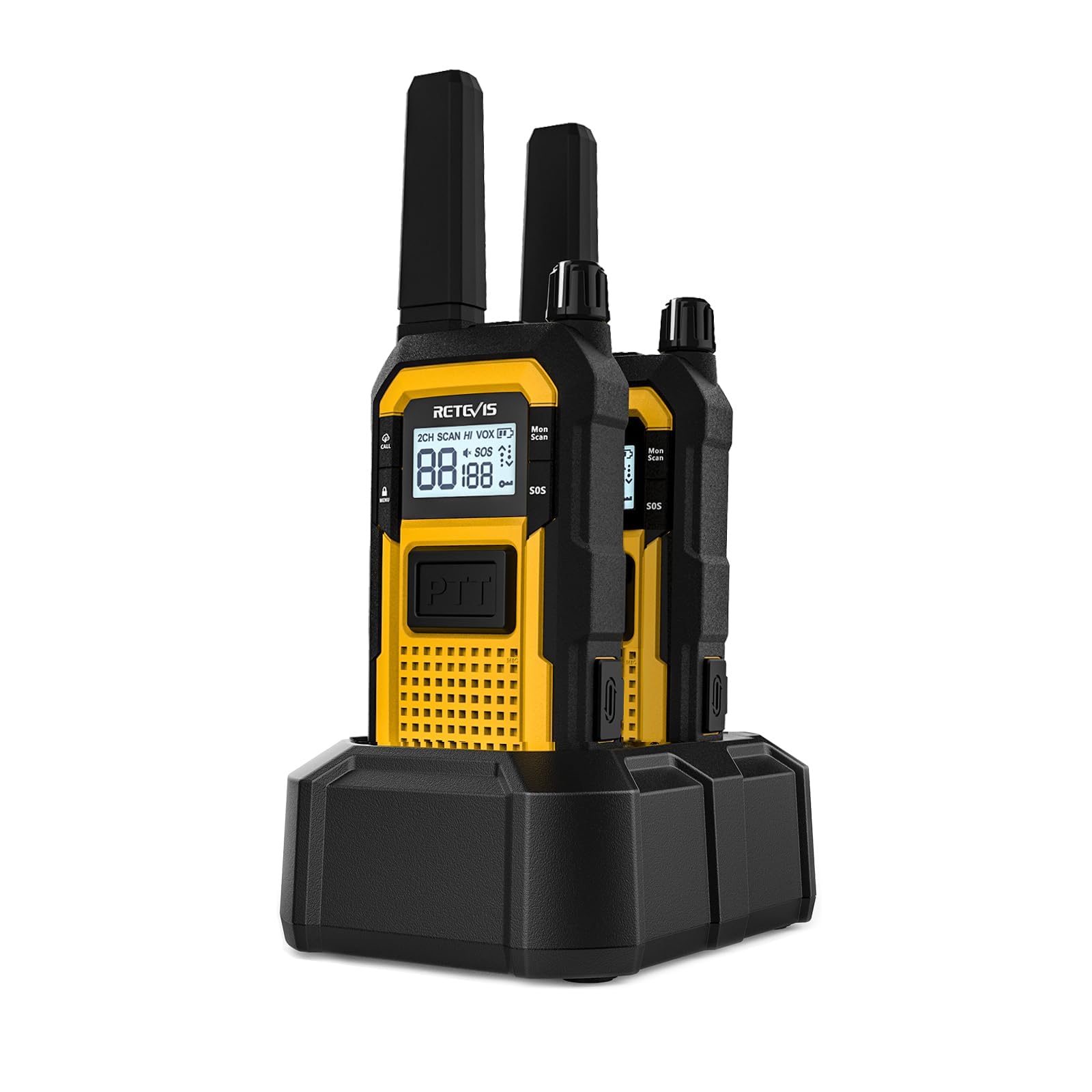
The Retevis RB48 is the best choice for water enthusiasts. It is IP67 rated, which means it is dust-tight and can survive immersion in water, but what sets it apart is that it is designed to float. If it bounces out of a kayak or drops in a river, you simply grab it from the surface rather than diving for a dead radio. The bright yellow high-visibility color is a practical bonus in low-light conditions.
It meets MIL-STD-810H standards for drops, vibration, and extreme temperatures, having passed 1000 two-meter drops without breaking. The 2000mAh battery provides up to 20 hours of runtime, and charging is handled via USB-C or the included desktop dock. The silicone button covers make it easy to operate with wet hands or gloves, and the roger beep confirms the end of a transmission.
The FRS license-free operation means anyone in your group can use it without a license, but this also limits power to 2 watts maximum on FRS frequencies. The display is prone to scratching easily, even from a fingernail, so a screen protector is recommended. For kayak trips, beach days, or any environment where dropping a radio in water is a real risk, the RB48 is the practical choice.
Why it’s great
- Designed to float and survive full water immersion
- MIL-STD-810H tested for extreme drops and vibration
- Long 20-hour battery life with USB-C charging
Good to know
- Display scratches very easily
- FRS license-free limits power to 2 watts
7. SAMCOM FPCN30A

The SAMCOM FPCN30A is purpose-built for construction sites, warehouses, and event management. Its standout feature is the instant group call capability, which lets you broadcast a message to all units across different channels simultaneously — perfect for site-wide safety alerts or urgent coordination. The 5 watts of UHF power penetrates concrete walls and steel beams effectively, covering over 300,000 square feet indoors.
The 20 UHF channels allow you to split your crew into separate teams without interference. The included K-type earpieces keep communications private in noisy environments. The 1500mAh battery provides eight hours of continuous use, covering a full shift. The large LCD display is easy to read, and the physical lock button prevents accidental channel changes in a pocket or on a belt.
The radios are not pre-programmed to standard channel frequencies out of the box, which means you will need a USB programming cable (not included) to set them up for use with other brands. The one-key group call feature, while powerful, only works within the same manufacturer’s fleet. For closed groups at a job site or event where everyone uses the same radio, the FPCN30A delivers reliable communication.
Why it’s great
- One-key group call broadcasts to all channels instantly
- 5W UHF signal penetrates concrete and steel well
- Large LCD with lock function for job site use
Good to know
- Requires USB cable to program standard frequencies
- Group call only works within SAMCOM models
FAQ
Do I need a license to operate a 5 watt GMRS walkie talkie?
How far can I actually communicate with a 5 watt walkie talkie?
What is the difference between GMRS and FRS frequencies?
Why should I care about superheterodyne vs SDR receiver?
Can I charge a 5 watt walkie talkie with a power bank?
Final Thoughts: The Verdict
For most users, the best 5 watt walkie talkie winner is the BTECH GMRS-PRO because it packs the most features — GPS location sharing, Bluetooth texting, IP67 waterproofing, and USB-C charging — into a package that still offers excellent value. If you want pure radio performance with the clearest receiver, grab the Wouxun KG-905G Plus. And for rugged overlanding and vehicle-to-spotter communication where durability is the top priority, nothing beats the Midland GXT67 Pro.