
Our readers keep the lights on and the weekend projects moving. As an Amazon Associate, I earn from qualifying purchases.
A 50-amp inverter generator is the threshold where portable power meets whole-home capability. Unlike standard generators that bog down with sensitive electronics, inverter models produce clean, stable electricity that protects your refrigerator, furnace control board, and expensive electronics. The 50-amp outlet specifically unlocks true 240-volt, 12,000-watt transfer switch compatibility—meaning one unit can power your well pump, multiple AC circuits, and kitchen appliances simultaneously during an outage. The challenge is separating real 50-amp-rated generators from units that merely include a 50-amp receptacle but lack the sustained wattage to actually use it.
I’m Rikta — the co-founder and writer behind FitlyFast. I’ve spent years analyzing portable power station specs, inverter topologies, and real-user load tests to identify which generators can realistically supply 50-amp service without tripping under sustained loads or damaging connected gear.
In this guide, I break down every critical spec and real-world performance factor to help you choose the absolute best 50 amp inverter generator for your home backup or RV boondocking needs.
How To Choose The Best 50 Amp Inverter Generator
Selecting a 50-amp inverter generator requires understanding that the 50-amp receptacle is only useful if the generator can sustain enough wattage to actually supply that current. A unit rated for 7,500 running watts will hit its limit far below the 12,000 watts a true 50-amp, 240-volt circuit demands—even if it physically has the plug. Focus on sustained running wattage first, then verify the outlet type matches your transfer switch inlet.
Running Wattage vs. Peak Wattage
Peak watts last only milliseconds during motor startup. Running watts determine what you can actually power hour after hour. For a 50-amp, 240-volt transfer switch, you need a generator with at least 10,000 running watts on gasoline. Propane running watts are typically 10-15% lower—factor that in if you plan to rely on propane.
Fuel Type Flexibility
Dual-fuel (gasoline + propane) and tri-fuel (adds natural gas) options give you operational flexibility during extended outages when only one fuel source may be available. Propane and natural gas run cleaner and don’t degrade in storage, making them ideal for emergency backup. However, your generator’s available running watts will drop on propane—check the specs carefully before assuming full output on any fuel.
50-Amp Outlet Types
Not all 50-amp outlets are identical. The NEMA 14-50R is the standard 120/240-volt, 50-amp RV and home inlet receptacle. Some generators use a NEMA SS2-50R (locking) or a 14-30R (30-amp). If your transfer switch requires a specific plug, verify compatibility. Also confirm the generator actually delivers 240 volts across both legs—some cheap units only provide 120 volts through the “50-amp” outlet, which defeats the purpose.
Noise Levels and Enclosure
Inverter generators are inherently quieter than conventional open-frame units, typically operating at 58-68 dBA. A fully enclosed design reduces noise further and protects components from weather. However, enclosed inverters can run hotter, so check if the manufacturer includes a robust cooling fan system. For neighborhood-friendly backup, aim for 65 dBA or less at 23 feet.
Safety and Shutdown Features
CO shutoff (CO-MINDER or similar) is now standard on most new models and is a critical safety feature if the generator operates near living spaces. Low-oil shutdown protects the engine from self-destruction during extended runs. Overload protection prevents damage to connected devices and the generator’s alternator. A battery tender maintains the electric start battery so it’s ready when needed.
Quick Comparison
On smaller screens, swipe sideways to see the full table.
| Model | Category | Best For | Key Spec | Amazon |
|---|---|---|---|---|
| DuroMax XP16000iH | Inverter | Whole Home Backup | 13,000W running (gas) | Amazon |
| Honda EU7000iS | Inverter | Reliable Quiet Power | 58 dBA at rated load | Amazon |
| DuroMax XP11000iH | Inverter | RV + Home Combo | 9,000W running (gas) | Amazon |
| Pulsar PGD105TiSCO | Inverter | Tri-Fuel Flexibility | 8,500W running (gas) | Amazon |
| AIVOLT 11250W | Inverter | 50A RV Ready | 9,000W running (gas) | Amazon |
| Westinghouse iGen11000DFc | Inverter | Clean Power Emphasis | 9,000W running (gas) | Amazon |
| GENMAX GM10500XiT | Inverter | Tri-Fuel + ATS Ready | 7,800W running (gas) | Amazon |
| Pulsar PGD95BISCO | Inverter | Extended Propane Use | 7,200W running (LPG) | Amazon |
| AIVOLT 8000W | Inverter | Compact 50A Output | 6,100W running (gas) | Amazon |
| Westinghouse WGen11500DFc | Open Frame | High Output Open Frame | 11,500W running (gas) | Amazon |
| Champion 4500W | Inverter | Budget RV/Camping | 3,500W running (gas) | Amazon |
| WEN DF480iX | Inverter | Entry Level Dual Fuel | 4,000W running (gas) | Amazon |
| WEN 56477i | Inverter | Budget Gas Only | 4,000W running (gas) | Amazon |
In‑Depth Reviews
1. DuroMax XP16000iH
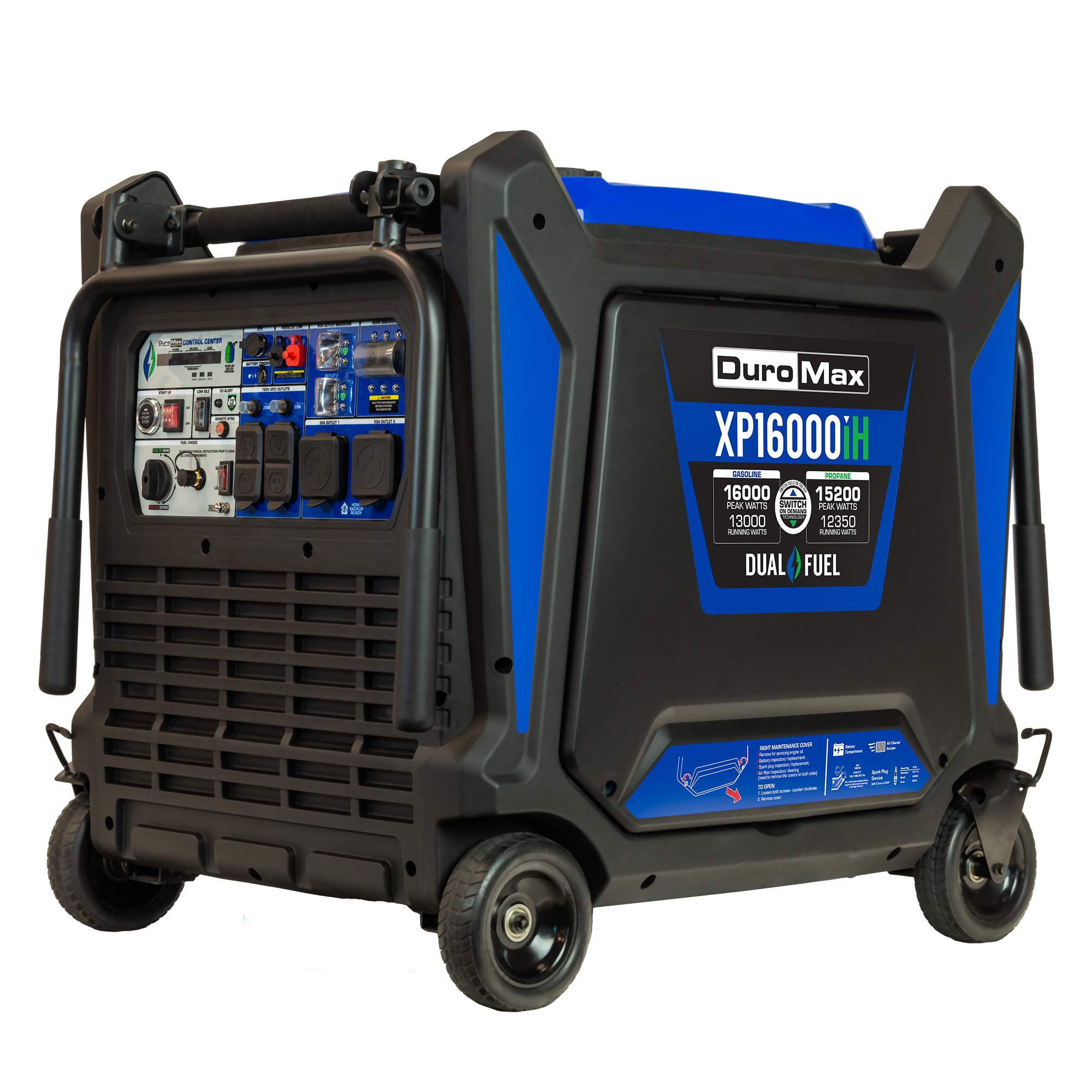
The DuroMax XP16000iH is the heaviest hitter on this list—16,000 peak watts and 13,000 running watts on gasoline, making it one of the few inverter generators that can genuinely supply a full 50-amp, 240-volt circuit without sweating. Its 459cc engine is paired with Duromax’s inverter technology, producing clean power (under 3% THD) safe for all sensitive electronics. The dual-fuel capability lets you switch to propane, though running watts drop to around 10,400 on LPG.
The control center includes an LCD display for voltage, frequency, and runtime, plus a remote start fob that works from inside the house. At 368 pounds, this unit requires a hand truck or strong helper to move, but the built-in wheel kit and handle make rolling it manageable. The CO shutoff and low-oil shutdown provide peace of mind during extended runs.
Some users reported break-in issues with metal shavings in the oil, which is typical for new engines but warrants an early oil change at 5 hours. A smaller number experienced starter failures before 50 hours. The 3-year limited warranty is solid, but given the price point, verifying seller support before purchase is wise.
Why it’s great
- True 13,000W running capacity for whole-home 50A backup
- Clean inverter power (under 3% THD)
- Remote start and digital display
Good to know
- Extremely heavy at 368 lbs
- Some reports of early starter failures
- Requires careful seller research for warranty support
2. Honda EU7000iS
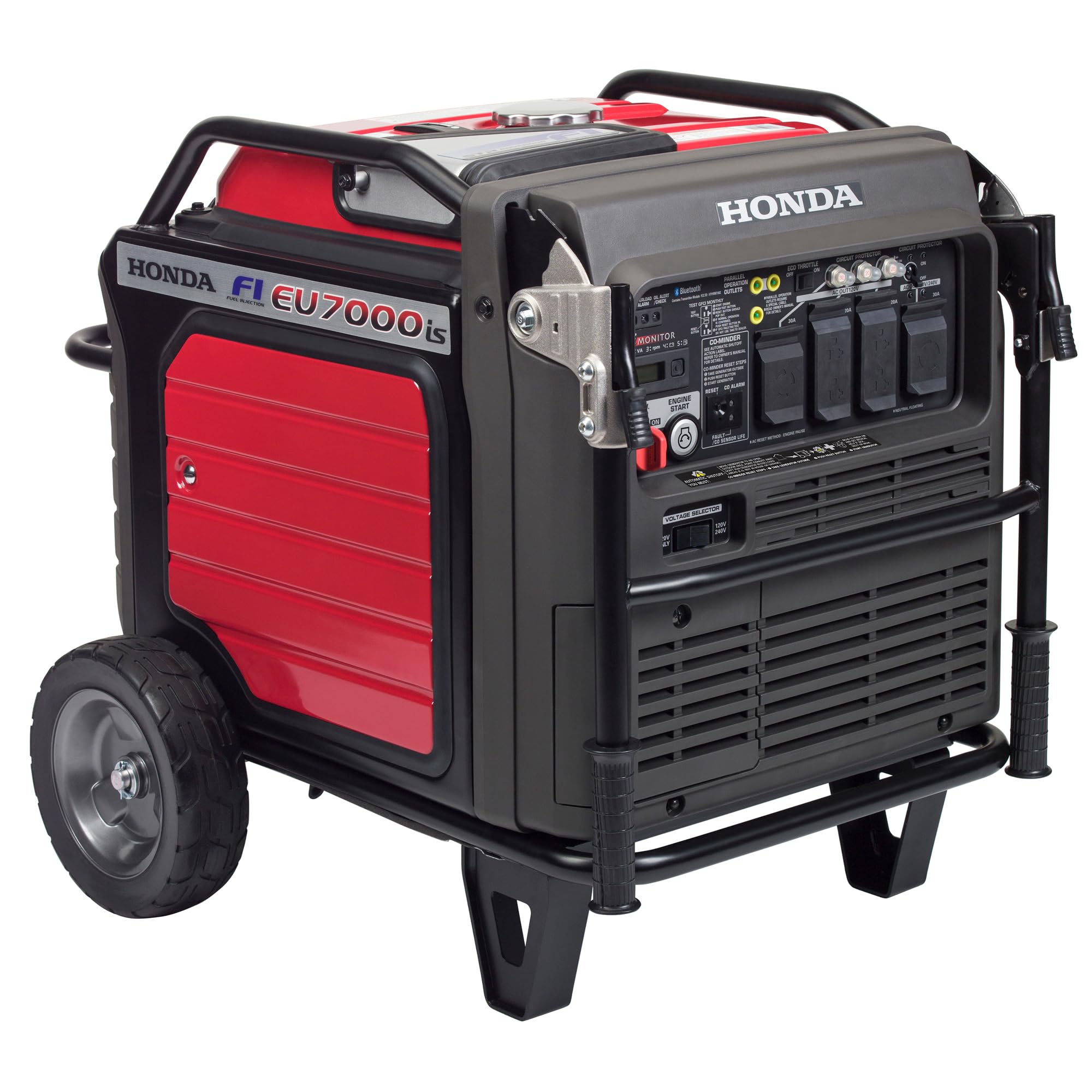
Honda’s EU7000iS is the gold standard for noise-sensitive environments—it operates at just 52 to 58 dBA, quieter than a normal conversation. This 7,000-watt inverter generator (7,000 peak, 5,500 running) is not a 50-amp unit by itself, but it is a critical building block for a 50-amp setup when paired with a second unit via a parallel kit (Honda’s proprietary parallel cables). Its 389cc engine produces exceptionally clean sine-wave power, and the Eco Throttle system adjusts engine speed to load, dramatically improving fuel economy.
The Bluetooth-enabled My Generator app allows remote start, stop, and monitoring from your phone—unmatched convenience in this class. The CO-MINDER sensor automatically shuts down the generator if CO levels rise. At 263 pounds, it’s still heavy, but the built-in wheels and fold-down handle make it rollable.
The major limitation is its 30-amp, 240-volt L14-30R outlet—not a 50-amp NEMA 14-50R. To use it for whole-home 50-amp backup, you need a parallel setup or a step-up adapter, which adds cost. The price is also the highest on this list per watt. But for those who prioritize reliability, near-silent operation, and Honda’s legendary longevity, this is the benchmark.
Why it’s great
- Extremely quiet—58 dBA or less
- Bluetooth app control with remote start
- Honda build quality and longevity
Good to know
- Only 30A outlet; must parallel for 50A
- Highest price per watt in this roundup
- Not CARB approved for California
3. DuroMax XP11000iH
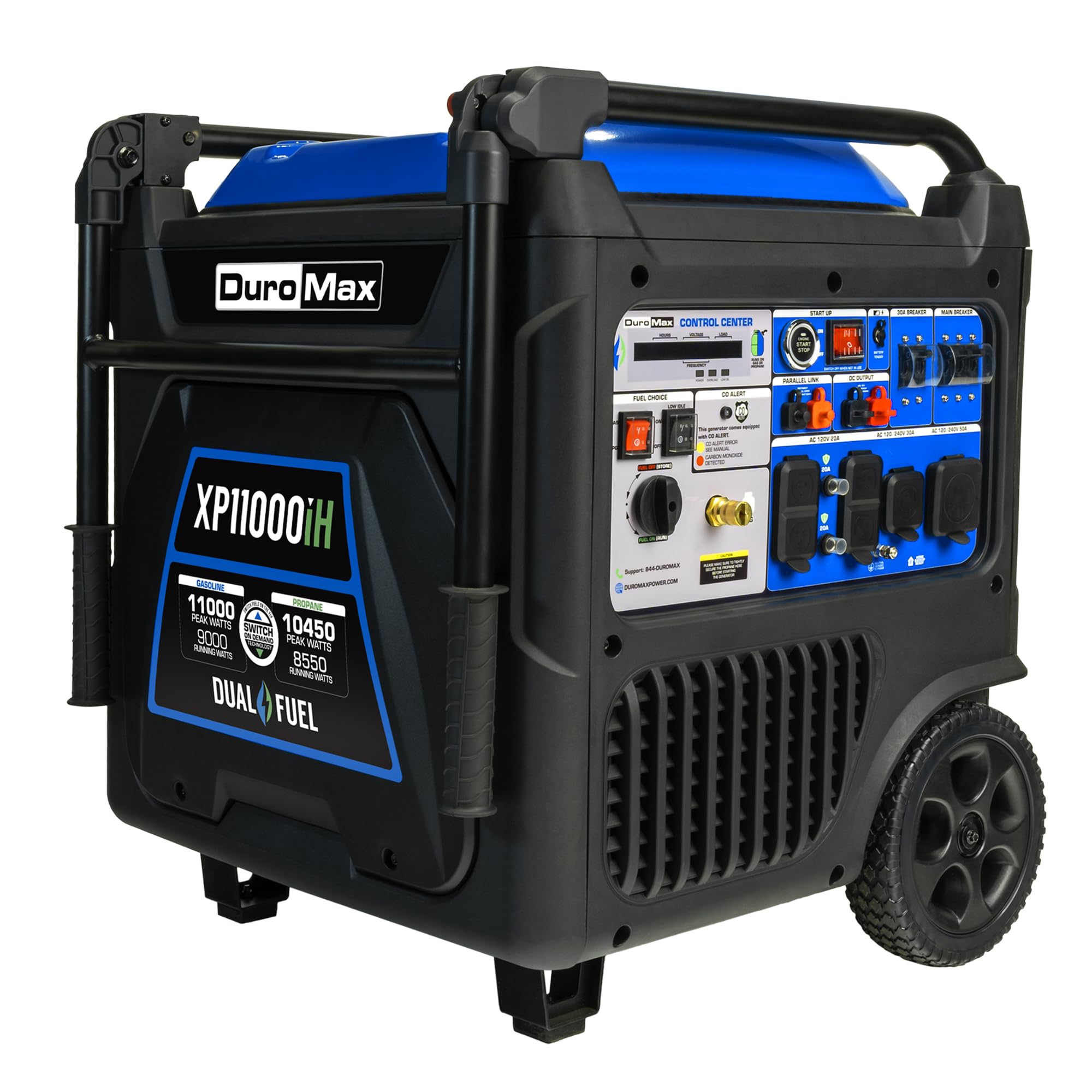
The DuroMax XP11000iH delivers 11,000 peak watts and 9,000 running watts on gasoline, making it a legitimate 50-amp contender for larger RVs with dual air conditioners or for home backup. It includes a proper NEMA 14-50R 50-amp outlet, plus a 30-amp twist-lock. The dual-fuel system runs on gasoline or propane, and the remote start fob works up to 80 feet away.
The digital control center shows hours, voltage, and load, and the battery tender keeps the start battery charged. At 216 pounds, it’s light enough for two people to load into a pickup bed. The parallel capability lets you combine two units for up to 18,000 running watts.
Lab testing revealed the running watts are realistic compared to some competitors—users report it handles a 50-amp travel trailer with two AC units plus lights and a microwave. However, the oil fill location is awkward, making oil changes messy. Some users also note the noise level is higher than the 61 dBA claim, closer to 67 dBA under load.
Why it’s great
- True 50A 240V output for big RVs or homes
- Remote start and parallel capable
- Relatively manageable weight
Good to know
- Oil fill design is messy
- Noisier than advertised under load
- Some units struggle with surge loads
4. Pulsar PGD105TiSCO

The Pulsar PGD105TiSCO is one of the rare tri-fuel inverter generators—it runs on gasoline (10,500 peak/8,500 running), propane (9,500/8,000), and natural gas (8,400/6,800). This flexibility is invaluable for extended emergencies when gas stations are closed or propane tanks run dry. Its 458cc engine is paired with inverter technology for under 3% THD.
The control panel offers dual USB ports (USB-A and USB-C), four GFCI 120V outlets, a 30-amp twist-lock, and a 50-amp NEMA 14-50R outlet. The remote start fob works reliably, and the digital display shows hours, voltage, load, and frequency. At 247 pounds, it’s heavy but manageable with the built-in wheel kit.
Hurricane Beryl users reported it powered entire homes on natural gas with no issues. However, some units arrived with defects—failure to start due to a faulty fuel selector knob—suggesting QC is inconsistent. Also, the low-idle mode struggles with motor loads like refrigerators cycling on and off.
Why it’s great
- Tri-fuel capability (gas, propane, natural gas)
- True 50A 240V outlet included
- Quiet for its class at 62 dBA
Good to know
- Mixed quality control out of the box
- Low-idle mode not ideal for motor loads
- Heavy—247 lbs
5. AIVOLT 11250W Dual Fuel
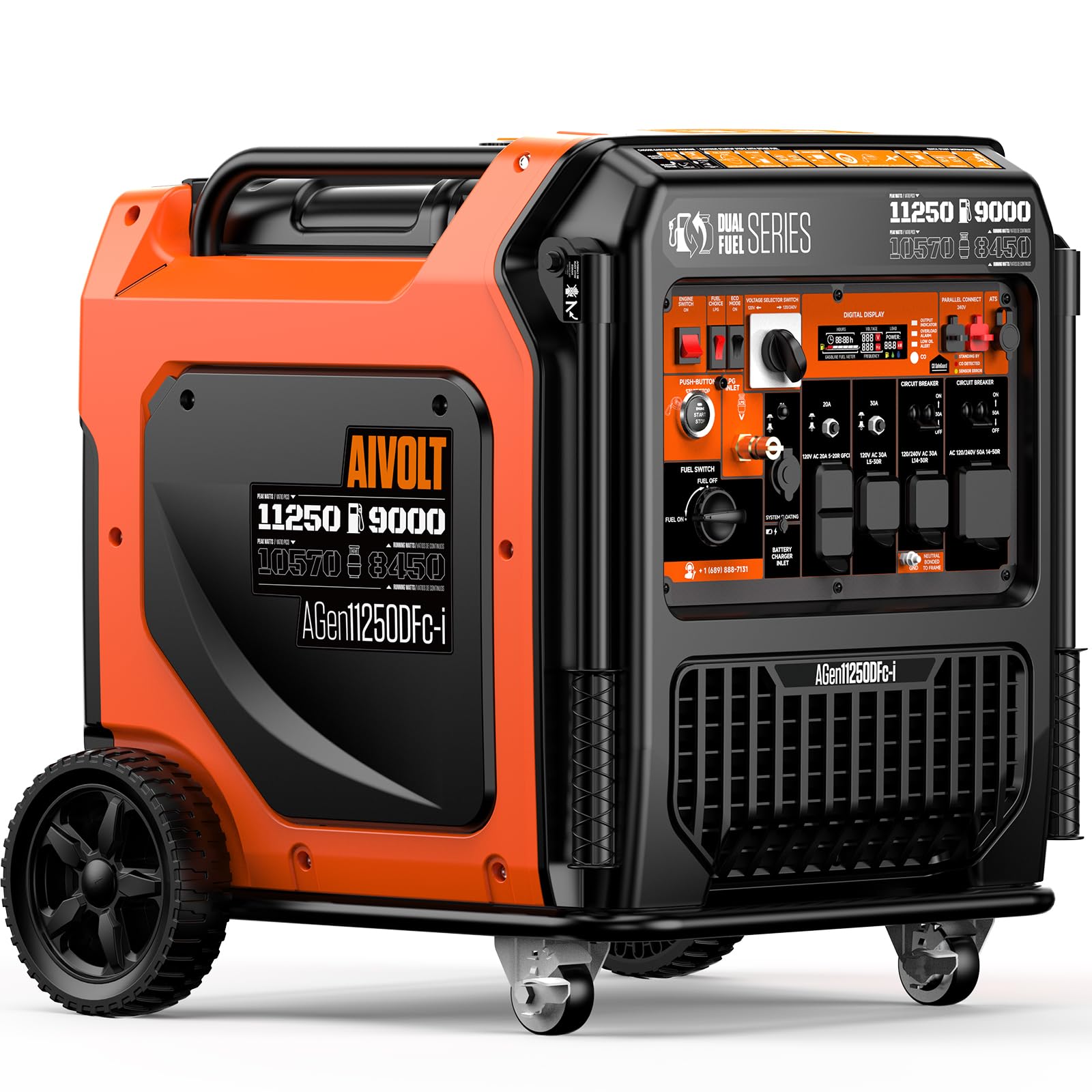
The AIVOLT 11250W offers 11,250 peak watts and 9,000 running watts on gasoline (10,570 peak/8,540 running on propane) in a fully enclosed inverter package. It is CARB-compliant and available in all 50 states, including California—a significant advantage over many competitors. The 50-amp NEMA 14-50R outlet is standard, making it plug-and-play for RV parks and home transfer switches.
The automatic fuel-switching technology lets you swap from gas to propane without stopping the engine. The 5-in-1 LCD display monitors fuel level, voltage, frequency, output, and runtime. The ECO mode adjusts engine speed to load for fuel savings—users report up to 19 hours of runtime at 25% load.
Noise levels rated at 62 dBA at 23 feet are realistic based on user feedback, though it gets louder under heavy load. A small number of users experienced total generator failure in the first hour of operation, and one reported overseas-based support that was difficult to navigate.
Why it’s great
- CARB compliant for all 50 states
- Hot-switch fuel selection between gas and propane
- Long runtime with ECO mode
Good to know
- Occasional early failure reports
- Support based overseas
- Full restart after shutdown requires cool-down
6. Westinghouse iGen11000DFc

Westinghouse’s iGen11000DFc produces 11,000 peak watts and 9,000 running watts on gasoline, with a 50-amp NEMA 14-50R outlet and a 30-amp L14-30R. The inverter technology delivers under 3% THD, producing clean enough power for sensitive electronics. The 457cc engine includes a cast-iron sleeve for durability.
The remote start fob works from up to 80 feet, and the LED data center cycles through fuel level, power output, remaining runtime, voltage, and lifetime hours. The 9.8-gallon fuel tank provides up to 17 hours of runtime on ECO mode. Users report excellent power quality—one user noted it runs a Tesla at 20-25 miles per hour charge rate via the 50-amp outlet.
The LP connection is a minor annoyance—the regulator is attached to the hose, and the fitting can feel loose. Some users also mention that the CO sensor can trigger false shutdowns on still days when exhaust accumulates near the unit. At 187 pounds, it’s among the lighter 50-amp inverter generators.
Why it’s great
- Excellent power quality with low THD
- Lightweight for its class at 187 lbs
- Long runtime and remote start
Good to know
- LP hose connection feels loose
- CO sensor may trigger false shutdowns
- Not as quiet as Honda competition
7. GENMAX GM10500XiT

The GENMAX GM10500XiT is a 10,500-peak-watt (7,800 running) tri-fuel inverter generator that runs on gasoline, propane, or natural gas. Its 2-wire automatic start/stop function allows seamless connection to an automatic transfer switch (ATS) for fully automatic home backup. The inverter produces under 3% THD, safe for sensitive electronics.
The control panel includes a digital display showing voltage, frequency, and runtime, plus USB ports. The ECO mode adjusts engine speed for fuel efficiency—GENMAX claims under 370 grams of fuel per kWh. The unit is also parallel capable, allowing two units to be combined.
However, independent testing suggests the power ratings are significantly overstated. One user found the unit could only deliver about 6,500 watts on gas and 5,800 watts on propane—roughly 85% of the advertised ratings. The front panel can also break on arrival, and several users reported that customer support was unresponsive. For those who accept the derating, it’s a functional tri-fuel inverter at a competitive price point.
Why it’s great
- Tri-fuel with ATS-ready 2-wire start
- Clean inverter power for electronics
- Parallel capable
Good to know
- Power ratings are inflated; real capacity ~6,500W
- Front panel reported broken on arrival
- Customer support can be unresponsive
8. Pulsar PGD95BISCO
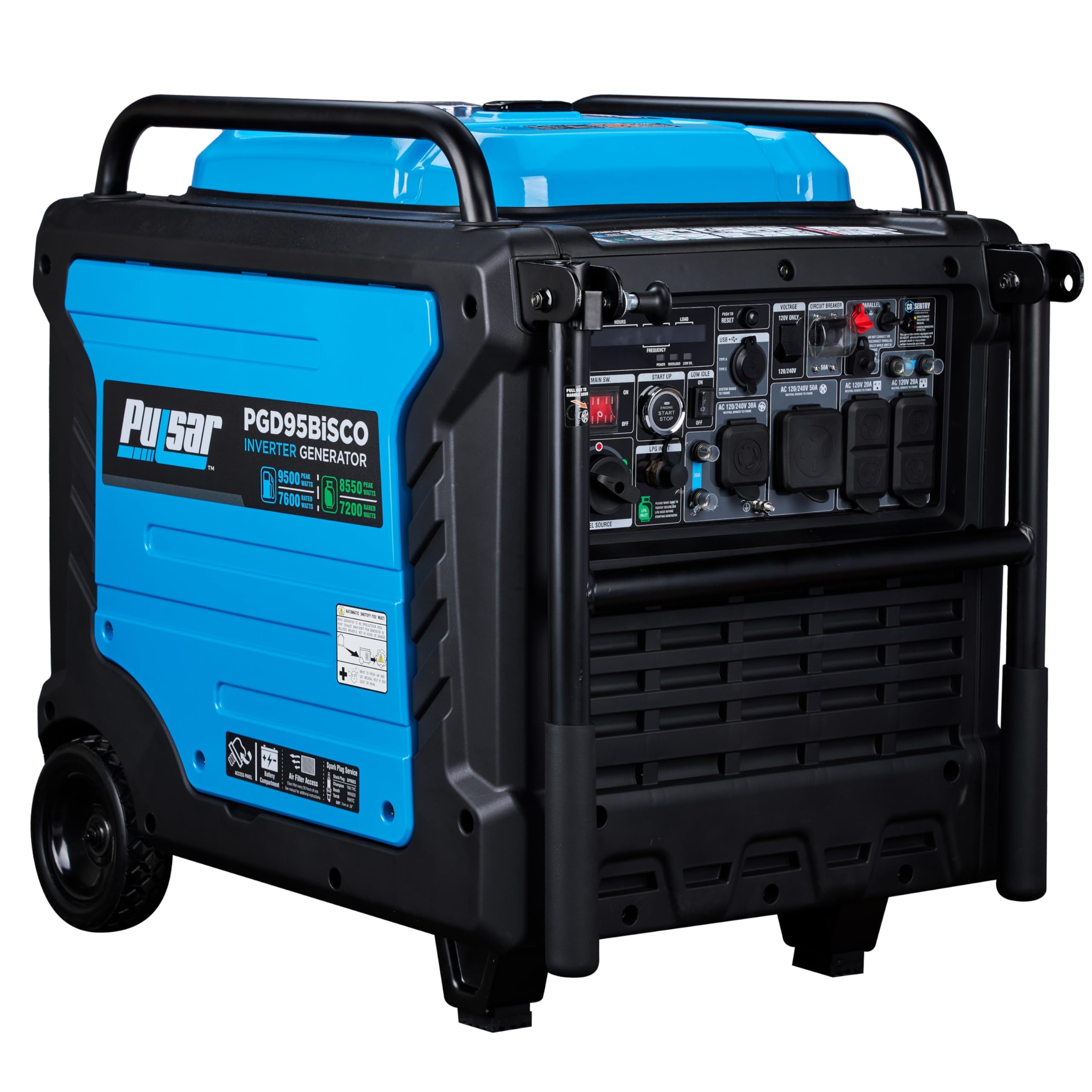
The Pulsar PGD95BISCO is a dual-fuel inverter generator with foam-insulated side panels for quiet operation—rated at 62 dBA. It delivers 9,500 peak/7,600 running on gasoline and 8,550 peak/7,200 running on propane. The 240-volt output is split between a 50-amp NEMA 14-50R and a 30-amp L14-30R.
The 6.9-gallon fuel tank provides up to 9.5 hours of runtime at half load on gasoline. The CO sentry, low-oil shutdown, and low-battery shutdown provide layered safety. One user successfully powered an entire home for six weeks during a power outage using propane only—running the well pump, refrigerator, and lights with careful load management.
The major caveat is that the 120-volt outlets are limited to roughly 1,000 watts each—you must use the 30A or 50A receptacles to access full generator capacity. Some users also report the unit is louder than the 62 dBA rating in actual use, especially under load. At 281 pounds, it’s heavier than most competitors.
Why it’s great
- Foam-insulated enclosure for quiet operation
- Proven reliability for extended outage use
- Dual fuel with 50A outlet
Good to know
- 120V outlets are wattage-limited
- Heavier than its class at 281 lbs
- Some users report higher noise than rated
9. AIVOLT 8000W Dual Fuel

The AIVOLT 8000W is a more compact 50-amp inverter generator option, producing 8,000 peak watts and 6,100 running watts on gasoline. Its 322cc copper-wound engine is paired with a 5-in-1 LCD display that tracks fuel consumption, output, voltage, and frequency. The unit includes a 50-amp NEMA 14-50R outlet, a 30-amp twist-lock, and dual USB ports.
At just 131 pounds and with telescoping handle and never-flat wheels, it’s one of the most portable units with a 50-amp receptacle. The ECO mode extends runtime to over 10 hours at 25% load. The CO Alert system automatically shuts down the generator if CO levels become dangerous.
Real-world noise is approximately 72-73 dB at 5 feet—significantly louder than the advertised 57 dBA at 23 feet, but still reasonable for an inverter unit. The 6,100 running watts means this is better suited for moderate-load applications—running a single AC unit plus essentials—rather than whole-home 50-amp service. Some users also note the generator goes into safety mode if shut down hot, requiring a full cool-down before restarting.
Why it’s great
- Lightweight and portable with telescoping handle
- 50-amp NEMA 14-50R outlet included
- ECO mode for fuel savings
Good to know
- Noisier than advertised
- 6,100W running limited for whole-home use
- Safety mode prevents hot restart
10. Westinghouse WGen11500DFc
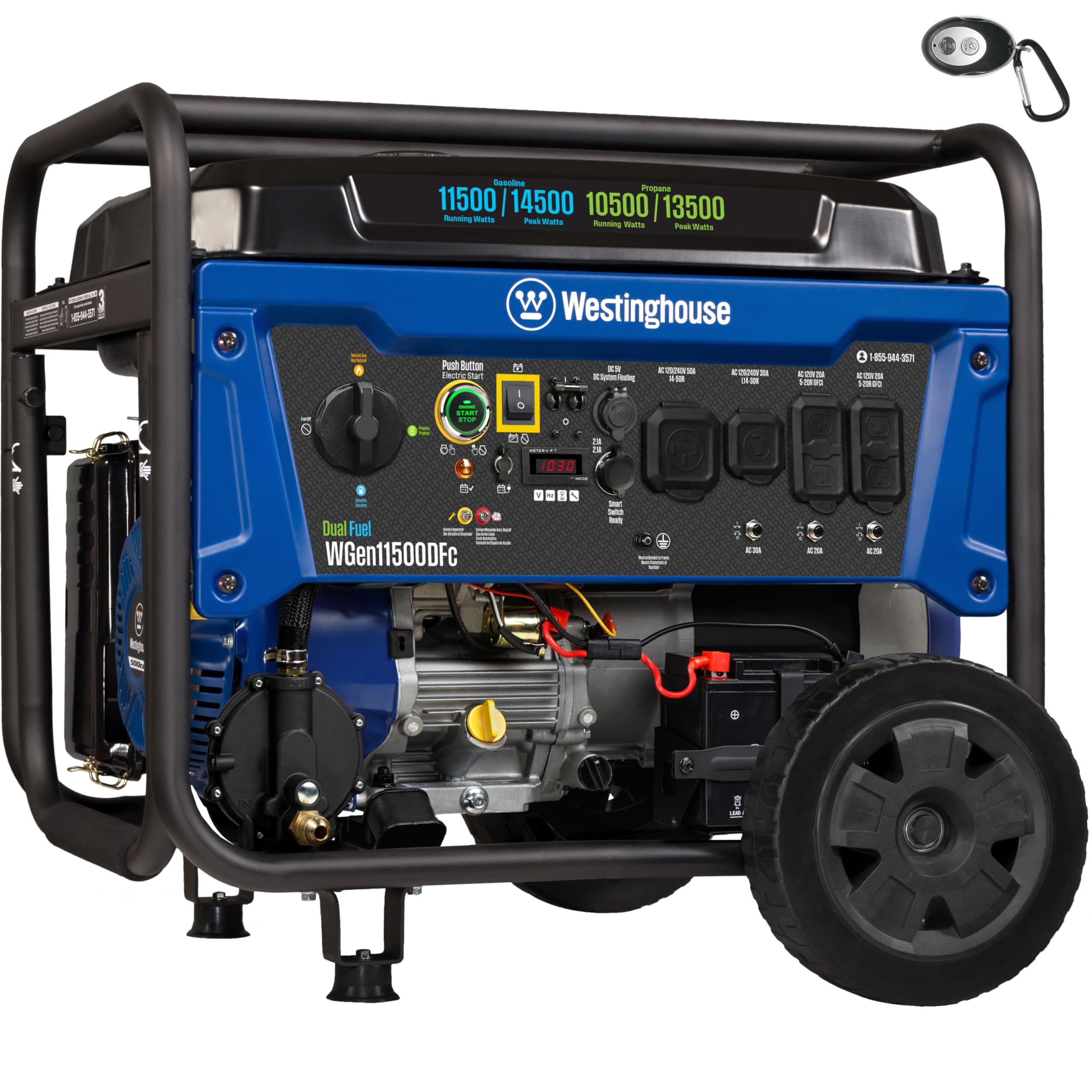
The Westinghouse WGen11500DFc is technically an open-frame generator, not a fully enclosed inverter model, but it earns a spot because it delivers true 50-amp, 240-volt power (14,500 peak/11,500 running on gasoline) at a price well below inverter competitors. It runs on gasoline and propane, and the 550cc cast-iron sleeve engine is designed to last.
The remote start key fob works from 100 feet, and the 9.5-gallon fuel tank provides up to 19 hours of runtime on gasoline. It includes a 50-amp NEMA 14-50R outlet, a 30-amp twist-lock, and four 120V GFCI outlets. One user reported powering a 5-ton AC unit (with soft starter), two refrigerators, and a TV without any flickering.
Being open-frame, it is significantly louder than any inverter generator on this list. It also requires unbonding the neutral-ground bond if connecting to a home panel via a transfer switch. At 230 pounds, it’s heavy but manageable with two people.
Why it’s great
- Highest running wattage in this group (11,500W)
- Remote start with key fob
- Cast-iron sleeve engine for durability
Good to know
- Loud—open frame design
- Requires neutral-ground unbonding for home use
- Heavy at 230 lbs
11. Champion 4500W Dual Fuel

The Champion 4500W is a smaller dual-fuel inverter generator designed for RVs and camping rather than whole-home 50-amp backup. It delivers 4,500 starting watts and 3,500 running watts on gasoline (3,150 on propane). Its 212cc engine features Champion’s Quiet Technology, rated at 61 dBA.
The unit includes a TT-30R RV receptacle (30-amp), but no 50-amp NEMA 14-50R outlet—you cannot directly power a 50-amp RV or home transfer switch with this generator alone. However, it is parallel-ready, meaning you can combine two units to increase output for a 50-amp setup. The electric start with a lithium battery (no dead lead-acid) and the EZ Start Dial make operation simple.
The 3-year limited warranty and lifetime technical support from Champion’s US-based team is a significant advantage over lesser-known brands. Users praise its quiet operation and fuel efficiency—one user reported powering an RV for four days on just 13 gallons of propane. The main limitation is wattage; it’s a great companion or starter unit, but not a standalone 50-amp solution.
Why it’s great
- Very quiet at 61 dBA
- Lithium battery electric start
- Excellent 3-year warranty with US support
Good to know
- No 50-amp outlet; must parallel for 50A
- Low running watts for heavy loads
- Propane running watts only 3,150W
12. WEN DF480iX
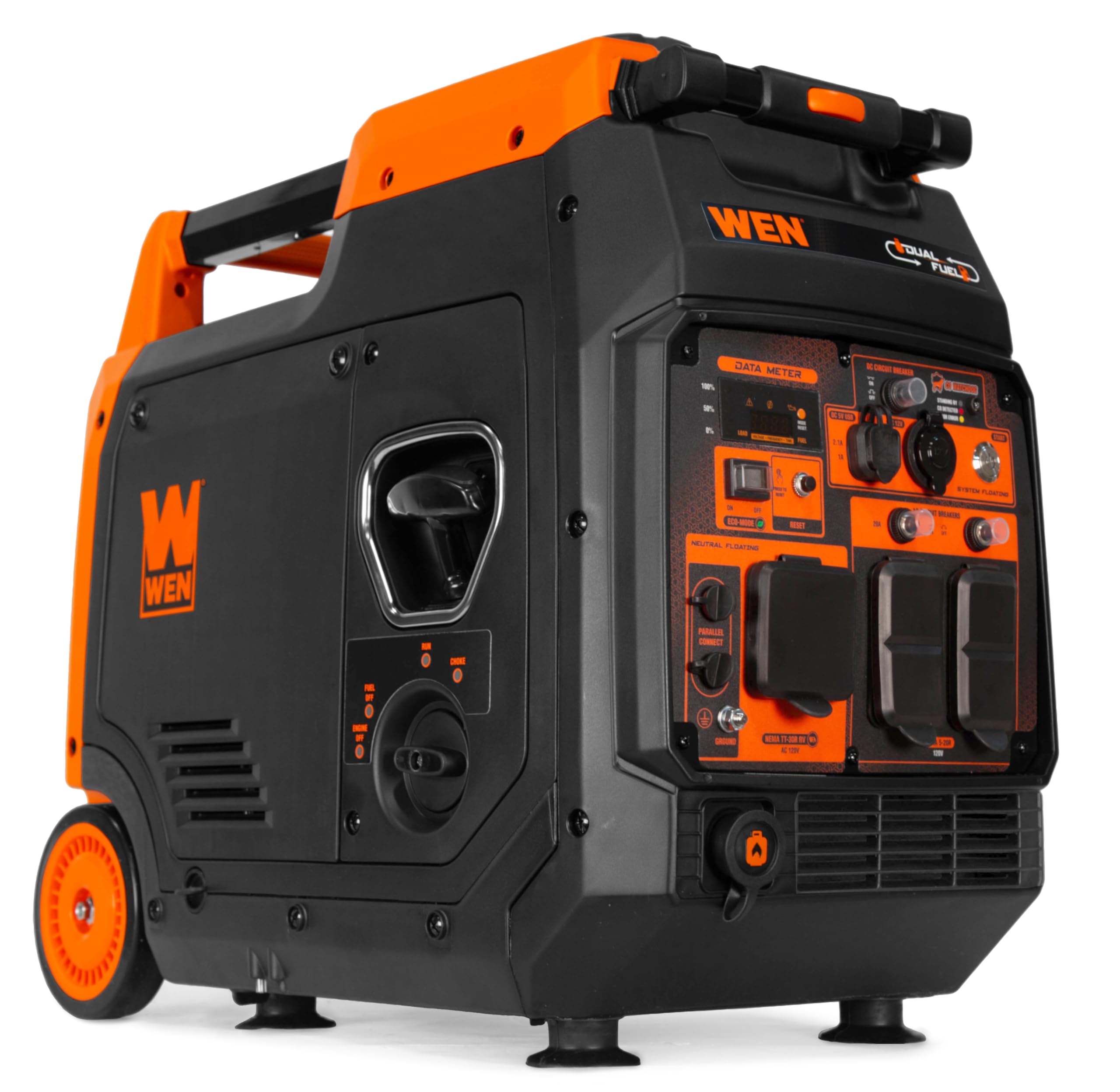
The WEN DF480iX is an entry-level dual-fuel inverter generator that offers 4,800 surge watts and 4,000 running watts on gasoline, or 4,320 surge/4,000 running on propane. It is designed for RV-style 30-amp TT-30R outlets, not 50-amp. The 224cc engine includes WEN’s Watchdog CO Shutdown Sensor for safety.
The electric start with recoil backup is convenient, and the fuel shut-off feature extends carburetor life by running the carb dry before shutdown. The telescoping pull handle and onboard wheels make it easy to move. At 78.5 pounds, it’s one of the lightest dual-fuel inverter generators available.
Users report it powers RV essentials (AC, microwave, lights) well, and runs on propane with less smell than gasoline. However, it lacks a 50-amp NEMA 14-50R outlet—the TT-30R is a 30-amp, 120-volt receptacle. The battery connection panel can also be difficult to reattach after servicing. For someone starting with an RV or small home and planning to upgrade to 50-amp later, this is a solid first step.
Why it’s great
- Lightweight at 78.5 lbs
- Dual-fuel flexibility
- Electric start and fuel shut-off
Good to know
- No 50-amp outlet
- Battery connection panel is hard to reattach
- Limited to 30A RV or small loads
13. WEN 56477i

The WEN 56477i is a gasoline-only inverter generator that delivers 4,800 surge watts and 4,000 rated watts. It is the most budget-friendly option for those needing clean, quiet power for essentials during an outage. At just 72.7 pounds with a telescoping pull handle, it’s exceptionally portable.
It includes a TT-30R 30-amp RV receptacle, four 120V 20-amp household outlets, one 12V DC outlet, and dual USB ports. The fuel shut-off feature maximizes engine lifespan. The Watchdog CO Shutdown Sensor automatically turns off the generator if dangerous CO levels are detected—an important safety feature at this price point.
Users consistently praise its quiet operation and reliability. One user powered their refrigerator, freezer, and lights for nine days during a fire-related outage. The main limitation is the lack of a 50-amp outlet, and it runs on gasoline only—no dual-fuel option. This generator is best suited for budget-conscious buyers who need a reliable backup for essentials, not for powering a 50-amp transfer switch.
Why it’s great
- Lightweight and highly portable
- Quiet operation with CO shutdown
- Reliable for essential backup power
Good to know
- No 50-amp outlet
- Gasoline only—no dual fuel
- Limited to 4,000 watts running
FAQ
Can I run my whole house on a 50 amp inverter generator?
What is the difference between a 50 amp receptacle and a 50 amp capable generator?
How long can a 50 amp inverter generator run continuously?
Do I need a transfer switch for a 50 amp generator?
What fuel is best for a 50 amp inverter generator?
Final Thoughts: The Verdict
For most users, the 50 amp inverter generator winner is the DuroMax XP16000iH because it delivers genuine 13,000 running watts on gasoline, a proper 50-amp NEMA 14-50R outlet, and clean inverter power for whole-home backup. If you want the quietest, most reliable unit with exceptional power quality, grab the Honda EU7000iS and parallel it for 50-amp capability. And for budget-conscious buyers needing tri-fuel flexibility, the Pulsar PGD105TiSCO offers the most fuel-source options at a mid-range price point.