
Our readers keep the lights on and the weekend projects moving. As an Amazon Associate, I earn from qualifying purchases.
Dropped video calls, buffering streams, and web pages that never load are the daily reality when your 5G router relies on flimsy stock antennas. An external antenna is the only fix that turns a spotty connection into a reliable lifeline, but picking the wrong one means wasted cash and zero improvement in signal quality.
I’m Rikta — the co-founder and writer behind FitlyFast. I’ve spent hundreds of hours analyzing cellular antenna specifications, poring over real user signal reports, and cross-referencing gain figures with frequency band compatibility to separate the true performers from the overhyped disappointments.
This guide highlights the top performers to help you find the best 5g antenna that matches your specific distance to the tower and budget.
How To Choose The Best 5G Antenna
Picking the wrong antenna is the most expensive mistake you can make when trying to fix poor cellular signal. The right choice depends on three fixed variables: your distance to the nearest cell tower, the type of router or modem you own, and whether you have a clear line of sight to that tower.
Directional vs. Omni-Directional Coverage
Directional antennas focus all their energy in a narrow beam, typically 10 to 75 degrees, which gives them higher gain (10 dBi or more) and longer reach. They are mandatory if you are 3 miles or more from a tower or if trees and hills block your signal. Omni-directional antennas broadcast in a full 360-degree circle, making them ideal for RVs, boats, or locations where the tower direction changes, but their gain rarely exceeds 10 dBi so they cannot reach distant towers.
MIMO Configuration and Your Router
Most modern 5G routers support 2×2 or 4×4 MIMO, meaning they use two or four antenna ports simultaneously to combine data streams. A 2×2 MIMO antenna kit delivers two separate connections to double throughput compared to a single antenna, while a 4×4 kit can quadruple it. Always verify your router’s antenna port count before buying — a 4×4 antenna will not perform better on a 2×2 router, but a 2×2 antenna will cap your speed if your router supports 4×4.
Gain and Frequency Band Support
Gain, measured in dBi (decibels relative to an isotropic radiator), tells you how much the antenna amplifies the signal, but it must be paired with the correct frequency range. A 5G antenna must cover sub-6 GHz bands from 600 MHz (Band 71, T-Mobile’s long-range 5G) up to 3800 MHz (C-Band and mid-band 5G from Verizon and AT&T). An antenna that only covers 698-2700 MHz will miss critical 5G bands, turning your “5G” connection into 4G speeds regardless of gain.
Quick Comparison
On smaller screens, swipe sideways to see the full table.
| Model | Category | Best For | Key Spec | Amazon |
|---|---|---|---|---|
| Proxicast ANT-129-001 | Directional Panel | Rural fixed installations | 7-10 dBi, 600-6000 MHz | Amazon |
| Waveform QuadPro | 4×4 MIMO Panel | Maximum speed with 4×4 routers | 9.1 dBi, 600-6000 MHz | Amazon |
| Bolton Long Ranger | Parabolic Grid | Extreme long distance (20mi) | 28 dBi, 600-6500 MHz | Amazon |
| Bolton BT974822-V2 | Parabolic Grid | Booster system upgrade | 26 dBi, 600-6500 MHz | Amazon |
| Proxicast ANT-126-002 | Omni-Directional | RV and Marine use | 10 dBi, 600-6000 MHz | Amazon |
| MOPHAMP Full Kit | Log Periodic 2×2 | High gain on a budget | 15 dBi, 698-3800 MHz | Amazon |
| Eifagur 11dBi MIMO | Directional Panel | Entry-level hotspot boost | 11 dBi, 698-2700 MHz | Amazon |
In‑Depth Reviews
1. Proxicast ANT-129-001

The Proxicast ANT-129-001 is a 7-10 dBi cross-polarized directional panel antenna that covers the full 600-6000 MHz range, including Band 71 and C-Band 5G. Its 75-degree beamwidth makes aiming less critical than narrower antennas, and the dual N-Female pigtails support 2×2 MIMO directly. Real user reports show RSRP improvements of 10-20 dB and download speeds jumping from 10 Mbps to 50 Mbps at distances up to 10 miles from the tower. The compact 11.8-inch height and 1.4-pound weight keep installation straightforward on a standard mast.
Build quality is a step above entry-level antennas — the ivory ABS radome resists UV degradation, and the stainless mounting bracket holds firm in high winds. The antenna ships with only 12-inch pigtails, so you must purchase two LMR400 or equivalent extension cables separately. Users pairing it with MoFi4500 and Cradlepoint routers consistently report doubled upload speeds, which is critical for video conferencing and cloud backups in remote offices.
The 4×4 MIMO upgrade potential is a hidden advantage: mounting two panels — one vertical and one at 45 degrees — creates a true 4×4 setup without buying a new antenna. This flexibility makes it future-proof for router upgrades. The main tradeoff is the lack of included cabling, which adds to the total cost, but the performance per dollar is unmatched for standard rural installations.
Why it’s great
- Full sub-6 GHz 5G band coverage including Band 71 and C-Band
- Measurable 15-20 dB signal improvement in real-world user tests
- Can be paired into 4×4 MIMO with a second unit
Good to know
- No coaxial cables included — requires separate purchase of two extension cables
- 75-degree beamwidth requires decent aiming precision at long distances
2. Waveform QuadPro 4×4 MIMO

The Waveform QuadPro is the only 4×4 MIMO panel antenna kit on this list, delivering four separate signal paths that fully utilize modern 5G routers with four antenna ports. Users with T-Mobile Home Internet (Arcadyan KVD21 and Nokia 5G21) report speed jumps from 50 Mbps to 300 Mbps after installation, with SINR improvements of 10 dB or more. The kit includes a Window Entry Cable that lets you test placement without drilling holes, a critical feature for renters or anyone wanting to experiment with aiming before committing to a permanent mount.
Build quality is exceptional — the white ABS radome is weather-sealed, the FlexMount bracket allows precise tilt and rotation, and the UltraFlex-Quad cables minimize signal loss over the 20-foot run. The included SMA and U.FL adapters cover almost every router on the market, and Waveform provides separate detailed guides for T-Mobile, Verizon, and AT&T gateways. The one downside is the delicate installation process: connecting the four tiny U.FL connectors inside a gateway requires steady hands and patience, and the antenna must be aimed using Waveform’s recommended positioning tool rather than guesswork.
At a premium price point, this is the correct choice for anyone who already has a 4×4 MIMO router and wants to squeeze every megabit out of their connection. Users in marginal coverage areas (suburban homes with tree interference) see the most dramatic gains because the 4×4 architecture recovers signal from multiple reflected paths. The three-year manufacturer warranty provides peace of mind that budget kits cannot match.
Why it’s great
- True 4×4 MIMO with four independent signal paths for maximum throughput
- Complete kit with window entry cable enables no-drill testing and installation
- Excellent documentation and router-specific guides from Waveform
Good to know
- Installation requires opening your gateway and connecting tiny U.FL connectors
- Premium price is only justified if your router supports 4×4 MIMO
3. Bolton Technical Long Ranger BT974822
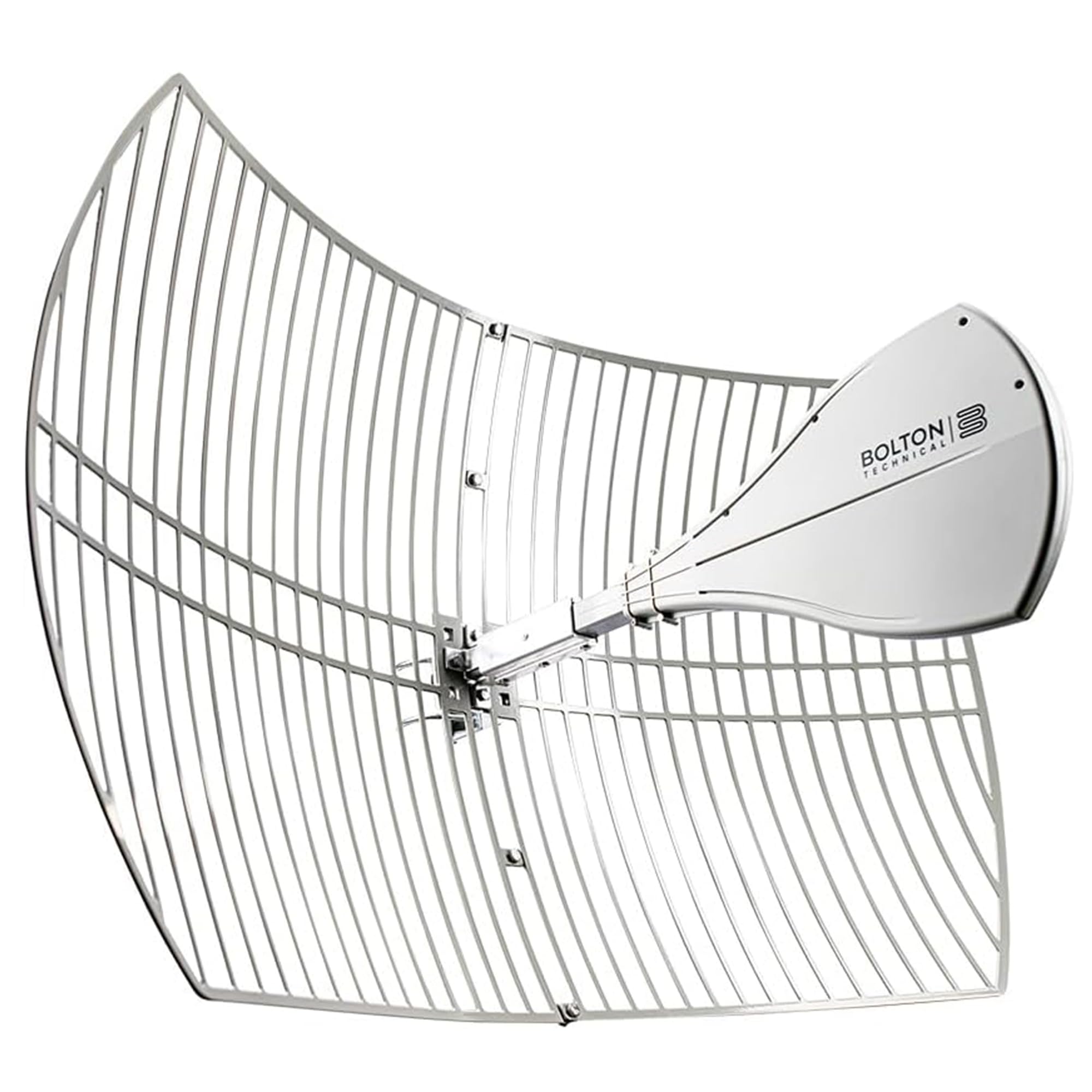
The Bolton Long Ranger is a massive parabolic grid antenna that delivers up to 28 dBi of gain, making it the most powerful option for reaching towers up to 20 miles away. At 39 inches wide and 24 inches tall, this antenna is physically imposing and requires a sturdy mast and careful assembly. Real users 5 to 7 miles from Verizon towers in heavily wooded rural areas report stable 14-25 Mbps downloads after switching from standard yagi antennas, with reliable VOIP and 4K streaming that was previously impossible.
The feedhorn design supports a narrow 10-degree beamwidth, which concentrates all the signal energy into a tight beam — this is excellent for distant tower hunting but punitive if you aim poorly. Users report spending 1-2 hours making pencil-mark adjustments on the mast to find the optimal direction, and a 4-degree error can drop signal by 12 dBm. The antenna covers 600-6500 MHz, encompassing all current 5G sub-6 bands plus WiFi 6 frequencies, making it useful for dual-purpose setups.
Assembly complaints about misaligned bolt holes and sharp metal edges appear in some reviews, so expect to spend time with a file and a 10mm wrench during setup. The N-Female connector requires high-quality LMR400 or better cable to avoid negating the antenna’s gain advantage. For extreme rural locations where no other antenna can reach a tower, the Long Ranger is the only viable solution, but the installation difficulty and precise aiming requirements make it unsuitable for casual users.
Why it’s great
- Highest gain available at 28 dBi for 20-mile tower reach
- Broad frequency support up to 6500 MHz includes WiFi and SDR bands
- Survives lightning strikes and harsh weather in field reports
Good to know
- Very narrow 10-degree beamwidth demands extremely precise aiming
- Large physical size (39×24 inches) requires heavy-duty mounting
4. Bolton Technical BT974822-V2

The Bolton Technical BT974822-V2 is essentially the same parabolic grid design as the Long Ranger but optimized for use as an upgrade antenna for existing cell signal booster systems like weBoost and Cel-Fi. With 26 dBi gain and the same 10-degree beamwidth, it functions as a laser-focused signal collector that dramatically improves booster performance in weak-signal areas. Users replacing standard yagi antennas with this grid report download speeds jumping from 2-5 Mbps to 40-50 Mbps at distances of 4-6.5 miles from AT&T towers.
The key difference from the Long Ranger is that this antenna requires a signal booster amplifier — it connects to the booster’s outside port, not directly to a router. This makes it an excellent drop-in upgrade for anyone who already owns a booster system but finds the included antenna insufficient. The 600-6500 MHz frequency coverage ensures compatibility with all 5G bands, including mid-band C-Band. Users recommend pairing it with LMR400 or LMR600 cable for minimal loss, as the antenna’s high gain is easily wasted by poor cable quality.
Assembly requires a 10mm wrench or socket, and the included mount brackets hold securely once tightened. Some ham radio operators criticize the log periodic design for phase center issues below 3 GHz, but real-world results from rural users consistently show meaningful signal gains. The biggest frustration is the lack of detailed aiming instructions in the box — you will need to research tuning techniques online, using speed tests and 2-minute waiting periods between adjustments to find the sweet spot.
Why it’s great
- Perfect drop-in upgrade for weBoost and Cel-Fi booster systems
- Proven 30-40 Mbps download speed increases in rural AT&T locations
- Full 600-6500 MHz support covers all 5G sub-6 and CBRS bands
Good to know
- Requires a signal booster amplifier — will not work as a standalone antenna
- Aiming is finicky and the included instructions lack detailed tuning guidance
5. Proxicast ANT-126-002

The Proxicast ANT-126-002 is a 10 dBi omni-directional antenna that broadcasts in a full 360-degree pattern, making it the go-to choice for RVs, boats, and any mobile setup where the tower direction changes constantly. Its aerodynamic white ABS radome stands 9.1 inches tall and includes a stainless steel 2-way pole/wall mount bracket, requiring no additional ground plane. Users mounting this on a roof apex behind a hill report gaining direct line-of-sight to towers and jumping from 2 to 5 bars on Netgear Nighthawk routers, with 25 Mbps download speeds in areas that previously had no usable signal.
The integrated female N connector eliminates the need for a ground plane, simplifying installation on fiberglass roofs and metal surfaces. The 600-6000 MHz frequency range covers all 4G and 5G sub-6 bands, including T-Mobile Band 71, making it future-proof for carrier changes. Because it is omni-directional, the gain is capped at 10 dBi, so it will not reach distant towers beyond 3-5 miles — but users in suburban and close-range rural areas consistently report reliable telecommuting performance after installation.
Durability feedback is mixed: some users report the unit burning out after two months of continuous use, while others have had the same antenna working for years through harsh weather. The difference likely comes down to surge protection — this antenna requires a proper lightning arrestor or gas discharge tube if mounted outdoors. For mobile users who travel between areas with different tower locations, the 360-degree coverage eliminates the need to re-aim, making it the most convenient option for life on the road.
Why it’s great
- 360-degree coverage ideal for RVs and boats with changing tower directions
- No ground plane required, simplifying installation on any roof type
- Full 600-6000 MHz range covers all 5G bands including Band 71
Good to know
- 10 dBi gain limits effective range to about 3-5 miles from the tower
- Some durability concerns — surge protection is strongly recommended
6. MOPHAMP 2×2 MIMO Full Kit
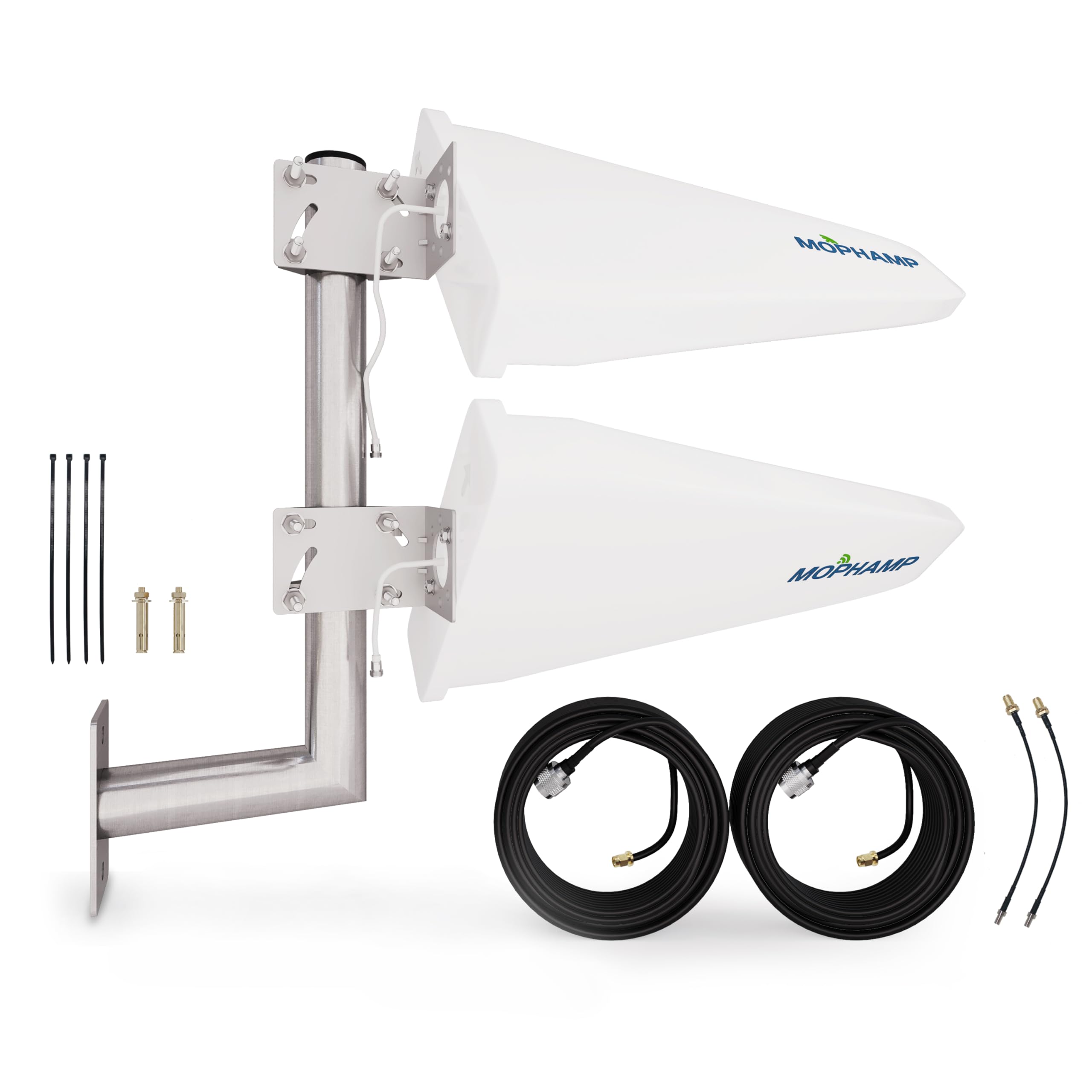
The MOPHAMP 2×2 MIMO Full Kit includes two log-periodic antennas, two 32-foot low-loss coaxial cables, TS9 adapters, and a solid L-mount — everything needed for a complete outdoor install except a mast. With 15 dBi gain across 698-3800 MHz, it covers all 4G LTE bands and most 5G sub-6 bands, though it misses the lowest 600 MHz Band 71 that T-Mobile uses for long-range 5G. Users with Netgear Nighthawk MR6500 hotspots report going from less than 1 Mbps indoors to approximately 300 Mbps down and 20 Mbps up when the antenna is placed on a tripod near a window.
The included cables use quality RG58-equivalent coax with minimal signal loss for the 32-foot length, and the TS9 adapters fit most mobile hotspot and router ports without additional pigtails. The stainless steel L-mount is the weak point — multiple users report that the base plate uses only three tiny tack welds that snap under wind load, creating a safety hazard. The manufacturer has addressed this in later revisions with full continuous welding, but inventory may vary, so inspect the mount immediately upon arrival.
Setup is genuinely plug-and-play for hotspots like the Nighthawk M6 and MR6500, making this kit appealing for temporary installations like vacation cabins or construction site trailers. The 698 MHz lower limit means it works well with AT&T and Verizon 5G networks but will disappoint T-Mobile users in fringe areas who rely on Band 71 for any signal at all. If you replace the mount with a strut channel or conduit clamp, the antennas themselves perform reliably for the price.
Why it’s great
- Complete 2×2 MIMO kit with antennas, cables, adapters, and mount included
- Dramatic speed improvement from sub-1 Mbps to 300 Mbps in hotspot tests
- Easy tripod or window placement without permanent roof mounting
Good to know
- Does not cover 600 MHz Band 71, limiting T-Mobile long-range performance
- Included L-mount may have weak welding — inspect and reinforce before use
7. Eifagur 11dBi MIMO

The Eifagur 11dBi MIMO antenna is a budget-friendly directional panel that covers 698-2700 MHz, making it suitable for 4G LTE and low-band 5G networks but incompatible with mid-band C-Band and high-band 5G frequencies above 2700 MHz. It ships with two 5-meter RG58 cables terminated with SMA male connectors, plus adapter cables for TS9 router ports, so installation is immediate for most hotspots and routers. Users report impressive results at short range — one user saw speed jump from 0-10 Mbps to 80-100 Mbps after aiming the antenna at the nearest tower and enabling antenna ports on their modem.
The included dual U-bolt brackets fit standard 1.5 to 2-inch masts, and the rugged waterproof housing holds up to rain and sun exposure. The directional design requires careful aiming using a cell tower mapping app, as the antenna only receives signal from the front plastic side. Some experienced users note that this antenna underperforms compared to smaller, more expensive options like the Waveform QuadMini, with one reviewer seeing worse speeds after switching from a smaller antenna.
The 2700 MHz upper frequency limit is the biggest limitation — this antenna cannot receive 5G C-Band (n77) at 3700 MHz or mmWave frequencies, so it effectively caps your connection at 4G speeds. Potential buyers should verify their carrier’s 5G bands before purchasing; if your primary tower uses Band 71 or n41, this antenna will not serve you well. For basic 4G hotspot boosting in areas with strong low-band signal, the price-to-performance ratio is hard to beat.
Why it’s great
- Very affordable complete solution with cables and adapters included
- Proven 80-100 Mbps speed increases in weak signal areas
- Simple waterproof design installs on standard mast in minutes
Good to know
- Limited to 2700 MHz — no support for mid-band 5G C-Band frequencies
- Inconsistent performance compared to premium compact alternatives
FAQ
Can I use a 5G antenna with a 4G-only router?
How do I accurately aim a directional 5G antenna?
Do I need a different antenna for T-Mobile 5G versus Verizon 5G?
What cable type minimizes signal loss between antenna and router?
Final Thoughts: The Verdict
For most users, the best 5g antenna winner is the Proxicast ANT-129-001 because it balances wide 5G band coverage, forgiving 75-degree beamwidth, and proven 15-20 dB signal improvements at a reasonable mid-range investment. If you want maximum possible throughput from a 4×4 MIMO router, grab the Waveform QuadPro. And for extreme rural locations 10 to 20 miles from the nearest tower, nothing beats the Bolton Technical Long Ranger.