
Our readers keep the lights on and the weekend projects moving. As an Amazon Associate, I earn from qualifying purchases.
Between six and nine months, a baby’s world transforms from passive observation to active discovery. Every reach, grasp, and shake is a learning event, and the right toy can turn that raw curiosity into focused skill-building—fine motor control, object permanence, cause-and-effect reasoning, and sensory differentiation all take root in this narrow developmental window.
I’m Rikta — the founder and writer behind FitlyFast. I’ve spent years analyzing developmental play categories, digging into material safety certifications, and cross-referencing specialist recommendations to separate genuine learning tools from mere distractions.
This guide walks through seven hand-picked contenders to help you identify the most effective 6-9 month old toys for encouraging independent exploration and milestone growth without the clutter of flashy gimmicks.
How To Choose The Best 6-9 Month Old Toys
At six to nine months, babies are developmentally transitioning from passive observation to active exploration. The best toys for this stage support three key areas: fine motor development (grasping, transferring, and intentional release), cognitive understanding (object permanence, cause and effect), and sensory differentiation (texture, sound, and visual contrast). Pay attention to material safety, size appropriateness, and whether the toy can grow with your child through the next few months.
Object Permanence & Cause and Effect
The single biggest cognitive milestone of this period is understanding that objects continue to exist even when out of sight. Toys like ball-drop boxes, hide-and-seek puzzles, and pop-up toys directly target this concept. A good permanence toy will have a clear reward—a ball that rolls out, a door that opens—so the baby connects the action with the outcome.
Material Safety & Teething Compatibility
Babies this age explore everything with their mouths. Look for toys made from solid wood with non-toxic finishes, food-grade silicone, or BPA-free ABS plastic. Avoid painted surfaces that can chip, and always check that no small parts can break off. Smooth edges, rounded corners, and choke-tube compliance are non-negotiable.
Fine Motor Skill Progression
At six months, babies use a palmar grasp. By nine months, they begin developing the pincer grasp (thumb and forefinger). Choose toys that offer multiple grip challenges: rattles with varied handle shapes, stacking rings of different sizes, and soft blocks that can be squeezed or stacked. The toy should encourage transferring from one hand to the other and eventually intentional release.
Quick Comparison
On smaller screens, swipe sideways to see the full table.
| Model | Category | Best For | Key Spec | Amazon |
|---|---|---|---|---|
| Plunack 6 in 1 Montessori Set | Premium Set | All-in-one developmental play | 27 pieces, food-grade silicone, 6 play modes | Amazon |
| hahaland Sensory Garden | Premium Plush | Tactile sensory exploration | 11 pieces, multiple textures, carry case | Amazon |
| Qirptey Montessori 4-in-1 | Premium Mix | Stacking, sorting & teething | Silicone blocks & cups, shape sorter bin | Amazon |
| JoyCat Beehive & Bees | Mid-Range | Object permanence with soft toys | 5 sensory bees, crinkle & rattle sounds | Amazon |
| iPlay, iLearn 10-Piece Rattles | Mid-Range | Sensory variety & teething | 10 unique rattles, BPA-free, varied textures | Amazon |
| Thremhoo Inflatable Roller | Budget-Friendly | Crawling encouragement | Glow-in-dark sequin, rattling balls, inflatable | Amazon |
| Busy edition Object Permanence Box | Budget-Friendly | Montessori ball-drop play | Solid wood, 3 balls, 1.77-inch ball diameter | Amazon |
In‑Depth Reviews
1. Plunack 6 in 1 Montessori Baby Toys
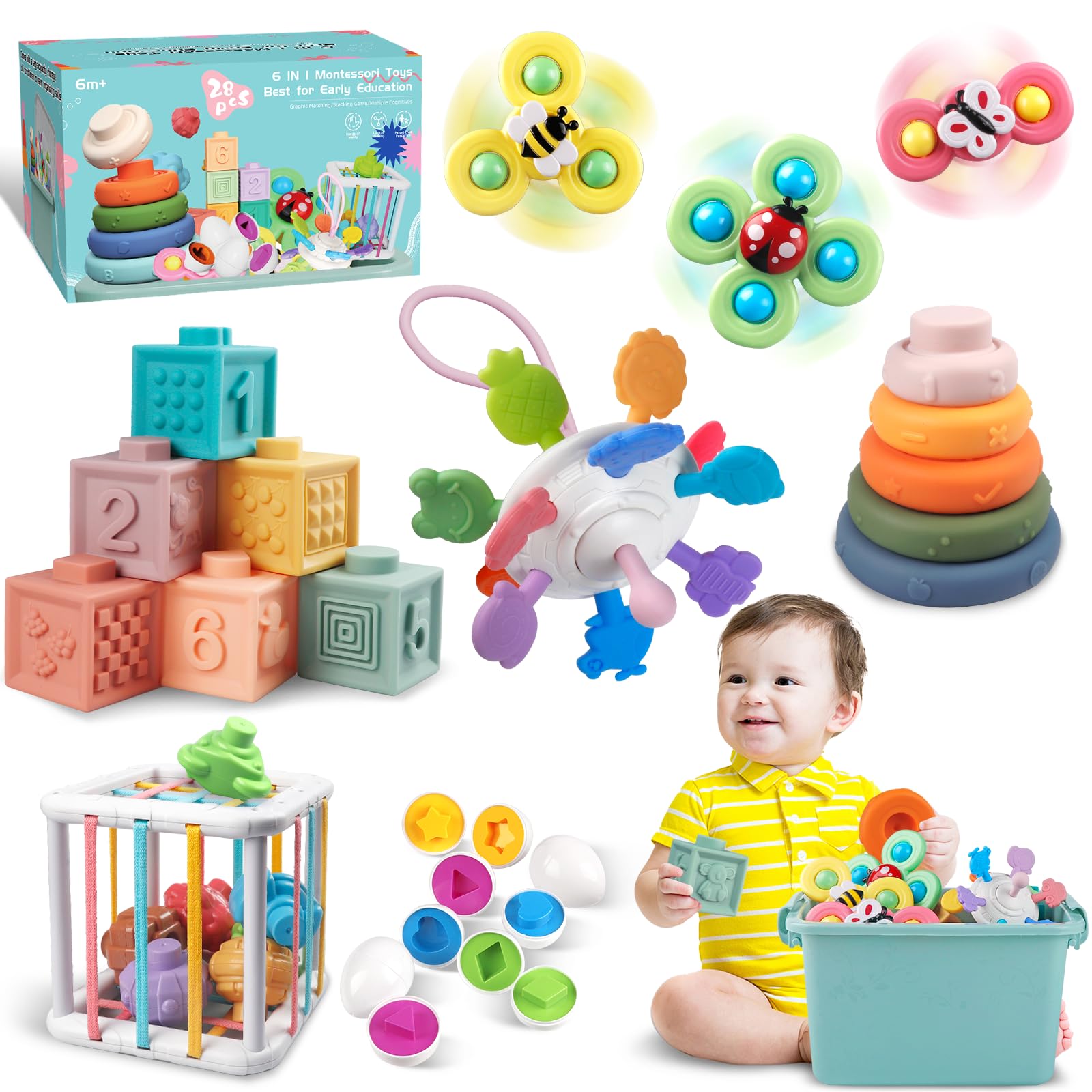
This 6-in-1 set covers stacking rings, soft building blocks, shape-sorter eggs, suction cup spinners, a pull-string toy, and a sensory bin—everything a 6-to-9-month-old needs for targeted milestone work in one box. The food-grade silicone blocks are soft enough for teething but dense enough to stack, and the 12 matching eggs with 6 shapes introduce spatial reasoning that scales into toddlerhood.
Each piece passed the choke tube test and is certified CPSIA and ASTM F963 compliant, which removes the anxiety of handing over multiple separate toys. The suction cup spinners stick firmly to highchair trays, offering an engaging distraction during meals. The included storage bin keeps all 27 pieces organized, making cleanup intuitive and teaching early tidying habits.
What makes this the top pick is its comprehensive coverage: one set addresses fine motor skills, cause and effect, shape recognition, color sorting, and sensory exploration. It eliminates the need to buy five or six individual toys that may not coordinate developmentally. The pull-string toy, in particular, is a recommended pincer-grasp builder by pediatric OTs.
Why it’s great
- Covers virtually every milestone from 6-9 months in one purchase
- Food-grade silicone and BPA-free materials withstand aggressive mouthing
- Suction spinners work on highchair trays and bathtub walls
- Storage bin keeps everything tidy and portable
Good to know
- Teething ball included has flat ends that some babies find less engaging
- Sensory bin is functional but not as visually stimulating as some plush options
2. hahaland Baby Toys Sensory Garden

The hahaland Sensory Garden turns tummy time and independent play into a garden exploration. Its 11-piece set includes plush vegetables and flowers, each with a distinct sensory feature—squeakers, rattles, crinkle textures, and a baby-safe mirror. A hidden pocket in the garden box lets babies tug crinkle tissue surprises, directly teaching object permanence and cause and effect in a gentle, non-electronic way.
Every piece is crafted from plush materials with no small parts, making it safe for mouthing and soft enough for a baby to hold while lying on their back. The carry case doubles as a play scene, which means it works equally well on a living room floor, in a diaper bag, or on an airplane tray table. The mirror, placed inside the garden door, encourages self-recognition and emotional expression—a subtle but valuable milestone for this age.
What sets this apart is the range of stimuli packed into soft, baby-friendly forms. Unlike hard plastic toys that can feel cold or impersonal, the plush texture invites repetitive interaction. Parents report babies returning to the same carrot or flower multiple times per session, which is exactly how neural pathways strengthen at this stage.
Why it’s great
- Multiple sensory features (squeaker, rattle, crinkle, mirror) in one set
- Plush material is gentle and safe for teething babies
- Portable carry case doubles as a play scene
- Supports object permanence and emotional development
Good to know
- No electronic or light-up elements—purely manual play
- Plush pieces may require gentle spot cleaning after heavy drooling
3. Qirptey Montessori 4-in-1 Baby Toys
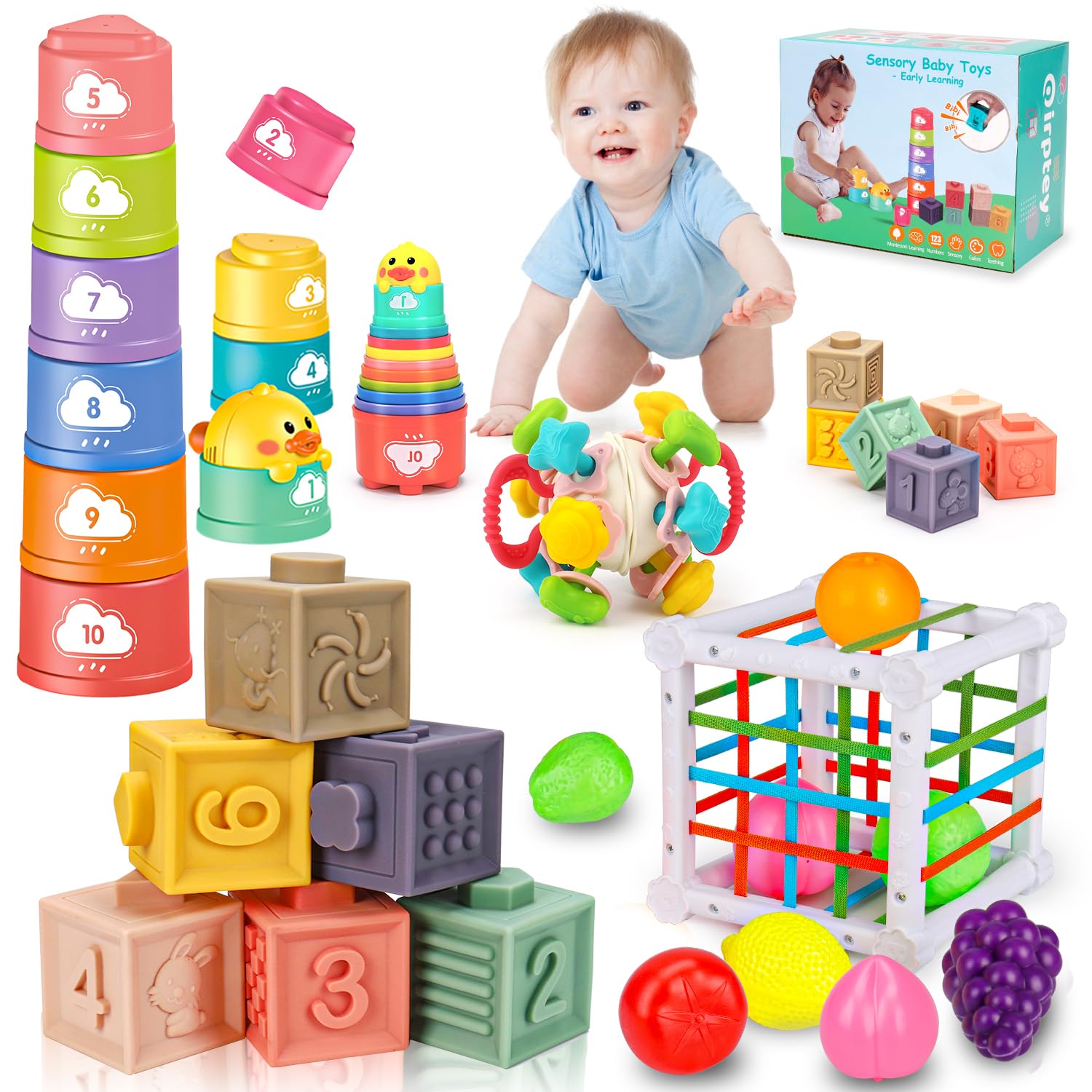
This 4-in-1 set bundles stacking blocks, stacking cups, a shape sorter bin, and a teething sensory toy into one package. The soft building blocks are made from food-grade silicone, making them chewy enough to soothe sore gums but structured enough to stack into small towers. The stacking cups feature numbers, shapes, and textures on each side, creating multiple learning layers within a single activity.
The shape sorter bin uses fruit-shaped pieces—guava, orange, peach, tomato, lemon, and grape—which is more engaging than abstract geometric shapes for babies still learning visual recognition. The pieces are sized for small hands to grasp and insert. The bin itself is sturdy enough to hold the cups and blocks when not in use, doubling as storage.
What gives this set strong value is its dual function as both a developmental toy and a teether. Parents report that the silicone blocks are the first thing their baby reaches for when teeth start coming in. The material withstands repeated dishwasher cycles without degrading, which is a practical advantage over painted or coated alternatives.
Why it’s great
- Food-grade silicone blocks double as effective teethers
- Fruit-shaped sorter pieces are more engaging than abstract shapes
- Stacking cups introduce numbers and textures in one activity
- Dishwasher-safe and easy to sanitize
Good to know
- Some pieces are smaller than expected; best for supervised play
- Storage bin is functional but less durable than the silicone pieces
4. JoyCat Flower Beehive Sensory Toy
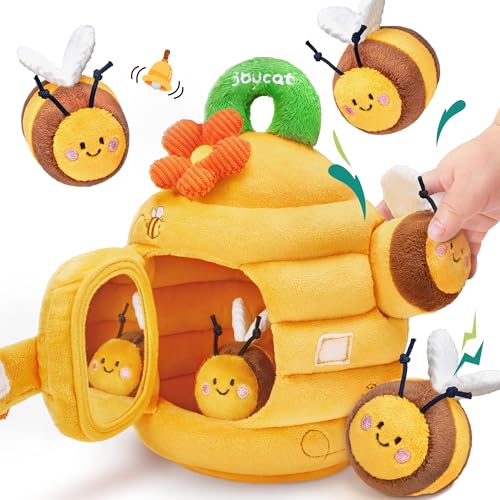
The JoyCat Beehive is a soft, quiet alternative to electronic toys that teaches object permanence through a simple peekaboo mechanism. Five plush bees with crinkly wings, gentle rattles, and squeakers tuck into the hive’s circular holes. When the baby pulls the door open, the bees tumble out—a direct cause-and-effect lesson without needing batteries or lights.
The beehive’s interior mirror adds a layer of self-discovery, encouraging facial expression exploration between nine and twelve months. Each bee is intentionally designed for tiny hands: at 6 months, babies will bat and crinkle; by 9 months, they’ll intentionally grab and remove them from the hive. The door mechanism is easy to open but requires deliberate effort, promoting problem-solving.
What makes this a calm pick is its lack of high-contrast flashing lights or loud mechanical sounds. The sensory input is entirely tactile and auditory in a gentle, natural range. Parents report the toy works well for wind-down time before naps and during travel, where overstimulation is a common concern.
Why it’s great
- Quiet, battery-free play great for calming babies
- Teaches object permanence through a simple peekaboo mechanism
- Five bees offer variety in texture and sound
- Machine washable for easy cleaning
Good to know
- Door can be tricky to keep open for younger babies
- No pull tab for mirror film—may need manual removal
5. iPlay, iLearn 10-Piece Baby Rattles Set

This 10-piece rattle set is a straightforward solution for parents who want variety without committing to one specific toy type. Each rattle has a different grip shape, handle texture, and sound profile—some jingle, some click, some shake. The variety prevents boredom and allows the baby to discover which grip style they prefer as their fine motor skills evolve from palmar to pincer grasp.
All pieces are made from BPA-free ABS plastic with no sharp edges, and the set includes both rattles and teething surfaces. The bright primary colors provide strong visual contrast that supports eye tracking at 6 months and beyond. The set is lightweight enough for stroller clips and small enough to pack multiple pieces in a diaper bag without taking up much space.
What makes this a useful mid-range option is its longevity across multiple developmental stages. At 6 months, babies will bat and shake; at 9 months, they’ll intentionally transfer rattles between hands and bring them to their mouth for inspection. The set works well for daycares or households with multiple babies, as there are enough pieces to share.
Why it’s great
- 10 unique designs prevent boredom and encourage exploration
- BPA-free ABS with no sharp edges for safe mouthing
- Varied grip shapes support fine motor progression
- Lightweight and portable for stroller or travel
Good to know
- Some rattles have small openings that can collect moisture
- No electronic or musical elements—purely manual sound production
6. Thremhoo Inflatable Rolling Baby Toy
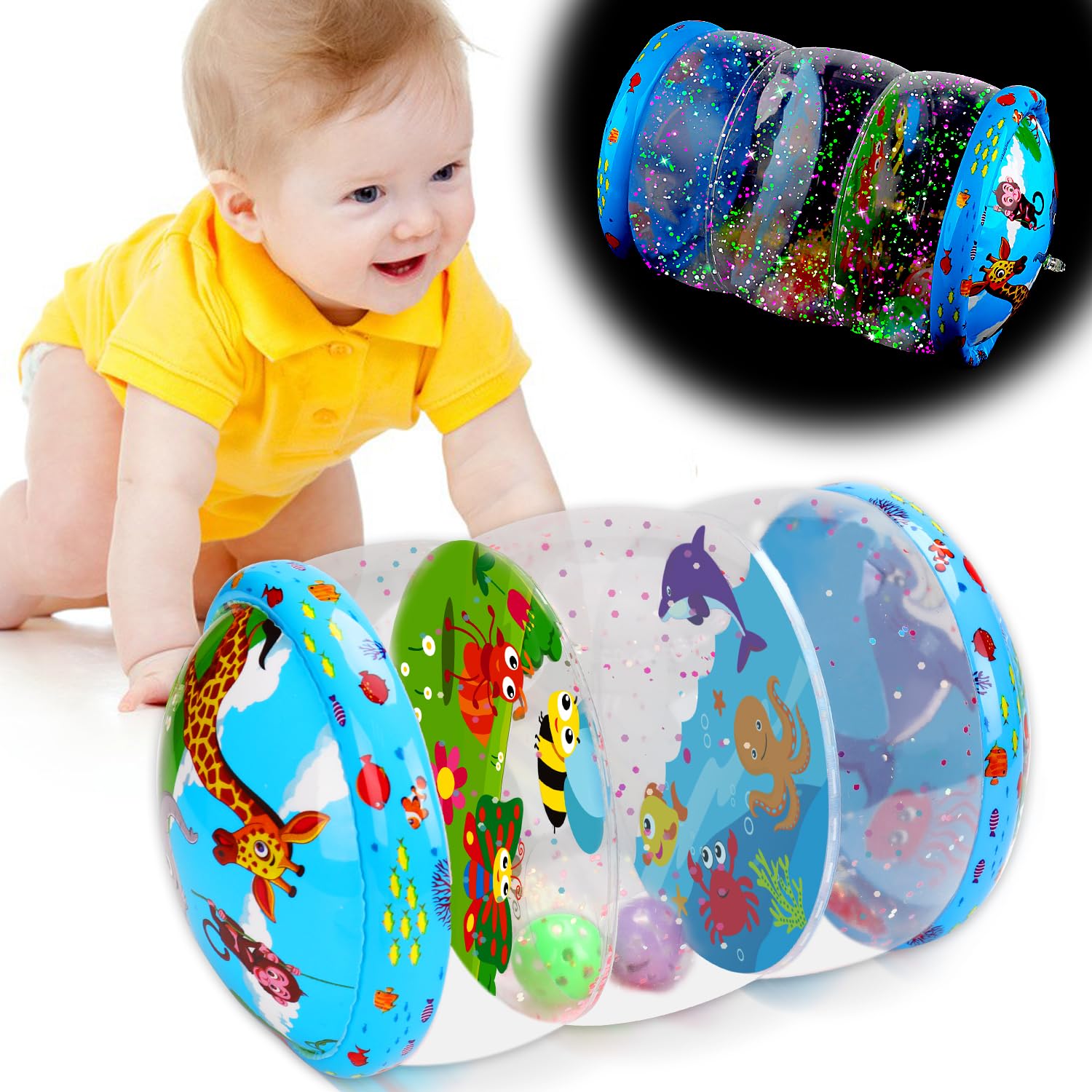
The Thremhoo inflatable roller is designed explicitly for crawling encouragement. At 16 x 8.5 inches, it’s large enough for a baby to push or chase but lightweight enough to be knocked over without injury. Two rattling balls inside create gentle sound when the roller moves, and the glow-in-the-dark sequin surface adds visual interest without needing batteries.
The material is thick, durable plastic that holds air well. Parents report minimal deflation over weeks of use. The roller works best when placed a few feet away from a sitting baby, encouraging them to crawl or scoot toward it. The movement is unpredictable but safe—the roller will stop on its own when the baby reaches it, preventing frustration.
Its weakness is that engagement is limited to the crawling stage. Once a baby is confidently walking, the roller loses appeal. But for babies struggling to transition from sitting to crawling, the combination of sound, motion, and visual stimulation provides strong motivation.
Why it’s great
- Directly encourages crawling through movement and sound
- Easy to inflate, deflate, and store (collapsible)
- Thick plastic holds air for weeks
- Glow-in-dark sequin adds visual engagement
Good to know
- Limited to crawling stage; less engaging for older babies
- Glow effect is subtle, not bright (needs direct light exposure first)
7. Busy edition Montessori Object Permanence Box
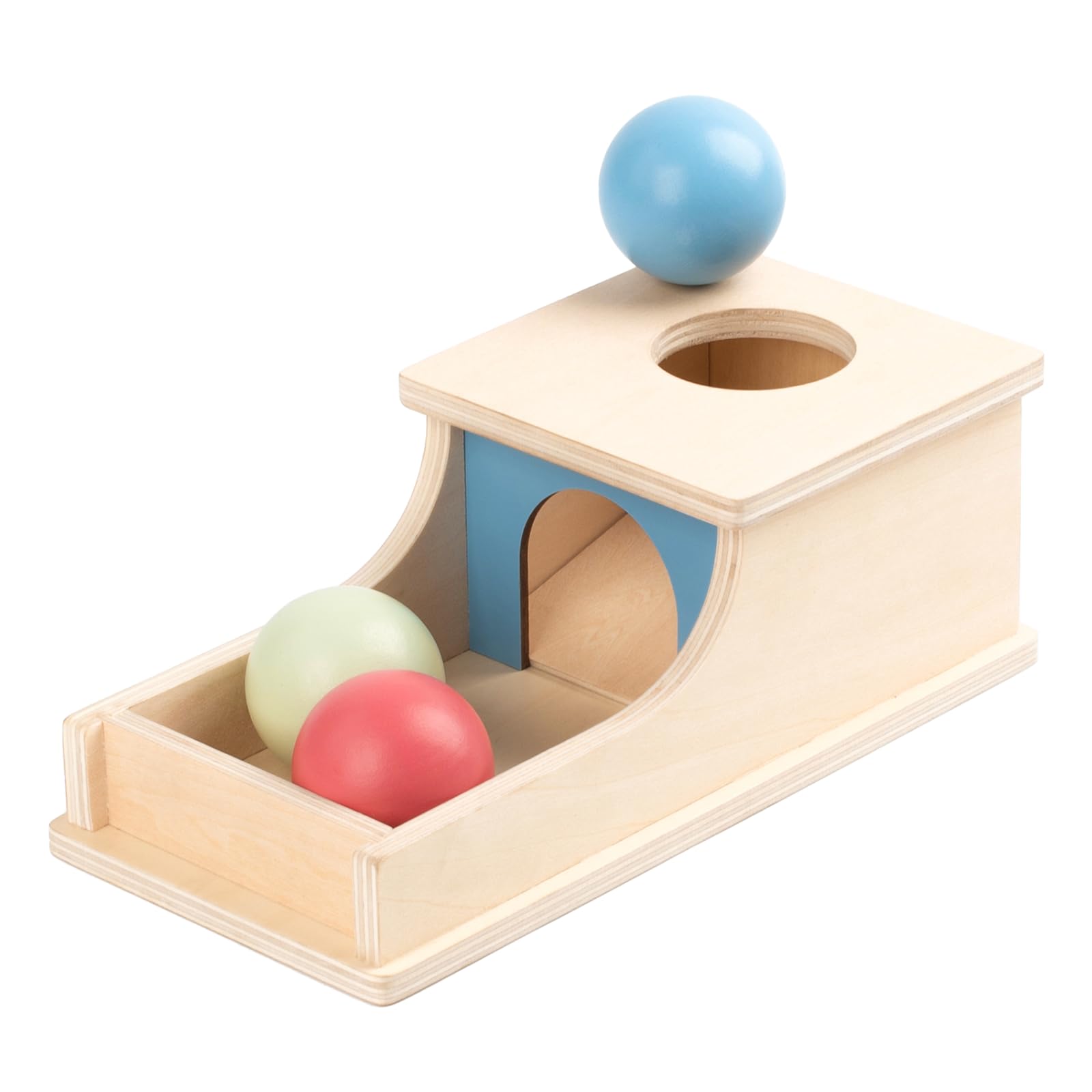
This wooden object permanence box is a stripped-down, Montessori-aligned learning tool. It consists of a small tray with a hole and three 1.77-inch wooden balls. The baby drops a ball into the hole, it disappears momentarily, then rolls out from the front of the tray. That simple sequence—drop, disappearance, reappearance—is the foundation of object permanence understanding.
The wood is smooth and unpainted except for a light finish on the tray, eliminating concerns about paint chipping. Balls are sized at 1.77 inches—large enough not to be a choking hazard but small enough for a 6-month-old to grasp with one hand. The weight and texture of solid wood provide sensory feedback that plastic cannot replicate.
Its simplicity is a strength and a limitation. There are no sounds, lights, or multiple pieces to distract. Babies who are easily overstimulated by electronic toys often focus intently on this box. However, some babies lose interest after repeated sessions unless the parent models the activity first.
Why it’s great
- Classic Montessori material—directly teaches object permanence
- Smooth, durable wood with no paint to chip
- Balls are large enough to be safe but easy to grasp
- Encourages focused, screen-free play
Good to know
- No electronic feedback—requires parent modeling for engagement
- Paint on balls may chip if cleaned with harsh chemicals
FAQ
What is the most important developmental concept for 6-9 month old toys to teach?
How do I know if a toy is safe for a 7-month-old who puts everything in their mouth?
Should I choose wooden toys or plastic toys for my 8-month-old?
What is the difference between a Montessori toy and a regular toy for babies?
How many toys does a 9-month-old actually need at once?
Final Thoughts: The Verdict
For most families, the 6-9 month old toys winner is the Plunack 6 in 1 Montessori Set because it covers object permanence, fine motor development, sensory exploration, and cause-and-effect learning in one safe, food-grade package. If you want a soft, travel-friendly toy that encourages self-directed exploration, grab the hahaland Sensory Garden. And for a budget-friendly, focused Montessori tool that teaches the foundational concept of object permanence, nothing beats the Busy edition Object Permanence Box.