
Our readers keep the lights on and the weekend projects moving. As an Amazon Associate, I earn from qualifying purchases.
A six-year-old boy is a machine of pure kinetic energy and relentless curiosity. The wrong gift sits in a corner within an hour while the right one channels that energy into building, experimenting, or racing. This guide cuts through the noise to pick gifts that match the way a six-year-old actually thinks: hands-on, cause-and-effect, and just challenging enough to hold focus.
I’m Rikta — the co-founder and writer behind FitlyFast. For this guide I spent hours cross-referencing specs, reading real parent feedback, and analyzing what separates a toy that gets played with daily from one that gets ignored after the wrapping comes off.
The best 6 year old boy gifts combine open-ended play with a clear success moment that a child can own by himself.
How To Choose The Best 6 Year Old Boy Gifts
At six, a boy’s brain is wiring cause-and-effect at an incredible rate. He wants to see what happens when he pushes, turns, or builds. The best toys for this age are those that give immediate feedback — a marble that drops, a light that blinks, a car that flips — and then invite him to do it again. Look for gifts that let him lead the play, not just watch it happen.
Prioritize Screen-Free, Hands-On Interaction
Every parent we spoke to emphasized the same thing: the toys that last are the ones that don’t need a screen. A physical puzzle like a marble run or a snap-together circuit board engages spatial reasoning and fine motor skills in a way a tablet game cannot. The more physical parts a child has to manipulate, the longer the toy holds his attention.
Check the Build Quality and Material Safety
Six-year-olds are not gentle. They drop, throw, and stomp. Look for thick ABS plastic, rounded edges, and parts that snap together with a satisfying click rather than a precarious balance. Avoid toys with small pieces that break off easily — those end up scattered and lost. Certifications like ASTM F963 or CE/FCC/CPC are indicators that the manufacturer took safety seriously.
Look for Progressive Difficulty
The gift that keeps giving is the one with a difficulty curve. A marble run with 60 challenge cards, a circuit kit with 420 projects, or a building set with multiple configurations all allow a child to grow into the toy. If he masters it in one afternoon, the toy is done. If it takes him weeks to reach the final challenge, it becomes a daily ritual.
Quick Comparison
On smaller screens, swipe sideways to see the full table.
| Model | Category | Best For | Key Spec | Amazon |
|---|---|---|---|---|
| ThinkFun Gravity Maze | Logic Puzzle | Building critical thinking | 60 challenge cards (beginner to expert) | Amazon |
| LEGO City F1 Pit Stop & Pit Crew | Building Set | Construct-and-play racing action | 4 pit crew minifigures plus driver | Amazon |
| Doctor Jupiter Science Kit | Experiment Kit | 50+ hands-on science projects | 50+ unique experiments included | Amazon |
| SOGAWEBB Spider RC Car | RC Stunt Car | High-energy stunt driving | Gesture sensing + double-sided drive | Amazon |
| BMDSAE Digital Microscope | Science Tool | Exploring the microscopic world | 1000X magnification with 2” IPS screen | Amazon |
| iPlay, iLearn Rocket Playset | Take Apart Toy | Imaginative space missions | Electric drill + lights and sounds | Amazon |
| SMILESSKIDDO Circuit Kit | Electronics Kit | Learning electrical engineering basics | 420+ projects with 35 circuit parts | Amazon |
In‑Depth Reviews
1. ThinkFun Gravity Maze

ThinkFun Gravity Maze is a marble-run logic game that demands spatial reasoning and a healthy dose of trial-and-error. The box holds a game grid, nine towers, three marbles, and 60 challenge cards ranging from beginner to expert. Each card shows a starting layout, and the player must place the towers so the marble drops through the correct path and lands in the target. It feels like a physical coding puzzle — the kind of toy that makes a child think without realizing he’s learning.
Parents consistently report that this is the rare toy that both kids and adults end up fighting over. The instant feedback when the marble drops or misses the target keeps the loop tight and addictive. The 60 challenges mean a child can spend weeks working up to the expert levels, and the combination of building and logic taps into the spatial reasoning part of the brain that six-year-olds are actively developing.
The build quality is high — the plastic towers are thick and the grid feels solid. The only catch is that the toughest challenges can frustrate a six-year-old working alone, so a little adult coaching helps early on. But once he gets the hang of the cause-and-effect, Gravity Maze becomes a daily go-to. It’s an award-winning STEM toy that earns its shelf space.
Why it’s great
- 60 progressive challenges provide months of replay value
- Builds spatial reasoning and persistence through trial-and-error
- High-quality plastic pieces that survive drops
Good to know
- Expert challenges may need adult help for a six-year-old
- Not ideal for children who prefer fast-moving action
2. LEGO City F1 Pit Stop & Pit Crew

LEGO City’s F1 Pit Stop & Pit Crew set combines two things a six-year-old loves: building and racing. The set includes enough bricks to construct a Ferrari F1 car, a pit stop station, and four pit crew minifigures plus a driver. The clever interactive feature is a lever that moves the pit crew into position for a tire change, which turns a static diorama into an action sequence the child controls.
Parents note that a five- or six-year-old can assemble most of this set with minimal help, thanks to Lego’s industry-standard step-by-step instructions. The build takes about 30 to 45 minutes — long enough to be satisfying but short enough not to lose a young builder’s attention. Once built, the car drives smoothly and the pit stop lever keeps the play loop going.
The 1.3-pound box is compact enough for a shelf, and the pieces are compatible with any other Lego set, so it expands a collection rather than sitting alone. The only drawback is that once the car is assembled, the play is fairly linear — it’s a pit stop scenario, not an open-ended build. Still, for a child obsessed with Formula 1 or fast cars, this set is a direct hit.
Why it’s great
- Interactive pit stop lever adds motion to the build
- Clear instructions let a six-year-old build independently
- Lego quality guarantee on brick durability
Good to know
- Play scenario is fixed — limited open-ended replay
- Small pieces need sorting to avoid loss
3. Doctor Jupiter My First Science Kit

The Doctor Jupiter Science Kit packs over 50 experiments into a single box, making it one of the highest-value options for a curious six-year-old. The included materials cover everything from making dinosaur squishies and oobleck to exploding colors and underwater volcanoes. Each experiment comes with a clearly illustrated instruction manual that a child and adult can follow together.
The kit is ASTM F963-17 certified, so the materials are safe for young hands. The variety is the key strength — a child can do a different experiment every day for nearly two months. Parents report that the experiments that use common household staples (vinegar, baking soda) are easy to repeat on a whim, while the included specialty items like food essences and jelly powder make the kit feel complete.
One minor complaint from reviewers: the “walking water” experiment didn’t work exactly as described for some families. But the rest of the experiments delivered reliably. The kit requires adult supervision for most activities, which turns it into a bonding experience rather than a solo toy. For a gift that encourages screen-free discovery, this science kit is hard to beat.
Why it’s great
- 50+ experiments offer incredible variety and replay value
- ASTM safety certified for worry-free play
- Clear instructions make setup easy for parent and child
Good to know
- Most experiments require adult supervision
- A few household items needed are not included
4. SOGAWEBB Spider Gesture Sensing RC Car
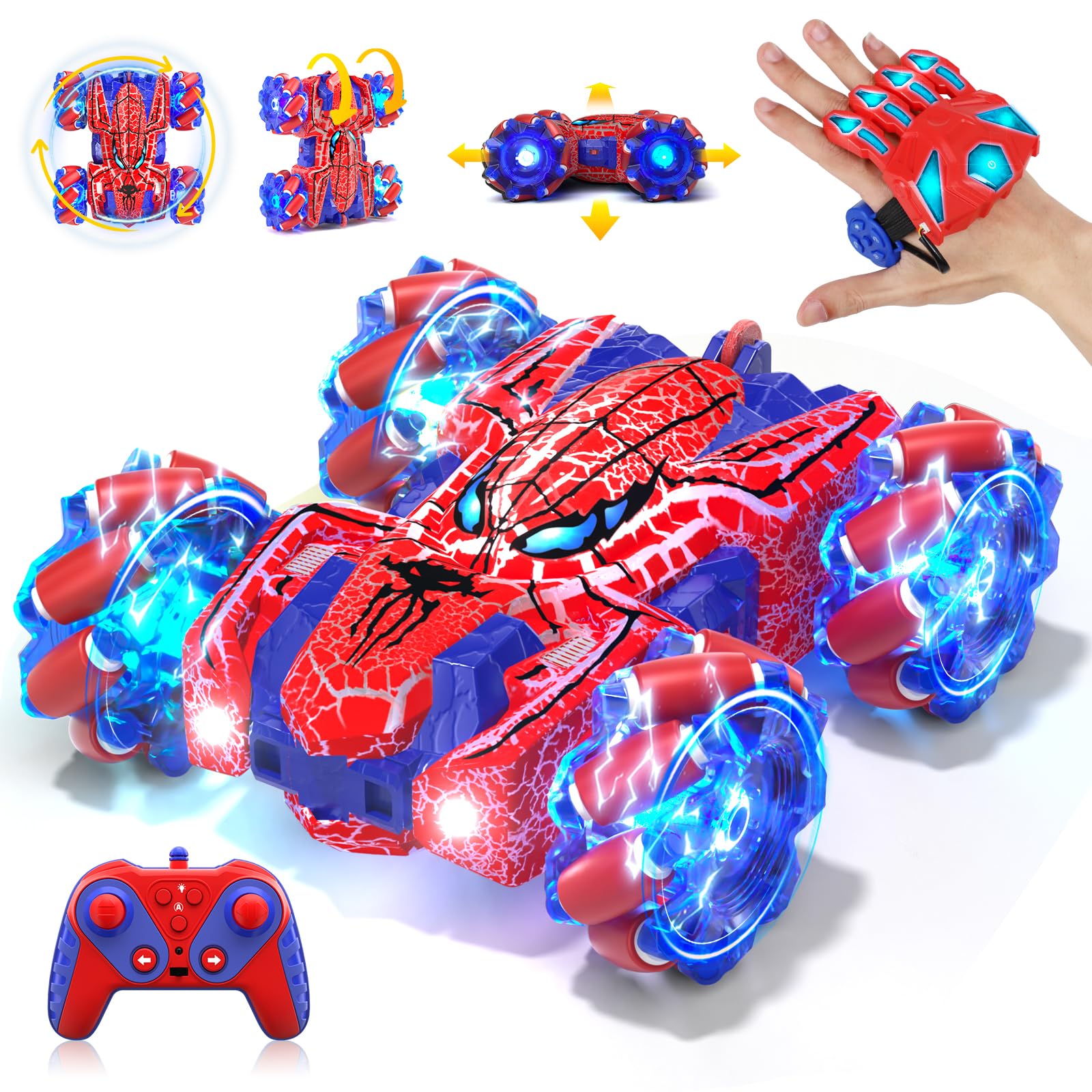
The SOGAWEBB Spider RC Car brings gesture-sensing control to the table, letting a child drive by moving his hand — or switch to traditional button control for precision moves. The car drives on both sides, does 360-degree spins, and has a full-body LED light show. It runs on a 2.4GHz frequency that supports multiple racers without interference, and the USB-C rechargeable battery delivers about 60 minutes of play per charge.
What makes this stand out for six-year-olds is the instant feedback loop. The car flips, drifts, and spins with simple commands, and the bright LEDs make it a showstopper in dim light. The flex-frame construction handles crashes better than typical hard-shell RC cars, and the shock-absorbing tires let it roll over carpet, grass, and pavement. Gesture control is intuitive enough that a child gets it within minutes.
Battery life is roughly a day of regular play, which is solid for this category. Some parents noted that the car doesn’t turn in the traditional left/right sense but rather rotates in place — which takes a little adjustment. But for a high-energy six-year-old who wants action, this RC car delivers immediate satisfaction with no setup time.
Why it’s great
- Gesture control is intuitive and fun for young kids
- Double-sided drive and 360-degree spins create endless stunts
- USB-C rechargeable with about 60 minutes per charge
Good to know
- Turns by rotating in place rather than traditional steering
- Battery lasts through a day of moderate play
5. BMDSAE 1000X Handheld Digital Microscope
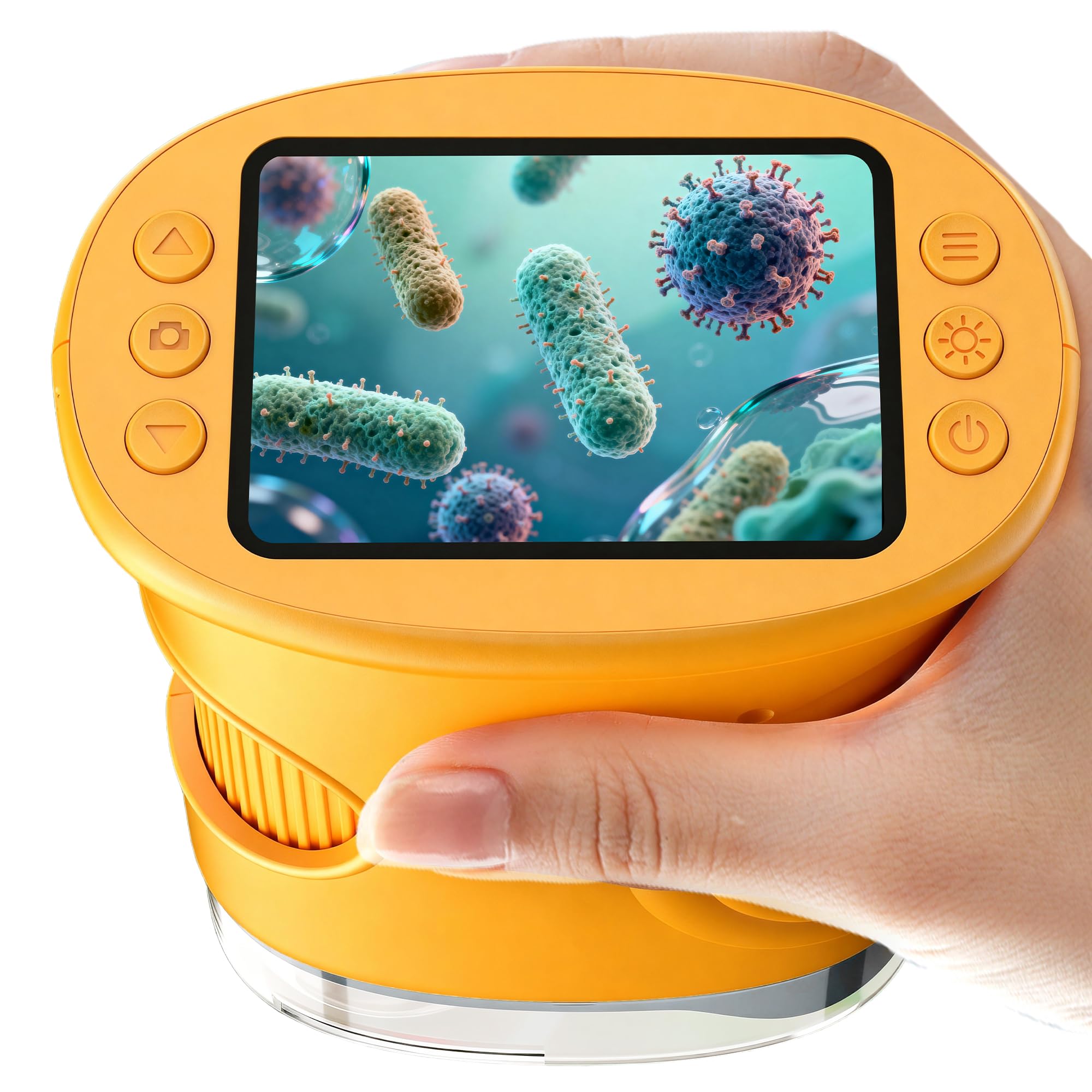
The BMDSAE Handheld Digital Microscope puts real 1000X optical-plus-digital magnification into a child’s hand. Unlike toy microscopes with blurry plastic lenses, this one uses a 2MP camera and a manual focus wheel to deliver crisp images of plant cells, insect legs, fabric threads, and coin details. The 2-inch IPS screen eliminates the need to squint into an eyepiece — the child just points, focuses, and sees the hidden world on the screen.
The build is kid-proof: a shock-absorbent rubber casing, oversized focus dials, and a 200-gram weight that makes it easy to hold. The 8-LED system with three brightness settings ensures good illumination in any light, and the anti-shake design keeps the image steady even in excited hands. It takes photos and videos (32MB storage holds about 200 images), which can be exported to a computer via USB-C for science projects or sharing with classmates.
Battery life runs about two hours per charge, which covers most exploration sessions. The included carry lanyard makes it a field tool rather than a desk toy. One minor complaint is the lack of included slides, but that pushes the child to find his own specimens — which is the whole point. It’s CE/FCC/CPC certified, so the ABS plastic shell is safe and odor-free.
Why it’s great
- Real 1000X magnification reveals details toy microscopes miss
- No eyepiece — kid-friendly screen eliminates frustration
- Rugged rubber casing survives drops and outdoor use
Good to know
- No prepared slides included — child gathers own specimens
- Button icons are small and hard to read
6. iPlay, iLearn Rocket Outer Space Playset

The iPlay, iLearn Rocket Playset is a take-apart toy that lets a child assemble a space shuttle using a battery-powered electric drill. The set includes a command module, turbine engine with spinning blades, instrument cabin, and two astronaut figures. The rocket has interactive lights and sounds that activate during play, and the parts are sized for small hands — no frustrating micro-screws.
Assembly is intuitive for a six-year-old: the electric drill makes a satisfying sound as the screws tighten, and the pieces snap together with a clear click. The rocket stands about 14.5 inches tall, large enough to feel impressive on a shelf but compact enough for tabletop play. Parents report that three-year-olds can handle the basic assembly with help, while six-year-olds can reconfigure the rocket independently.
The durability is notable — one reviewer reported six months of regular play with no broken parts. The sound effects have an auto-off feature, which is a thoughtful touch for parents. The main limitation is that the play patterns are somewhat fixed: assemble, launch, crash, repeat. But for a child who dreams of space, the combination of construction, role-play, and sensory feedback makes this an engaging daily toy.
Why it’s great
- Electric drill makes assembly feel like real engineering
- Lights and sounds add immersive sensory feedback
- Sturdy plastic survives rough daily play
Good to know
- Play patterns are fairly linear — limited open-ended options
- Battery for drill and sound effects needs periodic replacement
7. SMILESSKIDDO Circuit Kit (420+ Projects)

This SMILESSKIDDO Circuit Kit is a snap-together electronics lab that lets a child build over 420 different projects. The 35 included circuit parts include a spray module, RGB light module, flying saucer accessory, glow cord, and current indicator. The critical difference from other electronics kits: no soldering or wire stripping required. Every piece snaps onto a plastic plate, and the 37-page manual guides the child through 118 pre-designed builds step by step.
The range of projects is genuinely impressive. A six-year-old can start with a simple LED circuit, then graduate to a spinning flying saucer or a color-mixing light show. The parallel and series connection projects introduce real electrical engineering concepts without the child realizing he’s learning physics. Parents report that the kit holds the attention of both younger kids (3-5 with help) and older ones through age 10, which makes it one of the longest-lasting gifts in this list.
AA batteries are required but not included, so budget for those. A few reviewers mentioned that individual pieces can break if stepped on, but the manufacturer’s customer service quickly replaces broken parts. The instruction manual is colorful and well-organized, though a six-year-old reading independently will still need occasional adult guidance for the more complex builds. For the child who wants to know how things work, this kit delivers months of nightly experimentation.
Why it’s great
- 420+ projects provide unmatched variety and longevity
- No soldering — safe snap-together connections
- Teaches real circuit concepts through hands-on play
Good to know
- Requires AA batteries not included in the box
- Complex builds may need adult guidance for a six-year-old
FAQ
Are marble run logic games too difficult for a six-year-old?
How many experiments in a science kit will realistically get done?
What is the right age range for an electronics snap circuit kit?
Final Thoughts: The Verdict
For most users, the 6 year old boy gifts winner is the ThinkFun Gravity Maze because it combines progressive difficulty, spatial reasoning, and high replay value in a single compact box. If you want a toy that channels high energy into physical action, grab the SOGAWEBB Spider RC Car. And for a gift that grows with the child over years, nothing beats the SMILESSKIDDO Circuit Kit.